FundamentalsFundamentals
ofof
Thermal RadiationThermal Radiation
In the respect ofIn the respect of
SIR MUKHTIAR ALI MALLAHSIR MUKHTIAR ALI MALLAH
IHSAN ALI WASSANIHSAN ALI WASSAN
14CH18
Discipline:Discipline:
Chemical EngineeringChemical Engineering
Subject:Subject:
HEAT TRANSFERHEAT TRANSFER
Quaid-e-Awam University of Engineering, Science andQuaid-e-Awam University of Engineering, Science and
Technology Nawabshah, Sindh PakistanTechnology Nawabshah, Sindh Pakistan
Objectives:Objectives:
 Introduction
 Thermal Radiation
 Blackbody Radiation
 Radiative Properties
 Emissivity
 Absorptivity
 Reflectivity
 Transmissivity
 Kirchhoff’s Law
 The Greenhouse Effect
INTRODUCTIONINTRODUCTION
 Consider a hot object that is
suspended in an evacuated chamber
whose walls are at room temperature.
 The hot object will eventually cool
down and reach thermal equilibrium
with its surroundings.
 This mechanism is radiation.
INTRODUCTIONINTRODUCTION
 Radiation transfer occurs in solids as well as liquids and gases.
 But heat transfer through an evacuated space can occur only by
radiation.
 For example, the energy of the sun reaches the earth by radiation.
INTRODUCTIONINTRODUCTION
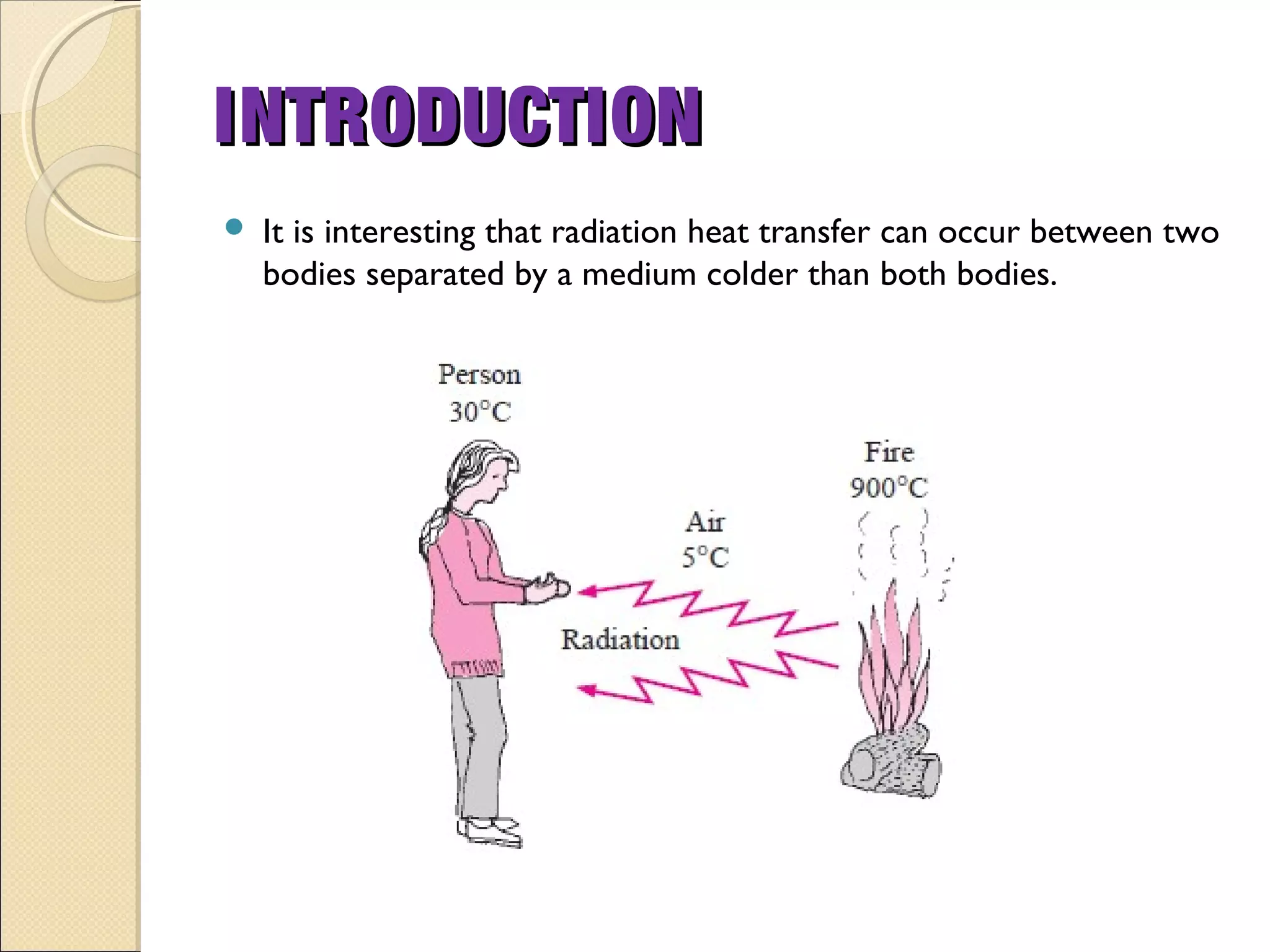
 It is interesting that radiation heat transfer can occur between two
bodies separated by a medium colder than both bodies.
INTRODUCTIONINTRODUCTION
 The theoretical foundation of radiation was established in 1864 by
physicist James Clerk Maxwell,
 Who postulated that accelerated charges or changing electric
currents give rise to electric and magnetic fields.
 These rapidly moving fields are called electromagnetic waves
or electromagnetic radiation.
INTRODUCTIONINTRODUCTION
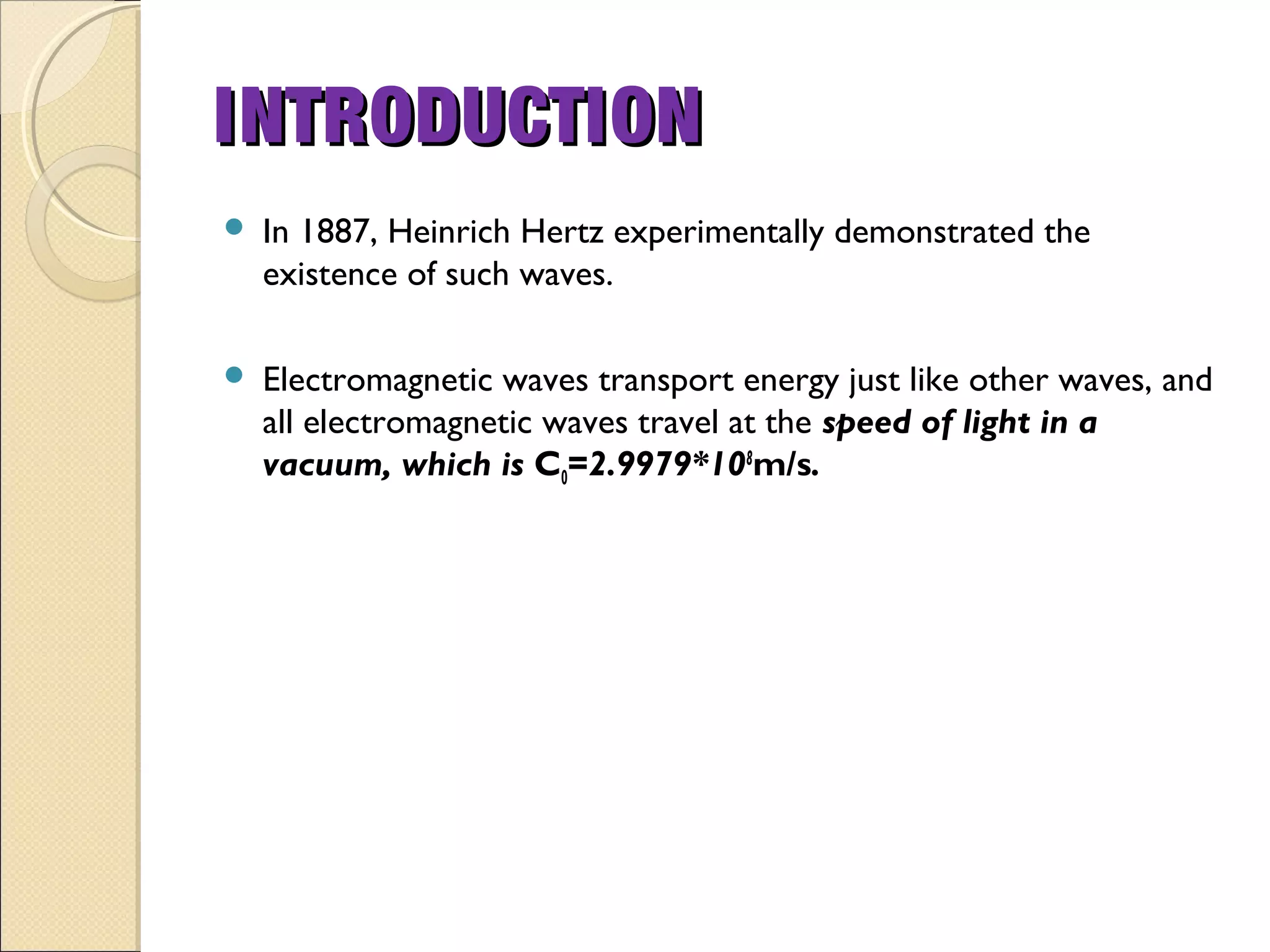
 In 1887, Heinrich Hertz experimentally demonstrated the
existence of such waves.
 Electromagnetic waves transport energy just like other waves, and
all electromagnetic waves travel at the speed of light in a
vacuum, which is C0=2.9979*108
m/s.
INTRODUCTIONINTRODUCTION
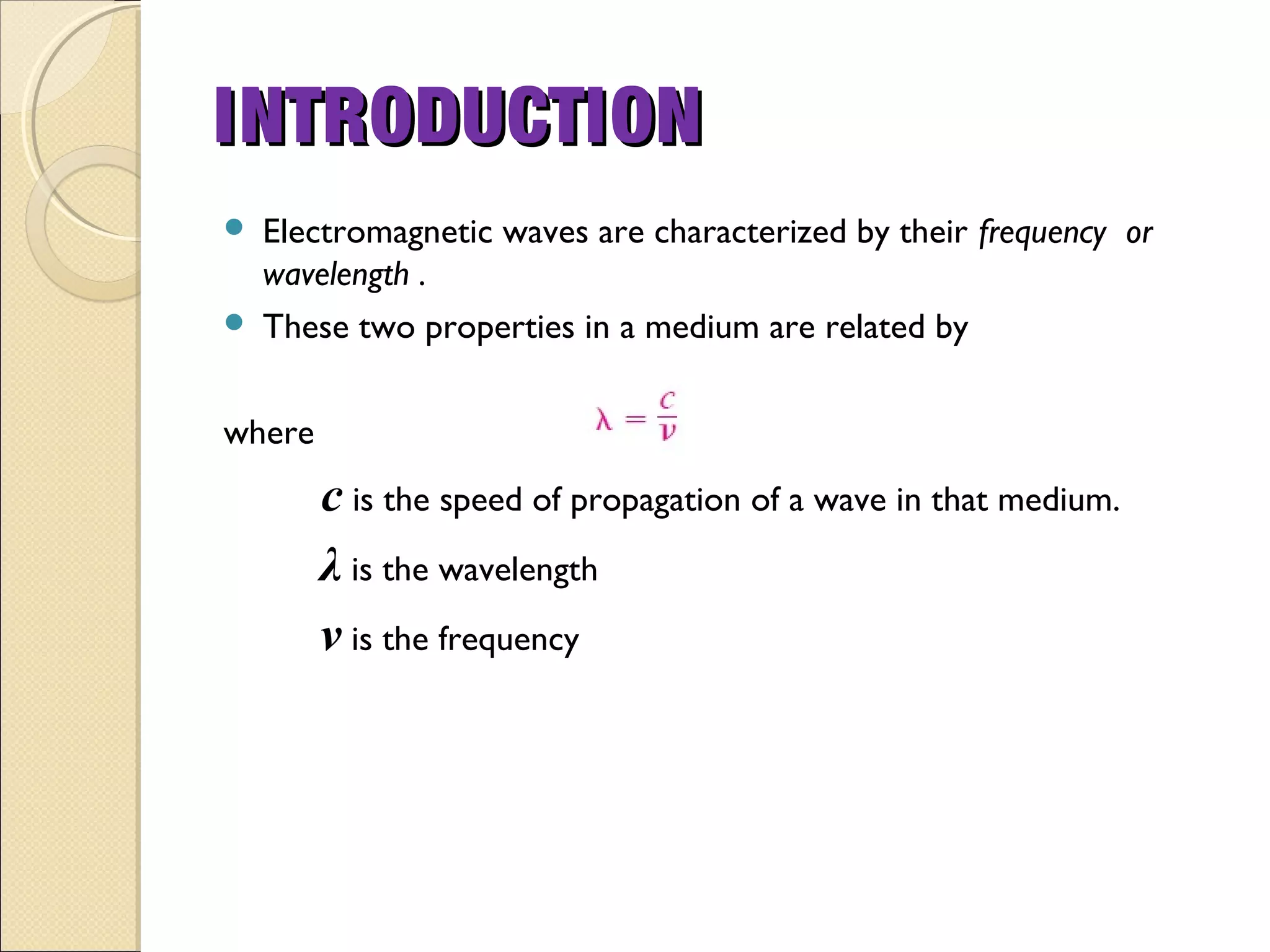
 Electromagnetic waves are characterized by their frequency or
wavelength .
 These two properties in a medium are related by
where
c is the speed of propagation of a wave in that medium.
λ is the wavelength
ν is the frequency
INTRODUCTIONINTRODUCTION
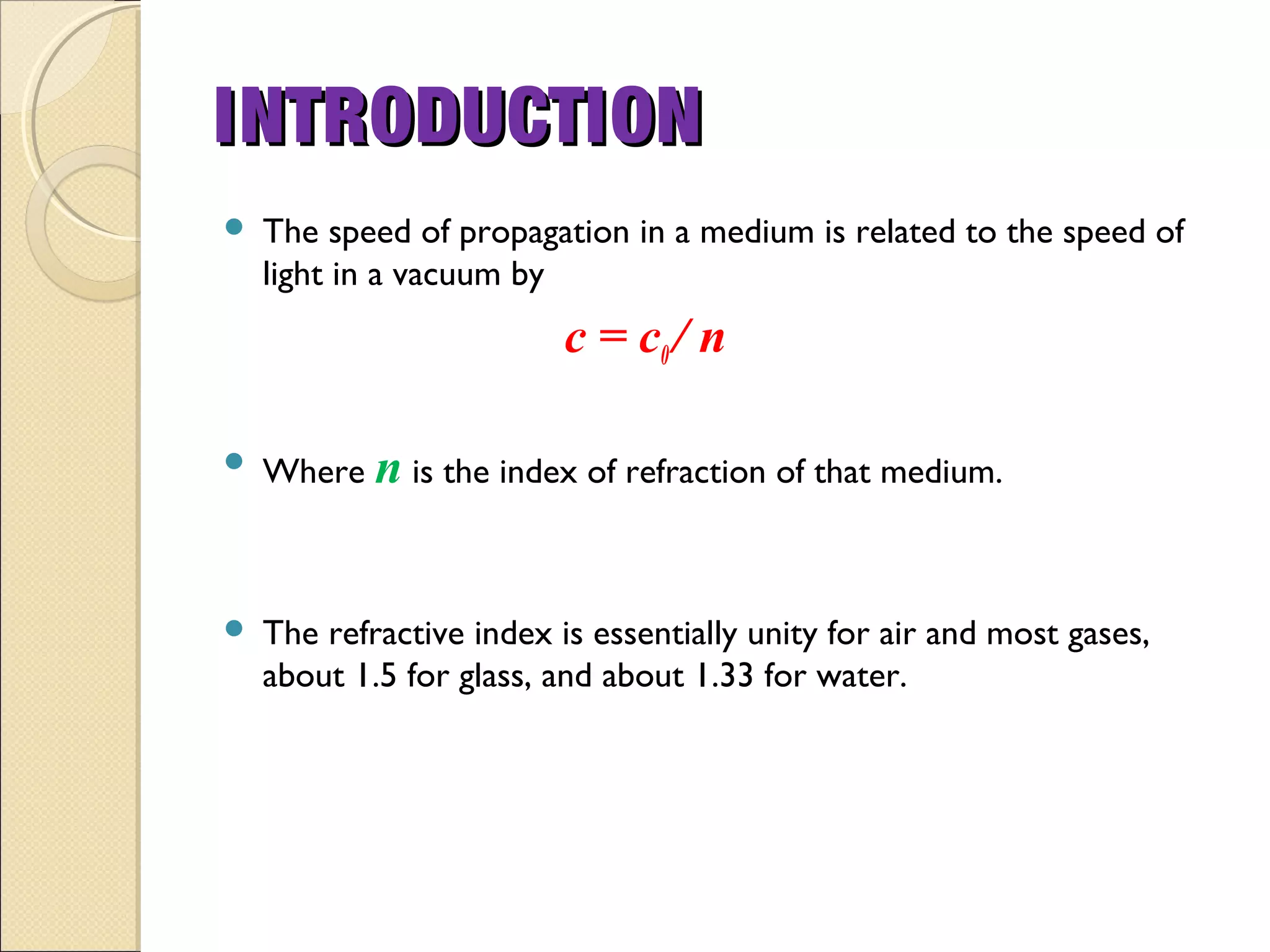
 The speed of propagation in a medium is related to the speed of
light in a vacuum by
c = c0/ n
 Where n is the index of refraction of that medium.
 The refractive index is essentially unity for air and most gases,
about 1.5 for glass, and about 1.33 for water.
INTRODUCTIONINTRODUCTION
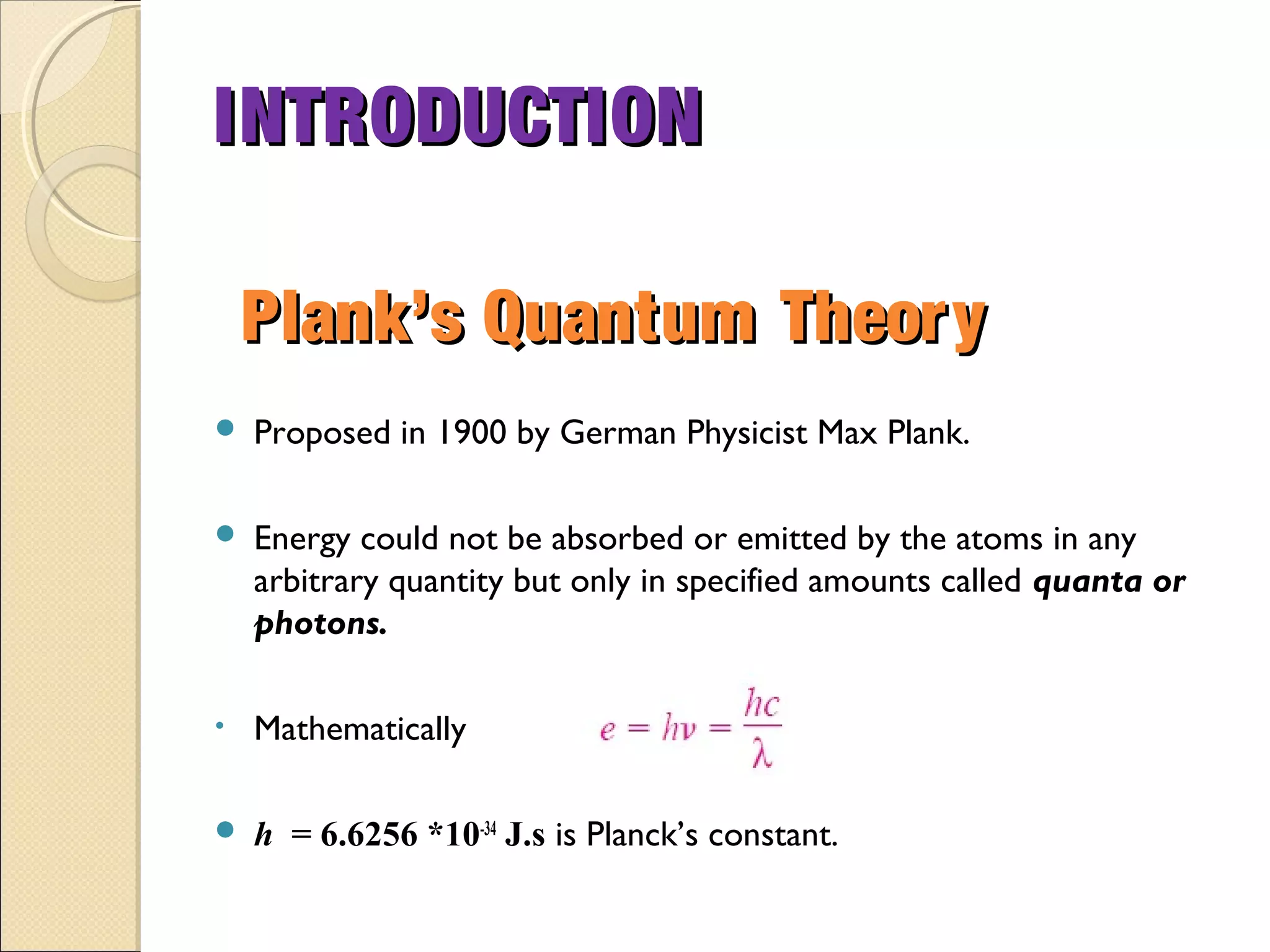
 Proposed in 1900 by German Physicist Max Plank.
 Energy could not be absorbed or emitted by the atoms in any
arbitrary quantity but only in specified amounts called quanta or
photons.
• Mathematically
 h = 6.6256 *10-34
J.s is Planck’s constant.
Plank’s Quantum TheoryPlank’s Quantum Theory
INTRODUCTIONINTRODUCTION
THERMALTHERMAL
RADIATIONRADIATION
• The electromagnetic Radiation
wavelengths, varying from less than
10-10
m for cosmic rays to more than
1010
m for electrical power waves.
Electromagnetic spectrum includes
THERMALTHERMAL
RADIATIONRADIATION
Electromagnetic wave spectrum
Gamma rays,
X-rays,
Ultraviolet radiation,
 Visible light,
 Infrared radiation,
Thermal radiation,
Microwaves, and
 Radio waves.
 Different types of electromagnetic radiation are produced through
various mechanisms.
For example,
 Gamma rays are produced by nuclear reactions.
 X-rays by the bombardment of metals with high-energy electrons.
 Microwaves by special types of electron tubes such as klystrons
and magnetrons.
 Radio waves by the excitation of some crystals or by the flow of
alternating current through electric conductors.
THERMALTHERMAL
RADIATIONRADIATION
THERMALTHERMAL
RADIATIONRADIATION
That is, everything around us such
as walls, furniture, and our friends
constantly emits (and absorbs)
radiation.
The type of electromagnetic radiation that is pertinent to heat
transfer is the thermal radiation emitted as a result of
energy transitions of molecules, atoms, and electrons of a
substance.
Thermal radiation is continuously emitted by all matter whose
temperature is above absolute zero.
 Thus, thermal radiation includes the entire visible and infrared (IR)
radiation as well as a portion of the ultraviolet (UV) radiation.
THERMALTHERMAL
RADIATIONRADIATION
What we call light is simply the
visible portion of the
electromagnetic spectrum
that lies between 0.40 and 0.76 m.
Light, or the visible spectrum,
consists of narrow bands of
color from violet (0.40–0.44
m) to red (0.63–0.76 m).
 A body that emits some radiation in the visible range is called a
light source.
 The electromagnetic radiation emitted by the sun is known as
solar radiation (wavelength band 0.3–3 m).
 Almost half of solar radiation is light (i.e., it falls into the visible
range), with the remaining being ultraviolet and infrared.
THERMALTHERMAL
RADIATIONRADIATION
THERMALTHERMAL
RADIATIONRADIATION
Bodies start emitting noticeable visible radiation at
temperatures above 800 K.
The ultraviolet radiation includes the low-wavelength end of
the thermal radiation spectrum and lies between the
wavelengths 0.01 and 0.40 m.
The radiation emitted by bodies at room temperature falls
into the infrared region of the spectrum, which extends
from 0.76 to 100 m.
 Ultraviolet rays are to be avoided since
they can kill microorganisms and cause
serious damage to humans and other living
organisms.
 Fortunately, the ozone (O3) layer in the
atmosphere acts as a protective blanket
and absorbs most of this ultraviolet
radiation.
THERMALTHERMAL
RADIATIONRADIATION
Recent discoveries of “holes” in the ozone layer have
prompted the international community to ban the use of
ozone-destroying chemicals such as the refrigerant Freon-12 in
order to save the earth.
About 12 percent
of solar radiation
is in the ultraviolet
range.
 The electrons, atoms, and molecules of all solids, liquids, and gases
above absolute zero temperature are constantly in motion,
 Thus radiation is constantly emitted, as well as being absorbed or
transmitted throughout the entire volume of matter.
 That radiation is a volumetric phenomenon.
THERMALTHERMAL
RADIATIONRADIATION
THERMALTHERMAL
RADIATIONRADIATION
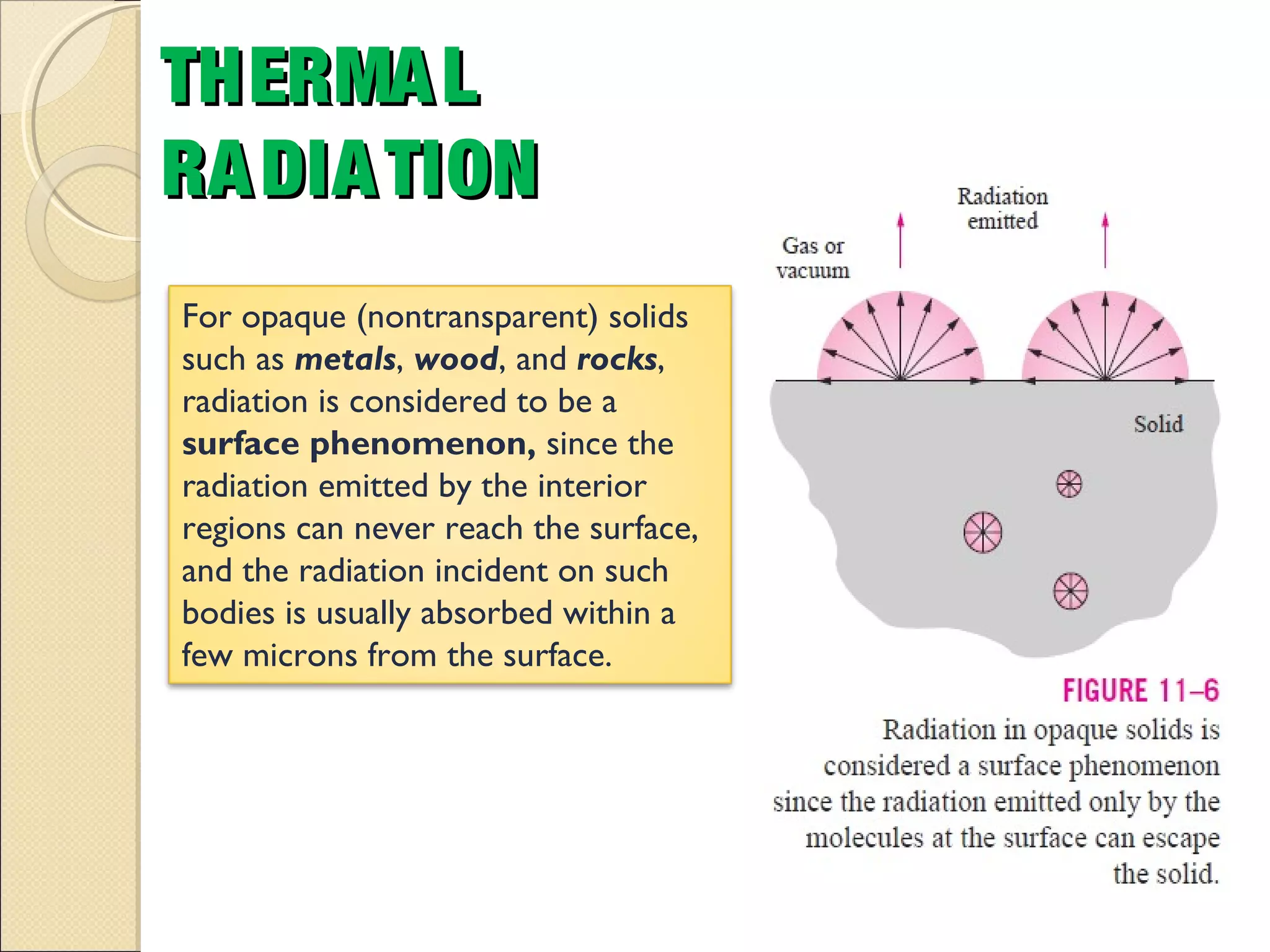
For opaque (nontransparent) solids
such as metals, wood, and rocks,
radiation is considered to be a
surface phenomenon, since the
radiation emitted by the interior
regions can never reach the surface,
and the radiation incident on such
bodies is usually absorbed within a
few microns from the surface.
BLACKBODYBLACKBODY
RADIATIONRADIATION
BLACKBODYBLACKBODY
BLACKBODYBLACKBODY
RADIATIONRADIATION
A perfect emitter and absorber of radiation.
A blackbody is a diffuse emitter. Diffuse means
“independent of direction.”
A blackbody absorbs all incident radiation, regardless of
wavelength and direction.
 Another type of body that closely resembles a blackbody is a large
cavity with a small opening.
BLACKBODYBLACKBODY
RADIATIONRADIATION
 In 1884 by Ludwig Boltzmann proposed a law called Stefan–
Boltzmann law and Eb is called the blackbody emissive
power.
The emission of thermal radiation is proportional to the fourth
power of the absolute temperature
where
 σ = 5.67 * 108
W/m2
. K4
is the Stefan–Boltzmann constant
 T is the absolute temperature of the surface in K.
BLACKBODYBLACKBODY
RADIATIONRADIATION
 The Stefan–Boltzmann law gives the total blackbody emissive power
Eb, which is the sum of the radiation emitted over all wavelengths.
 Sometimes we need to know the spectral blackbody emissive
power, which is the amount of radiation energy emitted by a
blackbody at an absolute temperature T per unit time, per unit surface
area, and per unit wavelength about the wavelength .
BLACKBODYBLACKBODY
RADIATIONRADIATION
 The relation for the spectral blackbody emissive power Eb was
developed by Max Planck in 1901 in conjunction with his famous
quantum theory.
 This relation is known as Planck’s law and is expressed as
BLACKBODYBLACKBODY
RADIATIONRADIATION
 T is the absolute temperature of the surface,
 λ is the wavelength of the radiation emitted,
 k = 1.38065 *10-23
J/K is Boltzmann’s constant.
 This relation is valid for a surface in a vacuum or a gas. For other
mediums, it needs to be modified by replacing c1 by c1/ n2
Where
 n is the index of refraction of the medium.
 Note that the term spectral indicates dependence on wavelength.
BLACKBODYBLACKBODY
RADIATIONRADIATION
BLACKBODYBLACKBODY
RADIATIONRADIATION
 As the temperature increases, the peak of the curve in Figure 11–9
shifts toward shorter wavelengths. The wavelength at which the
peak occurs for a specified temperature is given by Wien’s
displacement law as
 This relation was originally developed by Willy Wien in 1894 using
classical thermodynamics, but it can also be obtained by
differentiating Eq. 11-4 with respect to λ while holding T constant
and setting the result equal to zero.
BLACKBODYBLACKBODY
RADIATIONRADIATION
 A plot of Wien’s displacement law, which is the locus of the peaks
of the radiation emission curves, is also given in Figure 11–9.
 The peak of the solar radiation,
For example, occurs at λ = 2897.8/5780 = 0.50 m which is near the
middle of the visible range.
 The peak of the radiation emitted by a surface at room
temperature ( T = 298 K) occurs at 9.72 m, which is well into the
infrared region of the spectrum.
BLACKBODYBLACKBODY
RADIATIONRADIATION
BLACKBODYBLACKBODY
RADIATIONRADIATION
RADIATIVE PROPERTIESRADIATIVE PROPERTIES
 Most materials encountered in practice, such as metals, wood, and
bricks, are opaque to thermal radiation, and radiation is considered to
be a surface phenomenon for such materials.
 Emissivity
 Absorptivity
 Reflectivity
 Transmissivity
RADIATIVERADIATIVE
PROPERTIESPROPERTIES
EmissivityEmissivity
 The emissivity of a surface represents
the ratio of the radiation emitted by the surface at a given
temperature to the radiation emitted by a blackbody at the same
temperature.
• The emissivity of a surface is denoted by
• It varies between zero and one 0 ≤ ≤ 1
• Emissivity is a measure of how closely a surface approximates a
blackbody, for which = 1
Spectral Directional EmissivitySpectral Directional Emissivity
 The most elemental emissivity of a surface at a given temperature is the
spectral directional emissivity, which is defined as
the ratio of the intensity of radiation emitted by the surface at a
specified wavelength in a specified direction to the intensity of
radiation emitted by a blackbody at the same temperature at
the same wavelength.
That is,
Where
 Note that blackbody radiation intensity is independent of direction, and
thus it has no functional dependence on
Total Directional EmissivityTotal Directional Emissivity
 The total directional emissivity is defined in a like manner
by using total intensities (intensities integrated over all
wavelengths) as
Spectral HemisphericalSpectral Hemispherical
EmissivityEmissivity
 Spectral hemispherical emissivity can be expressed as
Total HemisphericalTotal Hemispherical
EmissivityEmissivity
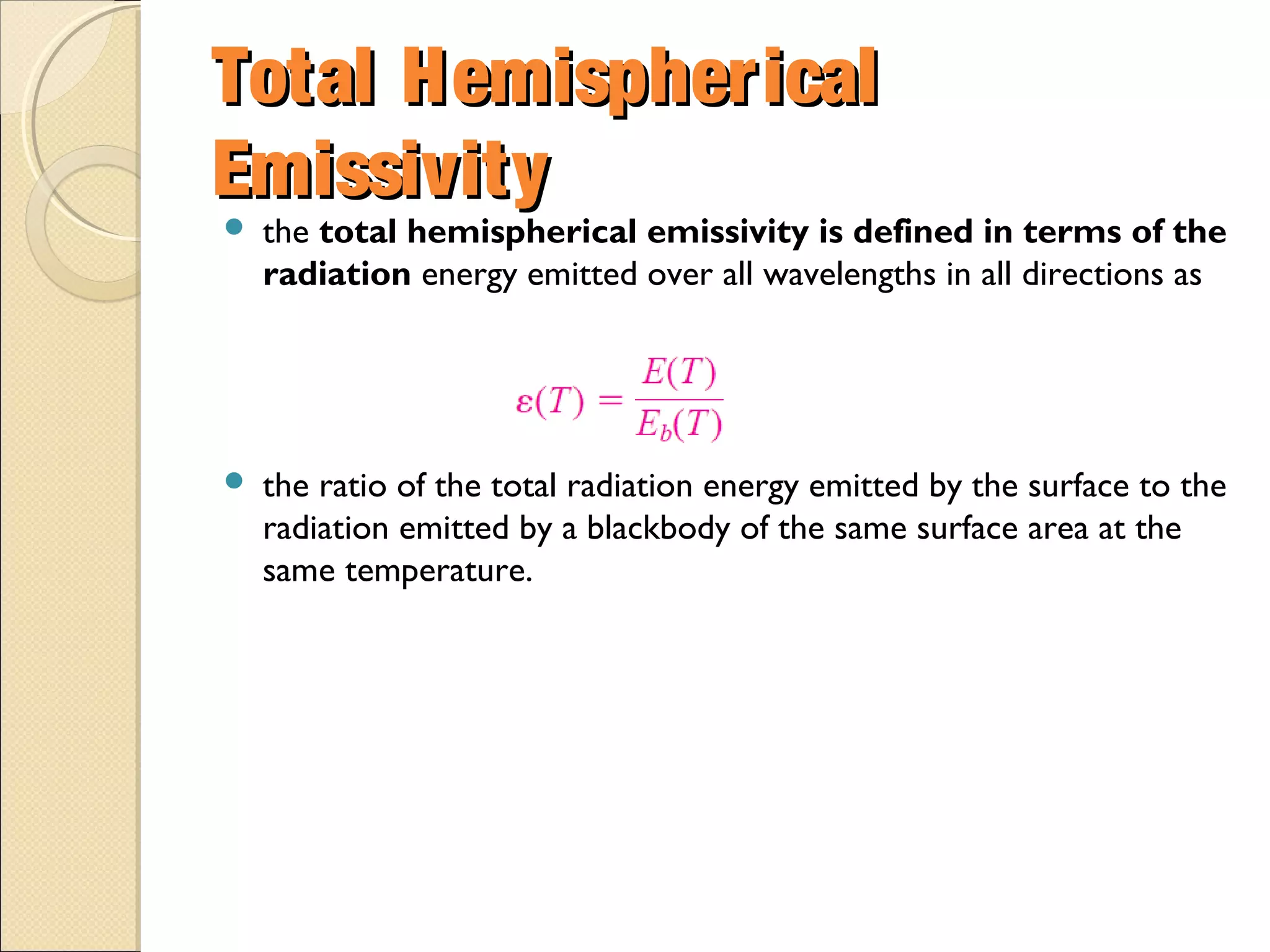
 the total hemispherical emissivity is defined in terms of the
radiation energy emitted over all wavelengths in all directions as
 the ratio of the total radiation energy emitted by the surface to the
radiation emitted by a blackbody of the same surface area at the
same temperature.
Total HemisphericalTotal Hemispherical
EmissivityEmissivity
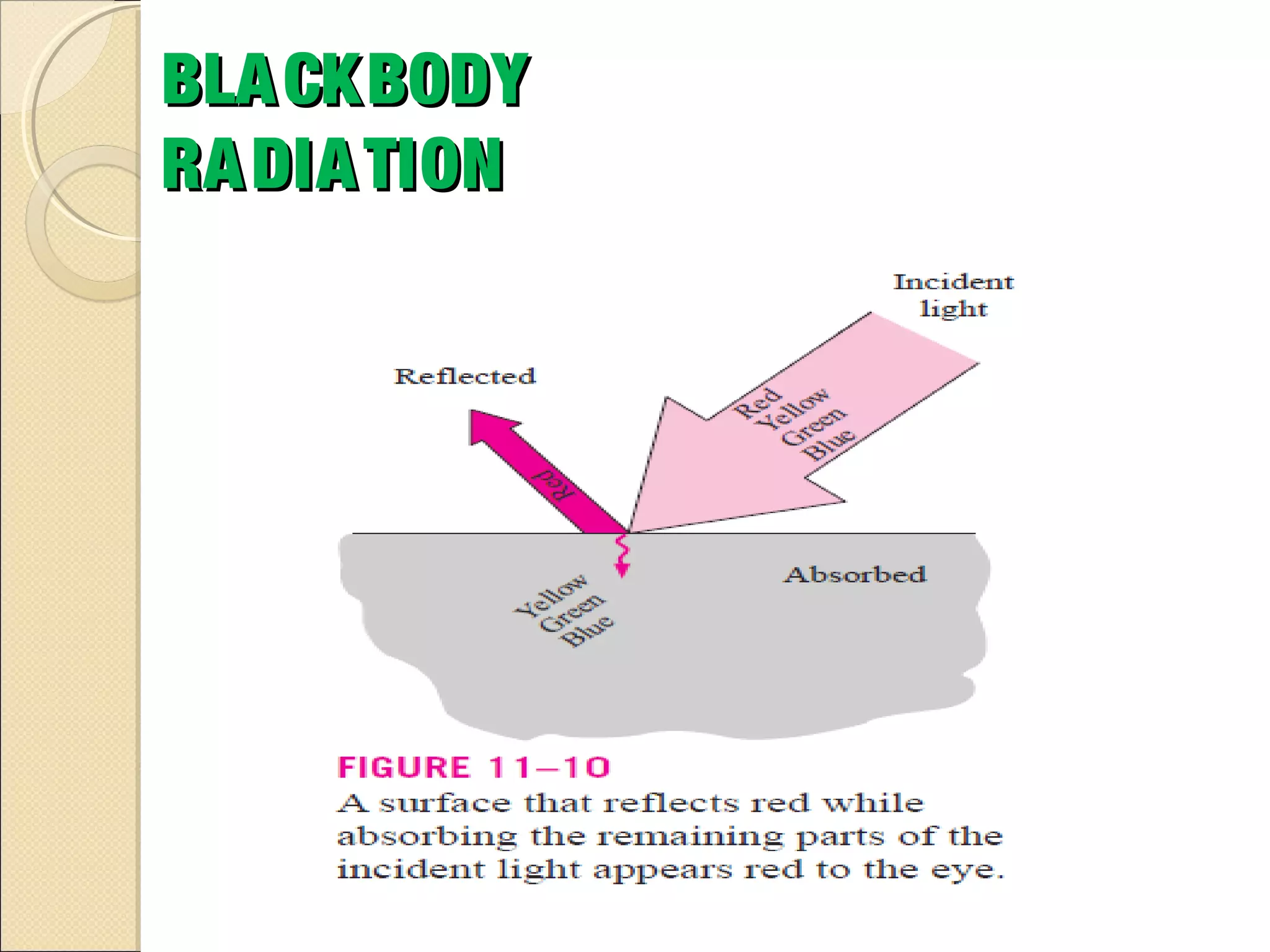
Absorptivity,Absorptivity, ReflectivityReflectivity && TransmissivityTransmissivity
Radiation flux incident on a surface is called irradiation and is denoted by G.
 The fraction of irradiation absorbed by the surface is called the absorptivity
 the fraction reflected by the surface is called the reflectivity
 the fraction transmitted is called the Transmissivity .
Absorptivity, Reflectivity & TransmissivityAbsorptivity, Reflectivity & Transmissivity
Kirchhoff’s LawKirchhoff’s Law
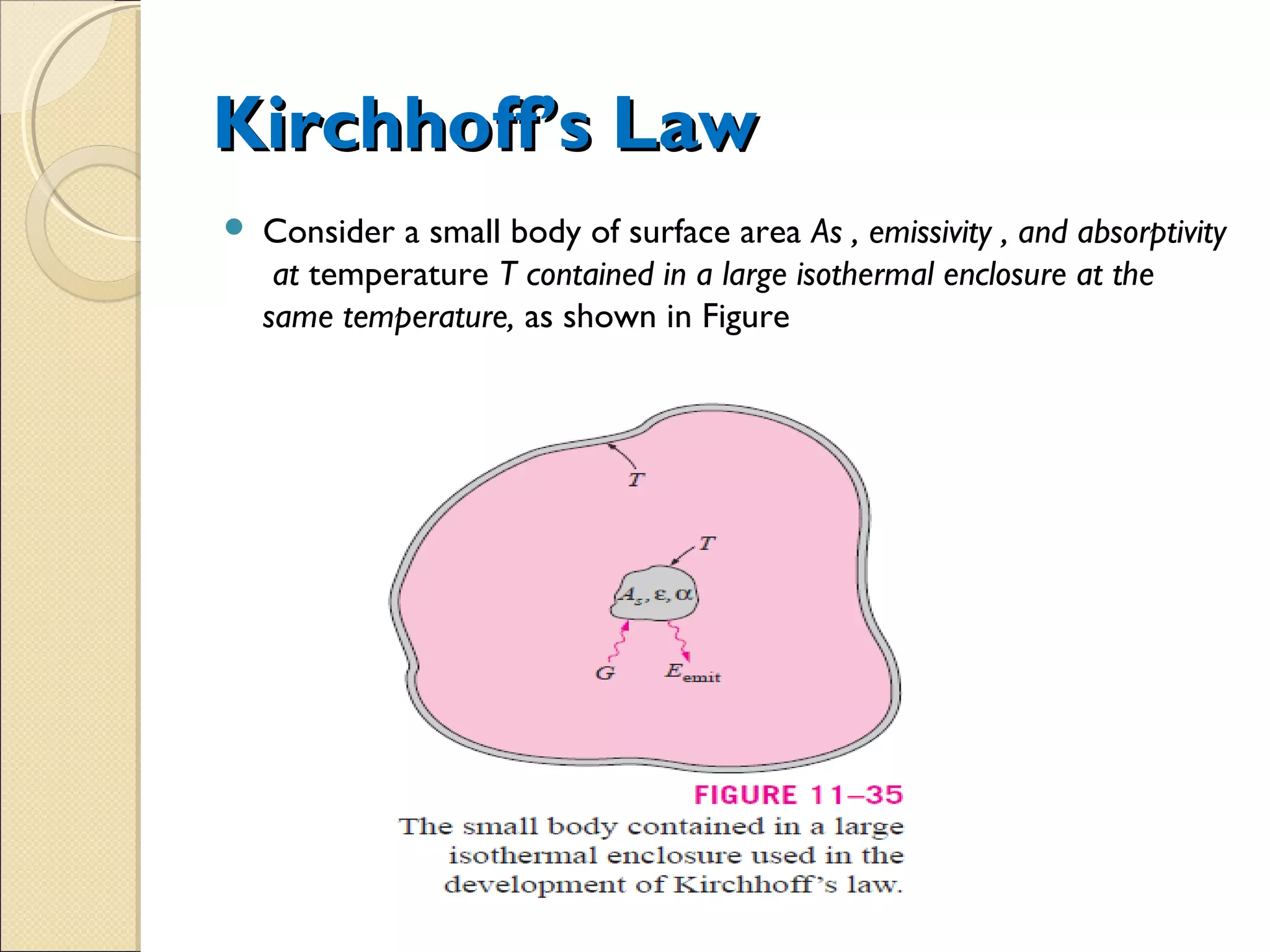
 Consider a small body of surface area As , emissivity , and absorptivity
at temperature T contained in a large isothermal enclosure at the
same temperature, as shown in Figure
 the radiative properties of the enclosure surface, and the body in the
enclosure is too small to interfere with the blackbody nature of the cavity.
Therefore, the radiation incident on any part of the surface of the small
body is equal to the radiation emitted by a blackbody at temperature T.
That is, G = Eb
(T ) = σT 4
and the radiation absorbed by the small body
per unit of its surface area is
 The radiation emitted by the small body is
Kirchhoff’s LawKirchhoff’s Law
 Considering that the small body is in thermal equilibrium with the
enclosure, the net rate of heat transfer to the body must be zero.
 Therefore, the radiation emitted by the body must be equal to the
radiation absorbed by it:
 Thus, we conclude that:
Kirchhoff’s LawKirchhoff’s Law
 That is, the total hemispherical emissivity of a surface at temperature T
is equal to its total hemispherical absorptivity for radiation coming from
a blackbody at the same temperature. This relation, which greatly
simplifies the radiation analysis, was first developed by Gustav
Kirchhoff in 1860 and is now called Kirchhoff’s law.
Kirchhoff’s LawKirchhoff’s Law
Greenhouse effectGreenhouse effect
 Heating effect, which is due to the nongray characteristic of glass
(or clear plastics), is known as the greenhouse effect.
Thank YouThank You
For Your AttentionFor Your Attention

Fundamentals of thermal radiations

  • 1.
  • 2.
    In the respectofIn the respect of SIR MUKHTIAR ALI MALLAHSIR MUKHTIAR ALI MALLAH IHSAN ALI WASSANIHSAN ALI WASSAN 14CH18 Discipline:Discipline: Chemical EngineeringChemical Engineering Subject:Subject: HEAT TRANSFERHEAT TRANSFER Quaid-e-Awam University of Engineering, Science andQuaid-e-Awam University of Engineering, Science and Technology Nawabshah, Sindh PakistanTechnology Nawabshah, Sindh Pakistan
  • 3.
    Objectives:Objectives:  Introduction  ThermalRadiation  Blackbody Radiation  Radiative Properties  Emissivity  Absorptivity  Reflectivity  Transmissivity  Kirchhoff’s Law  The Greenhouse Effect
  • 4.
  • 5.
     Consider ahot object that is suspended in an evacuated chamber whose walls are at room temperature.  The hot object will eventually cool down and reach thermal equilibrium with its surroundings.  This mechanism is radiation. INTRODUCTIONINTRODUCTION
  • 6.
     Radiation transferoccurs in solids as well as liquids and gases.  But heat transfer through an evacuated space can occur only by radiation.  For example, the energy of the sun reaches the earth by radiation. INTRODUCTIONINTRODUCTION
  • 7.
     It isinteresting that radiation heat transfer can occur between two bodies separated by a medium colder than both bodies. INTRODUCTIONINTRODUCTION
  • 8.
     The theoreticalfoundation of radiation was established in 1864 by physicist James Clerk Maxwell,  Who postulated that accelerated charges or changing electric currents give rise to electric and magnetic fields.  These rapidly moving fields are called electromagnetic waves or electromagnetic radiation. INTRODUCTIONINTRODUCTION
  • 9.
     In 1887,Heinrich Hertz experimentally demonstrated the existence of such waves.  Electromagnetic waves transport energy just like other waves, and all electromagnetic waves travel at the speed of light in a vacuum, which is C0=2.9979*108 m/s. INTRODUCTIONINTRODUCTION
  • 10.
     Electromagnetic wavesare characterized by their frequency or wavelength .  These two properties in a medium are related by where c is the speed of propagation of a wave in that medium. λ is the wavelength ν is the frequency INTRODUCTIONINTRODUCTION
  • 11.
     The speedof propagation in a medium is related to the speed of light in a vacuum by c = c0/ n  Where n is the index of refraction of that medium.  The refractive index is essentially unity for air and most gases, about 1.5 for glass, and about 1.33 for water. INTRODUCTIONINTRODUCTION
  • 12.
     Proposed in1900 by German Physicist Max Plank.  Energy could not be absorbed or emitted by the atoms in any arbitrary quantity but only in specified amounts called quanta or photons. • Mathematically  h = 6.6256 *10-34 J.s is Planck’s constant. Plank’s Quantum TheoryPlank’s Quantum Theory INTRODUCTIONINTRODUCTION
  • 13.
  • 14.
    • The electromagneticRadiation wavelengths, varying from less than 10-10 m for cosmic rays to more than 1010 m for electrical power waves. Electromagnetic spectrum includes THERMALTHERMAL RADIATIONRADIATION Electromagnetic wave spectrum Gamma rays, X-rays, Ultraviolet radiation,  Visible light,  Infrared radiation, Thermal radiation, Microwaves, and  Radio waves.
  • 15.
     Different typesof electromagnetic radiation are produced through various mechanisms. For example,  Gamma rays are produced by nuclear reactions.  X-rays by the bombardment of metals with high-energy electrons.  Microwaves by special types of electron tubes such as klystrons and magnetrons.  Radio waves by the excitation of some crystals or by the flow of alternating current through electric conductors. THERMALTHERMAL RADIATIONRADIATION
  • 16.
    THERMALTHERMAL RADIATIONRADIATION That is, everythingaround us such as walls, furniture, and our friends constantly emits (and absorbs) radiation. The type of electromagnetic radiation that is pertinent to heat transfer is the thermal radiation emitted as a result of energy transitions of molecules, atoms, and electrons of a substance. Thermal radiation is continuously emitted by all matter whose temperature is above absolute zero.
  • 17.
     Thus, thermalradiation includes the entire visible and infrared (IR) radiation as well as a portion of the ultraviolet (UV) radiation. THERMALTHERMAL RADIATIONRADIATION What we call light is simply the visible portion of the electromagnetic spectrum that lies between 0.40 and 0.76 m. Light, or the visible spectrum, consists of narrow bands of color from violet (0.40–0.44 m) to red (0.63–0.76 m).
  • 18.
     A bodythat emits some radiation in the visible range is called a light source.  The electromagnetic radiation emitted by the sun is known as solar radiation (wavelength band 0.3–3 m).  Almost half of solar radiation is light (i.e., it falls into the visible range), with the remaining being ultraviolet and infrared. THERMALTHERMAL RADIATIONRADIATION
  • 19.
    THERMALTHERMAL RADIATIONRADIATION Bodies start emittingnoticeable visible radiation at temperatures above 800 K. The ultraviolet radiation includes the low-wavelength end of the thermal radiation spectrum and lies between the wavelengths 0.01 and 0.40 m. The radiation emitted by bodies at room temperature falls into the infrared region of the spectrum, which extends from 0.76 to 100 m.
  • 20.
     Ultraviolet raysare to be avoided since they can kill microorganisms and cause serious damage to humans and other living organisms.  Fortunately, the ozone (O3) layer in the atmosphere acts as a protective blanket and absorbs most of this ultraviolet radiation. THERMALTHERMAL RADIATIONRADIATION Recent discoveries of “holes” in the ozone layer have prompted the international community to ban the use of ozone-destroying chemicals such as the refrigerant Freon-12 in order to save the earth. About 12 percent of solar radiation is in the ultraviolet range.
  • 21.
     The electrons,atoms, and molecules of all solids, liquids, and gases above absolute zero temperature are constantly in motion,  Thus radiation is constantly emitted, as well as being absorbed or transmitted throughout the entire volume of matter.  That radiation is a volumetric phenomenon. THERMALTHERMAL RADIATIONRADIATION
  • 22.
    THERMALTHERMAL RADIATIONRADIATION For opaque (nontransparent)solids such as metals, wood, and rocks, radiation is considered to be a surface phenomenon, since the radiation emitted by the interior regions can never reach the surface, and the radiation incident on such bodies is usually absorbed within a few microns from the surface.
  • 23.
  • 24.
    BLACKBODYBLACKBODY BLACKBODYBLACKBODY RADIATIONRADIATION A perfect emitterand absorber of radiation. A blackbody is a diffuse emitter. Diffuse means “independent of direction.” A blackbody absorbs all incident radiation, regardless of wavelength and direction.
  • 25.
     Another typeof body that closely resembles a blackbody is a large cavity with a small opening. BLACKBODYBLACKBODY RADIATIONRADIATION
  • 26.
     In 1884by Ludwig Boltzmann proposed a law called Stefan– Boltzmann law and Eb is called the blackbody emissive power. The emission of thermal radiation is proportional to the fourth power of the absolute temperature where  σ = 5.67 * 108 W/m2 . K4 is the Stefan–Boltzmann constant  T is the absolute temperature of the surface in K. BLACKBODYBLACKBODY RADIATIONRADIATION
  • 27.
     The Stefan–Boltzmannlaw gives the total blackbody emissive power Eb, which is the sum of the radiation emitted over all wavelengths.  Sometimes we need to know the spectral blackbody emissive power, which is the amount of radiation energy emitted by a blackbody at an absolute temperature T per unit time, per unit surface area, and per unit wavelength about the wavelength . BLACKBODYBLACKBODY RADIATIONRADIATION
  • 28.
     The relationfor the spectral blackbody emissive power Eb was developed by Max Planck in 1901 in conjunction with his famous quantum theory.  This relation is known as Planck’s law and is expressed as BLACKBODYBLACKBODY RADIATIONRADIATION
  • 29.
     T isthe absolute temperature of the surface,  λ is the wavelength of the radiation emitted,  k = 1.38065 *10-23 J/K is Boltzmann’s constant.  This relation is valid for a surface in a vacuum or a gas. For other mediums, it needs to be modified by replacing c1 by c1/ n2 Where  n is the index of refraction of the medium.  Note that the term spectral indicates dependence on wavelength. BLACKBODYBLACKBODY RADIATIONRADIATION
  • 30.
  • 31.
     As thetemperature increases, the peak of the curve in Figure 11–9 shifts toward shorter wavelengths. The wavelength at which the peak occurs for a specified temperature is given by Wien’s displacement law as  This relation was originally developed by Willy Wien in 1894 using classical thermodynamics, but it can also be obtained by differentiating Eq. 11-4 with respect to λ while holding T constant and setting the result equal to zero. BLACKBODYBLACKBODY RADIATIONRADIATION
  • 32.
     A plotof Wien’s displacement law, which is the locus of the peaks of the radiation emission curves, is also given in Figure 11–9.  The peak of the solar radiation, For example, occurs at λ = 2897.8/5780 = 0.50 m which is near the middle of the visible range.  The peak of the radiation emitted by a surface at room temperature ( T = 298 K) occurs at 9.72 m, which is well into the infrared region of the spectrum. BLACKBODYBLACKBODY RADIATIONRADIATION
  • 33.
  • 34.
  • 35.
     Most materialsencountered in practice, such as metals, wood, and bricks, are opaque to thermal radiation, and radiation is considered to be a surface phenomenon for such materials.  Emissivity  Absorptivity  Reflectivity  Transmissivity RADIATIVERADIATIVE PROPERTIESPROPERTIES
  • 36.
    EmissivityEmissivity  The emissivityof a surface represents the ratio of the radiation emitted by the surface at a given temperature to the radiation emitted by a blackbody at the same temperature. • The emissivity of a surface is denoted by • It varies between zero and one 0 ≤ ≤ 1 • Emissivity is a measure of how closely a surface approximates a blackbody, for which = 1
  • 37.
    Spectral Directional EmissivitySpectralDirectional Emissivity  The most elemental emissivity of a surface at a given temperature is the spectral directional emissivity, which is defined as the ratio of the intensity of radiation emitted by the surface at a specified wavelength in a specified direction to the intensity of radiation emitted by a blackbody at the same temperature at the same wavelength. That is, Where  Note that blackbody radiation intensity is independent of direction, and thus it has no functional dependence on
  • 38.
    Total Directional EmissivityTotalDirectional Emissivity  The total directional emissivity is defined in a like manner by using total intensities (intensities integrated over all wavelengths) as
  • 39.
    Spectral HemisphericalSpectral Hemispherical EmissivityEmissivity Spectral hemispherical emissivity can be expressed as
  • 40.
    Total HemisphericalTotal Hemispherical EmissivityEmissivity the total hemispherical emissivity is defined in terms of the radiation energy emitted over all wavelengths in all directions as  the ratio of the total radiation energy emitted by the surface to the radiation emitted by a blackbody of the same surface area at the same temperature.
  • 41.
  • 42.
    Absorptivity,Absorptivity, ReflectivityReflectivity &&TransmissivityTransmissivity Radiation flux incident on a surface is called irradiation and is denoted by G.  The fraction of irradiation absorbed by the surface is called the absorptivity  the fraction reflected by the surface is called the reflectivity  the fraction transmitted is called the Transmissivity .
  • 43.
    Absorptivity, Reflectivity &TransmissivityAbsorptivity, Reflectivity & Transmissivity
  • 44.
    Kirchhoff’s LawKirchhoff’s Law Consider a small body of surface area As , emissivity , and absorptivity at temperature T contained in a large isothermal enclosure at the same temperature, as shown in Figure
  • 45.
     the radiativeproperties of the enclosure surface, and the body in the enclosure is too small to interfere with the blackbody nature of the cavity. Therefore, the radiation incident on any part of the surface of the small body is equal to the radiation emitted by a blackbody at temperature T. That is, G = Eb (T ) = σT 4 and the radiation absorbed by the small body per unit of its surface area is  The radiation emitted by the small body is Kirchhoff’s LawKirchhoff’s Law
  • 46.
     Considering thatthe small body is in thermal equilibrium with the enclosure, the net rate of heat transfer to the body must be zero.  Therefore, the radiation emitted by the body must be equal to the radiation absorbed by it:  Thus, we conclude that: Kirchhoff’s LawKirchhoff’s Law
  • 47.
     That is,the total hemispherical emissivity of a surface at temperature T is equal to its total hemispherical absorptivity for radiation coming from a blackbody at the same temperature. This relation, which greatly simplifies the radiation analysis, was first developed by Gustav Kirchhoff in 1860 and is now called Kirchhoff’s law. Kirchhoff’s LawKirchhoff’s Law
  • 48.
    Greenhouse effectGreenhouse effect Heating effect, which is due to the nongray characteristic of glass (or clear plastics), is known as the greenhouse effect.
  • 49.
    Thank YouThank You ForYour AttentionFor Your Attention