Engineering Thermodynamics
Module 1 - Basic Concepts and First law
Lecture 2 of 3 - Basic Concepts 2
Prepared by
Mr.M.Mani Vannan
Assistant Professor
Department of Mechanical Engineering
1
Unit I - Basic Concepts and First Law
Basic concepts - concept of continuum, comparison of
microscopic and macroscopic approach. Path and point functions.
Intensive and extensive, total and specific quantities. System and
their types. Thermodynamic Equilibrium State, path and process.
Quasi-static, reversible and irreversible processes. Heat and work
transfer, definition and comparison, sign convention.
Displacement work and other modes of work .P-V diagram.
Zeroth law of thermodynamics – concept of temperature and
thermal equilibrium– relationship between temperature scales –
new temperature scales. First law of thermodynamics –
application to closed and open systems – steady and unsteady
flow processes
Basic Concepts 2 2
Thermodynamic System, Boundary and
surrounding s
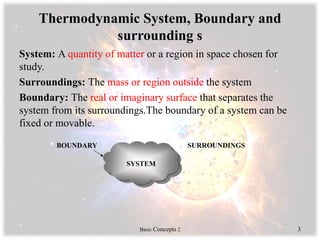
System: A quantity of matter or a region in space chosen for
study.
Surroundings: The mass or region outside the system
Boundary: The real or imaginary surface that separates the
system from its surroundings.The boundary of a system can be
fixed or movable.
BOUNDARY SURROUNDINGS
Basic Concepts 2 3
SYSTEM
Types of Thermodynamic system
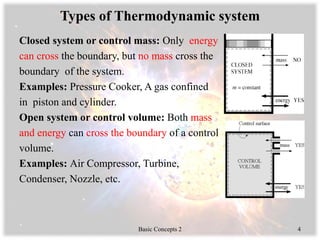
Closed system or control mass: Only energy
can cross the boundary, but no mass cross the
boundary of the system.
Examples: Pressure Cooker, A gas confined
in piston and cylinder.
Open system or control volume: Both mass
and energy can cross the boundary of a control
volume.
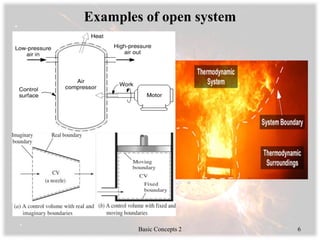
Examples: Air Compressor, Turbine,
Condenser, Nozzle, etc.
Basic Concepts 2 4
Cont..
Isolated system: A closed system that does not communicate
with the surroundings by any means.
Examples:
Rigid system: A closed system that communicates with the
surroundings by heat only.
Adiabatic system: A closed or open system that does not
exchange energy with the surroundings by heat.
 Basic Concepts 2 5
Examples of open system
Basic Concepts 2 6
Thermodynamic State, Process and Path
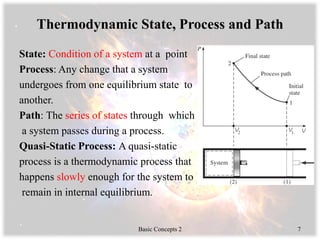
State: Condition of a system at a point
Process: Any change that a system
undergoes from one equilibrium state to
another.
Path: The series of states through which
a system passes during a process.
Quasi-Static Process: A quasi-static
process is a thermodynamic process that
happens slowly enough for the system to
remain in internal equilibrium.
Basic Concepts 2 7
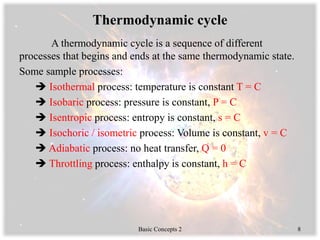
Thermodynamic cycle
A thermodynamic cycle is a sequence of different
processes that begins and ends at the same thermodynamic state.
Some sample processes:
 Isothermal process: temperature is constant T = C
 Isobaric process: pressure is constant, P = C
 Isentropic process: entropy is constant, s = C
 Isochoric / isometric process: Volume is constant, v = C
 Adiabatic process: no heat transfer, Q = 0
 Throttling process: enthalpy is constant, h = C
Basic Concepts 2 8
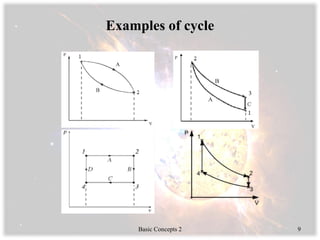
Examples of cycle
Basic Concepts 2 9
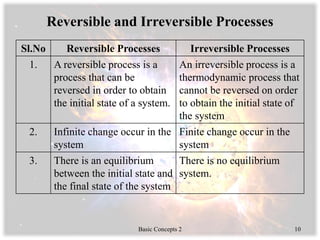
Reversible and Irreversible Processes
Sl.No Reversible Processes Irreversible Processes
1. A reversible process is a
process that can be
reversed in order to obtain
the initial state of a system.
An irreversible process is a
thermodynamic process that
cannot be reversed on order
to obtain the initial state of
the system
2. Infinite change occur in the
system
Finite change occur in the
system
3. There is an equilibrium
between the initial state and
the final state of the system
There is no equilibrium
system.
Basic Concepts 2 10
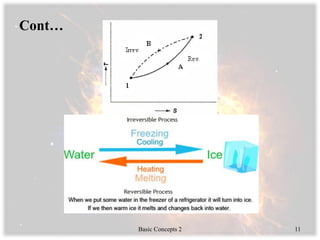
Cont…
Basic Concepts 2 11
Heat (Q)
It is a form of energy which generally
flows from due to temperature difference in
a system. It is denoted by ‘Q’.
1 J = 1 N∙ m : 1 cal = 4.1868 J
1 Btu = 1.0551 kJ
Heat to work Thermal power plant
Work to heat Refrigeration
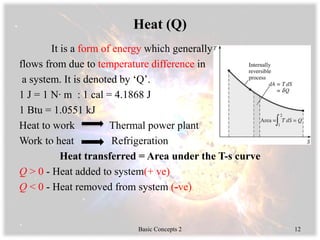
Heat transferred = Area under the T-s curve
Q > 0 - Heat added to system(+ ve)
Q < 0 - Heat removed from system (-ve)
Basic Concepts 2 12
Work (W)
1.Displacement Work ,Wd = Force(F)  Distance(dx)
W = p.A.dx [Pressure, p= F/A]
W= ʃ p.dv
1 J = 1 N∙ m : 1 cal = 4.1868 J
1 Btu = 1.0551 kJ
Work done = Area under a p-V curve
W > 0 Work done by the system (+ve) or Expansion
W < 0 Work done on the system(-ve) or Compression
Basic Concepts 2 13
Cont..
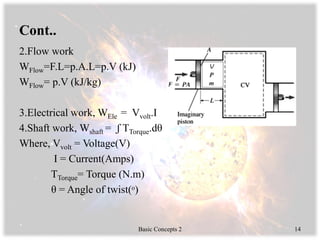
2.Flow work
WFlow=F.L=p.A.L=p.V (kJ)
WFlow= p.V (kJ/kg)
3.Electrical work, WEle = Vvolt.I
4.Shaft work, Wshaft = ʃ TTorque.dθ
Where, Vvolt = Voltage(V)
I = Current(Amps)
TTorque= Torque (N.m)
θ = Angle of twist(ᵒ)
Basic Concepts 2 14
Internal Energy (ΔU)
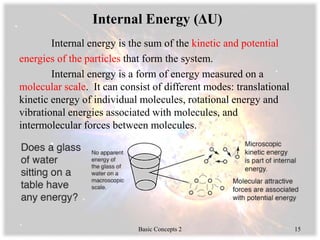
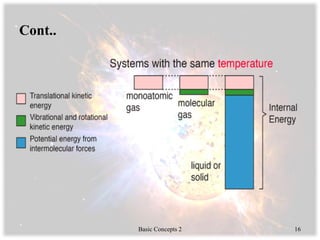
Internal energy is the sum of the kinetic and potential
energies of the particles that form the system.
Internal energy is a form of energy measured on a
molecular scale. It can consist of different modes: translational
kinetic energy of individual molecules, rotational energy and
vibrational energies associated with molecules, and
intermolecular forces between molecules.
Basic Concepts 2 15
Cont..
Basic Concepts 2 16
Enthalpy (H)
A thermodynamic quantity equivalent to the total heat
content of a system.
Enthalpy or Total enthalpy H = U + (p.V) or H = m.h
h = u + (p.v) or Cp
. ΔT
Where , h = Specific Enthalpy(kJ)
u = Internal energy of the system(kJ)
p = pressure of the system(N/m2)
v = Specific Volume(m3/kg)
Cp= Specific heat capacity at constant pressure(kJ/kg.K)
ΔT= Change in temperaure(K)
m = Mass of the system(kg)
Specific enthalpy is an intensive property
Basic Concepts 2 17
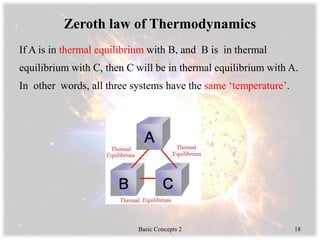
Zeroth law of Thermodynamics
If A is in thermal equilibrium with B, and B is in thermal
equilibrium with C, then C will be in thermal equilibrium with A.
In other words, all three systems have the same ‘temperature’.
Basic Concepts 2 18
Equilibrium
A state of balance. In an equilibrium state there are no
unbalanced potentials (or driving forces) within the system.
Types of Equilibrium:
1.Thermal equilibrium
2.Mechanical equilibrium
3.Phase equilibrium
4.Chemical equilibrium
Basic Concepts 2 19
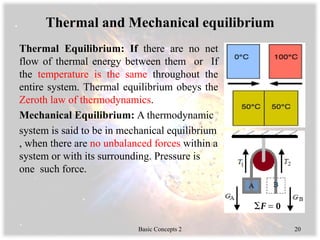
Thermal and Mechanical equilibrium
Thermal Equilibrium: If there are no net
flow of thermal energy between them or If
the temperature is the same throughout the
entire system. Thermal equilibrium obeys the
Zeroth law of thermodynamics.
Mechanical Equilibrium: A thermodynamic
system is said to be in mechanical equilibrium
, when there are no unbalanced forces within a
system or with its surrounding. Pressure is
one such force.
Basic Concepts 2 20
Phase and Chemical equilibrium
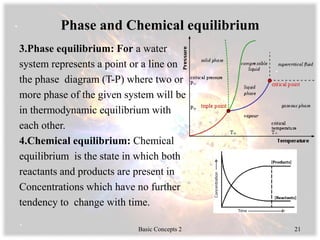
3.Phase equilibrium: For a water
system represents a point or a line on
the phase diagram (T-P) where two or
more phase of the given system will be
in thermodynamic equilibrium with
each other.
4.Chemical equilibrium: Chemical
equilibrium is the state in which both
reactants and products are present in
Concentrations which have no further
tendency to change with time.
Basic Concepts 2 21
First Law of thermodynamics
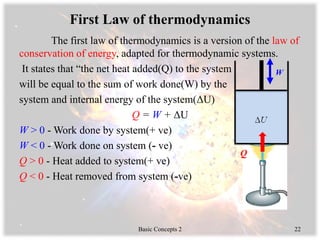
The first law of thermodynamics is a version of the law of
conservation of energy, adapted for thermodynamic systems.
It states that “the net heat added(Q) to the system
will be equal to the sum of work done(W) by the
system and internal energy of the system(ΔU)
Q = W + ΔU
W > 0 - Work done by system(+ ve)
W < 0 - Work done on system (- ve)
Q > 0 - Heat added to system(+ ve)
Q < 0 - Heat removed from system (-ve)
Basic Concepts 2 22
Thank you
Basic Concepts 2 23

Engineering Thermodynamics -Basic Concepts 2

  • 1.
    Engineering Thermodynamics Module 1- Basic Concepts and First law Lecture 2 of 3 - Basic Concepts 2 Prepared by Mr.M.Mani Vannan Assistant Professor Department of Mechanical Engineering 1
  • 2.
    Unit I -Basic Concepts and First Law Basic concepts - concept of continuum, comparison of microscopic and macroscopic approach. Path and point functions. Intensive and extensive, total and specific quantities. System and their types. Thermodynamic Equilibrium State, path and process. Quasi-static, reversible and irreversible processes. Heat and work transfer, definition and comparison, sign convention. Displacement work and other modes of work .P-V diagram. Zeroth law of thermodynamics – concept of temperature and thermal equilibrium– relationship between temperature scales – new temperature scales. First law of thermodynamics – application to closed and open systems – steady and unsteady flow processes Basic Concepts 2 2
  • 3.
    Thermodynamic System, Boundaryand surrounding s System: A quantity of matter or a region in space chosen for study. Surroundings: The mass or region outside the system Boundary: The real or imaginary surface that separates the system from its surroundings.The boundary of a system can be fixed or movable. BOUNDARY SURROUNDINGS Basic Concepts 2 3 SYSTEM
  • 4.
    Types of Thermodynamicsystem Closed system or control mass: Only energy can cross the boundary, but no mass cross the boundary of the system. Examples: Pressure Cooker, A gas confined in piston and cylinder. Open system or control volume: Both mass and energy can cross the boundary of a control volume. Examples: Air Compressor, Turbine, Condenser, Nozzle, etc. Basic Concepts 2 4
  • 5.
    Cont.. Isolated system: Aclosed system that does not communicate with the surroundings by any means. Examples: Rigid system: A closed system that communicates with the surroundings by heat only. Adiabatic system: A closed or open system that does not exchange energy with the surroundings by heat. Basic Concepts 2 5
  • 6.
    Examples of opensystem Basic Concepts 2 6
  • 7.
    Thermodynamic State, Processand Path State: Condition of a system at a point Process: Any change that a system undergoes from one equilibrium state to another. Path: The series of states through which a system passes during a process. Quasi-Static Process: A quasi-static process is a thermodynamic process that happens slowly enough for the system to remain in internal equilibrium. Basic Concepts 2 7
  • 8.
    Thermodynamic cycle A thermodynamiccycle is a sequence of different processes that begins and ends at the same thermodynamic state. Some sample processes:  Isothermal process: temperature is constant T = C  Isobaric process: pressure is constant, P = C  Isentropic process: entropy is constant, s = C  Isochoric / isometric process: Volume is constant, v = C  Adiabatic process: no heat transfer, Q = 0  Throttling process: enthalpy is constant, h = C Basic Concepts 2 8
  • 9.
  • 10.
    Reversible and IrreversibleProcesses Sl.No Reversible Processes Irreversible Processes 1. A reversible process is a process that can be reversed in order to obtain the initial state of a system. An irreversible process is a thermodynamic process that cannot be reversed on order to obtain the initial state of the system 2. Infinite change occur in the system Finite change occur in the system 3. There is an equilibrium between the initial state and the final state of the system There is no equilibrium system. Basic Concepts 2 10
  • 11.
  • 12.
    Heat (Q) It isa form of energy which generally flows from due to temperature difference in a system. It is denoted by ‘Q’. 1 J = 1 N∙ m : 1 cal = 4.1868 J 1 Btu = 1.0551 kJ Heat to work Thermal power plant Work to heat Refrigeration Heat transferred = Area under the T-s curve Q > 0 - Heat added to system(+ ve) Q < 0 - Heat removed from system (-ve) Basic Concepts 2 12
  • 13.
    Work (W) 1.Displacement Work,Wd = Force(F)  Distance(dx) W = p.A.dx [Pressure, p= F/A] W= ʃ p.dv 1 J = 1 N∙ m : 1 cal = 4.1868 J 1 Btu = 1.0551 kJ Work done = Area under a p-V curve W > 0 Work done by the system (+ve) or Expansion W < 0 Work done on the system(-ve) or Compression Basic Concepts 2 13
  • 14.
    Cont.. 2.Flow work WFlow=F.L=p.A.L=p.V (kJ) WFlow=p.V (kJ/kg) 3.Electrical work, WEle = Vvolt.I 4.Shaft work, Wshaft = ʃ TTorque.dθ Where, Vvolt = Voltage(V) I = Current(Amps) TTorque= Torque (N.m) θ = Angle of twist(ᵒ) Basic Concepts 2 14
  • 15.
    Internal Energy (ΔU) Internalenergy is the sum of the kinetic and potential energies of the particles that form the system. Internal energy is a form of energy measured on a molecular scale. It can consist of different modes: translational kinetic energy of individual molecules, rotational energy and vibrational energies associated with molecules, and intermolecular forces between molecules. Basic Concepts 2 15
  • 16.
  • 17.
    Enthalpy (H) A thermodynamicquantity equivalent to the total heat content of a system. Enthalpy or Total enthalpy H = U + (p.V) or H = m.h h = u + (p.v) or Cp . ΔT Where , h = Specific Enthalpy(kJ) u = Internal energy of the system(kJ) p = pressure of the system(N/m2) v = Specific Volume(m3/kg) Cp= Specific heat capacity at constant pressure(kJ/kg.K) ΔT= Change in temperaure(K) m = Mass of the system(kg) Specific enthalpy is an intensive property Basic Concepts 2 17
  • 18.
    Zeroth law ofThermodynamics If A is in thermal equilibrium with B, and B is in thermal equilibrium with C, then C will be in thermal equilibrium with A. In other words, all three systems have the same ‘temperature’. Basic Concepts 2 18
  • 19.
    Equilibrium A state ofbalance. In an equilibrium state there are no unbalanced potentials (or driving forces) within the system. Types of Equilibrium: 1.Thermal equilibrium 2.Mechanical equilibrium 3.Phase equilibrium 4.Chemical equilibrium Basic Concepts 2 19
  • 20.
    Thermal and Mechanicalequilibrium Thermal Equilibrium: If there are no net flow of thermal energy between them or If the temperature is the same throughout the entire system. Thermal equilibrium obeys the Zeroth law of thermodynamics. Mechanical Equilibrium: A thermodynamic system is said to be in mechanical equilibrium , when there are no unbalanced forces within a system or with its surrounding. Pressure is one such force. Basic Concepts 2 20
  • 21.
    Phase and Chemicalequilibrium 3.Phase equilibrium: For a water system represents a point or a line on the phase diagram (T-P) where two or more phase of the given system will be in thermodynamic equilibrium with each other. 4.Chemical equilibrium: Chemical equilibrium is the state in which both reactants and products are present in Concentrations which have no further tendency to change with time. Basic Concepts 2 21
  • 22.
    First Law ofthermodynamics The first law of thermodynamics is a version of the law of conservation of energy, adapted for thermodynamic systems. It states that “the net heat added(Q) to the system will be equal to the sum of work done(W) by the system and internal energy of the system(ΔU) Q = W + ΔU W > 0 - Work done by system(+ ve) W < 0 - Work done on system (- ve) Q > 0 - Heat added to system(+ ve) Q < 0 - Heat removed from system (-ve) Basic Concepts 2 22
  • 23.