Mr.S.Selvakumar
Asst professor
Department of Physics
Thamirabharani Engineering
College
Contents
Motivation
 Definition of a Black-Body
 Black-Body Radation Laws
1- The Planck Law
2- The Wien Displacement Law
3- The Stefan-Boltzmann Law
4- The Rayleigh-Jeans Law
 Application for Black Body
 Conclusion
 Summary


2
Motivation
The black body is importance in thermal
radiation theory and practice.
• The ideal black body notion is importance
in studying thermal radiation and
electromagnetic radiation transfer in all
wavelength bands.
• The black body is used as a standard with
which the absorption of real bodies is
compared.
•

3
Definition of a black body
A black body is an ideal body
which allows the whole of the
incident radiation to pass into
itself ( without reflecting the
energy ) and absorbs within
itself this whole incident
radiation (without passing on
the energy). This propety is
valid for radiation corresponding
to all wavelengths and to all
angels of incidence. Therefore,
the black body is an ideal
absorber of incident radaition.
Univ. of Oregon web site
4
Black-Body Radiation Laws (1)
1- The Rayleigh-Jeans Law.
* It agrees with experimental
measurements for long
wavelengths.
* It predicts an energy output that
diverges towards infinity as
wavelengths grow smaller.
* The failure has become known
as the ultraviolet catastrophe.

2πckT
I (λ , T ) =
λ4

http://www.egglescliffe.org.uk/physics/astronomy/bl
ackbody/Image22c.gif
5
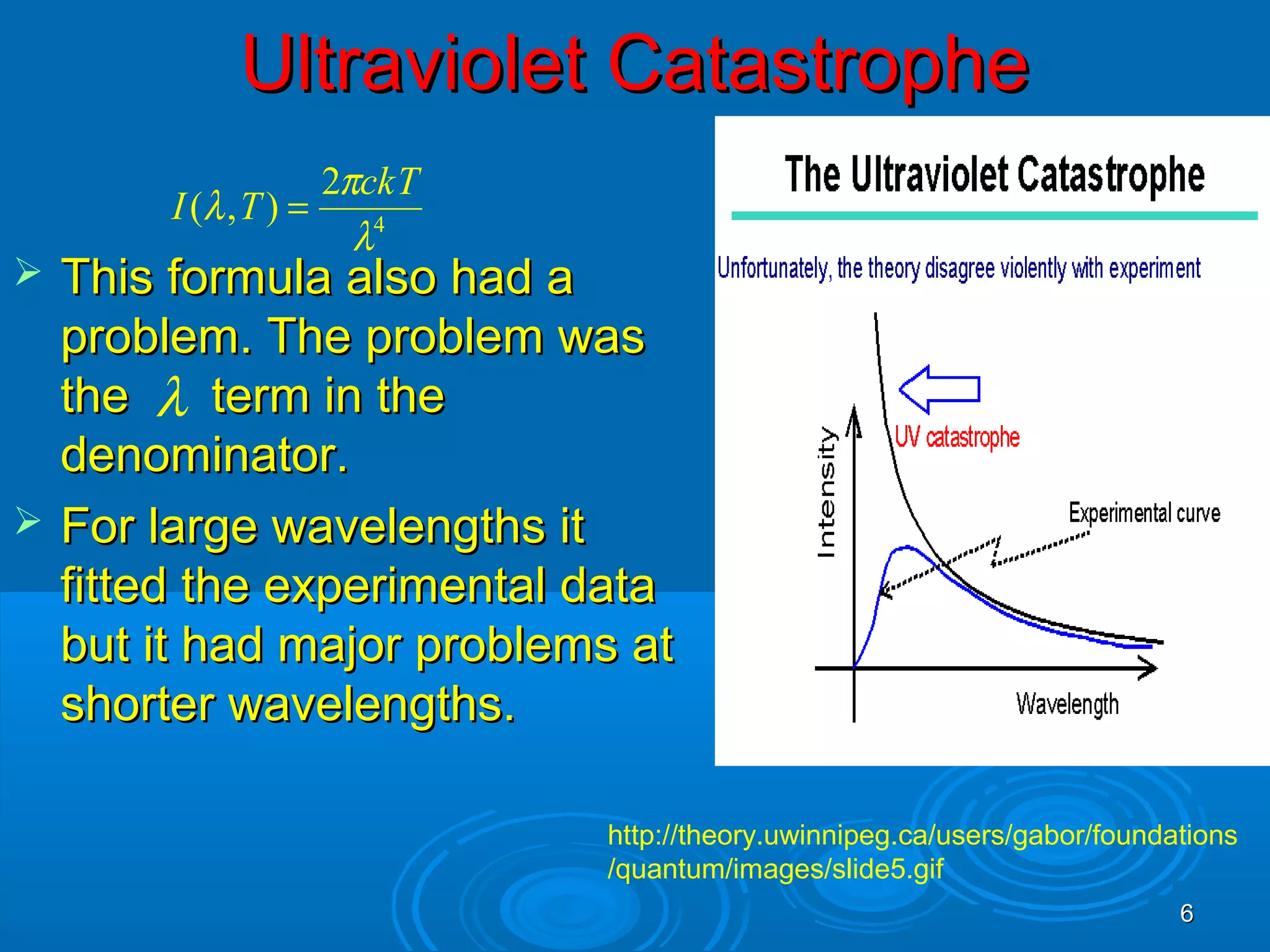
Ultraviolet Catastrophe




2πckT
I (λ , T ) =
λ4

This formula also had a
problem. The problem was
the λ term in the
denominator.
For large wavelengths it
fitted the experimental data
but it had major problems at
shorter wavelengths.
http://theory.uwinnipeg.ca/users/gabor/foundations
/quantum/images/slide5.gif
6
Black-Body Radiation Laws (2)
2- Planck Law
- We have two forms. As a function
of wavelength.
I(

2

2
λ ) = hc
,T
5
λ

e

1
hc
kT −
1

λ

And as a function of frequency
2 hν
1
I ( ,T ) =
ν
hν
c
3

2

e kT −
1

The Planck Law gives a distribution that
peaks at a certain wavelength, the peak
shifts to shorter wavelengths for higher
temperatures, and the area under the
curve grows rapidly with increasing
temperature.

http://scienceworld.wolfram.com/physics/PlanckLaw.html
7
Comparison between Classical and
Quantum viewpoint

There is a good fit at long wavelengths, but at short wavlengths there is a
major disagreement. Rayleigh-Jeans
∞, but Black-body
0.
http://upload.wikimedia.org/wikipedia/commons/a/a1/Blackbody-lg.png

8
Black-Body Radiation Laws (3)
λ

b
=
m
ax
T
3- Wein Displacement Law
- It tells us as we heat an object up, its
color changes from red to orange to
white hot.
- You can use this to calculate the
temperature of stars.
The surface temperature of the Sun is
5778 K, this temperature
corresponds to a peak emission =
502 nm = about 5000 Å.
- b is a constant of proportionality,
called Wien's displacement constant
and equals 2.897 768 5(51) × 10–3 m
K = 2.897768 5(51) × 106 nm K.

http://www.rumford.com/radiant/images/W
iengraph.gif
9
Black-Body Radiation Laws (4)

j =σ
T

4

4- The Stefan-Boltzmann Law
* Gives the total energy being
emitted at all wavelengths by
the blackbody (which is the
area under the Planck Law
curve).
* Explains the growth in the
height of the curve as the
temperature increases. Notice
that this growth is very abrupt.
* Sigma = 5.67 * 10-8 J s-1 m-2 K-4,
Known as the StefanBoltzmann constant.
http://ceos.cnes.fr:8100/cdrom-98/ceos1/science/dg/fig10.gif

10
Black-Body Radiation Laws (5)

Comparison of Rayleigh-Jeans law with Wien's
law and Planck's law, for a body of 8 mK
temperature.

http://en.wikipedia.org/wiki/Image:
RWP-comparison.svg
11
Application for Black Body
- The area of Earth's disk as viewed from

space is, Area = πr2.
- The total energy incident on Earth is,
Incident energy = (πr2)So.
- The energy absorbed by the
Earth/atmosphere system, as viewed from
space is
Absorbed energy = (πr2)So(1 - A). As we know
that bodies must be in radiative
equilibrium. The solar energy striking
Earth's disk as viewed from space is reemitted as thermal radiation by the
surface of the entire globe, as described
by the Stefan-Boltzmann Law, Emitted
energy = (4πr2)σT4.
- Set the absorbed energy equal to the
emitted energy:
(πr2)So(1 - A) = (4πr2)σTE4, Solving for T yields:
TE = [So(1 - A)/(4σ)](1/4)
= [1370•(1-0.3)/(4•5.67x10-8)](1/4) = 255 K.
http://soer.justice.tas.gov.au/2003/image/378/atm_structure/o_atm_Radn_Balance-m.jpg

12
Conclusion






As the temperature
increases, the peak
wavelength emitted by the
black body decreases.
As temperature increases,
the total energy emitted
increases, because the
total area under the curve
increases.
The curve gets infinitely
close to the x-axis but
never touches it.

http://www.astro.ufl.edu/~oliver/ast3722/lectures/BasicDetectors/BlackBody.gif
13
Summary
-

-

-

A black body is a theoretical object that absorbs 100% of the
radiation that hits it. Therefore it reflects no radiation and
appears perfectly black.
Roughly we can say that the stars radiate like blackbody
radiators. This is important because it means that we can use
the theory for blackbody radiators to infer things about stars.
At a particular temperature the black body would emit the
maximum amount of energy possible for that temperature.
Blackbody radiation does not depend on the type of object
emitting it. Entire spectrum of blackbody radiation depends on
only one parameter, the temperature, T.

14
Thanks for your

attention
Any suggestions or questions are
welcome.

15

Blackbody ppt

  • 1.
    Mr.S.Selvakumar Asst professor Department ofPhysics Thamirabharani Engineering College
  • 2.
    Contents Motivation  Definition ofa Black-Body  Black-Body Radation Laws 1- The Planck Law 2- The Wien Displacement Law 3- The Stefan-Boltzmann Law 4- The Rayleigh-Jeans Law  Application for Black Body  Conclusion  Summary  2
  • 3.
    Motivation The black bodyis importance in thermal radiation theory and practice. • The ideal black body notion is importance in studying thermal radiation and electromagnetic radiation transfer in all wavelength bands. • The black body is used as a standard with which the absorption of real bodies is compared. • 3
  • 4.
    Definition of ablack body A black body is an ideal body which allows the whole of the incident radiation to pass into itself ( without reflecting the energy ) and absorbs within itself this whole incident radiation (without passing on the energy). This propety is valid for radiation corresponding to all wavelengths and to all angels of incidence. Therefore, the black body is an ideal absorber of incident radaition. Univ. of Oregon web site 4
  • 5.
    Black-Body Radiation Laws(1) 1- The Rayleigh-Jeans Law. * It agrees with experimental measurements for long wavelengths. * It predicts an energy output that diverges towards infinity as wavelengths grow smaller. * The failure has become known as the ultraviolet catastrophe. 2πckT I (λ , T ) = λ4 http://www.egglescliffe.org.uk/physics/astronomy/bl ackbody/Image22c.gif 5
  • 6.
    Ultraviolet Catastrophe   2πckT I (λ, T ) = λ4 This formula also had a problem. The problem was the λ term in the denominator. For large wavelengths it fitted the experimental data but it had major problems at shorter wavelengths. http://theory.uwinnipeg.ca/users/gabor/foundations /quantum/images/slide5.gif 6
  • 7.
    Black-Body Radiation Laws(2) 2- Planck Law - We have two forms. As a function of wavelength. I( 2 2 λ ) = hc ,T 5 λ e 1 hc kT − 1 λ And as a function of frequency 2 hν 1 I ( ,T ) = ν hν c 3 2 e kT − 1 The Planck Law gives a distribution that peaks at a certain wavelength, the peak shifts to shorter wavelengths for higher temperatures, and the area under the curve grows rapidly with increasing temperature. http://scienceworld.wolfram.com/physics/PlanckLaw.html 7
  • 8.
    Comparison between Classicaland Quantum viewpoint There is a good fit at long wavelengths, but at short wavlengths there is a major disagreement. Rayleigh-Jeans ∞, but Black-body 0. http://upload.wikimedia.org/wikipedia/commons/a/a1/Blackbody-lg.png 8
  • 9.
    Black-Body Radiation Laws(3) λ b = m ax T 3- Wein Displacement Law - It tells us as we heat an object up, its color changes from red to orange to white hot. - You can use this to calculate the temperature of stars. The surface temperature of the Sun is 5778 K, this temperature corresponds to a peak emission = 502 nm = about 5000 Å. - b is a constant of proportionality, called Wien's displacement constant and equals 2.897 768 5(51) × 10–3 m K = 2.897768 5(51) × 106 nm K. http://www.rumford.com/radiant/images/W iengraph.gif 9
  • 10.
    Black-Body Radiation Laws(4) j =σ T 4 4- The Stefan-Boltzmann Law * Gives the total energy being emitted at all wavelengths by the blackbody (which is the area under the Planck Law curve). * Explains the growth in the height of the curve as the temperature increases. Notice that this growth is very abrupt. * Sigma = 5.67 * 10-8 J s-1 m-2 K-4, Known as the StefanBoltzmann constant. http://ceos.cnes.fr:8100/cdrom-98/ceos1/science/dg/fig10.gif 10
  • 11.
    Black-Body Radiation Laws(5) Comparison of Rayleigh-Jeans law with Wien's law and Planck's law, for a body of 8 mK temperature. http://en.wikipedia.org/wiki/Image: RWP-comparison.svg 11
  • 12.
    Application for BlackBody - The area of Earth's disk as viewed from space is, Area = πr2. - The total energy incident on Earth is, Incident energy = (πr2)So. - The energy absorbed by the Earth/atmosphere system, as viewed from space is Absorbed energy = (πr2)So(1 - A). As we know that bodies must be in radiative equilibrium. The solar energy striking Earth's disk as viewed from space is reemitted as thermal radiation by the surface of the entire globe, as described by the Stefan-Boltzmann Law, Emitted energy = (4πr2)σT4. - Set the absorbed energy equal to the emitted energy: (πr2)So(1 - A) = (4πr2)σTE4, Solving for T yields: TE = [So(1 - A)/(4σ)](1/4) = [1370•(1-0.3)/(4•5.67x10-8)](1/4) = 255 K. http://soer.justice.tas.gov.au/2003/image/378/atm_structure/o_atm_Radn_Balance-m.jpg 12
  • 13.
    Conclusion    As the temperature increases,the peak wavelength emitted by the black body decreases. As temperature increases, the total energy emitted increases, because the total area under the curve increases. The curve gets infinitely close to the x-axis but never touches it. http://www.astro.ufl.edu/~oliver/ast3722/lectures/BasicDetectors/BlackBody.gif 13
  • 14.
    Summary - - - A black bodyis a theoretical object that absorbs 100% of the radiation that hits it. Therefore it reflects no radiation and appears perfectly black. Roughly we can say that the stars radiate like blackbody radiators. This is important because it means that we can use the theory for blackbody radiators to infer things about stars. At a particular temperature the black body would emit the maximum amount of energy possible for that temperature. Blackbody radiation does not depend on the type of object emitting it. Entire spectrum of blackbody radiation depends on only one parameter, the temperature, T. 14
  • 15.
    Thanks for your attention Anysuggestions or questions are welcome. 15

Editor's Notes

  • #5 An oven with a small opening produces a very good blackbody spectrum.
  • #8 I:- Spectral radiance or energy per unit time per unit surface area per unit solid angle per unit frequency or wavelength. It has SI unit of J•s-1•m-2•sr-1•Hz-1, or J•s-1•m-2•sr-1•m-1. C = nu * Lambda.
  • #11 Radiant exitance is defined as the amount of radiant flux (radiant energy per unit time) leaving a surface per unit area.
  • #13 The albedo A of the Earth/atmosphere system is the fraction of incoming solar radiation that is reflected by the Earth/atmosphere system. where r is Earth's radius, about 6,378 km.