Riccardo Rigon
IlSole,F.Lelong,2008,ValdiSella
Solar Radiation
From Sun to Earth
R. Rigon
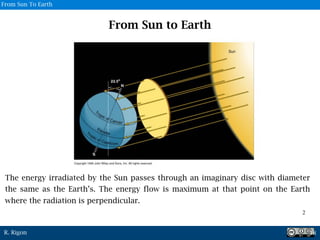
The energy irradiated by the Sun passes through an imaginary disc with diameter
the same as the Earth’s. The energy flow is maximum at that point on the Earth
where the radiation is perpendicular.
From Sun to Earth
18
2
From Sun To Earth
R. Rigon
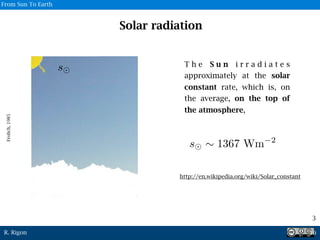
T h e S u n i r r a d i a t e s
approximately at the solar
constant rate, which is, on
the average, on the top of
the atmosphere,
Solar radiation
http://en.wikipedia.org/wiki/Solar_constant
Frolich,1985
19
3
From Sun To Earth
R. Rigon
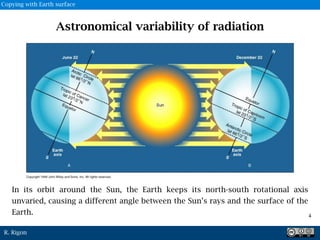
In its orbit around the Sun, the Earth keeps its north-south rotational axis
unvaried, causing a different angle between the Sun’s rays and the surface of the
Earth.
Astronomical variability of radiation
4
Copying with Earth surface
R. Rigon
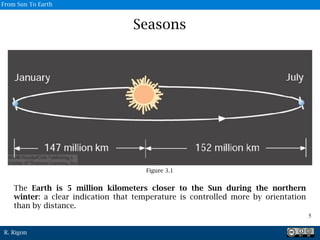
Seasons
The Earth is 5 million kilometers closer to the Sun during the northern
winter: a clear indication that temperature is controlled more by orientation
than by distance.
Figure 3.1
5
From Sun To Earth
R. Rigon
The Earth’s orbit around the Sun is an ellipse. The shape of the ellipse is
determined by its eccentricity, which varies in time, changing the distances of
the aphelion and perihelion
Corrections to the solar constant
http://www.ascensionrecta.com/
20
6
From Sun To Earth
R. Rigon
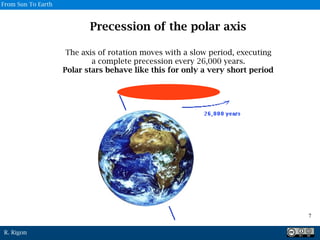
Precession of the polar axis
The axis of rotation moves with a slow period, executing
a complete precession every 26,000 years.
Polar stars behave like this for only a very short period
7
From Sun To Earth
R. Rigon
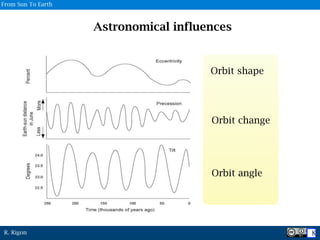
Astronomical influences
Orbit angle
Orbit change
Orbit shape
8
From Sun To Earth
R. Rigon
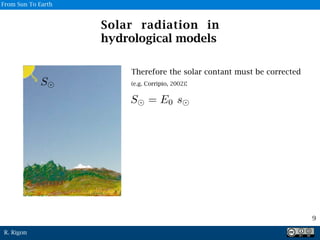
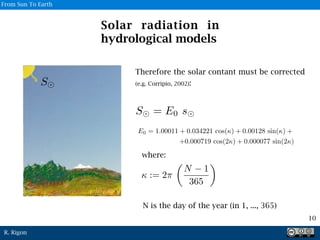
Therefore the solar contant must be corrected
(e.g. Corripio, 2002):
Solar radiation in
hydrological models
9
S
From Sun To Earth
R. Rigon
N is the day of the year (in 1, ..., 365)
where:
Solar radiation in
hydrological models
10
Therefore the solar contant must be corrected
(e.g. Corripio, 2002):S
From Sun To Earth

6 d-radiation-from sun2earth

  • 1.
  • 2.
    R. Rigon The energyirradiated by the Sun passes through an imaginary disc with diameter the same as the Earth’s. The energy flow is maximum at that point on the Earth where the radiation is perpendicular. From Sun to Earth 18 2 From Sun To Earth
  • 3.
    R. Rigon T he S u n i r r a d i a t e s approximately at the solar constant rate, which is, on the average, on the top of the atmosphere, Solar radiation http://en.wikipedia.org/wiki/Solar_constant Frolich,1985 19 3 From Sun To Earth
  • 4.
    R. Rigon In itsorbit around the Sun, the Earth keeps its north-south rotational axis unvaried, causing a different angle between the Sun’s rays and the surface of the Earth. Astronomical variability of radiation 4 Copying with Earth surface
  • 5.
    R. Rigon Seasons The Earthis 5 million kilometers closer to the Sun during the northern winter: a clear indication that temperature is controlled more by orientation than by distance. Figure 3.1 5 From Sun To Earth
  • 6.
    R. Rigon The Earth’sorbit around the Sun is an ellipse. The shape of the ellipse is determined by its eccentricity, which varies in time, changing the distances of the aphelion and perihelion Corrections to the solar constant http://www.ascensionrecta.com/ 20 6 From Sun To Earth
  • 7.
    R. Rigon Precession ofthe polar axis The axis of rotation moves with a slow period, executing a complete precession every 26,000 years. Polar stars behave like this for only a very short period 7 From Sun To Earth
  • 8.
    R. Rigon Astronomical influences Orbitangle Orbit change Orbit shape 8 From Sun To Earth
  • 9.
    R. Rigon Therefore thesolar contant must be corrected (e.g. Corripio, 2002): Solar radiation in hydrological models 9 S From Sun To Earth
  • 10.
    R. Rigon N isthe day of the year (in 1, ..., 365) where: Solar radiation in hydrological models 10 Therefore the solar contant must be corrected (e.g. Corripio, 2002):S From Sun To Earth