TOPIC : MICROSCOPIC & MACROSCOPIC POINT OF VIEW ,
THERMODYNAMIC SYSTEM & CONTROL VOLUME ,
THERMODYNMAIC PROPERTIES.
GOVERNMENT ENGINEERING COLLEGE BHARUCH
SUBJECT : ENGINEERING THERMODYNAMICS
DIV : MECHANICAL B (3RD SEM)
PREPARED BY :
 RAVAL KRUNAL - 160140119096
 SAKHIWALA MAHIR -160140119098
 SARDHARA KISHAN -160140119099
 SHAH VRAJ -160140119101
THERMODYNAMICS
 Thermodynamics is science of energy transfer and its effects
on properties.
 Main aim is to convert disorganized form of energy into
organized form of energy in an efficient manner. Based on
the macroscopic approach which does not require
knowledge of behavior of individual particles and is called
classical thermodynamics.
 A set of of mathematical models and concepts that allow us
to describe the way changes in the system state
(temperature, pressure, and composition) affect equilibrium.
2
MACROSCOPIC AND MICROSOPIC
APPROACH
Macroscopic Thermodynamics:
 when matter are considered as continuous function of
space variables.
 It is classical approach of thermodynamics, which
requires simple mathematical for mule for analyzing
the system.
Microscopic Thermodynamics:
 All the atoms and molecules of the system are
considered and the summation of all the atoms and
molecules are used.
 it is statistical approach of thermodynamics
3
MICROSCOPIC V/S MACROSCOPIC
MICROSCOPIC
• Overall Behaviour
• Few properties can be
needed
• Properties like pressure,
temperature can be
calculated easily
• Properties can be taken as
the average molecules.
MACROSCOPIC
• Structural knowledge
• Large number of variable is
needed
• Properties like velocity,
momentum can never be
calculated easily
• Properties are defined for
each molecules.
4
SYSTEM, SURROUDING &
BOUNDARY
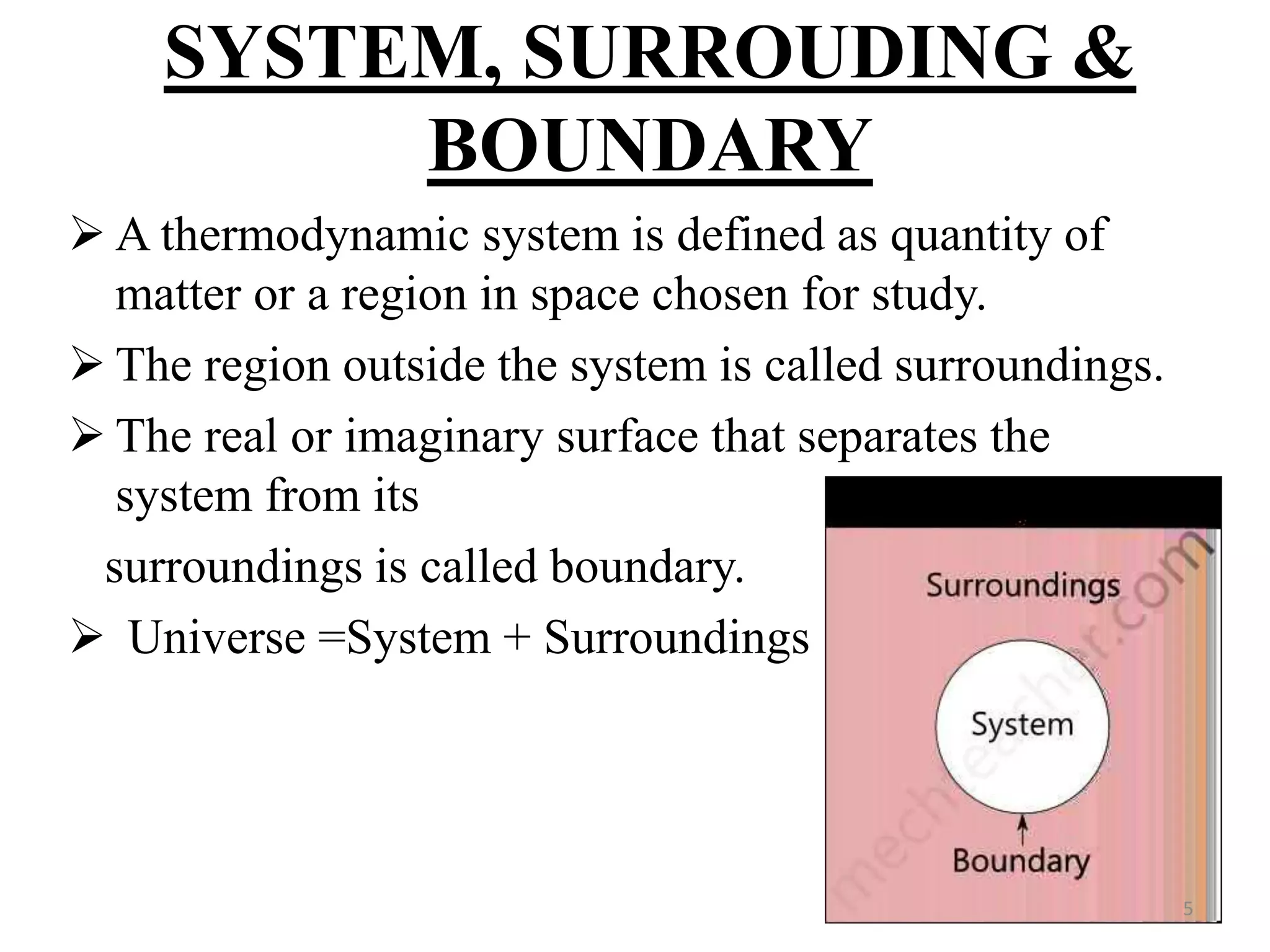
 A thermodynamic system is defined as quantity of
matter or a region in space chosen for study.
 The region outside the system is called surroundings.
 The real or imaginary surface that separates the
system from its
surroundings is called boundary.
 Universe =System + Surroundings
5
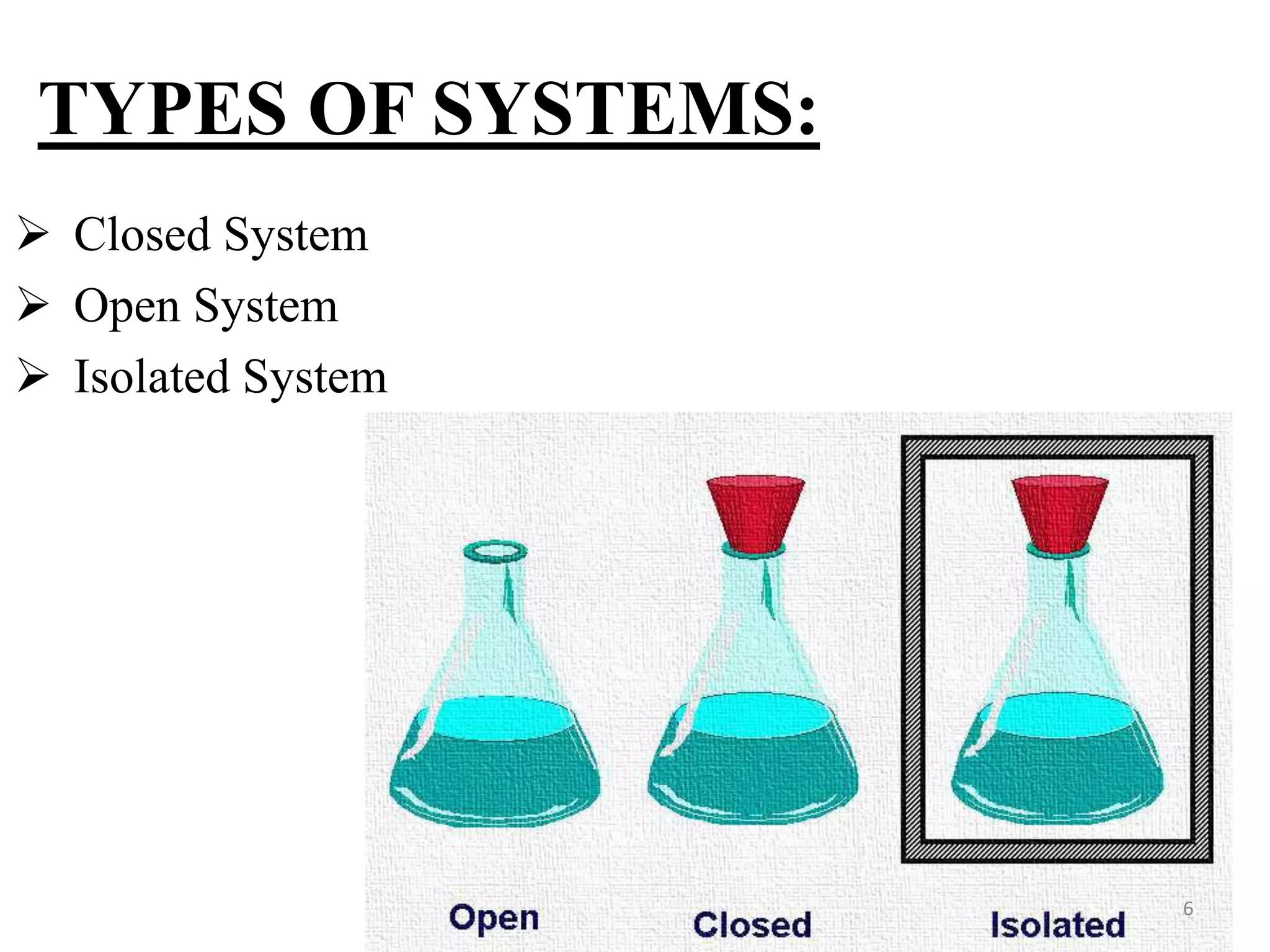
TYPES OF SYSTEMS:
 Closed System
 Open System
 Isolated System
6
:CLOSED SYSTEM:
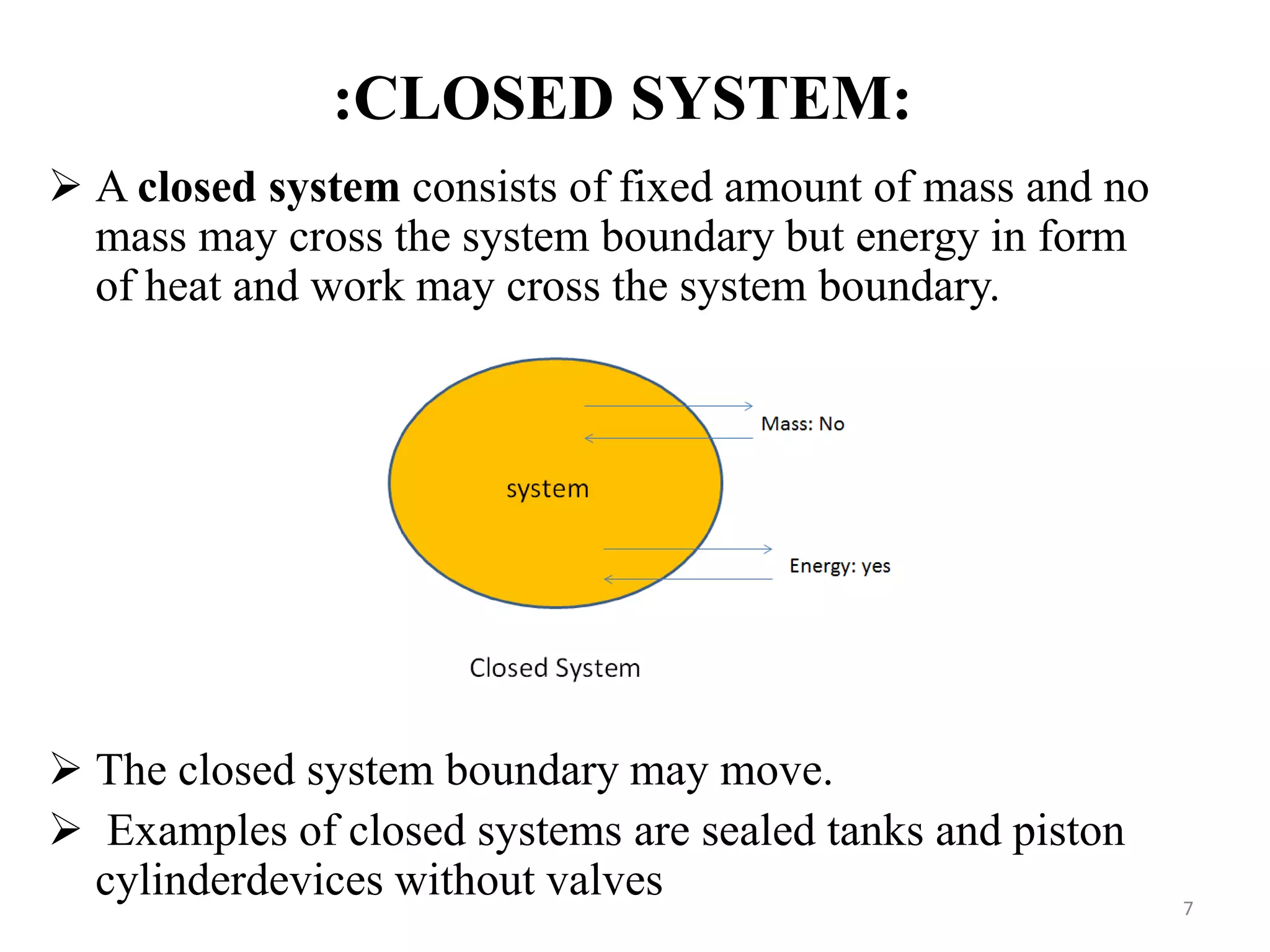
 A closed system consists of fixed amount of mass and no
mass may cross the system boundary but energy in form
of heat and work may cross the system boundary.
 The closed system boundary may move.
 Examples of closed systems are sealed tanks and piston
cylinderdevices without valves 7
Example of closed system:
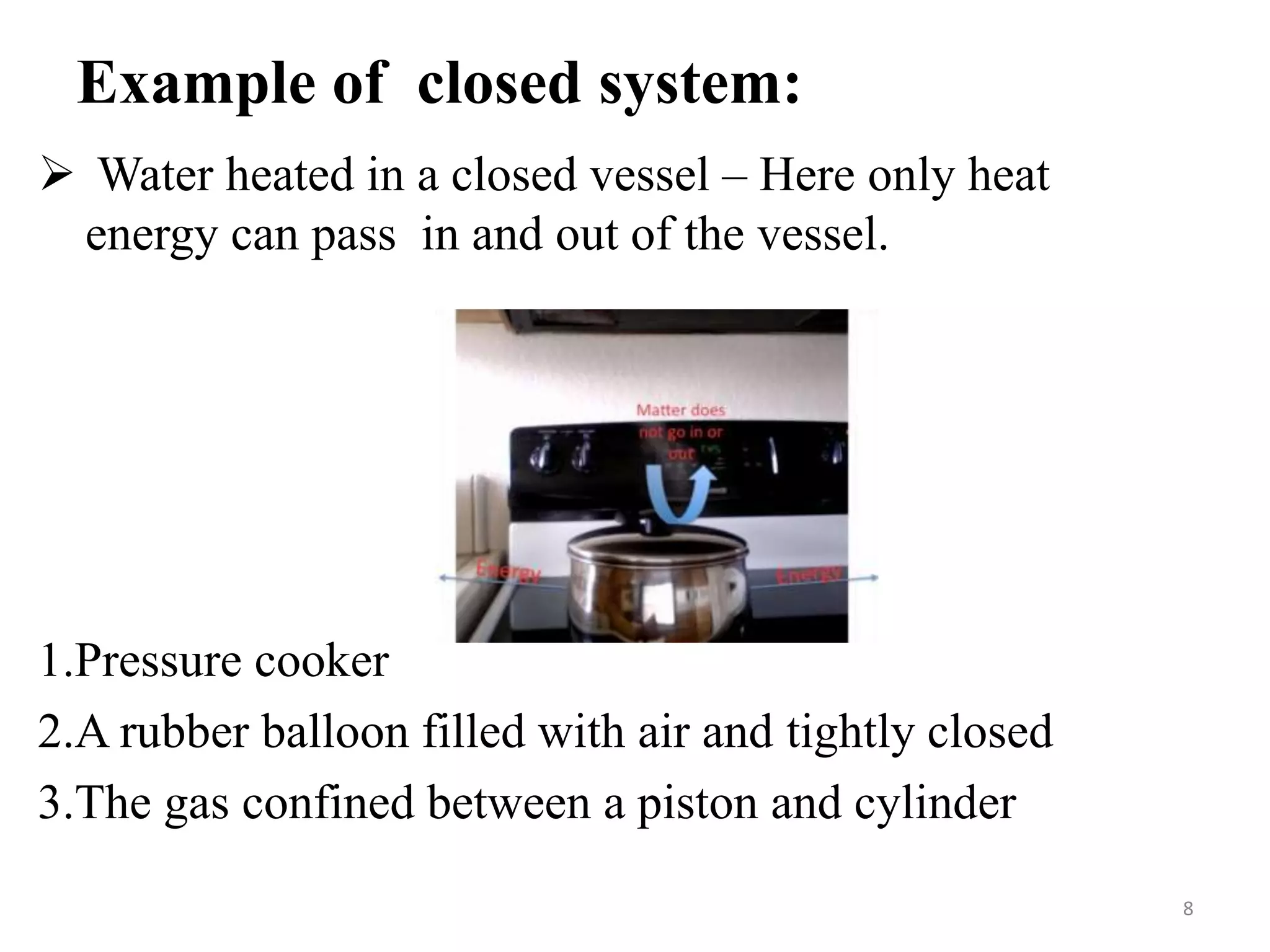
 Water heated in a closed vessel – Here only heat
energy can pass in and out of the vessel.
1.Pressure cooker
2.A rubber balloon filled with air and tightly closed
3.The gas confined between a piston and cylinder
8
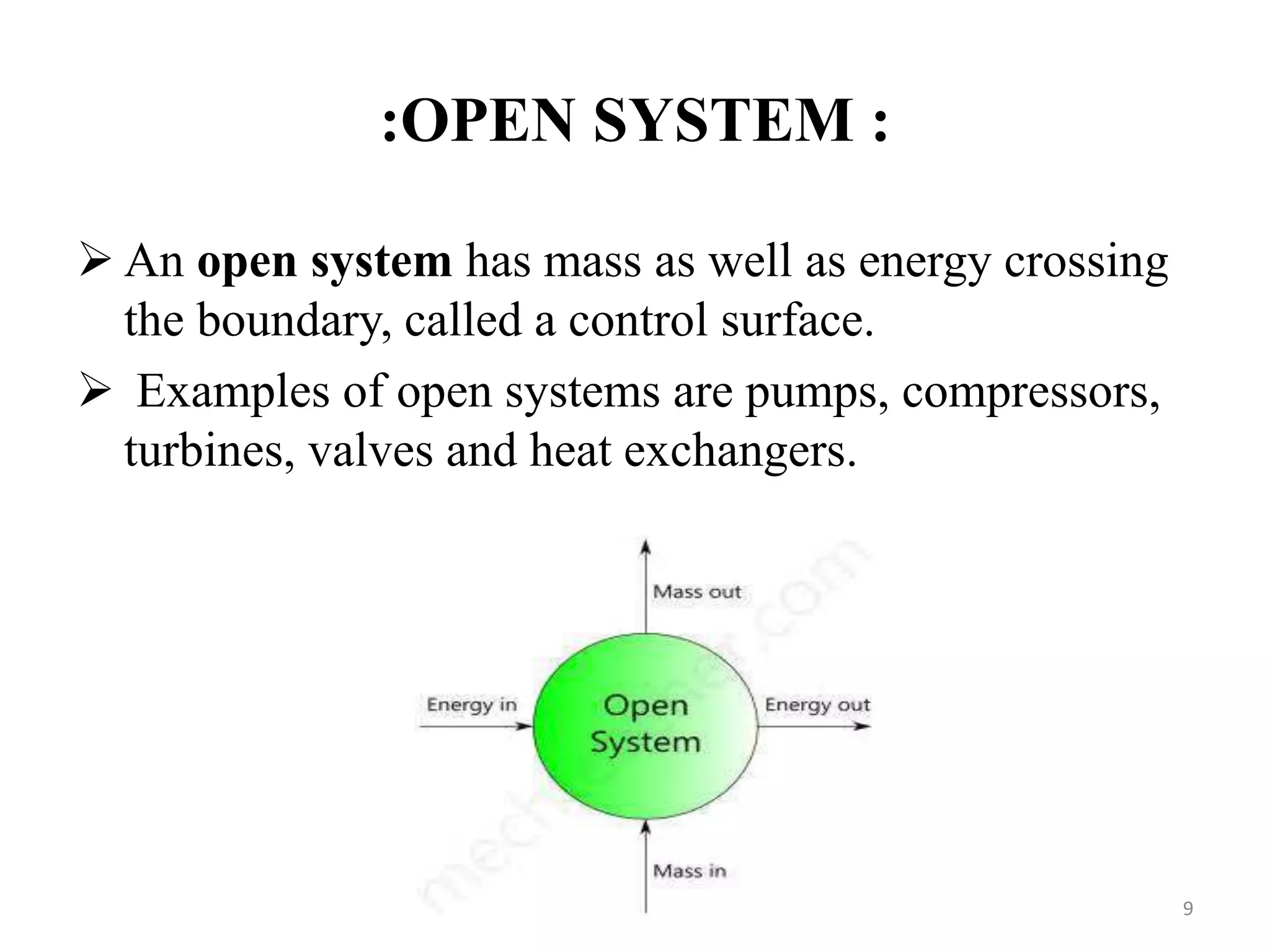
:OPEN SYSTEM :
 An open system has mass as well as energy crossing
the boundary, called a control surface.
 Examples of open systems are pumps, compressors,
turbines, valves and heat exchangers.
9
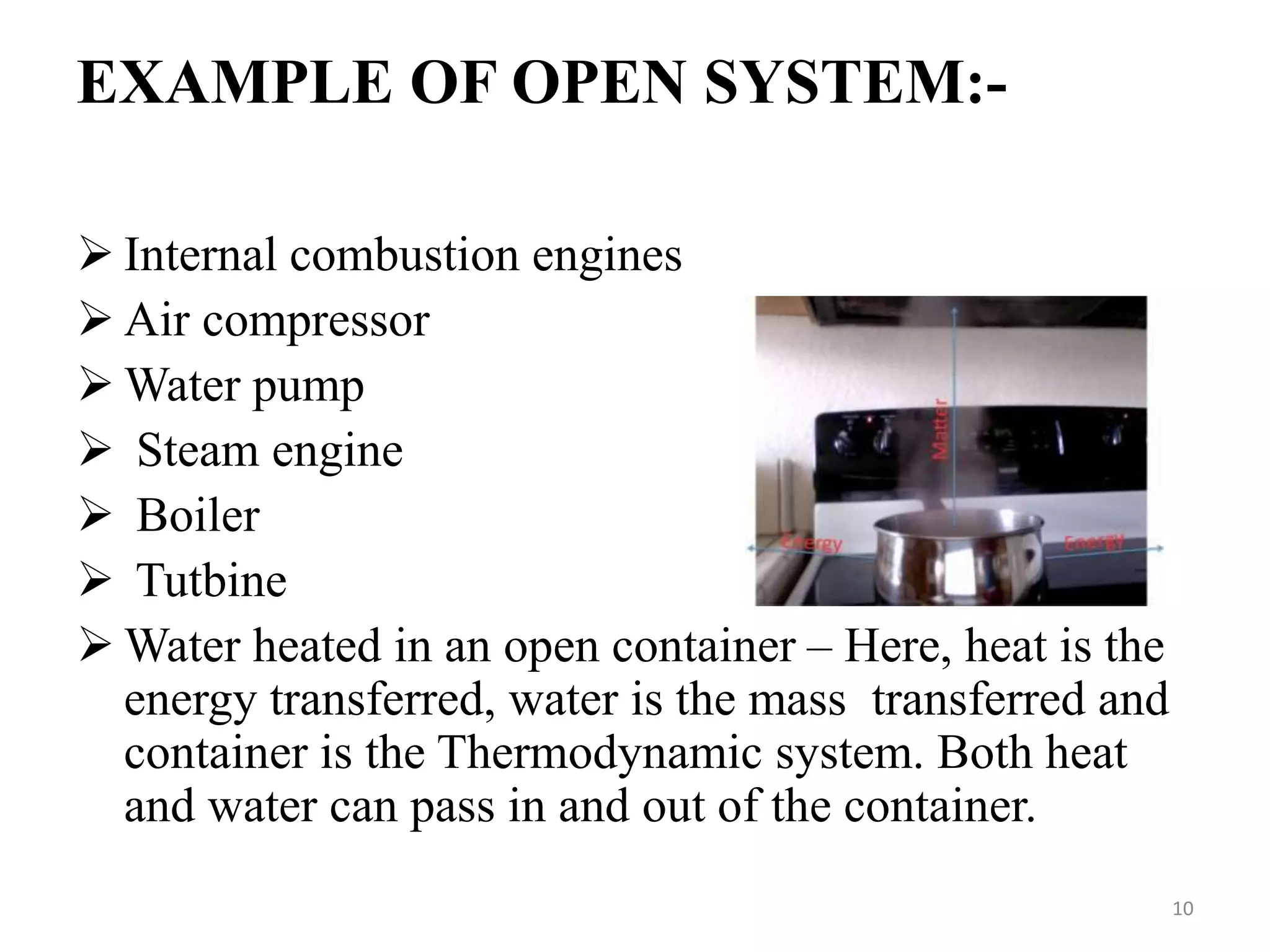
EXAMPLE OF OPEN SYSTEM:-
 Internal combustion engines
 Air compressor
 Water pump
 Steam engine
 Boiler
 Tutbine
 Water heated in an open container – Here, heat is the
energy transferred, water is the mass transferred and
container is the Thermodynamic system. Both heat
and water can pass in and out of the container.
10
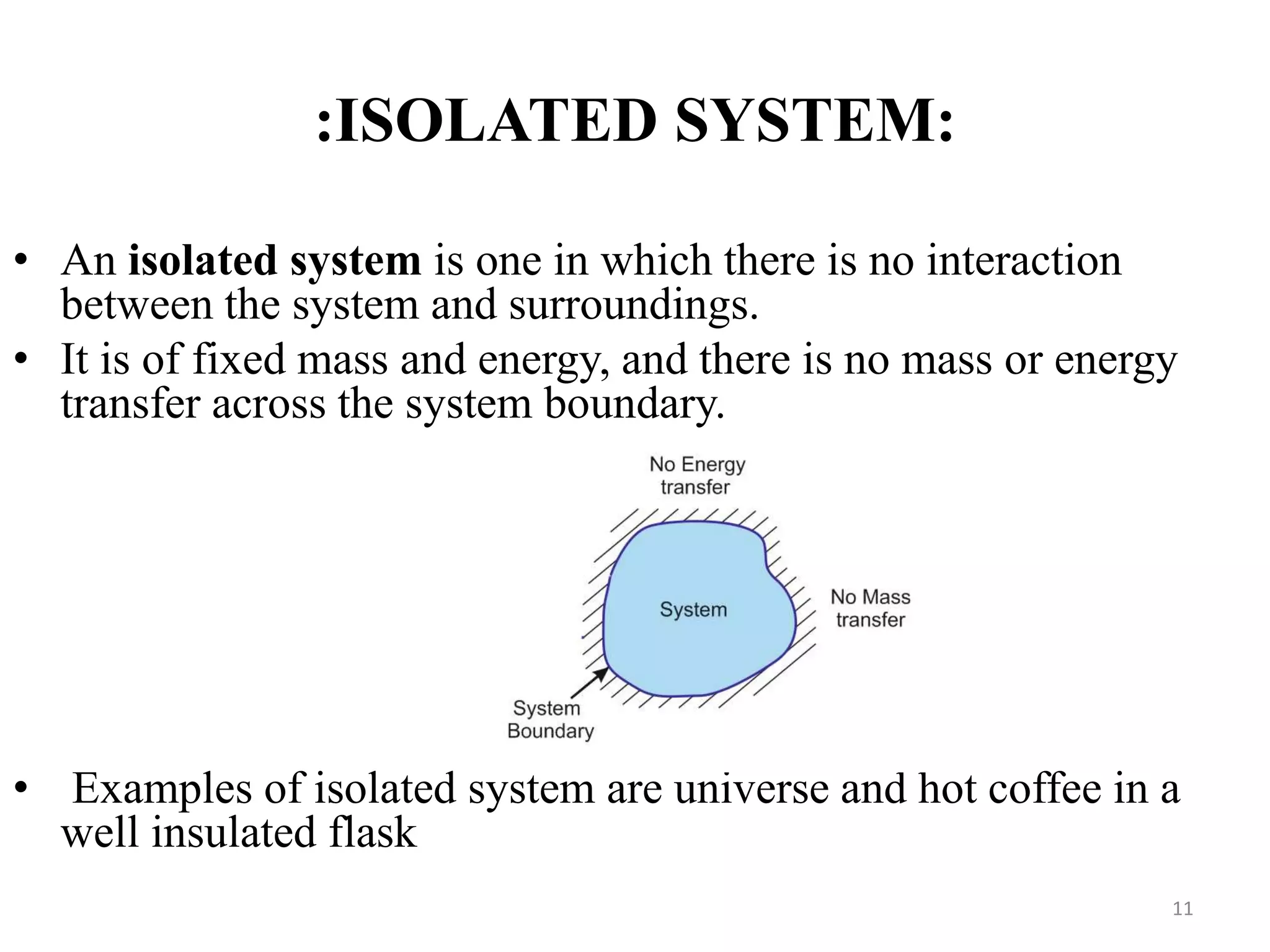
:ISOLATED SYSTEM:
• An isolated system is one in which there is no interaction
between the system and surroundings.
• It is of fixed mass and energy, and there is no mass or energy
transfer across the system boundary.
• Examples of isolated system are universe and hot coffee in a
well insulated flask
11
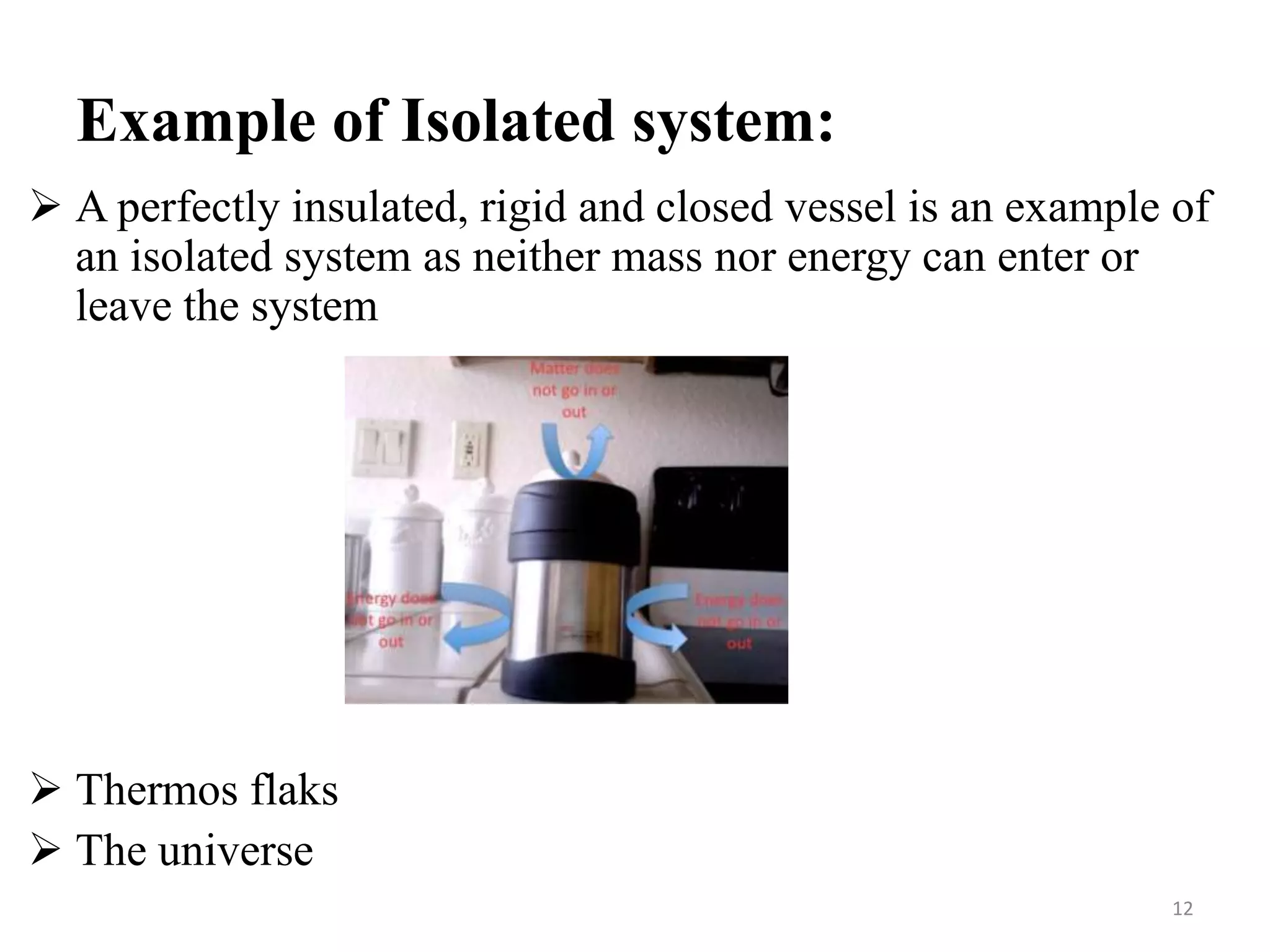
Example of Isolated system:
 A perfectly insulated, rigid and closed vessel is an example of
an isolated system as neither mass nor energy can enter or
leave the system
 Thermos flaks
 The universe
12
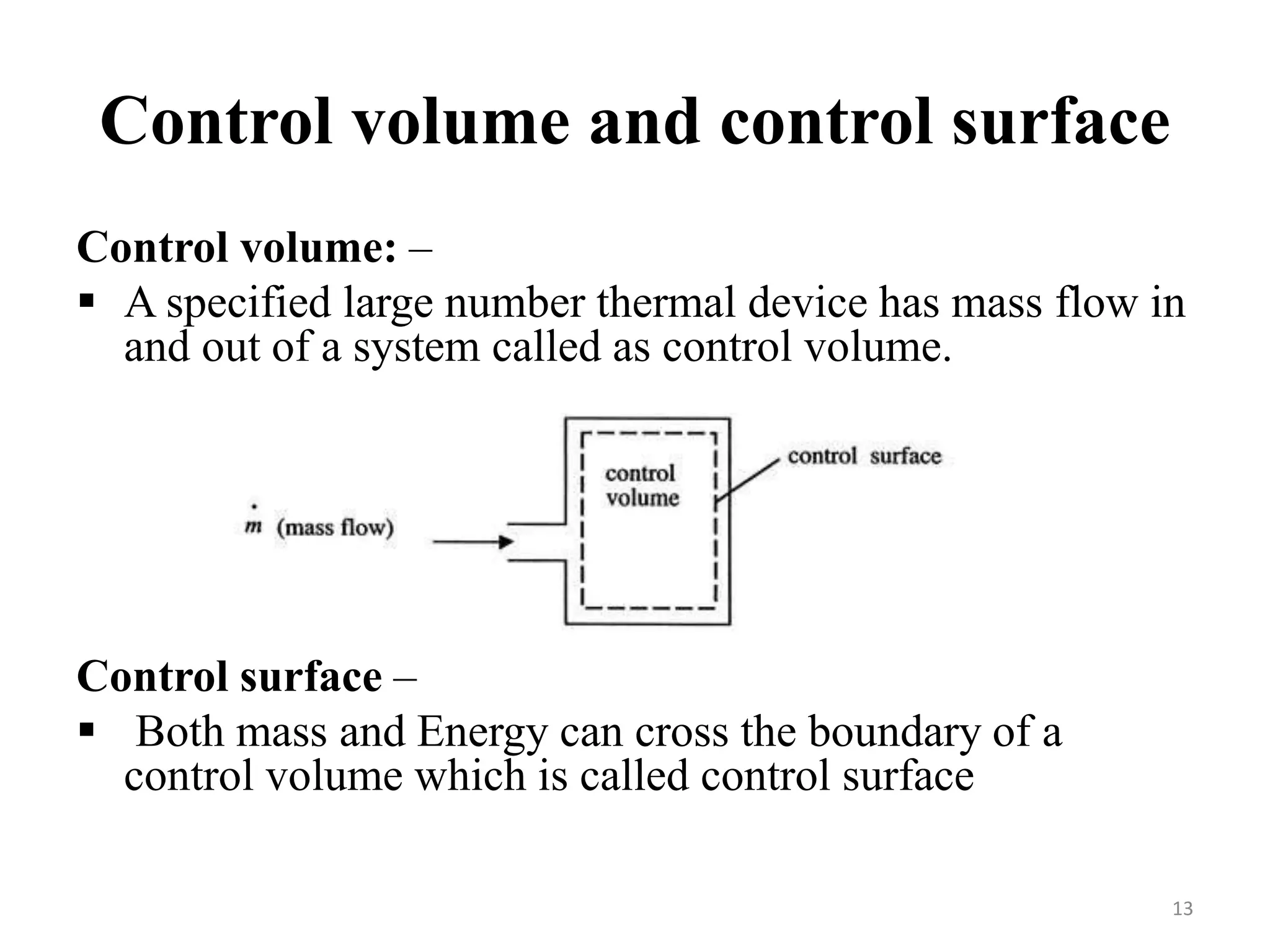
Control volume and control surface
Control volume: –
 A specified large number thermal device has mass flow in
and out of a system called as control volume.
Control surface –
 Both mass and Energy can cross the boundary of a
control volume which is called control surface
13
PROPERTIES OF SYSTEM
 Any measurable characteristic of a system in
equilibrium is called a property.
 The property is independent of the path used to
arrive at the system condition.
 Properties are point functions.
 Properties are exact differentials.
 Properties may be intensive or extensive.
14
Extensive Properties
• Extensive properties depends on size or mass of the
system.
• Some extensive properties are:
a. Mass
b. Volume
c. Total Energy
d. Electric Charge
e. Magnetization
15
Intensive Properties
• Intensive properties are independent of size or mass
of the system.
• Some intensive properties are:
a. Pressure
b. Temperature
c. Density
d. Velocity
e. Viscosity
16
HOMOGENEOUS AND HETROGENEOUS
SYSTEM :-
Homogeneous System :-
 A system which consist a single phase is termed as a
homogeneous system.
 For ex;- mixture of air and water vapour, water + nitric
acid.
Heterogeneous System :-
 A system consist two or more phases is called
heterogeneous system.
 For ex;- water + steam, ice + water, water + oil,
17
THANK YOU
18

MICROSCOPIC & MACROSCOPIC POINT OF VIEW , THERMODYNAMIC SYSTEM & CONTROL VOLUME , THERMODYNMAIC PROPERTIES.

  • 1.
    TOPIC : MICROSCOPIC& MACROSCOPIC POINT OF VIEW , THERMODYNAMIC SYSTEM & CONTROL VOLUME , THERMODYNMAIC PROPERTIES. GOVERNMENT ENGINEERING COLLEGE BHARUCH SUBJECT : ENGINEERING THERMODYNAMICS DIV : MECHANICAL B (3RD SEM) PREPARED BY :  RAVAL KRUNAL - 160140119096  SAKHIWALA MAHIR -160140119098  SARDHARA KISHAN -160140119099  SHAH VRAJ -160140119101
  • 2.
    THERMODYNAMICS  Thermodynamics isscience of energy transfer and its effects on properties.  Main aim is to convert disorganized form of energy into organized form of energy in an efficient manner. Based on the macroscopic approach which does not require knowledge of behavior of individual particles and is called classical thermodynamics.  A set of of mathematical models and concepts that allow us to describe the way changes in the system state (temperature, pressure, and composition) affect equilibrium. 2
  • 3.
    MACROSCOPIC AND MICROSOPIC APPROACH MacroscopicThermodynamics:  when matter are considered as continuous function of space variables.  It is classical approach of thermodynamics, which requires simple mathematical for mule for analyzing the system. Microscopic Thermodynamics:  All the atoms and molecules of the system are considered and the summation of all the atoms and molecules are used.  it is statistical approach of thermodynamics 3
  • 4.
    MICROSCOPIC V/S MACROSCOPIC MICROSCOPIC •Overall Behaviour • Few properties can be needed • Properties like pressure, temperature can be calculated easily • Properties can be taken as the average molecules. MACROSCOPIC • Structural knowledge • Large number of variable is needed • Properties like velocity, momentum can never be calculated easily • Properties are defined for each molecules. 4
  • 5.
    SYSTEM, SURROUDING & BOUNDARY A thermodynamic system is defined as quantity of matter or a region in space chosen for study.  The region outside the system is called surroundings.  The real or imaginary surface that separates the system from its surroundings is called boundary.  Universe =System + Surroundings 5
  • 6.
    TYPES OF SYSTEMS: Closed System  Open System  Isolated System 6
  • 7.
    :CLOSED SYSTEM:  Aclosed system consists of fixed amount of mass and no mass may cross the system boundary but energy in form of heat and work may cross the system boundary.  The closed system boundary may move.  Examples of closed systems are sealed tanks and piston cylinderdevices without valves 7
  • 8.
    Example of closedsystem:  Water heated in a closed vessel – Here only heat energy can pass in and out of the vessel. 1.Pressure cooker 2.A rubber balloon filled with air and tightly closed 3.The gas confined between a piston and cylinder 8
  • 9.
    :OPEN SYSTEM : An open system has mass as well as energy crossing the boundary, called a control surface.  Examples of open systems are pumps, compressors, turbines, valves and heat exchangers. 9
  • 10.
    EXAMPLE OF OPENSYSTEM:-  Internal combustion engines  Air compressor  Water pump  Steam engine  Boiler  Tutbine  Water heated in an open container – Here, heat is the energy transferred, water is the mass transferred and container is the Thermodynamic system. Both heat and water can pass in and out of the container. 10
  • 11.
    :ISOLATED SYSTEM: • Anisolated system is one in which there is no interaction between the system and surroundings. • It is of fixed mass and energy, and there is no mass or energy transfer across the system boundary. • Examples of isolated system are universe and hot coffee in a well insulated flask 11
  • 12.
    Example of Isolatedsystem:  A perfectly insulated, rigid and closed vessel is an example of an isolated system as neither mass nor energy can enter or leave the system  Thermos flaks  The universe 12
  • 13.
    Control volume andcontrol surface Control volume: –  A specified large number thermal device has mass flow in and out of a system called as control volume. Control surface –  Both mass and Energy can cross the boundary of a control volume which is called control surface 13
  • 14.
    PROPERTIES OF SYSTEM Any measurable characteristic of a system in equilibrium is called a property.  The property is independent of the path used to arrive at the system condition.  Properties are point functions.  Properties are exact differentials.  Properties may be intensive or extensive. 14
  • 15.
    Extensive Properties • Extensiveproperties depends on size or mass of the system. • Some extensive properties are: a. Mass b. Volume c. Total Energy d. Electric Charge e. Magnetization 15
  • 16.
    Intensive Properties • Intensiveproperties are independent of size or mass of the system. • Some intensive properties are: a. Pressure b. Temperature c. Density d. Velocity e. Viscosity 16
  • 17.
    HOMOGENEOUS AND HETROGENEOUS SYSTEM:- Homogeneous System :-  A system which consist a single phase is termed as a homogeneous system.  For ex;- mixture of air and water vapour, water + nitric acid. Heterogeneous System :-  A system consist two or more phases is called heterogeneous system.  For ex;- water + steam, ice + water, water + oil, 17
  • 18.