Pulse Compression Waveform
SOLO HERMELIN
Updated: 27.10.08http://www.solohermelin.com
Table of Content
SOLO
Pulse Compression Waveform
Resolution
Pulse Range Resolution
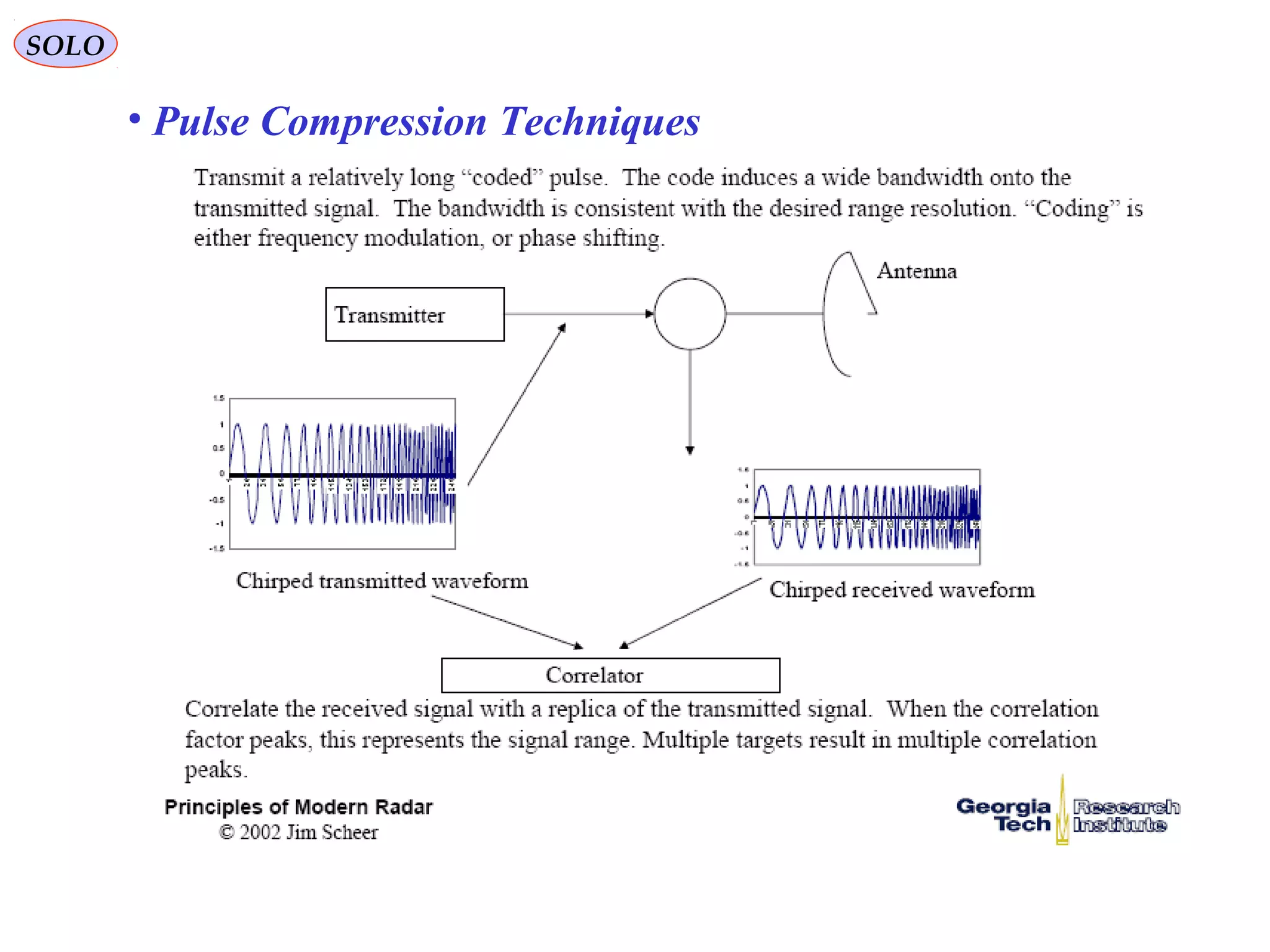
Pulse Compression Waveform Introduction
Waveform Hierarchy
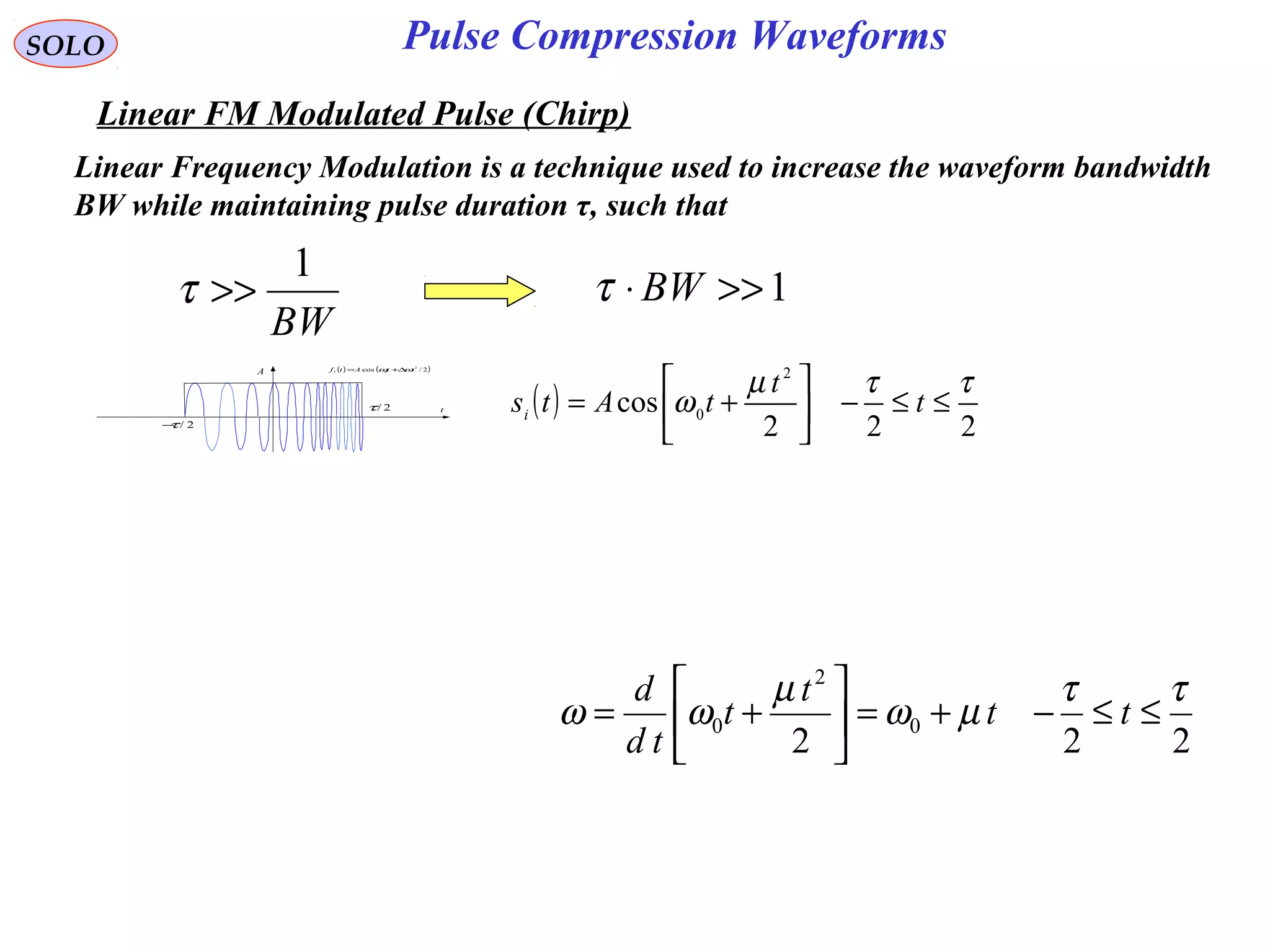
Linear FM Modulated Pulse (Chirp)
Barker Codes
Combined Barker Codes
Poly-Phase Codes
Phase Coded Waveforms
Matched Filter Response to Phase Coding
Bi-Phase Codes
Table of Content (continue – 1)
SOLO
Pulse Compression Waveform
Poly-Phase Codes
Frank Codes
P1, P2, P3, P4 Poly-Phase Codes
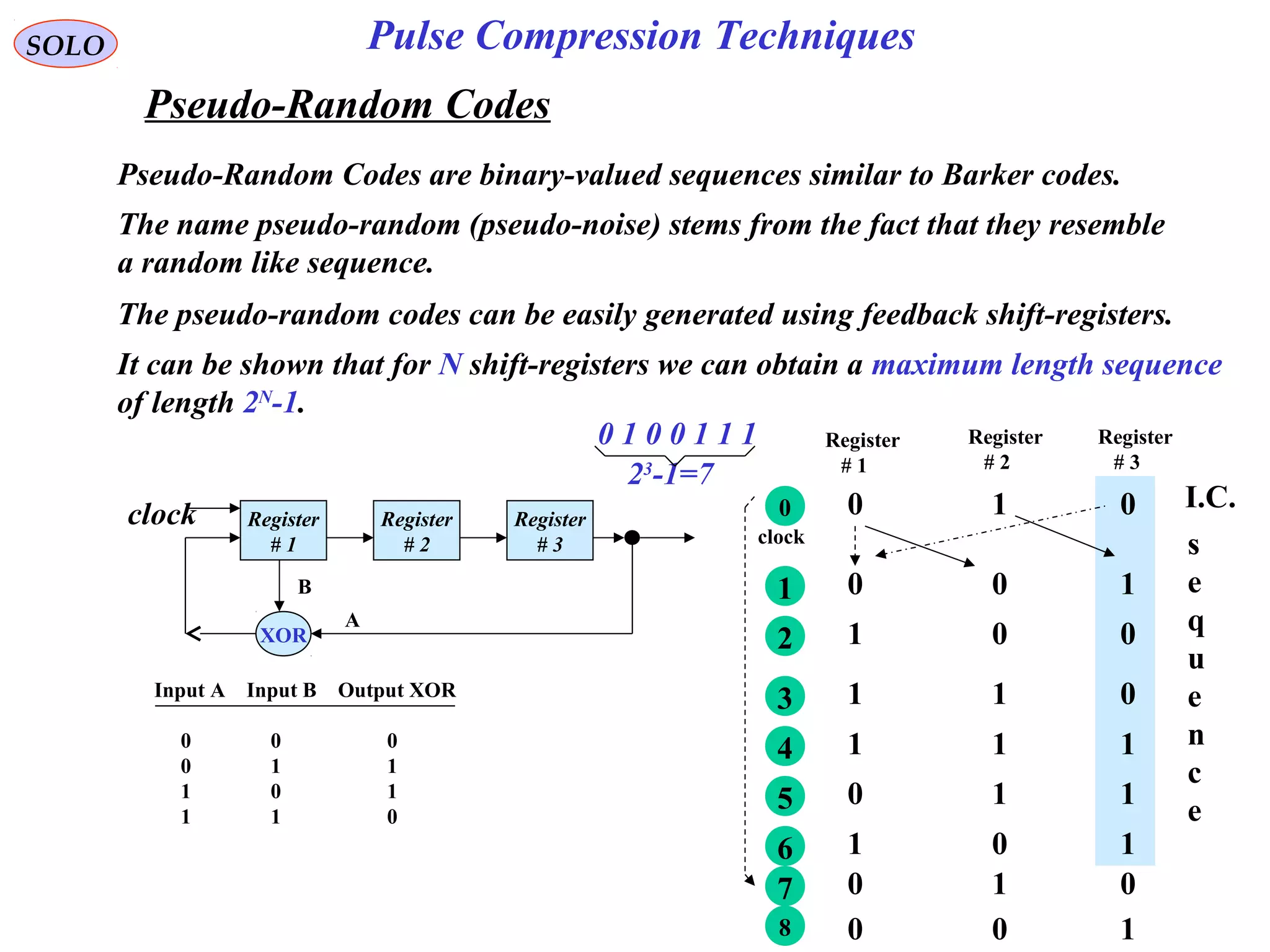
Pseudo-Random Codes
Frequency Codes
Costas Codes
Complementary Pulse Codes
Summary of Pulse Compression Codes
References
Range & Doppler Measurements in RADAR SystemsSOLO
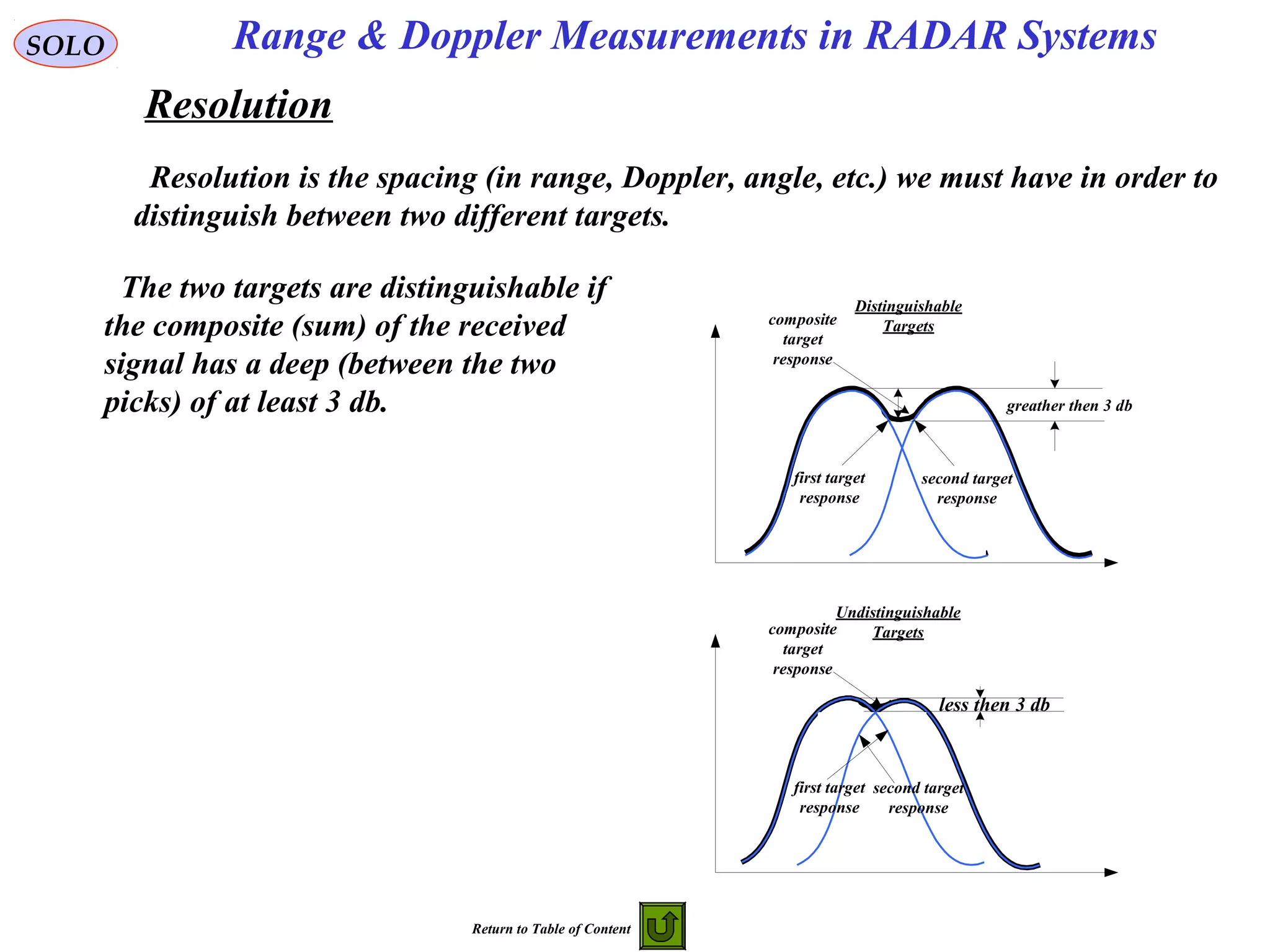
Resolution
Resolution is the spacing (in range, Doppler, angle, etc.) we must have in order to
distinguish between two different targets.
first target
response
second target
response
composite
target
response
greather then 3 db
Distinguishable
Targets
first target
response
second target
response
composite
target
response
Undistinguishable
Targets
less then 3 db
The two targets are distinguishable if
the composite (sum) of the received
signal has a deep (between the two
picks) of at least 3 db.
Return to Table of Content
SOLO
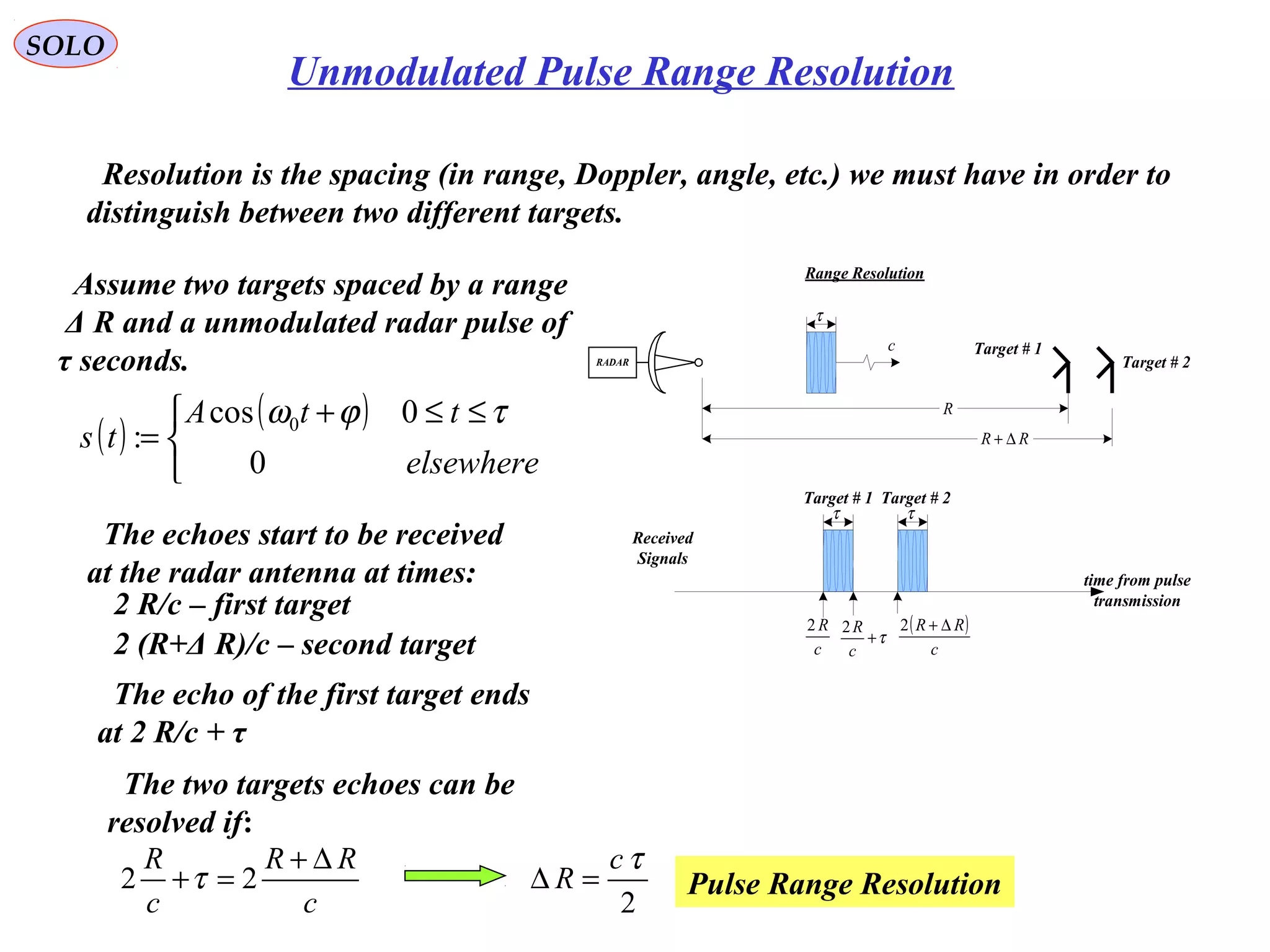
Unmodulated Pulse Range Resolution
Resolution is the spacing (in range, Doppler, angle, etc.) we must have in order to
distinguish between two different targets.
Range Resolution
RADAR
τ
c
R
RR ∆+
Target # 1
Target # 2
Assume two targets spaced by a range
Δ R and a unmodulated radar pulse of
τ seconds.
The echoes start to be received
at the radar antenna at times:
2 R/c – first target
2 (R+Δ R)/c – second target
The echo of the first target ends
at 2 R/c + τ
τ τ
time from pulse
transmission
c
R2 ( )
c
RR ∆+2
τ+
c
R2
Received
Signals
Target # 1 Target # 2
The two targets echoes can be
resolved if:
c
RR
c
R ∆+
=+ 22 τ
2
τc
R =∆ Pulse Range Resolution
( )
( )


 ≤≤+
=
elsewhere
ttA
ts
0
0cos
: 0 τϕω
Unmodulated
Pulse
SOLO
Energy ( ) ( ) ( )∫∫∫
+∞
∞−
+∞
∞−
+∞
∞−
=== ωω
π
dSdttsdttsEs
222
2
1
:
( )
( )


 ≤≤+
=
elsewhere
ttA
ts
0
0cos
: 0 τϕω
( ) ( )
( )[ ] ( ) ( )





 −+
+=++=
+==
∫
∫∫
+∞
∞−
τ
ϕϕτωτ
ϕω
ϕω
τ
τ
000
2
0
00
2
0
2
00
2
2cos22cos
1
2
22cos1
2
cos
A
dtt
A
dttAdttsEs
Unmodulated Pulse
RADAR SignalsSOLO
( )
( )


 ≤≤+
=
elsewhere
ttA
ts
0
0cos
: 0 τϕω
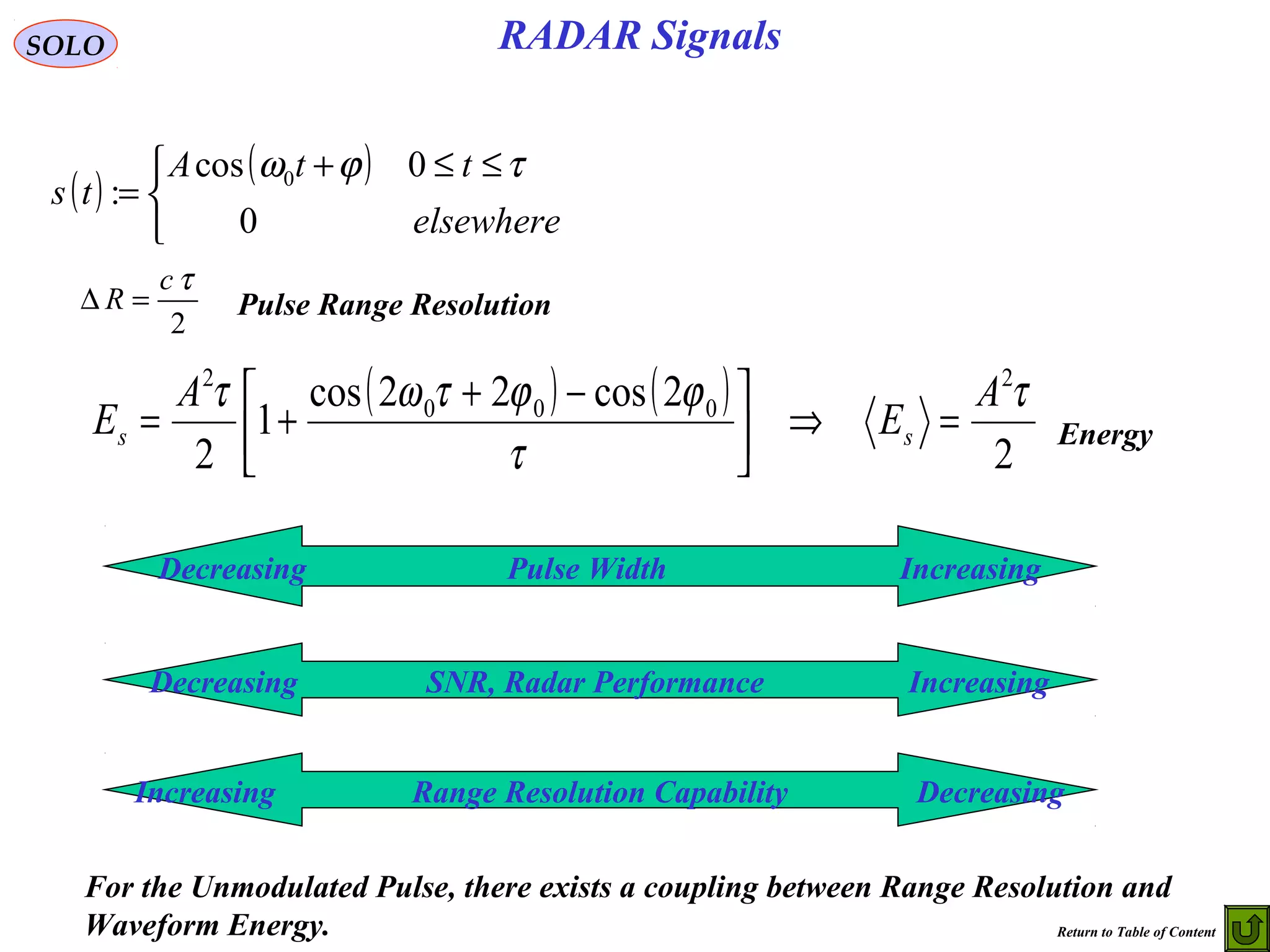
Energy
( ) ( )
2
2cos22cos
1
2
2
000
2
τ
τ
ϕϕτωτ A
E
A
E ss =⇒




 −+
+=
2
τc
R =∆ Pulse Range Resolution
Decreasing Pulse Width Increasing
Decreasing SNR, Radar Performance Increasing
Increasing Range Resolution Capability Decreasing
For the Unmodulated Pulse, there exists a coupling between Range Resolution and
Waveform Energy. Return to Table of Content
Pulse Compression WaveformsSOLO
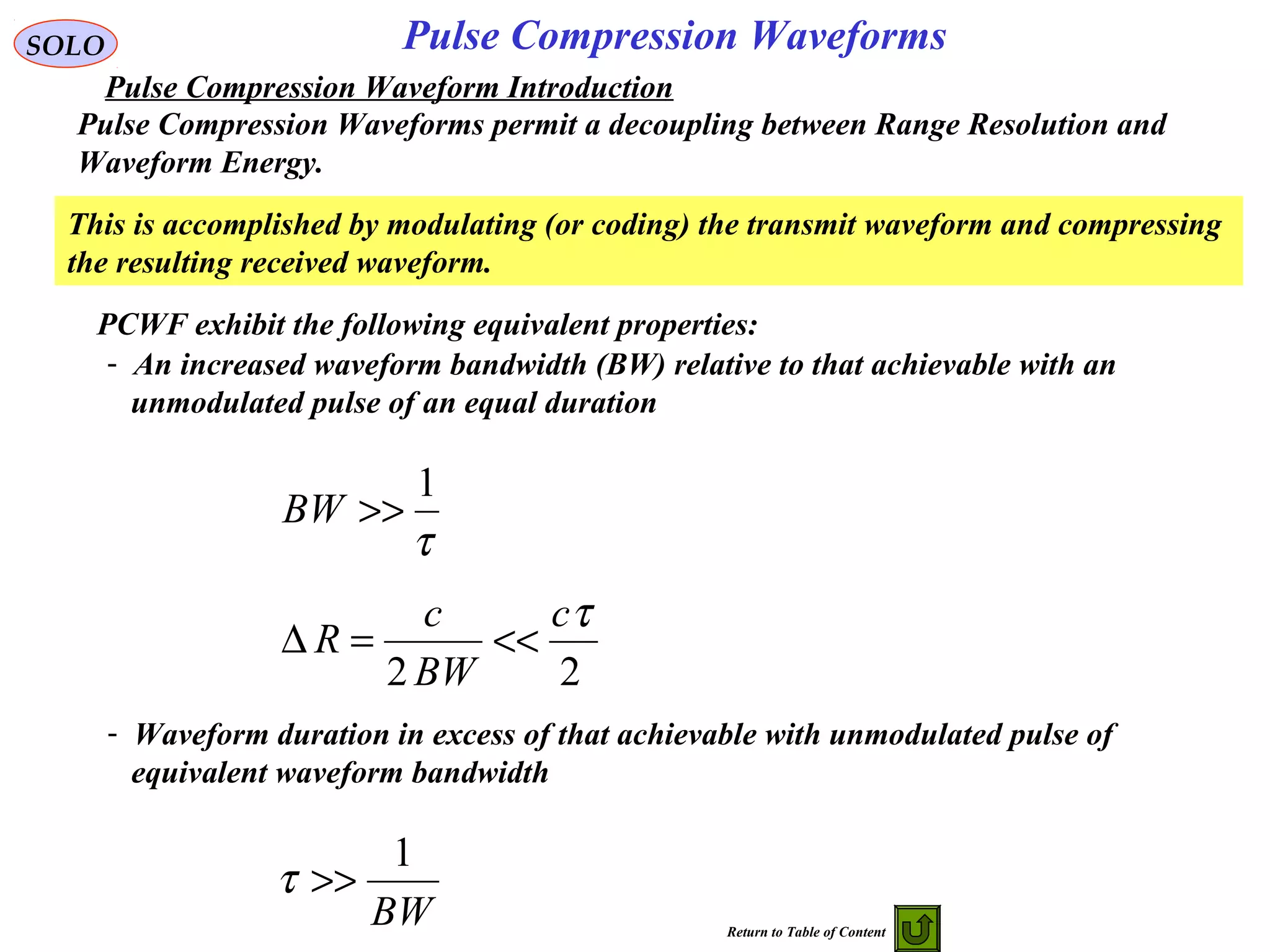
Pulse Compression Waveforms permit a decoupling between Range Resolution and
Waveform Energy.
- An increased waveform bandwidth (BW) relative to that achievable with an
unmodulated pulse of an equal duration
τ
1
>>BW
22
τc
BW
c
R <<=∆
- Waveform duration in excess of that achievable with unmodulated pulse of
equivalent waveform bandwidth
BW
1
>>τ
PCWF exhibit the following equivalent properties:
This is accomplished by modulating (or coding) the transmit waveform and compressing
the resulting received waveform.
Pulse Compression Waveform Introduction
Return to Table of Content
SOLO
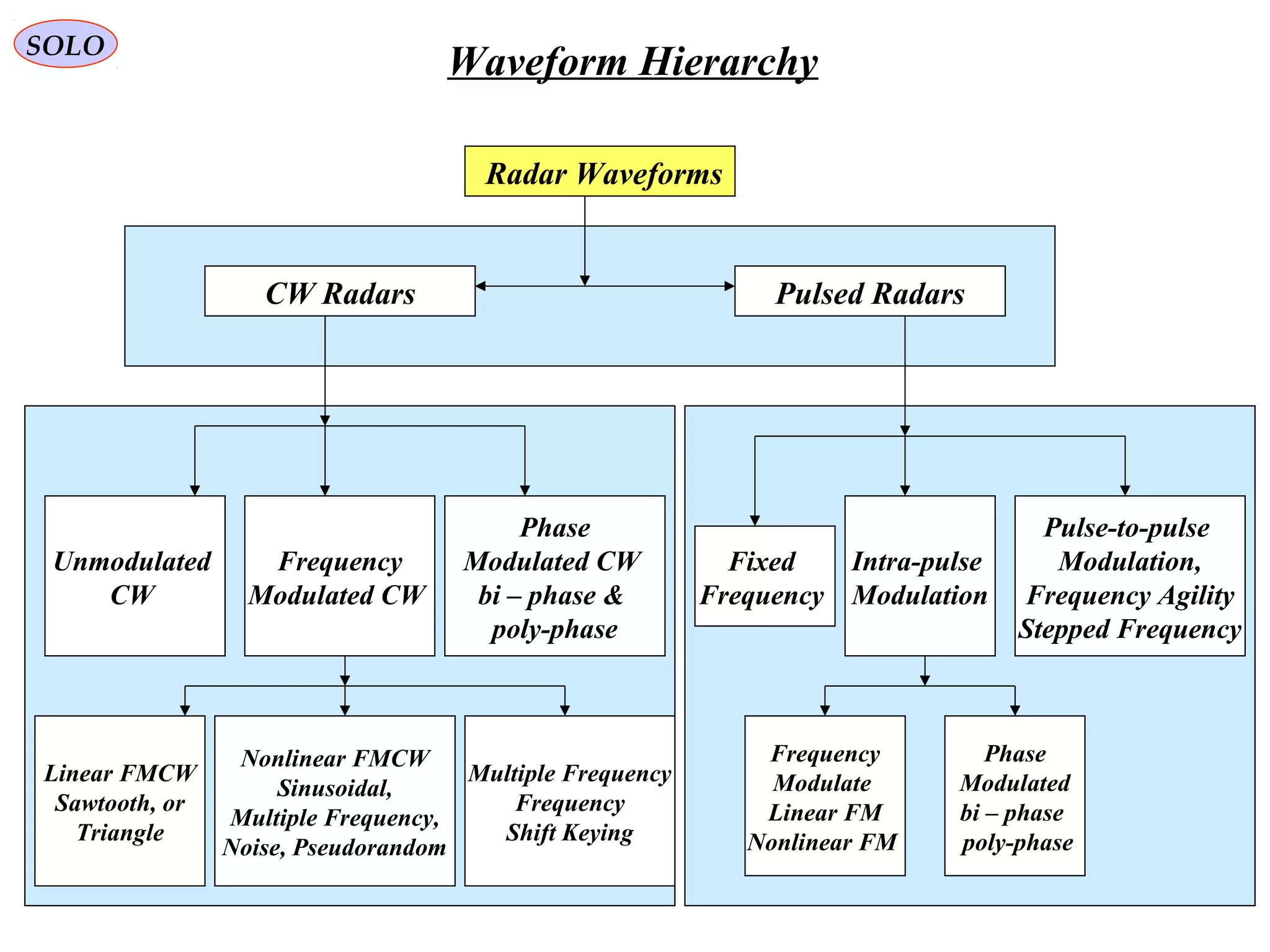
Waveform Hierarchy
Radar Waveforms
CW Radars Pulsed Radars
Frequency
Modulated CW
Phase
Modulated CW
bi – phase &
poly-phase
Linear FMCW
Sawtooth, or
Triangle
Nonlinear FMCW
Sinusoidal,
Multiple Frequency,
Noise, Pseudorandom
Intra-pulse
Modulation
Pulse-to-pulse
Modulation,
Frequency Agility
Stepped Frequency
Frequency
Modulate
Linear FM
Nonlinear FM
Phase
Modulated
bi – phase
poly-phase
Unmodulated
CW
Multiple Frequency
Frequency
Shift Keying
Fixed
Frequency
SOLO
Waveform Hierarchy
• Pulse Compression Techniques
• Wave Coding
• Frequency Modulation (FM)
- Linear
• Phase Modulation (PM)]
- Non-linear
- Pseudo-Random Noise (PRN)
- Bi-phase (0º/180º)
- Quad-phase (0º/90º/180º/270º)
• Implementation
• Hardware
- Surface Acoustic Wave (SAW) expander/compressor
• Digital Control
- Direct Digital Synthesizer (DDS)
- Software compression “filter”
Return to Table of Content
SOLO
• Pulse Compression Techniques
SOLO
• Pulse Compression Techniques
SOLO
Waveform Hierarchy
• Pulse Compression Techniques
SOLO Coherent Pulse Doppler Radar
Return to Table of Content
SOLO
Linear FM Modulated Pulse (Chirp)
( ) ( )2/cos 2
03 ttAtf ωω ∆+=
t
A
2/τ−
2/τ ( )
222
cos
2
0
ττµ
ω ≤≤−





+= t
t
tAtsi
Pulse Compression Waveforms
Linear Frequency Modulation is a technique used to increase the waveform bandwidth
BW while maintaining pulse duration τ, such that
BW
1
>>τ 1>>⋅ BWτ
222
0
2
0
ττ
µω
µ
ωω ≤≤−+=





+= tt
t
t
td
d
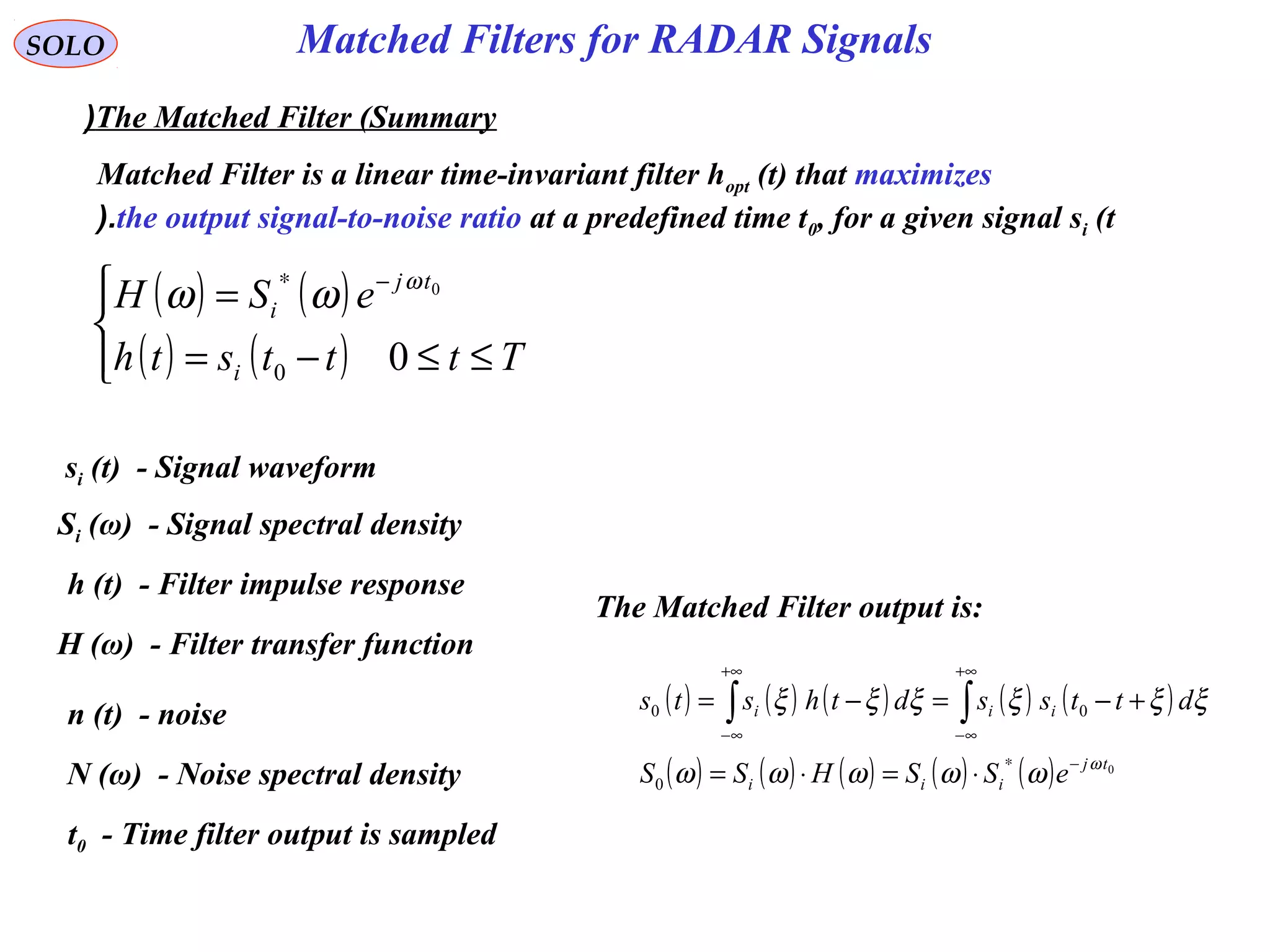
Matched Filters for RADAR Signals
( ) ( )
( ) ( )



≤≤−=
= −∗
Ttttsth
eSH
i
tj
i
00
0ω
ωω
SOLO
The Matched Filter (Summary(
si (t) - Signal waveform
Si (ω) - Signal spectral density
h (t) - Filter impulse response
H (ω) - Filter transfer function
t0 - Time filter output is sampled
n (t) - noise
N (ω) - Noise spectral density
Matched Filter is a linear time-invariant filter hopt (t) that maximizes
the output signal-to-noise ratio at a predefined time t0, for a given signal si (t(.
The Matched Filter output is:
( ) ( ) ( ) ( ) ( )
( ) ( ) ( ) ( ) ( ) 0
0
00
tj
iii
iii
eSSHSS
dttssdthsts
ω
ωωωωω
ξξξξξξ
−∗
+∞
∞−
+∞
∞−
⋅=⋅=
+−=−= ∫∫
SOLO
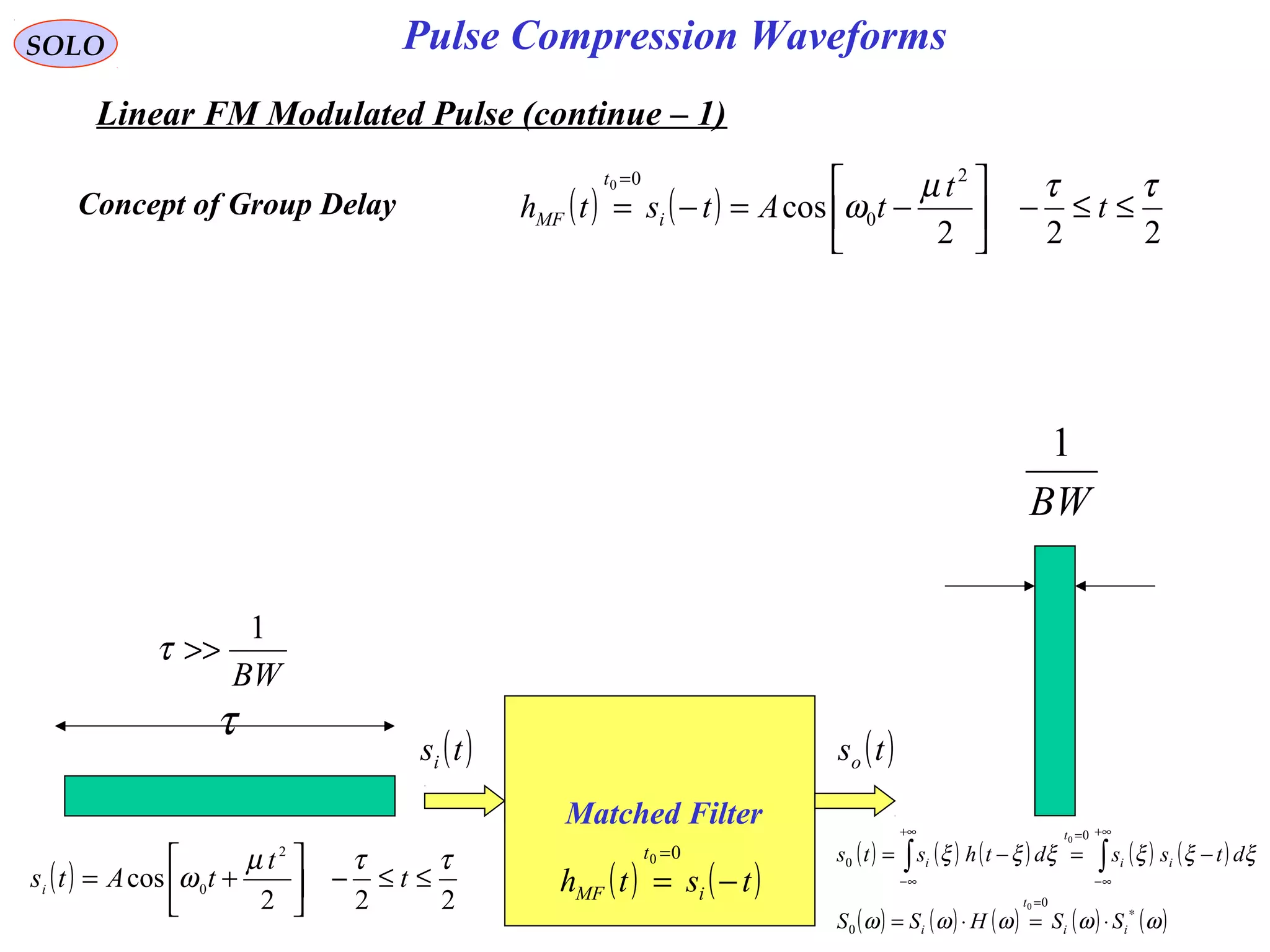
Linear FM Modulated Pulse (continue – 1)
Pulse Compression Waveforms
Concept of Group Delay
BW
1
>>τ
τ
BW
1
( )
222
cos
2
0
ττµ
ω ≤≤−





+= t
t
tAtsi
( ) ( )
222
cos
2
0
00 ττµ
ω ≤≤−





−=−=
=
t
t
tAtsth i
t
MF
Matched Filter
( )tsi ( )tso
( ) ( )tsth i
t
MF −=
=00 ( ) ( ) ( ) ( ) ( )
( ) ( ) ( ) ( ) ( )ωωωωω
ξξξξξξ
∗
=
+∞
∞−
=+∞
∞−
⋅=⋅=
−=−= ∫∫
ii
t
i
ii
t
i
SSHSS
dtssdthsts
0
0
0
0
0
0
SOLO
Linear FM Modulated Pulse (continue – 2)
Pulse Compression Waveforms
Concept of Group Delay (continue -1)
BW
1
>>τ
τ
BW
1
( )
222
cos
2
0
ττµ
ω ≤≤−





+= t
t
tAtsi
Matched Filter
( )tsi ( )tso
( ) ( )tsth i
t
MF −=
=00
( ) ( ) ( ) ( ) ( )
( ) ( ) ( ) ( ) ( )ωωωωω
ξξξξξξ
∗
=
+∞
∞−
=+∞
∞−
⋅=⋅=
−=−= ∫∫
ii
t
i
ii
t
i
SSHSS
dtssdthsts
0
0
0
0
0
0
( ) ( ) ( ) ( )






>≤≤+−
<+≤≤−





 −
+−





+=−
0
22
0
22
2
cos
2
cos
2
0
2
0
2
tt
tt
t
tAtss ii
τ
ξ
τ
τ
ξ
τ
ξµ
ξω
ξµ
ξωξξ
( ) ( ) ( ) ( ) ( )
∫∫
+
+−
>∞+
∞−
>
=





 −
+−





+=−=
2/
2/
2
0
2
0
2
00
0
0
2
cos
2
cos
0
τ
τ
ξ
ξµ
ξω
ξµ
ξωξξξ
t
t
ii
t
t
d
t
tAdtssts
( ) ( )
222
cos
2
0
00 ττµ
ω ≤≤−





−=−=
=
t
t
tAtsth i
t
MF
Ignoring terms of 2 ω0
( ) ( ) ( )
( ) ( )
t
tttA
t
tttA
t
tttA
dttt
A
ts
tt
t
t
µ
µτµω
µ
µτµω
µ
µξµω
ξµξµω
τ
τ
τ
τ
2/2/sin
2
2/2/sin
2
2/sin
2
2/cos
2
2
0
22
0
2
2/
2/
2
0
22/
2/
2
0
20
0
0
0
+−
−
−+
=
−+
=−+≅
+
+−
+
+−
>
=
∫
( ) ( ) βαβαβα coscos2coscos =−++( )[ ] ( )∫∫
+
+−
+
+−
−+++−+−=
2/
2/
2
0
22/
2/
22
0
2
2/cos
2
2/2/2cos
2
τ
τ
τ
τ
ξµξµωξµξµξµξω
tt
dtt
A
dtt
A
SOLO
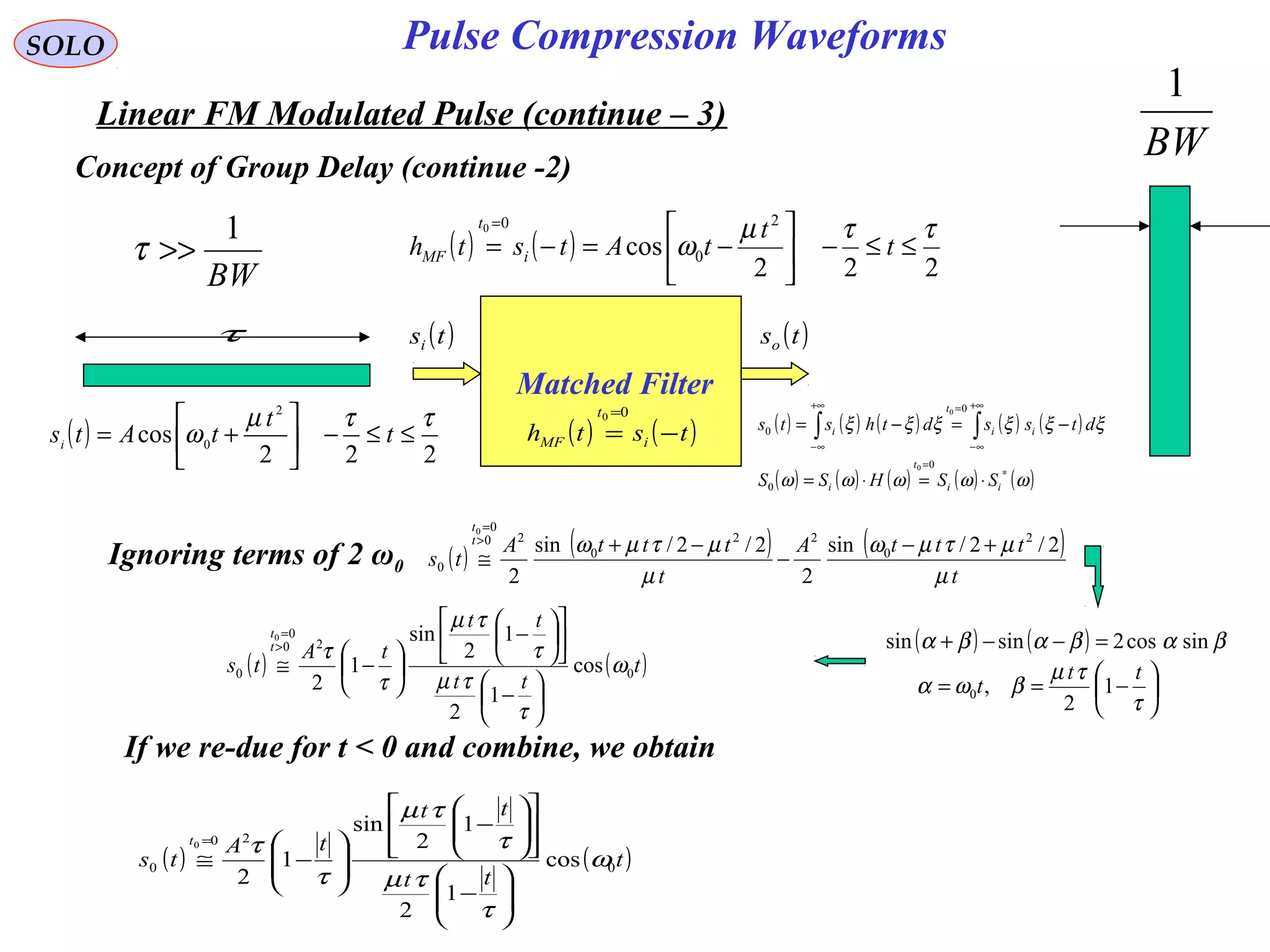
Linear FM Modulated Pulse (continue – 3)
Pulse Compression Waveforms
Concept of Group Delay (continue -2)
BW
1
>>τ
τ
BW
1
( )
222
cos
2
0
ττµ
ω ≤≤−





+= t
t
tAtsi
Matched Filter
( )tsi ( )tso
( ) ( )tsth i
t
MF −=
=00
( ) ( ) ( ) ( ) ( )
( ) ( ) ( ) ( ) ( )ωωωωω
ξξξξξξ
∗
=
+∞
∞−
=+∞
∞−
⋅=⋅=
−=−= ∫∫
ii
t
i
ii
t
i
SSHSS
dtssdthsts
0
0
0
0
0
0
( ) ( )
222
cos
2
0
00 ττµ
ω ≤≤−





−=−=
=
t
t
tAtsth i
t
MF
Ignoring terms of 2 ω0 ( ) ( ) ( )
t
tttA
t
tttA
ts
t
t
µ
µτµω
µ
µτµω 2/2/sin
2
2/2/sin
2
2
0
22
0
20
0
0
0
+−
−
−+
≅
>
=
( ) ( )t
tt
tt
tA
ts
t
t
0
20
0
0 cos
1
2
1
2
sin
1
2
0
ω
τ
τµ
τ
τµ
τ
τ






−












−






−≅
>
=
( ) ( ) βαβαβα sincos2sinsin =−−+






−==
τ
τµ
βωα
tt
t 1
2
,0
If we re-due for t < 0 and combine, we obtain
( ) ( )t
tt
tt
tA
ts
t
0
20
0 cos
1
2
1
2
sin
1
2
0
ω
τ
τµ
τ
τµ
τ
τ






−
















−








−≅
=
SOLO
( ) ( )2/cos 2
03 ttAtf ωω ∆+=
t
A
2/τ−
2/τ
Linear FM Modulated Pulse (continue – 4)
( )
222
cos
2
0
ττµ
ω ≤≤−





+= t
t
tAtsi
The Fourier Transform is:
( ) [ ]
( ) ( )∫∫
∫
−−
−












++−+












+−=
−





+=
2/
2/
2
0
2/
2/
2
0
2/
2/
2
0
2
exp
2
1
2
exp
2
1
exp
2
cos
τ
τ
τ
τ
τ
τ
µ
ωω
µ
ωω
ω
µ
ωω
dt
t
tjAdt
t
tjA
dttj
t
tASi
∫∫ −− 












 +
+−













 +
+













 −
−













 −
−=
2/
2/
2
0
2
0
2/
2/
2
0
2
0
2
exp
2
exp
22
exp
2
exp
2
τ
τ
τ
τ
µ
ωωµ
µ
ωω
µ
ωωµ
µ
ωω
dttjj
A
dttjj
A
Change variables: xt =




 −
−
µ
ωω
π
µ 0
yt =




 +
+
µ
ωω
π
µ 0
( ) ∫∫ −− 





−













 +
+



















 −
−=
2
1
2
1
2
exp
2
exp
22
exp
2
exp
2
2
2
0
2
2
0
Y
Y
X
X
i dt
y
jj
A
dt
x
jj
A
S
π
µ
ωωπ
µ
ωω
ω





 −
−=




 −
+=
µ
ωωτ
π
µ
µ
ωωτ
π
µ 0
2
0
1
2
&
2
XX 




 +
−=




 +
+=
µ
ωωτ
π
µ
µ
ωωτ
π
µ 0
2
0
1
2
&
2
YY
Define: ( )f
n
f ∆=−=∆ πωωτµ
π
2
2
&
2
1
: 0
Pulse Compression Waveforms
SOLO
( ) ( )2/cos 2
03 ttAtf ωω ∆+=
t
A
2/τ−
2/τ
Linear FM Modulated Pulse (continue – 5)
( )
222
cos
2
0
ττµ
ω ≤≤−





+= t
t
tAtsi
The Fourier Transform is:
( ) ( ) ( )
∫∫ −− 





−




 +
+











 −
−=
2
1
2
1
2
exp
2
exp
22
exp
2
exp
2
22
0
22
0
Y
Y
X
X
i dt
y
jj
A
dt
x
jj
A
S
π
µ
ωωπ
µ
ωω
ω
The first part gives the spectrum around ω = ω0, and the second part around ω = -ω0 :
where: are Fresnel Integrals,
which have the properties:
( ) ( ) ∫∫ ==
UU
dz
z
USdz
z
UC
0
2
0
2
2
sin&
2
cos
ππ
( ) ( ) ( ) ( )USUSUCUC −=−−=− &
( ) ( ) ( ) ( ) ( ) ( )[ ]
( ) ( ) ( ) ( ) ( )[ ] ( ) ( )−+
++−=−+−




 −
+
+++




 −
−=
ωωωω
µ
ωω
µ
π
µ
ωω
µ
π
ω
002211
2
0
2211
2
0
2
exp
2
2
exp
2
ii
i
SSYSjYCYSjYCj
A
XSjXCXSjXCj
A
S
ωωωπωτµ
π
∆=−∆=∆=∆
2
:&2:
2
1
: 0
n
ff
Pulse Compression Waveforms
SOLO
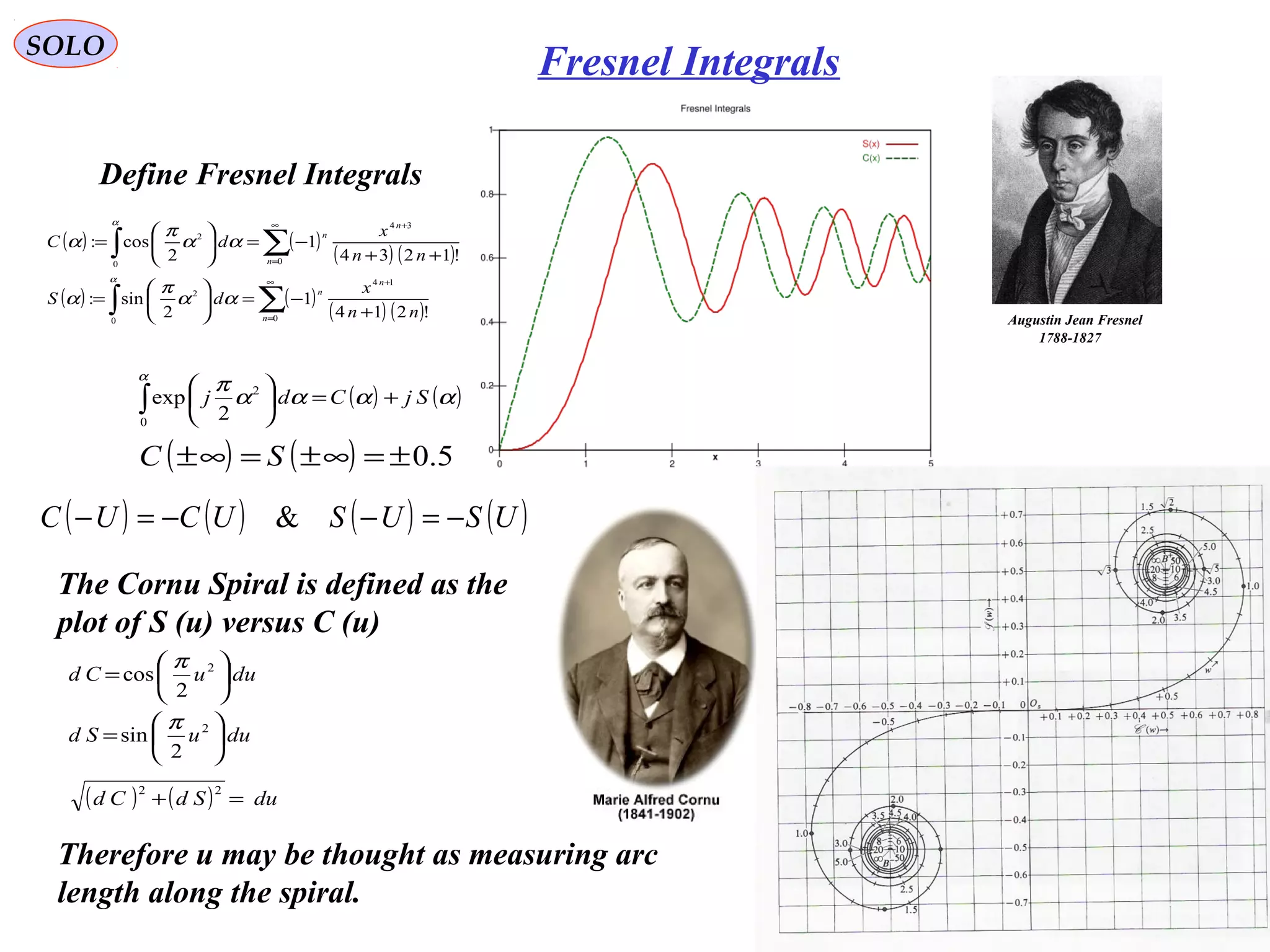
Fresnel Integrals
Augustin Jean Fresnel
1788-1827
Define Fresnel Integrals
( ) ( )
( ) ( )
( ) ( )
( ) ( )∫ ∑
∑∫
∞
=
+
∞
=
+
+
−=





=
++
−=





=
α
α
αα
π
α
αα
π
α
0 0
14
2
0
34
0
2
!214
1
2
sin:
!1234
1
2
cos:
n
n
n
n
n
n
nn
x
dS
nn
x
dC
( ) ( )αααα
πα
SjCdj +=





∫0
2
2
exp
( ) ( ) 5.0±=∞±=∞± SC
( ) ( ) ( ) ( )USUSUCUC −=−−=− &
The Cornu Spiral is defined as the
plot of S (u) versus C (u)
duuSd
duuCd






=






=
2
2
2
sin
2
cos
π
π
( ) ( ) duSdCd =+
22
Therefore u may be thought as measuring arc
length along the spiral.
SOLO
( ) ( )2/cos 2
03 ttAtf ωω ∆+=
t
A
2/τ−
2/τ
Linear FM Modulated Pulse (continue – 6)
( )
222
cos
2
0
ττµ
ω ≤≤−





+= t
t
tAtsi
The Fourier
Transform is:
ωωωπωτµ
π
∆=−∆=∆=∆
2
:&2:
2
1
: 0
n
ff
Define:
( ) ( ) ( )[ ] ( ) ( )[ ]{ }2
21
2
210
2
XSXSXCXC
A
Si
+++=− +
µ
π
ωωAmplitude Term:
Square Law Phase Term: ( ) ( )
µ
ωω
ω
2
2
0
1
−
−=Φ
Residual Phase Term: ( ) ( ) ( )
( ) ( ) 4
1tan
5.05.0
5.05.0
tantan 11
1
21
211
2
π
ω
τ
==
+
+
→
+
+
=Φ −−
>>∆
−
f
XCXC
XSXS
( ) ( )nfXnfX −∆=+∆= 1
2
&1
2
21
ττ
( ) ( ) ( ) ( ) ( ) ( )[ ]
( ) ( ) ( ) ( ) ( )[ ] ( ) ( )−+
++−=−+−




 −
+
+++




 −
−=
ωωωω
µ
ωω
µ
π
µ
ωω
µ
π
ω
002211
2
0
2211
2
0
2
exp
2
2
exp
2
ii
i
SSYSjYCYSjYCj
A
XSjXCXSjXCj
A
S
( )ω2Φ( ) +
− ωω0iS
Pulse Compression Waveforms
SOLO
Linear FM Modulated Pulse (continue – 7)
Pulse Compression Waveforms
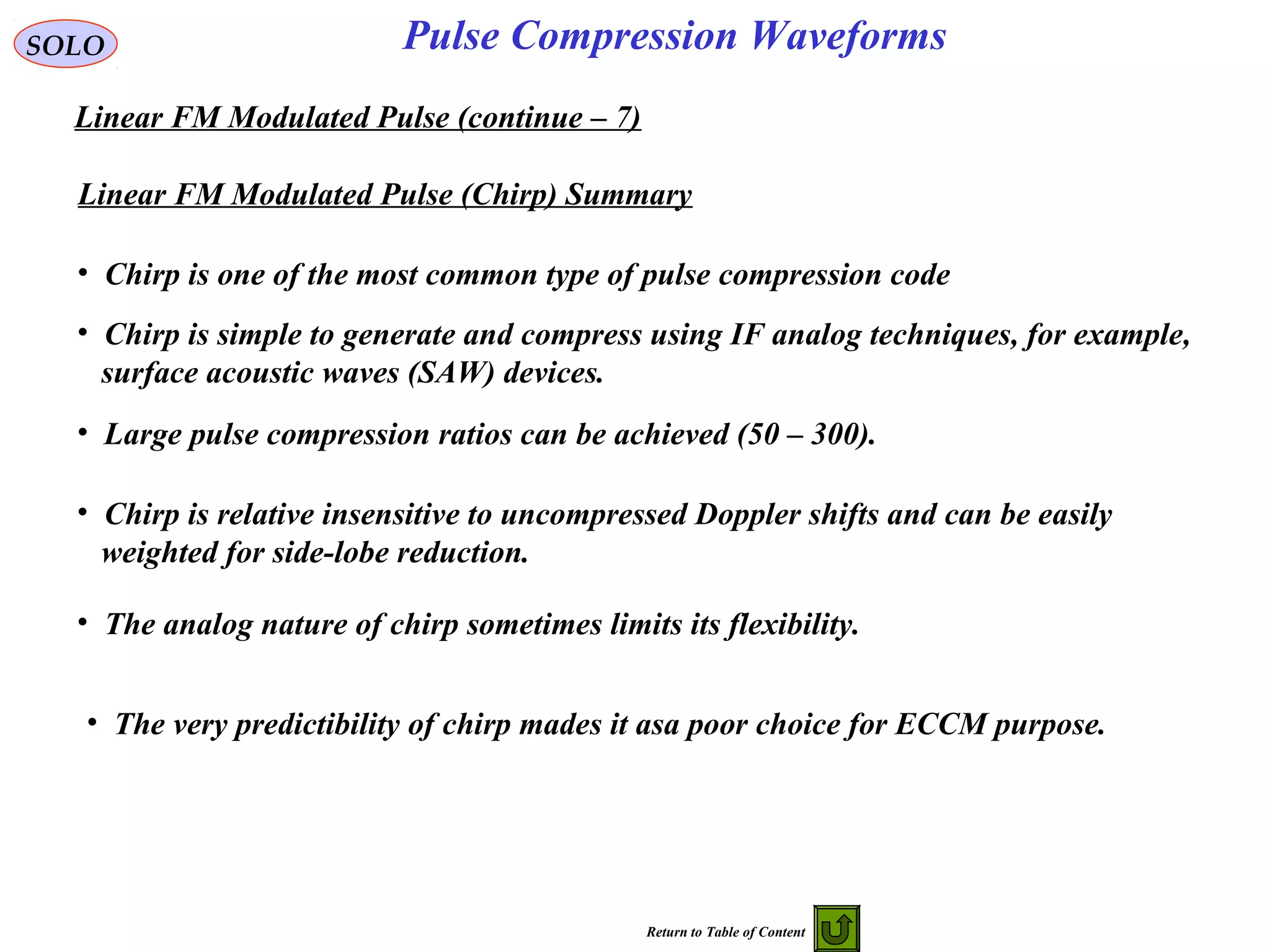
Linear FM Modulated Pulse (Chirp) Summary
• Chirp is one of the most common type of pulse compression code
• Chirp is simple to generate and compress using IF analog techniques, for example,
surface acoustic waves (SAW) devices.
• Large pulse compression ratios can be achieved (50 – 300).
• Chirp is relative insensitive to uncompressed Doppler shifts and can be easily
weighted for side-lobe reduction.
• The analog nature of chirp sometimes limits its flexibility.
• The very predictibility of chirp mades it asa poor choice for ECCM purpose.
Return to Table of Content
SOLO
Pulse Compression Techniques
Phase Coded Waveforms
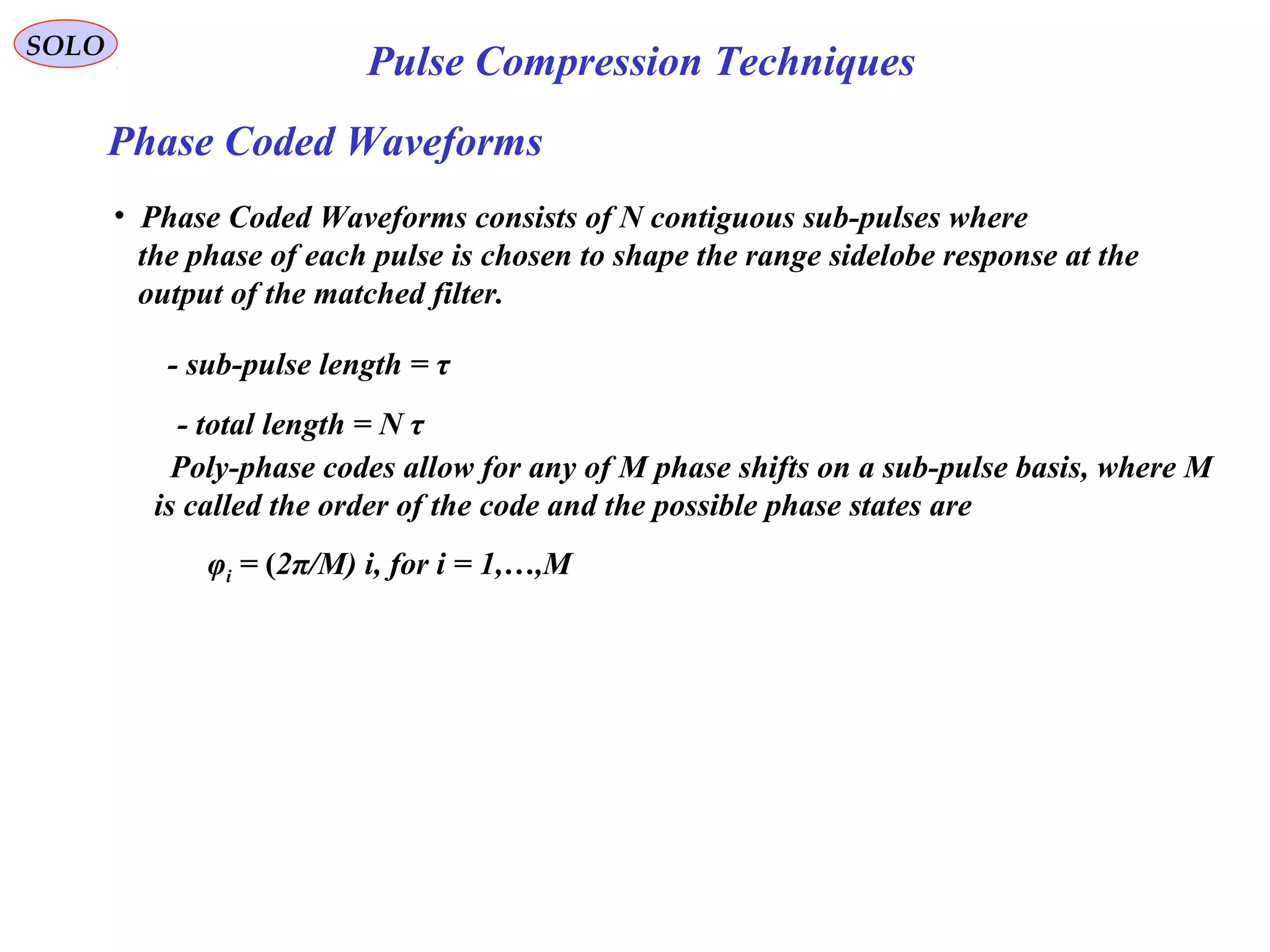
• Phase Coded Waveforms consists of N contiguous sub-pulses where
the phase of each pulse is chosen to shape the range sidelobe response at the
output of the matched filter.
- sub-pulse length = τ
- total length = N τ
Poly-phase codes allow for any of M phase shifts on a sub-pulse basis, where M
is called the order of the code and the possible phase states are
φi = (2π/M) i, for i = 1,…,M
SOLO
Pulse Compression Techniques
Phase Coding
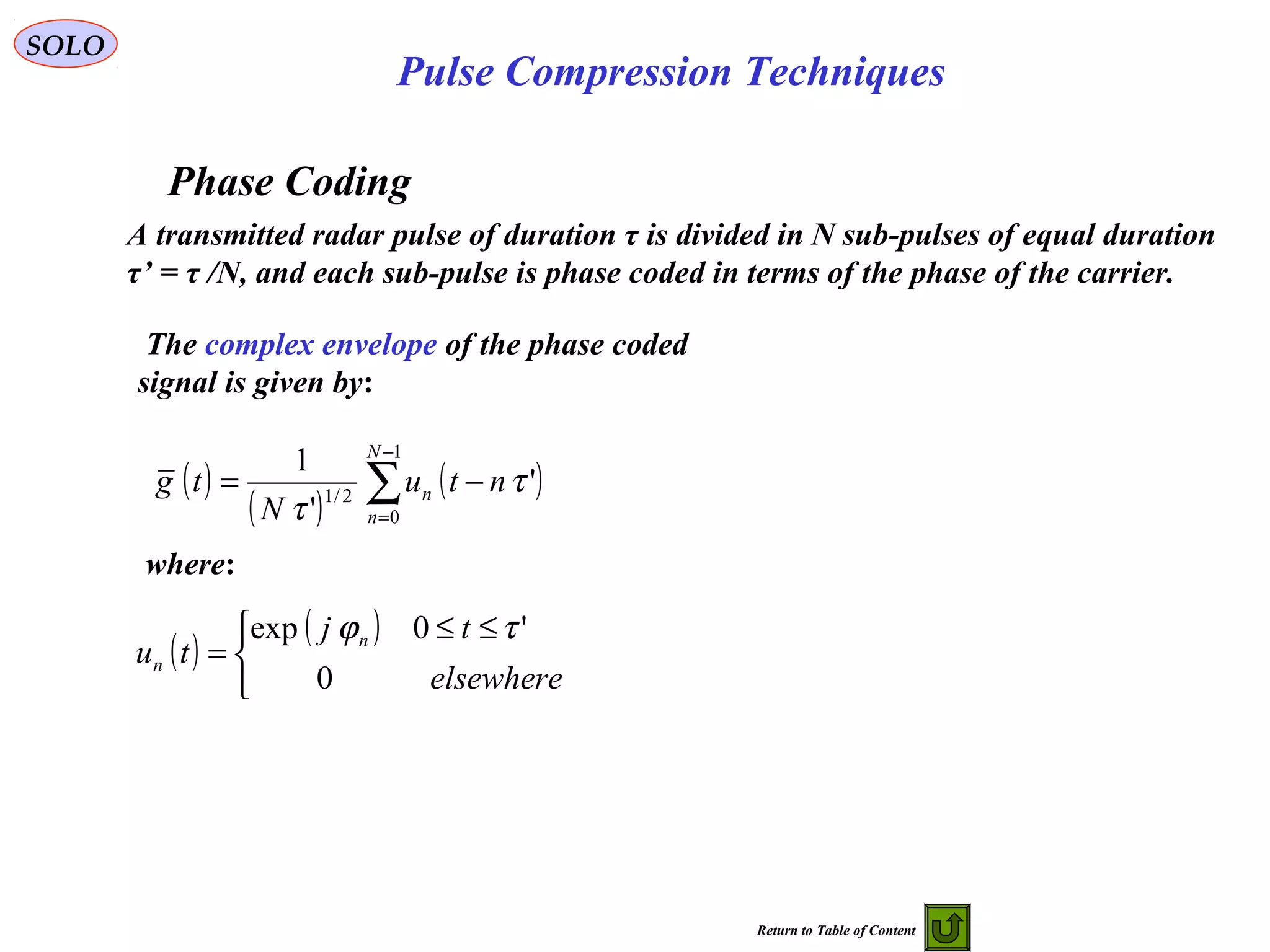
A transmitted radar pulse of duration τ is divided in N sub-pulses of equal duration
τ’ = τ /N, and each sub-pulse is phase coded in terms of the phase of the carrier.
The complex envelope of the phase coded
signal is given by:
( )
( )
( )∑
−
=
−=
1
0
2/1
'
'
1 N
n
n ntu
N
tg τ
τ
where:
( )
( )


 ≤≤
=
elsewhere
tj
tu n
n
0
'0exp τϕ
Return to Table of Content
Matched Filters for RADAR SignalsSOLO
Matched Filter Response to Phase Coding
( ) ( ) ( ) ( ) ( )tjtgtjtgts 00 exp
2
1
exp
2
1
ωω −+= ∗
( ) ( ) ( )


 ∆<<
=∆−= ∑
−
= elsewhere
tt
tftptfctg
M
p
p
0
011
0
Let the signal be a phase-modulated carrier, in which the modulation is in discrete and
equal steps Δt. The complex envelope of the signal can be described by a sequence of
complex numbers , such thatkc
( ) [ ] ( ) ( )∫
+∞
∞−
∗
+−−= dtttgtgtjgo 000exp
2
1
τωτ
Constant Phase
Matched Filter output envelope (change t ↔τ):
( )ttk ∆<≤+∆→ τττ 0
tMt ∆=0
( ) [ ] ( ) ( )[ ]
[ ] ( )[ ]
( )
∑ ∫
∫∑
−
=
∆+
∆
∗
+∞
∞−
∗
−
=
∆−+−∆−=
∆−+−∆−∆−=+∆
1
0
1
0
1
0
0
exp
2
1
exp
2
1
M
p
tp
tp
p
M
p
po
dttkMtgctMj
dttkMtgtptfctMjtkg
τω
τωτ
Change variable of integration to t1 = t – τ + (M - k) Δt
( ) [ ] ( )
( )
( )
∑ ∫
−
=
−∆+−+
−∆−+
∗
∆−=+∆
1
0
1
110exp
2
1 M
p
tkMp
tkMp
po dttgctMjtkg
τ
τ
ωτ
Matched Filters for RADAR SignalsSOLO
Matched Filter Response to Phase Coding (continue – 1(
Matched Filter output envelope for a Phase Coding is:
( ) [ ] ( )[ ]
( )
∑ ∫
−
=
∆+
∆
∗
∆−+−∆−=+∆
1
0
1
0exp
2
1 M
p
tp
tp
po dttkMtgctMjtkg τωτ
Change variable of integration to t1 = t – τ + (M - k) Δt
( ) [ ] ( )
( )
( )
[ ] ( )
( )
( )
( )
( )
( )
∑ ∫∫∑ ∫
−
=
−∆+−+
∆−+
∗
∆−+
−∆−+
∗
−
=
−∆+−+
−∆−+
∗








+∆−=∆−=+∆
1
0
1
11110
1
0
1
110 exp
2
1
exp
2
1 M
p
tkMp
tkMp
tkMp
tkMp
p
M
p
tkMp
tkMp
po dttgdttgctMjdttgctMjtkg
τ
τ
τ
τ
ωωτ
( ) ( ) ( )
( ) ( ) ( ) τ
τ
−∆+−+<<∆−+=
∆−+<<−∆−+=
−+
∗
−−+
∗
tkMpttkMpctg
tkMpttkMpctg
kMp
kMp
11
*
1
11
*
1
( ) [ ] ∑ ∫∫
−
=
−∆
−+
−
−−+








+∆−=+∆
1
0 0
1
*
0
11
*
0exp
2
1 M
p
t
kMpkMppo dtcdtcctMjtkg
τ
τ
ωτ
( ) [ ] ∑
−
=
−+−−+ 











∆
−+





∆
∆−
∆
=+∆
1
0
*
1
*
0 1exp
2
1 M
p
kMpkMppo
t
c
t
cctMj
t
tkg
ττ
ωτ
This equation describes straight lines in the complex plane, that can have corners only at
τ = 0. At those corners
( ) [ ] ∑
−
=
−+∆−
∆
=∆
1
0
*
0exp
2
1 M
p
kMppo cctMj
t
tkg ω
Constant Phase
Matched Filters for RADAR SignalsSOLO
Matched Filter Response to Phase Coding (continue – 2(
Matched Filter output envelope for a Phase Coding is:
( ) [ ] ∑
−
=
−+−−+ 











∆
−+





∆
∆−
∆
=+∆
1
0
*
1
*
0 1exp
2
1 M
p
kMpkMppo
t
c
t
cctMj
t
tkg
ττ
ωτ
This equation describes straight lines in the complex plane, that can have corners only at
τ = 0. At those corners
( ) [ ] ∑
−
=
−+∆−
∆
=∆
1
0
*
0exp
2
1 M
p
kMppo cctMj
t
tkg ω
Constant Phase
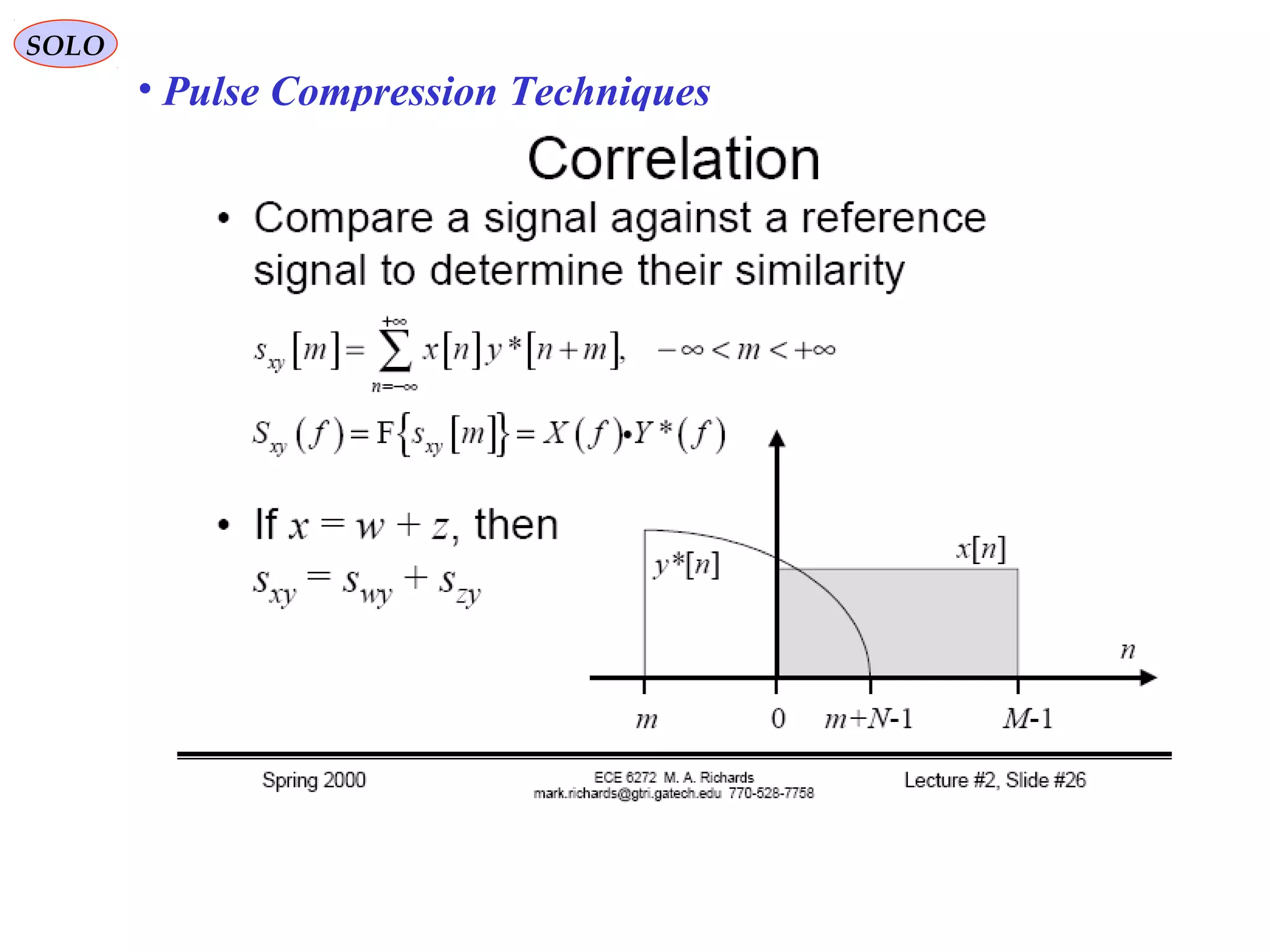
We can see that is the discrete autocorrelation function for the
observation time t0 = M Δt (the time the received Radar signal return is expected)
∑
−
=
−+
1
0
*
M
p
kMpp cc
Matched Filters for RADAR SignalsSOLO
Matched Filter Response to Phase Coding (continue – 3(
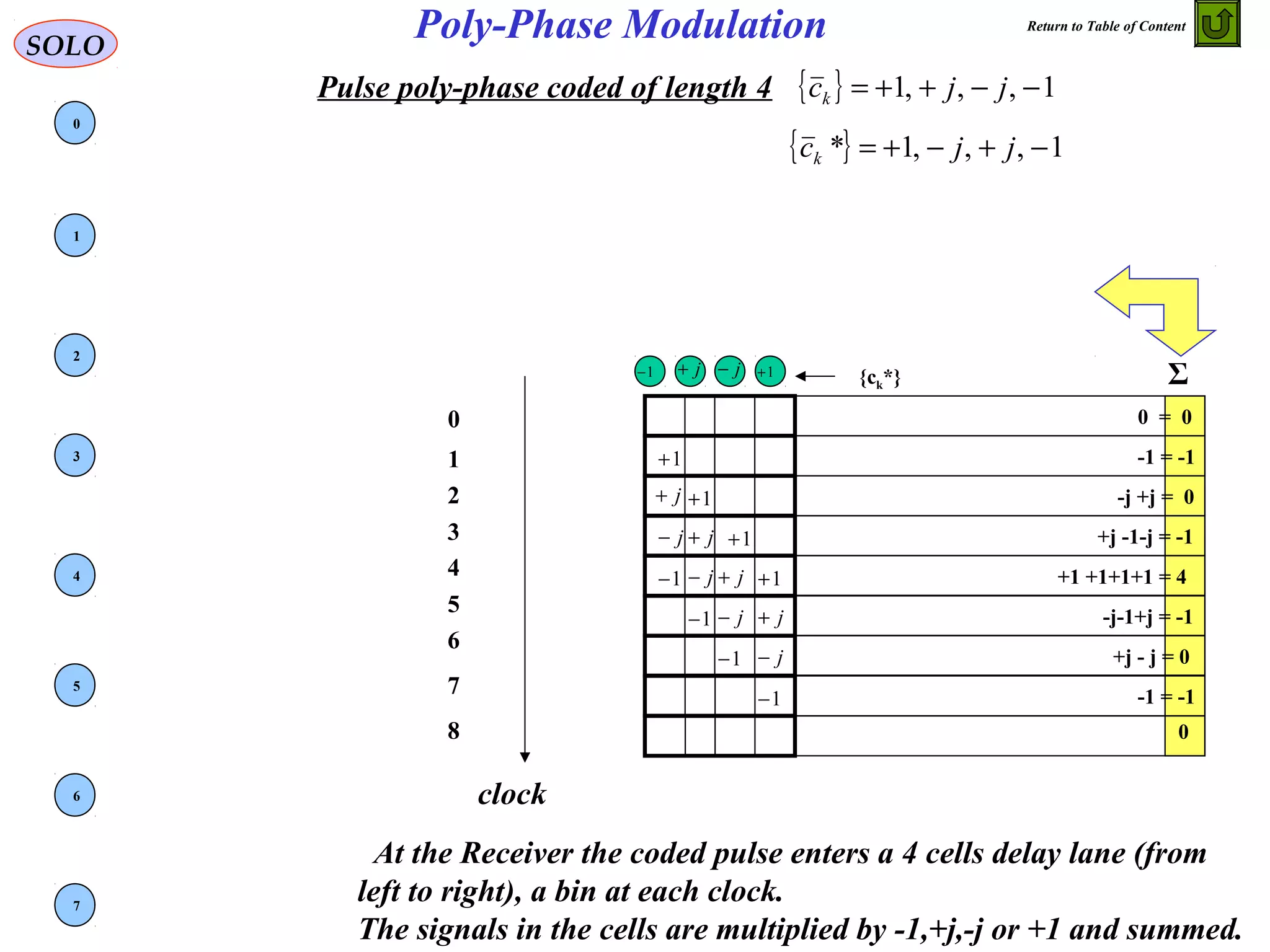
Example: Pulse poly-phase coded of length 4
Given the sequence: { } 1,,,1 −−++= jjck
which corresponds to the sequence of phases 0◦, 90◦, 270◦ and 180◦, the matched filter is
given in Figure bellow.
{ } 1,,,1
*
−+−+= jjck
Pulse poly-phase coded of length 4
At the Receiver the coded pulse enters a 4 cells delay lane (from
left to right), a bin at each clock.
The signals in the cells are multiplied by -1,+j,-j or +1 and summed.
clock
SOLO
Poly-Phase Modulation
-1 = -11 1+
-j +j = 02 1+j+
+j -1-j = -13 1+j+j−
+1 +1+1+1 = 44 1+j+j−1−
-j-1+j = -1
5 j+j−1−
+j - j = 0
6
j−1−
7 1− -1 = -1
8 0
Σ
{ } 1,,,1 −−++= jjck
1− 1+j+ j− {ck*}
0 = 00
0
1
2
3
4
5
6
7
{ } 1,,,1* −+−+= jjck
Return to Table of Content
SOLO
Pulse Compression Techniques
Bi-Phase Codes
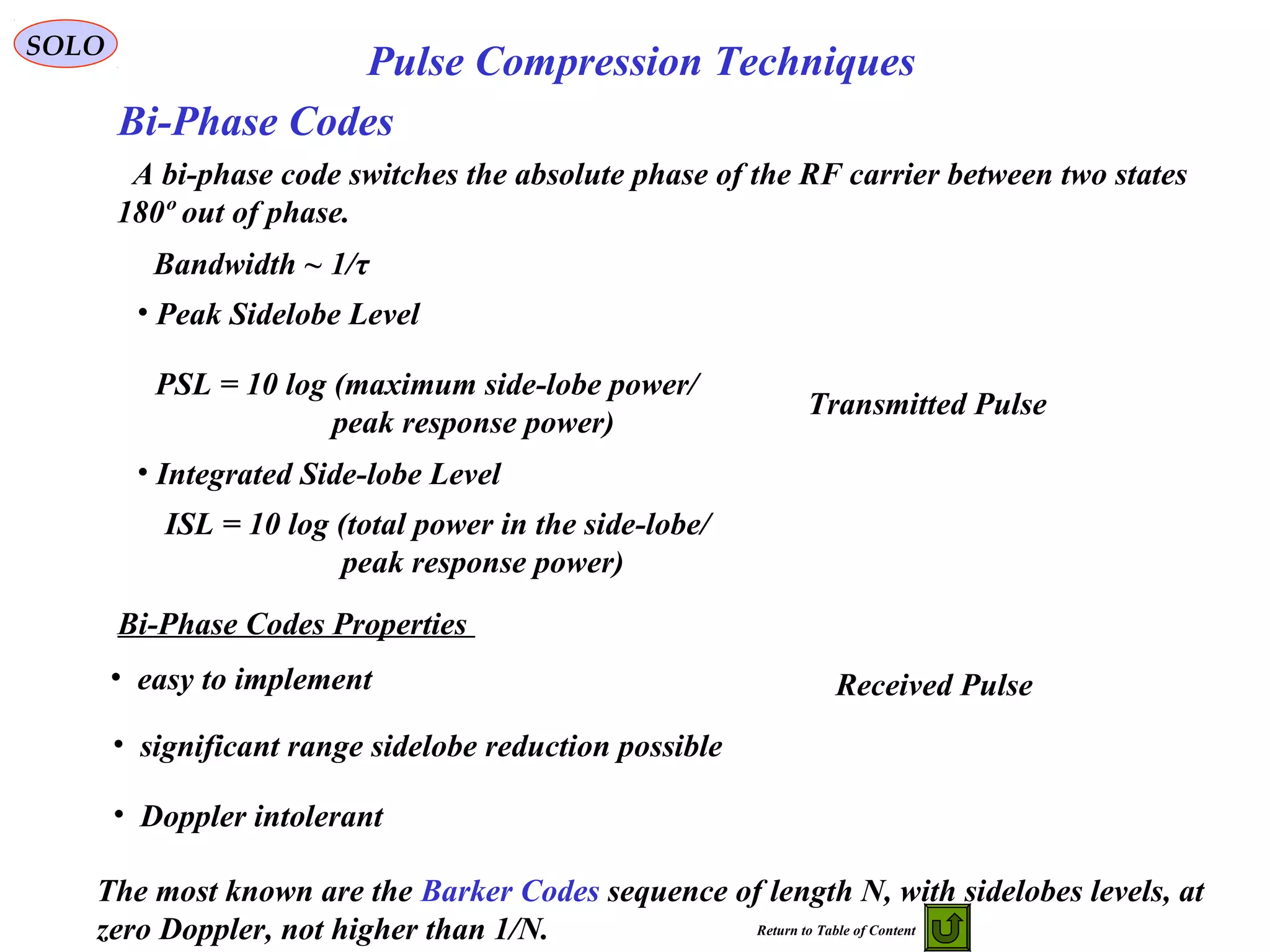
• easy to implement
• significant range sidelobe reduction possible
• Doppler intolerant
A bi-phase code switches the absolute phase of the RF carrier between two states
180º out of phase.
Bandwidth ~ 1/τ
Transmitted Pulse
Received Pulse
• Peak Sidelobe Level
PSL = 10 log (maximum side-lobe power/
peak response power)
• Integrated Side-lobe Level
ISL = 10 log (total power in the side-lobe/
peak response power)
Bi-Phase Codes Properties
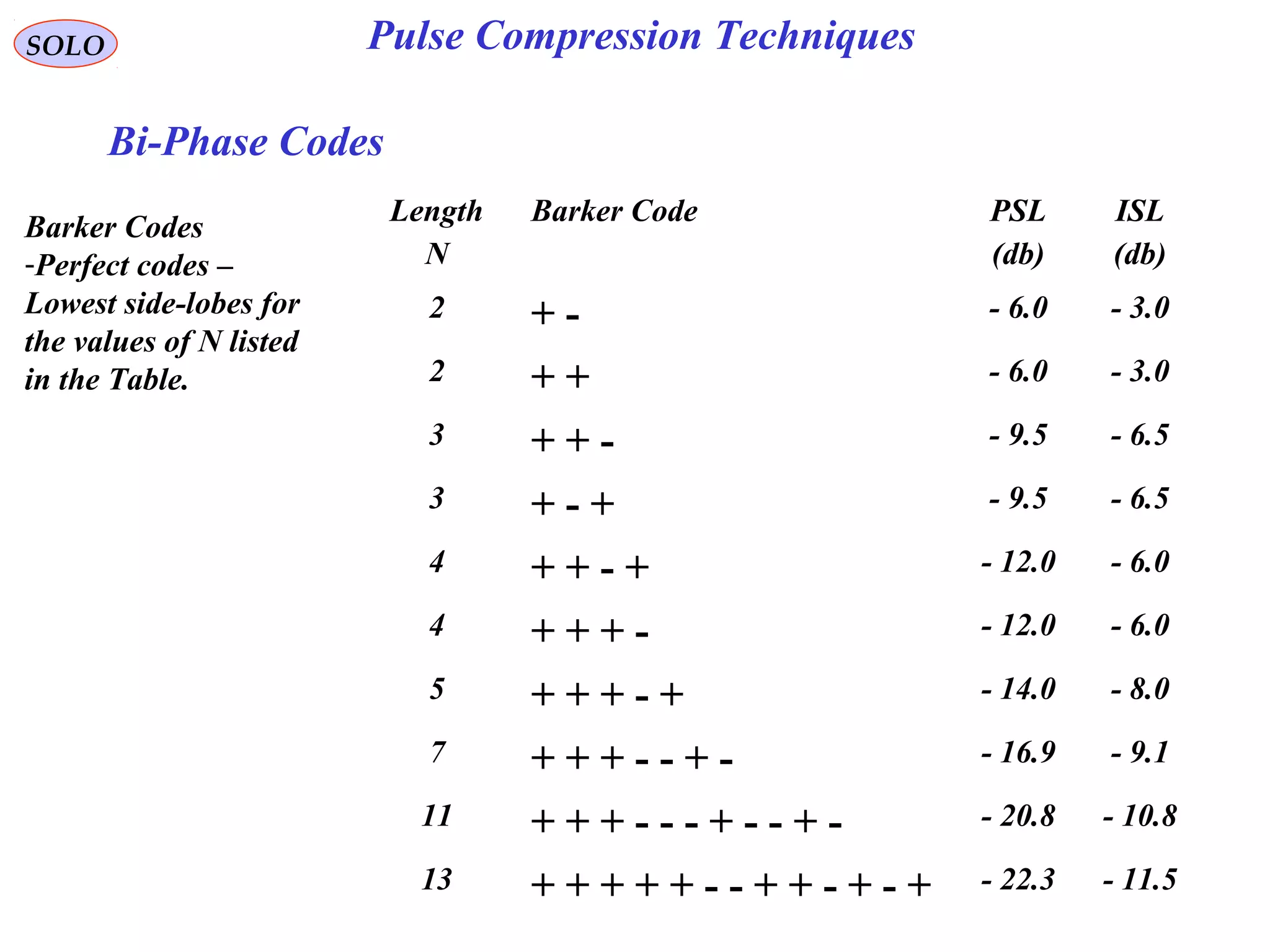
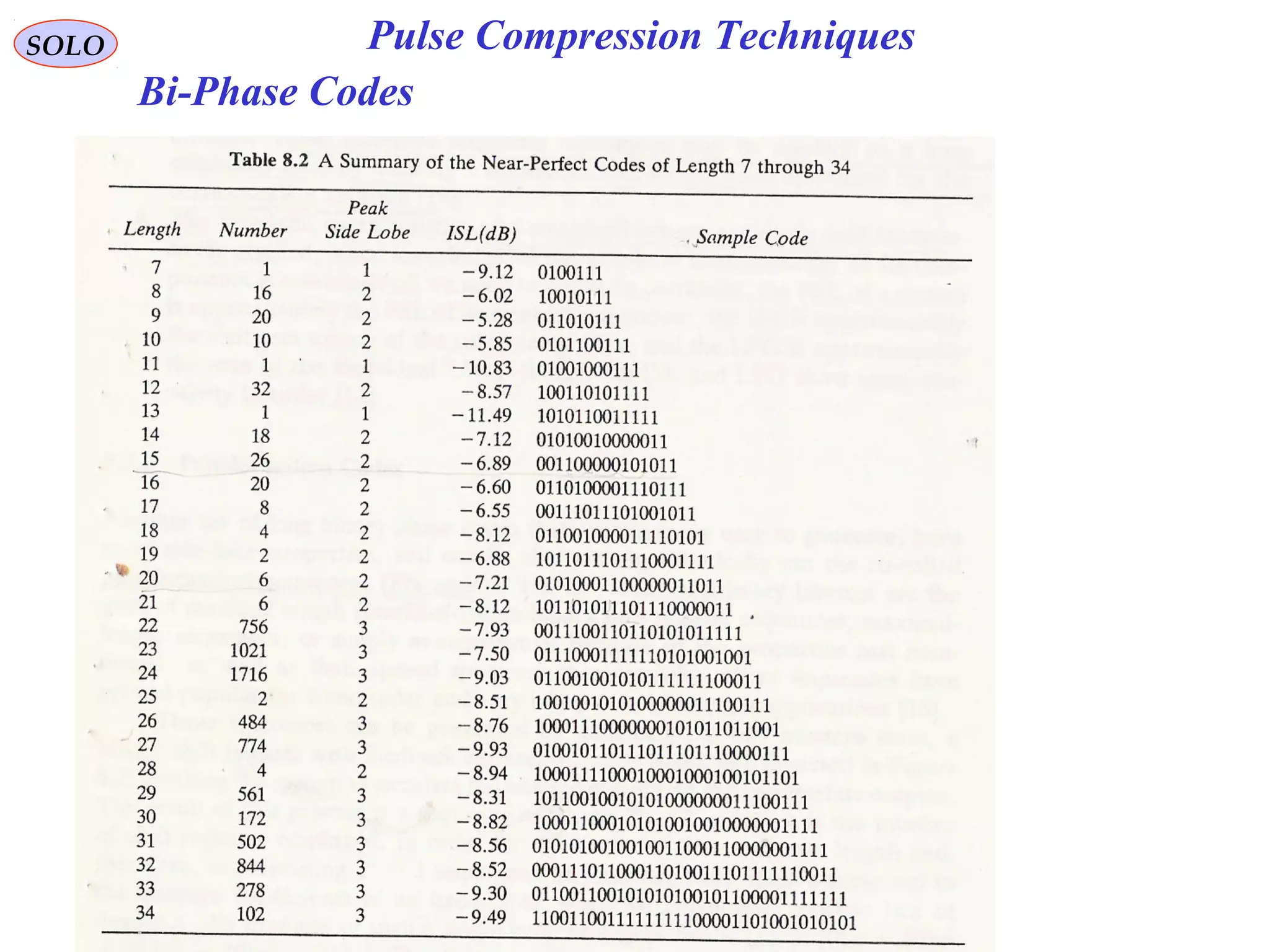
The most known are the Barker Codes sequence of length N, with sidelobes levels, at
zero Doppler, not higher than 1/N. Return to Table of Content
SOLO Pulse Compression Techniques
Bi-Phase Codes
Length
N
Barker Code PSL
(db)
ISL
(db)
2 + - - 6.0 - 3.0
2 + + - 6.0 - 3.0
3 + + - - 9.5 - 6.5
3 + - + - 9.5 - 6.5
4 + + - + - 12.0 - 6.0
4 + + + - - 12.0 - 6.0
5 + + + - + - 14.0 - 8.0
7 + + + - - + - - 16.9 - 9.1
11 + + + - - - + - - + - - 20.8 - 10.8
13 + + + + + - - + + - + - + - 22.3 - 11.5
Barker Codes
-Perfect codes –
Lowest side-lobes for
the values of N listed
in the Table.
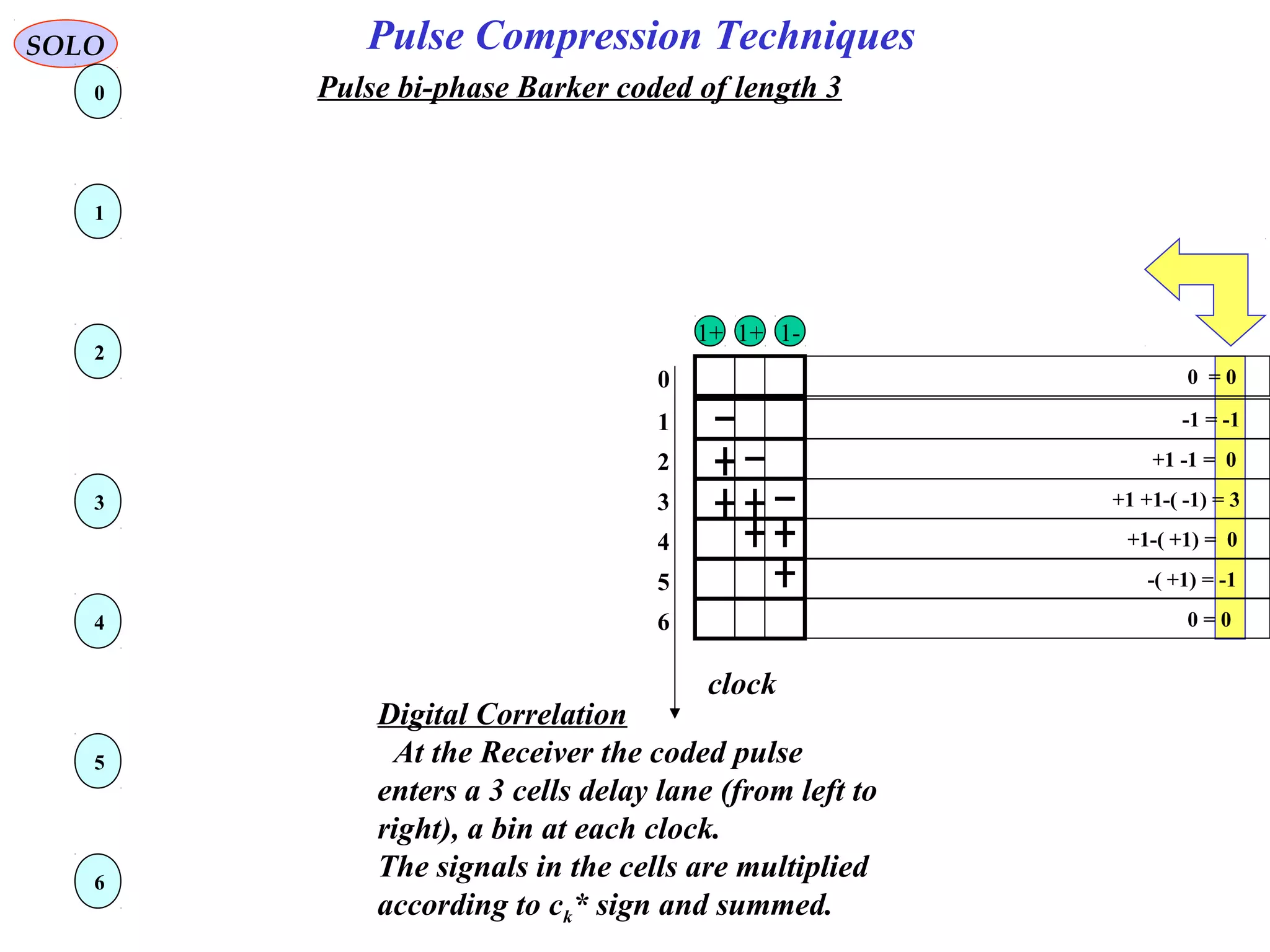
-1
Pulse bi-phase Barker coded of length 3
Digital Correlation
At the Receiver the coded pulse
enters a 3 cells delay lane (from left to
right), a bin at each clock.
The signals in the cells are multiplied
according to ck* sign and summed.
clock
-1 = -11
+1 -1 = 02
-( +1) = -15
0 = 06
+1 +1-( -1) = 33
+1-( +1) = 04
SOLO Pulse Compression Techniques
1
2
3
4
5
6
0
+1+1
0 = 00
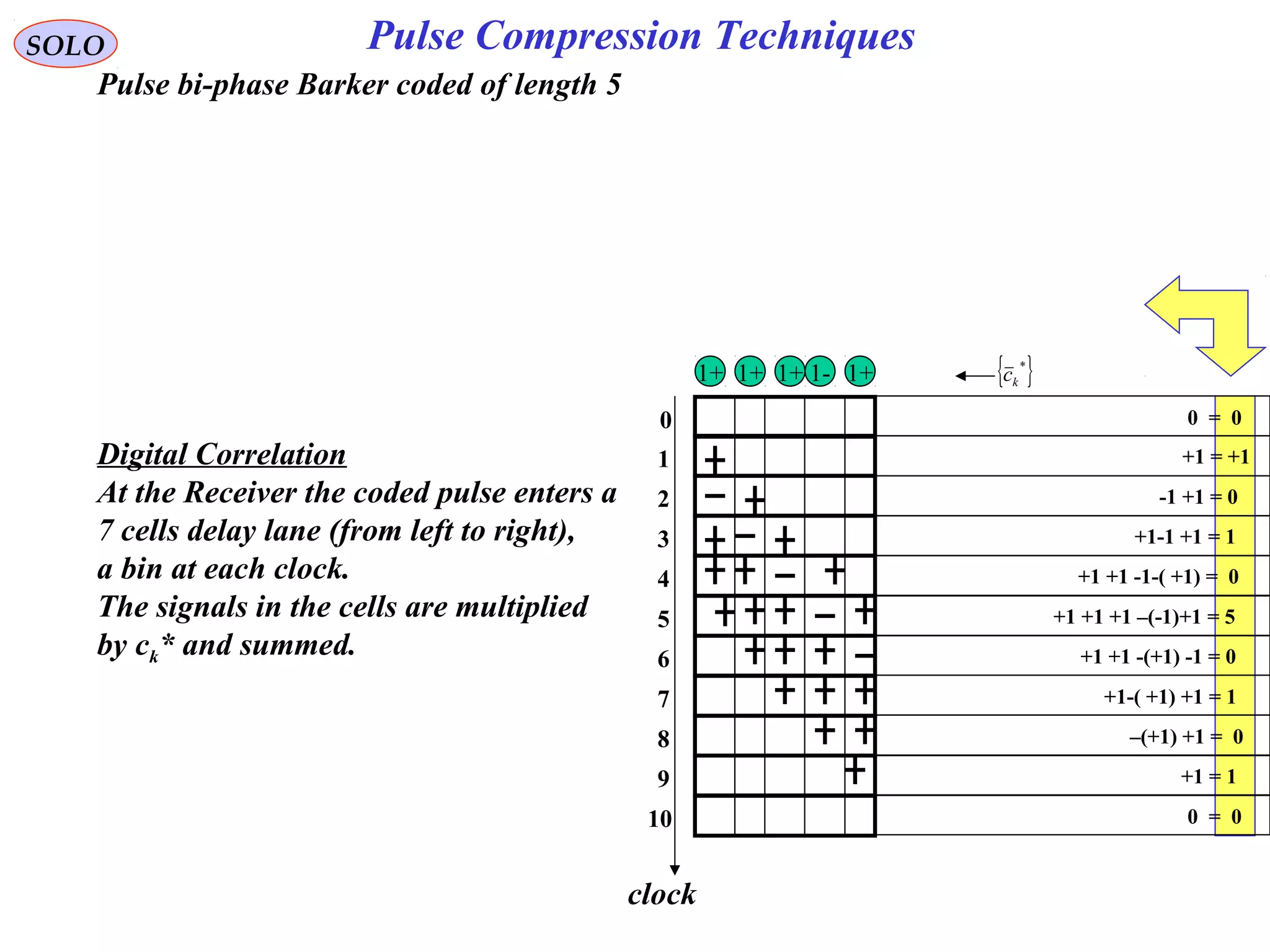
Pulse bi-phase Barker coded of length 5
Digital Correlation
At the Receiver the coded pulse enters a
7 cells delay lane (from left to right),
a bin at each clock.
The signals in the cells are multiplied
by ck* and summed.
clock
SOLO Pulse Compression Techniques
+1-1+1+1+1 { }*
kc
+1 = +11
+1 = 19
0 = 010
2 -1 +1 = 0
+1 +1 -1-( +1) = 04
+1 +1 +1 –(-1)+1 = 55
0 = 00
3 +1-1 +1 = 1
+1 +1 -(+1) -1 = 06
+1-( +1) +1 = 17
–(+1) +1 = 08
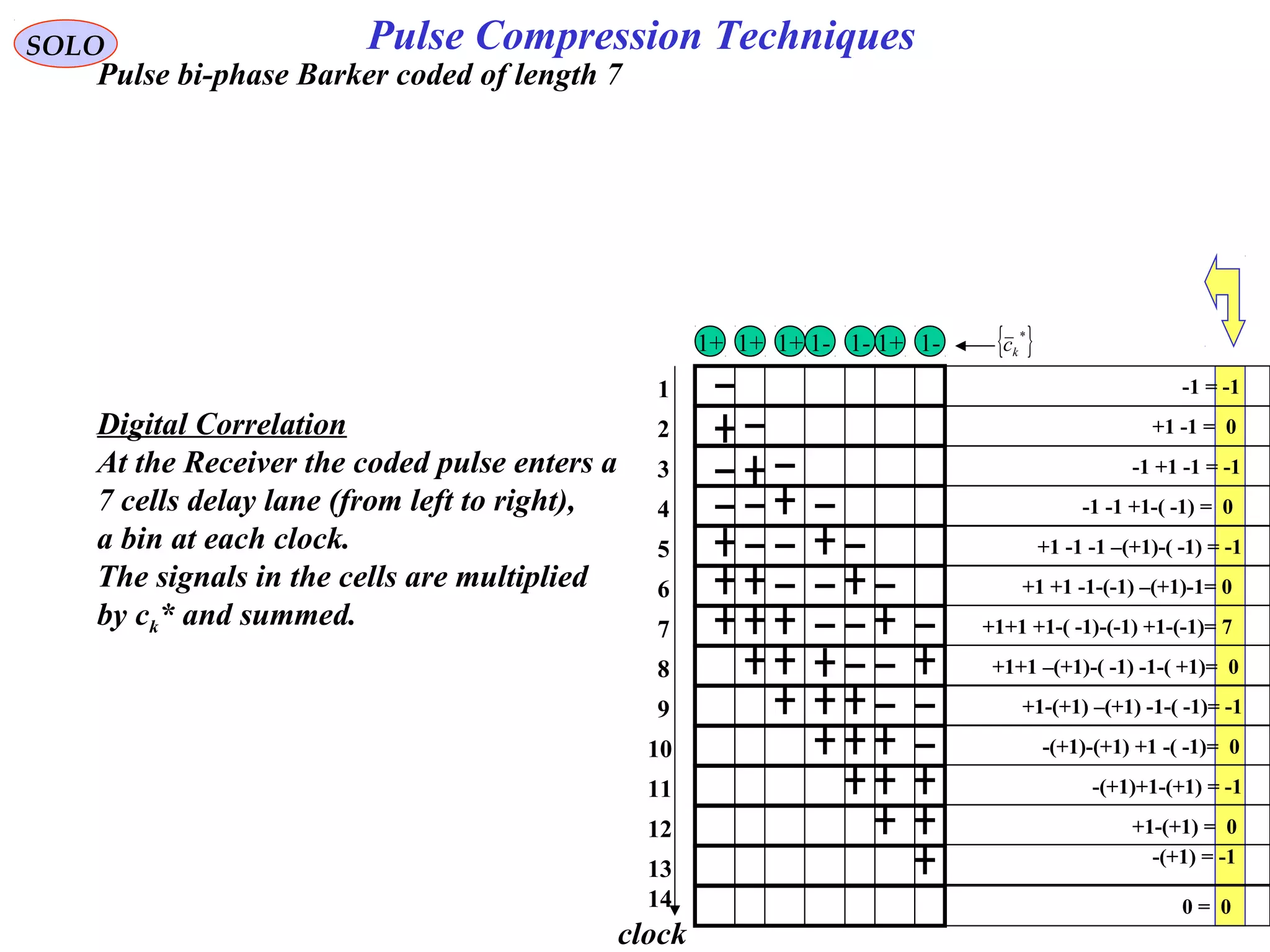
Pulse bi-phase Barker coded of length 7
Digital Correlation
At the Receiver the coded pulse enters a
7 cells delay lane (from left to right),
a bin at each clock.
The signals in the cells are multiplied
by ck* and summed.
clock
-1 = -11
+1 -1 = 02
-1 +1 -1 = -13
-1 -1 +1-( -1) = 04
+1 -1 -1 –(+1)-( -1) = -15
+1 +1 -1-(-1) –(+1)-1= 06
+1+1 +1-( -1)-(-1) +1-(-1)= 77
+1+1 –(+1)-( -1) -1-( +1)= 08
+1-(+1) –(+1) -1-( -1)= -19
-(+1)-(+1) +1 -( -1)= 010
-(+1)+1-(+1) = -111
+1-(+1) = 012
-(+1) = -1
13
0 = 014
SOLO Pulse Compression Techniques
-1-1 -1+1+1+1+1 { }*
kc
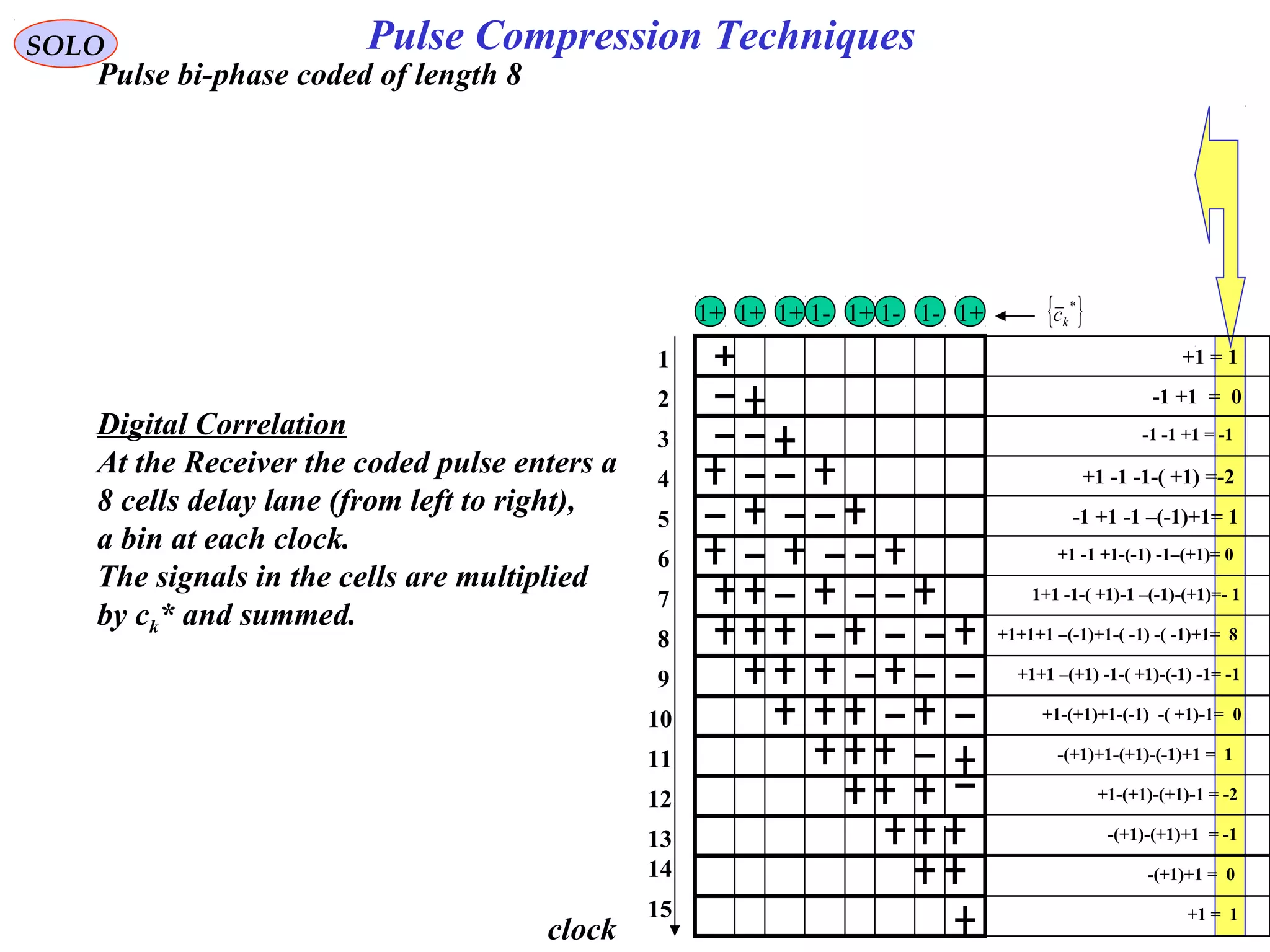
Pulse bi-phase coded of length 8
Digital Correlation
At the Receiver the coded pulse enters a
8 cells delay lane (from left to right),
a bin at each clock.
The signals in the cells are multiplied
by ck* and summed.
clock
SOLO Pulse Compression Techniques
+1 = 11
-1-1 -1+1+1+1+1 { }*
kc+1
-1 +1 = 02
-1 -1 +1 = -13
+1 -1 -1-( +1) =-24
-1 +1 -1 –(-1)+1= 15
+1 -1 +1-(-1) -1–(+1)= 06
1+1 -1-( +1)-1 –(-1)-(+1)=- 17
+1+1+1 –(-1)+1-( -1) -( -1)+1= 88
+1+1 –(+1) -1-( +1)-(-1) -1= -19
+1-(+1)+1-(-1) -( +1)-1= 010
-(+1)+1-(+1)-(-1)+1 = 111
+1-(+1)-(+1)-1 = -212
-(+1)-(+1)+1 = -113
-(+1)+1 = 014
+1 = 115
SOLO Pulse Compression Techniques
Bi-Phase Codes
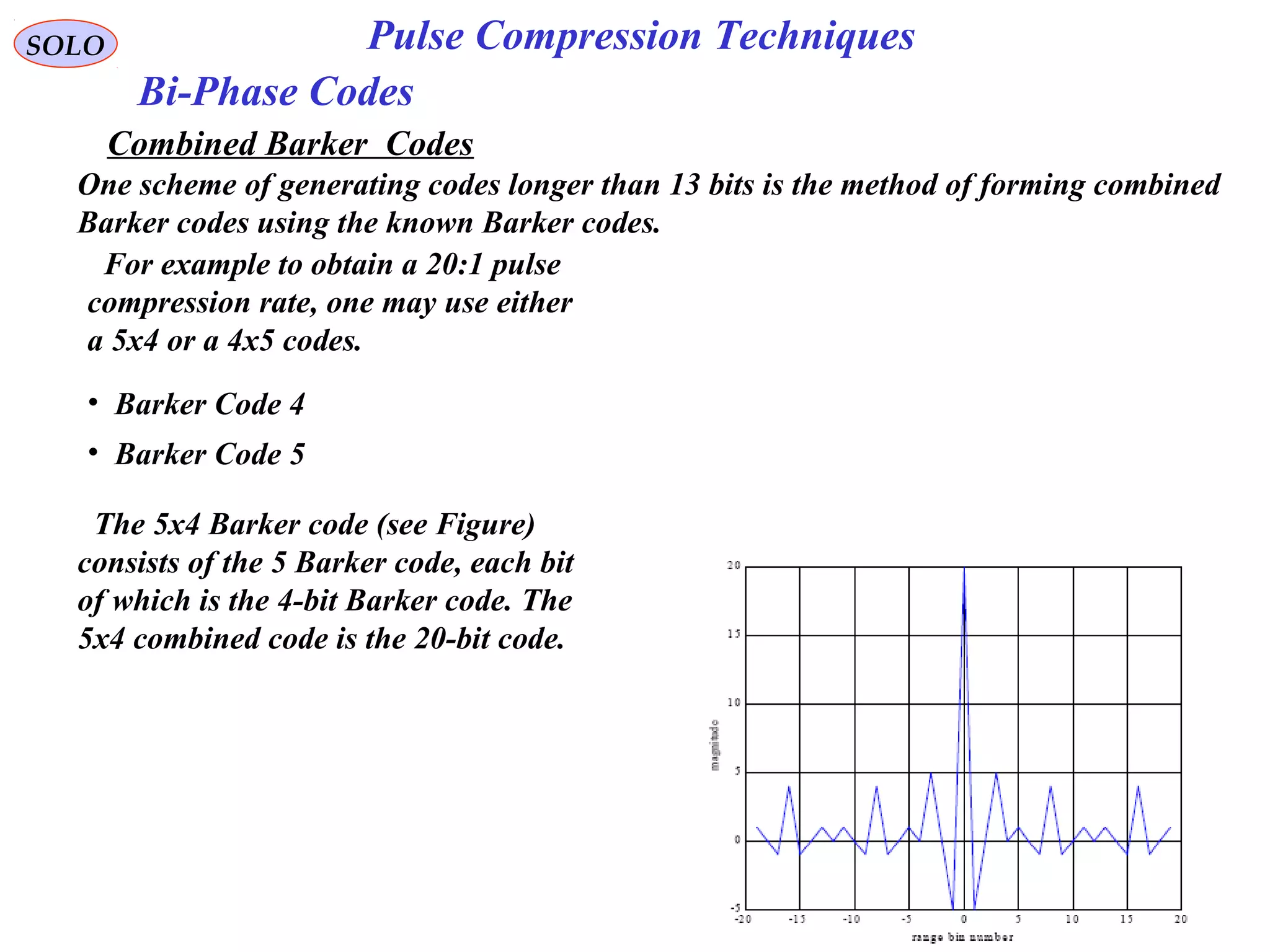
Combined Barker Codes
One scheme of generating codes longer than 13 bits is the method of forming combined
Barker codes using the known Barker codes.
For example to obtain a 20:1 pulse
compression rate, one may use either
a 5x4 or a 4x5 codes.
The 5x4 Barker code (see Figure)
consists of the 5 Barker code, each bit
of which is the 4-bit Barker code. The
5x4 combined code is the 20-bit code.
• Barker Code 4
• Barker Code 5
SOLO Pulse Compression Techniques
Bi-Phase Codes
SOLO Pulse Compression Techniques
Bi-Phase Codes
Binary Phase Codes Summary
• Binary phase codes (Barker, Combined Barker) are used in most radar applications.
• Binary phase codes can be digitally implemented. It is applied separately to I and Q
channels.
• Binary phase codes are Doppler frequency shift sensitive.
• Barker codes have good side-lobe for low compression ratios.
• At Higher PRFs Doppler frequency shift sensitivity may pose a problem.
Return to Table of Content
SOLO Pulse Compression Techniques
Poly-Phase Codes
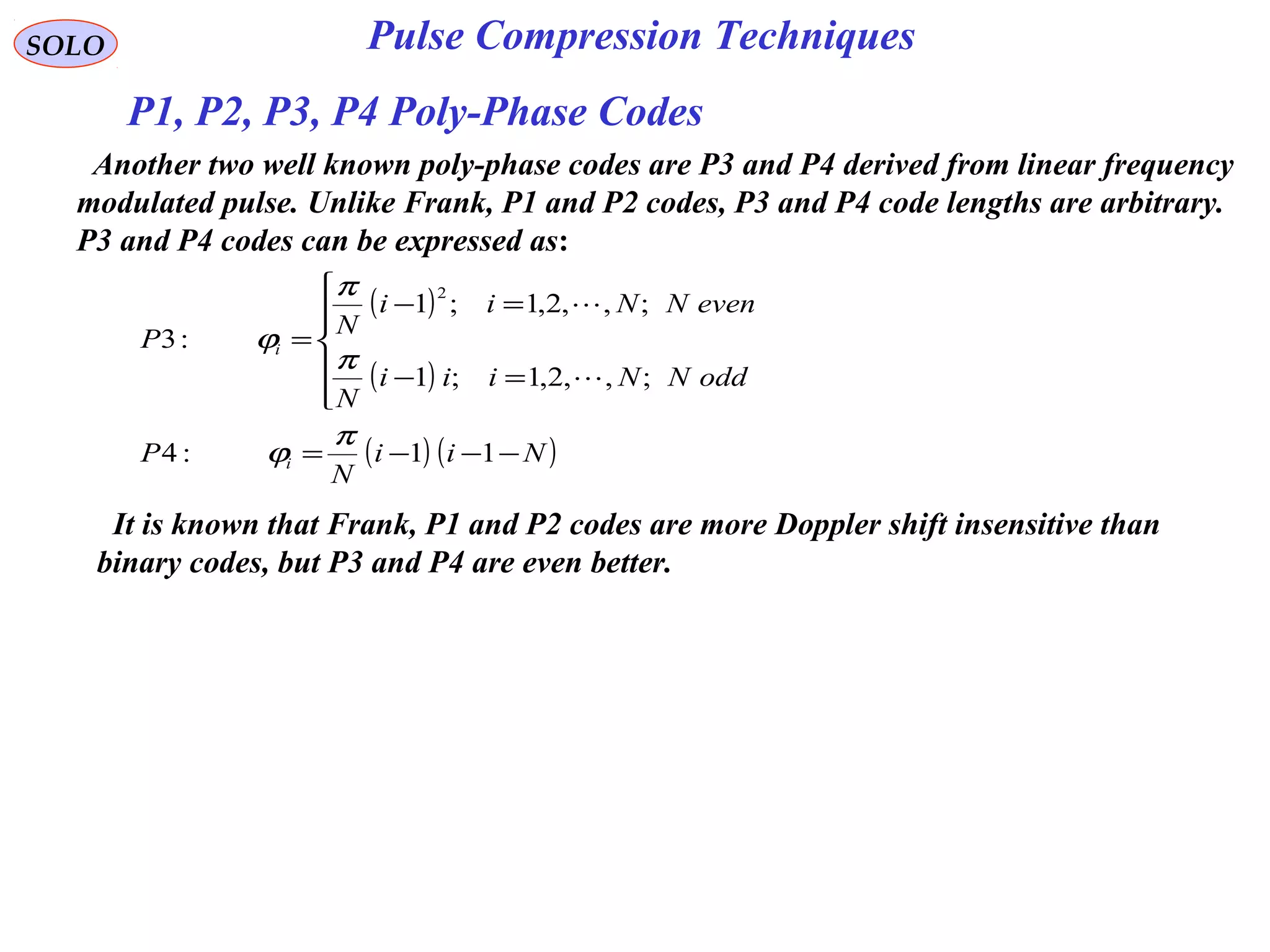
Frank Codes
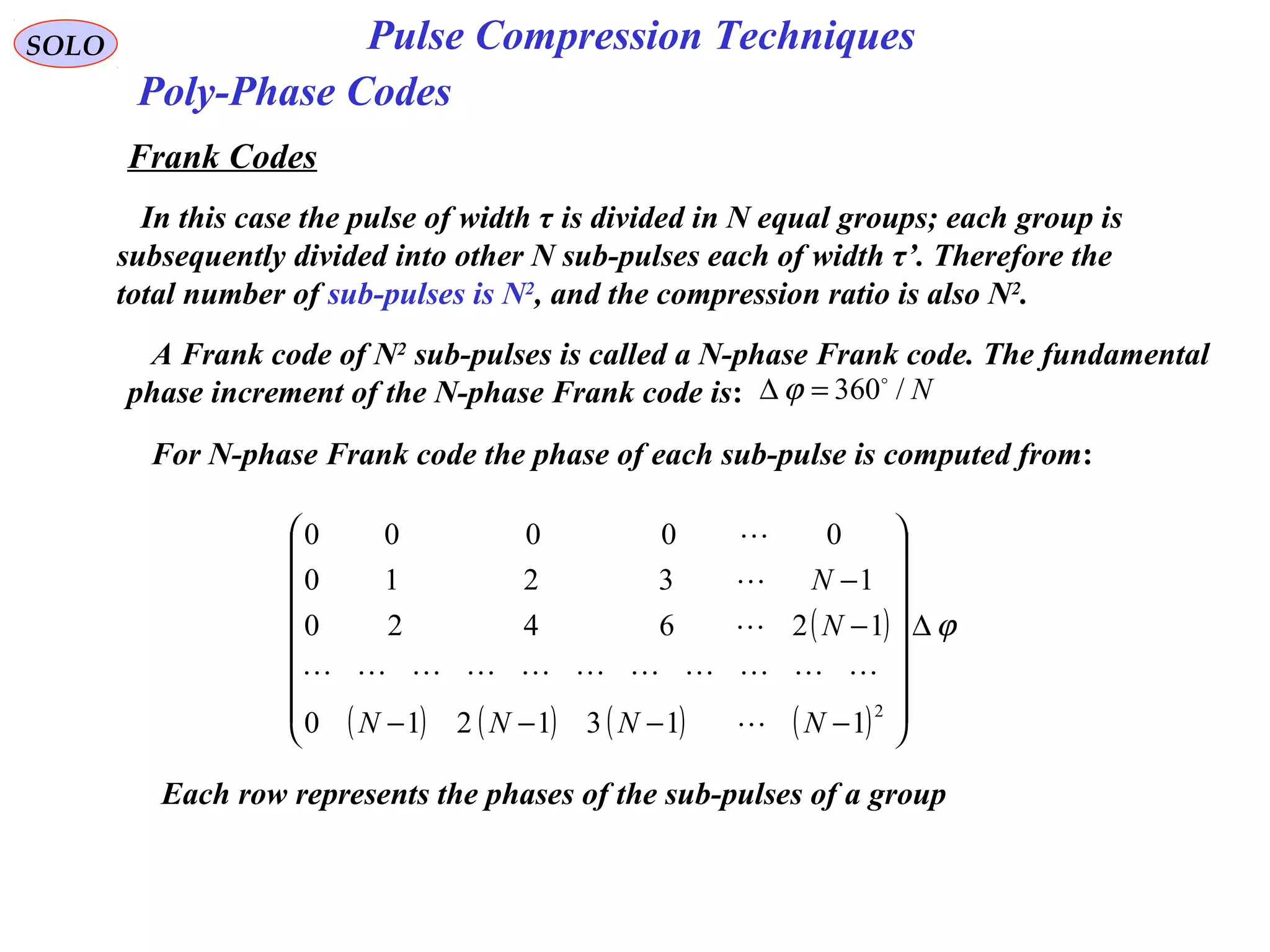
In this case the pulse of width τ is divided in N equal groups; each group is
subsequently divided into other N sub-pulses each of width τ’. Therefore the
total number of sub-pulses is N2
, and the compression ratio is also N2
.
A Frank code of N2
sub-pulses is called a N-phase Frank code. The fundamental
phase increment of the N-phase Frank code is: N/360
=∆ ϕ
For N-phase Frank code the phase of each sub-pulse is computed from:
( )
( ) ( ) ( ) ( )
ϕ∆
















−−−−
−
−
2
1131210
126420
13210
00000
NNNN
N
N





Each row represents the phases of the sub-pulses of a group
SOLO Pulse Compression Techniques
Poly-Phase Codes
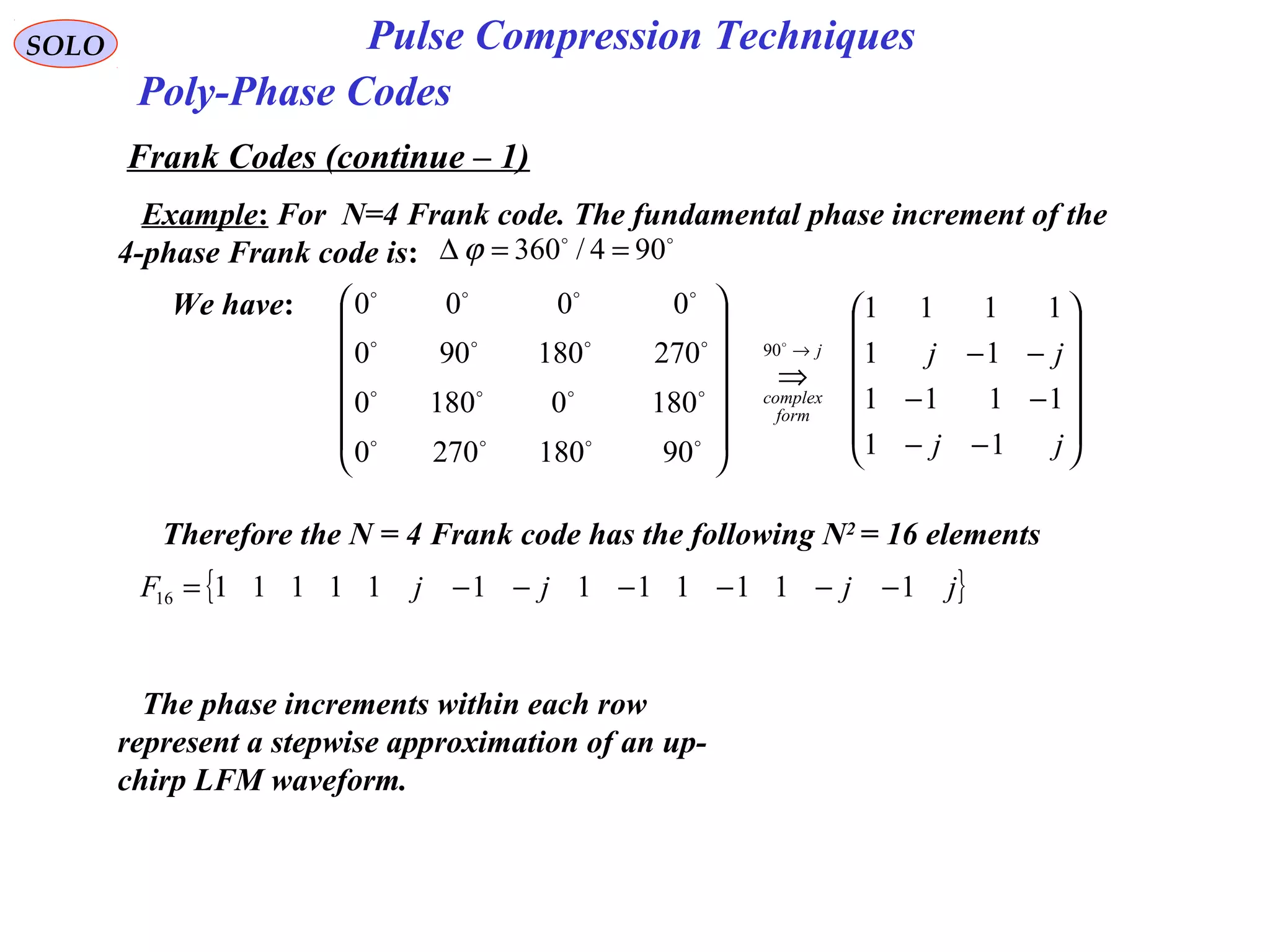
Frank Codes (continue – 1)
Example: For N=4 Frank code. The fundamental phase increment of the
4-phase Frank code is:

904/360 ==∆ ϕ
We have:














−−
−−
−−
⇒














→
jj
jjj
form
complex
11
1111
11
1111
901802700
18001800
270180900
0000
90




Therefore the N = 4 Frank code has the following N2
= 16 elements
{ }jjjjF 11111111111116 −−−−−−=
The phase increments within each row
represent a stepwise approximation of an up-
chirp LFM waveform.
SOLO Pulse Compression Techniques
Poly-Phase Codes
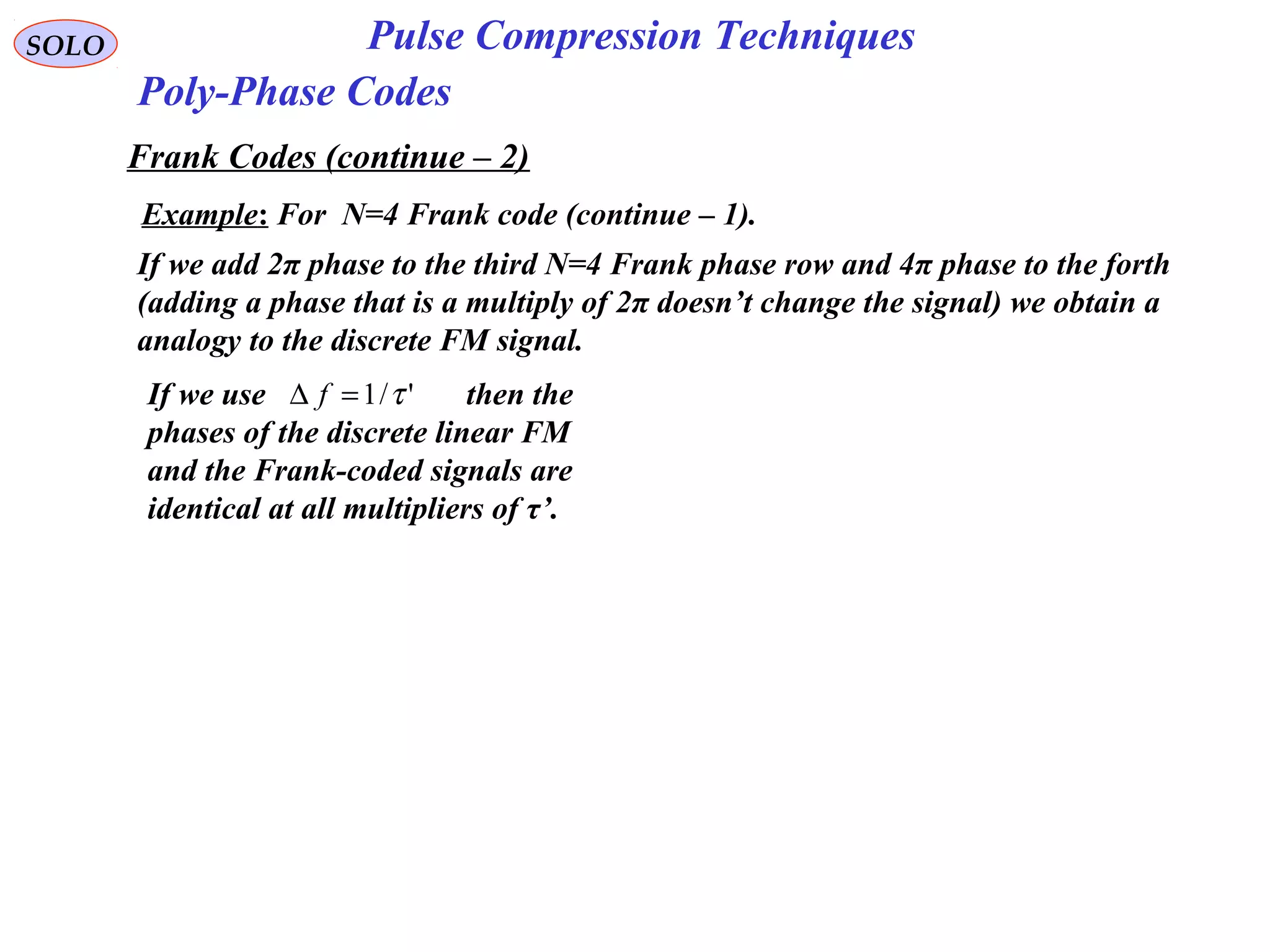
Frank Codes (continue – 2)
Example: For N=4 Frank code (continue – 1).
If we add 2π phase to the third N=4 Frank phase row and 4π phase to the forth
(adding a phase that is a multiply of 2π doesn’t change the signal) we obtain a
analogy to the discrete FM signal.
If we use then the
phases of the discrete linear FM
and the Frank-coded signals are
identical at all multipliers of τ’.
'/1 τ=∆ f
SOLO Pulse Compression Techniques
Poly-Phase Codes
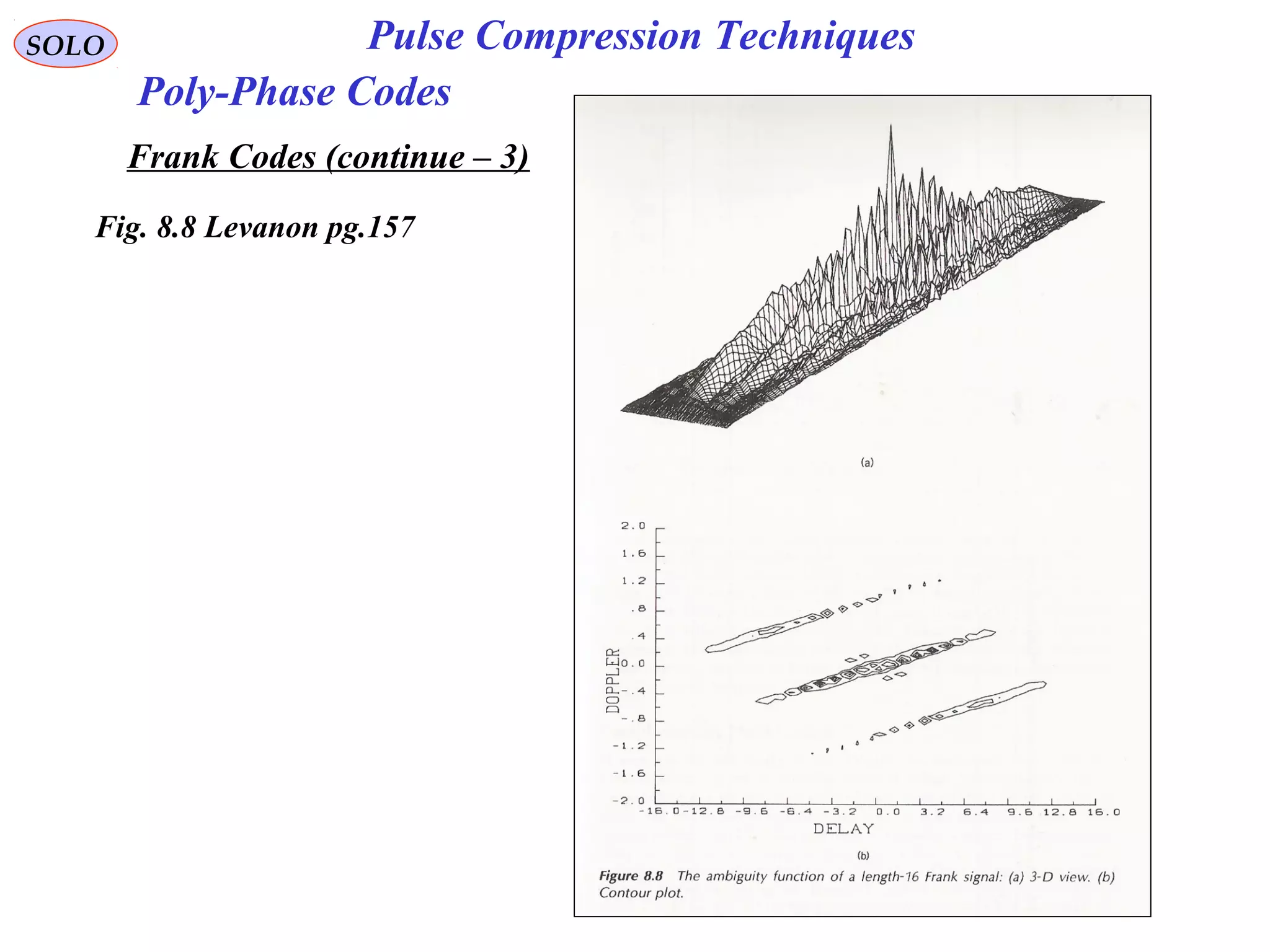
Frank Codes (continue – 3)
Fig. 8.8 Levanon pg.157
SOLO Pulse Compression Techniques
Poly-Phase Codes
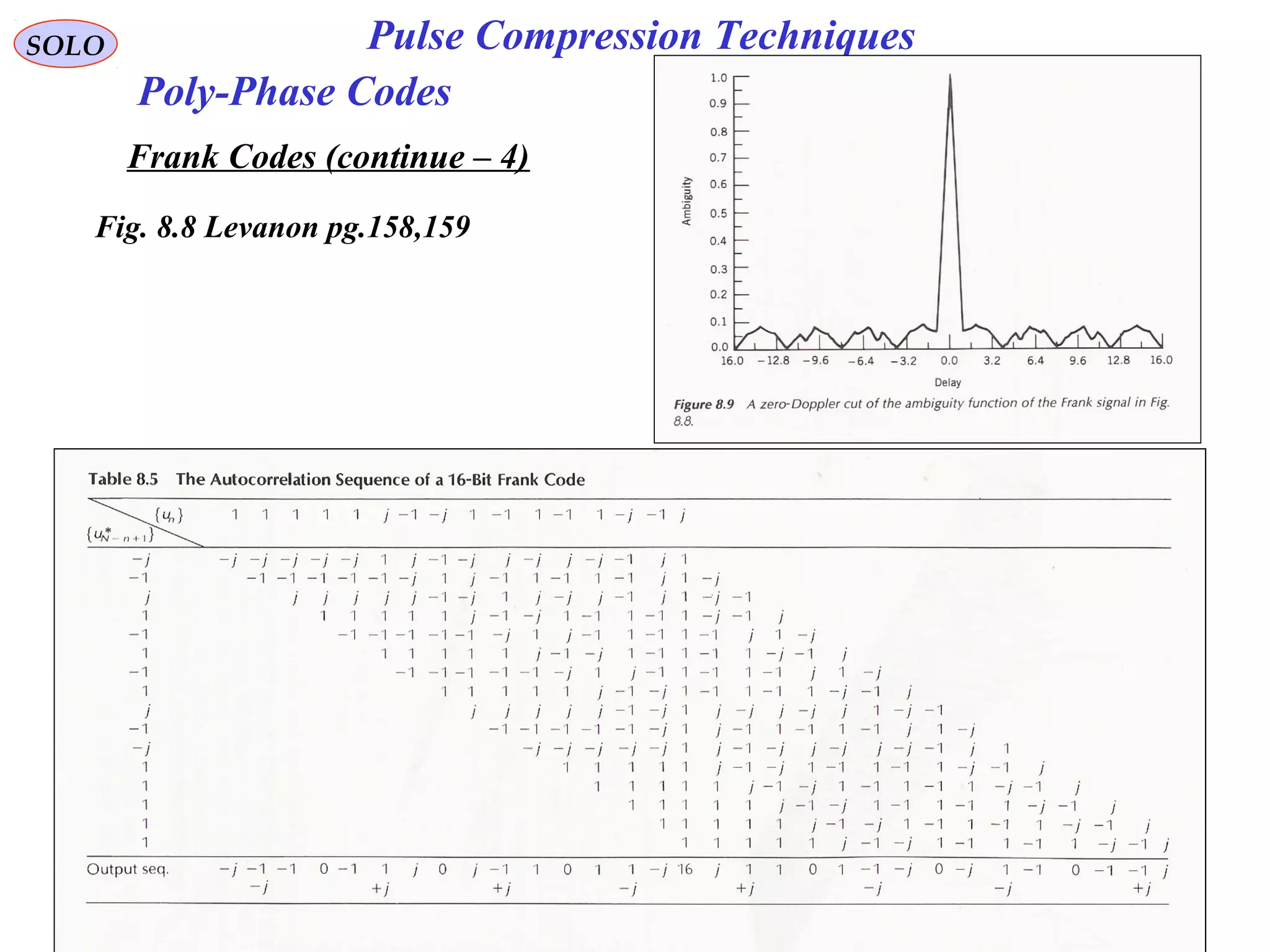
Frank Codes (continue – 4)
Fig. 8.8 Levanon pg.158,159
SOLO Pulse Compression Techniques
Poly-Phase Codes
Frank Codes (continue – 5)
Return to Table of Content
SOLO Pulse Compression Techniques
P1, P2, P3, P4 Poly-Phase Codes
The phase-code pulses envelope is given by: ( ) ( ) ( )
∑=





 −−
=
N
m
m
mt
recj
NT
tg
1 '
1
exp
1
τ
ϕ
The phases φm are chosen such that the autocorrelation function has the smallest
Peak-to-sidelobe ratio (PSR), for a certain code length. PSR is bounded from bellow
by the code length N
( )NPSR log20=
Binary phase codes use only φm=0 or π. The main drawback of binary codes, such as
Barker codes or m-sequences is their sensitivity to Doppler shift.
Poly-phase codes are not restricted on code elements and are generated from phase
history of frequency-modulated pulse. The Frank code and the P1 and P2 codes,
The modified version of Frank code, are derived from the linear stepped frequency
Modulation. These three codes are only applicable for perfect square length (N = L2
),
and can be expressed as:
( ) ( )
( ) ( )[ ] ( )[ ]
( )[ ] ( )[ ]jLiL
L
P
jLiLj
L
P
ji
L
Frank
ji
ji
ji
−+−+=
−−−+−=
−−=
2/12/1
2
:2
1211
2
:1
11
2
:
,
,
,
π
ϕ
π
ϕ
π
ϕ
SOLO Pulse Compression Techniques
( )
( )
( ) ( )Nii
N
P
oddNNiii
N
evenNNii
N
P
i
i
−−−=






=−
=−
=
11:4
;,,2,1;1
;,,2,1;1
:3
2
π
ϕ
π
π
ϕ


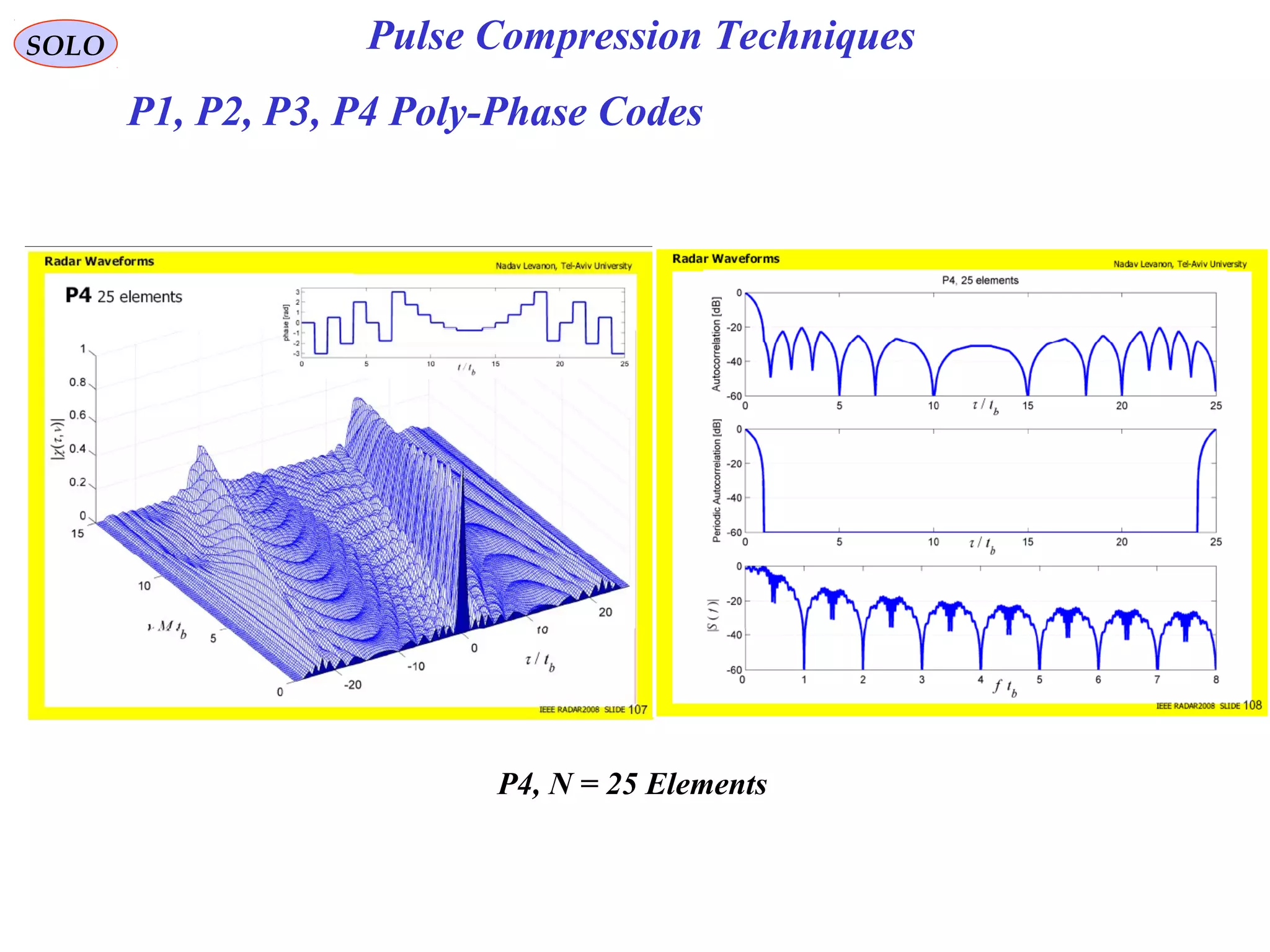
Another two well known poly-phase codes are P3 and P4 derived from linear frequency
modulated pulse. Unlike Frank, P1 and P2 codes, P3 and P4 code lengths are arbitrary.
P3 and P4 codes can be expressed as:
It is known that Frank, P1 and P2 codes are more Doppler shift insensitive than
binary codes, but P3 and P4 are even better.
P1, P2, P3, P4 Poly-Phase Codes
SOLO Pulse Compression Techniques
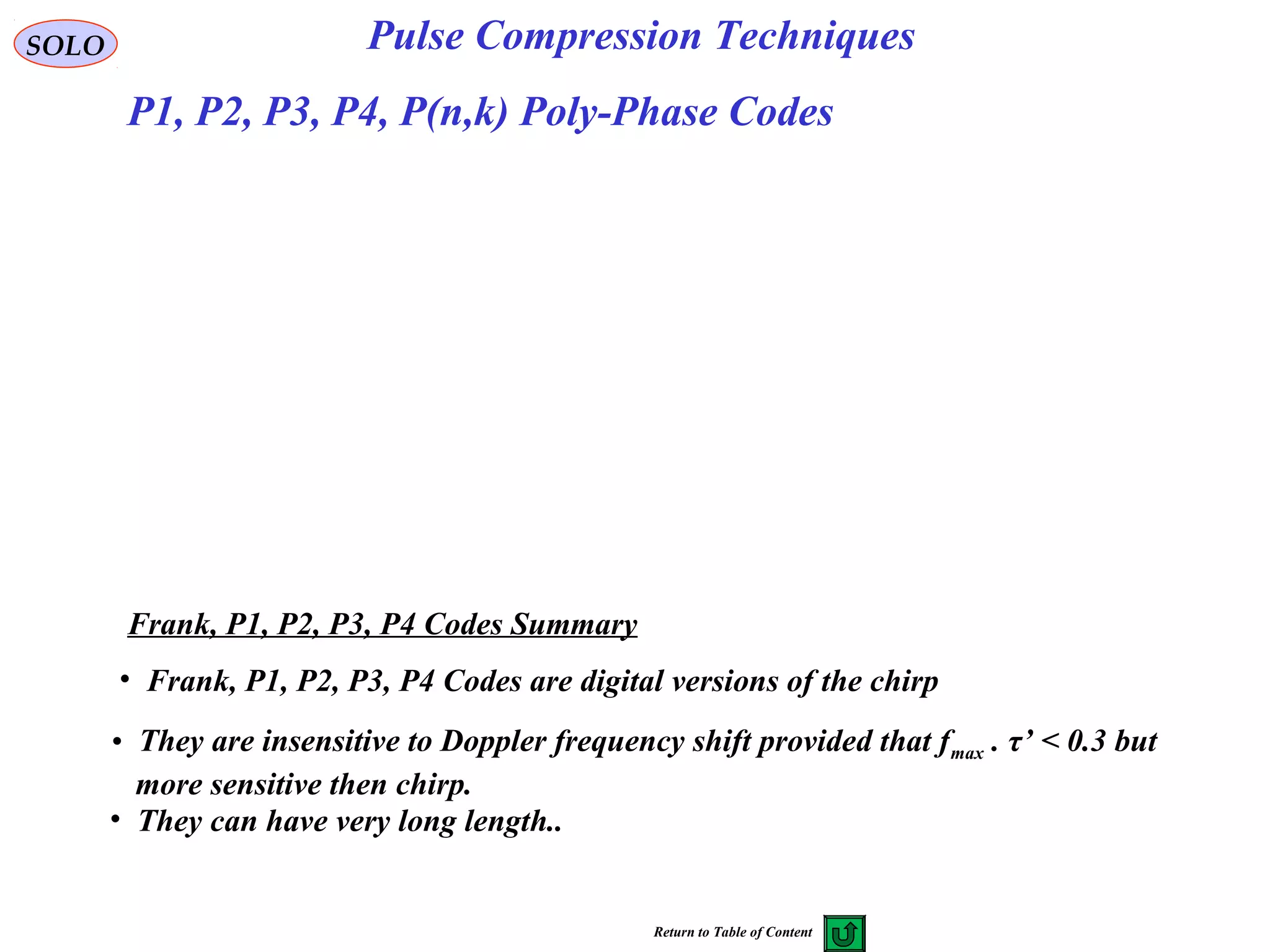
P1, P2, P3, P4 Poly-Phase Codes
P4, N = 25 Elements
SOLO Pulse Compression Techniques
Frank, P1, P2, P3, P4 Codes Summary
• Frank, P1, P2, P3, P4 Codes are digital versions of the chirp
• They are insensitive to Doppler frequency shift provided that fmax . τ’ < 0.3 but
more sensitive then chirp.
• They can have very long length..
P1, P2, P3, P4, P(n,k) Poly-Phase Codes
Return to Table of Content
SOLO
Pseudo-Random Codes
Pseudo-Random Codes are binary-valued sequences similar to Barker codes.
The name pseudo-random (pseudo-noise) stems from the fact that they resemble
a random like sequence.
The pseudo-random codes can be easily generated using feedback shift-registers.
It can be shown that for N shift-registers we can obtain a maximum length sequence
of length 2N
-1.
0 1 0 0 1 1 1
23
-1=7
Register
# 1
Register
# 2
Register
# 3
XOR
clock
A
B
Input A Input B Output XOR
0 0 0
0 1 1
1 0 1
1 1 0
Register
# 1
Register
# 2
Register
# 3
0 1 0
s
e
q
u
e
n
c
e
I.C.
0 0 11
1 0 02
1 1 03
1 1 14
0 1 15
1 0 16
0 1 07
clock
0 0 18
0
Pulse Compression Techniques
SOLO
Pseudo-Random Codes (continue – 1)
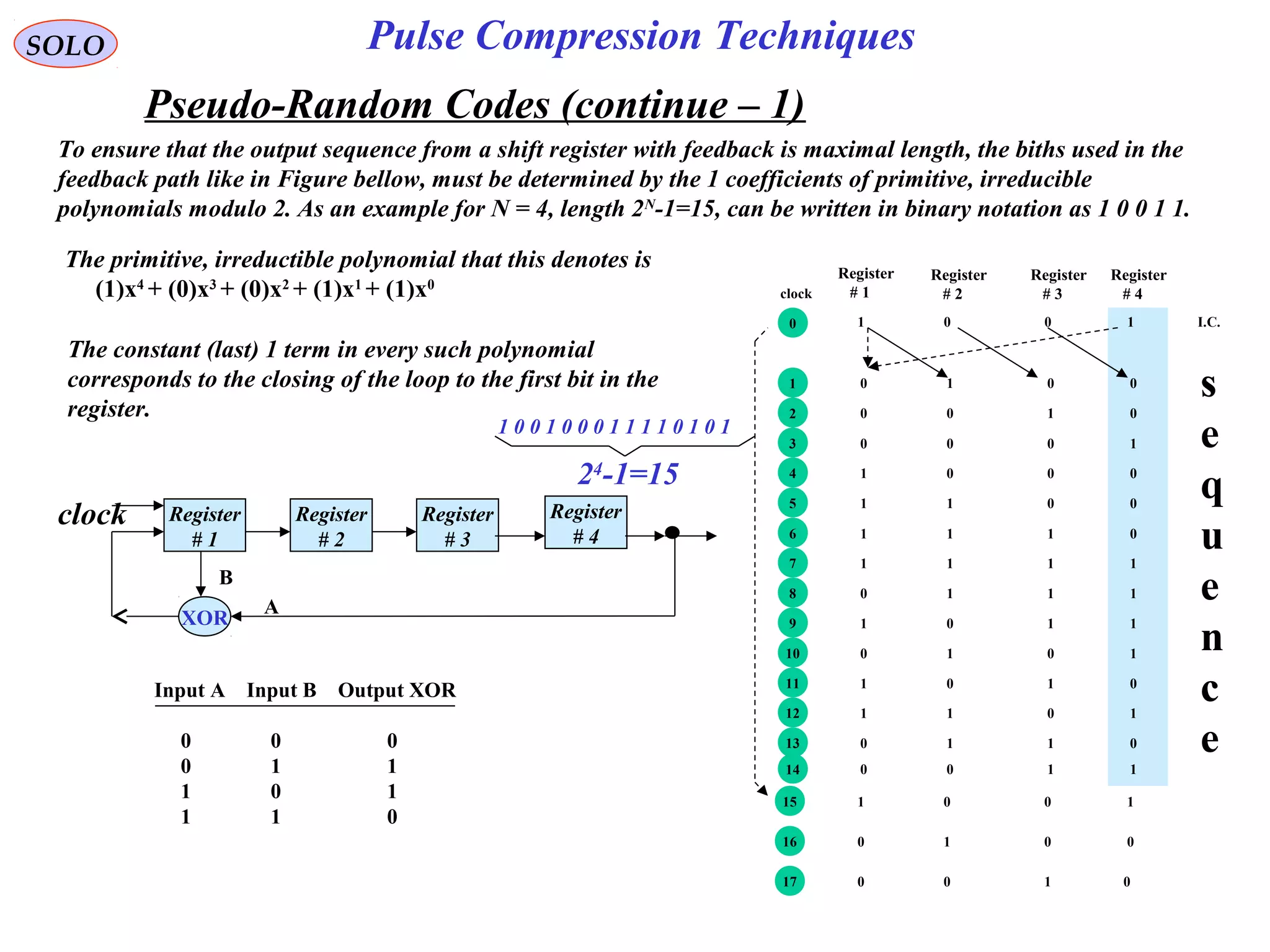
To ensure that the output sequence from a shift register with feedback is maximal length, the biths used in the
feedback path like in Figure bellow, must be determined by the 1 coefficients of primitive, irreducible
polynomials modulo 2. As an example for N = 4, length 2N
-1=15, can be written in binary notation as 1 0 0 1 1.
The primitive, irreductible polynomial that this denotes is
(1)x4
+ (0)x3
+ (0)x2
+ (1)x1
+ (1)x0
1 0 0 1 0 0 0 1 1 1 1 0 1 0 1
24
-1=15
s
e
q
u
e
n
c
e
1 0 0 1 I.C.0
The constant (last) 1 term in every such polynomial
corresponds to the closing of the loop to the first bit in the
register.
Register
# 1
Register
# 2
Register
# 3
XOR
clock
A
B
Input A Input B Output XOR
0 0 0
0 1 1
1 0 1
1 1 0
Register
# 4
Register
# 1
Register
# 2
Register
# 3clock
Register
# 4
1 0 1 0 0
0 0 1 02
0 0 0 13
1 0 0 04
1 1 0 05
1 1 1 06
1 1 1 17
0 1 1 18
1 0 1 19
0 1 0 110
1 0 1 011
1 1 0 112
0 1 1 013
0 0 1 114
1 0 0 115
0 1 0 016
0 0 1 017
Pulse Compression Techniques
SOLO
Pseudo-Random Codes (continue – 2)
Pulse Compression Techniques
Input A Input B Output XOR
0 0 0
0 1 1
1 0 1
1 1 0
Register
# 1
Register
# 2
Register
# n
XOR
clock
A
B
Register
# (n-1)
Register
# m
. . .. . .
2 3 1 2,1
3 7 2 3,2
4 15 2 4,3
5 31 6 5,3
6 63 6 6,5
7 127 18 7,6
8 255 16 8,6,5,4
9 511 48 9,5
10 1,023 60 10,7
11 2,047 176 11,9
12 4,095 144 12,11,8,6
13 8,191 630 13,12,10,9
14 16,383 756 14,13,8,4
15 32,767 1,800 15,14
16 65,535 2,048 16,15,13,4
17 131,071 7,710 17,4
18 262,143 7,776 18,11
19 524,287 27,594 19,18,17,14
20 1,048,575 24,000 20,17
Number of
Stages n
Length of
Maximal Sequence N
Number of
Maximal Sequence M
Feedback stage
connections
Maximum Length Sequence
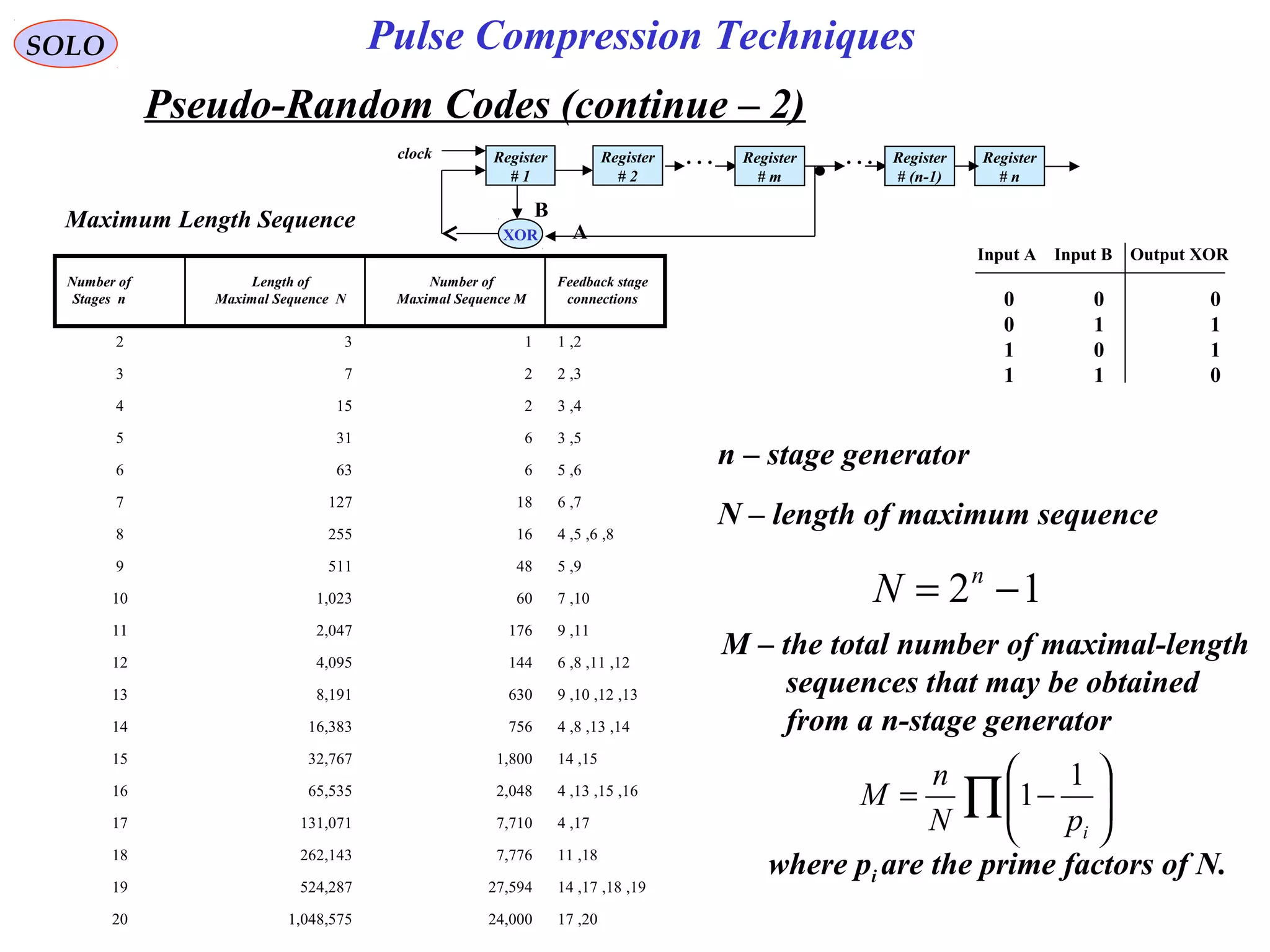
n – stage generator
N – length of maximum sequence
12 −= n
N
M – the total number of maximal-length
sequences that may be obtained
from a n-stage generator
∏ 





−=
ipN
n
M
1
1
where pi are the prime factors of N.
SOLO
Pseudo-Random Codes (continue – 3)
Pulse Compression Techniques
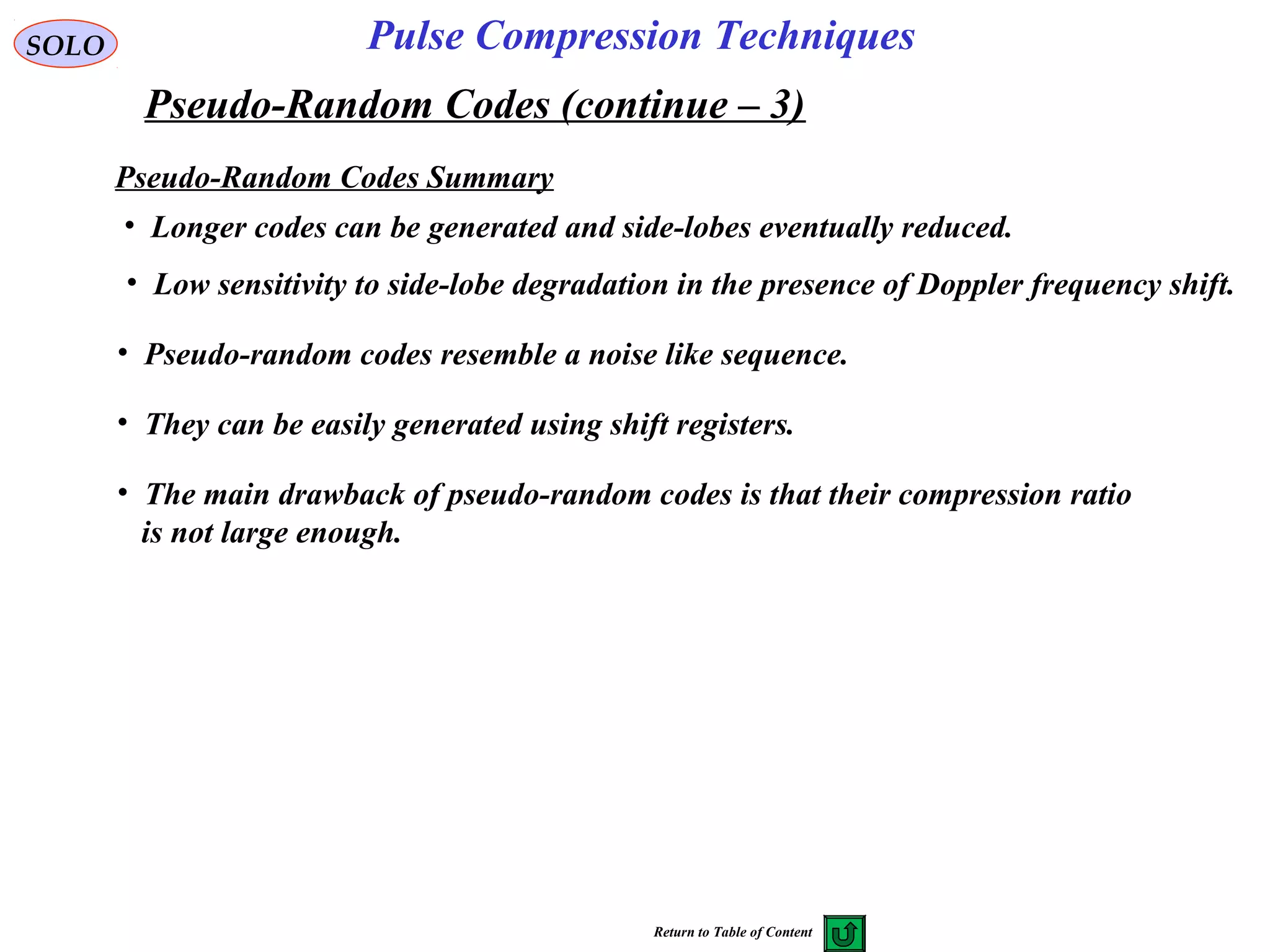
Pseudo-Random Codes Summary
• Longer codes can be generated and side-lobes eventually reduced.
• Low sensitivity to side-lobe degradation in the presence of Doppler frequency shift.
• Pseudo-random codes resemble a noise like sequence.
• They can be easily generated using shift registers.
• The main drawback of pseudo-random codes is that their compression ratio
is not large enough.
Return to Table of Content
SOLO Pulse Compression Techniques
Frequency Codes
Costas Codes
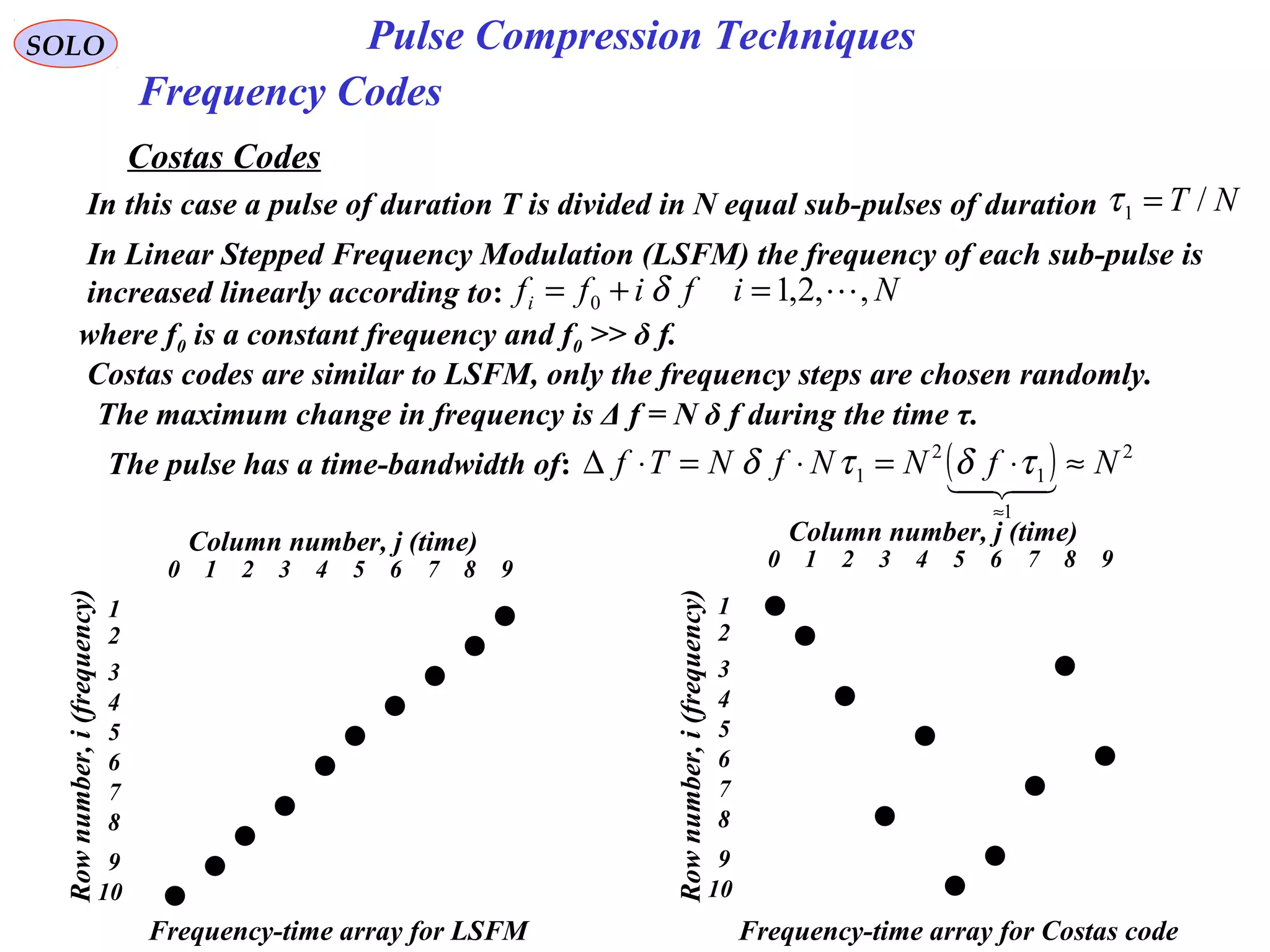
In this case a pulse of duration T is divided in N equal sub-pulses of duration NT /1 =τ
In Linear Stepped Frequency Modulation (LSFM) the frequency of each sub-pulse is
increased linearly according to: Nififfi ,,2,10 =+= δ
where f0 is a constant frequency and f0 >> δ f.
The maximum change in frequency is Δ f = N δ f during the time τ.
The pulse has a time-bandwidth of: ( ) 2
1
1
2
1 NfNNfNTf ≈⋅=⋅=⋅∆
≈

τδτδ
0 1 2 3 4 5 6 7 8 9
1
2
3
4
5
6
7
8
9
10
0 1 2 3 4 5 6 7 8 9
1
2
3
4
5
6
7
8
9
10
Column number, j (time) Column number, j (time)
Rownumber,i(frequency)
Frequency-time array for LSFM Frequency-time array for Costas code
Costas codes are similar to LSFM, only the frequency steps are chosen randomly.
SOLO Pulse Compression Techniques
Frequency Codes
Costas Codes (continue – 1)
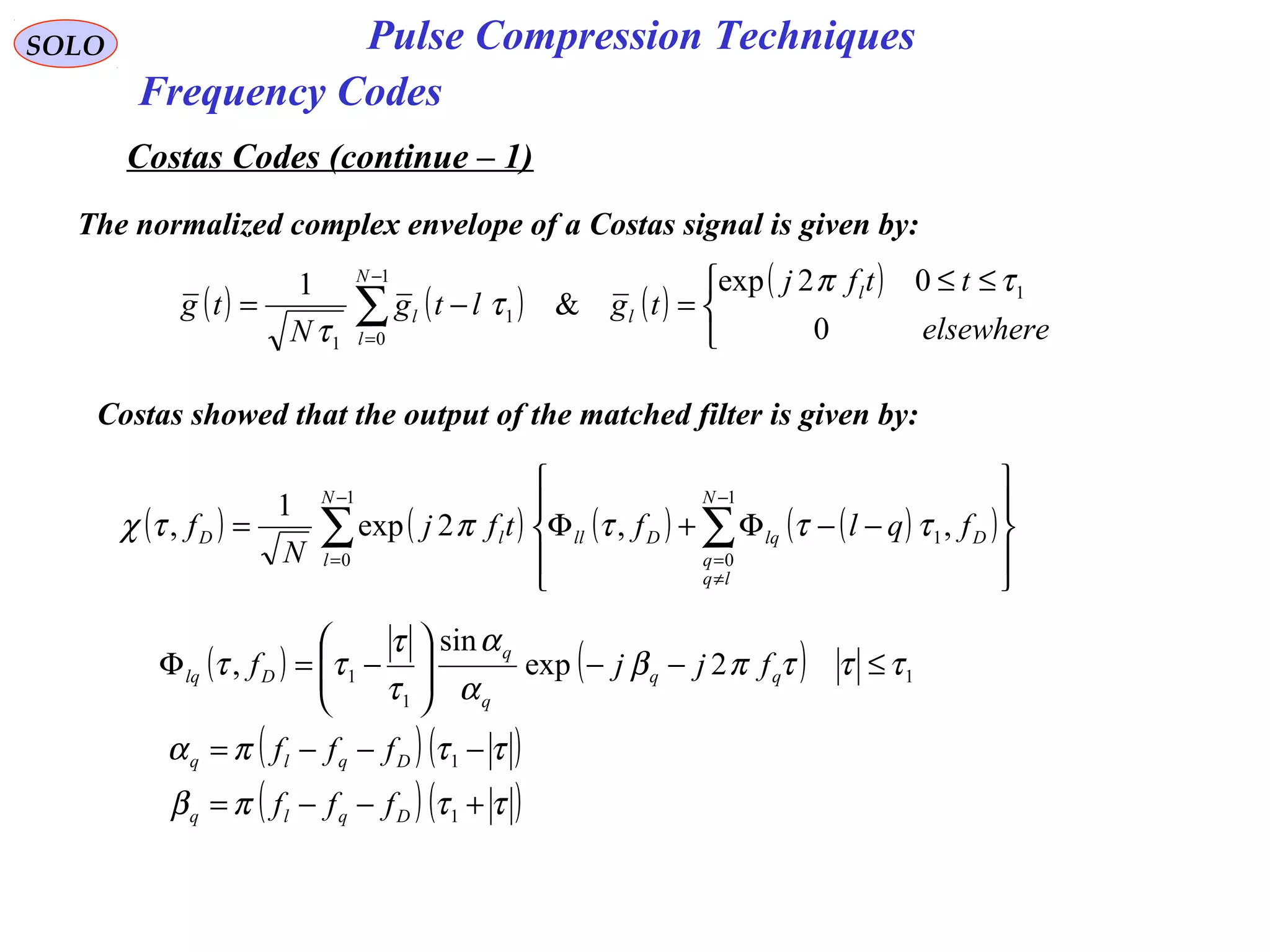
The normalized complex envelope of a Costas signal is given by:
( ) ( ) ( )
( )


 ≤≤
=−= ∑
−
= elsewhere
ttfj
tgltg
N
tg
l
l
N
l
l
0
02exp
&
1 1
1
0
1
1
τπ
τ
τ
Costas showed that the output of the matched filter is given by:
( ) ( ) ( ) ( )( )∑ ∑
−
=
−
≠
= 









−−Φ+Φ=
1
0
1
0
1,,2exp
1
,
N
l
N
lq
q
DlqDlllD fqlftfj
N
f τττπτχ
( ) ( ) 1
1
1 2exp
sin
, τττπβ
α
α
τ
τ
ττ ≤−−







−=Φ qq
q
q
Dlq fjjf
( ) ( )
( ) ( )ττπβ
ττπα
+−−=
−−−=
1
1
Dqlq
Dqlq
fff
fff
SOLO Pulse Compression Techniques
Frequency Codes
Costas Codes (continue – 2)
0 1 2 3 4 5 6 7 8 9
1
2
3
4
5
6
7
8
9
10
Column number, j (time)
Rownumber,i(frequency)
Frequency-time array for Costas code
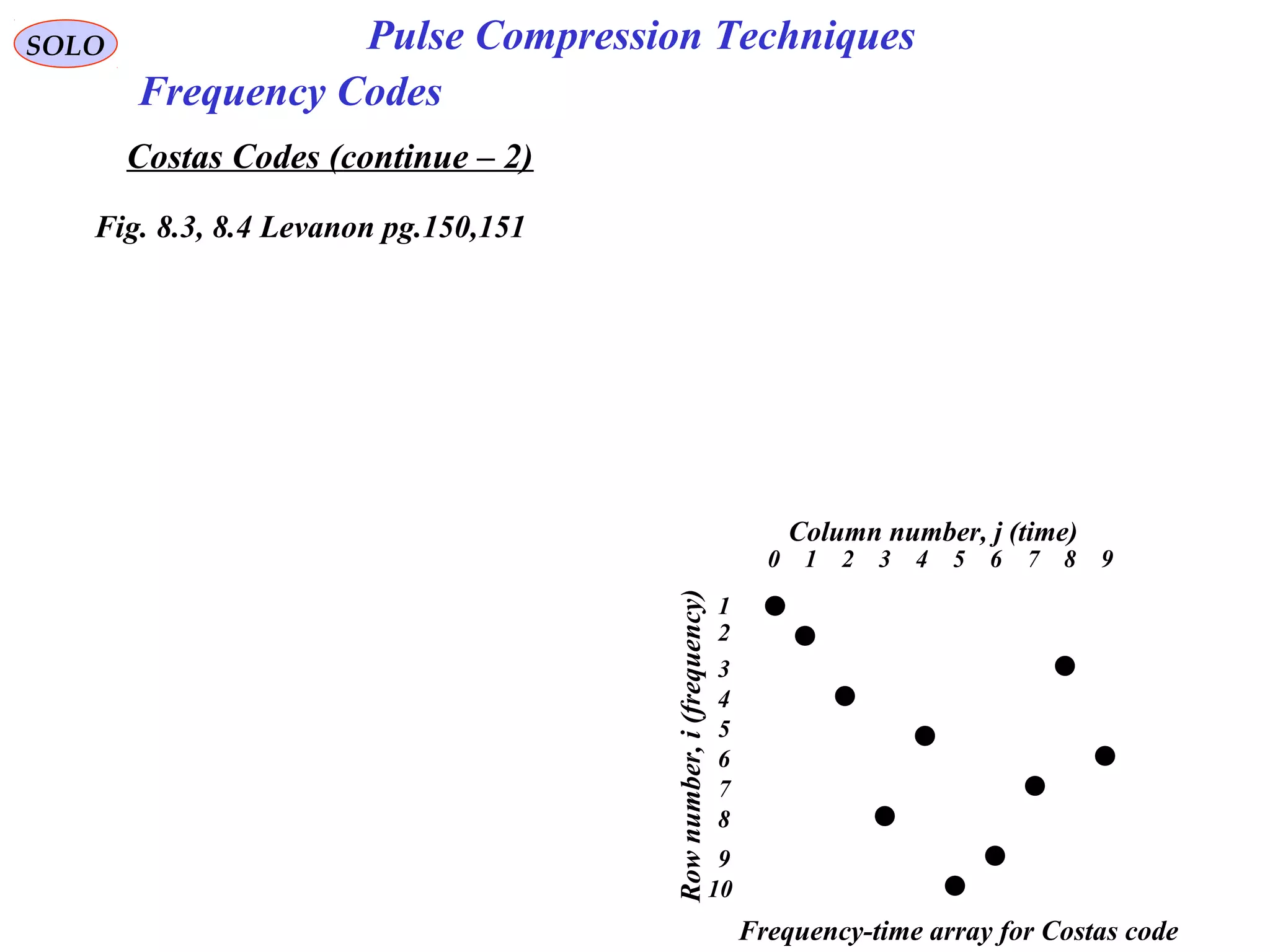
Fig. 8.3, 8.4 Levanon pg.150,151
SOLO Pulse Compression Techniques
Frequency Codes
Costas Codes (continue – 3)
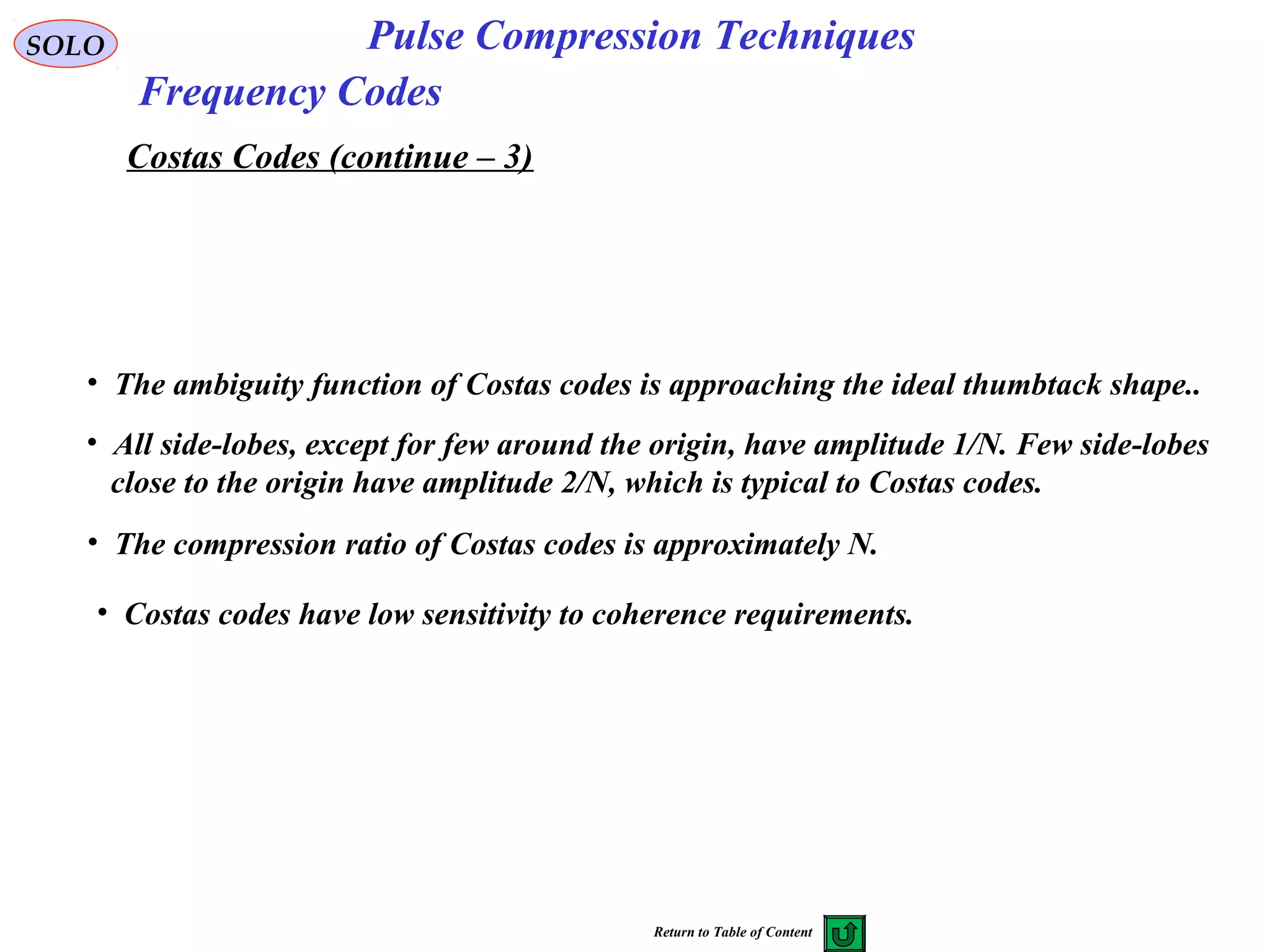
• All side-lobes, except for few around the origin, have amplitude 1/N. Few side-lobes
close to the origin have amplitude 2/N, which is typical to Costas codes.
• The compression ratio of Costas codes is approximately N.
• The ambiguity function of Costas codes is approaching the ideal thumbtack shape..
• Costas codes have low sensitivity to coherence requirements.
Return to Table of Content
SOLO Pulse Compression Techniques
Complementary Pulse Codes
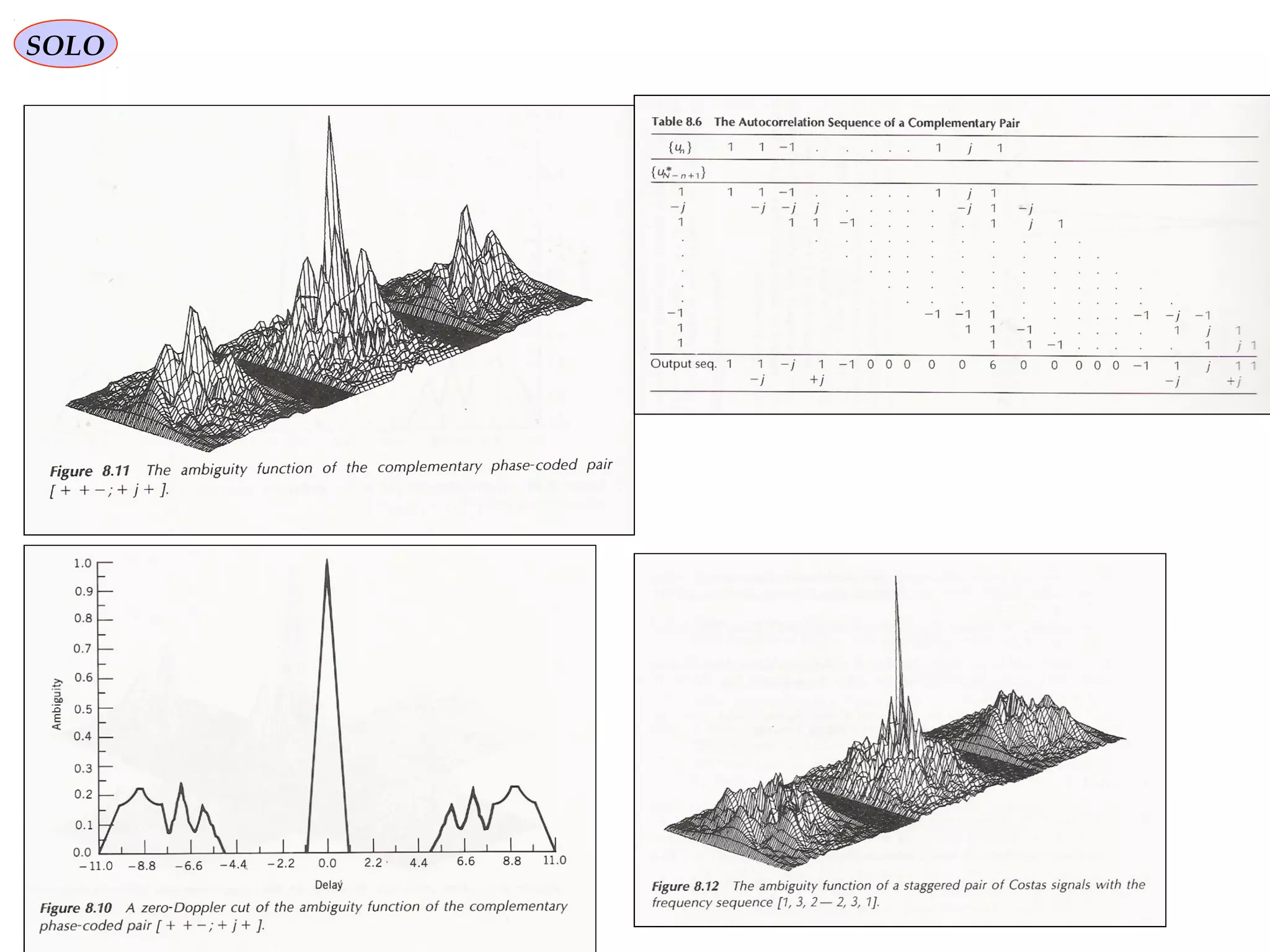
Complementary codes consist of a pair of codes with complementary
side-lobes, that is, their side-lobes are equal and opposite Golay, 1961).
SOLO
Bogler, P.L., “Radar Principles with Applications to Tracking Systems”,
John Wiley & Sons, 1989
References
SOLO Pulse Compression Techniques
Levanon, N., “Radar Principles”, John Wiley & Sons, 1988
Mahafza, B.R., “Radar System Analysis and Design Using MATLAB”,
Chapman & Hall/CRC, 2000
Nathanson, F.E., “Radar Design Principles”, McGraw-Hill, 1969
Morris, G.V., “Airborne Pulse Radar”, Artech House, 1988
Berkowitz, R.S. Ed., “Modern Radar – Analysis, Evaluation, and System Design”,
John Wiley & Sons, 1965
Richards, M.A., “Fundamentals of Radar Signal Processing”, Georgia Tech Course
ECE 6272, Spring 2000
“Principles of Modern Radar” Georgia Tech, 2004, Jim Scheer,
“Advanced Radar Waveforms”
Hermelin, S., “Matched Filters and Ambiguity Functions for RADAR Signals”,
Power Point Presentation
Return to Table of Content
January 20, 2015 62
SOLO
Technion
Israeli Institute of Technology
1964 – 1968 BSc EE
1968 – 1971 MSc EE
Israeli Air Force
1970 – 1974
RAFAEL
Israeli Armament Development Authority
1974 – 2013
Stanford University
1983 – 1986 PhD AA
SOLO
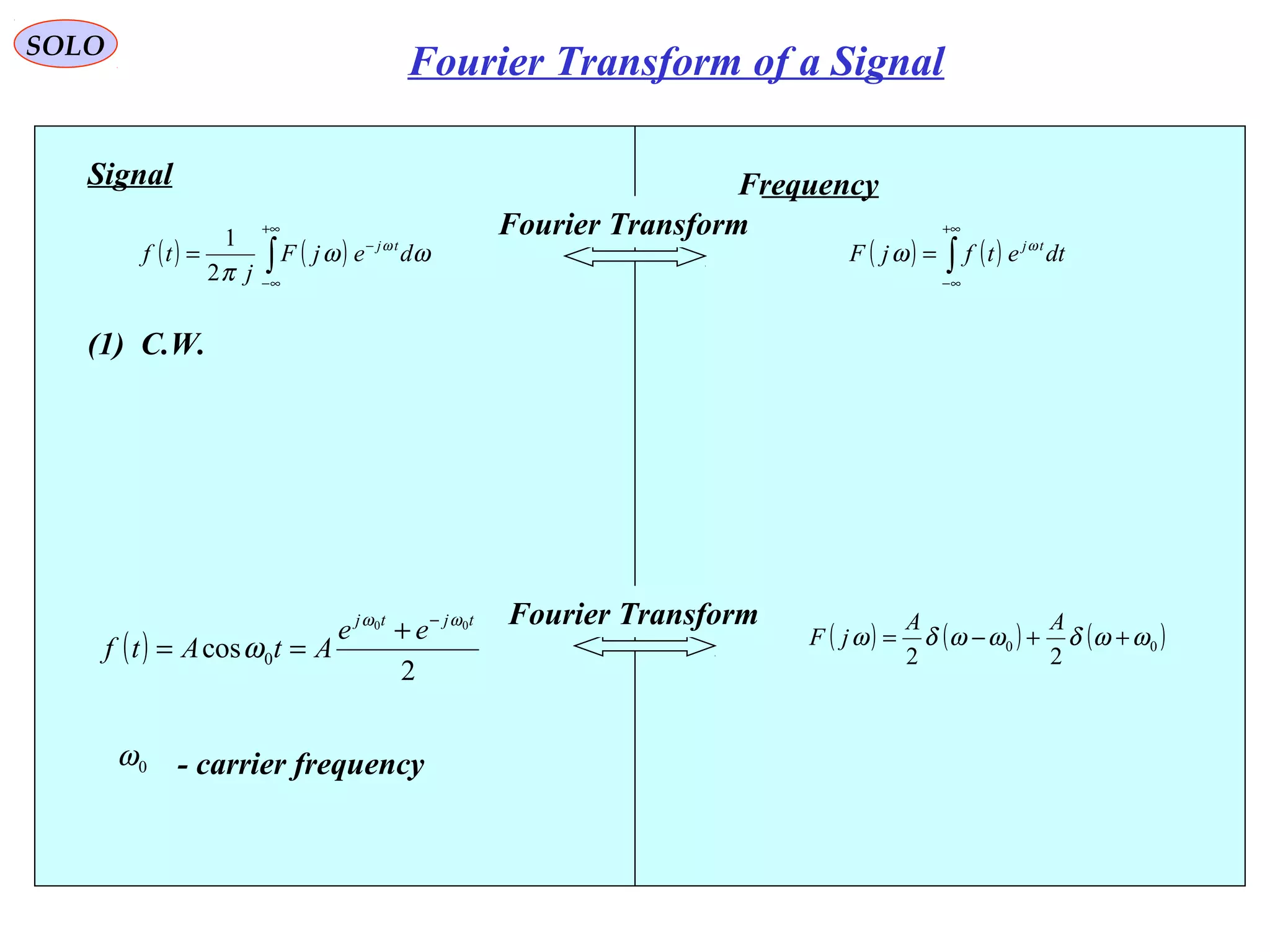
Fourier Transform of a Signal
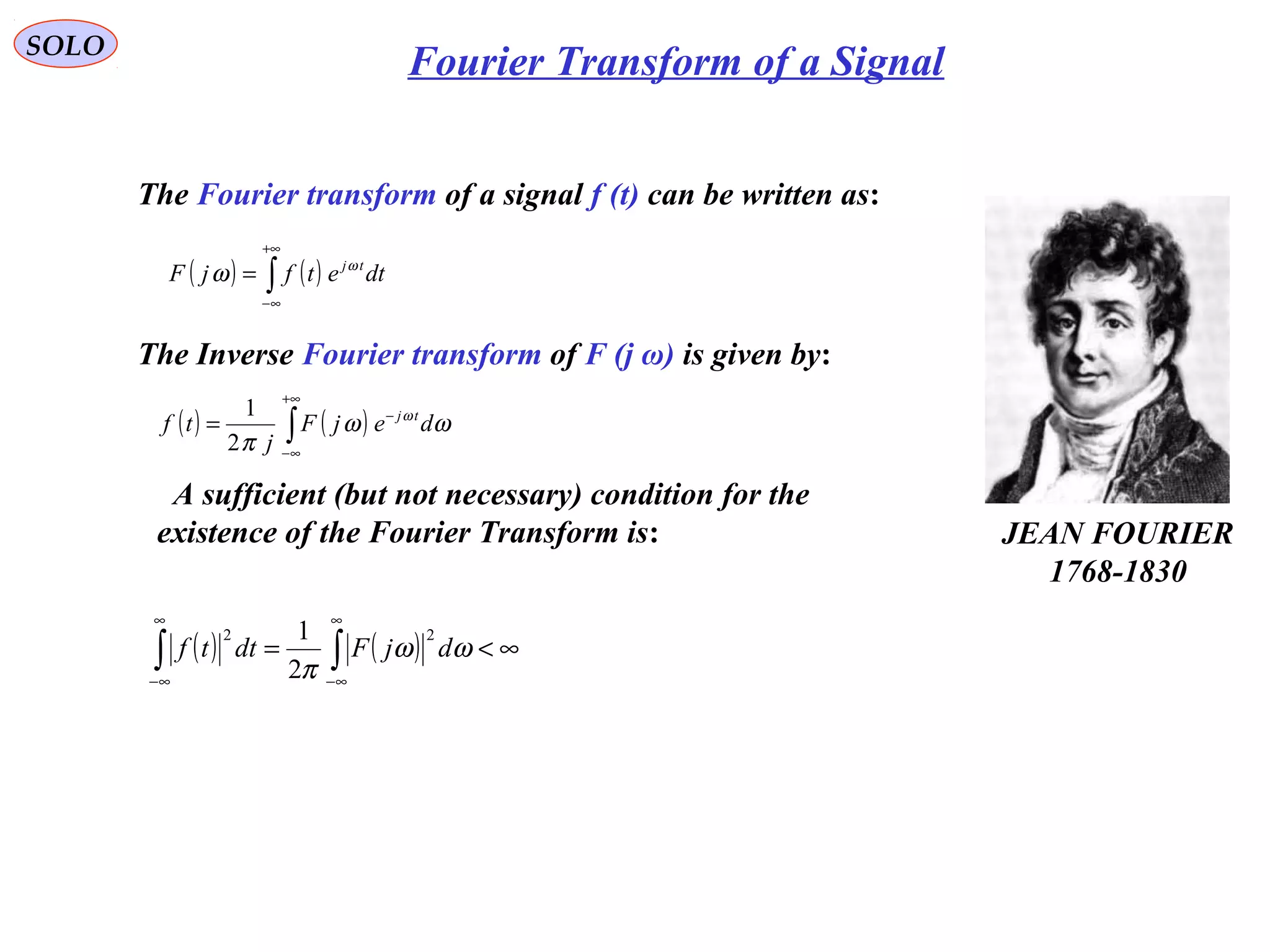
The Fourier transform of a signal f (t) can be written as:
A sufficient (but not necessary) condition for the
existence of the Fourier Transform is:
( ) ( ) ∞<= ∫∫
∞
∞−
∞
∞−
ωω
π
djFdttf
22
2
1
JEAN FOURIER
1768-1830
( ) ( )∫
+∞
∞−
−
= ωω
π
ω
dejF
j
tf tj
2
1
The Inverse Fourier transform of F (j ω) is given by:
( ) ( )∫
+∞
∞−
= dtetfjF tjω
ω
( ) ( )∫
+∞
∞−
−
= ωω
π
ω
dejF
j
tf tj
2
1
Signal
(1) C.W.
( )
2
cos
00
0
tjtj
ee
AtAtf
ωω
ω
−
+
==
0ω - carrier frequency
Frequency
( ) ( )∫
+∞
∞−
= dtetfjF tjω
ω
Fourier Transform
( ) ( ) ( )00
22
ωωδωωδω ++−=
AA
jF
Fourier Transform
SOLO
Fourier Transform of a Signal
( ) ( )∫
+∞
∞−
−
= ωω
π
ω
dejF
j
tf tj
2
1
Signal
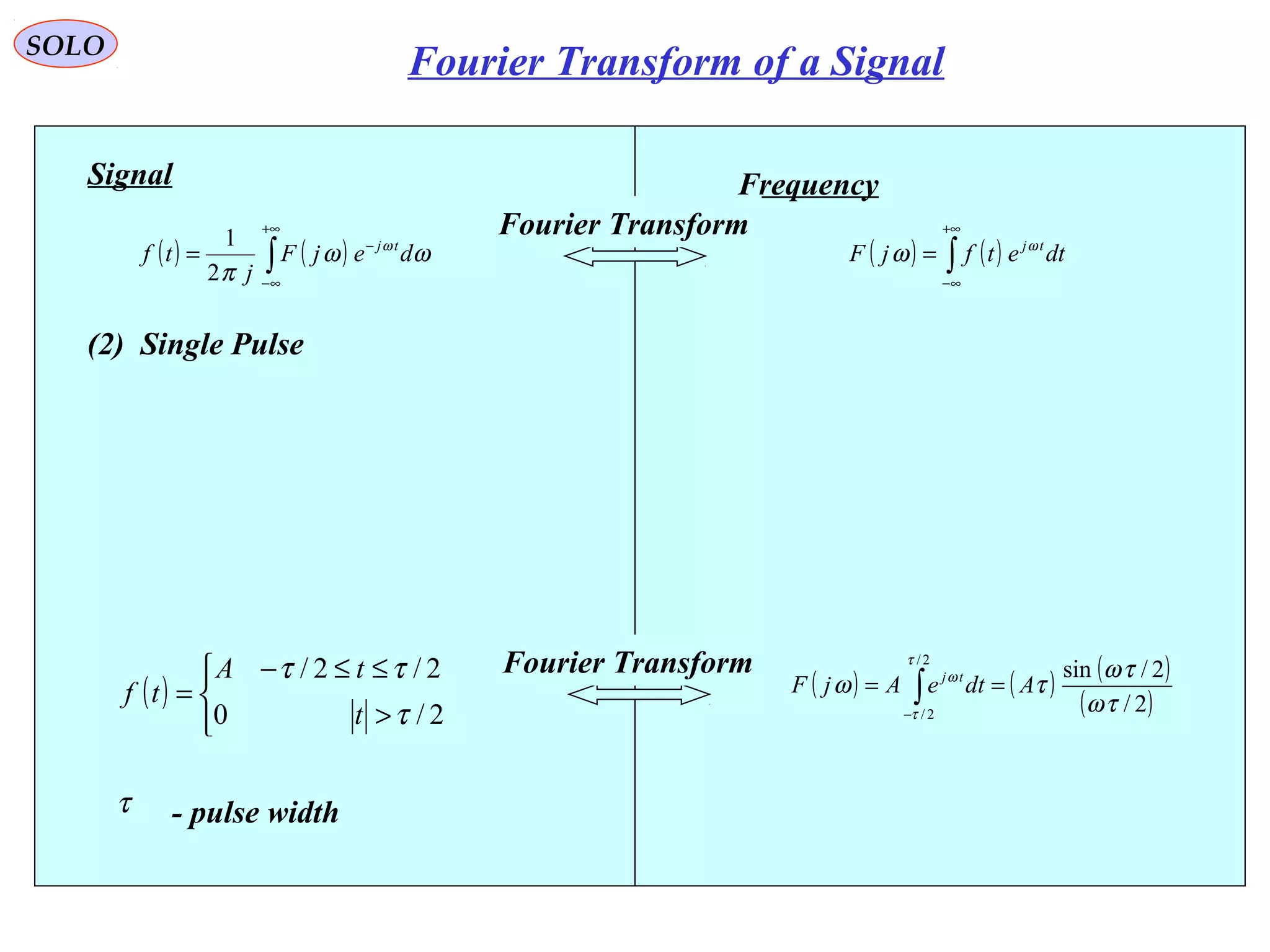
(2) Single Pulse
( )



>
≤≤−
=
2/0
2/2/
τ
ττ
t
tA
tf
τ - pulse width
Frequency
( ) ( )∫
+∞
∞−
= dtetfjF tjω
ω
Fourier Transform
( ) ( ) ( )
( )2/
2/sin
2/
2/
τω
τω
τω
τ
τ
ω
AdteAjF tj
== ∫−
Fourier Transform
SOLO
Fourier Transform of a Signal
( ) ( )∫
+∞
∞−
−
= ωω
π
ω
dejF
j
tf tj
2
1
Signal
( )
( )



>
≤≤−
=
2/0
2/2/cos 0
τ
ττω
t
ttA
tf
τ - pulse width
Frequency
( ) ( )∫
+∞
∞−
= dtetfjF tjω
ω
Fourier Transform
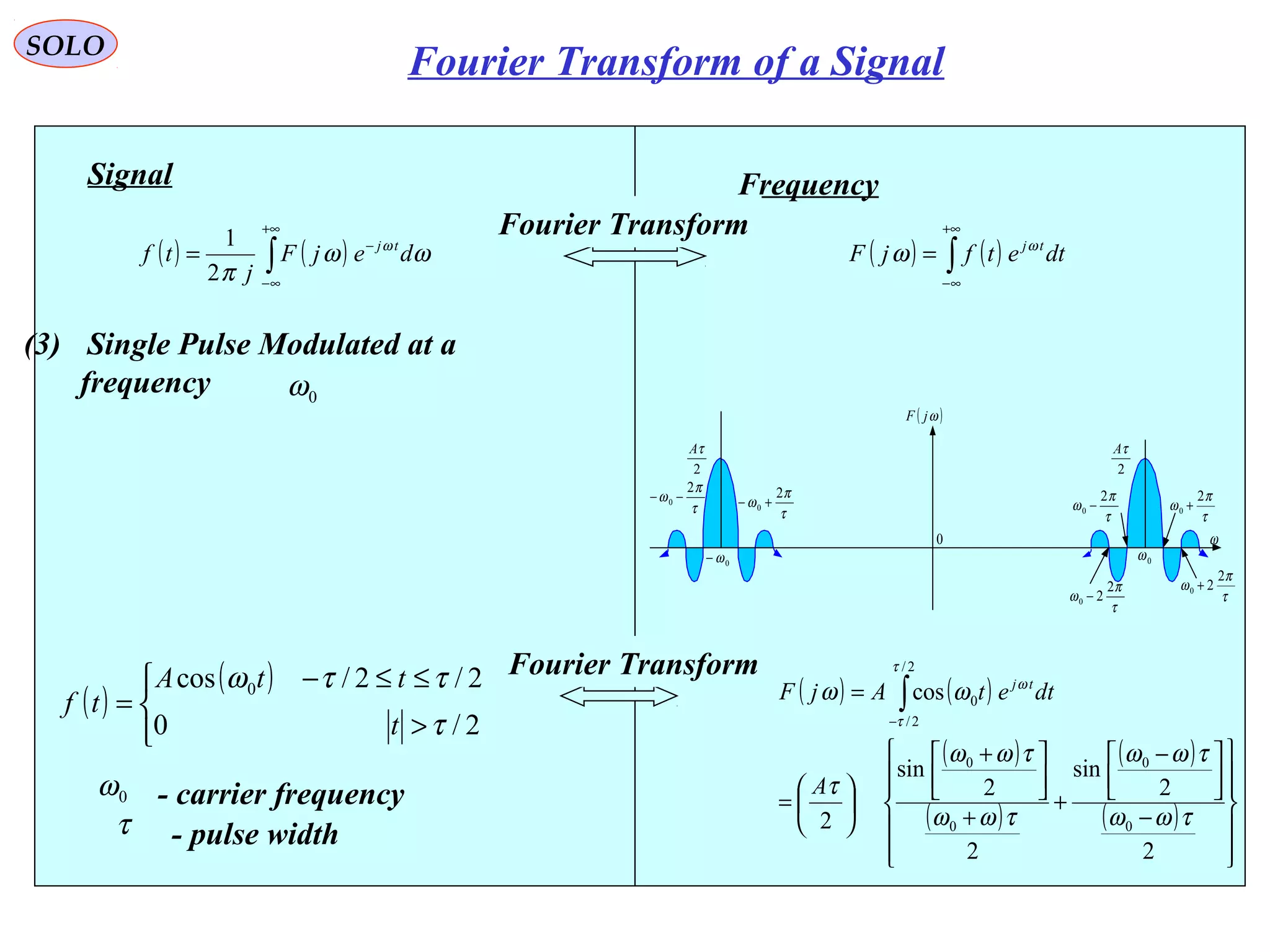
( ) ( )
( )
( )
( )
( )












−



 −
+
+



 +






=
= ∫−
2
2
sin
2
2
sin
2
cos
0
0
0
0
2/
2/
0
τωω
τωω
τωω
τωω
τ
ωω
τ
τ
ω
A
dtetAjF tj
Fourier Transform
0ω - carrier frequency
(3) Single Pulse Modulated at a
frequency 0ω
ω
( )ωjF
0
τ
π
ω
2
0 +
2
τA
0ω
τ
π
ω
2
0 −
τ
π
ω
2
0 +−
2
τA
0ω−
τ
π
ω
2
0 −−
τ
π
ω
2
20 +
τ
π
ω
2
20 −
SOLO
Fourier Transform of a Signal
( ) ( )∫
+∞
∞−
−
= ωω
π
ω
dejF
j
tf tj
2
1
Signal
( )
( )



±±=>−
≤−≤−+
=
,2,1,0,2/0
2/2/cos 0
kkkTt
kTttA
tf
rand
τ
ττϕω
τ - pulse width
Frequency
( ) ( )∫
+∞
∞−
= dtetfjF tjω
ω
Fourier Transform
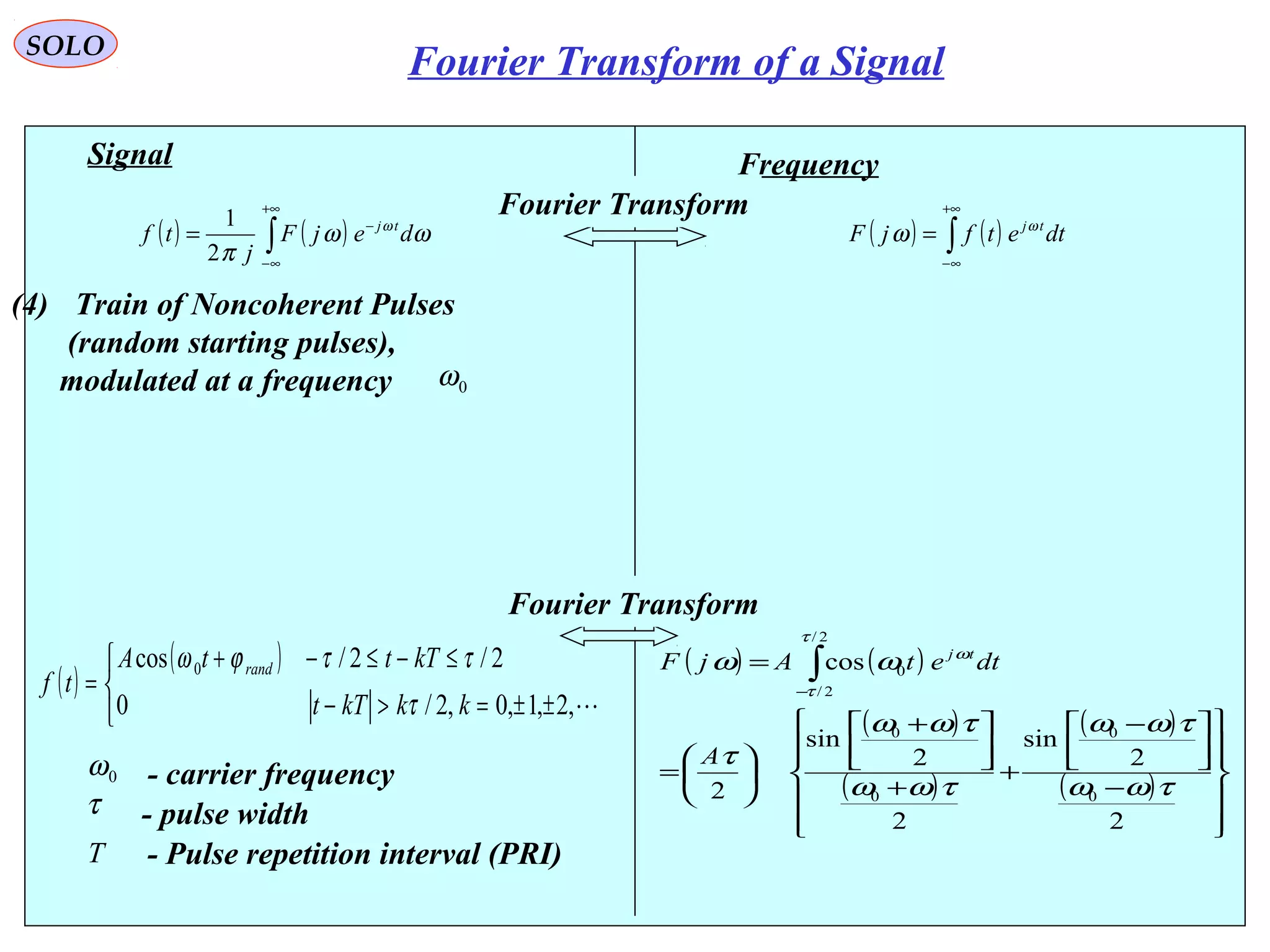
( ) ( )
( )
( )
( )
( )












−



 −
+
+



 +






=
= ∫−
2
2
sin
2
2
sin
2
cos
0
0
0
0
2/
2/
0
τωω
τωω
τωω
τωω
τ
ωω
τ
τ
ω
A
dtetAjF tj
Fourier Transform
0ω - carrier frequency
(4) Train of Noncoherent Pulses
(random starting pulses),
modulated at a frequency 0ω
T - Pulse repetition interval (PRI)
SOLO
Fourier Transform of a Signal
( ) ( )∫
+∞
∞−
−
= ωω
π
ω
dejF
j
tf tj
2
1
Signal
( )
( )
( ) ( )( ) ( )( )[ ]












−++












+=



±±=>−
≤−≤−
=
∑
∞
=1
000
0
coscos
2
2
sin
cos
,2,1,0,2/0
2/2/cos
n
PRPR
PR
PR
series
Fourier
tntn
n
n
t
T
A
kkkTt
kTttA
tf
ωωωω
τω
τω
ω
τ
τ
ττω

τ - pulse width
Frequency
( ) ( )∫
+∞
∞−
= dtetfjF tjω
ω
Fourier Transform
Fourier Transform
0ω - carrier frequency
5) Train of Coherent Pulses,
of infinite length,
modulated at a frequency 0ω
T - Pulse repetition interval (PRI)
( ) ( ) ( ){
( ) ( ) ( ) ( )[ ]






+−+−+−−++












+
−+=
∑
∞
=1
0000
00
2
2
sin
2
n
PRPRPRPR
PR
PR
nnnn
n
n
T
A
jF
ωωδωωδωωδωωδ
τω
τω
ωδωδ
τ
ω
T/1 - Pulse repetition frequency (PRF)
TPR /2πω =
SOLO
Fourier Transform of a Signal
( ) ( )∫
+∞
∞−
−
= ωω
π
ω
dejF
j
tf tj
2
1
Signal
( )
( )
( ) ( )( ) ( )( )[ ]












−++












+=



±±=>−
≤−≤−
=
∑
∞
=
≤≤−
1
000
22
0
coscos
2
2
sin
cos
2/,,2,1,0,2/0
2/2/cos
n
PRPR
PR
PRNT
t
NT
tntn
n
n
t
T
A
NkkkTt
kTttA
tf
ωωωω
τω
τω
ω
τ
τ
ττω

τ - pulse width
Frequency
( ) ( )∫
+∞
∞−
= dtetfjF tjω
ω
Fourier Transform
Fourier Transform
0ω - carrier frequency
6) Train of Coherent Pulses,
of finite length N T,
modulated at a frequency 0ω
T - Pulse repetition interval (PRI)
( )
( )
( )
( )
( )
( )
( )
( )
( )
( )
( )
( )
( )



















−−




−−
+
+−




+−












+
+




+
+



















−+




−+
+
++




++












+
+




+
=
∑
∑
∞
=
∞
=
1
0
0
0
0
0
0
1
0
0
0
0
0
0
2
2
sin
2
2
sin
2
2
sin
2
2
sin
2
2
sin
2
2
sin
2
2
sin
2
2
sin
2
n
PR
PR
PR
PR
PR
PR
n
PR
PR
PR
PR
PR
PR
TN
n
TN
n
TN
n
TN
n
n
n
TN
TN
TN
n
TN
n
TN
n
TN
n
n
n
TN
TN
T
A
jF
ωωω
ωωω
ωωω
ωωω
τω
τω
ωω
ωω
ωωω
ωωω
ωωω
ωωω
τω
τω
ωω
ωω
τ
ω
T/1 - Pulse repetition frequency (PRF)
TPR /2πω =
SOLO
Fourier Transform of a Signal
Signal
( ) ( )
























+=



±±=>−
≤−≤−
= ∑
∞
=1
1 cos
2
2
sin
21
,2,1,0,2/0
2/2/
n
PR
PR
PR
Series
Fourier
tn
n
n
T
A
kkkTt
kTtA
tf ω
τω
τω
τ
τ
ττ

τ - pulse width
0ω - carrier frequency
6) Train of Coherent Pulses,
of finite length N T,
modulated at a frequency 0ω
T - Pulse repetition interval (PRI)
T/1 - Pulse repetition frequency (PRF)
TPR /2πω =
( ) ( )tAtf 03 cos ω=
t
A A
( )tf1
t
2
τ
2
τ
−T
A
T T
2
2
τ+T
2
2
τ−T
T T
2
τ− 2
τ+T
( )tf2
t
TN
2/TN2/TN−
( ) ( ) ( ) ( )tftftftf 321 ⋅⋅=
( ) ( ) ( ) ( )
( )
( ) ( )( ) ( )( )[ ]












−++












+=



±±=>−
≤−≤−
=⋅⋅=
∑
∞
=
≤≤−
1
000
22
0
321
coscos
2
2
sin
cos
2/,,2,1,0,2/0
2/2/cos
n
PRPR
PR
PRNT
t
NT
tntn
n
n
t
T
A
NkkkTt
kTttA
tftftftf
ωωωω
τω
τω
ω
τ
τ
ττω

( )



>
≤≤−
=
2/0
2/2/1
2
TNt
TNtTN
tf ( ) ( )ttf 03 cos ω=
SOLO
Fourier Transform of a Signal
5 pulse compression waveform

5 pulse compression waveform

  • 1.
    Pulse Compression Waveform SOLOHERMELIN Updated: 27.10.08http://www.solohermelin.com
  • 2.
    Table of Content SOLO PulseCompression Waveform Resolution Pulse Range Resolution Pulse Compression Waveform Introduction Waveform Hierarchy Linear FM Modulated Pulse (Chirp) Barker Codes Combined Barker Codes Poly-Phase Codes Phase Coded Waveforms Matched Filter Response to Phase Coding Bi-Phase Codes
  • 3.
    Table of Content(continue – 1) SOLO Pulse Compression Waveform Poly-Phase Codes Frank Codes P1, P2, P3, P4 Poly-Phase Codes Pseudo-Random Codes Frequency Codes Costas Codes Complementary Pulse Codes Summary of Pulse Compression Codes References
  • 4.
    Range & DopplerMeasurements in RADAR SystemsSOLO Resolution Resolution is the spacing (in range, Doppler, angle, etc.) we must have in order to distinguish between two different targets. first target response second target response composite target response greather then 3 db Distinguishable Targets first target response second target response composite target response Undistinguishable Targets less then 3 db The two targets are distinguishable if the composite (sum) of the received signal has a deep (between the two picks) of at least 3 db. Return to Table of Content
  • 5.
    SOLO Unmodulated Pulse RangeResolution Resolution is the spacing (in range, Doppler, angle, etc.) we must have in order to distinguish between two different targets. Range Resolution RADAR τ c R RR ∆+ Target # 1 Target # 2 Assume two targets spaced by a range Δ R and a unmodulated radar pulse of τ seconds. The echoes start to be received at the radar antenna at times: 2 R/c – first target 2 (R+Δ R)/c – second target The echo of the first target ends at 2 R/c + τ τ τ time from pulse transmission c R2 ( ) c RR ∆+2 τ+ c R2 Received Signals Target # 1 Target # 2 The two targets echoes can be resolved if: c RR c R ∆+ =+ 22 τ 2 τc R =∆ Pulse Range Resolution ( ) ( )    ≤≤+ = elsewhere ttA ts 0 0cos : 0 τϕω
  • 6.
    Unmodulated Pulse SOLO Energy ( )( ) ( )∫∫∫ +∞ ∞− +∞ ∞− +∞ ∞− === ωω π dSdttsdttsEs 222 2 1 : ( ) ( )    ≤≤+ = elsewhere ttA ts 0 0cos : 0 τϕω ( ) ( ) ( )[ ] ( ) ( )       −+ +=++= +== ∫ ∫∫ +∞ ∞− τ ϕϕτωτ ϕω ϕω τ τ 000 2 0 00 2 0 2 00 2 2cos22cos 1 2 22cos1 2 cos A dtt A dttAdttsEs Unmodulated Pulse
  • 7.
    RADAR SignalsSOLO ( ) ()    ≤≤+ = elsewhere ttA ts 0 0cos : 0 τϕω Energy ( ) ( ) 2 2cos22cos 1 2 2 000 2 τ τ ϕϕτωτ A E A E ss =⇒      −+ += 2 τc R =∆ Pulse Range Resolution Decreasing Pulse Width Increasing Decreasing SNR, Radar Performance Increasing Increasing Range Resolution Capability Decreasing For the Unmodulated Pulse, there exists a coupling between Range Resolution and Waveform Energy. Return to Table of Content
  • 8.
    Pulse Compression WaveformsSOLO PulseCompression Waveforms permit a decoupling between Range Resolution and Waveform Energy. - An increased waveform bandwidth (BW) relative to that achievable with an unmodulated pulse of an equal duration τ 1 >>BW 22 τc BW c R <<=∆ - Waveform duration in excess of that achievable with unmodulated pulse of equivalent waveform bandwidth BW 1 >>τ PCWF exhibit the following equivalent properties: This is accomplished by modulating (or coding) the transmit waveform and compressing the resulting received waveform. Pulse Compression Waveform Introduction Return to Table of Content
  • 9.
    SOLO Waveform Hierarchy Radar Waveforms CWRadars Pulsed Radars Frequency Modulated CW Phase Modulated CW bi – phase & poly-phase Linear FMCW Sawtooth, or Triangle Nonlinear FMCW Sinusoidal, Multiple Frequency, Noise, Pseudorandom Intra-pulse Modulation Pulse-to-pulse Modulation, Frequency Agility Stepped Frequency Frequency Modulate Linear FM Nonlinear FM Phase Modulated bi – phase poly-phase Unmodulated CW Multiple Frequency Frequency Shift Keying Fixed Frequency
  • 10.
    SOLO Waveform Hierarchy • PulseCompression Techniques • Wave Coding • Frequency Modulation (FM) - Linear • Phase Modulation (PM)] - Non-linear - Pseudo-Random Noise (PRN) - Bi-phase (0º/180º) - Quad-phase (0º/90º/180º/270º) • Implementation • Hardware - Surface Acoustic Wave (SAW) expander/compressor • Digital Control - Direct Digital Synthesizer (DDS) - Software compression “filter” Return to Table of Content
  • 11.
  • 12.
  • 13.
    SOLO Waveform Hierarchy • PulseCompression Techniques
  • 14.
    SOLO Coherent PulseDoppler Radar Return to Table of Content
  • 15.
    SOLO Linear FM ModulatedPulse (Chirp) ( ) ( )2/cos 2 03 ttAtf ωω ∆+= t A 2/τ− 2/τ ( ) 222 cos 2 0 ττµ ω ≤≤−      += t t tAtsi Pulse Compression Waveforms Linear Frequency Modulation is a technique used to increase the waveform bandwidth BW while maintaining pulse duration τ, such that BW 1 >>τ 1>>⋅ BWτ 222 0 2 0 ττ µω µ ωω ≤≤−+=      += tt t t td d
  • 16.
    Matched Filters forRADAR Signals ( ) ( ) ( ) ( )    ≤≤−= = −∗ Ttttsth eSH i tj i 00 0ω ωω SOLO The Matched Filter (Summary( si (t) - Signal waveform Si (ω) - Signal spectral density h (t) - Filter impulse response H (ω) - Filter transfer function t0 - Time filter output is sampled n (t) - noise N (ω) - Noise spectral density Matched Filter is a linear time-invariant filter hopt (t) that maximizes the output signal-to-noise ratio at a predefined time t0, for a given signal si (t(. The Matched Filter output is: ( ) ( ) ( ) ( ) ( ) ( ) ( ) ( ) ( ) ( ) 0 0 00 tj iii iii eSSHSS dttssdthsts ω ωωωωω ξξξξξξ −∗ +∞ ∞− +∞ ∞− ⋅=⋅= +−=−= ∫∫
  • 17.
    SOLO Linear FM ModulatedPulse (continue – 1) Pulse Compression Waveforms Concept of Group Delay BW 1 >>τ τ BW 1 ( ) 222 cos 2 0 ττµ ω ≤≤−      += t t tAtsi ( ) ( ) 222 cos 2 0 00 ττµ ω ≤≤−      −=−= = t t tAtsth i t MF Matched Filter ( )tsi ( )tso ( ) ( )tsth i t MF −= =00 ( ) ( ) ( ) ( ) ( ) ( ) ( ) ( ) ( ) ( )ωωωωω ξξξξξξ ∗ = +∞ ∞− =+∞ ∞− ⋅=⋅= −=−= ∫∫ ii t i ii t i SSHSS dtssdthsts 0 0 0 0 0 0
  • 18.
    SOLO Linear FM ModulatedPulse (continue – 2) Pulse Compression Waveforms Concept of Group Delay (continue -1) BW 1 >>τ τ BW 1 ( ) 222 cos 2 0 ττµ ω ≤≤−      += t t tAtsi Matched Filter ( )tsi ( )tso ( ) ( )tsth i t MF −= =00 ( ) ( ) ( ) ( ) ( ) ( ) ( ) ( ) ( ) ( )ωωωωω ξξξξξξ ∗ = +∞ ∞− =+∞ ∞− ⋅=⋅= −=−= ∫∫ ii t i ii t i SSHSS dtssdthsts 0 0 0 0 0 0 ( ) ( ) ( ) ( )       >≤≤+− <+≤≤−       − +−      +=− 0 22 0 22 2 cos 2 cos 2 0 2 0 2 tt tt t tAtss ii τ ξ τ τ ξ τ ξµ ξω ξµ ξωξξ ( ) ( ) ( ) ( ) ( ) ∫∫ + +− >∞+ ∞− > =       − +−      +=−= 2/ 2/ 2 0 2 0 2 00 0 0 2 cos 2 cos 0 τ τ ξ ξµ ξω ξµ ξωξξξ t t ii t t d t tAdtssts ( ) ( ) 222 cos 2 0 00 ττµ ω ≤≤−      −=−= = t t tAtsth i t MF Ignoring terms of 2 ω0 ( ) ( ) ( ) ( ) ( ) t tttA t tttA t tttA dttt A ts tt t t µ µτµω µ µτµω µ µξµω ξµξµω τ τ τ τ 2/2/sin 2 2/2/sin 2 2/sin 2 2/cos 2 2 0 22 0 2 2/ 2/ 2 0 22/ 2/ 2 0 20 0 0 0 +− − −+ = −+ =−+≅ + +− + +− > = ∫ ( ) ( ) βαβαβα coscos2coscos =−++( )[ ] ( )∫∫ + +− + +− −+++−+−= 2/ 2/ 2 0 22/ 2/ 22 0 2 2/cos 2 2/2/2cos 2 τ τ τ τ ξµξµωξµξµξµξω tt dtt A dtt A
  • 19.
    SOLO Linear FM ModulatedPulse (continue – 3) Pulse Compression Waveforms Concept of Group Delay (continue -2) BW 1 >>τ τ BW 1 ( ) 222 cos 2 0 ττµ ω ≤≤−      += t t tAtsi Matched Filter ( )tsi ( )tso ( ) ( )tsth i t MF −= =00 ( ) ( ) ( ) ( ) ( ) ( ) ( ) ( ) ( ) ( )ωωωωω ξξξξξξ ∗ = +∞ ∞− =+∞ ∞− ⋅=⋅= −=−= ∫∫ ii t i ii t i SSHSS dtssdthsts 0 0 0 0 0 0 ( ) ( ) 222 cos 2 0 00 ττµ ω ≤≤−      −=−= = t t tAtsth i t MF Ignoring terms of 2 ω0 ( ) ( ) ( ) t tttA t tttA ts t t µ µτµω µ µτµω 2/2/sin 2 2/2/sin 2 2 0 22 0 20 0 0 0 +− − −+ ≅ > = ( ) ( )t tt tt tA ts t t 0 20 0 0 cos 1 2 1 2 sin 1 2 0 ω τ τµ τ τµ τ τ       −             −       −≅ > = ( ) ( ) βαβαβα sincos2sinsin =−−+       −== τ τµ βωα tt t 1 2 ,0 If we re-due for t < 0 and combine, we obtain ( ) ( )t tt tt tA ts t 0 20 0 cos 1 2 1 2 sin 1 2 0 ω τ τµ τ τµ τ τ       −                 −         −≅ =
  • 20.
    SOLO ( ) ()2/cos 2 03 ttAtf ωω ∆+= t A 2/τ− 2/τ Linear FM Modulated Pulse (continue – 4) ( ) 222 cos 2 0 ττµ ω ≤≤−      += t t tAtsi The Fourier Transform is: ( ) [ ] ( ) ( )∫∫ ∫ −− −             ++−+             +−= −      += 2/ 2/ 2 0 2/ 2/ 2 0 2/ 2/ 2 0 2 exp 2 1 2 exp 2 1 exp 2 cos τ τ τ τ τ τ µ ωω µ ωω ω µ ωω dt t tjAdt t tjA dttj t tASi ∫∫ −−               + +−               + +               − −               − −= 2/ 2/ 2 0 2 0 2/ 2/ 2 0 2 0 2 exp 2 exp 22 exp 2 exp 2 τ τ τ τ µ ωωµ µ ωω µ ωωµ µ ωω dttjj A dttjj A Change variables: xt =      − − µ ωω π µ 0 yt =      + + µ ωω π µ 0 ( ) ∫∫ −−       −               + +                     − −= 2 1 2 1 2 exp 2 exp 22 exp 2 exp 2 2 2 0 2 2 0 Y Y X X i dt y jj A dt x jj A S π µ ωωπ µ ωω ω       − −=      − += µ ωωτ π µ µ ωωτ π µ 0 2 0 1 2 & 2 XX       + −=      + += µ ωωτ π µ µ ωωτ π µ 0 2 0 1 2 & 2 YY Define: ( )f n f ∆=−=∆ πωωτµ π 2 2 & 2 1 : 0 Pulse Compression Waveforms
  • 21.
    SOLO ( ) ()2/cos 2 03 ttAtf ωω ∆+= t A 2/τ− 2/τ Linear FM Modulated Pulse (continue – 5) ( ) 222 cos 2 0 ττµ ω ≤≤−      += t t tAtsi The Fourier Transform is: ( ) ( ) ( ) ∫∫ −−       −      + +             − −= 2 1 2 1 2 exp 2 exp 22 exp 2 exp 2 22 0 22 0 Y Y X X i dt y jj A dt x jj A S π µ ωωπ µ ωω ω The first part gives the spectrum around ω = ω0, and the second part around ω = -ω0 : where: are Fresnel Integrals, which have the properties: ( ) ( ) ∫∫ == UU dz z USdz z UC 0 2 0 2 2 sin& 2 cos ππ ( ) ( ) ( ) ( )USUSUCUC −=−−=− & ( ) ( ) ( ) ( ) ( ) ( )[ ] ( ) ( ) ( ) ( ) ( )[ ] ( ) ( )−+ ++−=−+−      − + +++      − −= ωωωω µ ωω µ π µ ωω µ π ω 002211 2 0 2211 2 0 2 exp 2 2 exp 2 ii i SSYSjYCYSjYCj A XSjXCXSjXCj A S ωωωπωτµ π ∆=−∆=∆=∆ 2 :&2: 2 1 : 0 n ff Pulse Compression Waveforms
  • 22.
    SOLO Fresnel Integrals Augustin JeanFresnel 1788-1827 Define Fresnel Integrals ( ) ( ) ( ) ( ) ( ) ( ) ( ) ( )∫ ∑ ∑∫ ∞ = + ∞ = + + −=      = ++ −=      = α α αα π α αα π α 0 0 14 2 0 34 0 2 !214 1 2 sin: !1234 1 2 cos: n n n n n n nn x dS nn x dC ( ) ( )αααα πα SjCdj +=      ∫0 2 2 exp ( ) ( ) 5.0±=∞±=∞± SC ( ) ( ) ( ) ( )USUSUCUC −=−−=− & The Cornu Spiral is defined as the plot of S (u) versus C (u) duuSd duuCd       =       = 2 2 2 sin 2 cos π π ( ) ( ) duSdCd =+ 22 Therefore u may be thought as measuring arc length along the spiral.
  • 23.
    SOLO ( ) ()2/cos 2 03 ttAtf ωω ∆+= t A 2/τ− 2/τ Linear FM Modulated Pulse (continue – 6) ( ) 222 cos 2 0 ττµ ω ≤≤−      += t t tAtsi The Fourier Transform is: ωωωπωτµ π ∆=−∆=∆=∆ 2 :&2: 2 1 : 0 n ff Define: ( ) ( ) ( )[ ] ( ) ( )[ ]{ }2 21 2 210 2 XSXSXCXC A Si +++=− + µ π ωωAmplitude Term: Square Law Phase Term: ( ) ( ) µ ωω ω 2 2 0 1 − −=Φ Residual Phase Term: ( ) ( ) ( ) ( ) ( ) 4 1tan 5.05.0 5.05.0 tantan 11 1 21 211 2 π ω τ == + + → + + =Φ −− >>∆ − f XCXC XSXS ( ) ( )nfXnfX −∆=+∆= 1 2 &1 2 21 ττ ( ) ( ) ( ) ( ) ( ) ( )[ ] ( ) ( ) ( ) ( ) ( )[ ] ( ) ( )−+ ++−=−+−      − + +++      − −= ωωωω µ ωω µ π µ ωω µ π ω 002211 2 0 2211 2 0 2 exp 2 2 exp 2 ii i SSYSjYCYSjYCj A XSjXCXSjXCj A S ( )ω2Φ( ) + − ωω0iS Pulse Compression Waveforms
  • 24.
    SOLO Linear FM ModulatedPulse (continue – 7) Pulse Compression Waveforms Linear FM Modulated Pulse (Chirp) Summary • Chirp is one of the most common type of pulse compression code • Chirp is simple to generate and compress using IF analog techniques, for example, surface acoustic waves (SAW) devices. • Large pulse compression ratios can be achieved (50 – 300). • Chirp is relative insensitive to uncompressed Doppler shifts and can be easily weighted for side-lobe reduction. • The analog nature of chirp sometimes limits its flexibility. • The very predictibility of chirp mades it asa poor choice for ECCM purpose. Return to Table of Content
  • 25.
    SOLO Pulse Compression Techniques PhaseCoded Waveforms • Phase Coded Waveforms consists of N contiguous sub-pulses where the phase of each pulse is chosen to shape the range sidelobe response at the output of the matched filter. - sub-pulse length = τ - total length = N τ Poly-phase codes allow for any of M phase shifts on a sub-pulse basis, where M is called the order of the code and the possible phase states are φi = (2π/M) i, for i = 1,…,M
  • 26.
    SOLO Pulse Compression Techniques PhaseCoding A transmitted radar pulse of duration τ is divided in N sub-pulses of equal duration τ’ = τ /N, and each sub-pulse is phase coded in terms of the phase of the carrier. The complex envelope of the phase coded signal is given by: ( ) ( ) ( )∑ − = −= 1 0 2/1 ' ' 1 N n n ntu N tg τ τ where: ( ) ( )    ≤≤ = elsewhere tj tu n n 0 '0exp τϕ Return to Table of Content
  • 27.
    Matched Filters forRADAR SignalsSOLO Matched Filter Response to Phase Coding ( ) ( ) ( ) ( ) ( )tjtgtjtgts 00 exp 2 1 exp 2 1 ωω −+= ∗ ( ) ( ) ( )    ∆<< =∆−= ∑ − = elsewhere tt tftptfctg M p p 0 011 0 Let the signal be a phase-modulated carrier, in which the modulation is in discrete and equal steps Δt. The complex envelope of the signal can be described by a sequence of complex numbers , such thatkc ( ) [ ] ( ) ( )∫ +∞ ∞− ∗ +−−= dtttgtgtjgo 000exp 2 1 τωτ Constant Phase Matched Filter output envelope (change t ↔τ): ( )ttk ∆<≤+∆→ τττ 0 tMt ∆=0 ( ) [ ] ( ) ( )[ ] [ ] ( )[ ] ( ) ∑ ∫ ∫∑ − = ∆+ ∆ ∗ +∞ ∞− ∗ − = ∆−+−∆−= ∆−+−∆−∆−=+∆ 1 0 1 0 1 0 0 exp 2 1 exp 2 1 M p tp tp p M p po dttkMtgctMj dttkMtgtptfctMjtkg τω τωτ Change variable of integration to t1 = t – τ + (M - k) Δt ( ) [ ] ( ) ( ) ( ) ∑ ∫ − = −∆+−+ −∆−+ ∗ ∆−=+∆ 1 0 1 110exp 2 1 M p tkMp tkMp po dttgctMjtkg τ τ ωτ
  • 28.
    Matched Filters forRADAR SignalsSOLO Matched Filter Response to Phase Coding (continue – 1( Matched Filter output envelope for a Phase Coding is: ( ) [ ] ( )[ ] ( ) ∑ ∫ − = ∆+ ∆ ∗ ∆−+−∆−=+∆ 1 0 1 0exp 2 1 M p tp tp po dttkMtgctMjtkg τωτ Change variable of integration to t1 = t – τ + (M - k) Δt ( ) [ ] ( ) ( ) ( ) [ ] ( ) ( ) ( ) ( ) ( ) ( ) ∑ ∫∫∑ ∫ − = −∆+−+ ∆−+ ∗ ∆−+ −∆−+ ∗ − = −∆+−+ −∆−+ ∗         +∆−=∆−=+∆ 1 0 1 11110 1 0 1 110 exp 2 1 exp 2 1 M p tkMp tkMp tkMp tkMp p M p tkMp tkMp po dttgdttgctMjdttgctMjtkg τ τ τ τ ωωτ ( ) ( ) ( ) ( ) ( ) ( ) τ τ −∆+−+<<∆−+= ∆−+<<−∆−+= −+ ∗ −−+ ∗ tkMpttkMpctg tkMpttkMpctg kMp kMp 11 * 1 11 * 1 ( ) [ ] ∑ ∫∫ − = −∆ −+ − −−+         +∆−=+∆ 1 0 0 1 * 0 11 * 0exp 2 1 M p t kMpkMppo dtcdtcctMjtkg τ τ ωτ ( ) [ ] ∑ − = −+−−+             ∆ −+      ∆ ∆− ∆ =+∆ 1 0 * 1 * 0 1exp 2 1 M p kMpkMppo t c t cctMj t tkg ττ ωτ This equation describes straight lines in the complex plane, that can have corners only at τ = 0. At those corners ( ) [ ] ∑ − = −+∆− ∆ =∆ 1 0 * 0exp 2 1 M p kMppo cctMj t tkg ω Constant Phase
  • 29.
    Matched Filters forRADAR SignalsSOLO Matched Filter Response to Phase Coding (continue – 2( Matched Filter output envelope for a Phase Coding is: ( ) [ ] ∑ − = −+−−+             ∆ −+      ∆ ∆− ∆ =+∆ 1 0 * 1 * 0 1exp 2 1 M p kMpkMppo t c t cctMj t tkg ττ ωτ This equation describes straight lines in the complex plane, that can have corners only at τ = 0. At those corners ( ) [ ] ∑ − = −+∆− ∆ =∆ 1 0 * 0exp 2 1 M p kMppo cctMj t tkg ω Constant Phase We can see that is the discrete autocorrelation function for the observation time t0 = M Δt (the time the received Radar signal return is expected) ∑ − = −+ 1 0 * M p kMpp cc
  • 30.
    Matched Filters forRADAR SignalsSOLO Matched Filter Response to Phase Coding (continue – 3( Example: Pulse poly-phase coded of length 4 Given the sequence: { } 1,,,1 −−++= jjck which corresponds to the sequence of phases 0◦, 90◦, 270◦ and 180◦, the matched filter is given in Figure bellow. { } 1,,,1 * −+−+= jjck
  • 31.
    Pulse poly-phase codedof length 4 At the Receiver the coded pulse enters a 4 cells delay lane (from left to right), a bin at each clock. The signals in the cells are multiplied by -1,+j,-j or +1 and summed. clock SOLO Poly-Phase Modulation -1 = -11 1+ -j +j = 02 1+j+ +j -1-j = -13 1+j+j− +1 +1+1+1 = 44 1+j+j−1− -j-1+j = -1 5 j+j−1− +j - j = 0 6 j−1− 7 1− -1 = -1 8 0 Σ { } 1,,,1 −−++= jjck 1− 1+j+ j− {ck*} 0 = 00 0 1 2 3 4 5 6 7 { } 1,,,1* −+−+= jjck Return to Table of Content
  • 32.
    SOLO Pulse Compression Techniques Bi-PhaseCodes • easy to implement • significant range sidelobe reduction possible • Doppler intolerant A bi-phase code switches the absolute phase of the RF carrier between two states 180º out of phase. Bandwidth ~ 1/τ Transmitted Pulse Received Pulse • Peak Sidelobe Level PSL = 10 log (maximum side-lobe power/ peak response power) • Integrated Side-lobe Level ISL = 10 log (total power in the side-lobe/ peak response power) Bi-Phase Codes Properties The most known are the Barker Codes sequence of length N, with sidelobes levels, at zero Doppler, not higher than 1/N. Return to Table of Content
  • 33.
    SOLO Pulse CompressionTechniques Bi-Phase Codes Length N Barker Code PSL (db) ISL (db) 2 + - - 6.0 - 3.0 2 + + - 6.0 - 3.0 3 + + - - 9.5 - 6.5 3 + - + - 9.5 - 6.5 4 + + - + - 12.0 - 6.0 4 + + + - - 12.0 - 6.0 5 + + + - + - 14.0 - 8.0 7 + + + - - + - - 16.9 - 9.1 11 + + + - - - + - - + - - 20.8 - 10.8 13 + + + + + - - + + - + - + - 22.3 - 11.5 Barker Codes -Perfect codes – Lowest side-lobes for the values of N listed in the Table.
  • 34.
    -1 Pulse bi-phase Barkercoded of length 3 Digital Correlation At the Receiver the coded pulse enters a 3 cells delay lane (from left to right), a bin at each clock. The signals in the cells are multiplied according to ck* sign and summed. clock -1 = -11 +1 -1 = 02 -( +1) = -15 0 = 06 +1 +1-( -1) = 33 +1-( +1) = 04 SOLO Pulse Compression Techniques 1 2 3 4 5 6 0 +1+1 0 = 00
  • 35.
    Pulse bi-phase Barkercoded of length 5 Digital Correlation At the Receiver the coded pulse enters a 7 cells delay lane (from left to right), a bin at each clock. The signals in the cells are multiplied by ck* and summed. clock SOLO Pulse Compression Techniques +1-1+1+1+1 { }* kc +1 = +11 +1 = 19 0 = 010 2 -1 +1 = 0 +1 +1 -1-( +1) = 04 +1 +1 +1 –(-1)+1 = 55 0 = 00 3 +1-1 +1 = 1 +1 +1 -(+1) -1 = 06 +1-( +1) +1 = 17 –(+1) +1 = 08
  • 36.
    Pulse bi-phase Barkercoded of length 7 Digital Correlation At the Receiver the coded pulse enters a 7 cells delay lane (from left to right), a bin at each clock. The signals in the cells are multiplied by ck* and summed. clock -1 = -11 +1 -1 = 02 -1 +1 -1 = -13 -1 -1 +1-( -1) = 04 +1 -1 -1 –(+1)-( -1) = -15 +1 +1 -1-(-1) –(+1)-1= 06 +1+1 +1-( -1)-(-1) +1-(-1)= 77 +1+1 –(+1)-( -1) -1-( +1)= 08 +1-(+1) –(+1) -1-( -1)= -19 -(+1)-(+1) +1 -( -1)= 010 -(+1)+1-(+1) = -111 +1-(+1) = 012 -(+1) = -1 13 0 = 014 SOLO Pulse Compression Techniques -1-1 -1+1+1+1+1 { }* kc
  • 37.
    Pulse bi-phase codedof length 8 Digital Correlation At the Receiver the coded pulse enters a 8 cells delay lane (from left to right), a bin at each clock. The signals in the cells are multiplied by ck* and summed. clock SOLO Pulse Compression Techniques +1 = 11 -1-1 -1+1+1+1+1 { }* kc+1 -1 +1 = 02 -1 -1 +1 = -13 +1 -1 -1-( +1) =-24 -1 +1 -1 –(-1)+1= 15 +1 -1 +1-(-1) -1–(+1)= 06 1+1 -1-( +1)-1 –(-1)-(+1)=- 17 +1+1+1 –(-1)+1-( -1) -( -1)+1= 88 +1+1 –(+1) -1-( +1)-(-1) -1= -19 +1-(+1)+1-(-1) -( +1)-1= 010 -(+1)+1-(+1)-(-1)+1 = 111 +1-(+1)-(+1)-1 = -212 -(+1)-(+1)+1 = -113 -(+1)+1 = 014 +1 = 115
  • 38.
    SOLO Pulse CompressionTechniques Bi-Phase Codes Combined Barker Codes One scheme of generating codes longer than 13 bits is the method of forming combined Barker codes using the known Barker codes. For example to obtain a 20:1 pulse compression rate, one may use either a 5x4 or a 4x5 codes. The 5x4 Barker code (see Figure) consists of the 5 Barker code, each bit of which is the 4-bit Barker code. The 5x4 combined code is the 20-bit code. • Barker Code 4 • Barker Code 5
  • 39.
    SOLO Pulse CompressionTechniques Bi-Phase Codes
  • 40.
    SOLO Pulse CompressionTechniques Bi-Phase Codes Binary Phase Codes Summary • Binary phase codes (Barker, Combined Barker) are used in most radar applications. • Binary phase codes can be digitally implemented. It is applied separately to I and Q channels. • Binary phase codes are Doppler frequency shift sensitive. • Barker codes have good side-lobe for low compression ratios. • At Higher PRFs Doppler frequency shift sensitivity may pose a problem. Return to Table of Content
  • 41.
    SOLO Pulse CompressionTechniques Poly-Phase Codes Frank Codes In this case the pulse of width τ is divided in N equal groups; each group is subsequently divided into other N sub-pulses each of width τ’. Therefore the total number of sub-pulses is N2 , and the compression ratio is also N2 . A Frank code of N2 sub-pulses is called a N-phase Frank code. The fundamental phase increment of the N-phase Frank code is: N/360 =∆ ϕ For N-phase Frank code the phase of each sub-pulse is computed from: ( ) ( ) ( ) ( ) ( ) ϕ∆                 −−−− − − 2 1131210 126420 13210 00000 NNNN N N      Each row represents the phases of the sub-pulses of a group
  • 42.
    SOLO Pulse CompressionTechniques Poly-Phase Codes Frank Codes (continue – 1) Example: For N=4 Frank code. The fundamental phase increment of the 4-phase Frank code is:  904/360 ==∆ ϕ We have:               −− −− −− ⇒               → jj jjj form complex 11 1111 11 1111 901802700 18001800 270180900 0000 90     Therefore the N = 4 Frank code has the following N2 = 16 elements { }jjjjF 11111111111116 −−−−−−= The phase increments within each row represent a stepwise approximation of an up- chirp LFM waveform.
  • 43.
    SOLO Pulse CompressionTechniques Poly-Phase Codes Frank Codes (continue – 2) Example: For N=4 Frank code (continue – 1). If we add 2π phase to the third N=4 Frank phase row and 4π phase to the forth (adding a phase that is a multiply of 2π doesn’t change the signal) we obtain a analogy to the discrete FM signal. If we use then the phases of the discrete linear FM and the Frank-coded signals are identical at all multipliers of τ’. '/1 τ=∆ f
  • 44.
    SOLO Pulse CompressionTechniques Poly-Phase Codes Frank Codes (continue – 3) Fig. 8.8 Levanon pg.157
  • 45.
    SOLO Pulse CompressionTechniques Poly-Phase Codes Frank Codes (continue – 4) Fig. 8.8 Levanon pg.158,159
  • 46.
    SOLO Pulse CompressionTechniques Poly-Phase Codes Frank Codes (continue – 5) Return to Table of Content
  • 47.
    SOLO Pulse CompressionTechniques P1, P2, P3, P4 Poly-Phase Codes The phase-code pulses envelope is given by: ( ) ( ) ( ) ∑=       −− = N m m mt recj NT tg 1 ' 1 exp 1 τ ϕ The phases φm are chosen such that the autocorrelation function has the smallest Peak-to-sidelobe ratio (PSR), for a certain code length. PSR is bounded from bellow by the code length N ( )NPSR log20= Binary phase codes use only φm=0 or π. The main drawback of binary codes, such as Barker codes or m-sequences is their sensitivity to Doppler shift. Poly-phase codes are not restricted on code elements and are generated from phase history of frequency-modulated pulse. The Frank code and the P1 and P2 codes, The modified version of Frank code, are derived from the linear stepped frequency Modulation. These three codes are only applicable for perfect square length (N = L2 ), and can be expressed as: ( ) ( ) ( ) ( )[ ] ( )[ ] ( )[ ] ( )[ ]jLiL L P jLiLj L P ji L Frank ji ji ji −+−+= −−−+−= −−= 2/12/1 2 :2 1211 2 :1 11 2 : , , , π ϕ π ϕ π ϕ
  • 48.
    SOLO Pulse CompressionTechniques ( ) ( ) ( ) ( )Nii N P oddNNiii N evenNNii N P i i −−−=       =− =− = 11:4 ;,,2,1;1 ;,,2,1;1 :3 2 π ϕ π π ϕ   Another two well known poly-phase codes are P3 and P4 derived from linear frequency modulated pulse. Unlike Frank, P1 and P2 codes, P3 and P4 code lengths are arbitrary. P3 and P4 codes can be expressed as: It is known that Frank, P1 and P2 codes are more Doppler shift insensitive than binary codes, but P3 and P4 are even better. P1, P2, P3, P4 Poly-Phase Codes
  • 49.
    SOLO Pulse CompressionTechniques P1, P2, P3, P4 Poly-Phase Codes P4, N = 25 Elements
  • 50.
    SOLO Pulse CompressionTechniques Frank, P1, P2, P3, P4 Codes Summary • Frank, P1, P2, P3, P4 Codes are digital versions of the chirp • They are insensitive to Doppler frequency shift provided that fmax . τ’ < 0.3 but more sensitive then chirp. • They can have very long length.. P1, P2, P3, P4, P(n,k) Poly-Phase Codes Return to Table of Content
  • 51.
    SOLO Pseudo-Random Codes Pseudo-Random Codesare binary-valued sequences similar to Barker codes. The name pseudo-random (pseudo-noise) stems from the fact that they resemble a random like sequence. The pseudo-random codes can be easily generated using feedback shift-registers. It can be shown that for N shift-registers we can obtain a maximum length sequence of length 2N -1. 0 1 0 0 1 1 1 23 -1=7 Register # 1 Register # 2 Register # 3 XOR clock A B Input A Input B Output XOR 0 0 0 0 1 1 1 0 1 1 1 0 Register # 1 Register # 2 Register # 3 0 1 0 s e q u e n c e I.C. 0 0 11 1 0 02 1 1 03 1 1 14 0 1 15 1 0 16 0 1 07 clock 0 0 18 0 Pulse Compression Techniques
  • 52.
    SOLO Pseudo-Random Codes (continue– 1) To ensure that the output sequence from a shift register with feedback is maximal length, the biths used in the feedback path like in Figure bellow, must be determined by the 1 coefficients of primitive, irreducible polynomials modulo 2. As an example for N = 4, length 2N -1=15, can be written in binary notation as 1 0 0 1 1. The primitive, irreductible polynomial that this denotes is (1)x4 + (0)x3 + (0)x2 + (1)x1 + (1)x0 1 0 0 1 0 0 0 1 1 1 1 0 1 0 1 24 -1=15 s e q u e n c e 1 0 0 1 I.C.0 The constant (last) 1 term in every such polynomial corresponds to the closing of the loop to the first bit in the register. Register # 1 Register # 2 Register # 3 XOR clock A B Input A Input B Output XOR 0 0 0 0 1 1 1 0 1 1 1 0 Register # 4 Register # 1 Register # 2 Register # 3clock Register # 4 1 0 1 0 0 0 0 1 02 0 0 0 13 1 0 0 04 1 1 0 05 1 1 1 06 1 1 1 17 0 1 1 18 1 0 1 19 0 1 0 110 1 0 1 011 1 1 0 112 0 1 1 013 0 0 1 114 1 0 0 115 0 1 0 016 0 0 1 017 Pulse Compression Techniques
  • 53.
    SOLO Pseudo-Random Codes (continue– 2) Pulse Compression Techniques Input A Input B Output XOR 0 0 0 0 1 1 1 0 1 1 1 0 Register # 1 Register # 2 Register # n XOR clock A B Register # (n-1) Register # m . . .. . . 2 3 1 2,1 3 7 2 3,2 4 15 2 4,3 5 31 6 5,3 6 63 6 6,5 7 127 18 7,6 8 255 16 8,6,5,4 9 511 48 9,5 10 1,023 60 10,7 11 2,047 176 11,9 12 4,095 144 12,11,8,6 13 8,191 630 13,12,10,9 14 16,383 756 14,13,8,4 15 32,767 1,800 15,14 16 65,535 2,048 16,15,13,4 17 131,071 7,710 17,4 18 262,143 7,776 18,11 19 524,287 27,594 19,18,17,14 20 1,048,575 24,000 20,17 Number of Stages n Length of Maximal Sequence N Number of Maximal Sequence M Feedback stage connections Maximum Length Sequence n – stage generator N – length of maximum sequence 12 −= n N M – the total number of maximal-length sequences that may be obtained from a n-stage generator ∏       −= ipN n M 1 1 where pi are the prime factors of N.
  • 54.
    SOLO Pseudo-Random Codes (continue– 3) Pulse Compression Techniques Pseudo-Random Codes Summary • Longer codes can be generated and side-lobes eventually reduced. • Low sensitivity to side-lobe degradation in the presence of Doppler frequency shift. • Pseudo-random codes resemble a noise like sequence. • They can be easily generated using shift registers. • The main drawback of pseudo-random codes is that their compression ratio is not large enough. Return to Table of Content
  • 55.
    SOLO Pulse CompressionTechniques Frequency Codes Costas Codes In this case a pulse of duration T is divided in N equal sub-pulses of duration NT /1 =τ In Linear Stepped Frequency Modulation (LSFM) the frequency of each sub-pulse is increased linearly according to: Nififfi ,,2,10 =+= δ where f0 is a constant frequency and f0 >> δ f. The maximum change in frequency is Δ f = N δ f during the time τ. The pulse has a time-bandwidth of: ( ) 2 1 1 2 1 NfNNfNTf ≈⋅=⋅=⋅∆ ≈  τδτδ 0 1 2 3 4 5 6 7 8 9 1 2 3 4 5 6 7 8 9 10 0 1 2 3 4 5 6 7 8 9 1 2 3 4 5 6 7 8 9 10 Column number, j (time) Column number, j (time) Rownumber,i(frequency) Rownumber,i(frequency) Frequency-time array for LSFM Frequency-time array for Costas code Costas codes are similar to LSFM, only the frequency steps are chosen randomly.
  • 56.
    SOLO Pulse CompressionTechniques Frequency Codes Costas Codes (continue – 1) The normalized complex envelope of a Costas signal is given by: ( ) ( ) ( ) ( )    ≤≤ =−= ∑ − = elsewhere ttfj tgltg N tg l l N l l 0 02exp & 1 1 1 0 1 1 τπ τ τ Costas showed that the output of the matched filter is given by: ( ) ( ) ( ) ( )( )∑ ∑ − = − ≠ =           −−Φ+Φ= 1 0 1 0 1,,2exp 1 , N l N lq q DlqDlllD fqlftfj N f τττπτχ ( ) ( ) 1 1 1 2exp sin , τττπβ α α τ τ ττ ≤−−        −=Φ qq q q Dlq fjjf ( ) ( ) ( ) ( )ττπβ ττπα +−−= −−−= 1 1 Dqlq Dqlq fff fff
  • 57.
    SOLO Pulse CompressionTechniques Frequency Codes Costas Codes (continue – 2) 0 1 2 3 4 5 6 7 8 9 1 2 3 4 5 6 7 8 9 10 Column number, j (time) Rownumber,i(frequency) Frequency-time array for Costas code Fig. 8.3, 8.4 Levanon pg.150,151
  • 58.
    SOLO Pulse CompressionTechniques Frequency Codes Costas Codes (continue – 3) • All side-lobes, except for few around the origin, have amplitude 1/N. Few side-lobes close to the origin have amplitude 2/N, which is typical to Costas codes. • The compression ratio of Costas codes is approximately N. • The ambiguity function of Costas codes is approaching the ideal thumbtack shape.. • Costas codes have low sensitivity to coherence requirements. Return to Table of Content
  • 59.
    SOLO Pulse CompressionTechniques Complementary Pulse Codes Complementary codes consist of a pair of codes with complementary side-lobes, that is, their side-lobes are equal and opposite Golay, 1961).
  • 60.
  • 61.
    Bogler, P.L., “RadarPrinciples with Applications to Tracking Systems”, John Wiley & Sons, 1989 References SOLO Pulse Compression Techniques Levanon, N., “Radar Principles”, John Wiley & Sons, 1988 Mahafza, B.R., “Radar System Analysis and Design Using MATLAB”, Chapman & Hall/CRC, 2000 Nathanson, F.E., “Radar Design Principles”, McGraw-Hill, 1969 Morris, G.V., “Airborne Pulse Radar”, Artech House, 1988 Berkowitz, R.S. Ed., “Modern Radar – Analysis, Evaluation, and System Design”, John Wiley & Sons, 1965 Richards, M.A., “Fundamentals of Radar Signal Processing”, Georgia Tech Course ECE 6272, Spring 2000 “Principles of Modern Radar” Georgia Tech, 2004, Jim Scheer, “Advanced Radar Waveforms” Hermelin, S., “Matched Filters and Ambiguity Functions for RADAR Signals”, Power Point Presentation Return to Table of Content
  • 62.
    January 20, 201562 SOLO Technion Israeli Institute of Technology 1964 – 1968 BSc EE 1968 – 1971 MSc EE Israeli Air Force 1970 – 1974 RAFAEL Israeli Armament Development Authority 1974 – 2013 Stanford University 1983 – 1986 PhD AA
  • 63.
    SOLO Fourier Transform ofa Signal The Fourier transform of a signal f (t) can be written as: A sufficient (but not necessary) condition for the existence of the Fourier Transform is: ( ) ( ) ∞<= ∫∫ ∞ ∞− ∞ ∞− ωω π djFdttf 22 2 1 JEAN FOURIER 1768-1830 ( ) ( )∫ +∞ ∞− − = ωω π ω dejF j tf tj 2 1 The Inverse Fourier transform of F (j ω) is given by: ( ) ( )∫ +∞ ∞− = dtetfjF tjω ω
  • 64.
    ( ) ()∫ +∞ ∞− − = ωω π ω dejF j tf tj 2 1 Signal (1) C.W. ( ) 2 cos 00 0 tjtj ee AtAtf ωω ω − + == 0ω - carrier frequency Frequency ( ) ( )∫ +∞ ∞− = dtetfjF tjω ω Fourier Transform ( ) ( ) ( )00 22 ωωδωωδω ++−= AA jF Fourier Transform SOLO Fourier Transform of a Signal
  • 65.
    ( ) ()∫ +∞ ∞− − = ωω π ω dejF j tf tj 2 1 Signal (2) Single Pulse ( )    > ≤≤− = 2/0 2/2/ τ ττ t tA tf τ - pulse width Frequency ( ) ( )∫ +∞ ∞− = dtetfjF tjω ω Fourier Transform ( ) ( ) ( ) ( )2/ 2/sin 2/ 2/ τω τω τω τ τ ω AdteAjF tj == ∫− Fourier Transform SOLO Fourier Transform of a Signal
  • 66.
    ( ) ()∫ +∞ ∞− − = ωω π ω dejF j tf tj 2 1 Signal ( ) ( )    > ≤≤− = 2/0 2/2/cos 0 τ ττω t ttA tf τ - pulse width Frequency ( ) ( )∫ +∞ ∞− = dtetfjF tjω ω Fourier Transform ( ) ( ) ( ) ( ) ( ) ( )             −     − + +     +       = = ∫− 2 2 sin 2 2 sin 2 cos 0 0 0 0 2/ 2/ 0 τωω τωω τωω τωω τ ωω τ τ ω A dtetAjF tj Fourier Transform 0ω - carrier frequency (3) Single Pulse Modulated at a frequency 0ω ω ( )ωjF 0 τ π ω 2 0 + 2 τA 0ω τ π ω 2 0 − τ π ω 2 0 +− 2 τA 0ω− τ π ω 2 0 −− τ π ω 2 20 + τ π ω 2 20 − SOLO Fourier Transform of a Signal
  • 67.
    ( ) ()∫ +∞ ∞− − = ωω π ω dejF j tf tj 2 1 Signal ( ) ( )    ±±=>− ≤−≤−+ = ,2,1,0,2/0 2/2/cos 0 kkkTt kTttA tf rand τ ττϕω τ - pulse width Frequency ( ) ( )∫ +∞ ∞− = dtetfjF tjω ω Fourier Transform ( ) ( ) ( ) ( ) ( ) ( )             −     − + +     +       = = ∫− 2 2 sin 2 2 sin 2 cos 0 0 0 0 2/ 2/ 0 τωω τωω τωω τωω τ ωω τ τ ω A dtetAjF tj Fourier Transform 0ω - carrier frequency (4) Train of Noncoherent Pulses (random starting pulses), modulated at a frequency 0ω T - Pulse repetition interval (PRI) SOLO Fourier Transform of a Signal
  • 68.
    ( ) ()∫ +∞ ∞− − = ωω π ω dejF j tf tj 2 1 Signal ( ) ( ) ( ) ( )( ) ( )( )[ ]             −++             +=    ±±=>− ≤−≤− = ∑ ∞ =1 000 0 coscos 2 2 sin cos ,2,1,0,2/0 2/2/cos n PRPR PR PR series Fourier tntn n n t T A kkkTt kTttA tf ωωωω τω τω ω τ τ ττω  τ - pulse width Frequency ( ) ( )∫ +∞ ∞− = dtetfjF tjω ω Fourier Transform Fourier Transform 0ω - carrier frequency 5) Train of Coherent Pulses, of infinite length, modulated at a frequency 0ω T - Pulse repetition interval (PRI) ( ) ( ) ( ){ ( ) ( ) ( ) ( )[ ]       +−+−+−−++             + −+= ∑ ∞ =1 0000 00 2 2 sin 2 n PRPRPRPR PR PR nnnn n n T A jF ωωδωωδωωδωωδ τω τω ωδωδ τ ω T/1 - Pulse repetition frequency (PRF) TPR /2πω = SOLO Fourier Transform of a Signal
  • 69.
    ( ) ()∫ +∞ ∞− − = ωω π ω dejF j tf tj 2 1 Signal ( ) ( ) ( ) ( )( ) ( )( )[ ]             −++             +=    ±±=>− ≤−≤− = ∑ ∞ = ≤≤− 1 000 22 0 coscos 2 2 sin cos 2/,,2,1,0,2/0 2/2/cos n PRPR PR PRNT t NT tntn n n t T A NkkkTt kTttA tf ωωωω τω τω ω τ τ ττω  τ - pulse width Frequency ( ) ( )∫ +∞ ∞− = dtetfjF tjω ω Fourier Transform Fourier Transform 0ω - carrier frequency 6) Train of Coherent Pulses, of finite length N T, modulated at a frequency 0ω T - Pulse repetition interval (PRI) ( ) ( ) ( ) ( ) ( ) ( ) ( ) ( ) ( ) ( ) ( ) ( ) ( )                    −−     −− + +−     +−             + +     + +                    −+     −+ + ++     ++             + +     + = ∑ ∑ ∞ = ∞ = 1 0 0 0 0 0 0 1 0 0 0 0 0 0 2 2 sin 2 2 sin 2 2 sin 2 2 sin 2 2 sin 2 2 sin 2 2 sin 2 2 sin 2 n PR PR PR PR PR PR n PR PR PR PR PR PR TN n TN n TN n TN n n n TN TN TN n TN n TN n TN n n n TN TN T A jF ωωω ωωω ωωω ωωω τω τω ωω ωω ωωω ωωω ωωω ωωω τω τω ωω ωω τ ω T/1 - Pulse repetition frequency (PRF) TPR /2πω = SOLO Fourier Transform of a Signal
  • 70.
    Signal ( ) ()                         +=    ±±=>− ≤−≤− = ∑ ∞ =1 1 cos 2 2 sin 21 ,2,1,0,2/0 2/2/ n PR PR PR Series Fourier tn n n T A kkkTt kTtA tf ω τω τω τ τ ττ  τ - pulse width 0ω - carrier frequency 6) Train of Coherent Pulses, of finite length N T, modulated at a frequency 0ω T - Pulse repetition interval (PRI) T/1 - Pulse repetition frequency (PRF) TPR /2πω = ( ) ( )tAtf 03 cos ω= t A A ( )tf1 t 2 τ 2 τ −T A T T 2 2 τ+T 2 2 τ−T T T 2 τ− 2 τ+T ( )tf2 t TN 2/TN2/TN− ( ) ( ) ( ) ( )tftftftf 321 ⋅⋅= ( ) ( ) ( ) ( ) ( ) ( ) ( )( ) ( )( )[ ]             −++             +=    ±±=>− ≤−≤− =⋅⋅= ∑ ∞ = ≤≤− 1 000 22 0 321 coscos 2 2 sin cos 2/,,2,1,0,2/0 2/2/cos n PRPR PR PRNT t NT tntn n n t T A NkkkTt kTttA tftftftf ωωωω τω τω ω τ τ ττω  ( )    > ≤≤− = 2/0 2/2/1 2 TNt TNtTN tf ( ) ( )ttf 03 cos ω= SOLO Fourier Transform of a Signal

Editor's Notes

  • #10 “Principles of Modern Radar” Georgia Tech, 2004, Samuel O.Piper
  • #11 “Principles of Modern Radar” Georgia Tech, 2004, Jim Scheer, “Advanced Radar Waveforms”
  • #12 “Principles of Modern Radar” Georgia Tech, 2004, Jim Scheer, “Advanced Radar Waveforms”
  • #13 “Principles of Modern Radar” Georgia Tech, 2004, Jim Scheer, “Advanced Radar Waveforms”
  • #14 “Principles of Modern Radar” Georgia Tech, 2004, Jim Scheer, “Advanced Radar Waveforms”
  • #16 Cook, C.E., Barnfeld, M., “Radar Signals: An Introduction to Theory and Applications”, Artech House, 1993, Ch.6, “The Linear FM Waveform and Matched Filter”, pp.130-172
  • #17 J.V.DiFranco, W.I. Rubin, “RADAR Detection”, Artech House, 1981, Ch.5, pp.143-201 D. Curtis Schleher Ed., “Automatic Detection and Radar Data Processing”,
  • #18 Cook, C.E., Barnfeld, M., “Radar Signals: An Introduction to Theory and Applications”, Artech House, 1993, Ch.6, “The Linear FM Waveform and Matched Filter”, pp.130-172
  • #19 Cook, C.E., Barnfeld, M., “Radar Signals: An Introduction to Theory and Applications”, Artech House, 1993, Ch.6, “The Linear FM Waveform and Matched Filter”, pp.130-172
  • #20 Cook, C.E., Barnfeld, M., “Radar Signals: An Introduction to Theory and Applications”, Artech House, 1993, Ch.6, “The Linear FM Waveform and Matched Filter”, pp.130-172
  • #21 Cook, C.E., Barnfeld, M., “Radar Signals: An Introduction to Theory and Applications”, Artech House, 1993, Ch.6, “The Linear FM Waveform and Matched Filter”, pp.130-172
  • #22 Cook, C.E., Barnfeld, M., “Radar Signals: An Introduction to Theory and Applications”, Artech House, 1993, Ch.6, “The Linear FM Waveform and Matched Filter”, pp.130-172
  • #23 Reference in J. Meyer-Arendt, “Introduction to Classical &amp; Modern Optics”, 3th Ed.,Prentince Hall, 1989, pg. 258 http://en.wikipedia.org/wiki/Fresnel_integral http://mathworld.wolfram.com/FresnelIntegrals.html
  • #24 Cook, C.E., Barnfeld, M., “Radar Signals: An Introduction to Theory and Applications”, Artech House, 1993, Ch.6, “The Linear FM Waveform and Matched Filter”, pp.130-172
  • #25 Bogler, P.L., “Radar Principles with Applications to Tracking Systems”, John Wiley &amp; Sons, 1989, pg. 102
  • #26 “Principles of Modern Radar” Georgia Tech, 2004, Jim Scheer, “Advanced Radar Waveforms”
  • #27 “Principles of Modern Radar” Georgia Tech, 2004, Jim Scheer, “Advanced Radar Waveforms”
  • #28 N. Levanon, “Radar Principles”, John Wiley &amp; Sons, 1988, pp.113-117
  • #29 N. Levanon, “Radar Principles”, John Wiley &amp; Sons, 1988, pp.113-117
  • #30 N. Levanon, “Radar Principles”, John Wiley &amp; Sons, 1988, pp.113-117
  • #31 N. Levanon, “Radar Principles”, John Wiley &amp; Sons, 1988, pp.113-117
  • #33 “Principles of Modern Radar” Georgia Tech, 2004, Jim Scheer, “Advanced Radar Waveforms”
  • #34 “Principles of Modern Radar” Georgia Tech, 2004, Jim Scheer, “Advanced Radar Waveforms” Morris, G.V., “Pulsed Doppler Radar”, Artech House, 1988, Ch. 8, Cohen, M.N., “Pulse Compression in Pulsed Doppler Radar System”, pg.135
  • #39 Cohen, M.N., “Pulse Compression in Pulsed Doppler Radar System”, pg.136 in Morris, G.V., “Pulsed Doppler Radar”, Artech House, 1988, Ch. 8, or Eaves, J.L., Reedy, E.K., “Principlesof Modern Radar”, Van Nostrand Reinhold Company, 1967, pp. 481-483 Richards, M.A., “Fundamentals of Radar Signal Processing”, GeorgiaTech Course ECE 6272, Spring 2000, Lecture #11, Slide # 30
  • #40 Morris, G.V., “Pulsed Doppler Radar”, Artech House, 1988, Ch. 8, Cohen, M.N., “Pulse Compression in Pulsed Doppler Radar System”, pg.136 Nathanson, F.E., “Radar Design Principles”, 2nd Ed., McGraw Hill, 1991, pg.540
  • #41 Bogler, P.L., “Radar Principles with Applications to Tracking Systems”, John Wiley &amp; Sons, 1989, pg. 105
  • #42 Mahafza, B.R., “Radar System Analysis and Design Using MATLAB”, Chapman &amp; Hall/CRC, 2000, pp.274-275 Levanon, N., “Radar Principles”, John Wiley &amp; Sons, 1988, pp.152-153 Morris, G.V., “Pulsed Doppler Radar”, Artech House, 1988, Ch. 8, Cohen, M.N., “Pulse Compression in Pulsed Doppler Radar System”, pg.136 Nathanson, F.E., “Radar Design Principles”, 2nd Ed., McGraw Hill, 1991, pg.540 Bogler, P.L., “Radar Principles with Applications to Tracking Systems”, John Wiley &amp; Sons, 1989, pp. 110-115
  • #43 Mahafza, B.R., “Radar System Analysis and Design Using MATLAB”, Chapman &amp; Hall/CRC, 2000, pp.274-275 Levanon, N., “Radar Principles”, John Wiley &amp; Sons, 1988, pp.152-153 Morris, G.V., “Pulsed Doppler Radar”, Artech House, 1988, Ch. 8, Cohen, M.N., “Pulse Compression in Pulsed Doppler Radar System”, pg.136 Nathanson, F.E., “Radar Design Principles”, 2nd Ed., McGraw Hill, 1991, pg.540
  • #44 Mahafza, B.R., “Radar System Analysis and Design Using MATLAB”, Chapman &amp; Hall/CRC, 2000, pp.274-275 Levanon, N., “Radar Principles”, John Wiley &amp; Sons, 1988, pp.152-153 Morris, G.V., “Pulsed Doppler Radar”, Artech House, 1988, Ch. 8, Cohen, M.N., “Pulse Compression in Pulsed Doppler Radar System”, pg.136 Nathanson, F.E., “Radar Design Principles”, 2nd Ed., McGraw Hill, 1991, pg.540
  • #45 Levanon, N., “Radar Principles”, John Wiley &amp; Sons, 1988, pp.152-153 Morris, G.V., “Pulsed Doppler Radar”, Artech House, 1988, Ch. 8, Cohen, M.N., “Pulse Compression in Pulsed Doppler Radar System”, pg.136 Nathanson, F.E., “Radar Design Principles”, 2nd Ed., McGraw Hill, 1991, pg.540
  • #46 Levanon, N., “Radar Principles”, John Wiley &amp; Sons, 1988, pp.152-153 Morris, G.V., “Pulsed Doppler Radar”, Artech House, 1988, Ch. 8, Cohen, M.N., “Pulse Compression in Pulsed Doppler Radar System”, pg.136 Nathanson, F.E., “Radar Design Principles”, 2nd Ed., McGraw Hill, 1991, pg.540 Bogler, P.L., “Radar Principles with Applications to Tracking Systems”, John Wiley &amp; Sons, 1989, pp. 110-115
  • #47 Levanon, N., “Waveform Analysis and Design”, 2008 IEEE Radar Conference, May 26 – 30, Rome, Italy
  • #48 http://www.cis.syr.edu/~tksarkar/pdf/2006_Elsevier_DSP_YDSPR680.pdf Levanon, N., “Radar Principles”, John Wiley &amp; Sons, 1988, pp.152-153
  • #49 http://www.cis.syr.edu/~tksarkar/pdf/2006_Elsevier_DSP_YDSPR680.pdf Levanon, N., “Radar Principles”, John Wiley &amp; Sons, 1988, pp.152-153 Bogler, P.L., “Radar Principles with Applications to Tracking Systems”, John Wiley &amp; Sons, 1989, pp. 110-115
  • #50 Levanon, N., “Waveform Analysis and Design”, 2008 IEEE Radar Conference, May 26 – 30, Rome, Italy
  • #51 http://www.cis.syr.edu/~tksarkar/pdf/2006_Elsevier_DSP_YDSPR680.pdf Levanon, N., “Radar Principles”, John Wiley &amp; Sons, 1988, pp.152-153 Bogler, P.L., “Radar Principles with Applications to Tracking Systems”, John Wiley &amp; Sons, 1989, pp. 110-115
  • #52 Nathanson, F.E., “Radar Design Principles”, McGraw-Hill, 1969, pp.457-466, 1991, pp.543-554 Bogler, P.L., “Radar Principles with Applications to Tracking Systems”, John Wiley &amp; Sons, 1989, pp. 106-108 Morris, G.V., Ed., “Airborne Pulse Radar”, Artech House, 1988, pp. 138 – 141 Berkowitz, R.S. Ed., “Modern Radar – Analysis, Evaluation, and System Design”, John Wiley &amp; Sons, 1965, Ch.4, Ristenbatt, M.P., “Pseudo-Random Coded Waveforms”
  • #53 Nathanson, F.E., “Radar Design Principles”, McGraw-Hill, 1969, pp.457-466, 1991, pp.543-554 Bogler, P.L., “Radar Principles with Applications to Tracking Systems”, John Wiley &amp; Sons, 1989, pp. 106-108 Morris, G.V., “Airborne Pulse Radar”, Artech House, 1988, pp. 138 – 141 Berkowitz, R.S. Ed., “Modern Radar – Analysis, Evaluation, and System Design”, John Wiley &amp; Sons, 1965, Ch.4, Ristenbatt, M.P., “Pseudo-Random Coded Waveforms”
  • #54 Skolnik, M.I., “Radar Handbook”, § 20.5 “Phase-Code Waveform”, pp.20-19,20-22,
  • #55 Bogler, P.L., “Radar Principles with Applications to Tracking Systems”, John Wiley &amp; Sons, 1989, pp. 107-108
  • #56 Costas, J., “A study of a class of detection waveforms having nearly ideal range-doppler ambiguity properties”, Proc. IEEE, vol. 72, Aug. 1984, pp. 996 - 1009 Levanon, N., “Radar Principles”, John Wiley &amp; Sons, 1988, pp.145-152 Bogler, P.L., “Radar Principles with Applications to Tracking Systems”, John Wiley &amp; Sons, 1989, pp. 319-321 Mahafza, B.R., “Radar System Analysis and Design Using MATLAB”, Chapman &amp; Hall/CRC, 2000, pp.267
  • #57 Levanon, N., “Radar Principles”, John Wiley &amp; Sons, 1988, pp.145-152 Bogler, P.L., “Radar Principles with Applications to Tracking Systems”, John Wiley &amp; Sons, 1989, pp. 319-321 Mahafza, B.R., “Radar System Analysis and Design Using MATLAB”, Chapman &amp; Hall/CRC, 2000, pp.267
  • #58 Levanon, N., “Radar Principles”, John Wiley &amp; Sons, 1988, pp.145-152 Bogler, P.L., “Radar Principles with Applications to Tracking Systems”, John Wiley &amp; Sons, 1989, pp. 319-321 Mahafza, B.R., “Radar System Analysis and Design Using MATLAB”, Chapman &amp; Hall/CRC, 2000, pp.267
  • #59 Levanon, N., “Radar Principles”, John Wiley &amp; Sons, 1988, pp.145-152 Bogler, P.L., “Radar Principles with Applications to Tracking Systems”, John Wiley &amp; Sons, 1989, pp. 319-321 Mahafza, B.R., “Radar System Analysis and Design Using MATLAB”, Chapman &amp; Hall/CRC, 2000, pp.267
  • #60 Levanon, N., “Radar Principles”, John Wiley &amp; Sons, 1988, pp.145-152 Bogler, P.L., “Radar Principles with Applications to Tracking Systems”, John Wiley &amp; Sons, 1989, pp. 319-321 Mahafza, B.R., “Radar System Analysis and Design Using MATLAB”, Chapman &amp; Hall/CRC, 2000, pp.267