V I J E N D R A S I N G H R A T H O R
1 3 0 1 7 0 1 1 1 0 9 2
CW and FM CW Radar
Contents
 Basics of Radar
 Classification of Radar
 Doppler effect
 CW Radar
 FMCW radar
Radar Abbreviation
 RA – Radio
 D – Detection
 A – And
 R – Ranging
Definition
 Radar is an electromagnetic device and regarded to
be a powerful electronic eye.
 It is also an electromagnetic sensor.
What is done by Radar?
 Radar can see the objects hidden anywhere in the
globe or planet except some special cases like low
altitude, shape changing the reflection direction,
special fiber material etc.
Applications of Radar
 Military purpose
 Weather forecast
 Airport controlling
 Navigation
 To detect and measure objects under the earth
 To indicate speed of automobiles, cricket and tennis
balls etc.
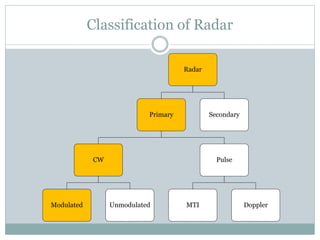
Classification of Radar
Radar
Primary
CW
Modulated Unmodulated
Pulse
MTI Doppler
Secondary
Doppler effect
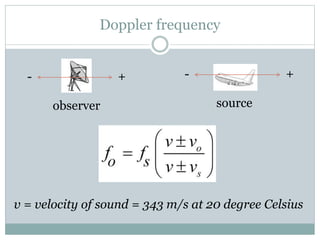
 If either the source of oscillation or the observer of
the oscillation is in motion, an apparent shift in
frequency will result. This is the Doppler effect and
is the basis of the CW radar.
Doppler frequency
+- - +
observer source
v = velocity of sound = 343 m/s at 20 degree Celsius
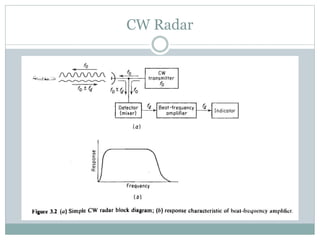
CW Radar
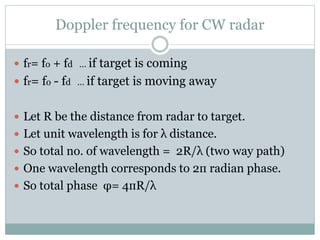
Doppler frequency for CW radar
 fr= fo + fd … if target is coming
 fr= fo - fd … if target is moving away
 Let R be the distance from radar to target.
 Let unit wavelength is for λ distance.
 So total no. of wavelength = 2R/λ (two way path)
 One wavelength corresponds to 2п radian phase.
 So total phase φ= 4пR/λ
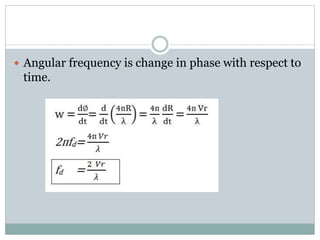
 Angular frequency is change in phase with respect to
time.
Applications
 To find the target’s bearing angle, elevation angle,
velocity
 To indicate the presence of moving targets
 To find radial velocity of moving targets
 To find whether an object is approaching or moving
away
Disadvantage
 Does not give information about range
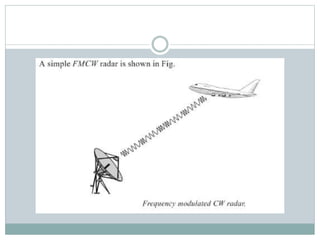
FMCW Radar
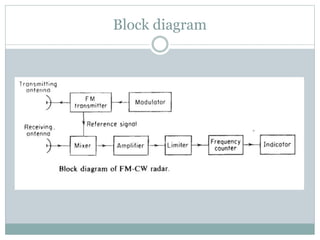
 FMCW radar detects, measures range and radial
velocity of objects.
 It is a Frequency Modulated Continuous Wave radar
in which the frequency of continuously transmitted
wave is varied at a known rate and the frequency of
reflected signals is compared with the frequency of
transmitted signal
Block diagram
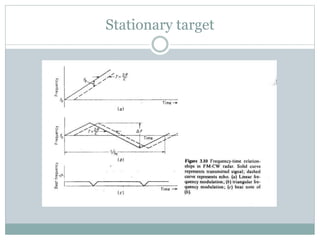
Stationary target
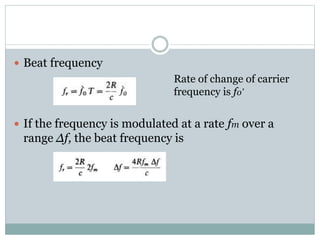
 Beat frequency
Rate of change of carrier
frequency is fo’
 If the frequency is modulated at a rate fm over a
range ∆f, the beat frequency is
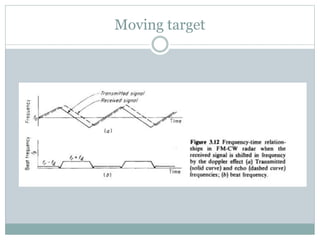
Moving target
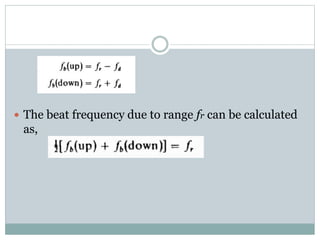
 The beat frequency due to range fr can be calculated
as,
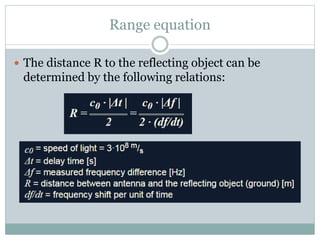
Range equation
 The distance R to the reflecting object can be
determined by the following relations:
Applications
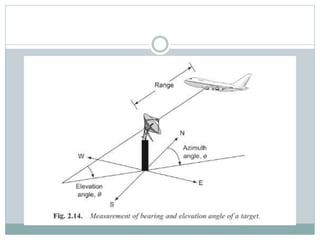
 Slant range of the target
 Bearing and elevation angle of target
 Height of target
Thank You
 References:
Radar Engineering
By G. S. N. Raju
Introduction to Radar
Systems
Second Edition
By Merrill Skolnik

Cw and fm cw radar

  • 1.
    V I JE N D R A S I N G H R A T H O R 1 3 0 1 7 0 1 1 1 0 9 2 CW and FM CW Radar
  • 2.
    Contents  Basics ofRadar  Classification of Radar  Doppler effect  CW Radar  FMCW radar
  • 3.
    Radar Abbreviation  RA– Radio  D – Detection  A – And  R – Ranging
  • 4.
    Definition  Radar isan electromagnetic device and regarded to be a powerful electronic eye.  It is also an electromagnetic sensor.
  • 5.
    What is doneby Radar?  Radar can see the objects hidden anywhere in the globe or planet except some special cases like low altitude, shape changing the reflection direction, special fiber material etc.
  • 6.
    Applications of Radar Military purpose  Weather forecast  Airport controlling  Navigation  To detect and measure objects under the earth  To indicate speed of automobiles, cricket and tennis balls etc.
  • 7.
    Classification of Radar Radar Primary CW ModulatedUnmodulated Pulse MTI Doppler Secondary
  • 8.
    Doppler effect  Ifeither the source of oscillation or the observer of the oscillation is in motion, an apparent shift in frequency will result. This is the Doppler effect and is the basis of the CW radar.
  • 10.
    Doppler frequency +- -+ observer source v = velocity of sound = 343 m/s at 20 degree Celsius
  • 11.
  • 12.
    Doppler frequency forCW radar  fr= fo + fd … if target is coming  fr= fo - fd … if target is moving away  Let R be the distance from radar to target.  Let unit wavelength is for λ distance.  So total no. of wavelength = 2R/λ (two way path)  One wavelength corresponds to 2п radian phase.  So total phase φ= 4пR/λ
  • 13.
     Angular frequencyis change in phase with respect to time.
  • 14.
    Applications  To findthe target’s bearing angle, elevation angle, velocity  To indicate the presence of moving targets  To find radial velocity of moving targets  To find whether an object is approaching or moving away
  • 15.
    Disadvantage  Does notgive information about range
  • 16.
    FMCW Radar  FMCWradar detects, measures range and radial velocity of objects.  It is a Frequency Modulated Continuous Wave radar in which the frequency of continuously transmitted wave is varied at a known rate and the frequency of reflected signals is compared with the frequency of transmitted signal
  • 18.
  • 19.
  • 20.
     Beat frequency Rateof change of carrier frequency is fo’  If the frequency is modulated at a rate fm over a range ∆f, the beat frequency is
  • 21.
  • 22.
     The beatfrequency due to range fr can be calculated as,
  • 23.
    Range equation  Thedistance R to the reflecting object can be determined by the following relations:
  • 24.
    Applications  Slant rangeof the target  Bearing and elevation angle of target  Height of target
  • 26.
    Thank You  References: RadarEngineering By G. S. N. Raju Introduction to Radar Systems Second Edition By Merrill Skolnik