Constant False Alarm Rate
         (CFAR)


                 Presented By:
                 Umair Saeed
Agenda
CAGO-CFAR
OS-CFAR
CASH-CFAR
MAMIS-CFAR
What is CFAR?


• Constant false alarm rate (CFAR) detection
  refers to a common form of adaptive
  algorithm used in radar systems to detect
  target returns against a background of noise,
  clutter and interference.
What is CFAR?


• Constant false alarm rate (CFAR) is a
  property of threshold or gain control devices
  that maintain an approximately constant
  rate of false target detections when the noise,
  and/or clutter levels, and/or ECM (electronic
  countermeasures) into the detector are
  variable.
Why Do We Use CFAR?


• CFAR techniques are used in reception and
  signal processing to avoid increased false
  alarm rates in the presence of jamming,
  clutter residue, or other interference sources.
CFAR


• The basic feature of CFAR is that the false
  alarm probability remains approximately
  constant in clutter by a threshold, riding a
  definite value above clutter. Targets with an
  echo power exceeding the threshold level can
  still be detected.
Efficient CFAR Requirements
• Efficient implementation regarding required
  processing power and production costs.
• Low CFAR-loss.
• Accurate fitting of the CFAR threshold to the
  clutter scenario.
• The CFAR threshold must pass point targets
  and extended targets.
• Closely spaced targets must not mask each
  other.
CAGO-CFAR
CAGO-CFAR


• The CAGO-CFAR (Cell Averaging Greatest Of-)
  comprises essentially a shift register consisting
  of two sub-registers, each containing L storage
  cells. Between the sub-registers, the so-called
  cell under test (CUT) is located. Each sub-
  register has its own adding circuit.(MAX) is use
  for adding purpose.
CAGO-CFAR continue…
• Using a multiplicative factor α for linear
  processing or an additive factor β for
  processing with a LOG-amplifier, the threshold
  value (TV) is calculated. Finally, the amplitude
  of the signal under test (SUT) is compared
  with the threshold value to decide whether
  the SUT belongs to a target or not.
Advantages of CAGO-CFAR

• Require little processing power.
• Having low CFAR loss.
Disadvantages of CAGO-CFAR

• Ineffective thresholding.
• Closely spaced targets can mask each other.
• MAX-process, the CAGO threshold cannot
  immediately follow an abrupt rise or fall in
  clutter level.
OS-CFAR
OS-CFAR
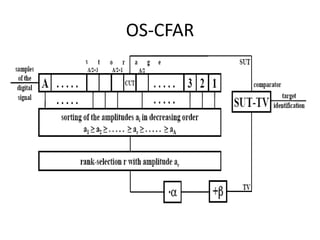
• The OS-CFAR (Ordered Statistic) comprises a shift
  register containing “A” storage cells, plus the CUT.
• A sorting algorithm arranges the amplitudes of
  the storage cells in order of decreasing
  magnitude.
• In a rank-selection process, the “r-th” largest
  amplitude is chosen as a representative of the
  clutter.
• The TV is calculated using a multiplicative α or
  additive factor β as described for the CAGO-CFAR
  above. Target detection is accomplished by
  comparing the SUT with the TV.
Advantage of OS-CFAR
• In contrast to the CAGO-CFAR, the OS-CFAR
  has the advantage of effective threshold
  formation.
      Disadvantage of OS-CFAR
• The major disadvantage of the OS-CFAR is the
  high processing power required for
  performing the sorting algorithm.
CASH-CFAR
CASH-CFAR
• The CASH-CFAR (Cell Averaging Statistic Hofele)
  comprises essentially a shift register configured
  by “A” sub-registers, each having its own adder
  and containing L storage cells.
• By means of a special maximum-minimum
  process a clutter-representative sum-value Sr, will
  be selected from the “A” sum-values S1 to SA.
• The threshold value is then calculated using a
  multiplicative (α/L) and/or additive (β/L) factor.
• Special maximum-minimum circuit block
  interference.
Advantages of CASH-CFAR
• CASH-CFAR avoids mutual masking of targets.
• In clutter level with almost no time
  displacement.
• CASHCFAR requires much less processing
  power than the OS-CFAR with its rank-
  selection method.
MAMIS-CFAR
MAMIS-CFAR
• The MAMIS-CFAR (Maximum Minimum Statistic)
  is essentially the same as the CASHCFAR,
• except that the special maximum-minimum
  circuit M replaces the adders of the
• CASH-CFAR. The characteristics of the MAMIS-
  CFAR are quite similar to those of the
• CASH-CFAR. For the CFAR-handling of block
  interference and of point- and extended targets.
THANKS

CFAR

  • 1.
    Constant False AlarmRate (CFAR) Presented By: Umair Saeed
  • 2.
  • 3.
    What is CFAR? •Constant false alarm rate (CFAR) detection refers to a common form of adaptive algorithm used in radar systems to detect target returns against a background of noise, clutter and interference.
  • 4.
    What is CFAR? •Constant false alarm rate (CFAR) is a property of threshold or gain control devices that maintain an approximately constant rate of false target detections when the noise, and/or clutter levels, and/or ECM (electronic countermeasures) into the detector are variable.
  • 5.
    Why Do WeUse CFAR? • CFAR techniques are used in reception and signal processing to avoid increased false alarm rates in the presence of jamming, clutter residue, or other interference sources.
  • 6.
    CFAR • The basicfeature of CFAR is that the false alarm probability remains approximately constant in clutter by a threshold, riding a definite value above clutter. Targets with an echo power exceeding the threshold level can still be detected.
  • 7.
    Efficient CFAR Requirements •Efficient implementation regarding required processing power and production costs. • Low CFAR-loss. • Accurate fitting of the CFAR threshold to the clutter scenario. • The CFAR threshold must pass point targets and extended targets. • Closely spaced targets must not mask each other.
  • 8.
  • 9.
    CAGO-CFAR • The CAGO-CFAR(Cell Averaging Greatest Of-) comprises essentially a shift register consisting of two sub-registers, each containing L storage cells. Between the sub-registers, the so-called cell under test (CUT) is located. Each sub- register has its own adding circuit.(MAX) is use for adding purpose.
  • 10.
    CAGO-CFAR continue… • Usinga multiplicative factor α for linear processing or an additive factor β for processing with a LOG-amplifier, the threshold value (TV) is calculated. Finally, the amplitude of the signal under test (SUT) is compared with the threshold value to decide whether the SUT belongs to a target or not.
  • 11.
    Advantages of CAGO-CFAR •Require little processing power. • Having low CFAR loss.
  • 12.
    Disadvantages of CAGO-CFAR •Ineffective thresholding. • Closely spaced targets can mask each other. • MAX-process, the CAGO threshold cannot immediately follow an abrupt rise or fall in clutter level.
  • 13.
  • 14.
    OS-CFAR • The OS-CFAR(Ordered Statistic) comprises a shift register containing “A” storage cells, plus the CUT. • A sorting algorithm arranges the amplitudes of the storage cells in order of decreasing magnitude. • In a rank-selection process, the “r-th” largest amplitude is chosen as a representative of the clutter. • The TV is calculated using a multiplicative α or additive factor β as described for the CAGO-CFAR above. Target detection is accomplished by comparing the SUT with the TV.
  • 15.
    Advantage of OS-CFAR •In contrast to the CAGO-CFAR, the OS-CFAR has the advantage of effective threshold formation. Disadvantage of OS-CFAR • The major disadvantage of the OS-CFAR is the high processing power required for performing the sorting algorithm.
  • 16.
  • 17.
    CASH-CFAR • The CASH-CFAR(Cell Averaging Statistic Hofele) comprises essentially a shift register configured by “A” sub-registers, each having its own adder and containing L storage cells. • By means of a special maximum-minimum process a clutter-representative sum-value Sr, will be selected from the “A” sum-values S1 to SA. • The threshold value is then calculated using a multiplicative (α/L) and/or additive (β/L) factor. • Special maximum-minimum circuit block interference.
  • 18.
    Advantages of CASH-CFAR •CASH-CFAR avoids mutual masking of targets. • In clutter level with almost no time displacement. • CASHCFAR requires much less processing power than the OS-CFAR with its rank- selection method.
  • 19.
  • 20.
    MAMIS-CFAR • The MAMIS-CFAR(Maximum Minimum Statistic) is essentially the same as the CASHCFAR, • except that the special maximum-minimum circuit M replaces the adders of the • CASH-CFAR. The characteristics of the MAMIS- CFAR are quite similar to those of the • CASH-CFAR. For the CFAR-handling of block interference and of point- and extended targets.
  • 21.