Synthetic-Aperture Radar (SAR)
Basics
Outline
Spatial resolution
Range resolution
• Short pulse system
• Pulse compression
• Chirp waveform
• Slant range vs. ground range
Azimuth resolution
• Unfocused SAR
• Focused SAR
Geometric distortion
Foreshortening
Layover
Shadow
Radiometric resolution
Fading
Radiometric calibration
Spatial discrimination
Spatial discrimination relates to the ability to resolve signals
from targets based on spatial position or velocity.
angle, range, velocity
Resolution is the measure of the ability to determine
whether only one or more than one different targets are
observed.
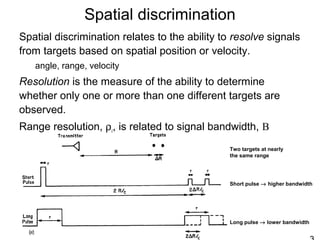
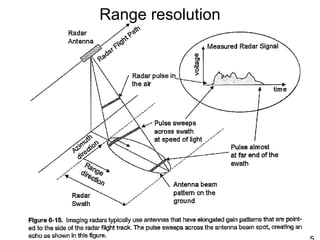
Range resolution, ρr, is related to signal bandwidth, B
Short pulse → higher bandwidth
Long pulse → lower bandwidth
Two targets at nearly
the same range
Spatial discrimination
The ability to discriminate between targets is better when
the resolution distance is said to be finer (not greater)
Fine (and coarse) resolution are preferred to high (and low) resolution
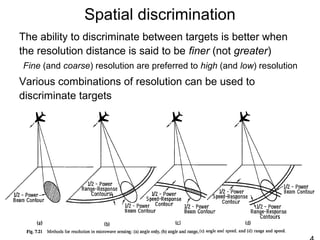
Various combinations of resolution can be used to
discriminate targets
Range resolution
Range resolution
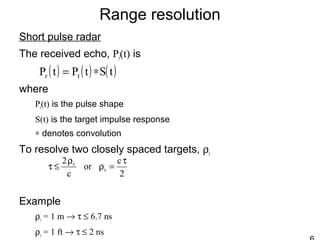
Short pulse radar
The received echo, Pr(t) is
where
Pt(t) is the pulse shape
S(t) is the target impulse response
∗ denotes convolution
To resolve two closely spaced targets, ρr
Example
ρr = 1 m → τ ≤ 6.7 ns
ρr = 1 ft → τ ≤ 2 ns
( ) ( ) ( )tStPtP tr ∗=
2
c
or
c
2
r
r τ
=ρ
ρ
≤τ
Range resolution
Clearly to obtain fine range resolution, a short pulse
duration is needed.
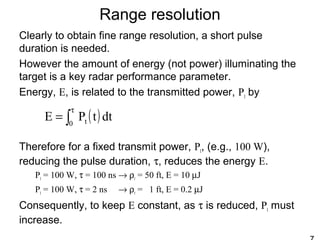
However the amount of energy (not power) illuminating the
target is a key radar performance parameter.
Energy, E, is related to the transmitted power, Pt by
Therefore for a fixed transmit power, Pt, (e.g., 100 W),
reducing the pulse duration, τ, reduces the energy E.
Pt = 100 W, τ = 100 ns → ρr = 50 ft, E = 10 µJ
Pt = 100 W, τ = 2 ns → ρr = 1 ft, E = 0.2 µJ
Consequently, to keep E constant, as τ is reduced, Pt must
increase.
( )∫
τ
= 0 t dttPE
More Tx Power??
Why not just get a transmitter that outputs more power?
High-power transmitters present problems
Require high-voltage power supplies (kV)
Reliability problems
Safety issues (both from electrocution and irradiation)
Bigger, heavier, costlier, …
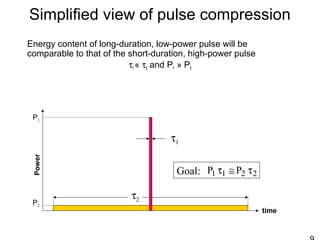
Simplified view of pulse compression
Energy content of long-duration, low-power pulse will be
comparable to that of the short-duration, high-power pulse
τ1 « τ2 and P1 » P2
time
τ1
Power
P1
P2
τ2
2211 PP τ≅τGoal:
Pulse compression
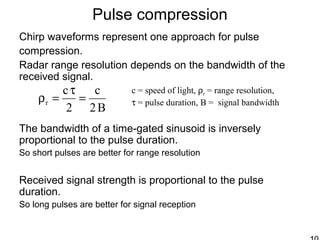
Chirp waveforms represent one approach for pulse
compression.
Radar range resolution depends on the bandwidth of the
received signal.
The bandwidth of a time-gated sinusoid is inversely
proportional to the pulse duration.
So short pulses are better for range resolution
Received signal strength is proportional to the pulse
duration.
So long pulses are better for signal reception
B2
c
2
c
r =
τ
=ρ
c = speed of light, ρr = range resolution,
τ = pulse duration, B = signal bandwidth
Pulse compression, the compromise
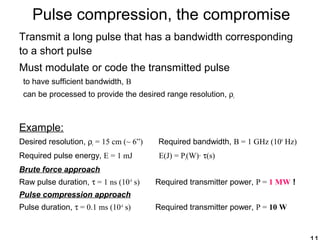
Transmit a long pulse that has a bandwidth corresponding
to a short pulse
Must modulate or code the transmitted pulse
to have sufficient bandwidth, B
can be processed to provide the desired range resolution, ρr
Example:
Desired resolution, ρr = 15 cm (~ 6”) Required bandwidth, B = 1 GHz (109
Hz)
Required pulse energy, E = 1 mJ E(J) = Pt(W)· τ(s)
Brute force approach
Raw pulse duration, τ = 1 ns (10-9
s) Required transmitter power, P = 1 MW !
Pulse compression approach
Pulse duration, τ = 0.1 ms (10-4
s) Required transmitter power, P = 10 W
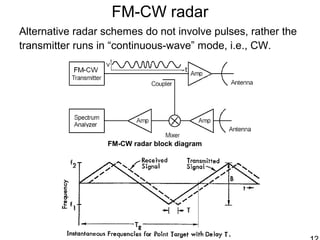
FM-CW radar
Alternative radar schemes do not involve pulses, rather the
transmitter runs in “continuous-wave” mode, i.e., CW.
FM-CW radar block diagram
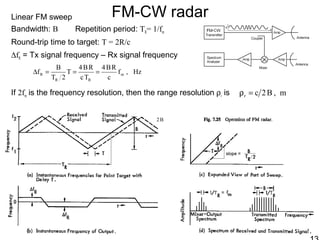
FM-CW radarLinear FM sweep
Bandwidth: B Repetition period: TR= 1/fm
Round-trip time to target: T = 2R/c
∆fR = Tx signal frequency – Rx signal frequency
If 2fm is the frequency resolution, then the range resolution ρr is
Hz,f
c
RB4
Tc
RB4
T
2T
B
f m
RR
R ===∆
m,B2cr =ρ
B2
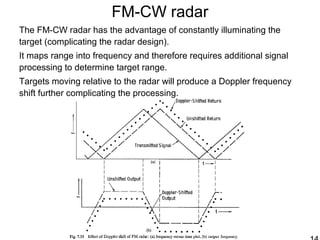
FM-CW radar
The FM-CW radar has the advantage of constantly illuminating the
target (complicating the radar design).
It maps range into frequency and therefore requires additional signal
processing to determine target range.
Targets moving relative to the radar will produce a Doppler frequency
shift further complicating the processing.
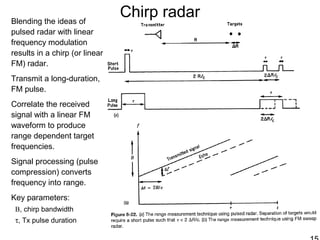
Chirp radarBlending the ideas of
pulsed radar with linear
frequency modulation
results in a chirp (or linear
FM) radar.
Transmit a long-duration,
FM pulse.
Correlate the received
signal with a linear FM
waveform to produce
range dependent target
frequencies.
Signal processing (pulse
compression) converts
frequency into range.
Key parameters:
B, chirp bandwidth
τ, Tx pulse duration
Chirp radar
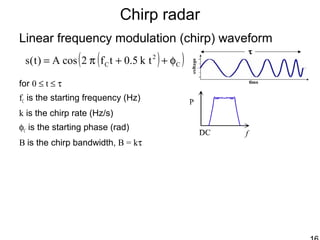
Linear frequency modulation (chirp) waveform
for 0 ≤ t ≤ τ
fC is the starting frequency (Hz)
k is the chirp rate (Hz/s)
φC is the starting phase (rad)
B is the chirp bandwidth, B = kτ
( )( )C
2
C tk5.0tf2cosA)t(s φ++π=
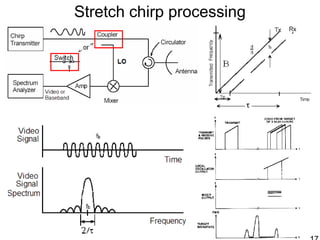
Stretch chirp processing
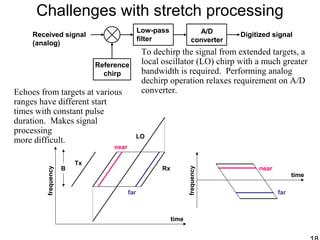
Challenges with stretch processing
time
Tx
B Rx
LO
near
far
frequency
time
frequency
near
far
Reference
chirp
Received signal
(analog)
Digitized signal
Low-pass
filter
A/D
converter
Echoes from targets at various
ranges have different start
times with constant pulse
duration. Makes signal
processing
more difficult.
To dechirp the signal from extended targets, a
local oscillator (LO) chirp with a much greater
bandwidth is required. Performing analog
dechirp operation relaxes requirement on A/D
converter.
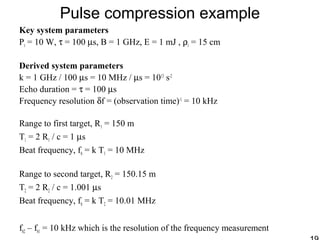
Pulse compression example
Key system parameters
Pt = 10 W, τ = 100 µs, B = 1 GHz, E = 1 mJ , ρr = 15 cm
Derived system parameters
k = 1 GHz / 100 µs = 10 MHz / µs = 1013
s-2
Echo duration = τ = 100 µs
Frequency resolution δf = (observation time)-1
= 10 kHz
Range to first target, R1 = 150 m
T1 = 2 R1 / c = 1 µs
Beat frequency, fb = k T1 = 10 MHz
Range to second target, R2 = 150.15 m
T2 = 2 R2 / c = 1.001 µs
Beat frequency, fb = k T2 = 10.01 MHz
fb2 – fb1 = 10 kHz which is the resolution of the frequency measurement
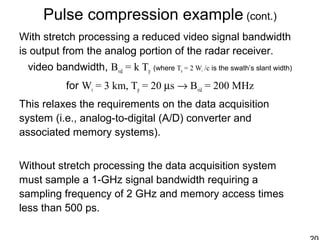
Pulse compression example (cont.)
With stretch processing a reduced video signal bandwidth
is output from the analog portion of the radar receiver.
video bandwidth, Bvid = k Tp (where Tp = 2 Wr /c is the swath’s slant width)
for Wr = 3 km, Tp = 20 µs → Bvid = 200 MHz
This relaxes the requirements on the data acquisition
system (i.e., analog-to-digital (A/D) converter and
associated memory systems).
Without stretch processing the data acquisition system
must sample a 1-GHz signal bandwidth requiring a
sampling frequency of 2 GHz and memory access times
less than 500 ps.
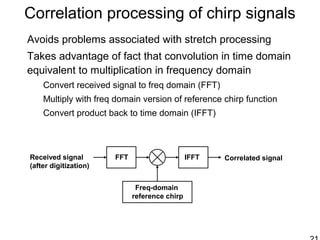
Correlation processing of chirp signals
Avoids problems associated with stretch processing
Takes advantage of fact that convolution in time domain
equivalent to multiplication in frequency domain
Convert received signal to freq domain (FFT)
Multiply with freq domain version of reference chirp function
Convert product back to time domain (IFFT)
FFT IFFT
Freq-domain
reference chirp
Received signal
(after digitization)
Correlated signal
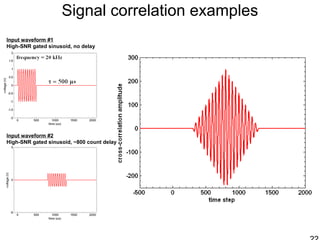
Signal correlation examples
Input waveform #1
High-SNR gated sinusoid, no delay
Input waveform #2
High-SNR gated sinusoid, ~800 count delay
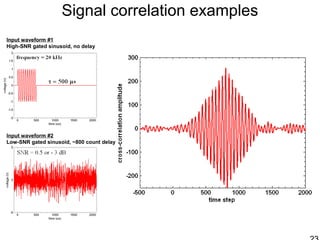
Signal correlation examples
Input waveform #1
High-SNR gated sinusoid, no delay
Input waveform #2
Low-SNR gated sinusoid, ~800 count delay
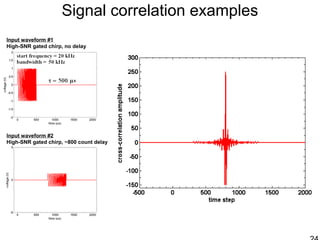
Signal correlation examples
Input waveform #1
High-SNR gated chirp, no delay
Input waveform #2
High-SNR gated chirp, ~800 count delay
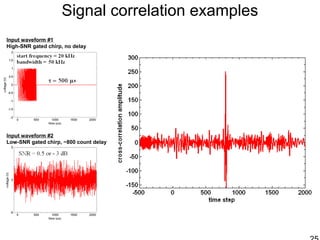
Signal correlation examples
Input waveform #1
High-SNR gated chirp, no delay
Input waveform #2
Low-SNR gated chirp, ~800 count delay
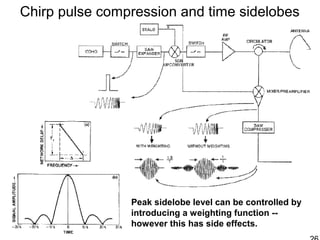
Chirp pulse compression and time sidelobes
Peak sidelobe level can be controlled by
introducing a weighting function --
however this has side effects.
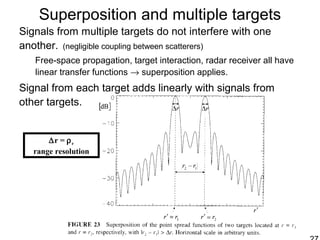
Superposition and multiple targets
Signals from multiple targets do not interfere with one
another. (negligible coupling between scatterers)
Free-space propagation, target interaction, radar receiver all have
linear transfer functions → superposition applies.
Signal from each target adds linearly with signals from
other targets.
∆r = ρr
range resolution
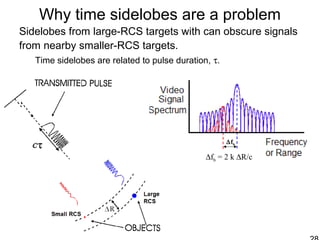
Why time sidelobes are a problem
Sidelobes from large-RCS targets with can obscure signals
from nearby smaller-RCS targets.
Time sidelobes are related to pulse duration, τ.
∆fb = 2 k ∆R/c
∆fb
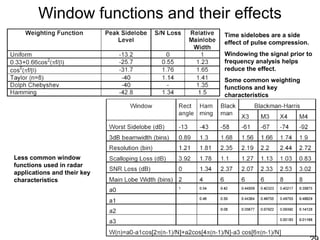
Window functions and their effects
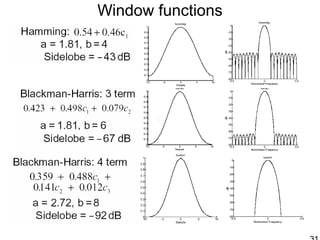
Time sidelobes are a side
effect of pulse compression.
Windowing the signal prior to
frequency analysis helps
reduce the effect.
Some common weighting
functions and key
characteristics
Less common window
functions used in radar
applications and their key
characteristics
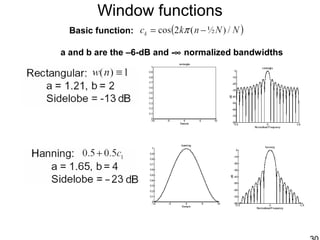
Window functions
Basic function:
a and b are the –6-dB and -∞ normalized bandwidths
Window functions
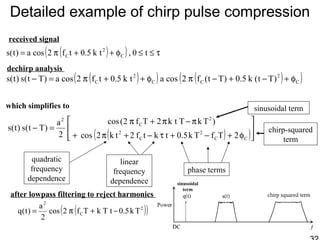
Detailed example of chirp pulse compression
( )( ) τ≤≤φ++π= t0,tk5.0tf2cosa)t(s C
2
C
( )( ) ( )( )C
2
CC
2
C )Tt(k5.0)Tt(f2cosatk5.0tf2cosa)Tt(s)t(s φ+−+−πφ++π=−
( )( )







φ+−+τ−+π+
π−π+π
=−
CC
2
C
2
2
C
2
2TfTk5.0tktf2tk2cos
)TkTtk2Tf2(cos
2
a
)Tt(s)t(s
( )( )2
C
2
Tk5.0tTkTf2cos
2
a
)t(q −+π=
after lowpass filtering to reject harmonics
dechirp analysis
which simplifies to
received signal
quadratic
frequency
dependence
linear
frequency
dependence
phase terms
chirp-squared
term
sinusoidal term
sinusoidal
term
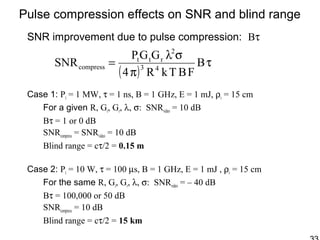
Pulse compression effects on SNR and blind range
SNR improvement due to pulse compression: Bτ
Case 1: Pt = 1 MW, τ = 1 ns, B = 1 GHz, E = 1 mJ, ρr = 15 cm
For a given R, Gt, Gr, λ, σ: SNRvideo = 10 dB
Bτ = 1 or 0 dB
SNRcompress = SNRvideo = 10 dB
Blind range = cτ/2 = 0.15 m
Case 2: Pt = 10 W, τ = 100 µs, B = 1 GHz, E = 1 mJ , ρr = 15 cm
For the same R, Gt, Gr, λ, σ: SNRvideo = – 40 dB
Bτ = 100,000 or 50 dB
SNRcompress = 10 dB
Blind range = cτ/2 = 15 km
( )
τ
π
σλ
= B
FBTkR4
GGP
SNR 43
2
rtt
compress
Pulse compression
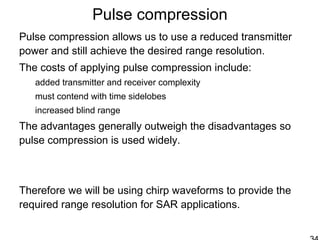
Pulse compression allows us to use a reduced transmitter
power and still achieve the desired range resolution.
The costs of applying pulse compression include:
added transmitter and receiver complexity
must contend with time sidelobes
increased blind range
The advantages generally outweigh the disadvantages so
pulse compression is used widely.
Therefore we will be using chirp waveforms to provide the
required range resolution for SAR applications.
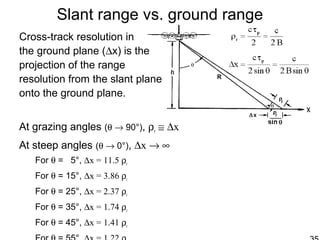
Slant range vs. ground range
Cross-track resolution in
the ground plane (∆x) is the
projection of the range
resolution from the slant plane
onto the ground plane.
At grazing angles (θ → 90°), ρr ≅ ∆x
At steep angles (θ → 0°), ∆x → ∞
For θ = 5°, ∆x = 11.5 ρr
For θ = 15°, ∆x = 3.86 ρr
For θ = 25°, ∆x = 2.37 ρr
For θ = 35°, ∆x = 1.74 ρr
For θ = 45°, ∆x = 1.41 ρr
Azimuth (along-track) resolution
Discrimination of targets based on their along-track or
azimuth position is possible due to the unique phase history
associated with each azimuth position.
Note that phase variations and Doppler frequency shifts are
analogous since f = dφ/dt where φ is phase.
Assuming the phase of the target’s echo is essentially
constant over all observation angles, the phase variation is
due entirely to range variations during the observation
period.
Recall that φ/2π = 2R/λ where R is the slant range, λ is the
wavelength, and the factor of 2 is due to the round-trip path
length.
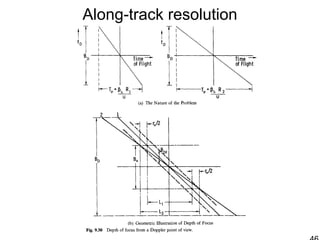
Along-track resolution
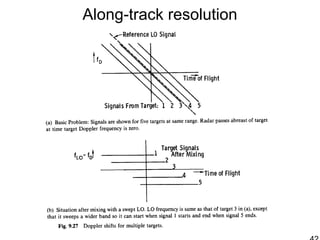
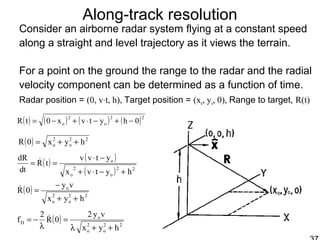
Consider an airborne radar system flying at a constant speed
along a straight and level trajectory as it views the terrain.
For a point on the ground the range to the radar and the radial
velocity component can be determined as a function of time.
Radar position = (0, v⋅t, h), Target position = (xo, yo, 0), Range to target, R(t)
( ) ( ) ( ) ( )22
o
2
o 0hytvx0tR −+−⋅+−=
( ) 22
o
2
o hyx0R ++=
( ) ( )
( ) 22
o
2
o
o
hytvx
ytvv
tR
td
dR
+−⋅+
−⋅
== 
( ) 22
o
2
o
o
hyx
vy
0R
++
−
=
( ) 22
o
2
o
o
D
hyx
vy2
0R
2
f
++λ
=
λ
−= 
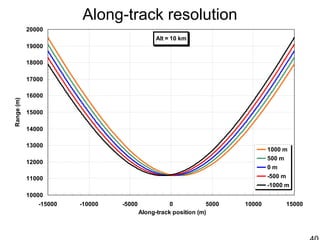
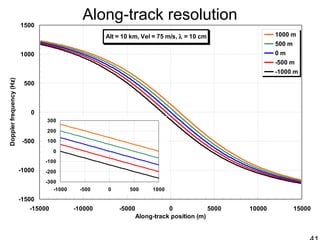
Along-track resolution
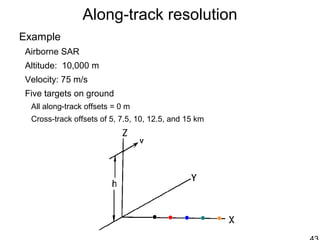
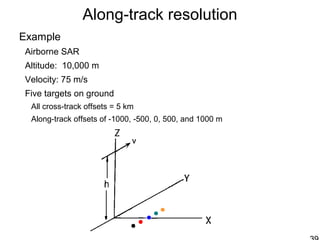
Example
Airborne SAR
Altitude: 10,000 m
Velocity: 75 m/s
Five targets on ground
All cross-track offsets = 5 km
Along-track offsets of -1000, -500, 0, 500, and 1000 m
Along-track resolution
Alt = 10 km
10000
11000
12000
13000
14000
15000
16000
17000
18000
19000
20000
-15000 -10000 -5000 0 5000 10000 15000
Along-track position (m)
Range(m)
1000 m
500 m
0 m
-500 m
-1000 m
Alt = 10 km, Vel = 75 m/s, λ = 10 cm
-1500
-1000
-500
0
500
1000
1500
-15000 -10000 -5000 0 5000 10000 15000
Along-track position (m)
Dopplerfrequency(Hz)
1000 m
500 m
0 m
-500 m
-1000 m
-300
-200
-100
0
100
200
300
-1000 -500 0 500 1000
c
Along-track resolution
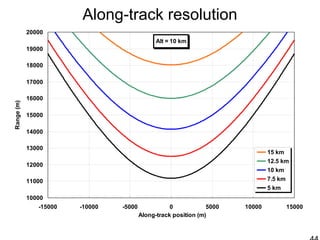
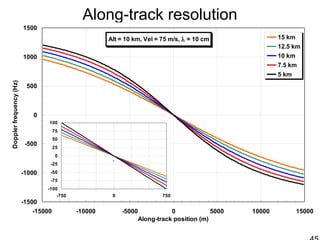
Example
Airborne SAR
Altitude: 10,000 m
Velocity: 75 m/s
Five targets on ground
All along-track offsets = 0 m
Cross-track offsets of 5, 7.5, 10, 12.5, and 15 km
Along-track resolution
Alt = 10 km
10000
11000
12000
13000
14000
15000
16000
17000
18000
19000
20000
-15000 -10000 -5000 0 5000 10000 15000
Along-track position (m)
Range(m)
15 km
12.5 km
10 km
7.5 km
5 km
Along-track resolution
Alt = 10 km, Vel = 75 m/s, λ = 10 cm
-1500
-1000
-500
0
500
1000
1500
-15000 -10000 -5000 0 5000 10000 15000
Along-track position (m)
Dopplerfrequency(Hz)
15 km
12.5 km
10 km
7.5 km
5 km
-100
-75
-50
-25
0
25
50
75
100
-750 0 750
c
Along-track resolution
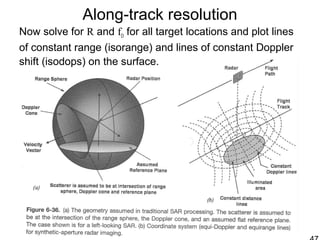
Now solve for R and fD for all target locations and plot lines
of constant range (isorange) and lines of constant Doppler
shift (isodops) on the surface.
Along-track resolution
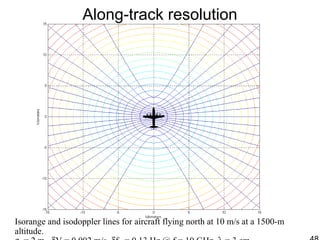
Isorange and isodoppler lines for aircraft flying north at 10 m/s at a 1500-m
altitude.
Along-track resolution
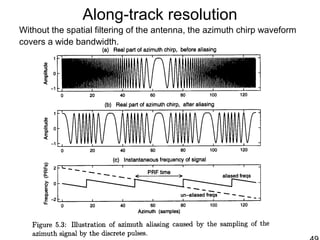
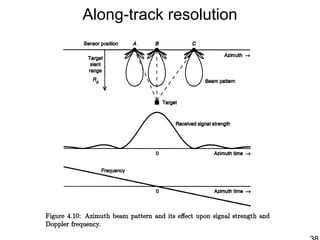
Without the spatial filtering of the antenna, the azimuth chirp waveform
covers a wide bandwidth.
Along-track resolution
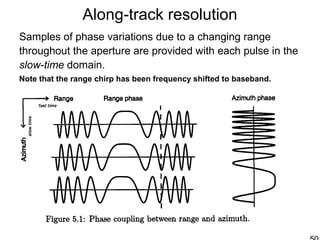
Samples of phase variations due to a changing range
throughout the aperture are provided with each pulse in the
slow-time domain.
Note that the range chirp has been frequency shifted to baseband.
Along-track resolution
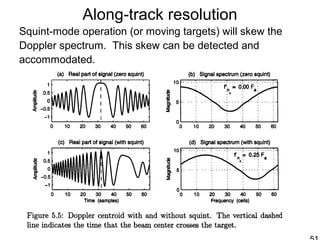
Squint-mode operation (or moving targets) will skew the
Doppler spectrum. This skew can be detected and
accommodated.
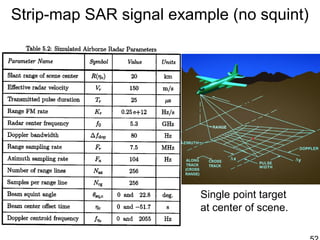
Strip-map SAR signal example (no squint)
Single point target
at center of scene.
Strip-map SAR signal example (no squint)
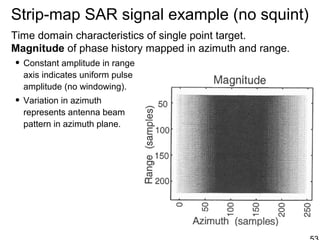
Time domain characteristics of single point target.
Magnitude of phase history mapped in azimuth and range.
• Constant amplitude in range
axis indicates uniform pulse
amplitude (no windowing).
• Variation in azimuth
represents antenna beam
pattern in azimuth plane.
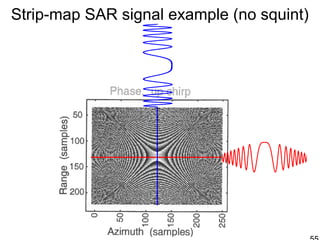
Strip-map SAR signal example (no squint)
Time domain characteristics of single point target.
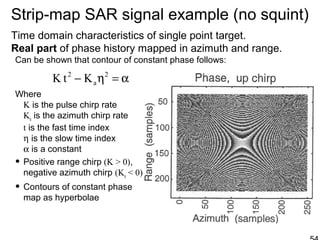
Real part of phase history mapped in azimuth and range.
Can be shown that contour of constant phase follows:
Where
K is the pulse chirp rate
Ka is the azimuth chirp rate
t is the fast time index
η is the slow time index
α is a constant
• Positive range chirp (K > 0),
negative azimuth chirp (Ka < 0)
• Contours of constant phase
map as hyperbolae
α=η− 2
a
2
KtK
Strip-map SAR signal example (no squint)
Time domain characteristics of single point target.
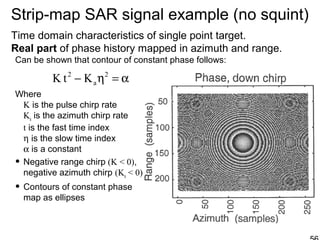
Real part of phase history mapped in azimuth and range.
Can be shown that contour of constant phase follows:
Where
K is the pulse chirp rate
Ka is the azimuth chirp rate
t is the fast time index
η is the slow time index
α is a constant
• Negative range chirp (K < 0),
negative azimuth chirp (Ka < 0)
• Contours of constant phase
map as ellipses
α=η− 2
a
2
KtK
Unfocused SAR
Processing SAR phase data to achieve a fine-resolution
image requires elaborate signal processing.
In some cases trading off resolution for processing
complexity is acceptable.
In these cases a simplified unfocused SAR processing is
used wherein only a portion of the azimuth phase history is
used resulting in a coarser azimuth resolution.
In unfocused SAR processing consecutive azimuth
samples are added together (in the slow-time domain).
Since addition a is simple operation for digital signal
processors, the image formation processing is much easier
(less time consuming) than fully-focused SAR processing.
Unfocused SAR
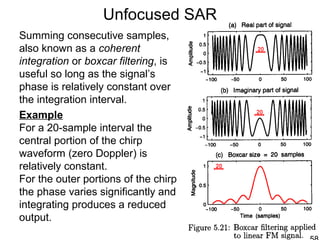
Summing consecutive samples,
also known as a coherent
integration or boxcar filtering, is
useful so long as the signal’s
phase is relatively constant over
the integration interval.
Example
For a 20-sample interval the
central portion of the chirp
waveform (zero Doppler) is
relatively constant.
For the outer portions of the chirp
the phase varies significantly and
integrating produces a reduced
output.
Unfocused SAR
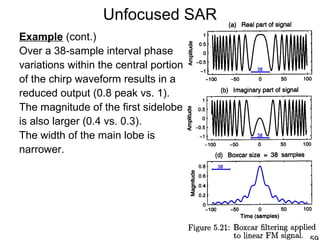
Example (cont.)
Over a 38-sample interval phase
variations within the central portion
of the chirp waveform results in a
reduced output (0.8 peak vs. 1).
The magnitude of the first sidelobe
is also larger (0.4 vs. 0.3).
The width of the main lobe is
narrower.
Unfocused SAR
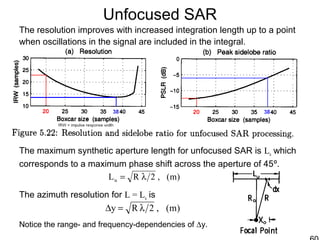
The resolution improves with increased integration length up to a point
when oscillations in the signal are included in the integral.
The maximum synthetic aperture length for unfocused SAR is Lu which
corresponds to a maximum phase shift across the aperture of 45º.
The azimuth resolution for L = Lu is
Notice the range- and frequency-dependencies of ∆y.
)m(,2Ry λ=∆
)m(,2RLu λ=
Focused SAR
To realize the full potential of SAR and achieve fine along-
track (azimuth) resolution requires matched filtering of the
azimuth chirp signal.
Stretch chirp processing, correlation processing, tracking
Doppler filters, as well as other techniques can be used in a
matched filter process.
However the range processing is not entirely separable
from the azimuth processing as an intricate interaction
between range and azimuth domains exists which must
also be dealt with to achieve the desired image quality.
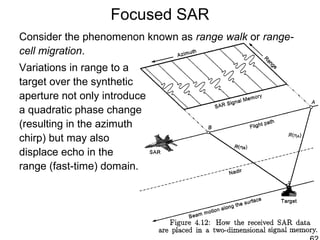
Focused SAR
Consider the phenomenon known as range walk or range-
cell migration.
Variations in range to a
target over the synthetic
aperture not only introduce
a quadratic phase change
(resulting in the azimuth
chirp) but may also
displace echo in the
range (fast-time) domain.
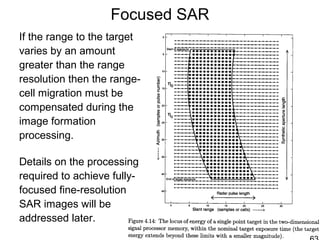
Focused SAR
If the range to the target
varies by an amount
greater than the range
resolution then the range-
cell migration must be
compensated during the
image formation
processing.
Details on the processing
required to achieve fully-
focused fine-resolution
SAR images will be
addressed later.
Focused SAR
In SAR systems a very long antenna aperture is
synthesized resulting in fine along-track resolution.
For a synthesized-aperture length, L, the along-track resolution, ∆y, is
L is determined by the system configuration.
For a fully focused stripmap system, Lm = βaz⋅R (m), where
βaz is the azimuthal or along-track beamwidth of the real antenna (βaz ≅ λ/ℓ)
R is the range to the target
For L = Lm, ∆y = ℓ/2 (independent of range and wavelength)
( )L2Ry λ=∆
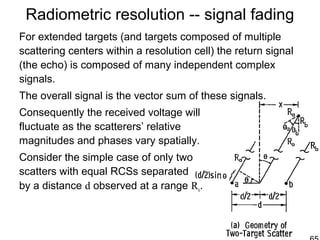
Radiometric resolution -- signal fading
For extended targets (and targets composed of multiple
scattering centers within a resolution cell) the return signal
(the echo) is composed of many independent complex
signals.
The overall signal is the vector sum of these signals.
Consequently the received voltage will
fluctuate as the scatterers’ relative
magnitudes and phases vary spatially.
Consider the simple case of only two
scatters with equal RCSs separated
by a distance d observed at a range Ro.
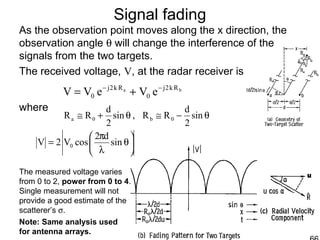
Signal fading
As the observation point moves along the x direction, the
observation angle θ will change the interference of the
signals from the two targets.
The received voltage, V, at the radar receiver is
where
The measured voltage varies
from 0 to 2, power from 0 to 4.
Single measurement will not
provide a good estimate of the
scatterer’s σ.
ba Rk2j
0
Rk2j
0 eVeVV −−
+=
θ−≅θ+≅ sin
2
d
RR,sin
2
d
RR 0b0a






θ
λ
π
= sin
d2
cosV2V 0
Note: Same analysis used
for antenna arrays.
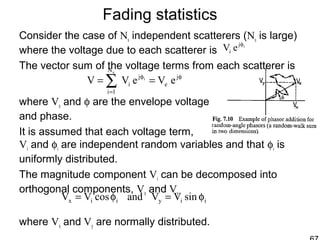
Fading statistics
Consider the case of Ns independent scatterers (Ns is large)
where the voltage due to each scatterer is
The vector sum of the voltage terms from each scatterer is
where Ve and φ are the envelope voltage
and phase.
It is assumed that each voltage term,
Vi and φi are independent random variables and that φi is
uniformly distributed.
The magnitude component Vi can be decomposed into
orthogonal components, Vx and Vy
where Vx and Vy are normally distributed.
ij
i eV φ
φ
=
φ
== ∑ j
e
N
1i
j
i eVeVV
s
i
iiyiix sinVVandcosVV φ=φ=
Fading statistics
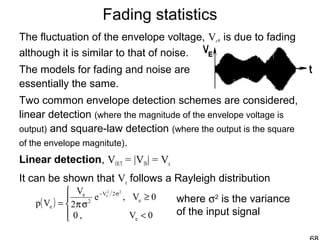
The fluctuation of the envelope voltage, Ve, is due to fading
although it is similar to that of noise.
The models for fading and noise are
essentially the same.
Two common envelope detection schemes are considered,
linear detection (where the magnitude of the envelope voltage is
output) and square-law detection (where the output is the square
of the envelope magnitute).
Linear detection, VOUT = |VIN| = Ve
It can be shown that Ve follows a Rayleigh distribution
( )




<
≥
σπ=
σ−
0V,0
0V,e
2
V
Vp
e
e
2V
2
e
e
22
e
where σ2
is the variance
of the input signal
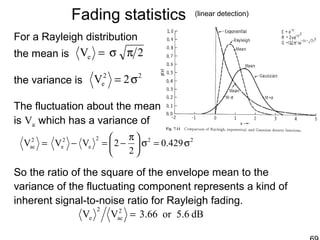
Fading statistics (linear detection)
For a Rayleigh distribution
the mean is
the variance is
The fluctuation about the mean
is Vac which has a variance of
So the ratio of the square of the envelope mean to the
variance of the fluctuating component represents a kind of
inherent signal-to-noise ratio for Rayleigh fading.
22
e 2V σ=
2Ve πσ=
222
e
2
e
2
ac 429.0
2
2VVV σ=σ




 π
−=−=
dB6.5or66.3VV 2
ac
2
e =
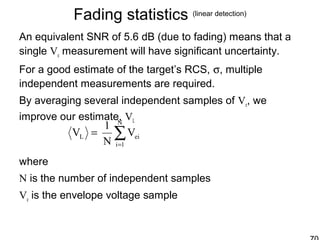
Fading statistics (linear detection)
An equivalent SNR of 5.6 dB (due to fading) means that a
single Ve measurement will have significant uncertainty.
For a good estimate of the target’s RCS, σ, multiple
independent measurements are required.
By averaging several independent samples of Ve, we
improve our estimate, VL
where
N is the number of independent samples
Ve is the envelope voltage sample
∑=
=
N
1i
eiL V
N
1
V
Fading statistics (linear detection)
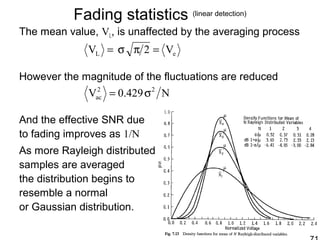
The mean value, VL, is unaffected by the averaging process
However the magnitude of the fluctuations are reduced
And the effective SNR due
to fading improves as 1/N
As more Rayleigh distributed
samples are averaged
the distribution begins to
resemble a normal
or Gaussian distribution.
eL V2V =πσ=
N429.0V 22
ac σ=
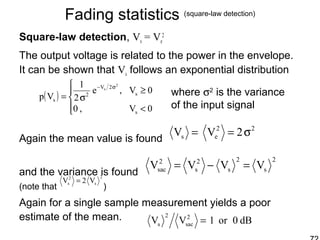
Fading statistics (square-law detection)
Square-law detection, Vs = Ve
2
The output voltage is related to the power in the envelope.
It can be shown that Vs follows an exponential distribution
Again the mean value is found
and the variance is found
(note that )
Again for a single sample measurement yields a poor
estimate of the mean.
( )




<
≥
σ=
σ−
0V,0
0V,e
2
1
Vp
s
s
2V
2
s
2
s
where σ2
is the variance
of the input signal
2
s
2
s
2
s
2
sac VVVV =−=
22
es 2VV σ==
2
s
2
s V2V =
dB0or1VV 2
sac
2
s =
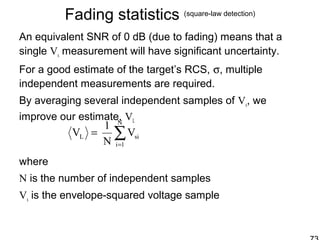
Fading statistics (square-law detection)
An equivalent SNR of 0 dB (due to fading) means that a
single Vs measurement will have significant uncertainty.
For a good estimate of the target’s RCS, σ, multiple
independent measurements are required.
By averaging several independent samples of Vs, we
improve our estimate, VL
where
N is the number of independent samples
Vs is the envelope-squared voltage sample
∑=
=
N
1i
siL V
N
1
V
Fading statistics (square-law detection)
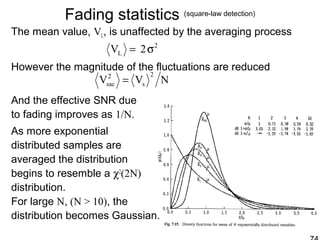
The mean value, VL, is unaffected by the averaging process
However the magnitude of the fluctuations are reduced
And the effective SNR due
to fading improves as 1/N.
As more exponential
distributed samples are
averaged the distribution
begins to resemble a χ2
(2N)
distribution.
For large N, (N > 10), the
distribution becomes Gaussian.
2
L 2V σ=
NVV
2
s
2
sac =
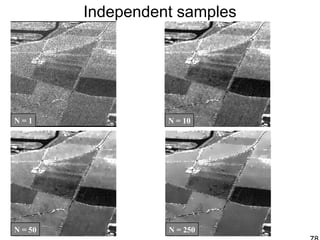
Independent samples
Fading is not a noise phenomenon, therefore multiple
observations from a fixed radar position observing the
same target geometry will not reduce the fading effects.
Two approaches exist for obtaining independent samples
change the observation geometry
change the observation frequency (more bandwidth)
Both methods produce a change in φ which yields an
independent sample.
Estimating the number of independent samples depends
on the system parameters, the illuminated scene size, and
on how the data are processed.
Independent samples
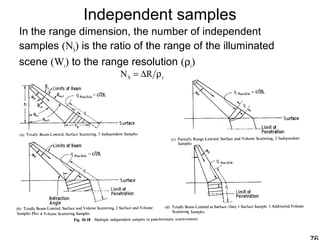
In the range dimension, the number of independent
samples (NS) is the ratio of the range of the illuminated
scene (Wr) to the range resolution (ρr)
rS RN ρ∆=
Independent samples
When relative motion exists between the target and the
radar, the frequency shift due to Doppler can be used to
obtain independent samples.
The number of independent samples due to the Doppler
shift, ND, is the product of the Doppler bandwidth, ∆fD, and
the observation time, T
The total number of independent samples is
In both cases (range or Doppler) the result is that to reduce
the effects of fading, the resolution is degraded.
TfN DD ∆=
DS NNN =
Independent samples
N = 1 N = 10
N = 50 N = 250
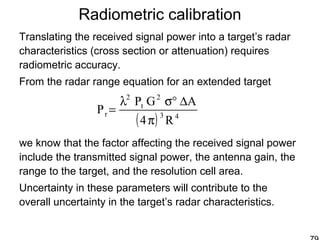
Radiometric calibration
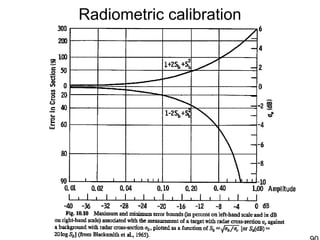
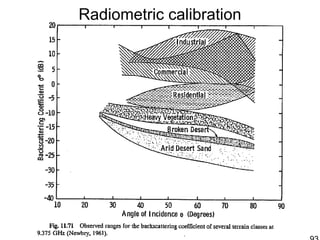
Translating the received signal power into a target’s radar
characteristics (cross section or attenuation) requires
radiometric accuracy.
From the radar range equation for an extended target
we know that the factor affecting the received signal power
include the transmitted signal power, the antenna gain, the
range to the target, and the resolution cell area.
Uncertainty in these parameters will contribute to the
overall uncertainty in the target’s radar characteristics.
( ) 43
2
t
2
r
R4
AGP
P
π
∆°σλ
=
Radiometric calibration
Transmit power, Pt
Addition of an RF coupler or power splitter at the transmitter output
permits continuous monitoring of the transmitted signal power.
Antenna gain, G
The antenna’s radiation pattern must be well characterized. In
many cases the antenna must be characterized on the platform
(aircraft or spacecraft) as it’s immediate environment may affect
the radiation characteristics. Furthermore the characterization may
need to be performed in flight.
Target range, R
Radar’s inherent ability to measure range accurately minimizes any
contribution to radiometric uncertainty.
Resolution cell area, ∆A
Difficult to measure directly, requires measurement data from
extended target with known σ°.
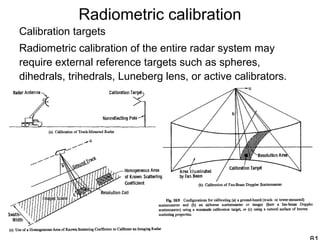
Radiometric calibration
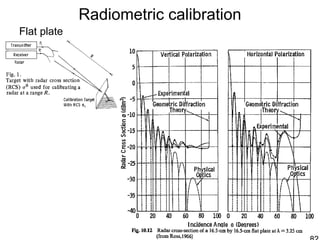
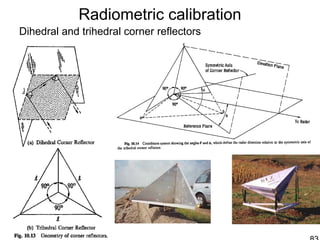
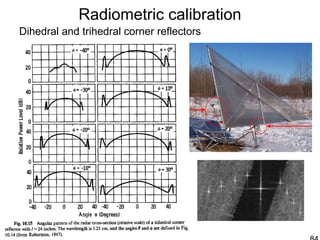
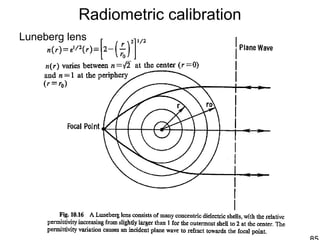
Calibration targets
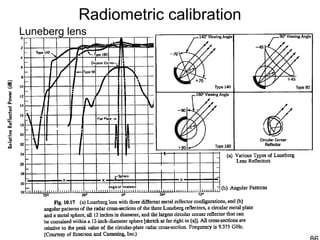
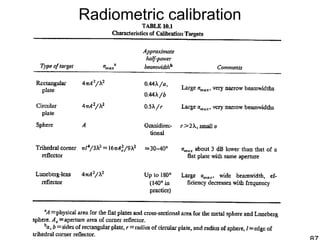
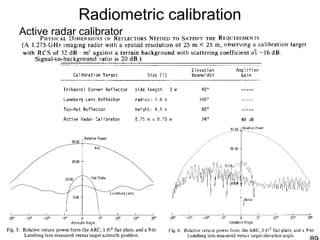
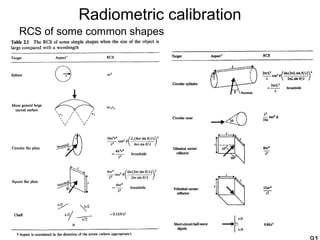
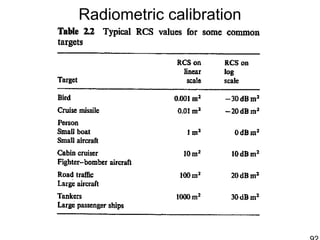
Radiometric calibration of the entire radar system may
require external reference targets such as spheres,
dihedrals, trihedrals, Luneberg lens, or active calibrators.
Radiometric calibration
Flat plate
Radiometric calibration
Dihedral and trihedral corner reflectors
Radiometric calibration
Dihedral and trihedral corner reflectors
Radiometric calibration
Luneberg lens
Radiometric calibration
Luneberg lens
Radiometric calibration
Active radar calibrator [Brunfeldt and Ulaby, IEEE Trans. Geosci. Rem. Sens., 22(2),
pp. 165-169, 1984.]
Radiometric calibration
Active radar calibrator
Radiometric calibration
RCS of some common shapes
Radiometric calibration

synthetic aperture radar

  • 1.
  • 2.
    Outline Spatial resolution Range resolution •Short pulse system • Pulse compression • Chirp waveform • Slant range vs. ground range Azimuth resolution • Unfocused SAR • Focused SAR Geometric distortion Foreshortening Layover Shadow Radiometric resolution Fading Radiometric calibration
  • 3.
    Spatial discrimination Spatial discriminationrelates to the ability to resolve signals from targets based on spatial position or velocity. angle, range, velocity Resolution is the measure of the ability to determine whether only one or more than one different targets are observed. Range resolution, ρr, is related to signal bandwidth, B Short pulse → higher bandwidth Long pulse → lower bandwidth Two targets at nearly the same range
  • 4.
    Spatial discrimination The abilityto discriminate between targets is better when the resolution distance is said to be finer (not greater) Fine (and coarse) resolution are preferred to high (and low) resolution Various combinations of resolution can be used to discriminate targets
  • 5.
  • 6.
    Range resolution Short pulseradar The received echo, Pr(t) is where Pt(t) is the pulse shape S(t) is the target impulse response ∗ denotes convolution To resolve two closely spaced targets, ρr Example ρr = 1 m → τ ≤ 6.7 ns ρr = 1 ft → τ ≤ 2 ns ( ) ( ) ( )tStPtP tr ∗= 2 c or c 2 r r τ =ρ ρ ≤τ
  • 7.
    Range resolution Clearly toobtain fine range resolution, a short pulse duration is needed. However the amount of energy (not power) illuminating the target is a key radar performance parameter. Energy, E, is related to the transmitted power, Pt by Therefore for a fixed transmit power, Pt, (e.g., 100 W), reducing the pulse duration, τ, reduces the energy E. Pt = 100 W, τ = 100 ns → ρr = 50 ft, E = 10 µJ Pt = 100 W, τ = 2 ns → ρr = 1 ft, E = 0.2 µJ Consequently, to keep E constant, as τ is reduced, Pt must increase. ( )∫ τ = 0 t dttPE
  • 8.
    More Tx Power?? Whynot just get a transmitter that outputs more power? High-power transmitters present problems Require high-voltage power supplies (kV) Reliability problems Safety issues (both from electrocution and irradiation) Bigger, heavier, costlier, …
  • 9.
    Simplified view ofpulse compression Energy content of long-duration, low-power pulse will be comparable to that of the short-duration, high-power pulse τ1 « τ2 and P1 » P2 time τ1 Power P1 P2 τ2 2211 PP τ≅τGoal:
  • 10.
    Pulse compression Chirp waveformsrepresent one approach for pulse compression. Radar range resolution depends on the bandwidth of the received signal. The bandwidth of a time-gated sinusoid is inversely proportional to the pulse duration. So short pulses are better for range resolution Received signal strength is proportional to the pulse duration. So long pulses are better for signal reception B2 c 2 c r = τ =ρ c = speed of light, ρr = range resolution, τ = pulse duration, B = signal bandwidth
  • 11.
    Pulse compression, thecompromise Transmit a long pulse that has a bandwidth corresponding to a short pulse Must modulate or code the transmitted pulse to have sufficient bandwidth, B can be processed to provide the desired range resolution, ρr Example: Desired resolution, ρr = 15 cm (~ 6”) Required bandwidth, B = 1 GHz (109 Hz) Required pulse energy, E = 1 mJ E(J) = Pt(W)· τ(s) Brute force approach Raw pulse duration, τ = 1 ns (10-9 s) Required transmitter power, P = 1 MW ! Pulse compression approach Pulse duration, τ = 0.1 ms (10-4 s) Required transmitter power, P = 10 W
  • 12.
    FM-CW radar Alternative radarschemes do not involve pulses, rather the transmitter runs in “continuous-wave” mode, i.e., CW. FM-CW radar block diagram
  • 13.
    FM-CW radarLinear FMsweep Bandwidth: B Repetition period: TR= 1/fm Round-trip time to target: T = 2R/c ∆fR = Tx signal frequency – Rx signal frequency If 2fm is the frequency resolution, then the range resolution ρr is Hz,f c RB4 Tc RB4 T 2T B f m RR R ===∆ m,B2cr =ρ B2
  • 14.
    FM-CW radar The FM-CWradar has the advantage of constantly illuminating the target (complicating the radar design). It maps range into frequency and therefore requires additional signal processing to determine target range. Targets moving relative to the radar will produce a Doppler frequency shift further complicating the processing.
  • 15.
    Chirp radarBlending theideas of pulsed radar with linear frequency modulation results in a chirp (or linear FM) radar. Transmit a long-duration, FM pulse. Correlate the received signal with a linear FM waveform to produce range dependent target frequencies. Signal processing (pulse compression) converts frequency into range. Key parameters: B, chirp bandwidth τ, Tx pulse duration
  • 16.
    Chirp radar Linear frequencymodulation (chirp) waveform for 0 ≤ t ≤ τ fC is the starting frequency (Hz) k is the chirp rate (Hz/s) φC is the starting phase (rad) B is the chirp bandwidth, B = kτ ( )( )C 2 C tk5.0tf2cosA)t(s φ++π=
  • 17.
  • 18.
    Challenges with stretchprocessing time Tx B Rx LO near far frequency time frequency near far Reference chirp Received signal (analog) Digitized signal Low-pass filter A/D converter Echoes from targets at various ranges have different start times with constant pulse duration. Makes signal processing more difficult. To dechirp the signal from extended targets, a local oscillator (LO) chirp with a much greater bandwidth is required. Performing analog dechirp operation relaxes requirement on A/D converter.
  • 19.
    Pulse compression example Keysystem parameters Pt = 10 W, τ = 100 µs, B = 1 GHz, E = 1 mJ , ρr = 15 cm Derived system parameters k = 1 GHz / 100 µs = 10 MHz / µs = 1013 s-2 Echo duration = τ = 100 µs Frequency resolution δf = (observation time)-1 = 10 kHz Range to first target, R1 = 150 m T1 = 2 R1 / c = 1 µs Beat frequency, fb = k T1 = 10 MHz Range to second target, R2 = 150.15 m T2 = 2 R2 / c = 1.001 µs Beat frequency, fb = k T2 = 10.01 MHz fb2 – fb1 = 10 kHz which is the resolution of the frequency measurement
  • 20.
    Pulse compression example(cont.) With stretch processing a reduced video signal bandwidth is output from the analog portion of the radar receiver. video bandwidth, Bvid = k Tp (where Tp = 2 Wr /c is the swath’s slant width) for Wr = 3 km, Tp = 20 µs → Bvid = 200 MHz This relaxes the requirements on the data acquisition system (i.e., analog-to-digital (A/D) converter and associated memory systems). Without stretch processing the data acquisition system must sample a 1-GHz signal bandwidth requiring a sampling frequency of 2 GHz and memory access times less than 500 ps.
  • 21.
    Correlation processing ofchirp signals Avoids problems associated with stretch processing Takes advantage of fact that convolution in time domain equivalent to multiplication in frequency domain Convert received signal to freq domain (FFT) Multiply with freq domain version of reference chirp function Convert product back to time domain (IFFT) FFT IFFT Freq-domain reference chirp Received signal (after digitization) Correlated signal
  • 22.
    Signal correlation examples Inputwaveform #1 High-SNR gated sinusoid, no delay Input waveform #2 High-SNR gated sinusoid, ~800 count delay
  • 23.
    Signal correlation examples Inputwaveform #1 High-SNR gated sinusoid, no delay Input waveform #2 Low-SNR gated sinusoid, ~800 count delay
  • 24.
    Signal correlation examples Inputwaveform #1 High-SNR gated chirp, no delay Input waveform #2 High-SNR gated chirp, ~800 count delay
  • 25.
    Signal correlation examples Inputwaveform #1 High-SNR gated chirp, no delay Input waveform #2 Low-SNR gated chirp, ~800 count delay
  • 26.
    Chirp pulse compressionand time sidelobes Peak sidelobe level can be controlled by introducing a weighting function -- however this has side effects.
  • 27.
    Superposition and multipletargets Signals from multiple targets do not interfere with one another. (negligible coupling between scatterers) Free-space propagation, target interaction, radar receiver all have linear transfer functions → superposition applies. Signal from each target adds linearly with signals from other targets. ∆r = ρr range resolution
  • 28.
    Why time sidelobesare a problem Sidelobes from large-RCS targets with can obscure signals from nearby smaller-RCS targets. Time sidelobes are related to pulse duration, τ. ∆fb = 2 k ∆R/c ∆fb
  • 29.
    Window functions andtheir effects Time sidelobes are a side effect of pulse compression. Windowing the signal prior to frequency analysis helps reduce the effect. Some common weighting functions and key characteristics Less common window functions used in radar applications and their key characteristics
  • 30.
    Window functions Basic function: aand b are the –6-dB and -∞ normalized bandwidths
  • 31.
  • 32.
    Detailed example ofchirp pulse compression ( )( ) τ≤≤φ++π= t0,tk5.0tf2cosa)t(s C 2 C ( )( ) ( )( )C 2 CC 2 C )Tt(k5.0)Tt(f2cosatk5.0tf2cosa)Tt(s)t(s φ+−+−πφ++π=− ( )( )        φ+−+τ−+π+ π−π+π =− CC 2 C 2 2 C 2 2TfTk5.0tktf2tk2cos )TkTtk2Tf2(cos 2 a )Tt(s)t(s ( )( )2 C 2 Tk5.0tTkTf2cos 2 a )t(q −+π= after lowpass filtering to reject harmonics dechirp analysis which simplifies to received signal quadratic frequency dependence linear frequency dependence phase terms chirp-squared term sinusoidal term sinusoidal term
  • 33.
    Pulse compression effectson SNR and blind range SNR improvement due to pulse compression: Bτ Case 1: Pt = 1 MW, τ = 1 ns, B = 1 GHz, E = 1 mJ, ρr = 15 cm For a given R, Gt, Gr, λ, σ: SNRvideo = 10 dB Bτ = 1 or 0 dB SNRcompress = SNRvideo = 10 dB Blind range = cτ/2 = 0.15 m Case 2: Pt = 10 W, τ = 100 µs, B = 1 GHz, E = 1 mJ , ρr = 15 cm For the same R, Gt, Gr, λ, σ: SNRvideo = – 40 dB Bτ = 100,000 or 50 dB SNRcompress = 10 dB Blind range = cτ/2 = 15 km ( ) τ π σλ = B FBTkR4 GGP SNR 43 2 rtt compress
  • 34.
    Pulse compression Pulse compressionallows us to use a reduced transmitter power and still achieve the desired range resolution. The costs of applying pulse compression include: added transmitter and receiver complexity must contend with time sidelobes increased blind range The advantages generally outweigh the disadvantages so pulse compression is used widely. Therefore we will be using chirp waveforms to provide the required range resolution for SAR applications.
  • 35.
    Slant range vs.ground range Cross-track resolution in the ground plane (∆x) is the projection of the range resolution from the slant plane onto the ground plane. At grazing angles (θ → 90°), ρr ≅ ∆x At steep angles (θ → 0°), ∆x → ∞ For θ = 5°, ∆x = 11.5 ρr For θ = 15°, ∆x = 3.86 ρr For θ = 25°, ∆x = 2.37 ρr For θ = 35°, ∆x = 1.74 ρr For θ = 45°, ∆x = 1.41 ρr
  • 36.
    Azimuth (along-track) resolution Discriminationof targets based on their along-track or azimuth position is possible due to the unique phase history associated with each azimuth position. Note that phase variations and Doppler frequency shifts are analogous since f = dφ/dt where φ is phase. Assuming the phase of the target’s echo is essentially constant over all observation angles, the phase variation is due entirely to range variations during the observation period. Recall that φ/2π = 2R/λ where R is the slant range, λ is the wavelength, and the factor of 2 is due to the round-trip path length.
  • 37.
    Along-track resolution Consider anairborne radar system flying at a constant speed along a straight and level trajectory as it views the terrain. For a point on the ground the range to the radar and the radial velocity component can be determined as a function of time. Radar position = (0, v⋅t, h), Target position = (xo, yo, 0), Range to target, R(t) ( ) ( ) ( ) ( )22 o 2 o 0hytvx0tR −+−⋅+−= ( ) 22 o 2 o hyx0R ++= ( ) ( ) ( ) 22 o 2 o o hytvx ytvv tR td dR +−⋅+ −⋅ ==  ( ) 22 o 2 o o hyx vy 0R ++ − = ( ) 22 o 2 o o D hyx vy2 0R 2 f ++λ = λ −= 
  • 38.
  • 39.
    Along-track resolution Example Airborne SAR Altitude:10,000 m Velocity: 75 m/s Five targets on ground All cross-track offsets = 5 km Along-track offsets of -1000, -500, 0, 500, and 1000 m
  • 40.
    Along-track resolution Alt =10 km 10000 11000 12000 13000 14000 15000 16000 17000 18000 19000 20000 -15000 -10000 -5000 0 5000 10000 15000 Along-track position (m) Range(m) 1000 m 500 m 0 m -500 m -1000 m
  • 41.
    Alt = 10km, Vel = 75 m/s, λ = 10 cm -1500 -1000 -500 0 500 1000 1500 -15000 -10000 -5000 0 5000 10000 15000 Along-track position (m) Dopplerfrequency(Hz) 1000 m 500 m 0 m -500 m -1000 m -300 -200 -100 0 100 200 300 -1000 -500 0 500 1000 c Along-track resolution
  • 42.
  • 43.
    Along-track resolution Example Airborne SAR Altitude:10,000 m Velocity: 75 m/s Five targets on ground All along-track offsets = 0 m Cross-track offsets of 5, 7.5, 10, 12.5, and 15 km
  • 44.
    Along-track resolution Alt =10 km 10000 11000 12000 13000 14000 15000 16000 17000 18000 19000 20000 -15000 -10000 -5000 0 5000 10000 15000 Along-track position (m) Range(m) 15 km 12.5 km 10 km 7.5 km 5 km
  • 45.
    Along-track resolution Alt =10 km, Vel = 75 m/s, λ = 10 cm -1500 -1000 -500 0 500 1000 1500 -15000 -10000 -5000 0 5000 10000 15000 Along-track position (m) Dopplerfrequency(Hz) 15 km 12.5 km 10 km 7.5 km 5 km -100 -75 -50 -25 0 25 50 75 100 -750 0 750 c
  • 46.
  • 47.
    Along-track resolution Now solvefor R and fD for all target locations and plot lines of constant range (isorange) and lines of constant Doppler shift (isodops) on the surface.
  • 48.
    Along-track resolution Isorange andisodoppler lines for aircraft flying north at 10 m/s at a 1500-m altitude.
  • 49.
    Along-track resolution Without thespatial filtering of the antenna, the azimuth chirp waveform covers a wide bandwidth.
  • 50.
    Along-track resolution Samples ofphase variations due to a changing range throughout the aperture are provided with each pulse in the slow-time domain. Note that the range chirp has been frequency shifted to baseband.
  • 51.
    Along-track resolution Squint-mode operation(or moving targets) will skew the Doppler spectrum. This skew can be detected and accommodated.
  • 52.
    Strip-map SAR signalexample (no squint) Single point target at center of scene.
  • 53.
    Strip-map SAR signalexample (no squint) Time domain characteristics of single point target. Magnitude of phase history mapped in azimuth and range. • Constant amplitude in range axis indicates uniform pulse amplitude (no windowing). • Variation in azimuth represents antenna beam pattern in azimuth plane.
  • 54.
    Strip-map SAR signalexample (no squint) Time domain characteristics of single point target. Real part of phase history mapped in azimuth and range. Can be shown that contour of constant phase follows: Where K is the pulse chirp rate Ka is the azimuth chirp rate t is the fast time index η is the slow time index α is a constant • Positive range chirp (K > 0), negative azimuth chirp (Ka < 0) • Contours of constant phase map as hyperbolae α=η− 2 a 2 KtK
  • 55.
    Strip-map SAR signalexample (no squint)
  • 56.
    Strip-map SAR signalexample (no squint) Time domain characteristics of single point target. Real part of phase history mapped in azimuth and range. Can be shown that contour of constant phase follows: Where K is the pulse chirp rate Ka is the azimuth chirp rate t is the fast time index η is the slow time index α is a constant • Negative range chirp (K < 0), negative azimuth chirp (Ka < 0) • Contours of constant phase map as ellipses α=η− 2 a 2 KtK
  • 57.
    Unfocused SAR Processing SARphase data to achieve a fine-resolution image requires elaborate signal processing. In some cases trading off resolution for processing complexity is acceptable. In these cases a simplified unfocused SAR processing is used wherein only a portion of the azimuth phase history is used resulting in a coarser azimuth resolution. In unfocused SAR processing consecutive azimuth samples are added together (in the slow-time domain). Since addition a is simple operation for digital signal processors, the image formation processing is much easier (less time consuming) than fully-focused SAR processing.
  • 58.
    Unfocused SAR Summing consecutivesamples, also known as a coherent integration or boxcar filtering, is useful so long as the signal’s phase is relatively constant over the integration interval. Example For a 20-sample interval the central portion of the chirp waveform (zero Doppler) is relatively constant. For the outer portions of the chirp the phase varies significantly and integrating produces a reduced output.
  • 59.
    Unfocused SAR Example (cont.) Overa 38-sample interval phase variations within the central portion of the chirp waveform results in a reduced output (0.8 peak vs. 1). The magnitude of the first sidelobe is also larger (0.4 vs. 0.3). The width of the main lobe is narrower.
  • 60.
    Unfocused SAR The resolutionimproves with increased integration length up to a point when oscillations in the signal are included in the integral. The maximum synthetic aperture length for unfocused SAR is Lu which corresponds to a maximum phase shift across the aperture of 45º. The azimuth resolution for L = Lu is Notice the range- and frequency-dependencies of ∆y. )m(,2Ry λ=∆ )m(,2RLu λ=
  • 61.
    Focused SAR To realizethe full potential of SAR and achieve fine along- track (azimuth) resolution requires matched filtering of the azimuth chirp signal. Stretch chirp processing, correlation processing, tracking Doppler filters, as well as other techniques can be used in a matched filter process. However the range processing is not entirely separable from the azimuth processing as an intricate interaction between range and azimuth domains exists which must also be dealt with to achieve the desired image quality.
  • 62.
    Focused SAR Consider thephenomenon known as range walk or range- cell migration. Variations in range to a target over the synthetic aperture not only introduce a quadratic phase change (resulting in the azimuth chirp) but may also displace echo in the range (fast-time) domain.
  • 63.
    Focused SAR If therange to the target varies by an amount greater than the range resolution then the range- cell migration must be compensated during the image formation processing. Details on the processing required to achieve fully- focused fine-resolution SAR images will be addressed later.
  • 64.
    Focused SAR In SARsystems a very long antenna aperture is synthesized resulting in fine along-track resolution. For a synthesized-aperture length, L, the along-track resolution, ∆y, is L is determined by the system configuration. For a fully focused stripmap system, Lm = βaz⋅R (m), where βaz is the azimuthal or along-track beamwidth of the real antenna (βaz ≅ λ/ℓ) R is the range to the target For L = Lm, ∆y = ℓ/2 (independent of range and wavelength) ( )L2Ry λ=∆
  • 65.
    Radiometric resolution --signal fading For extended targets (and targets composed of multiple scattering centers within a resolution cell) the return signal (the echo) is composed of many independent complex signals. The overall signal is the vector sum of these signals. Consequently the received voltage will fluctuate as the scatterers’ relative magnitudes and phases vary spatially. Consider the simple case of only two scatters with equal RCSs separated by a distance d observed at a range Ro.
  • 66.
    Signal fading As theobservation point moves along the x direction, the observation angle θ will change the interference of the signals from the two targets. The received voltage, V, at the radar receiver is where The measured voltage varies from 0 to 2, power from 0 to 4. Single measurement will not provide a good estimate of the scatterer’s σ. ba Rk2j 0 Rk2j 0 eVeVV −− += θ−≅θ+≅ sin 2 d RR,sin 2 d RR 0b0a       θ λ π = sin d2 cosV2V 0 Note: Same analysis used for antenna arrays.
  • 67.
    Fading statistics Consider thecase of Ns independent scatterers (Ns is large) where the voltage due to each scatterer is The vector sum of the voltage terms from each scatterer is where Ve and φ are the envelope voltage and phase. It is assumed that each voltage term, Vi and φi are independent random variables and that φi is uniformly distributed. The magnitude component Vi can be decomposed into orthogonal components, Vx and Vy where Vx and Vy are normally distributed. ij i eV φ φ = φ == ∑ j e N 1i j i eVeVV s i iiyiix sinVVandcosVV φ=φ=
  • 68.
    Fading statistics The fluctuationof the envelope voltage, Ve, is due to fading although it is similar to that of noise. The models for fading and noise are essentially the same. Two common envelope detection schemes are considered, linear detection (where the magnitude of the envelope voltage is output) and square-law detection (where the output is the square of the envelope magnitute). Linear detection, VOUT = |VIN| = Ve It can be shown that Ve follows a Rayleigh distribution ( )     < ≥ σπ= σ− 0V,0 0V,e 2 V Vp e e 2V 2 e e 22 e where σ2 is the variance of the input signal
  • 69.
    Fading statistics (lineardetection) For a Rayleigh distribution the mean is the variance is The fluctuation about the mean is Vac which has a variance of So the ratio of the square of the envelope mean to the variance of the fluctuating component represents a kind of inherent signal-to-noise ratio for Rayleigh fading. 22 e 2V σ= 2Ve πσ= 222 e 2 e 2 ac 429.0 2 2VVV σ=σ      π −=−= dB6.5or66.3VV 2 ac 2 e =
  • 70.
    Fading statistics (lineardetection) An equivalent SNR of 5.6 dB (due to fading) means that a single Ve measurement will have significant uncertainty. For a good estimate of the target’s RCS, σ, multiple independent measurements are required. By averaging several independent samples of Ve, we improve our estimate, VL where N is the number of independent samples Ve is the envelope voltage sample ∑= = N 1i eiL V N 1 V
  • 71.
    Fading statistics (lineardetection) The mean value, VL, is unaffected by the averaging process However the magnitude of the fluctuations are reduced And the effective SNR due to fading improves as 1/N As more Rayleigh distributed samples are averaged the distribution begins to resemble a normal or Gaussian distribution. eL V2V =πσ= N429.0V 22 ac σ=
  • 72.
    Fading statistics (square-lawdetection) Square-law detection, Vs = Ve 2 The output voltage is related to the power in the envelope. It can be shown that Vs follows an exponential distribution Again the mean value is found and the variance is found (note that ) Again for a single sample measurement yields a poor estimate of the mean. ( )     < ≥ σ= σ− 0V,0 0V,e 2 1 Vp s s 2V 2 s 2 s where σ2 is the variance of the input signal 2 s 2 s 2 s 2 sac VVVV =−= 22 es 2VV σ== 2 s 2 s V2V = dB0or1VV 2 sac 2 s =
  • 73.
    Fading statistics (square-lawdetection) An equivalent SNR of 0 dB (due to fading) means that a single Vs measurement will have significant uncertainty. For a good estimate of the target’s RCS, σ, multiple independent measurements are required. By averaging several independent samples of Vs, we improve our estimate, VL where N is the number of independent samples Vs is the envelope-squared voltage sample ∑= = N 1i siL V N 1 V
  • 74.
    Fading statistics (square-lawdetection) The mean value, VL, is unaffected by the averaging process However the magnitude of the fluctuations are reduced And the effective SNR due to fading improves as 1/N. As more exponential distributed samples are averaged the distribution begins to resemble a χ2 (2N) distribution. For large N, (N > 10), the distribution becomes Gaussian. 2 L 2V σ= NVV 2 s 2 sac =
  • 75.
    Independent samples Fading isnot a noise phenomenon, therefore multiple observations from a fixed radar position observing the same target geometry will not reduce the fading effects. Two approaches exist for obtaining independent samples change the observation geometry change the observation frequency (more bandwidth) Both methods produce a change in φ which yields an independent sample. Estimating the number of independent samples depends on the system parameters, the illuminated scene size, and on how the data are processed.
  • 76.
    Independent samples In therange dimension, the number of independent samples (NS) is the ratio of the range of the illuminated scene (Wr) to the range resolution (ρr) rS RN ρ∆=
  • 77.
    Independent samples When relativemotion exists between the target and the radar, the frequency shift due to Doppler can be used to obtain independent samples. The number of independent samples due to the Doppler shift, ND, is the product of the Doppler bandwidth, ∆fD, and the observation time, T The total number of independent samples is In both cases (range or Doppler) the result is that to reduce the effects of fading, the resolution is degraded. TfN DD ∆= DS NNN =
  • 78.
    Independent samples N =1 N = 10 N = 50 N = 250
  • 79.
    Radiometric calibration Translating thereceived signal power into a target’s radar characteristics (cross section or attenuation) requires radiometric accuracy. From the radar range equation for an extended target we know that the factor affecting the received signal power include the transmitted signal power, the antenna gain, the range to the target, and the resolution cell area. Uncertainty in these parameters will contribute to the overall uncertainty in the target’s radar characteristics. ( ) 43 2 t 2 r R4 AGP P π ∆°σλ =
  • 80.
    Radiometric calibration Transmit power,Pt Addition of an RF coupler or power splitter at the transmitter output permits continuous monitoring of the transmitted signal power. Antenna gain, G The antenna’s radiation pattern must be well characterized. In many cases the antenna must be characterized on the platform (aircraft or spacecraft) as it’s immediate environment may affect the radiation characteristics. Furthermore the characterization may need to be performed in flight. Target range, R Radar’s inherent ability to measure range accurately minimizes any contribution to radiometric uncertainty. Resolution cell area, ∆A Difficult to measure directly, requires measurement data from extended target with known σ°.
  • 81.
    Radiometric calibration Calibration targets Radiometriccalibration of the entire radar system may require external reference targets such as spheres, dihedrals, trihedrals, Luneberg lens, or active calibrators.
  • 82.
  • 83.
    Radiometric calibration Dihedral andtrihedral corner reflectors
  • 84.
    Radiometric calibration Dihedral andtrihedral corner reflectors
  • 85.
  • 86.
  • 87.
  • 88.
    Radiometric calibration Active radarcalibrator [Brunfeldt and Ulaby, IEEE Trans. Geosci. Rem. Sens., 22(2), pp. 165-169, 1984.]
  • 89.
  • 90.
  • 91.
  • 92.
  • 93.