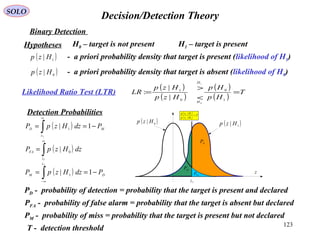
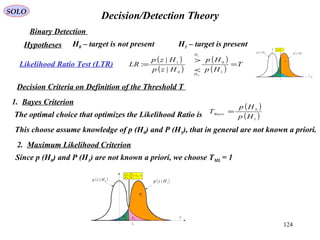
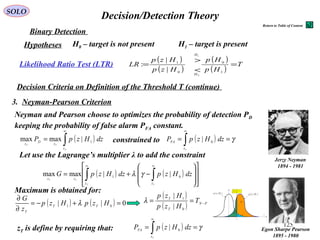
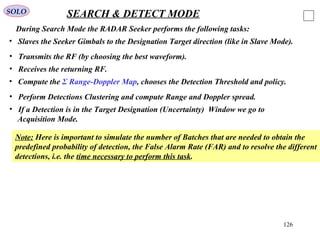
1
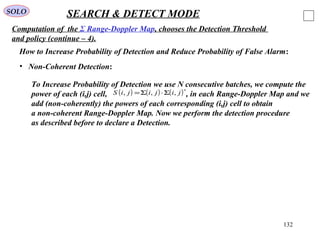
RADAR Signal
Processing
SOLO HERMELIN
Updated: 28.11.08http://www.solohermelin.com
2
SOLO RADAR Signal Processing
Table of Contents
RADAR Signals
Waveform Hierarchy
RADAR Types
Radar Generic Procedures
Fourier Transform
Waveforms
Quadrature Form
Spectrum
Energy
Complex and Analytic Signals
Signal Duration and Bandwidth
Complex Representation of Bandpass Signals
Autocorrelation
Sampling and z-Transform
Nyquist-Shannon Sampling Theorem
3
SOLO RADAR Signal Processing
Table of Contents (continue – 1)
The Discrete Time Fourier Transform (DTFT)
The Discrete Fourier Transform (DFT)
Fast Fourier Transform (FFT)
Digital Filtering
Windowing
Doppler Frequency Shift
Coherent Pulse Doppler Radar
Signal Processing
Decision/Detection Theory
Search & Detect Mode
Acquisition Mode
References
4
SOLO
The transmitted RADAR RF
Signal is:
( ) ( ) ( )[ ]ttftEtEt 0000 2cos ϕπ +=
E0 – amplitude of the signal
f0 – RF frequency of the signal
φ0 –phase of the signal (possible modulated)
The returned signal is delayed by the time that takes to signal to reach the target and to
return back to the receiver. Since the electromagnetic waves travel with the speed of light
c (much greater then RADAR and
Target velocities), the received signal
is delayed by
c
RR
td
21 +
≅
The received signal is: ( ) ( ) ( ) ( )[ ] ( )tnoisettttfttEtE dddr +−+−⋅−= ϕπα 00 2cos
To retrieve the range (and range-rate) information from the received signal the
transmitted signal must be modulated in Amplitude or/and Frequency or/and Phase.
ά < 1 represents the attenuation of the signal
RADAR Signal Processing
RADAR Signals
5
SOLO
The received signal is:
( ) ( ) ( ) ( )[ ] ( )tnoisettttfttEtE dddr +−+−⋅−= ϕπα 00 2cos
( ) ( ) tRRtRtRRtR ⋅+=⋅+= 222111 & 
We want to compute the delay time td due to the time td1 it takes the EM-wave to reach
the target at a distance R1 (at t=0), from the transmitter, and to the time td2 it takes the
EM-wave to return to the receiver, at a distance R2 (at t=0) from the target. 21 ddd ttt +=
According to the Special Theory of Relativity
the EM wave will travel with a constant
velocity c (independent of the relative
velocities ).21 & RR 
The EM wave that reached the target at
time t was send at td1 ,therefore
( ) ( ) 111111 ddd tcttRRttR ⋅=−⋅+=−  ( )
1
11
1
Rc
tRR
ttd 

+
⋅+
=
In the same way the EM wave received from the target at time t was reflected at td2 ,
therefore
( ) ( ) 222222 ddd tcttRRttR ⋅=−⋅+=−  ( )
2
22
2
Rc
tRR
ttd 

+
⋅+
=
RADAR Signal Processing
6
SOLO
The received signal is:
( ) ( ) ( ) ( )[ ] ( )tnoisettttfttEtE dddr +−+−⋅−= ϕπα 00 2cos
21 ddd ttt += ( )
1
11
1
Rc
tRR
ttd 

+
⋅+
= ( )
2
22
2
Rc
tRR
ttd 

+
⋅+
=
( ) ( )
2
22
1
11
21
Rc
tRR
Rc
tRR
tttttttt ddd 



+
⋅+
−
+
⋅+
−=−−=−






+
−
+
−
+





+
−
+
−
=−
2
2
2
2
1
1
1
1
2
1
2
1
Rc
R
t
Rc
Rc
Rc
R
t
Rc
Rc
tt d 



From which:
or:
Since in most applications we can
approximate where they appear in the arguments of E0 (t-td), φ (t-td),
however, because f0 is of order of 109
Hz=1 GHz, in radar applications, we must use:
cRR <<21, 
1,
2
2
1
1
≈
+
−
+
−
Rc
Rc
Rc
Rc




( )   





−⋅










++





−⋅










+=





−⋅





−+





−⋅





−⋅≈− 2
.
201
.
10
22
0
11
00
2
1
2
1
2
12
1
2
12
1
21
D
Ralong
FreqDoppler
DD
Ralong
FreqDoppler
Dd ttffttff
c
R
t
c
R
f
c
R
t
c
R
fttf

( ) ( ) ( ) ( ) ( )[ ] ( )tnoisettttffttEtE ddDdr +−+−⋅+−= ˆˆˆ2cosˆ 00 ϕπα
where 21
2
2
1
121
2
02
1
01
ˆˆˆ,,,ˆˆˆ,
2ˆ,
2ˆ
dddddDDDDD ttt
c
R
t
c
R
tfff
c
R
ff
c
R
ff +=≈≈+=−≈−≈

Finally
RADAR Signal Processing
Doppler Effect
7
SOLO
The received signal model:
( ) ( ) ( ) ( ) ( )[ ] ( )tnoisettttffttEtE ddDdr +−+−⋅+−≈ ϕπα 00 2cos
Delayed by two-
way trip time
Scaled down
Amplitude Possible phase
modulated
Corrupted
By noise
Doppler
effect
We want to estimate:
• delay td range c td/2
• amplitude reduction α
• Doppler frequency fD
• noise power n (relative to signal power)
• phase modulation φ
Return to Table of Content
8
SOLO
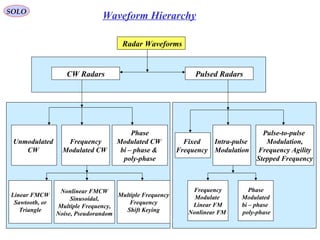
Waveform Hierarchy
Radar Waveforms
CW Radars Pulsed Radars
Frequency
Modulated CW
Phase
Modulated CW
bi – phase &
poly-phase
Linear FMCW
Sawtooth, or
Triangle
Nonlinear FMCW
Sinusoidal,
Multiple Frequency,
Noise, Pseudorandom
Intra-pulse
Modulation
Pulse-to-pulse
Modulation,
Frequency Agility
Stepped Frequency
Frequency
Modulate
Linear FM
Nonlinear FM
Phase
Modulated
bi – phase
poly-phase
Unmodulated
CW
Multiple Frequency
Frequency
Shift Keying
Fixed
Frequency
9
SOLO
( )tf
2
τ
2
τ
−
A
∞→t
2
τ
+T
2
τ
−T
A
2
τ
+−T
2
τ
−−T
A
t←∞−
T T
NONCOHERENT PULSESCOHERENT PULSES
( )tf
t
A
2
τ
2
τ
−T
AA
T T
A
2
2
τ
+T
2
2
τ
−T
A
T T
A
2
τ
− 2
τ
+T
TN
PULSED (UNCODED)
A Partial List of the Family of RADAR Waveforms
PRI – Pulse Repetition Interval PRF – Pulse Repetition Frequency
τ – Pulse Width [μsec]
PRF = 1/PRI
Pulse Duty Cycle = DC = τ / PRI = τ * PRF
Paverrage = DC * Ppeak
Pulse Waveform Parameters
Continuous Waves (CW)
Pulses
• Coherent – Phase is predictable from pulse-to-pulse
• Non-coherent – Phase from pulse-to-pulse is not predictable
Waveform Hierarchy
10
SOLO
( )tf
2
τ
2
τ
−
A
∞→t
2
τ
+T
2
τ
−T
A
2
τ
+−T
2
τ
−−T
A
t←∞−
T T
A
t
A
t
A
LINEAR FM PULSECODED PULSE
T T
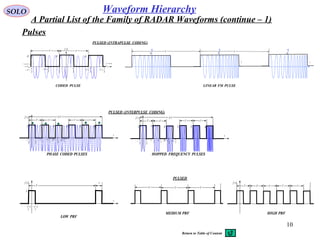
PULSED (INTRAPULSE CODING)
t
( )tf
A
2
τ
2
τ
−T
AA
T T
A
2
2
τ
+T
2
2
τ
−T
A
T T
A
2
τ
− 2
τ
+T
TN
t
( )tf
A
2
τ
2
τ
−T
AA
T T
A
2
2
τ
+T
2
2
τ
−T
A
T T
A
2
τ
− 2
τ
+T
TN
PHASE CODED PULSES HOPPED FREQUENCY PULSES
PULSED (INTERPULSE CODING)
t
( )tf
A
T
2/τ−
LOW PRF
MEDIUM PRF
PULSED
( )tf
T T T T
2/τ+
τ
HIGH PRF
T
T T T
A Partial List of the Family of RADAR Waveforms (continue – 1)
Pulses
Waveform Hierarchy
Return to Table of Content
11
SOLO
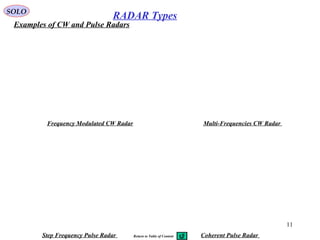
RADAR Types
Frequency Modulated CW Radar Multi-Frequencies CW Radar
Step Frequency Pulse Radar Coherent Pulse Radar
Examples of CW and Pulse Radars
Return to Table of Content
12
SOLO
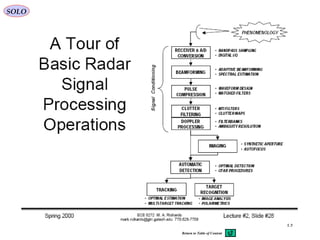
Radar Generic Procedures:
Matched Filters in RADAR Systems
• Transmits high frequency (f0) EM signal: ( ) ( ) ( )[ ]ttftEtEt 0000 2cos ϕπ +=
( ) ( ) ( ) ( ) ( )[ ] ( )tnoisettttffttEtE ddDdr +−+−⋅+−≈ ϕπα 00 2cos
• Receives low power reflected EM signal that contains doppler information (f0 + fD):
• Down-converts to Intermediate Frequency (IF) signal (fIF + fD), Amplifies at Low Noise,
and Automatically Controls the Gain (AGC) of the receiver:
( ) ( ) ( ) ( ) ( )[ ] ( )tnoisettttffttEGtE IFddDIFdIFIF +−+−⋅+−≈ ϕπα 2cos0
• Down-converts to Video Frequency (V) signal (fV + fD), (often using a Synchronous I,Q
configuration), samples the video (A/D) for Digital Signal Processing.
• The Digital Signal Processing (DSP) performs Fast Fourier Transforms (FFT),
to produce the Data Cube (Range, Doppler, Receiving Channels). Using the data
DSP detects the potential targets, and computes the receiving delay td (Range),
Doppler frequency (closing velocity), angular target position. According to the
Radar policy, he will acquire the targets of interest, and will track them.
Doing this he prevents unwanted signal (Clutter, ECM, …) to interfere with
the target of interest received signals.
This presentation deals with some aspects of the Radar Digital Processing.
13
SOLO
Return to Table of Content
14
Fourier Transform
( ) ( ){ } ( ) ( )∫
+∞
∞−
−== dttjtftfF ωω exp:F
SOLO
Jean Baptiste Joseph
Fourier
1768-1830
F (ω) is known as Fourier Integral or Fourier Transform
and is in general complex
( ) ( ) ( ) ( ) ( )[ ]ωφωωωω jAFjFF expImRe =+=
Using the identities
( ) ( )t
d
tj δ
π
ω
ω =∫
+∞
∞− 2
exp
we can find the Inverse Fourier Transform ( ) ( ){ }ωFtf -1
F=
( ) ( ) ( ) ( ) ( )
( ) ( )( ) ( ) ( ) ( ) ( )[ ]00
2
1
2
exp
2
expexp
2
exp
++−=−=−=




−=
∫∫ ∫
∫ ∫∫
∞+
∞−
∞+
∞−
∞+
∞−
+∞
∞−
+∞
∞−
+∞
∞−
tftfdtfd
d
tjf
d
tjdjf
d
tjF
ττδττ
π
ω
τωτ
π
ω
ωττωτ
π
ω
ωω
( ) ( ){ } ( ) ( )∫
+∞
∞−
==
π
ω
ωωω
2
exp:
d
tjFFtf -1
F
( ) ( ) ( ) ( )[ ]00
2
1
++−=−∫
+∞
∞−
tftfdtf ττδτ
If f (t) is continuous at t, i.e. f (t-0) = f (t+0)
This is true if (sufficient not necessary)
f (t) and f ’ (t) are piecewise continue in every finite interval1
2 and converge, i.e. f (t) is absolute integrable in (-∞,∞)( )∫
+∞
∞−
dttf
15
( )atf −
-1
F
F ( ) ( )ωω ajF −exp
Fourier TransformSOLO
( )tf
-1
F
F
( )ωFProperties of Fourier Transform (Summary)
Linearity1
( ) ( ){ } ( ) ( )[ ] ( ) ( ) ( )ωαωαωαααα 221122112211 exp: FFdttjtftftftf +=−+=+ ∫
+∞
∞−
F
Symmetry2
( )tF
-1
F
F
( )ωπ −f2
Conjugate Functions3 ( )tf *
-1
F
F
( )ω−*
F
Scaling4 ( )taf
-1
F
F






a
F
a
ω1
Derivatives5 ( ) ( )tftj
n
−
-1
F
F ( )ω
ω
F
d
d
n
n
( )tf
td
d
n
n
-1
F
F
( ) ( )ωω Fj
n
Convolution6
( ) ( )tftf 21
-1
F
F ( ) ( )ωω 21
* FF( ) ( ) ( ) ( )∫
+∞
∞−
−= τττ dtfftftf 2121
:*
-1
F
F ( ) ( )ωω 21
FF
( ) ( ) ( ) ( )∫∫
+∞
∞−
+∞
∞−
= ωωω
π
dFFdttftf 2
*
12
*
1
2
1
Parseval’s Formula7
Shifting: for any a real8
( ) ( )tajtf exp
-1
F
F ( )aF −ω
Modulation9 ( ) ttf 0
cos ω -1
F
F
( ) ( )[ ]00
2
1
ωωωω −++ FF
( ) ( ) ( ) ( ) ( ) ( )∫∫∫
+∞
∞−
+∞
∞−
+∞
∞−
−=−= ωωω
π
ωωω
π
dFFdFFdttftf 212121
2
1
2
1
16
( ) ( )∫
+∞
∞−
−
= ωω
π
ω
dejF
j
tf tj
2
1
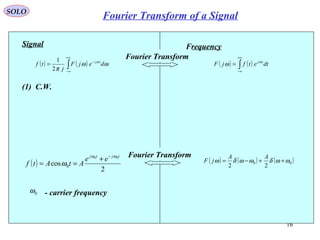
Signal
(1) C.W.
( )
2
cos
00
0
tjtj
ee
AtAtf
ωω
ω
−
+
==
0ω - carrier frequency
Frequency
( ) ( )∫
+∞
∞−
= dtetfjF tjω
ω
Fourier Transform
( ) ( ) ( )00
22
ωωδωωδω ++−=
AA
jF
Fourier Transform
SOLO
Fourier Transform of a Signal
17
( ) ( )∫
+∞
∞−
−
= ωω
π
ω
dejF
j
tf tj
2
1
Signal
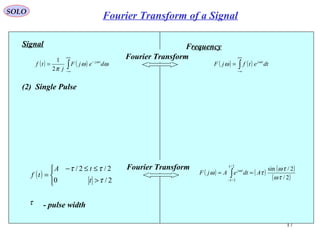
(2) Single Pulse
( )



>
≤≤−
=
2/0
2/2/
τ
ττ
t
tA
tf
τ - pulse width
Frequency
( ) ( )∫
+∞
∞−
= dtetfjF tjω
ω
Fourier Transform
( ) ( ) ( )
( )2/
2/sin
2/
2/
τω
τω
τω
τ
τ
ω
AdteAjF tj
== ∫−
Fourier Transform
SOLO
Fourier Transform of a Signal
18
( ) ( )∫
+∞
∞−
−
= ωω
π
ω
dejF
j
tf tj
2
1
Signal
( )
( )



>
≤≤−
=
2/0
2/2/cos 0
τ
ττω
t
ttA
tf
τ - pulse width
Frequency
( ) ( )∫
+∞
∞−
= dtetfjF tjω
ω
Fourier Transform
( ) ( )
( )
( )
( )
( )












−



 −
+
+



 +






=
= ∫−
2
2
sin
2
2
sin
2
cos
0
0
0
0
2/
2/
0
τωω
τωω
τωω
τωω
τ
ωω
τ
τ
ω
A
dtetAjF tj
Fourier Transform
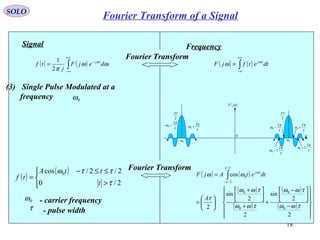
0ω - carrier frequency
(3) Single Pulse Modulated at a
frequency 0ω
ω
( )ωjF
0
τ
π
ω
2
0 +
2
τA
0ω
τ
π
ω
2
0 −
τ
π
ω
2
0 +−
2
τA
0ω−
τ
π
ω
2
0 −−
τ
π
ω
2
20 +
τ
π
ω
2
20 −
SOLO
Fourier Transform of a Signal
19
( ) ( )∫
+∞
∞−
−
= ωω
π
ω
dejF
j
tf tj
2
1
Signal
( )
( )



±±=>−
≤−≤−+
=
,2,1,0,2/0
2/2/cos 0
kkkTt
kTttA
tf
rand
τ
ττϕω
τ - pulse width
Frequency
( ) ( )∫
+∞
∞−
= dtetfjF tjω
ω
Fourier Transform
( ) ( )
( )
( )
( )
( )












−



 −
+
+



 +






=
= ∫−
2
2
sin
2
2
sin
2
cos
0
0
0
0
2/
2/
0
τωω
τωω
τωω
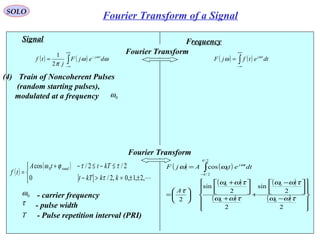
τωω
τ
ωω
τ
τ
ω
A
dtetAjF tj
Fourier Transform
0ω - carrier frequency
(4) Train of Noncoherent Pulses
(random starting pulses),
modulated at a frequency 0ω
T - Pulse repetition interval (PRI)
SOLO
Fourier Transform of a Signal
20
( ) ( )∫
+∞
∞−
−
= ωω
π
ω
dejF
j
tf tj
2
1
Signal
( )
( )
( ) ( )( ) ( )( )[ ]












−++












+=



±±=>−
≤−≤−
=
∑
∞
=1
000
0
coscos
2
2
sin
cos
,2,1,0,2/0
2/2/cos
n
PRPR
PR
PR
series
Fourier
tntn
n
n
t
T
A
kkkTt
kTttA
tf
ωωωω
τω
τω
ω
τ
τ
ττω

τ - pulse width
Frequency
( ) ( )∫
+∞
∞−
= dtetfjF tjω
ω
Fourier Transform
Fourier Transform
0ω - carrier frequency
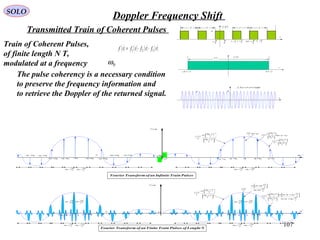
5) Train of Coherent Pulses,
of infinite length,
modulated at a frequency 0ω
T - Pulse repetition interval (PRI)
( ) ( ) ( ){
( ) ( ) ( ) ( )[ ]






+−+−+−−++












+
−+=
∑
∞
=1
0000
00
2
2
sin
2
n
PRPRPRPR
PR
PR
nnnn
n
n
T
A
jF
ωωδωωδωωδωωδ
τω
τω
ωδωδ
τ
ω
T/1 - Pulse repetition frequency (PRF)
TPR /2πω =
SOLO
Fourier Transform of a Signal
21
( ) ( )∫
+∞
∞−
−
= ωω
π
ω
dejF
j
tf tj
2
1
Signal
( )
( )
( ) ( )( ) ( )( )[ ]












−++












+=



±±=>−
≤−≤−
=
∑
∞
=
≤≤−
1
000
22
0
coscos
2
2
sin
cos
2/,,2,1,0,2/0
2/2/cos
n
PRPR
PR
PRNT
t
NT
tntn
n
n
t
T
A
NkkkTt
kTttA
tf
ωωωω
τω
τω
ω
τ
τ
ττω

τ - pulse width
Frequency
( ) ( )∫
+∞
∞−
= dtetfjF tjω
ω
Fourier Transform
Fourier Transform
0ω - carrier frequency
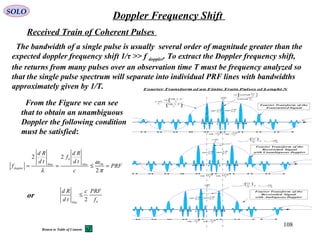
6) Train of Coherent Pulses,
of finite length N T,
modulated at a frequency 0ω
T - Pulse repetition interval (PRI)
( )
( )
( )
( )
( )
( )
( )
( )
( )
( )
( )
( )
( )



















−−




−−
+
+−




+−












+
+




+
+



















−+




−+
+
++




++












+
+




+
=
∑
∑
∞
=
∞
=
1
0
0
0
0
0
0
1
0
0
0
0
0
0
2
2
sin
2
2
sin
2
2
sin
2
2
sin
2
2
sin
2
2
sin
2
2
sin
2
2
sin
2
n
PR
PR
PR
PR
PR
PR
n
PR
PR
PR
PR
PR
PR
TN
n
TN
n
TN
n
TN
n
n
n
TN
TN
TN
n
TN
n
TN
n
TN
n
n
n
TN
TN
T
A
jF
ωωω
ωωω
ωωω
ωωω
τω
τω
ωω
ωω
ωωω
ωωω
ωωω
ωωω
τω
τω
ωω
ωω
τ
ω
T/1 - Pulse repetition frequency (PRF)
TPR /2πω =
SOLO
Fourier Transform of a Signal
22
Signal
( ) ( )
























+=



±±=>−
≤−≤−
= ∑
∞
=1
1 cos
2
2
sin
21
,2,1,0,2/0
2/2/
n
PR
PR
PR
Series
Fourier
tn
n
n
T
A
kkkTt
kTtA
tf ω
τω
τω
τ
τ
ττ

τ - pulse width
0ω - carrier frequency
6) Train of Coherent Pulses,
of finite length N T,
modulated at a frequency 0ω
T - Pulse repetition interval (PRI)
T/1 - Pulse repetition frequency (PRF)
TPR /2πω =
( ) ( )tAtf 03 cos ω=
t
A A
( )tf1
t
2
τ
2
τ
−T
A
T T
2
2
τ+T
2
2
τ−T
T T
2
τ− 2
τ+T
( )tf2
t
TN
2/TN2/TN−
( ) ( ) ( ) ( )tftftftf 321 ⋅⋅=
( ) ( ) ( ) ( )
( )
( ) ( )( ) ( )( )[ ]












−++












+=



±±=>−
≤−≤−
=⋅⋅=
∑
∞
=
≤≤−
1
000
22
0
321
coscos
2
2
sin
cos
2/,,2,1,0,2/0
2/2/cos
n
PRPR
PR
PRNT
t
NT
tntn
n
n
t
T
A
NkkkTt
kTttA
tftftftf
ωωωω
τω
τω
ω
τ
τ
ττω

( )



>
≤≤−
=
2/0
2/2/1
2
TNt
TNtTN
tf ( ) ( )ttf 03 cos ω=
SOLO
Fourier Transform of a Signal
23
Range & Doppler Measurements in RADAR SystemsSOLO
Radar Waveforms and their Fourier Transforms
24
Range & Doppler Measurements in RADAR SystemsSOLO
Radar Waveforms and their Fourier Transforms
Return to Table of Content
25
RADAR SignalsSOLO
Waveforms
( ) ( ) ( )[ ]tttats θω += 0cos
a (t) – nonnegative function that represents any amplitude modulation (AM)
θ (t) – phase angle associated with any frequency modulation (FM)
ω0 – nominal carrier angular frequency ω0 = 2 π f0
f0 – nominal carrier frequency
Transmitted Signal
( ) ( ) ( )[ ]{ }ttjtats θω += 0exp
Phasor (complex) Transmitted Signal
Return to Table of Content
26
RADAR SignalsSOLO
Quadrature Form
( ) ( ) ( )[ ]
( ) ( )[ ] ( ) ( ) ( )[ ] ( )tttattta
tttats
00
0
sinsincoscos
cos
ωθωθ
θω
−=
+=
where: ( ) ( ) ( )[ ]
( ) ( ) ( )[ ]ttats
ttats
Q
I
θ
θ
sin
cos
=
=
( ) ( ) ( ) ( ) ( )ttsttsts QI 00 sincos ωω −=
One other form: ( ) ( ) ( )[ ] ( ) ( ) ( )
[ ]tjtjtjtj
ee
ta
tttats θωθω
θω −−+
+=+= 00
2
cos 0
( ) ( ) ( )[ ]tjtj
etgetgts 00 *
2
1 ωω −
+= ( ) ( ) ( ) ( ) ( )tj
QI etatsjtstg θ
=+=:
Envelope of the signal
( ) ( ) tj
etgts 0ω
=
Phasor (complex) Transmitted Signal
Transmitted Signal
Return to Table of Content
27
RADAR SignalsSOLO
Spectrum
Define the Fourier Transfer F
( ) ( ){ } ( ) ( )∫
+∞
∞−
−== dttjtstsS ωω exp:F ( ) ( ){ } ( ) ( )∫
+∞
∞−
==
π
ω
ωωω
2
exp:
d
tjSSts 1-
F
( ) ( ) ( )[ ]tjtj
etgetgts 00 *
2
1 ωω −
+= ( ) ( ) ( )[ ]0
*
0
2
1
ωωωωω −−+−= GGS-1
F
F
-1
F
F
( ) ( ) ( ) ( ) ( )tj
QI etatsjtstg θ
=+=:
( ) ( ) ( )[ ]tttats θω += 0cos
Inverse Fourier Transfer F -1
Envelope of the signalWe defined:
Return to Table of Content
28
RADAR SignalsSOLO
Energy ( ) ( ) ( )[ ]tttats θω += 0cos
( ) ( ) ( )[ ]{ } ( )∫∫∫
+∞
∞−
+∞
∞−
+∞
∞−
≈++== dttadttttadttsEs
2
0
22
2
1
22cos1
2
1
: θω
Parseval’s Formula
Proof:
( ) ( ) ( ) ( )∫∫
+∞
∞−
+∞
∞−
= ωωω
π
dFFdttftf 2
*
12
*
1
2
1
( ) ( ) ( )∫
+∞
∞−
−= dttjtfF ωω exp11
( ) ( ) ( ) ( ) ( ) ( ) ( ) ( ) ( ) ( )∫∫ ∫∫ ∫∫
+∞
∞−
+∞
∞−
+∞
∞−
+∞
∞−
+∞
∞−
+∞
∞−
=−=−=
π
ω
ωω
π
ω
ωω
π
ω
ωω
22
exp
2
exp 2
*
112
*
2
*
12
*
1
d
FF
d
dttjtfFdt
d
tjFtfdttftf
( ) ( ) ( )∫
+∞
∞−
−=
π
ω
ωω
2
exp
*
2
*
2
d
tjFtf
If s (t) is real, than s (t) = s*(t) and
( ) ( ) ( )∫∫∫
+∞
∞−
+∞
∞−
+∞
∞−
=== ωω
π
dSdttsdttsEs
222
2
1
:
29
RADAR SignalsSOLO
Energy (continue – 1) ( ) ( ) ( )[ ]tttats θω += 0cos
( ) ( ) ( )∫∫∫
+∞
∞−
+∞
∞−
+∞
∞−
=== ωω
π
dSdttsdttsEs
222
2
1
:
( ) ( ) ( ) ( )[ ] ( ) ( )[ ]
( ) ( ) ( ) ( )
( ) ( ) ( ) ( ) 





−−−+−−−+
−−−−+−−
=
−−+−−−+−=
−
−−
00
0000
0
*
0
*2
00
0
*
00
*
0
00
*
0
*
0
*
4
1
4
1
ϕϕ
ϕϕϕϕ
ωωωωωωωω
ωωωωωωωω
ωωωωωωωωωω
jj
jjjj
eGGeGG
GGGG
eGeGeGeGSS
For finite band (W << ω0 ) signals (see Figure)
( ) ( ) ( ) ( )
( ) ( ) ( ) ( ) ( ) ( )∫∫∫
∫∫
∞+
∞−
∞+
∞−
∞+
∞−
+∞
∞−
−
+∞
∞−
=−−−−=−−
≈−−−=−−−
ωωωωωωωωωωωωω
ωωωωωωωωωω ϕϕ
dGGdGGdGG
deGGdeGG jj
*
0
*
00
*
0
2
0
*
0
*2
00 000
( ) ( ) gs EdGdSE
2
1
2
1
2
1
2
1
:
22
=≈= ∫∫
+∞
∞−
+∞
∞−
ωω
π
ωω
π
Return to Table of Content
30
RADAR SignalsSOLO
Complex and Analytic Signals
( ) ( ) ( )[ ]tttats θω += 0cos
We have the following definitions:
Real signal
( ) ( ) ( )[ ]tjtj
etgetgts 00 *
2
1 ωω −
+=
( ) ( ) ( ) ( ) ( )tj
QI etatsjtstg θ
=+=: Envelope of the signal
( ) ( ) ( )[ ] ( ) tj
etgtjtjtats 0
0exp: ω
θω =+= Complex Signal
( ) ( ) ( )[ ]tjtj
etgetgts 00 *
2
1 ωω −
+= ( ) ( ) ( )[ ]0
*
0
2
1
ωωωωω −−+−= GGS-1
F
F
( ) ( ){ } ( ){ } ( )0
0
ωωω ω
−=== GetgtsS tj
FF
( ) ( )
( )
( ) ( )ωω
ω
ωω
ωωω SU
S
GS 2
00
02
0 =






<
>
≈−=
For Band limited signals
31
RADAR SignalsSOLO
Complex and Analytic Signals (continue – 1)
( ) ( ) ( )[ ] ( ) tj
etgtjtjtats 0
0exp: ω
θω =+=
Complex Signal
( ) ( ){ } ( ){ } ( )0
0
ωωω ω
−=== GetgtsS tj
FF
( ) ( )
( )
( ) ( )ωω
ω
ωω
ωωω SU
S
GS 2
00
02
0 =






<
>
≈−=
For Band limited signals
Analytic Signal
The Analytic Signal is a Complex Signal chosen that its spectrum if forced to be zero for ω<0.
( ) ( ) ( ) ( )[ ] ( )ωωωωω SsignSUS +== 12:
~
( )





<−
=
>+
=
01
00
01
:
ω
ω
ω
ωsign
( )[ ] ( )[ ] ( )
t
j
tsignU
π
δωω +=+= −−
12 11
FF
The time function corresponding to the product of the spectrums of two time functions is
given by the time convolution of the two functions
( ) ( )[ ] ( ) ( )[ ] ( ) ( )
( )
( ) ( )
∫∫
+∞
∞−
+∞
∞−
−−
−
+=





−
+−=== ξ
ξ
ξ
π
ξ
ξπ
ξδξωωω d
t
sj
tsd
t
j
tsSUS 2
~~ 11
FFts
32
RADAR SignalsSOLO
Analytic Signal
The Analytic Signal is a Complex Signal chosen that its spectrum if forced to be zero for ω<0.
( ) ( )[ ] ( ) ( )[ ] ( ) ( )
( )
( ) ( )
∫∫
+∞
∞−
+∞
∞−
−−
−
+=





−
+−=== ξ
ξ
ξ
π
ξ
ξπ
ξδξωωω d
t
sj
tsd
t
j
tsSUS 2
~~ 11
FFts
( ) ( ) ( ) ( ) ( )tsjtsd
t
sj
ts ˆ~ +=
−
+= ∫
+∞
∞−
ξ
ξ
ξ
π
ts
or
Complex and Analytic Signals (continue – 2)
From ( ) ( )[ ] ( ) ( ) ( )ωωωωω SjSSsignS ˆ1:
~
+=+=
we have
( ) ( ) ( )
( )
( )




<+
=
>−
=−=
0
00
0
ˆ
ωω
ω
ωω
ωωω
Sj
Sj
SsignjS
Assuming a Band Limited signal we can assume that
( ) ( ) ( ) ( ) ( ) ( ) ( ) ( )tsjtststsSUSS ˆ~2
~
+=≈⇒=≈ ωωωω
where is the Hilbert Transform of s (t)( ) ( )
∫
+∞
∞−
−
= ξ
ξ
ξ
π
d
t
s
ts
1
:ˆ
(see “Hilbert Transformation” Presentation)
Return to Table of Content
33
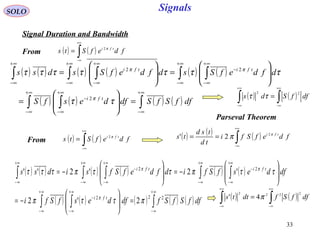
Signals
( ) ( )∫
+∞
∞−
= fdefSts tfi π2
SOLO
Signal Duration and Bandwidth
( ) ( ) ( ) ( ) ( ) ( )
( ) ( ) ( ) ( )∫∫ ∫
∫ ∫∫ ∫∫
∞+
∞−
∞+
∞−
∞+
∞−
−
∞+
∞−
∞+
∞−
−
∞+
∞−
∞+
∞−
∞+
∞−
=







=








=







=
dffSfSdfdesfS
dfdefSsdfdefSsdss
tfi
tfitfi
ττ
τττττττ
π
ππ
2
22
( ) ( )∫
+∞
∞−
= fdefSts tfi π2 ( ) ( ) ( )∫
+∞
∞−
== fdefSfi
td
tsd
ts tfi π
π 2
2'
( ) ( ) ( ) ( ) ( ) ( )
( ) ( ) ( ) ( ) ( )∫∫ ∫
∫ ∫∫ ∫∫
∞+
∞−
∞+
∞−
∞+
∞−
−
+∞
∞−
+∞
∞−
−
+∞
∞−
+∞
∞−
−
+∞
∞−
=







−=








−=







−=
dffSfSfdfdesfSfi
dfdesfSfidfdefSfsidss
tfi
tfitfi
222
22
2'2
'2'2''
πττπ
ττπττπτττ
π
ππ
( ) ( )∫∫
+∞
∞−
+∞
∞−
= dffSds
22
ττ
Parseval Theorem
From
From
( ) ( )∫∫
+∞
∞−
+∞
∞−
= dffSfdtts
2222
4' π
34
Signals
( )
( )
( ) ( )
( )
( ) ( )
( )
( ) ( )
( )
( ) ( )
( )∫
∫
∫
∫ ∫
∫
∫ ∫
∫
∫
∫
∫
∞+
∞−
+∞
∞−
∞+
∞−
+∞
∞−
+∞
∞−
−
∞+
∞−
+∞
∞−
+∞
∞−
−
∞+
∞−
+∞
∞−
∞+
∞−
+∞
∞−
=====
dffS
fd
fd
fSd
fS
i
dffS
fdtdetstfS
dffS
tdfdefStst
dffS
tdtstst
tdts
tdtst
t
fifi
22
2
2
2
22
2
2
:
π
ππ
SOLO
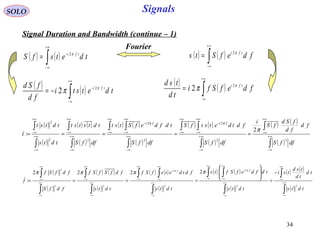
Signal Duration and Bandwidth (continue – 1)
( ) ( )∫
+∞
∞−
−
= tdetsfS tfi π2
( ) ( )∫
+∞
∞−
= fdefSts tfi π2
Fourier
( ) ( )∫
+∞
∞−
−
−= tdetsti
fd
fSd tfi π
π 2
2
( ) ( )∫
+∞
∞−
= fdefSfi
td
tsd tfi π
π 2
2
( )
( )
( ) ( )
( )
( ) ( )
( )
( ) ( )
( )
( ) ( )
( )∫
∫
∫
∫ ∫
∫
∫ ∫
∫
∫
∫
∫
∞+
∞−
+∞
∞−
∞+
∞−
+∞
∞−
+∞
∞−
∞+
∞−
+∞
∞−
+∞
∞−
∞+
∞−
+∞
∞−
∞+
∞−
+∞
∞−
−
=








====
tdts
td
td
tsd
tsi
tdts
tdfdefSfts
tdts
fdtdetsfSf
tdts
fdfSfSf
fdfS
fdfSf
f
fifi
22
2
2
2
22
2
2222
:
ππ
ππππ
35
Signals
( ) ( ) ( ) ( ) ( )∫∫∫∫∫
+∞
∞−
+∞
∞−
+∞
∞−
+∞
∞−
+∞
∞−
=≤








dffSfdttstdttsdttstdtts
222222
2
2
4'
4
1
π
( ) ( )∫∫
+∞
∞−
+∞
∞−
= dffSdts
22
τ
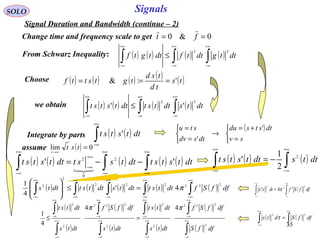
SOLO
Signal Duration and Bandwidth (continue – 2)
0&0 == ftChange time and frequency scale to get
From Schwarz Inequality: ( ) ( ) ( ) ( )∫∫∫
+∞
∞−
+∞
∞−
+∞
∞−
≤ dttgdttfdttgtf
22
Choose ( ) ( ) ( ) ( ) ( )ts
td
tsd
tgtsttf ':& ===
( ) ( ) ( ) ( )∫∫∫
+∞
∞−
+∞
∞−
+∞
∞−
≤ dttsdttstdttstst
22
''we obtain
( ) ( )∫
+∞
∞−
dttstst 'Integrate by parts
( )



=
+=
→



=
=
sv
dtstsdu
dtsdv
stu '
'
( ) ( ) ( ) ( ) ( )∫∫∫
+∞
∞−
+∞
∞−
∞+
∞−
+∞
∞−
−−= dttststdttsstdttstst '' 2
0
2

( ) ( ) ( )∫∫
+∞
∞−
+∞
∞−
−= dttsdttstst 2
2
1
'
( ) ( )∫∫
+∞
∞−
+∞
∞−
= dffSfdtts
2222
4' π
( )
( )
( )
( )
( )
( )
( )
( )∫
∫
∫
∫
∫
∫
∫
∫
∞+
∞−
+∞
∞−
∞+
∞−
+∞
∞−
∞+
∞−
+∞
∞−
∞+
∞−
+∞
∞−
=≤
dffS
dffSf
dtts
dttst
dtts
dffSf
dtts
dttst
2
222
2
2
2
222
2
2
44
4
1
ππ
assume ( ) 0lim =
→∞
tst
t
36
SignalsSOLO
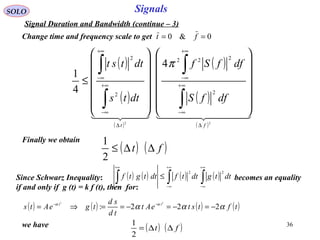
Signal Duration and Bandwidth (continue – 3)
( )
( )
( )
( )
( )
( )
    
22
2
222
2
2
4
4
1
ft
dffS
dffSf
dtts
dttst
∆
∞+
∞−
+∞
∞−
∆
∞+
∞−
+∞
∞−




























≤
∫
∫
∫
∫ π
Finally we obtain
( ) ( )ft ∆∆≤
2
1
0&0 == ftChange time and frequency scale to get
Since Schwarz Inequality: becomes an equality
if and only if g (t) = k f (t), then for:
( ) ( ) ( ) ( )∫∫∫
+∞
∞−
+∞
∞−
+∞
∞−
≤ dttgdttfdttgtf
22
( ) ( ) ( ) ( )tftsteAt
td
sd
tgeAts tt
ααα αα
222:
22
−=−=−==⇒= −−
we have ( ) ( )ft ∆∆=
2
1
37
Signals
t
t∆2
t
( ) 2
ts
f
f
f∆2
( ) 2
fS
SOLO
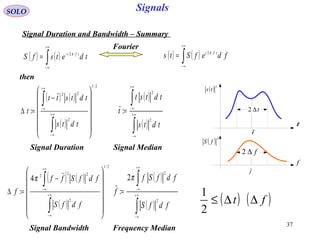
Signal Duration and Bandwidth – Summary
then
( ) ( )∫
+∞
∞−
−
= tdetsfS tfi π2
( ) ( )∫
+∞
∞−
= fdefSts tfi π2
( ) ( )
( )
2/1
2
22
:














−
=∆
∫
∫
∞+
∞−
+∞
∞−
tdts
tdtstt
t
( )
( )∫
∫
∞+
∞−
+∞
∞−
=
tdts
tdtst
t
2
2
:
Signal Duration Signal Median
( ) ( )
( )
2/1
2
22
2
4
:














−
=∆
∫
∫
∞+
∞−
+∞
∞−
fdfS
fdfSff
f
π ( )
( )∫
∫
∞+
∞−
+∞
∞−
=
fdfS
fdfSf
f
2
2
2
:
π
Signal Bandwidth Frequency Median
Fourier
( ) ( )ft ∆∆≤
2
1
38
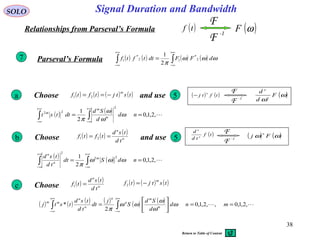
Signal Duration and BandwidthSOLO
( )tf
-1
F
F
( )ωFRelationships from Parseval’s Formula
( ) ( ) ( ) ( )∫∫
+∞
∞−
+∞
∞−
= ωωω
π
dFFdttftf 2
*
12
*
1
2
1
Parseval’s Formula7
Choose ( ) ( ) ( ) ( )tstjtftf
m
−== 21
( ) ( ) ,2,1,0
2
1
2
22
== ∫∫
∞+
∞−
∞+
∞−
nd
d
Sd
dttst m
m
m
ω
ω
ω
π
( ) ( )tftj
n
−
-1
F
F ( )ω
ω
F
d
d
n
n
and use 5a
Choose ( ) ( ) ( )
n
n
td
tsd
tftf == 21 and use 5b
( )tf
td
d
n
n
-1
F
F
( ) ( )ωω Fj
n
( ) ( ) ,2,1,0
2
1 22
2
== ∫∫
∞+
∞−
∞+
∞−
ndSdt
td
tsd m
n
n
ωωω
π
Choosec
( ) ( ) ( ) ( ) ( ) ( )  ,2,1,0,,2,1,0
2
* ==





= ∫∫
+∞
∞−
+∞
∞−
mnd
d
Sd
S
j
dt
td
tsd
tstj m
m
n
n
n
n
mm
ω
ω
ω
ωω
π
( ) ( )
n
n
td
tsd
tf =1
( ) ( ) ( )tstjtf
m
−=2
Return to Table of Content
39
( ) ( ) ( )[ ]tttats θω += 0cos
SOLO
Complex Representation of Bandpass Signals
The majority of radar signals are narrow band signals, whose Fourier transform is
limited to an angular-frequency bandwidth of W centered about a carrier angular
frequency of ±ω0.
Another form of s (t) is
( ) ( ) ( )
( )
( ) ( ) ( )
( )
( )
( ) ( ) ( ) ( )ttstts
tttatttats
QI
tsts QI
00
00
sincos
sinsincoscos
ωω
ωθωθ
−=
−=

sI (t) – in phase component sQ (t) – quadrature component
1
2
Define the signal complex envelope: ( ) ( ) ( ) ( ) ( ) ( )[ ]
( ) ( )[ ]tjta
tjttatsjtstg QI
θ
θθ
exp
sincos:
=
+=+=
Therefore:
( ) ( ) ( )[ ] ( )[ ]tstjtgts ReexpRe 0 == ω
( ) ( ) ( ) ( ) ( ) ( ) ( )tststjtgtjtgts *
2
1
2
1
exp
2
1
exp
2
1
00 +=−+= ∗
ωω
or:
3
4
( ) ( ) ( )[ ]tjtjtats θω += 0exp
Analytic (complex) signal
Return to Table of Content
40
( ) ( ) ( )[ ]tttats θω += 0cos
SOLO
Autocorrelation
The Autocorrelation Function is extensively used in Radar Signal Processing
( ) ( ) ( )∫
+∞
∞−
−= tdtstsRss ττ :
Real signalFor
The Autocorrelation Function is defined as:
Properties of the Autocorrelation Function:
2 ( ) ( )ττ ssss RR =−
( ) ( ) ( ) ( ) ( ) ( )ττττ
τ
ss
tt
ss RtdtststdtstsR =−=+=− ∫∫
+∞
∞−
+=+∞
∞−
'''
'
1 ( ) ( ) ( ) ( ) ( ) sss EfdfSfStdtstsR === ∫∫
+∞
∞−
+∞
∞−
*0 Es – signal energy
3
( ) ( ) ( ) ( ) ( ) ( )2222
2
2
0sss
EE
Inequality
Schwarz
ss REtdtstdtstdtstsR
ss
==−≤−= ∫∫∫
∞+
∞−
∞+
∞−
∞+
∞−
  
τττ
( ) ( )0ssss RR ≤τ
Autocorrelation is a mathematical tool for
finding specific patterns, such as the
presence of a known signal which has been
buried under noise.
41
SOLO
Autocorrelation (continue – 1(
The Autocorrelation Function is extensively used in Radar Signal Processing
( ) ( ) ( )∫
+∞
∞−
−= tdtgtgRgg ττ *:
Signal complex envelopeFor
The Autocorrelation Function is defined as:
Properties of the Autocorrelation Function:
2 ( ) ( )ττ *gggg RR =−
( ) ( ) ( ) ( ) ( ) ( )ττττ
τ
*''*'*
'
gg
tt
gg RtdtgtgtdtgtgR =−=+=− ∫∫
+∞
∞−
+=+∞
∞−
1 ( ) ( ) ( ) ( ) ( ) sgg EfdfGfGtdtgtgR 2**0 === ∫∫
+∞
∞−
+∞
∞−
Es – signal energy
3
( ) ( ) ( ) ( ) ( ) ( )22
2
2
2
2
2
2
04** ggs
EE
Inequality
Schwarz
gg REtdtgtdtgtdtgtgR
ss
==−≤−= ∫∫∫
∞+
∞−
∞+
∞−
∞+
∞−
  
τττ
( ) ( )0gggg RR ≤τ
( ) ( ) ( )[ ]tjtatg θexp:=
42
SOLO
Autocorrelation (continue – 2(
The Autocorrelation Function is extensively used in Radar Signal Processing
( ) ( ) ( )∫
+∞
∞−
−= tdtgtgRgg ττ *:
Signal complex envelopeFor
The Autocorrelation Function is defined as:
3
( ) ( ) ( ) ( ) ( )
( ) ( ) ( ) ( )
( )
( ) ( ) ( ) ( )
( )
∫ ∫∫ ∫
∫ ∫
∞+
∞−
∞+
∞−
∞+
∞−
∞+
∞−
=
+∞
∞−
+∞
∞−
∂
∂
+
∂
∂
=






−−
∂
∂
==
∂
∂
=
    
0
11122
2
2
0
22211
1
1
0
212211
2
****
**00
gggg RR
gg
tdtgtgtdtg
t
tgtdtgtgtdtg
t
tg
tdtdtgtgtgtgR
τ
ττ
τ
τ
τ
( ) ( )0gggg RR ≤τ
( ) ( ) ( )[ ]tjtatg θexp:=
(continue – 1)
Since Rgg (0) is a maximum of a continuous function at τ=0, we must have
( ) 00
2
==
∂
∂
τ
τ
ggR
Therefore ( ) ( ) ( ) ( ) 0** =
∂
∂
+
∂
∂
∫∫
+∞
∞−
+∞
∞−
tdtg
t
tgtdtg
t
tg
Return to Table of Content
43
Fourier Transform
( )tf
( ) ( )∑
∞
=
−=
0n
T Tntt δδ
( ) ( ) ( ) ( ) ( )∑
∞
=
−==
0
*
n
T
TntTnfttftf δδ
( )tf *
( )tf
T t
( ) ( ){ } ( ) σσ <== +∫
∞
−
f
ts
dtetftfsF
0
L
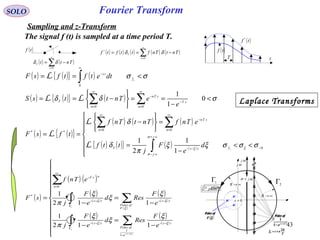
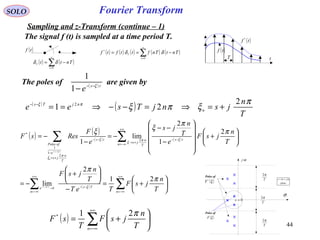
SOLO
Sampling and z-Transform
( ) ( ){ } ( ) σδδ <
−
==






−== −
∞
=
−
∞
=
∑∑ 0
1
1
00
sT
n
sTn
n
T
e
eTnttsS LL
( ) ( ){ }
( ) ( ) ( )
( ) ( ){ } ( ) ( )






<<
−
=
=






−
==
−
∞+
∞−
−−
∞
=
−
∞
=
+∫
∑∑
0
00
**
1
1
2
1
σσσξξ
π
δ
δ
ξ
σ
σ
ξ f
j
j
tsT
n
sTn
n
d
e
F
j
ttf
eTnfTntTnf
tfsF
L
L
L
( )
( ) ( )
( )
( )
( )
( )
( )
( )
( )
( )
( )
( )













−
=
−
−
=
−
=
∑∫
∑∫
∑
−−
−
−−
Γ
−−
−−
Γ
−−
∞
=
−
ts
e
ofPoles
tsts
F
ofPoles
tsts
n
nsT
e
F
Resd
e
F
j
e
F
Resd
e
F
j
eTnf
sF
ξ
ξξ
ξ
ξξ
ξ
ξ
ξ
π
ξ
ξ
ξ
π
1
1
0
*
112
1
112
1
2
1
Poles of
( ) Ts
e ξ−−
−1
1
Poles of
( )ξF
planes
T
nsn
π
ξ
2
+=
ωj
ωσ j+
0=s
Laplace Transforms
The signal f (t) is sampled at a time period T.
1Γ
2
Γ
∞→R
∞→R
Poles of
( ) Ts
e ξ−−
−1
1
Poles of
( )ξF
planeξ
T
nsn
π
ξ
2
+=
ωj
ωσ j+
0=s
44
Fourier Transform
( )tf
( ) ( )∑
∞
=
−=
0n
T Tntt δδ
( ) ( ) ( ) ( ) ( )∑
∞
=
−==
0
*
n
T
TntTnfttftf δδ
( )tf *
( )tf
T t
SOLO
Sampling and z-Transform (continue – 1)
( ) ( )
( )
( )
( )
( ) ( ) ∑∑
∑∑
∞+
−∞=
∞+
−∞=
−−→
∞+
−∞=
−−
+→
+=
−
−−






+=
−






+
−=






+












−
−−
−=
−
−=
−−
−−
nn
Tse
n
ts
T
n
js
T
n
js
e
ofPoles
ts
T
n
jsF
TeT
T
n
jsF
T
n
jsF
e
T
n
js
e
F
RessF
ts
n
ts
π
π
π
π
ξ
ξ
ξ
ξπ
ξ
π
ξ
ξ
ξ
ξ
21
2
lim
2
1
2
lim
1
1
2
2
1
1
*
Poles of
( )ξF
ωj
σ
0=s
T
π2
T
π2
T
π2
Poles of
( )ξ*
F plane
js ωσ +=
The signal f (t) is sampled at a time period T.
The poles of are given by( )ts
e ξ−−
−1
1
( )
( )
T
n
jsnjTsee n
njTs π
ξπξπξ 2
21 2
+=⇒=−−⇒==−−
( ) ∑
+∞
−∞=






+=
n T
n
jsF
T
sF
π21*
45
Fourier TransformSOLO
F F-1
frequency-B/2 B/2
B
F F-1
-B/2 B/2
B
1/Ts-1/Ts frequency
Sample
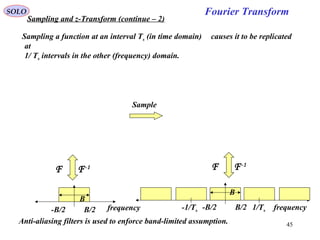
Sampling a function at an interval Ts (in time domain)
Anti-aliasing filters is used to enforce band-limited assumption.
causes it to be replicated
at
1/ Ts intervals in the other (frequency) domain.
Sampling and z-Transform (continue – 2)
46
Fourier Transform
( )tf
( ) ( )∑
∞
=
−=
0n
T Tntt δδ
( ) ( ) ( ) ( ) ( )∑
∞
=
−==
0
*
n
T
TntTnfttftf δδ
( )tf *
( )tf
T t
SOLO
Sampling and z-Transform (continue – 3)
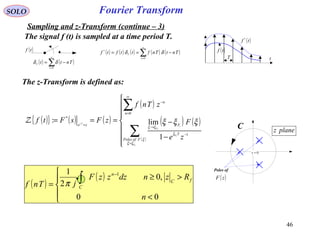
0=z
planez
Poles of
( )zF
C
The signal f (t) is sampled at a time period T.
The z-Transform is defined as:
( ){ } ( ) ( )
( )
( ) ( )
( )








−
−===
∑
∑
=
−
→
∞
=
−
=
iF
iF
i
iF
Ts
FofPoles
T
F
n
n
ze
ze
F
zTnf
zFsFtf
ξξ
ξ
ξ
ξξ
ξξξ
1
0
*
1
lim:Z
( )
( )





<
>≥
= ∫
−
00
,0
2
1 1
n
RzndzzzF
jTnf
fC
C
n
π
47
Fourier TransformSOLO
Sampling and z-Transform (continue – 4)
( ) ( ) ( )∑∑
∞
=
−
+∞
−∞=
=





+=
0
* 21
n
nsT
n
eTnf
T
n
jsF
T
sF
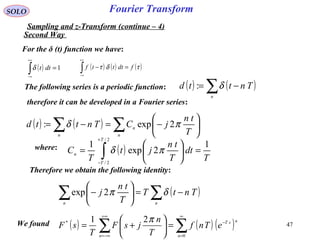
πWe found
For the δ (t) function we have:
( ) 1=∫
+∞
∞−
dttδ ( ) ( ) ( )τδτ fdtttf =−∫
+∞
∞−
The following series is a periodic function: ( ) ( )∑ −=
n
Tnttd δ:
therefore it can be developed in a Fourier series:
( ) ( ) ∑∑ 





−=−=
n
n
n T
tn
jCTnttd πδ 2exp:
where: ( )
T
dt
T
tn
jt
T
C
T
T
n
1
2exp
1
2/
2/
=





= ∫
+
−
πδ
Therefore we obtain the following identity:
( )∑∑ −=





−
nn
TntT
T
tn
j δπ2exp
Second Way
48
Fourier Transform
( ) ( ){ } ( ) ( )∫
+∞
∞−
−== dttjtftfF νπνπ 2exp:2 F
( ) ( ) ( )∑∑
∞
=
−
+∞
−∞=
=





+=
0
* 21
n
nsT
n
eTnf
T
n
jsF
T
sF
π
( ) ( ){ } ( ) ( )∫
+∞
∞−
== ννπνπνπ dtjFFtf 2exp2:2-1
F
SOLO
Sampling and z-Transform (continue – 5)
We found
Using the definition of the Fourier Transform and it’s inverse:
we obtain ( ) ( ) ( )∫
+∞
∞−
= ννπνπ dTnjFTnf 2exp2
( ) ( ) ( ) ( ) ( ) ( )∑∫∑
∞
=
+∞
∞−
∞
=
−=−=
0
111
0
*
exp2exp2exp
nn
n
sTndTnjFsTTnfsF ννπνπ
( ) ( ) ( )[ ]∫ ∑
+∞
∞−
+∞
−∞=
−−== 111
*
2exp22 νννπνπνπ dTnjFjsF
n
( ) ( ) ∑∫ ∑
+∞
−∞=
+∞
∞−
+∞
−∞=












−=





−−==
nn T
n
F
T
d
T
n
T
FjsF νπνννδνπνπ 2
11
22 111
*
We recovered (with –n instead of n) ( ) ∑
+∞
−∞=






+=
n T
n
jsF
T
sF
π21*
Second Way (continue)
Making use of the identity: with 1/T instead of T
and ν - ν 1 instead of t we obtain: ( )[ ] ∑∑ 





−−=−−
nn T
n
T
Tnj 11
1
2exp ννδννπ
( )∑∑ −=





−
nn
TntT
T
tn
j δπ2exp
Return to Table of Content
49
Fourier TransformSOLO
Henry Nyquist
1889 - 1976
http://en.wikipedia.org/wiki/Harry_Nyquist
Nyquist-Shannon Sampling Theorem
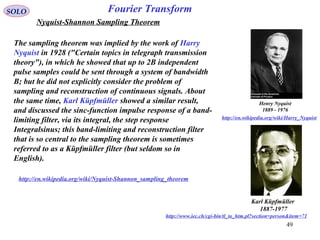
The sampling theorem was implied by the work of Harry
Nyquist in 1928 ("Certain topics in telegraph transmission
theory"), in which he showed that up to 2B independent
pulse samples could be sent through a system of bandwidth
B; but he did not explicitly consider the problem of
sampling and reconstruction of continuous signals. About
the same time, Karl Küpfmüller showed a similar result,
and discussed the sinc-function impulse response of a band-
limiting filter, via its integral, the step response
Integralsinus; this band-limiting and reconstruction filter
that is so central to the sampling theorem is sometimes
referred to as a Küpfmüller filter (but seldom so in
English).
http://en.wikipedia.org/wiki/Nyquist-Shannon_sampling_theorem
Karl Küpfmüller
1887-1977
http://www.iec.ch/cgi-bin/tl_to_htm.pl?section=person&item=71
50
Claude Elwood Shannon
1916 – 2001
http://en.wikipedia.org/wiki/Claude_E._Shannon
Fourier TransformSOLO
Nyquist-Shannon Sampling Theorem
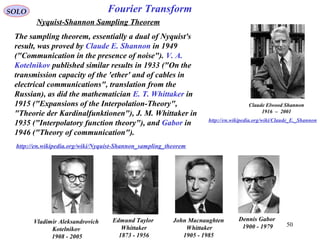
The sampling theorem, essentially a dual of Nyquist's
result, was proved by Claude E. Shannon in 1949
("Communication in the presence of noise"). V. A.
Kotelnikov published similar results in 1933 ("On the
transmission capacity of the 'ether' and of cables in
electrical communications", translation from the
Russian), as did the mathematician E. T. Whittaker in
1915 ("Expansions of the Interpolation-Theory",
"Theorie der Kardinalfunktionen"), J. M. Whittaker in
1935 ("Interpolatory function theory"), and Gabor in
1946 ("Theory of communication").
http://en.wikipedia.org/wiki/Nyquist-Shannon_sampling_theorem
Edmund Taylor
Whittaker
1873 - 1956
Dennis Gabor
1900 - 1979
Vladimir Aleksandrovich
Kotelnikov
1908 - 2005
John Macnaughten
Whittaker
1905 - 1985
51
Fourier TransformSOLO
Nyquist-Shannon Sampling Theorem (continue – 1)
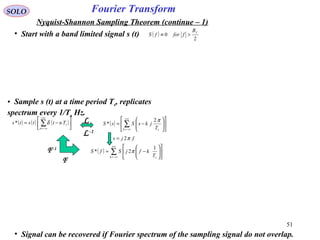
• Signal can be recovered if Fourier spectrum of the sampling signal do not overlap.
• Start with a band limited signal s (t) ( )
2
0
fB
fforfS >≡
• Sample s (t) at a time period Ts, replicates
spectrum every 1/Ts Hz.
( ) ∑
∞+
−∞=












−=
k sT
kfjSfS
1
2* π
fjs π2=
( ) ( ) ( )





−= ∑
+∞
−∞=n
sTnttsts δ* ( ) 











−= ∑
∞+
−∞=k sT
jksSsS
π2
*
L-1
L
F
F-1
52
Fourier Transform
2
1
2
B
T
B
s
−<
SOLO
Nyquist-Shannon Sampling Theorem (continue – 2)
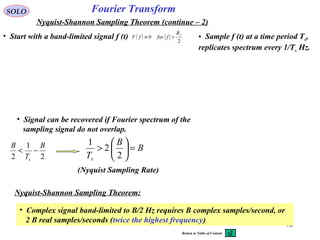
• Signal can be recovered if Fourier spectrum of the
sampling signal do not overlap.
B
B
Ts
=





>
2
2
1
(Nyquist Sampling Rate)
• Complex signal band-limited to B/2 Hz requires B complex samples/second, or
2 B real samples/seconds (twice the highest frequency)
• Start with a band-limited signal f (t) ( )
2
0
fB
fforfF >≡ • Sample f (t) at a time period Ts,
replicates spectrum every 1/Ts Hz.
Nyquist-Shannon Sampling Theorem:
Return to Table of Content
53
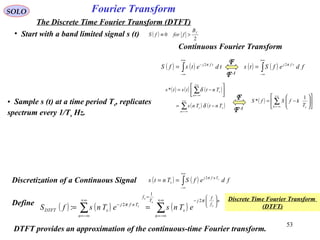
Fourier TransformSOLO
The Discrete Time Fourier Transform (DTFT)
• Start with a band limited signal s (t) ( )
2
0
fB
fforfS >≡
• Sample s (t) at a time period Ts, replicates
spectrum every 1/Ts Hz.
( ) 











−= ∑
∞+
−∞=k sT
kfSfS
1
*
( ) ( ) ( )
( ) ( )∑
∑
∞+
−∞=
+∞
−∞=
−=






−=
n
ss
n
s
TntTns
Tnttsts
δ
δ*
( ) ( )∫
+∞
∞−
−
= tdetsfS tfj π2
( ) ( )∫
+∞
∞−
= fdefSts tfj π2F
F-1
Continuous Fourier Transform
F
F-1
Discretization of a Continuous Signal ( ) ( )∫
+∞
∞−
== fdefSTnts sTnfj
s
π2
( ) ( ) ( )∑∑
∞+
−∞=






−
=
∞+
−∞=
−
==
n
n
f
f
j
s
T
f
n
Tnfj
sDTFT
s
s
s
s
eTnseTnsfS
π
π
2
1
2
:
DTFT provides an approximation of the continuous-time Fourier transform.
Discrete Time Fourier Transform
(DTFT)
Define
54
Fourier TransformSOLO
The Discrete Time Fourier Transform (DTFT) (continue-1)
• Signal can be recovered if Fourier spectrum of the sampling signal do not overlap.
Discretization of a Continuous Signal ( ) ( )∫
+∞
∞−
== fdefSTnts sTnfj
s
π2
DTFT-1
DTF
T
Discrete Time Fourier Transform
(DTFT)
( ) ( ) ( )∑∑
∞+
−∞=






−
=
∞+
−∞=
−
==
n
n
f
f
j
s
T
f
n
Tnfj
sDTFT
s
s
s
s
eTnseTnsfS
π
π
2
1
2
:
We can see that
( ) ( ) ( ) ( )∑∑
∞+
−∞=
−





−∞+
−∞=





 +
−
===+
n
DTFT
nkj
n
f
f
j
s
n
n
f
fkf
j
ssDTFT fSeeTnseTnsfkfS ss
s

1
2
22
π
ππ
The Discrete Time Fourier Transform SDTFT (fs) is periodic with period fs.
Let compute
( ) ( )
( )
( )
( )
( )
( )
( ) ( ) ( )[ ]
( )
( )∑ ∑
∑ ∫∫ ∑∫
∞+
−∞=
∞+
−∞=
=←
≠←
+
−
−





∞+
−∞=
+
−
−




+
−
∞+
−∞=
−




+
−






=
−
−
=
−
=
==
n
s
sn
nm
nm
ss
f
fs
nm
f
f
j
s
n
f
f
nm
f
f
j
s
f
f n
nm
f
f
j
s
f
f
m
f
f
j
DTFT
Tms
Tnm
nm
fTns
f
nm
j
e
Tns
fdeTnsdfeTnsdfefS
s
s
s
s
s
s
s
s
s
s
s
s
1sin
2
1
0
2/
2/
2
2/
2/
22/
2/
22/
2/
2
  
π
π
π
π
πππ
( ) ( )∑
+∞
−∞=
−
=
n
Tnfj
sDTFT
s
eTnsfS π2
: ( ) ( )
( )
( )
∫
+
−
=
s
s
s
T
T
nTfj
DTFTss dfefSTTns
2/1
2/1
2π
55
Fourier TransformSOLO
The Discrete Time Fourier Transform (DTFT) (continue-2)
Normalization of the frequency
DTFT-1
DTFT
( ) ( )∑
+∞
−∞=
−
=
n
Tnfj
sDTFT
s
eTnsfS π2
: ( ) ( )
( )
( )
∫
+
−
=
s
s
s
T
T
nTfj
DTFTss dfefSTTns
2/1
2/1
2π
( ) ( )[ ]
[ ]2/1,2/1
2/1,2/1
:
*
*
+−∈
+−∈
=
f
TTf
Tff
ss
s
( ) ( )∑
+∞
−∞=
−
=
n
nfj
DTFT ensfS *2*
: π
DTFT-1
DTFT
( ) ( )∫
+
−
=
2/1
2/1
*2
** dfefSns nfj
DTFT
π
Example ( ) 1,,1,002
−== −
NneAns nfj
π
( ) ( )
( )
( )
( ) ( )
( ) ( )
( )
( )
( )[ ]
( )[ ]
( )( )1*
0
0
*
*
**
**
*2
*21
0
*2*
0
0
0
00
00
0
0
0
*sin
*sin
1
1
−−−
−−
−−
−−−
−−−
−−
−−−
=
−−
−
−
=
−
−
=
−
−
== ∑
Nffj
ffj
Nffj
ffjffj
NffjNffj
ffj
NffjN
n
nffj
DTFT
e
ff
Nff
A
e
e
ee
ee
A
e
e
AeAfS
π
π
π
ππ
ππ
π
π
π
π
π
|SDTFT(f*)|
Normalized Frequency
56
Fourier TransformSOLO
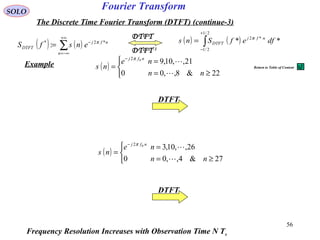
The Discrete Time Fourier Transform (DTFT) (continue-3)
( ) ( )∑
+∞
−∞=
−
=
n
nfj
DTFT ensfS *2*
: π
DTFT-1
DTFT
( ) ( )∫
+
−
=
2/1
2/1
*2
** dfefSns nfj
DTFT
π
Example ( )



≥=
=
=
−
22&8,,00
21,,10,902
nn
ne
ns
nfj

π
( )



≥=
=
=
−
27&4,,00
26,,10,302
nn
ne
ns
nfj

π
Frequency Resolution Increases with Observation Time N Ts
DTFT
DTFT
Return to Table of Content
57
Fourier Transform
( ) ( )∑
−
=
−
=
1
0
2
:
N
n
nk
N
j
sDFT eTnskS
π
SOLO
The Discrete Fourier Transform (DFT)
Assume a periodic sequence, sampled at a time period Ts, such that s (n Ts) = s [(n+kN) Ts]
The Discrete Fourier Transform (DFT) requires an input function that is discrete
and whose non-zero values have a limited (finite) duration.
Unlike the Discrete-time Fourier transform (DTFT), it only evaluates enough frequency
components to reconstruct the finite segment that was analyzed. Its inverse transform
cannot reproduce the entire time domain, unless the input happens to be periodic (forever).
Therefore it is often said that the DFT is a transform for Fourier analysis of finite-domain
discrete-time functions
For the sequence s (0), s (Ts),…,s [(N-1) Ts] we define the Discrete Fourier Transform:
58
Fourier Transform
( ) ( ) ( )∑∑
−
=
−
=
−
==
1
0
1
0
2
:
N
n
nk
s
N
n
nk
N
j
sDFT WTnseTnskS
π
SOLO
The Discrete Fourier Transform (DFT) (continue – 1)
For the sequence s (0), s (Ts),…,s [(N-1) Ts] we define the Discrete Fourier Transform:
where is a primitive N'th root of unity
and is periodic
N
j
eW
π2
:
−
=
n
Nm
N
j
n
N
j
Nmn
N
j
Nmn
WeeeW =















=







=
−−
+
−
+

1
222 πππ
( )
( )
( )
( )
( )
( ) ( ) ( ) ( ) ( )
( ) ( ) ( ) ( ) ( )
( ) ( ) ( ) ( ) ( )
( ) ( ) ( ) ( ) ( )
( ) ( ) ( ) ( ) ( )
[ ]
( )
( )
( )
( )[ ]
( )[ ]  

  






  

N
N
N s
s
s
s
s
s
W
NNNNNNN
NNNNNNN
NN
NN
NN
S
DFT
DFT
DFT
DFT
DFT
TNs
TNs
Ts
Ts
Ts
WWWWW
WWWWW
WWWWW
WWWWW
WWWWW
NS
NS
S
S
S




















⋅−
⋅−
⋅
⋅
⋅






















=




















−
−
−−−−−−−
−−−−−−−
−−
−−
−−
1
2
2
1
0
1
2
2
1
0
1121211101
1222221202
1222221202
1121211101
1020201000
[ ] NNN sWS = [ ]NW is a Vandermonde type of Matrix
59
Fourier TransformSOLO
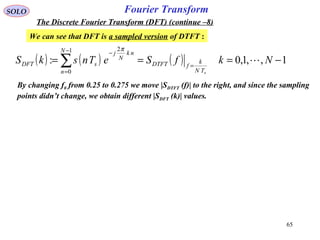
The Discrete Fourier Transform (DFT) (continue – 2)
nNmn
WW =+
[ ] [ ] N
H
NN I
N
WW
1
=
N
j
eW
π2
−
= 1
2
* −
== WeW N
j
π
[ ]
( ) ( ) ( ) ( ) ( )
( ) ( ) ( ) ( ) ( )
( ) ( ) ( ) ( ) ( )
( ) ( ) ( ) ( ) ( )
( ) ( ) ( ) ( ) ( ) 





















=
−−−−−−−
−−−−−−−
−−
−−
−−
1121211101
1222221202
1222221202
1121211101
1020201000
NNNNNNN
NNNNNNN
NN
NN
NN
N
WWWWW
WWWWW
WWWWW
WWWWW
WWWWW
W






[ ] [ ]
( ) ( ) ( ) ( ) ( )
( ) ( ) ( ) ( ) ( )
( ) ( ) ( ) ( ) ( )
( ) ( ) ( ) ( ) ( )
( ) ( ) ( ) ( ) ( ) 





















==
−+−−+−−−−−−
−+−−+−−−−−−
+−+−−−
+−+−−−
+−+−−−
1112121110
2122222120
2122222120
1112121110
0102020100
*
NNNNNNN
NNNNNNN
NN
NN
NN
T
N
H
N
WWWWW
WWWWW
WWWWW
WWWWW
WWWWW
WW






Let multiply those two matrices
[ ] [ ]( )( ) ( ) ( ) ( ) ( ) ( ) ( ) ( ) ( )
( )
( )
( )
( )
 ( )
( )






=
≠=
−
−
=
−
−
==
+++++=
−
−
−
−−
=
−
+−−−−
∑
mkN
mk
W
W
W
W
W
WWWWWWWWWW
mk
mk
N
mk
NmkN
j
jmk
mNNkmjjkmkmk
mk
H
NN
0
1
1
1
1
1
1
0
111100
,

Where IN is the N x N identity matrix
60
Fourier Transform
( ) ( ) ( )∑∑
−
=
−
=
−
==
1
0
1
0
2
:
N
n
nk
s
N
n
nk
N
j
sDFT WTnseTnskS
π
SOLO
The Discrete Fourier Transform (DFT) (continue – 3)
For the sequence s (0), s (Ts),…,s [(N-1) Ts] we defined the Discrete Fourier Transform:
[ ] NNN sWS = [ ]NW is a Vandermonde type of Matrix
We found that
[ ] [ ] N
H
NN I
N
WW
1
= Where IN is the NxN identity matrix
Therefore the Inverse Discrete Fourier Transform (IDFT) is
[ ] N
H
NN SW
N
s
1
=
( ) ( ) ( )∑∑
−
=
−
=
−
==
1
0
21
0
11 N
n
nk
N
j
DFT
N
k
nk
DFTs ekS
N
WkS
N
Tns
π
D.F.T.
I.D.F.T.
61
Fourier TransformSOLO
The Discrete Fourier Transform (DFT) (continue – 4)
Second way to find the Inverse Discrete Fourier Transform (IDFT). Let compute:
( ) ( )
( )
( )
( )
∑ ∑∑∑∑
−
=
−
=
−−−
=
−
=
−−−
=
+
==
1
0
1
0
21
0
1
0
21
0
2 N
n
N
k
rnk
N
j
s
N
k
N
n
rnk
N
j
s
N
k
rk
N
j
DFT eTnseTnsekS
πππ
( )
( )
( )
( )
( )
( )[ ] ( )[ ]
( ) ( )
( )[ ]
( )
( )[ ] ( )[ ]
( ) ( )
( )[ ]
( )
( )
( )
( )[ ] ( )[ ]
( ) ( ) 


≠−
=−
=




−+



−
−+−
















−
−






−
−
=




−+



−
−+−




−
−
=




−+



−−
−+−−
=
−
−
=
−






−
=
−−
−−
−−
−−
−
=
−−
∑
Nmrn
NmrnN
rn
N
jrn
N
rnjrn
rn
N
rn
N
rn
rn
N
rn
N
jrn
N
rnjrn
rn
N
rn
rn
N
jrn
N
rnjrn
e
e
e
e
e
rn
N
j
rnj
rn
N
j
N
rn
N
j
N
k
rnk
N
j
0
cossin
cossin
sin
sin
cossin
cossin
sin
sin
2
sin
2
cos1
2sin2cos1
1
1
1
1
2
2
2
2
1
0
2
ππ
ππ
π
π
π
π
ππ
ππ
π
π
ππ
ππ
π
π
π
π
π
( ) ( )[ ] ,2,1,0
1
0
2
±±=+=∑
−
=
+
mTmNrsNekS s
N
k
rk
N
j
DFT
π
62
Fourier Transform
( ) ( ) ( )∑∑
−
=
−
=
−
==
1
0
1
0
2
:
N
n
nk
s
N
n
nk
N
j
sDFT WTnseTnskS
π
SOLO
The Discrete Fourier Transform (DFT) (continue – 5)
For the sequence s (0), s (Ts),…,s [(N-1) Ts] we define the Discrete Fourier Transform:
where is a primitive N'th root of unity
and is periodic
N
j
eW
π2
:
−
=
n
Nm
N
j
n
N
j
Nmn
N
j
Nmn
WeeeW =















=







=
−−
+
−
+

1
222 πππ
( )
( )
( )
( )
( )
( )
( )
( )
( )[ ]
( )[ ] 



















⋅−
⋅−
⋅
⋅
⋅




















=




















−
−
−−
−−
−−
−−
s
s
s
s
s
NN
NN
NN
NN
DFT
DFT
DFT
DFT
DFT
TNs
TNs
Ts
Ts
Ts
WWWWW
WWWWW
WWWWW
WWWWW
WWWWW
NS
NS
S
S
S
1
2
2
1
0
1
2
2
1
0
12210
23320
23420
12210
00000








63
Fourier TransformSOLO
The Discrete Fourier Transform (DFT) (continue – 6)
The DFT ant Inverse DFT (IDFT) are given by
( ) ( )∑
−
=
+
=
1
0
2
1 N
k
nk
N
j
DFTs ekS
N
Tns
π
( ) ( )∑
−
=
−
=
1
0
2
:
N
n
nk
N
j
sDFT eTnskS
π
IDFT
DFT
with the periodic properties
( )[ ] ( )
,2,1,0 ±±=
=+
m
TnsTmNns ss
( ) ( )
,2,1,0 ±±=
=+
m
kSNmkS DFTDFT
The sequence s (0), s (Ts),…,s [(N-1) Ts] can be interpreted to be a sequence of finite
length, given for r = 0, 1,…,N-1, and zero otherwise or a periodic sequence, defined
for all r.
64
Fourier Transform
( ) ( )∑
−
=
−
=
1
0
2
:
N
n
nk
N
j
sDFT eTnskS
π
SOLO
The Discrete Fourier Transform (DFT) (continue – 7)
The DFT ant Inverse DFT (IDFT) are given by
( ) ( )∑
−
=
+
=
1
0
2
1 N
k
nk
N
j
DFTs ekS
N
Tns
π
IDFT
DFT
( ) ( )∑
+∞
−∞=
−
=
n
nfj
DTFT ensfS *2*
: π
( ) ( )∫
+
−
=
2/1
2/1
*2
** dfefSns nfj
DTFT
π
IDTFT
DTFT
The DTFT ant Inverse DTFT (IDTFT) where given by
We can see that DFT is a sampled version of DTFT by tacking:
( ) ( )[ ]
[ ]2/1,2/1
2/1,2/1
1,,1,0
*
*
+−∈
+−∈
−==⇒==
f
TTf
Nk
TN
k
f
N
k
fTf
ss
s
s 
( ) ( ) ( ) 1,,1,0:
1
0
2
−=== =
−
=
−
∑ NkfSeTnskS
sTN
k
fDTFT
N
n
nk
N
j
sDFT 
π
65
Fourier TransformSOLO
The Discrete Fourier Transform (DFT) (continue –8)
We can see that DFT is a sampled version of DTFT :
( ) ( ) ( ) 1,,1,0:
1
0
2
−=== =
−
=
−
∑ NkfSeTnskS
sTN
k
fDTFT
N
n
nk
N
j
sDFT 
π
By changing f0 from 0.25 to 0.275 we move |SDTFT (f)| to the right, and since the sampling
points didn’t change, we obtain different |SDFT (k)| values.
66
Fourier TransformSOLO
The Discrete Fourier Transform (DFT) (continue – 9)
We can see that DFT is a sampled version of DTFT :
( ) ( ) ( ) 1,,1,0:
1
0
2
−=== =
−
=
−
∑ NkfSeTnskS
sTN
k
fDTFT
N
n
nk
N
j
sDFT 
π
Increase sampling density from N=20 to N=60.
67
Fourier TransformSOLO
The Discrete Fourier Transform (DFT) (continue – 10)
Zero Padding
( ) ( )∑
−
=
−
=
1
0
2
:
N
n
nk
N
j
sDFT eTnskS
π
The DFT ant Inverse DFT (IDFT) are given by
( ) ( )∑
−
=
+
=
1
0
2
1 N
k
nk
N
j
DFTs ekS
N
Tns
π
IDFT
DFT
Let add to the signal L-N zeros (L > N) for k = N, N+1,…,L-1, to obtain:
( )
( )



−+=
−==
=
1,,1,0
1,,1,0,
LNNk
NknkTns
Tks s
s


( ) ( )∑
−
=
−
=
1
0
2
:'
L
m
mk
L
j
sDFT eTksmS
π
Define: ( )∑
−
=
−
=
1
0
2N
n
mn
L
j
s eTns
π
( )∑
−
=






−
=
1
0
2N
n
L
N
mn
N
j
s eTns
π






=
L
N
mSDFT
68
Fourier TransformSOLO
The Discrete Fourier Transform (DFT) (continue – 11)
Zero Padding (continue – 1)
We added to the signal L-N zeros (L > N) for k = N, N+1,…,L-1, to obtain:
( )
( )



−+=
−==
=
1,,1,0
1,,1,0,
LNNk
NknkTns
Tks s
s


( ) ( ) ( )∑∑
−
=






−−
=
−
==
1
0
21
0
2
:'
N
n
L
N
mn
N
j
s
L
m
mk
L
j
sDFT eTnseTksmS
ππ
Define:
( )
( )
( )∑ ∑∑ ∑
−
=
−
=






−+−
=






−−
=
+
==
1
0
1
0
21
0
21
0
2
11 N
k
N
k
L
N
mkn
N
j
DFT
N
n
L
N
mn
N
j
Tks
N
k
kn
N
j
DFT ekS
N
eekS
N
s
πππ
  





≠
≠
=
=












−












−
=
−
−
=
−
−
=






−




 −
+






−−





−+






−−





−+






−+






−+






−+






−+
−
=






−+
∑
integer/0
integer/&/0
integer/&/1
sin
sin
1
1
1
2
2
1
0
2
notNLk
NLkNLkm
NLkNLkm
L
N
mk
N
L
N
mk
e
ee
ee
e
e
e
e
e
L
N
mk
N
N
j
L
N
mk
N
j
L
N
mk
N
j
L
N
mkj
L
N
mkj
L
N
mk
N
j
L
N
mkj
L
N
mk
N
j
L
N
mkN
N
j
N
n
L
N
mkn
N
j
π
ππ
ππ
ππ
π
π
π
π
π
( ) ( )∑
−
=






−




 −
+












−












−
=
1
0
1
sin
sin
1
'
N
k
L
N
mk
N
N
j
DFTDFT
L
N
mk
N
L
N
mk
ekS
N
mS
π
ππ
69
Fourier TransformSOLO
The Discrete Fourier Transform (DFT) (continue – 12)
Zero Padding (continue – 11)
We added to the signal L-N zeros (L > N) for k = N, N+1,…,L-1, to obtain:
( )
( )



−+=
−==
=
1,,1,0
1,,1,0,
LNNk
NknkTns
Tks s
s


Define:
( ) ( ) ( )∑∑
−
=






−




 −
+−
=
−












−












−
=





==
1
0
11
0
2
sin
sin
1
:'
N
k
L
N
mk
N
N
j
DFTDFT
L
m
mk
L
j
sDFT
L
N
mk
N
L
N
mk
ekS
NL
N
mSeTksmS
π
πππ
We can see that S’ DFT has more points that S DFT by a factor of L/N, but it contains
no more information because it uses only the N values s (nTs).
If L/N is an integer then for the m=n L/N S’ DFT (m) = S DFT (n). Between those
points S’ DFT (m) is an interpolation of S DFT points, with the weight





≠
≠
=
=












−












−






−




 −
+
integer/0
integer/&/0
integer/&/1
sin
sin1
notNLk
NLkNLkm
NLkNLkm
L
N
mk
N
L
N
mk
e L
N
mk
N
N
j
π
π
π
70
Fourier TransformSOLO
The Discrete Fourier Transform (DFT) (continue – 13)
Increase sampling density from N=20 to N=60.
0
0.5
1
0
60 - SAMPLE PULSE
Signal sample
Signalamplitude
5 10 15 20 25 30 35 40 45 50 55 60
Zero Padding from n=21 to L=60.
DFT
DFT
DFT
71
SOLO
72
SOLO
Properties of The Discrete Fourier Transform (DFT) (continue – 14)
( )mns − ( )
mk
N
j
DFT ekS
π2
−
Linearity1 ( ) ( )nsns 2211 αα +
Shift of a Sequence2
3
4
5
Periodic Convolution
6
7
Conjugate
8
9
IDFT
DFT ( ) ( )∑
−
=
−
=
1
0
2
:
N
n
nk
N
j
DFT enskS
π
( ) ( )∑
−
=
+
=
1
0
2
1 N
k
nk
N
j
DFT ekS
N
ns
π
( ) ( )kSkS DFTDFT 2211 αα +
( ) ( )nsns 21 , Periodic Sequence
(Period N)
( ) ( )kSkS DFTDFT 21 , DFT
(Period N)
( )
nl
N
j
ens
π2
−
( )lkSDFT −
( ) ( )∑
−
=
−⋅
1
0
21
N
m
mnsms
( ) ( )kSkS DFTDFT 21 ⋅
( ) ( )nsns 21 ⋅
( ) ( )∑
−
=
−⋅
1
0
21
1 N
l
DFTDFT lkSlS
N
( )ns∗
( )kSDFT −
∗
( )ns −∗
( )kSDFT
∗
Real & Imaginary ( )[ ]nsRe
( )[ ]nsImj
( ) ( ) ( )[ ] 2/kSkSkS DFTDFTeven −+=
∗
( ) ( ) ( )[ ] 2/kSkSkS DFTDFTodd −−=
∗
73
SOLO
Properties of The Discrete Fourier Transform (DFT) (continue – 15)
( ) ( ) ( )[ ] 2/: nsnsnseven −+= ∗
( )kSDFTReEven Part10
11
12 Symmetric Proprties
(only when s (n) is real)
IDFT
DFT ( ) ( )∑
−
=
−
=
1
0
2
:
N
n
nk
N
j
DFT enskS
π
( ) ( )∑
−
=
+
=
1
0
2
1 N
k
nk
N
j
DFT ekS
N
ns
π
( ) ( )nsns 21 , Periodic Sequence
(Period N)
( ) ( )kSkS DFTDFT 21 , DFT
(Period N)
( )lkSDFT −
( ) ( )
( )[ ] ( )[ ]
( )[ ] ( )[ ]
( ) ( )
( ) ( )








−−∠=∠
−=
−−=
−=
−=
∗
kSkS
kSkS
kSmkSm
kSkS
kSkS
DFTDFT
DFTDFT
DFTDFT
DFTDFT
DFTDFT
II
ReRe
Odd Part ( ) ( ) ( )[ ] 2/: nsnsnsodd −−= ∗
Return to Table of Content
74
Fourier TransformSOLO
Fast Fourier Transform (FFT)
John Wilder Tukey
1915 – 2000
http://en.wikipedia.org/wiki/John_Tukey
James W. Cooley
1926 -
http://www.ieee.org/portal/pages/about/awards/bios/2002kilby.html
The Cooley-Tukey algorithm, is the most common fast
Fourier transform (FFT) algorithm. It re-expresses the
discrete Fourier transform (DFT) of an arbitrary composite
size N = N1N2 in terms of smaller DFTs of sizes N1 and N2,
recursively, in order to reduce the computation time to O(N
log N) for highly-composite N (smooth numbers).
FFTs became popular after J. W. Cooley of IBM and
John W. Tukey of Princeton published a paper in 1965
reinventing the algorithm (first invented by Gauss) and
describing how to perform it conveniently on a
computer
75
Fourier TransformSOLO
Fast Fourier Transform (FFT)
The radix-2 DIT Algorithm
The radix-2 decimation-in-time (DIT) FFT is the simplest and most common form of the
Cooley-Tukey algorithm, although highly optimized Cooley-Tukey implementations
typically use other forms of the algorithm as described below. Radix-2 DIT divides a DFT
of size N into two interleaved DFTs (hence the name "radix-2") of size N/2 with each
recursive stage.
( ) ( ) ( )∑∑
−
=
−
=
−
==
1
0
1
0
2
:
N
n
nk
s
N
n
nk
N
j
sDFT WTnseTnskS
π
For the sequence s (0), s (Ts),…,s [(N-1) Ts] we define the Discrete Fourier Transform:
1,1, 22/1
2
*
2
+==−====→= −−−
−
ππ
ππ
jNj
evenN
NN
j
N
j
eWeWWeWeW
Suppose N is a power of 2; i.e. N=2L
(L is integer). Since N is a even integer, let compute
SDFT (k) by separate s (nTs) into two (N/2)-point sequences consisting of the even-numbered
points (n=2r) and odd numbered points (n=2r+1).
( ) ( )
( )
( ) ( )
( )
( ) ( )
( )
( ) ( )
( )
∑∑
∑∑
−
=
−
=
−
=
+
−
=
++=
++=
12/
0
2
12/
0
2
12/
0
12
12/
0
2
122
122
N
n
kr
N
k
N
N
n
kr
N
N
n
kr
N
N
n
kr
NDFT
WrsWWrs
WrsWrskS
76
Fourier TransformSOLO
Fast Fourier Transform (FFT)
The radix-2 DIT Algorithm (continue – 1)
2/
2/
222
2
N
N
j
N
j
N WeeW ==







=
−−
ππ
We divided the N-point DFT into two N/2-points DFTs.
( ) ( ) ( )
( )
( ) ( )
( )
( )
( )
( )
( )
( )
( )
    
kH
N
n
kr
N
k
N
kG
N
n
kr
N
N
n
kr
N
k
N
N
n
kr
NDFT
WrsWWrs
WrsWWrskS
∑∑
∑∑
−
=
−
=
−
=
−
=
++=
++=
12/
0
2/
12/
0
2/
12/
0
2
12/
0
2
122
122
Since
77
Fourier TransformSOLO
Fast Fourier Transform (FFT)
The radix-2 DIT Algorithm (continue – 2)
We divided the N-point DFT into two N/2-points DFTs.
Reduction of an 8-points FFT to two
4-points FFTs
A 2-points FFT
(Butterfly)
Reduction of an 4-points FFT to two
2-points FFTs
78
Fourier TransformSOLO
Fast Fourier Transform (FFT)
The radix-2 DIT Algorithm (continue – 3)
Flow Diagram for an 8-points FFT
79
Fourier TransformSOLO
Fast Fourier Transform (FFT)
The radix-2 DIT Algorithm (continue – 2)
( ) ( )kkj
kN
N
j
Nk
N eeW 1
2
2/
−==







= −
−
π
π
We divided the N-point DFT into two N/2-points DFTs.
( ) ( ) ( ) ( )
[ ]
( )
( ) ( )
( )
( )
∑∑
−
=
−
−
=
+








++=++=
12/
0
1
2/
12/
0
2/
2/2/
N
n
kn
N
Nk
N
N
n
Nnk
N
kn
NDFT WWNnsnsWNnsWnskS
k

Since N/2 is an even integer (N=2L
)
( ) ( ) ( )[ ]
( )
( )
( )
( )
( )
  
  
tgofFFTN
N
n
nl
N
WW
N
N
n
nl
N
ng
DFT WngWNnsnslkS
NN
L
2/
12/
0
2/
2
12/
0
2
2/
2
2/2 ∑∑
−
=
=
=
−
=
=++==
( ) ( ) ( )[ ]
( )
( )
( )
( )
( )
  
  
thofFFTN
N
n
nl
N
WW
N
N
n
nl
N
nh
n
NDFT WnhWWNnsnslkS
NN
L
2/
12/
0
2/
2
12/
0
2
2/
2
2/12 ∑∑
−
=
=
=
−
=
=+−=+=
80
Fourier TransformSOLO
Fast Fourier Transform (FFT)
The radix-2 DIT Algorithm (continue – 3)
We divided the N-point DFT into two N/2-points DFTs.
Reduction of an 8-points FFT to two
4-points FFTs
Reduction of an 4-points FFT to two
2-points FFTs
A 2-points FFT
(Butterfly)
81
Fourier TransformSOLO
Fast Fourier Transform (FFT)
The radix-2 DIT Algorithm (continue – 4)
Flow Diagram for an 8-points FFT
82
Fourier Transform
( ) ( ) 1,,1,0:
1
0
2
−== ∑
−
=
−
NkeTnskS
N
n
nk
N
j
sDFT 
π
8 64 24 64 8
16 256 64 256 24
32 1024 160 1024 64
64 4096 384 4096 160
128 16384 896 16384 384
SOLO
Fast Fourier Transform (FFT)
Arithmetic Operations for a Radix FFT versus DFT
For N = 2L
we have L stages of Radix FFT and:
For N-point DFT we have:
For each row we have N complex additions and N complex multiplications, therefore for
the N rows we have
Number of complex additions DFT = Number of complex multiplications DFT = NxN=N2
Number of complex additions FFT =N L=N log2 N
Number of complex additions FFT =N/2 (multiplications per stage) x L -1 =N/2 log2 (N/2)
Operation
Complex additions Complex multiplications
DFT DFTFFT FFT
N=2L
Approximate number of Complex Arithmetic Operations Required for 2L-point DFT and FFT computations
Return to Table of Content
83
Fourier TransformSOLO
Digital Filtering
Digital Filters can be partitioned in two distinct classes:
• Finite Impulse Response (FIR) filters that have an impulse response
h (nT) of finite duration
( )
( )



≥<
−=
=
Nnn
Nnnh
Tnh
&,00
1,,1,0 
• Infinite Impulse Response (IIR) filters that have an impulse response
h (nT) of infinite duration
If s (n) is an input signal to the digital filter, then the output of the digital filter
y (k) is related to the input by a relation of the type:
( ) ( ) ( )[ ] ( )[ ]
( )[ ] ( )[ ]TMkybTkyb
TNksaTksaTksaTky
M
N
−−−−−
−++−+=


1
1
1
10
If all the coefficients ai, bi are constants we can use the z transform to obtain:
( ) ( ) ( ) ( )zSzHzS
zbzb
zazaa
zY M
M
N
N
⋅=⋅
+++
+++
= −−
−−


1
1
1
10
1
For a causal filter N ≤ M.
84
Fourier TransformSOLO
Digital Filtering (continue – 1)
( ) ( ) ( )zSzHzY ⋅=
( ) N
N
N
N
zbzb
zazaa
zH −−
−−
+++
+++
=


1
1
1
10
1
If b1 = b2= …
=bN =0 ( ) N
N zazaazH −−
+++= 1
10
This is Finite Impulse Filter (FIR) with ( )


 −=
=
otherways
Nna
nh n
0
1,,1,0 
If this is not the case we obtain the Infinite Impulse Filter (IIR) with
( ) H
n
nN
N
N
N
rzzczca
zbzb
zazaa
zH <++++=
+++
+++
= −−
−−
−−


 1
101
1
1
10
1
where
( ) ( )zCzrzdzzHz
j
c H
C
n
n ∈∀<= ∫π2
1
85
Fourier TransformSOLO
Digital Filtering (continue – 2)
( ) ( ) ( )zSzHzY ⋅= ( ) N
N
N
N
zbzb
zazaa
zH −−
−−
+++
+++
=


1
1
1
10
1
Rewrite this as:
( ) ( )
( ) ( ) ( ) 0011
1
11
1
=−+−++−+− −
−−
−−−
YSaYbSazYbSazYbSaz NN
N
NN
N

( ) ( )
( ) ( )YbSazYbSazYbSazSaY NN
N
NN
N
−+−++−+= −
−−
−−−
11
1
11
1
0 
Finally:
Transformation from Transfer Function to State-Space (Method 1)
86
Fourier TransformSOLO
Digital Filtering (continue – 3)
( ) ( ) ( )zSzHzY ⋅= ( ) N
N
N
N
zbzb
zazaa
zH −−
−−
+++
+++
=


1
1
1
10
1
Rewrite this as:
( )
( )
( )
( ) SazazazaW
WzbzbzbY
N
N
N
N
N
N
N
N
0
1
1
1
1
1
1
1
1 1
++++=
++++=
−−−
−
−
−−−
−
−


Transformation from Transfer Function to State-Space (Method 2)
87
Fourier TransformSOLO
Digital Filtering (continue – 4)
88
Fourier TransformSOLO
Digital Filtering (continue – 5)
89
Fourier TransformSOLO
Digital Filtering (continue – 6)
90
Fourier TransformSOLO
Digital Filtering (continue – 7)
Return to Table of Content
91
Fourier TransformSOLO
Windowing
• Windowing is used for DFT data
to reduce Doppler side lobes
• Windowing widen main lobe and
this decreases Doppler resolution
• Windowing reduces the peak of
the DFT producing a processing
loss, PL
• Windowing causes a modest signal
to noise (S/N) loss, called loss in
peak gain, or LPG.
Windows are an overlay applied to a given time series to improve the spectral quality
of the data base.
92
Fourier TransformSOLO
Windowing
Rectangular [ ]


 ≤≤
=
otherwise
Mn
nw
,0
0,1
Bartlett
(triangular) [ ]





≤<−
≤≤
=
otherwise
MnMMn
MnMn
nw
,0
2/,/22
2/0,/2
Hanning
Hammming
[ ]
( )


 ≤≤−
=
otherwise
MnMn
nw
,0
0,/2cos5.05.0 π
[ ]
( )


 ≤≤−
=
otherwise
MnMn
nw
,0
0,/2cos46.054.0 π
Blackman [ ]
( ) ( )


 ≤≤+−
=
otherwise
MnMnMn
nw
,0
0,/4sin08.0/2cos5.042.0 ππ
Julius Ferdinand von Hann (1839 -1921)
Richard Wesley Hamming (1915 –1998)
93
Fourier TransformSOLO
Windowing (continue – 1)
cosine
[ ]






≤≤<













 −
−
=
otherwise
Mn
M
Mn
nw
,0
0&5.0
2/
2/
2
1
exp
2
σ
σ
Lanczos
[ ]





≤≤





−
=
otherwise
Mn
M
n
nw
,0
0,1
2
sinc
Gauss
[ ]





≤≤





=





−
=
otherwise
Mn
M
n
M
n
nw
,0
0,sin
2
cos
πππ
[ ]
( )







≤≤














−−
=
otherwise
Mn
I
M
n
I
nw
,0
0,
1
2
1
0
2
0
α
α
Kaiser
α=2π
α=3π
94
Fourier TransformSOLO
Windowing (continue – 2)
Bartlett–Hann window
( )
38.0;42,0;62.0
1
2
cos
2
1
1
210
210
===






−
−−
−
−=
aaa
N
n
a
N
n
aanw
π
Bartlett–Hann window; B=1.46
Low-resolution (high-dynamic-range) windows
Nuttall window, continuous first derivative
( )
012604.0;144232.0;487396,0;355768.0
1
6
cos
1
4
cos
1
2
cos
3210
3210
====






−
−





−
+





−
−=
aaaa
N
n
a
N
n
a
N
n
aanw
πππ
Nuttall window, continuous first
derivative; B=2.02
Blackman–Harris window
( )
01168.0;14128.0;48829,0;35875.0
1
6
cos
1
4
cos
1
2
cos
3210
3210
====






−
−





−
+





−
−=
aaaa
N
n
a
N
n
a
N
n
aanw
πππ
Blackman–Nuttall window
Blackman–Harris window, B=1.98
Blackman–Nuttall window, B=3.77
( )
0106411.0;1365995.0;4891775,0;3635819.0
1
6
cos
1
4
cos
1
2
cos
3210
3210
====






−
−





−
+





−
−=
aaaa
N
n
a
N
n
a
N
n
aanw
πππ
95
Fourier TransformSOLO
Windowing (continue – 3)
Dolph-Chebyshev window
( ) ( )[ ]
( )
( )[ ]
( ) ( )4,3,2,10cosh
1
cosh
1,,2,1,0,
coshcosh
coscoscos
1
1
1
≈





=
−=

















=
=
−
−
−
αβ
β
π
β
ω
ω
α
N
Nk
N
N
k
N
W
WIDFTnw
k
k

The α parameter controls the side-lobe level via the formula:
Side-Lobe Level in dB = - 20 α
The Dolph-Chebyshev Window (or Dolph window) minimizes the Chebyshev norm of
the side lobes for a given main lobe width 2 ωc:
( ) ( ){ }ωωω WWsidelobes cwwww >=∞= ∑
=
∑
maxmin:min 1,1,
The Chebyshev norm is also called the L - infinity norm, uniform norm, minimax
norm, or simply the maximum absolute value.
96
Fourier TransformSOLO
Windowing (continue – 3)
Comparison of Windows
97
Fourier Transform
SOLO
Windowing (continue – 4)
Comparison of Windows
Window
Type
Peak
Sidelobe
Amplitude
(Relative)
Approximate
Width of
Mainlobe
Peak
Approximation
Error
20 log10δ
(dB)
Equivalent
Kaiser
Window
β
Transition
Width
of Equivalent
Kaiser
Window
Rectangular -13 4π/(M+1) -21 0 1.81π/M
Bartlett -25 8π/M -25 1.33 2.37π/M
Hanning -31 8π/M -44 3.86 5.01π/M
Hamming -41 8π/M -53 4.86 6.27π/M
Blackman -57 12π/M -74 7.04 9.19π/M
98
Fourier TransformSOLO
Windowing (continue – 5)
Comparison of Windows
99
Fourier TransformSOLO
Windowing (continue – 6)
Effect of Window in the Fourier Transform
• Good Effects
- Reduction of sidelobes
- Reduction of straddle loss
• Bad Effects
- Reduction in peak
- Widening of mainlobe
- Reduction in SNR
No Window
Hamming Window
∑
−
=
1
0
21 N
n
nw
N
21
0
1
0
2
1






∑
∑
−
=
−
=
N
n
n
N
n
n
w
w
N
100
Fourier TransformSOLO
Return to Table of Content
101
102
103
104
105
106
Return to Table of Content
107
SOLO
Doppler Frequency Shift
( )ωjF
2
NAτ
ω
TN
π
ω
2
0 +
0ω−
TN
π
ω
2
0 −
PRωω +− 0
PRωω −− 0
T
PR
π
ω
2
=
T
PR
π
ω
2
=
ω0
TN
π
ω
2
0 +
0ω
TN
π
ω
2
0 −
PRωω +0PRωω −0
T
PR
π
ω
2
=
T
PR
π
ω
2
=












2
2
sin
2 τω
τω
τ
n
n
NA
PR
PR
( )
( )
2
2
sin
0
0
NT
NT
ωω
ωω
−




−
( )
( )
2
2
sin
2
2
s in
2
0
0
NT
n
NT
n
n
n
NA
RP
RP
PR
PR
ωωω
ωωω
τω
τω
τ
−−




−−












( )ωjF
( )0
2
ωωδ
τ
−
NA
ω
0ω− PRωω +− 0PRωω −− 0
T
PR
π
ω
2
=
T
PR
π
ω
2
=
ω0
PRωω +0PRωω −0
T
PR
π
ω
2
=
T
PR
π
ω
2
=












2
2
sin
2 τω
τω
τ
n
n
NA
PR
PR












2
2
sin
2 τω
τω
τ
n
n
NA
P R
P R
0
ω P R
ωω 20
+
PRωω 20 −PRωω 20 −−
PR
ωω 30
−−PR
ωω 40
−−
PR
ωω 20
+−
PRωω 30 +− PR
ωω 40
+−
Fourier Transform of an Infinite Train Pulses
Fourier Transform of an Finite Train Pulses of Lenght N
( )P R
P R
P R
NA
ωωωδ
τω
τω
τ
−−












0
2
2
sin
2
( ) ( )tAtf 03 cos ω=
t
A A
( )tf1
t
2
τ
2
τ
−T
A
T T
2
2
τ+T
2
2
τ−T
T T
2
τ− 2
τ+T
( )tf2
t
TN
2/TN2/TN−
( ) ( ) ( ) ( )tftftftf 321 ⋅⋅=
Train of Coherent Pulses,
of finite length N T,
modulated at a frequency 0ω
The pulse coherency is a necessary condition
to preserve the frequency information and
to retrieve the Doppler of the returned signal.
Transmitted Train of Coherent Pulses
108
SOLO
Doppler Frequency Shift
Fourier Transform of an Finite Train Pulses of Lenght N
2
NAτ
ω
TN
πω 2
0 +
0ω
TN
πω 2
0 −
PRωω+0PRωω−0
T
PR
πω 2
=
T
PR
πω 2
=
2
NAτ
ω
TN
πω 2
0 +
0ω
TN
πω 2
0 −
PRωω+0PRωω−0
T
PR
πω 2
=
T
PR
πω 2
=
















2
2
sin
2 τω
τω
τ
n
n
NA
PR
PR
( )
( )
2
2
sin
0
0
NT
NT
ωω
ωω
−




−
2
NAτ
ω
TN
πω 2
0 +
0ω
TN
πω 2
0 −
P Rωω+0PRωω−0
T
PR
πω 2
=
T
PR
πω 2
=
π
ω
λ 2
&
2
P R
Doppl e rDopple r f
td
Rd
f <






−=
π
ω
λ 2
&
2
P R
Dopple rDopple r f
td
Rd
f >






−=
Fourier Transform of the
Transmitted Signal
Fourier Transform of the
Receiveded Signal
with Unambiguous Doppler
Fourier Transform of the
Receiveded Signal
with Ambiguous Doppler
Received Train of Coherent Pulses
The bandwidth of a single pulse is usually several order of magnitude greater than the
expected doppler frequency shift 1/τ >> f doppler. To extract the Doppler frequency shift,
the returns from many pulses over an observation time T must be frequency analyzed so
that the single pulse spectrum will separate into individual PRF lines with bandwidths
approximately given by 1/T.
From the Figure we can see
that to obtain an unambiguous
Doppler the following condition
must be satisfied:
PRF
c
td
Rd
f
td
Rd
f PRMaxMax
doppler
=≤==
π
ω
λ 2
22 0
or
0
2 f
PRFc
td
Rd
Max
≤
Return to Table of Content
109
SOLO Coherent Pulse Doppler Radar
An idealized target doppler response will
provide at IF Amplifier output the signal:
( ) ( )[ ] ( ) ( )
[ ]tjtj
dIFIF
dIFdIF
ee
A
tAts ωωωω
ωω +−+
+=+=
2
cos
that has the spectrum:
f
fIF+fd
-fIF-fd
-fIF fIF
A2
/4A2
/4 |s|2
0
Because we used N coherent pulses of
width τ and with Pulse Repetition Time T
the spectrum at the IF Amplifier output
f
-fd fd
A2
/4A2
/4
|s|2
0
After the mixer and base-band filter:
( ) ( ) [ ]tjtj
dd
dd
ee
A
tAts ωω
ω −
+==
2
cos
We can not distinguish between
positive to negative doppler!!!
and after the mixer :
110
SOLO Coherent Pulse Doppler Radar
We can not distinguish
between positive to negative
doppler!!!
Split IF Signal:
( ) ( )[ ] ( ) ( )
[ ]tjtj
dIFIF
dIFdIF
ee
A
tAts ωωωω
ωω +−+
+=+=
2
cos
( ) ( )[ ]
( ) ( )[ ]t
A
ts
t
A
ts
dIFQ
dIFI
ωω
ωω
+=
+=
sin
2
cos
2
Define a New Complex Signal:
( ) ( ) ( ) ( )[ ]tj
QI
dIF
e
A
tsjtstg ωω +
=+=
2
f
fIF+fd
fIF
A2
/2|g|2
0
f
fd
A2
/2
|s|2
0
Combining the signals after the mixers
( ) tj
d
d
e
A
tg ω
2
=
We now can distinguish
between positive to negative
doppler!!!
111
SOLO Coherent Pulse Doppler Radar
Split IF Signal:
( ) ( )[ ]
( ) ( )[ ]t
A
ts
t
A
ts
dIFQ
dIFI
ωω
ωω
+=
+=
sin
2
cos
2
Define a New Complex Signal:
( ) ( ) ( ) ( )[ ]tj
QI
dIF
e
A
tsjtstg ωω +
=+=
2
f
fd
A2
/2
|s|2
0
Combining the signals after the mixers
( ) tj
d
d
e
A
tg ω
2
=
We now can distinguish
between positive to negative
doppler!!!
From the Figure we can see that in this
case the doppler is unambiguous only if:
T
ff PRd
1
=<
Because we used N coherent pulses of
width τ and with Pulse Repetition Time T
the spectrum after the mixer output is
Return to Table of Content
112
SOLO Signal Processing
Collecting Pulsed Radar Data: 1 Pulse, Multiple Range-Gates Samples
• when using a coherent receiver, each range sample comprises one “I” sample and
one “Q” sample, forming one complex number I+j Q.
• Each range cells contains an echo from a different range interval.
• Also called Range-Bins, Range-Gates, Fast-Time Samples.
113
SOLO
Signal Processing
Collecting Pulsed Radar Data: Multiple Pulses
• when using a coherent receiver, each range sample comprises one “I” sample and
one “Q” sample, forming one complex number I+j Q.
• Repeat for multiple pulses in a “coherent processing interval” (CPI) or “dwell”
Sequence of samples for a fixed range bin represents echoes from same range interval
over a period of time.
114
SOLO Signal Processing
Perform FFT in Each Range Gate
After FFT a Range-Doppler
Map is obtained for Signal
Processing
FFT
Run This
115
SOLO Signal Processing
Perform FFT in Each Range Gate
Data-cube for Signal Processing
Repeat the Operation for each Receiver Channel (Σ,ΔAz,ΔEl,Γ for monopulse antenna
or Σi,j for each element in an Electronic Scanned Antenna)
Range – Doppler Cells in Σ and ΔAz, ΔEl
FFT
FFT
FFT
FFT
Run This
116
SOLO Signal Processing
Adaptive algorithms use additional data from the cube for weight estimation.
Datacube for Signal Processing
Standard radar signal processing algorithms correspond to operating in 1- or 2-D along
various axes of the data-cube
Space-Time Adaptive Processing:
2-D joint adaptive weighting across
antenna element and pulse number
Beamforming:
1-D weighting across
Electrical Scan Antenna
element number
Pulse Compression:
1-D convolution along
the range axis
(“fast time”)
Synthetic Aperture Imaging:
2-D matched filtering in slow
and fast time
Doppler Processing:
1-D filtering or spectral
analysis along the pulse axis
(“slow time”)
Run This
117
SOLO
Signal Processing
Range – Doppler Cells in Σ and ΔAz, ΔEl
118
SOLO
Signal Processing
Generation of Σ , ΔAz, ΔEl Range – Doppler Maps
The Parameters defining the Range – Doppler Maps are:
Δ R – Map Range Resolution
Δ f – Map Doppler Resolution
RUnambiguous – Unambiguous Range
fUnambiguous – Unambiguous Doppler
Range – Doppler
Cell
Range – Doppler
Map
f
f
M
R
R
N
sunambiguousunambiguou
∆
=
∆
= &
Range Gates are therefore i = 1, 2, …, N
Number of Range-Doppler Cells = N x M
Doppler Gates are therefore j = 1, 2, …, M
Note: The Map Range & Doppler resolution (Δ R, Δ f) may change as function of
Radar task (Search, Detection, Acquisition, Track). This is done by choosing
the Pulse Repetition Interval (PRI) and the number of pulses in a batch.
resolutionresolution ffRR ≥∆≥∆ &
119
SOLO Signal Processing
Generation of Σ , ΔAz, ΔEl Range – Doppler Maps (continue – 1)
The received signal from the scatter k is:
( ) ( )[ ] ( ) ( )ttTktttTkttfCts ddkdk
r
k
r
k ++≤≤++−= τθπ2cos
Ck
r
– amplitude of received signal
td (t) – round trip delay time given by ( )
2/c
tRR
tt kk
d
+
=
θk – relative phase
The received signal is down-converted to base-band in order to extract the quadrature
components. More precisely sk
r
(t) is mixed with: ( ) [ ] τθπ +≤≤+= TktTktfCty kkk 2cos
After Low-Pass filtering the quadrature components of Σk, ΔAz k or ΔEl k signals are:
( ) ( )
( ) ( )





=
=
tAtx
tAtx
kkQk
kkIk
ψ
ψ
sin
cos
( ) ( ) 





+−≅−=
c
tR
c
R
fttft kk
kdkk
22
22 ππψ
The quadrature samples are given by:
( ) ( ) 











+−≅=
c
tR
c
R
fjAjAtX kk
kkkkk
22
2expexp πψ
Ak - amplitude of Σk, ΔAz k or ΔEl k signals
ψk - phase of Σk, ΔAz k or ΔEl k signals
( ) 











+−











+≅+=
c
tR
c
R
fAj
c
tR
c
R
fAxjxtX kk
kk
kk
kkQkIkk
 22
2sin
22
2cos ππ
120
SOLO Signal Processing
Generation of Σ , ΔAz, ΔEl Range – Doppler Maps (continue – 2)
The received signal from the scatter k is:
The energy of the received signal is given by: ( ) ( ) 2
kkkk AtXtXP ==
∗
( ) 











+−











+≅+=
c
tR
c
R
fAj
c
tR
c
R
fAxjxtX kk
kk
kk
kkQkIkk
 22
2sin
22
2cos ππ
where * is the complex conjugate.
Therefore:
kk PA =
Return to Table of Content
121
Decision/Detection TheorySOLO
Hypotheses
H0 – target is not present
H1 – target is present
Binary Detection
( )0
Hp - probability that target is not present
( )1
Hp - probability that target is present
( )zHp |0 - probability that target is not present and not declared (correct decision)
( )zHp |1 - probability that target is present and declared (correct decision)
Using Bayes’ rule: ( ) ( ) ( )∫=
Z
dzzpzHpHp |00
( ) ( ) ( )∫=
Z
dzzpzHpHp |11
( )zp - probability of the event Zz ⊂
Since p (z) > 0 the Decision rules are:
( ) ( )zHpzHp || 01
< - target is not declared (H0)
( ) ( )zHpzHp || 01
> - target is declared (H1) ( ) ( )zHpzHp
H
H
|| 01
0
1
<
>
122
Decision/Detection TheorySOLO
Hypotheses H0 – target is not present H1 – target is present
Binary Detection
( )zHp |0 - probability that target is not present and not declared (correct decision)
( )zHp |1 - probability that target is present and declared (correct decision)
( )zp - probability of the event Zz ⊂
Decision rules are: ( ) ( )zHpzHp
H
H
|| 01
0
1
<
>
Using again Bayes’ rule:
( )
( ) ( )
( )
( )
( ) ( )
( )zp
HpHzp
zHp
zp
HpHzp
zHp
H
H
00
0
11
1
|
|
|
|
0
1
=
<
>
=
( )0
| Hzp - a priori probability that target is not present (H0)
( )1
| Hzp - a priori probability that target is present (H1)
Since all probabilities are
non-negative
( )
( )
( )
( )1
0
0
1
0
1
|
|
Hp
Hp
Hzp
Hzp
H
H
<
>
123
Decision/Detection TheorySOLO
Hypotheses
( )1
| Hzp - a priori probability density that target is present (likelihood of H1)
( )0
| Hzp - a priori probability density that target is absent (likelihood of H0)
Detection Probabilities
( ) M
z
D
PdzHzpP
T
−== ∫
∞
1| 1
( )∫
∞
=
Tz
FA
dzHzpP 0
|
( ) D
z
M
PdzHzpP
T
−== ∫∞−
1| 1
PD - probability of detection = probability that the target is present and declared
PFA - probability of false alarm = probability that the target is absent but declared
PM - probability of miss = probability that the target is present but not declared
T - detection threshold
D
P
FAP
( )1| Hzp( )0
| Hzp
M
P
z
Tz
( )
( )
T
Hzp
Hzp
T
T
=
0
1
|
|
H0 – target is not present H1 – target is present
Binary Detection
( )
( )
( )
( )
T
Hp
Hp
Hzp
Hzp
LR
H
H
=
<
>
=
1
0
0
1
0
1
|
|
:Likelihood Ratio Test (LTR)
124
Decision/Detection TheorySOLO
Hypotheses
Decision Criteria on Definition of the Threshold T
1. Bayes Criterion
D
P
FAP
( )1
| Hzp( )0
| Hzp
MP
z
T
z
( )
( )
T
Hzp
Hzp
T
T
=
0
1
|
|
H0 – target is not present H1 – target is present
Binary Detection
( )
( )
( )
( )
T
Hp
Hp
Hzp
Hzp
LR
H
H
=
<
>
=
1
0
0
1
0
1
|
|
:Likelihood Ratio Test (LTR)
The optimal choice that optimizes the Likelihood Ratio is
( )
( )1
0
Hp
Hp
TBayes
=
This choose assume knowledge of p (H0) and P (H1), that in general are not known a priori.
2. Maximum Likelihood Criterion
Since p (H0) and P (H1) are not known a priori, we choose TML = 1
( )1
| Hzp( )0
| Hzp
M
P z
Tz
( )
( )
1
|
|
0
1
== ML
T
T
T
Hzp
Hzp
D
P
FAP
125
Decision/Detection TheorySOLO
Hypotheses
Decision Criteria on Definition of the Threshold T (continue)
3. Neyman-Pearson Criterion
DP
γ=FAP
( )1
| Hzp( )0
| Hzp
M
P
z
T
z
( )
( ) PN
T
T
T
Hzp
Hzp
−
=
0
1
|
|
H0 – target is not present H1 – target is present
Binary Detection
( )
( )
( )
( )
T
Hp
Hp
Hzp
Hzp
LR
H
H
=
<
>
=
1
0
0
1
0
1
|
|
:Likelihood Ratio Test (LTR)
Neyman and Pearson choose to optimizes the probability of detection PD
keeping the probability of false alarm PFA constant.
Egon Sharpe Pearson
1895 - 1980
Jerzy Neyman
1894 - 1981
( )∫
∞
=
T
TT
z
z
D
z
dzHzpP 1
|maxmax ( ) γ== ∫
∞
Tz
FA
dzHzpP 0
|constrained to
Let use the Lagrange’s multiplier λ to add the constraint
( ) ( )
















−+= ∫∫
∞∞
TT
TT
zz
zz
dzHzpdzHzpG 01 ||maxmax γλ
Maximum is obtained for:
( ) ( ) 0|| 01
=+−=
∂
∂
HzpHzp
z
G
TT
T
λ
( )
( ) PN
T
T
T
Hzp
Hzp
−
==
0
1
|
|
λ
zT is define by requiring that: ( ) γ== ∫
∞
Tz
FA
dzHzpP 0
|
Return to Table of Content
126
SOLO SEARCH & DETECT MODE
During Search Mode the RADAR Seeker performs the following tasks:
• Slaves the Seeker Gimbals to the Designation Target direction (like in Slave Mode).
• Transmits the RF (by choosing the best waveform).
• Receives the returning RF.
• Compute the Σ Range-Doppler Map, chooses the Detection Threshold and policy.
• Perform Detections Clustering and compute Range and Doppler spread.
Note: Here is important to simulate the number of Batches that are needed to obtain the
predefined probability of detection, the False Alarm Rate (FAR) and to resolve the different
detections, i.e. the time necessary to perform this task.
• If a Detection is in the Target Designation (Uncertainty) Window we go to
Acquisition Mode.
127
Target returns are the summation of signals (amplitude and phase)
from all of the scattering centers within the radar resolution cell.
SOLO
Target RCS
where
Nsc – number of scatters in the volume VResol
σk– Radar Cross Section of scatter k
Rk– Range to scatter k
The equivalent Radar Cross Section σTarget of the target in the resolution cell of volume VResol is:
2N
scatter i4
Target Resol 4
i 1 iR
g
V R
σ
σ η Σ
=
= = ∑
24 N
scatter i
4
i 1Resol iR
gR
V
σ
η Σ
=
= ∑ ( )2/
4
2
Resol τϕϕ
π
cRV elaz=
gΣ (εAz,εEl) – antenna sum pattern ( gΣ(0,0)=1 )
R – Range to the center of the volume VResol
( )
( )
( )( )
∑=
Σ
























+
−=Σ
jiN
k
k
kk
kElkAzproc
trver
Rcvr
Xmtr
sc
c
c
R
RR
j
gG
L
GG
Pji
,
1
2
k
kscatter
proc
Targ
3
2
0
2
Targ
2
2
2exp
R
,
L4
,

π
σεε
π
λ
In the same way:
gΔ (εAz,εEl) – antenna difference pattern ( gΔ(0,0)=0 )
R G
A A
N T
G E
E S
DOPPLER
FILTERS
Range-
Doppler
S cells
Detections
According to Range and Doppler of each scatter determine the
Range-Doppler cell (i,j) for the scatter.
( )
( )
( )( )
∑=
∆
























+
−=∆
jiN
k
k
kk
kElkAzElAzproc
trver
Rcvr
Xmtr
sc
c
c
R
RR
j
gG
L
GG
Pji
,
1
2
k
kscatter,
proc
Targ
3
2
0
2
Az/ElTarg
2
2
2exp
R
,
L4
,

π
σεε
π
λ
128
SOLO SEARCH & DETECT MODE
According to the position of Target Uncertainty Window (TUW) versus Clutter chose the
Range – Doppler magnitude (Runambiguous and funambiguous) by defining the Pulse Repetition
Frequency (PRF) and the number of pulses in the batch, and choose resolution Δ R and Δ f.
Improvements
1. Change Range-Doppler cells indexes i,j to
bring the Target Uncertainty Window in
the middle of the Range-Doppler Map
2. Choose on the Range-Doppler Map a
area that includes the Target Uncertainty
Window and perform Ground Clutter
computations only for this area (we may add
Ground Clutter computations in Main Lobe
and Altitude Line: Rk = hI).
Transmits the RF (by choosing the best waveform).
Computation of the Σ Range-Doppler Map, chooses the Detection Threshold and policy
129
SOLO SEARCH & DETECT MODE
Computation of the Σ Range-Doppler Map, chooses the Detection Threshold
and policy (continue – 1)
• Computation of Noise Threshold in each cell: ( ) ( ) ( ) BFTkjijijiN NoiseNoise 0,,, =Σ⋅Σ=
∗
• Computation of Clutter Power in CFAR Window cells
(Cells in area around Target Uncertainty Window):
( ) ( ) ( )∗
Σ⋅Σ= jijijiC CFAR
,,,
• Computation of Signal Power in Target
Uncertainty Window cells:
( ) ( ) ( )∗
Σ⋅Σ= jijijiS ,,,
Window
yUncertaint
Target
• For each Range-Doppler Cell (i,j) perform the summation of complex signals for all
the scatters in this cell:
∑∑∑ ===
∆=∆∆=∆Σ=Σ
jijiji N
k
kEljiEl
N
k
kAzjiAz
N
k
kji
,,,
1
,
1
,
1
, ,,
130
SOLO SEARCH & DETECT MODE
Computation of the Σ Range-Doppler Map, chooses the Detection Threshold
and policy (continue – 2).
DOPPLER
WINDOW
R W
A I
N N
G D
E O
W
R G
A A
N T
G E
E S
DOPPLER
FILTERS
S cells
CFAR
Window
R∆
f∆
Target
Uncertainty
Window
( ) ( ) ( )[ ]∑
∗
+ Σ⋅Σ=
n
j Window
CFARNoiseClutter jiji
n
iC ,,
1
Guard
(Gap)
Window
• Computation of Clutter + Noise Threshold
• Coherent Detection:
( ) ( )
( ) ( ) ClutterThjiNiCIf
ClutternoThjiNiCIf
NoiseClutter
NoiseClutter
⇒+>
⇒+≤
+
+
1,
1,
( ) NoiseThNjiS +≥
Window
yUncertaint
Target,
( ) ( ) ( )[ ]∑
∗
+ Σ⋅Σ=
n
j Window
CFARNoiseClutter jiji
n
iC ,,
1
1. If no Clutter declare a Detection in the (i,j) cell of the Target Window if
ThNoise is chosen to assure a predefined
Probability of Detection pd and of False Alarm pFA
( ) NoiseClutterNoiseClutter ThCjiS ++ +≥
Window
yUncertaint
Target,
2. If Clutter declare a Detection in the (i,j) cell of the Target Window if
ThNoise is chosen to assure a predefined
Probability of Detection pd and of False Alarm pFA
131
SOLO SEARCH & DETECT MODE
Computation of the Σ Range-Doppler Map, chooses the Detection Threshold
and policy (continue – 3).
• Coherent Detection (M-out-of-N):
How to Increase Probability of Detection and Reduce Probability of False Alarm:
Suppose that by Coherent Detection using one Range – Doppler Map we have
Probability of Detection pd and Probability of False Alarm pfa.
To Increase Probability of Detection to pD and Reduce Probability of False Alarm
to pFA we use N consecutive batches (at different PRFs) , in each of them performing
the Coherent Detection procedure. We declare a detection in the if we have at least
M Detections for corresponding resolved Range-Doppler cells. In this way:
( )
( )∑=
−
−
−
=
N
Ml
lN
d
l
dD pp
lNl
N
P 1
!!
!
( )
( )∑=
−
−
−
=
N
Ml
lN
fa
l
faFA pp
lNl
N
P 1
!!
!
Example: pd = 0.6, pfa = 10-3
, N = 4, M = 2 gives pD = 0.82, pFA = 6 x10⁻⁶
Since we use different PRFs,
to obtain correlation between
Detections we must resolve the
Range-Doppler ambiguities.
132
SOLO SEARCH & DETECT MODE
Computation of the Σ Range-Doppler Map, chooses the Detection Threshold
and policy (continue – 4).
How to Increase Probability of Detection and Reduce Probability of False Alarm:
• Non-Coherent Detection:
To Increase Probability of Detection we use N consecutive batches, we compute the
power of each (i,j) cell, , in each Range-Doppler Map and we
add (non-coherently) the powers of each corresponding (i,j) cell to obtain
a non-coherent Range-Doppler Map. Now we perform the detection procedure
as described before to declare a Detection.
( ) ( ) ( )∗
Σ⋅Σ= jijijiS ,,,
133
SOLO SEARCH & DETECT MODE
Perform Detections Clustering and compute Range and Doppler spread.
• Clustering
The Target signal may be spread in more then one
Σ Range-Doppler cell. Clustering Process is to group
the detections in the Σ Range-Doppler Map.
Group l parameters are mean and spread:
( )
( )
( )
( )∑
∑
∑
∑
==
i
l
i
ll
l
i
l
i
ll
l
jiS
jiSi
i
jiS
jiSi
i
,
,
&
,
,
2
2
( )
( )
( )
( )∑
∑
∑
∑
==
i
l
i
ll
l
i
l
i
ll
l
jiS
jiSj
j
jiS
jiSj
j
,
,
&
,
,
2
2
Range
Doppler
integer=∆+= mRiRmR lsunambiguoul
Rii llRl
∆−=
22
σ
integer=∆+= nfifnf lsunambiguoul
fjj llfl
∆−=
22
σ
If the spread of Target Range/Doppler spread σRl/ σRl are too high, we may remove the
Target detection assumption and declare the group l as Clutter.
l
Radar
l
f
f
c
R
2
=
ll
f
Radar
R
f
c
σσ
2
=
134
SOLO SEARCH & DETECT MODE
Perform Detections Clustering and compute Range and Doppler spread.
• Altitude Line and Main Lobe Clutter
The Interceptor altitude above ground hI is unknown
(for simulation purposes we assume that the Seeker
Processor uses an estimation ĥI of hI). Therefore
is necessary to search for Altitude Line (Zero Doppler)
and the Main Lobe Clutter in order to properly choose
the PRFs and the Σ Range-Doppler Map.
clutterdf _
( )RangeR
( )RangeR
Clutter
No Clutter
Clutter
Power
Clutter
Power
Main Lobe
Clutter
(MLC)
Altitude
Return
λ
MV2
p
MV
θ
λ
cos
2
AA
M
e
V
coscos
2
ψ
λ
p
MV
θ
λ
sin
2
p
MV
θ
λ
cos
2
−
Target
Range
Target
Doppler
( ) ApA
I
e
h
ψθ cossin +
1
2
N
1 2 M
Range-Doppler Map
• Check that the detection are from returns in
the Main Lobe by comparing the signal power
with the antenna Γuard power.
( ) ( ) ( ) ∗∗
Γ⋅Γ>Σ⋅Σ= jijijiS ,,,
Window
yUncertaint
Target
If true the received signal is in the Main Lobe
If not the received signal is in the Side Lobe and
therefore rejected.
Return to Table of Content
135
SOLO ACQUISITION MODE
During Acquisition Mode the RADAR Seeker performs the following tasks:
• Slaves the Seeker Gimbals to the Designated Target direction.
• The Angular Tracker is initialized.
• Confirms that the Detection is steady and in the Designated Zone by solving the
ambiguities in Range and Doppler by using a number of Batches with different
PRFs (Pulse Repetition Frequency).
• The Angular Tracker uses the Δ Elevation and Δ Azimuth Maps, computes the
Radar Errors in the Detected Range-Doppler cells, and controls the gimbals
in the Track Mode, by closing the track loops.
• Compute the Σ and Δ Range-Doppler Maps.
136
SOLO ACQUISITION MODE
In the Acquisition Mode the RADAR Seeker Signal Processor continue to
Perform Detection in the Target Uncertainty Window of the Σ Range-Doppler Map as
in Detection Mode, performing Detection cells Clustering.
The Δ Elevation and Δ Azimuth Maps, are used to compute the Angular Radar Errors
in the Detected Range-Doppler cells. For a cluster of l cells:
( ) ( )
( ) ( )∑ 







Σ⋅Σ
∆⋅Σ
= ∗
∗
lCluster ll
AzlldbAz
Az
jiji
jiji
,,
,,
Re
2
3θ
ε
( ) ( )
( ) ( )∑ 







Σ⋅Σ
∆⋅Σ
= ∗
∗
lCluster ll
EllldbEl
El
jiji
jiji
,,
,,
Re
2
3θ
ε
Return to Table of Content
137
SOLO
References
J.V. DiFranco, W.I. Rubin, “RADAR Detection”, Artech House, 1981, Ch.5, pp.143-201
C.E. Cook, M. Bernfeld, “RADAR Signals An Introduction to Theory and Application”,
Artech House, 1993
D. C. Schleher, “MTI and Pulsed Doppler RADAR”, Artech House, 1991, Appendix B
J. Minkoff, “Signals, Noise, and Active Sensors”, John Wiley & Sons, 1992, Ch.5
M.A. Richards, ECE 6272, “Fundamentals of Signal Processing”, Georgia Institute of
Technology, Spring 2000, Appendix A, Optimum and Sub-optimum Filters
W.B. Davenport,Jr., W.L. Root,”An Introduction to the Theory of Random Signals
and Noise”, McGraw Hill, 1958, pp. 244-246
N. Levanon, “Radar Principles”, John Wiley & Sons, 1988, Ch.5 & 6
Peeble, P.Z. Jr, “Radar Principles”, John Wiley & Sons, 1998
RADAR Signal Processing
N. Levanon, E. Mozeson, “Radar Signals”, John Wiley & Sons, 2004
Return to Table of Content
January 17, 2015 138
SOLO
Technion
Israeli Institute of Technology
1964 – 1968 BSc EE
1968 – 1971 MSc EE
Israeli Air Force
1970 – 1974
RAFAEL
Israeli Armament Development Authority
1974 – 2013
Stanford University
1983 – 1986 PhD AA

1 radar signal processing

  • 1.
    1 RADAR Signal Processing SOLO HERMELIN Updated:28.11.08http://www.solohermelin.com
  • 2.
    2 SOLO RADAR SignalProcessing Table of Contents RADAR Signals Waveform Hierarchy RADAR Types Radar Generic Procedures Fourier Transform Waveforms Quadrature Form Spectrum Energy Complex and Analytic Signals Signal Duration and Bandwidth Complex Representation of Bandpass Signals Autocorrelation Sampling and z-Transform Nyquist-Shannon Sampling Theorem
  • 3.
    3 SOLO RADAR SignalProcessing Table of Contents (continue – 1) The Discrete Time Fourier Transform (DTFT) The Discrete Fourier Transform (DFT) Fast Fourier Transform (FFT) Digital Filtering Windowing Doppler Frequency Shift Coherent Pulse Doppler Radar Signal Processing Decision/Detection Theory Search & Detect Mode Acquisition Mode References
  • 4.
    4 SOLO The transmitted RADARRF Signal is: ( ) ( ) ( )[ ]ttftEtEt 0000 2cos ϕπ += E0 – amplitude of the signal f0 – RF frequency of the signal φ0 –phase of the signal (possible modulated) The returned signal is delayed by the time that takes to signal to reach the target and to return back to the receiver. Since the electromagnetic waves travel with the speed of light c (much greater then RADAR and Target velocities), the received signal is delayed by c RR td 21 + ≅ The received signal is: ( ) ( ) ( ) ( )[ ] ( )tnoisettttfttEtE dddr +−+−⋅−= ϕπα 00 2cos To retrieve the range (and range-rate) information from the received signal the transmitted signal must be modulated in Amplitude or/and Frequency or/and Phase. ά < 1 represents the attenuation of the signal RADAR Signal Processing RADAR Signals
  • 5.
    5 SOLO The received signalis: ( ) ( ) ( ) ( )[ ] ( )tnoisettttfttEtE dddr +−+−⋅−= ϕπα 00 2cos ( ) ( ) tRRtRtRRtR ⋅+=⋅+= 222111 &  We want to compute the delay time td due to the time td1 it takes the EM-wave to reach the target at a distance R1 (at t=0), from the transmitter, and to the time td2 it takes the EM-wave to return to the receiver, at a distance R2 (at t=0) from the target. 21 ddd ttt += According to the Special Theory of Relativity the EM wave will travel with a constant velocity c (independent of the relative velocities ).21 & RR  The EM wave that reached the target at time t was send at td1 ,therefore ( ) ( ) 111111 ddd tcttRRttR ⋅=−⋅+=−  ( ) 1 11 1 Rc tRR ttd   + ⋅+ = In the same way the EM wave received from the target at time t was reflected at td2 , therefore ( ) ( ) 222222 ddd tcttRRttR ⋅=−⋅+=−  ( ) 2 22 2 Rc tRR ttd   + ⋅+ = RADAR Signal Processing
  • 6.
    6 SOLO The received signalis: ( ) ( ) ( ) ( )[ ] ( )tnoisettttfttEtE dddr +−+−⋅−= ϕπα 00 2cos 21 ddd ttt += ( ) 1 11 1 Rc tRR ttd   + ⋅+ = ( ) 2 22 2 Rc tRR ttd   + ⋅+ = ( ) ( ) 2 22 1 11 21 Rc tRR Rc tRR tttttttt ddd     + ⋅+ − + ⋅+ −=−−=−       + − + − +      + − + − =− 2 2 2 2 1 1 1 1 2 1 2 1 Rc R t Rc Rc Rc R t Rc Rc tt d     From which: or: Since in most applications we can approximate where they appear in the arguments of E0 (t-td), φ (t-td), however, because f0 is of order of 109 Hz=1 GHz, in radar applications, we must use: cRR <<21,  1, 2 2 1 1 ≈ + − + − Rc Rc Rc Rc     ( )         −⋅           ++      −⋅           +=      −⋅      −+      −⋅      −⋅≈− 2 . 201 . 10 22 0 11 00 2 1 2 1 2 12 1 2 12 1 21 D Ralong FreqDoppler DD Ralong FreqDoppler Dd ttffttff c R t c R f c R t c R fttf  ( ) ( ) ( ) ( ) ( )[ ] ( )tnoisettttffttEtE ddDdr +−+−⋅+−= ˆˆˆ2cosˆ 00 ϕπα where 21 2 2 1 121 2 02 1 01 ˆˆˆ,,,ˆˆˆ, 2ˆ, 2ˆ dddddDDDDD ttt c R t c R tfff c R ff c R ff +=≈≈+=−≈−≈  Finally RADAR Signal Processing Doppler Effect
  • 7.
    7 SOLO The received signalmodel: ( ) ( ) ( ) ( ) ( )[ ] ( )tnoisettttffttEtE ddDdr +−+−⋅+−≈ ϕπα 00 2cos Delayed by two- way trip time Scaled down Amplitude Possible phase modulated Corrupted By noise Doppler effect We want to estimate: • delay td range c td/2 • amplitude reduction α • Doppler frequency fD • noise power n (relative to signal power) • phase modulation φ Return to Table of Content
  • 8.
    8 SOLO Waveform Hierarchy Radar Waveforms CWRadars Pulsed Radars Frequency Modulated CW Phase Modulated CW bi – phase & poly-phase Linear FMCW Sawtooth, or Triangle Nonlinear FMCW Sinusoidal, Multiple Frequency, Noise, Pseudorandom Intra-pulse Modulation Pulse-to-pulse Modulation, Frequency Agility Stepped Frequency Frequency Modulate Linear FM Nonlinear FM Phase Modulated bi – phase poly-phase Unmodulated CW Multiple Frequency Frequency Shift Keying Fixed Frequency
  • 9.
    9 SOLO ( )tf 2 τ 2 τ − A ∞→t 2 τ +T 2 τ −T A 2 τ +−T 2 τ −−T A t←∞− T T NONCOHERENTPULSESCOHERENT PULSES ( )tf t A 2 τ 2 τ −T AA T T A 2 2 τ +T 2 2 τ −T A T T A 2 τ − 2 τ +T TN PULSED (UNCODED) A Partial List of the Family of RADAR Waveforms PRI – Pulse Repetition Interval PRF – Pulse Repetition Frequency τ – Pulse Width [μsec] PRF = 1/PRI Pulse Duty Cycle = DC = τ / PRI = τ * PRF Paverrage = DC * Ppeak Pulse Waveform Parameters Continuous Waves (CW) Pulses • Coherent – Phase is predictable from pulse-to-pulse • Non-coherent – Phase from pulse-to-pulse is not predictable Waveform Hierarchy
  • 10.
    10 SOLO ( )tf 2 τ 2 τ − A ∞→t 2 τ +T 2 τ −T A 2 τ +−T 2 τ −−T A t←∞− T T A t A t A LINEARFM PULSECODED PULSE T T PULSED (INTRAPULSE CODING) t ( )tf A 2 τ 2 τ −T AA T T A 2 2 τ +T 2 2 τ −T A T T A 2 τ − 2 τ +T TN t ( )tf A 2 τ 2 τ −T AA T T A 2 2 τ +T 2 2 τ −T A T T A 2 τ − 2 τ +T TN PHASE CODED PULSES HOPPED FREQUENCY PULSES PULSED (INTERPULSE CODING) t ( )tf A T 2/τ− LOW PRF MEDIUM PRF PULSED ( )tf T T T T 2/τ+ τ HIGH PRF T T T T A Partial List of the Family of RADAR Waveforms (continue – 1) Pulses Waveform Hierarchy Return to Table of Content
  • 11.
    11 SOLO RADAR Types Frequency ModulatedCW Radar Multi-Frequencies CW Radar Step Frequency Pulse Radar Coherent Pulse Radar Examples of CW and Pulse Radars Return to Table of Content
  • 12.
    12 SOLO Radar Generic Procedures: MatchedFilters in RADAR Systems • Transmits high frequency (f0) EM signal: ( ) ( ) ( )[ ]ttftEtEt 0000 2cos ϕπ += ( ) ( ) ( ) ( ) ( )[ ] ( )tnoisettttffttEtE ddDdr +−+−⋅+−≈ ϕπα 00 2cos • Receives low power reflected EM signal that contains doppler information (f0 + fD): • Down-converts to Intermediate Frequency (IF) signal (fIF + fD), Amplifies at Low Noise, and Automatically Controls the Gain (AGC) of the receiver: ( ) ( ) ( ) ( ) ( )[ ] ( )tnoisettttffttEGtE IFddDIFdIFIF +−+−⋅+−≈ ϕπα 2cos0 • Down-converts to Video Frequency (V) signal (fV + fD), (often using a Synchronous I,Q configuration), samples the video (A/D) for Digital Signal Processing. • The Digital Signal Processing (DSP) performs Fast Fourier Transforms (FFT), to produce the Data Cube (Range, Doppler, Receiving Channels). Using the data DSP detects the potential targets, and computes the receiving delay td (Range), Doppler frequency (closing velocity), angular target position. According to the Radar policy, he will acquire the targets of interest, and will track them. Doing this he prevents unwanted signal (Clutter, ECM, …) to interfere with the target of interest received signals. This presentation deals with some aspects of the Radar Digital Processing.
  • 13.
  • 14.
    14 Fourier Transform ( )( ){ } ( ) ( )∫ +∞ ∞− −== dttjtftfF ωω exp:F SOLO Jean Baptiste Joseph Fourier 1768-1830 F (ω) is known as Fourier Integral or Fourier Transform and is in general complex ( ) ( ) ( ) ( ) ( )[ ]ωφωωωω jAFjFF expImRe =+= Using the identities ( ) ( )t d tj δ π ω ω =∫ +∞ ∞− 2 exp we can find the Inverse Fourier Transform ( ) ( ){ }ωFtf -1 F= ( ) ( ) ( ) ( ) ( ) ( ) ( )( ) ( ) ( ) ( ) ( )[ ]00 2 1 2 exp 2 expexp 2 exp ++−=−=−=     −= ∫∫ ∫ ∫ ∫∫ ∞+ ∞− ∞+ ∞− ∞+ ∞− +∞ ∞− +∞ ∞− +∞ ∞− tftfdtfd d tjf d tjdjf d tjF ττδττ π ω τωτ π ω ωττωτ π ω ωω ( ) ( ){ } ( ) ( )∫ +∞ ∞− == π ω ωωω 2 exp: d tjFFtf -1 F ( ) ( ) ( ) ( )[ ]00 2 1 ++−=−∫ +∞ ∞− tftfdtf ττδτ If f (t) is continuous at t, i.e. f (t-0) = f (t+0) This is true if (sufficient not necessary) f (t) and f ’ (t) are piecewise continue in every finite interval1 2 and converge, i.e. f (t) is absolute integrable in (-∞,∞)( )∫ +∞ ∞− dttf
  • 15.
    15 ( )atf − -1 F F( ) ( )ωω ajF −exp Fourier TransformSOLO ( )tf -1 F F ( )ωFProperties of Fourier Transform (Summary) Linearity1 ( ) ( ){ } ( ) ( )[ ] ( ) ( ) ( )ωαωαωαααα 221122112211 exp: FFdttjtftftftf +=−+=+ ∫ +∞ ∞− F Symmetry2 ( )tF -1 F F ( )ωπ −f2 Conjugate Functions3 ( )tf * -1 F F ( )ω−* F Scaling4 ( )taf -1 F F       a F a ω1 Derivatives5 ( ) ( )tftj n − -1 F F ( )ω ω F d d n n ( )tf td d n n -1 F F ( ) ( )ωω Fj n Convolution6 ( ) ( )tftf 21 -1 F F ( ) ( )ωω 21 * FF( ) ( ) ( ) ( )∫ +∞ ∞− −= τττ dtfftftf 2121 :* -1 F F ( ) ( )ωω 21 FF ( ) ( ) ( ) ( )∫∫ +∞ ∞− +∞ ∞− = ωωω π dFFdttftf 2 * 12 * 1 2 1 Parseval’s Formula7 Shifting: for any a real8 ( ) ( )tajtf exp -1 F F ( )aF −ω Modulation9 ( ) ttf 0 cos ω -1 F F ( ) ( )[ ]00 2 1 ωωωω −++ FF ( ) ( ) ( ) ( ) ( ) ( )∫∫∫ +∞ ∞− +∞ ∞− +∞ ∞− −=−= ωωω π ωωω π dFFdFFdttftf 212121 2 1 2 1
  • 16.
    16 ( ) ()∫ +∞ ∞− − = ωω π ω dejF j tf tj 2 1 Signal (1) C.W. ( ) 2 cos 00 0 tjtj ee AtAtf ωω ω − + == 0ω - carrier frequency Frequency ( ) ( )∫ +∞ ∞− = dtetfjF tjω ω Fourier Transform ( ) ( ) ( )00 22 ωωδωωδω ++−= AA jF Fourier Transform SOLO Fourier Transform of a Signal
  • 17.
    17 ( ) ()∫ +∞ ∞− − = ωω π ω dejF j tf tj 2 1 Signal (2) Single Pulse ( )    > ≤≤− = 2/0 2/2/ τ ττ t tA tf τ - pulse width Frequency ( ) ( )∫ +∞ ∞− = dtetfjF tjω ω Fourier Transform ( ) ( ) ( ) ( )2/ 2/sin 2/ 2/ τω τω τω τ τ ω AdteAjF tj == ∫− Fourier Transform SOLO Fourier Transform of a Signal
  • 18.
    18 ( ) ()∫ +∞ ∞− − = ωω π ω dejF j tf tj 2 1 Signal ( ) ( )    > ≤≤− = 2/0 2/2/cos 0 τ ττω t ttA tf τ - pulse width Frequency ( ) ( )∫ +∞ ∞− = dtetfjF tjω ω Fourier Transform ( ) ( ) ( ) ( ) ( ) ( )             −     − + +     +       = = ∫− 2 2 sin 2 2 sin 2 cos 0 0 0 0 2/ 2/ 0 τωω τωω τωω τωω τ ωω τ τ ω A dtetAjF tj Fourier Transform 0ω - carrier frequency (3) Single Pulse Modulated at a frequency 0ω ω ( )ωjF 0 τ π ω 2 0 + 2 τA 0ω τ π ω 2 0 − τ π ω 2 0 +− 2 τA 0ω− τ π ω 2 0 −− τ π ω 2 20 + τ π ω 2 20 − SOLO Fourier Transform of a Signal
  • 19.
    19 ( ) ()∫ +∞ ∞− − = ωω π ω dejF j tf tj 2 1 Signal ( ) ( )    ±±=>− ≤−≤−+ = ,2,1,0,2/0 2/2/cos 0 kkkTt kTttA tf rand τ ττϕω τ - pulse width Frequency ( ) ( )∫ +∞ ∞− = dtetfjF tjω ω Fourier Transform ( ) ( ) ( ) ( ) ( ) ( )             −     − + +     +       = = ∫− 2 2 sin 2 2 sin 2 cos 0 0 0 0 2/ 2/ 0 τωω τωω τωω τωω τ ωω τ τ ω A dtetAjF tj Fourier Transform 0ω - carrier frequency (4) Train of Noncoherent Pulses (random starting pulses), modulated at a frequency 0ω T - Pulse repetition interval (PRI) SOLO Fourier Transform of a Signal
  • 20.
    20 ( ) ()∫ +∞ ∞− − = ωω π ω dejF j tf tj 2 1 Signal ( ) ( ) ( ) ( )( ) ( )( )[ ]             −++             +=    ±±=>− ≤−≤− = ∑ ∞ =1 000 0 coscos 2 2 sin cos ,2,1,0,2/0 2/2/cos n PRPR PR PR series Fourier tntn n n t T A kkkTt kTttA tf ωωωω τω τω ω τ τ ττω  τ - pulse width Frequency ( ) ( )∫ +∞ ∞− = dtetfjF tjω ω Fourier Transform Fourier Transform 0ω - carrier frequency 5) Train of Coherent Pulses, of infinite length, modulated at a frequency 0ω T - Pulse repetition interval (PRI) ( ) ( ) ( ){ ( ) ( ) ( ) ( )[ ]       +−+−+−−++             + −+= ∑ ∞ =1 0000 00 2 2 sin 2 n PRPRPRPR PR PR nnnn n n T A jF ωωδωωδωωδωωδ τω τω ωδωδ τ ω T/1 - Pulse repetition frequency (PRF) TPR /2πω = SOLO Fourier Transform of a Signal
  • 21.
    21 ( ) ()∫ +∞ ∞− − = ωω π ω dejF j tf tj 2 1 Signal ( ) ( ) ( ) ( )( ) ( )( )[ ]             −++             +=    ±±=>− ≤−≤− = ∑ ∞ = ≤≤− 1 000 22 0 coscos 2 2 sin cos 2/,,2,1,0,2/0 2/2/cos n PRPR PR PRNT t NT tntn n n t T A NkkkTt kTttA tf ωωωω τω τω ω τ τ ττω  τ - pulse width Frequency ( ) ( )∫ +∞ ∞− = dtetfjF tjω ω Fourier Transform Fourier Transform 0ω - carrier frequency 6) Train of Coherent Pulses, of finite length N T, modulated at a frequency 0ω T - Pulse repetition interval (PRI) ( ) ( ) ( ) ( ) ( ) ( ) ( ) ( ) ( ) ( ) ( ) ( ) ( )                    −−     −− + +−     +−             + +     + +                    −+     −+ + ++     ++             + +     + = ∑ ∑ ∞ = ∞ = 1 0 0 0 0 0 0 1 0 0 0 0 0 0 2 2 sin 2 2 sin 2 2 sin 2 2 sin 2 2 sin 2 2 sin 2 2 sin 2 2 sin 2 n PR PR PR PR PR PR n PR PR PR PR PR PR TN n TN n TN n TN n n n TN TN TN n TN n TN n TN n n n TN TN T A jF ωωω ωωω ωωω ωωω τω τω ωω ωω ωωω ωωω ωωω ωωω τω τω ωω ωω τ ω T/1 - Pulse repetition frequency (PRF) TPR /2πω = SOLO Fourier Transform of a Signal
  • 22.
    22 Signal ( ) ()                         +=    ±±=>− ≤−≤− = ∑ ∞ =1 1 cos 2 2 sin 21 ,2,1,0,2/0 2/2/ n PR PR PR Series Fourier tn n n T A kkkTt kTtA tf ω τω τω τ τ ττ  τ - pulse width 0ω - carrier frequency 6) Train of Coherent Pulses, of finite length N T, modulated at a frequency 0ω T - Pulse repetition interval (PRI) T/1 - Pulse repetition frequency (PRF) TPR /2πω = ( ) ( )tAtf 03 cos ω= t A A ( )tf1 t 2 τ 2 τ −T A T T 2 2 τ+T 2 2 τ−T T T 2 τ− 2 τ+T ( )tf2 t TN 2/TN2/TN− ( ) ( ) ( ) ( )tftftftf 321 ⋅⋅= ( ) ( ) ( ) ( ) ( ) ( ) ( )( ) ( )( )[ ]             −++             +=    ±±=>− ≤−≤− =⋅⋅= ∑ ∞ = ≤≤− 1 000 22 0 321 coscos 2 2 sin cos 2/,,2,1,0,2/0 2/2/cos n PRPR PR PRNT t NT tntn n n t T A NkkkTt kTttA tftftftf ωωωω τω τω ω τ τ ττω  ( )    > ≤≤− = 2/0 2/2/1 2 TNt TNtTN tf ( ) ( )ttf 03 cos ω= SOLO Fourier Transform of a Signal
  • 23.
    23 Range & DopplerMeasurements in RADAR SystemsSOLO Radar Waveforms and their Fourier Transforms
  • 24.
    24 Range & DopplerMeasurements in RADAR SystemsSOLO Radar Waveforms and their Fourier Transforms Return to Table of Content
  • 25.
    25 RADAR SignalsSOLO Waveforms ( )( ) ( )[ ]tttats θω += 0cos a (t) – nonnegative function that represents any amplitude modulation (AM) θ (t) – phase angle associated with any frequency modulation (FM) ω0 – nominal carrier angular frequency ω0 = 2 π f0 f0 – nominal carrier frequency Transmitted Signal ( ) ( ) ( )[ ]{ }ttjtats θω += 0exp Phasor (complex) Transmitted Signal Return to Table of Content
  • 26.
    26 RADAR SignalsSOLO Quadrature Form () ( ) ( )[ ] ( ) ( )[ ] ( ) ( ) ( )[ ] ( )tttattta tttats 00 0 sinsincoscos cos ωθωθ θω −= += where: ( ) ( ) ( )[ ] ( ) ( ) ( )[ ]ttats ttats Q I θ θ sin cos = = ( ) ( ) ( ) ( ) ( )ttsttsts QI 00 sincos ωω −= One other form: ( ) ( ) ( )[ ] ( ) ( ) ( ) [ ]tjtjtjtj ee ta tttats θωθω θω −−+ +=+= 00 2 cos 0 ( ) ( ) ( )[ ]tjtj etgetgts 00 * 2 1 ωω − += ( ) ( ) ( ) ( ) ( )tj QI etatsjtstg θ =+=: Envelope of the signal ( ) ( ) tj etgts 0ω = Phasor (complex) Transmitted Signal Transmitted Signal Return to Table of Content
  • 27.
    27 RADAR SignalsSOLO Spectrum Define theFourier Transfer F ( ) ( ){ } ( ) ( )∫ +∞ ∞− −== dttjtstsS ωω exp:F ( ) ( ){ } ( ) ( )∫ +∞ ∞− == π ω ωωω 2 exp: d tjSSts 1- F ( ) ( ) ( )[ ]tjtj etgetgts 00 * 2 1 ωω − += ( ) ( ) ( )[ ]0 * 0 2 1 ωωωωω −−+−= GGS-1 F F -1 F F ( ) ( ) ( ) ( ) ( )tj QI etatsjtstg θ =+=: ( ) ( ) ( )[ ]tttats θω += 0cos Inverse Fourier Transfer F -1 Envelope of the signalWe defined: Return to Table of Content
  • 28.
    28 RADAR SignalsSOLO Energy () ( ) ( )[ ]tttats θω += 0cos ( ) ( ) ( )[ ]{ } ( )∫∫∫ +∞ ∞− +∞ ∞− +∞ ∞− ≈++== dttadttttadttsEs 2 0 22 2 1 22cos1 2 1 : θω Parseval’s Formula Proof: ( ) ( ) ( ) ( )∫∫ +∞ ∞− +∞ ∞− = ωωω π dFFdttftf 2 * 12 * 1 2 1 ( ) ( ) ( )∫ +∞ ∞− −= dttjtfF ωω exp11 ( ) ( ) ( ) ( ) ( ) ( ) ( ) ( ) ( ) ( )∫∫ ∫∫ ∫∫ +∞ ∞− +∞ ∞− +∞ ∞− +∞ ∞− +∞ ∞− +∞ ∞− =−=−= π ω ωω π ω ωω π ω ωω 22 exp 2 exp 2 * 112 * 2 * 12 * 1 d FF d dttjtfFdt d tjFtfdttftf ( ) ( ) ( )∫ +∞ ∞− −= π ω ωω 2 exp * 2 * 2 d tjFtf If s (t) is real, than s (t) = s*(t) and ( ) ( ) ( )∫∫∫ +∞ ∞− +∞ ∞− +∞ ∞− === ωω π dSdttsdttsEs 222 2 1 :
  • 29.
    29 RADAR SignalsSOLO Energy (continue– 1) ( ) ( ) ( )[ ]tttats θω += 0cos ( ) ( ) ( )∫∫∫ +∞ ∞− +∞ ∞− +∞ ∞− === ωω π dSdttsdttsEs 222 2 1 : ( ) ( ) ( ) ( )[ ] ( ) ( )[ ] ( ) ( ) ( ) ( ) ( ) ( ) ( ) ( )       −−−+−−−+ −−−−+−− = −−+−−−+−= − −− 00 0000 0 * 0 *2 00 0 * 00 * 0 00 * 0 * 0 * 4 1 4 1 ϕϕ ϕϕϕϕ ωωωωωωωω ωωωωωωωω ωωωωωωωωωω jj jjjj eGGeGG GGGG eGeGeGeGSS For finite band (W << ω0 ) signals (see Figure) ( ) ( ) ( ) ( ) ( ) ( ) ( ) ( ) ( ) ( )∫∫∫ ∫∫ ∞+ ∞− ∞+ ∞− ∞+ ∞− +∞ ∞− − +∞ ∞− =−−−−=−− ≈−−−=−−− ωωωωωωωωωωωωω ωωωωωωωωωω ϕϕ dGGdGGdGG deGGdeGG jj * 0 * 00 * 0 2 0 * 0 *2 00 000 ( ) ( ) gs EdGdSE 2 1 2 1 2 1 2 1 : 22 =≈= ∫∫ +∞ ∞− +∞ ∞− ωω π ωω π Return to Table of Content
  • 30.
    30 RADAR SignalsSOLO Complex andAnalytic Signals ( ) ( ) ( )[ ]tttats θω += 0cos We have the following definitions: Real signal ( ) ( ) ( )[ ]tjtj etgetgts 00 * 2 1 ωω − += ( ) ( ) ( ) ( ) ( )tj QI etatsjtstg θ =+=: Envelope of the signal ( ) ( ) ( )[ ] ( ) tj etgtjtjtats 0 0exp: ω θω =+= Complex Signal ( ) ( ) ( )[ ]tjtj etgetgts 00 * 2 1 ωω − += ( ) ( ) ( )[ ]0 * 0 2 1 ωωωωω −−+−= GGS-1 F F ( ) ( ){ } ( ){ } ( )0 0 ωωω ω −=== GetgtsS tj FF ( ) ( ) ( ) ( ) ( )ωω ω ωω ωωω SU S GS 2 00 02 0 =       < > ≈−= For Band limited signals
  • 31.
    31 RADAR SignalsSOLO Complex andAnalytic Signals (continue – 1) ( ) ( ) ( )[ ] ( ) tj etgtjtjtats 0 0exp: ω θω =+= Complex Signal ( ) ( ){ } ( ){ } ( )0 0 ωωω ω −=== GetgtsS tj FF ( ) ( ) ( ) ( ) ( )ωω ω ωω ωωω SU S GS 2 00 02 0 =       < > ≈−= For Band limited signals Analytic Signal The Analytic Signal is a Complex Signal chosen that its spectrum if forced to be zero for ω<0. ( ) ( ) ( ) ( )[ ] ( )ωωωωω SsignSUS +== 12: ~ ( )      <− = >+ = 01 00 01 : ω ω ω ωsign ( )[ ] ( )[ ] ( ) t j tsignU π δωω +=+= −− 12 11 FF The time function corresponding to the product of the spectrums of two time functions is given by the time convolution of the two functions ( ) ( )[ ] ( ) ( )[ ] ( ) ( ) ( ) ( ) ( ) ∫∫ +∞ ∞− +∞ ∞− −− − +=      − +−=== ξ ξ ξ π ξ ξπ ξδξωωω d t sj tsd t j tsSUS 2 ~~ 11 FFts
  • 32.
    32 RADAR SignalsSOLO Analytic Signal TheAnalytic Signal is a Complex Signal chosen that its spectrum if forced to be zero for ω<0. ( ) ( )[ ] ( ) ( )[ ] ( ) ( ) ( ) ( ) ( ) ∫∫ +∞ ∞− +∞ ∞− −− − +=      − +−=== ξ ξ ξ π ξ ξπ ξδξωωω d t sj tsd t j tsSUS 2 ~~ 11 FFts ( ) ( ) ( ) ( ) ( )tsjtsd t sj ts ˆ~ += − += ∫ +∞ ∞− ξ ξ ξ π ts or Complex and Analytic Signals (continue – 2) From ( ) ( )[ ] ( ) ( ) ( )ωωωωω SjSSsignS ˆ1: ~ +=+= we have ( ) ( ) ( ) ( ) ( )     <+ = >− =−= 0 00 0 ˆ ωω ω ωω ωωω Sj Sj SsignjS Assuming a Band Limited signal we can assume that ( ) ( ) ( ) ( ) ( ) ( ) ( ) ( )tsjtststsSUSS ˆ~2 ~ +=≈⇒=≈ ωωωω where is the Hilbert Transform of s (t)( ) ( ) ∫ +∞ ∞− − = ξ ξ ξ π d t s ts 1 :ˆ (see “Hilbert Transformation” Presentation) Return to Table of Content
  • 33.
    33 Signals ( ) ()∫ +∞ ∞− = fdefSts tfi π2 SOLO Signal Duration and Bandwidth ( ) ( ) ( ) ( ) ( ) ( ) ( ) ( ) ( ) ( )∫∫ ∫ ∫ ∫∫ ∫∫ ∞+ ∞− ∞+ ∞− ∞+ ∞− − ∞+ ∞− ∞+ ∞− − ∞+ ∞− ∞+ ∞− ∞+ ∞− =        =         =        = dffSfSdfdesfS dfdefSsdfdefSsdss tfi tfitfi ττ τττττττ π ππ 2 22 ( ) ( )∫ +∞ ∞− = fdefSts tfi π2 ( ) ( ) ( )∫ +∞ ∞− == fdefSfi td tsd ts tfi π π 2 2' ( ) ( ) ( ) ( ) ( ) ( ) ( ) ( ) ( ) ( ) ( )∫∫ ∫ ∫ ∫∫ ∫∫ ∞+ ∞− ∞+ ∞− ∞+ ∞− − +∞ ∞− +∞ ∞− − +∞ ∞− +∞ ∞− − +∞ ∞− =        −=         −=        −= dffSfSfdfdesfSfi dfdesfSfidfdefSfsidss tfi tfitfi 222 22 2'2 '2'2'' πττπ ττπττπτττ π ππ ( ) ( )∫∫ +∞ ∞− +∞ ∞− = dffSds 22 ττ Parseval Theorem From From ( ) ( )∫∫ +∞ ∞− +∞ ∞− = dffSfdtts 2222 4' π
  • 34.
    34 Signals ( ) ( ) () ( ) ( ) ( ) ( ) ( ) ( ) ( ) ( ) ( ) ( ) ( )∫ ∫ ∫ ∫ ∫ ∫ ∫ ∫ ∫ ∫ ∫ ∫ ∞+ ∞− +∞ ∞− ∞+ ∞− +∞ ∞− +∞ ∞− − ∞+ ∞− +∞ ∞− +∞ ∞− − ∞+ ∞− +∞ ∞− ∞+ ∞− +∞ ∞− ===== dffS fd fd fSd fS i dffS fdtdetstfS dffS tdfdefStst dffS tdtstst tdts tdtst t fifi 22 2 2 2 22 2 2 : π ππ SOLO Signal Duration and Bandwidth (continue – 1) ( ) ( )∫ +∞ ∞− − = tdetsfS tfi π2 ( ) ( )∫ +∞ ∞− = fdefSts tfi π2 Fourier ( ) ( )∫ +∞ ∞− − −= tdetsti fd fSd tfi π π 2 2 ( ) ( )∫ +∞ ∞− = fdefSfi td tsd tfi π π 2 2 ( ) ( ) ( ) ( ) ( ) ( ) ( ) ( ) ( ) ( ) ( ) ( ) ( ) ( )∫ ∫ ∫ ∫ ∫ ∫ ∫ ∫ ∫ ∫ ∫ ∫ ∞+ ∞− +∞ ∞− ∞+ ∞− +∞ ∞− +∞ ∞− ∞+ ∞− +∞ ∞− +∞ ∞− ∞+ ∞− +∞ ∞− ∞+ ∞− +∞ ∞− − =         ==== tdts td td tsd tsi tdts tdfdefSfts tdts fdtdetsfSf tdts fdfSfSf fdfS fdfSf f fifi 22 2 2 2 22 2 2222 : ππ ππππ
  • 35.
    35 Signals ( ) () ( ) ( ) ( )∫∫∫∫∫ +∞ ∞− +∞ ∞− +∞ ∞− +∞ ∞− +∞ ∞− =≤         dffSfdttstdttsdttstdtts 222222 2 2 4' 4 1 π ( ) ( )∫∫ +∞ ∞− +∞ ∞− = dffSdts 22 τ SOLO Signal Duration and Bandwidth (continue – 2) 0&0 == ftChange time and frequency scale to get From Schwarz Inequality: ( ) ( ) ( ) ( )∫∫∫ +∞ ∞− +∞ ∞− +∞ ∞− ≤ dttgdttfdttgtf 22 Choose ( ) ( ) ( ) ( ) ( )ts td tsd tgtsttf ':& === ( ) ( ) ( ) ( )∫∫∫ +∞ ∞− +∞ ∞− +∞ ∞− ≤ dttsdttstdttstst 22 ''we obtain ( ) ( )∫ +∞ ∞− dttstst 'Integrate by parts ( )    = += →    = = sv dtstsdu dtsdv stu ' ' ( ) ( ) ( ) ( ) ( )∫∫∫ +∞ ∞− +∞ ∞− ∞+ ∞− +∞ ∞− −−= dttststdttsstdttstst '' 2 0 2  ( ) ( ) ( )∫∫ +∞ ∞− +∞ ∞− −= dttsdttstst 2 2 1 ' ( ) ( )∫∫ +∞ ∞− +∞ ∞− = dffSfdtts 2222 4' π ( ) ( ) ( ) ( ) ( ) ( ) ( ) ( )∫ ∫ ∫ ∫ ∫ ∫ ∫ ∫ ∞+ ∞− +∞ ∞− ∞+ ∞− +∞ ∞− ∞+ ∞− +∞ ∞− ∞+ ∞− +∞ ∞− =≤ dffS dffSf dtts dttst dtts dffSf dtts dttst 2 222 2 2 2 222 2 2 44 4 1 ππ assume ( ) 0lim = →∞ tst t
  • 36.
    36 SignalsSOLO Signal Duration andBandwidth (continue – 3) ( ) ( ) ( ) ( ) ( ) ( )      22 2 222 2 2 4 4 1 ft dffS dffSf dtts dttst ∆ ∞+ ∞− +∞ ∞− ∆ ∞+ ∞− +∞ ∞−                             ≤ ∫ ∫ ∫ ∫ π Finally we obtain ( ) ( )ft ∆∆≤ 2 1 0&0 == ftChange time and frequency scale to get Since Schwarz Inequality: becomes an equality if and only if g (t) = k f (t), then for: ( ) ( ) ( ) ( )∫∫∫ +∞ ∞− +∞ ∞− +∞ ∞− ≤ dttgdttfdttgtf 22 ( ) ( ) ( ) ( )tftsteAt td sd tgeAts tt ααα αα 222: 22 −=−=−==⇒= −− we have ( ) ( )ft ∆∆= 2 1
  • 37.
    37 Signals t t∆2 t ( ) 2 ts f f f∆2 () 2 fS SOLO Signal Duration and Bandwidth – Summary then ( ) ( )∫ +∞ ∞− − = tdetsfS tfi π2 ( ) ( )∫ +∞ ∞− = fdefSts tfi π2 ( ) ( ) ( ) 2/1 2 22 :               − =∆ ∫ ∫ ∞+ ∞− +∞ ∞− tdts tdtstt t ( ) ( )∫ ∫ ∞+ ∞− +∞ ∞− = tdts tdtst t 2 2 : Signal Duration Signal Median ( ) ( ) ( ) 2/1 2 22 2 4 :               − =∆ ∫ ∫ ∞+ ∞− +∞ ∞− fdfS fdfSff f π ( ) ( )∫ ∫ ∞+ ∞− +∞ ∞− = fdfS fdfSf f 2 2 2 : π Signal Bandwidth Frequency Median Fourier ( ) ( )ft ∆∆≤ 2 1
  • 38.
    38 Signal Duration andBandwidthSOLO ( )tf -1 F F ( )ωFRelationships from Parseval’s Formula ( ) ( ) ( ) ( )∫∫ +∞ ∞− +∞ ∞− = ωωω π dFFdttftf 2 * 12 * 1 2 1 Parseval’s Formula7 Choose ( ) ( ) ( ) ( )tstjtftf m −== 21 ( ) ( ) ,2,1,0 2 1 2 22 == ∫∫ ∞+ ∞− ∞+ ∞− nd d Sd dttst m m m ω ω ω π ( ) ( )tftj n − -1 F F ( )ω ω F d d n n and use 5a Choose ( ) ( ) ( ) n n td tsd tftf == 21 and use 5b ( )tf td d n n -1 F F ( ) ( )ωω Fj n ( ) ( ) ,2,1,0 2 1 22 2 == ∫∫ ∞+ ∞− ∞+ ∞− ndSdt td tsd m n n ωωω π Choosec ( ) ( ) ( ) ( ) ( ) ( )  ,2,1,0,,2,1,0 2 * ==      = ∫∫ +∞ ∞− +∞ ∞− mnd d Sd S j dt td tsd tstj m m n n n n mm ω ω ω ωω π ( ) ( ) n n td tsd tf =1 ( ) ( ) ( )tstjtf m −=2 Return to Table of Content
  • 39.
    39 ( ) () ( )[ ]tttats θω += 0cos SOLO Complex Representation of Bandpass Signals The majority of radar signals are narrow band signals, whose Fourier transform is limited to an angular-frequency bandwidth of W centered about a carrier angular frequency of ±ω0. Another form of s (t) is ( ) ( ) ( ) ( ) ( ) ( ) ( ) ( ) ( ) ( ) ( ) ( ) ( )ttstts tttatttats QI tsts QI 00 00 sincos sinsincoscos ωω ωθωθ −= −=  sI (t) – in phase component sQ (t) – quadrature component 1 2 Define the signal complex envelope: ( ) ( ) ( ) ( ) ( ) ( )[ ] ( ) ( )[ ]tjta tjttatsjtstg QI θ θθ exp sincos: = +=+= Therefore: ( ) ( ) ( )[ ] ( )[ ]tstjtgts ReexpRe 0 == ω ( ) ( ) ( ) ( ) ( ) ( ) ( )tststjtgtjtgts * 2 1 2 1 exp 2 1 exp 2 1 00 +=−+= ∗ ωω or: 3 4 ( ) ( ) ( )[ ]tjtjtats θω += 0exp Analytic (complex) signal Return to Table of Content
  • 40.
    40 ( ) () ( )[ ]tttats θω += 0cos SOLO Autocorrelation The Autocorrelation Function is extensively used in Radar Signal Processing ( ) ( ) ( )∫ +∞ ∞− −= tdtstsRss ττ : Real signalFor The Autocorrelation Function is defined as: Properties of the Autocorrelation Function: 2 ( ) ( )ττ ssss RR =− ( ) ( ) ( ) ( ) ( ) ( )ττττ τ ss tt ss RtdtststdtstsR =−=+=− ∫∫ +∞ ∞− +=+∞ ∞− ''' ' 1 ( ) ( ) ( ) ( ) ( ) sss EfdfSfStdtstsR === ∫∫ +∞ ∞− +∞ ∞− *0 Es – signal energy 3 ( ) ( ) ( ) ( ) ( ) ( )2222 2 2 0sss EE Inequality Schwarz ss REtdtstdtstdtstsR ss ==−≤−= ∫∫∫ ∞+ ∞− ∞+ ∞− ∞+ ∞−    τττ ( ) ( )0ssss RR ≤τ Autocorrelation is a mathematical tool for finding specific patterns, such as the presence of a known signal which has been buried under noise.
  • 41.
    41 SOLO Autocorrelation (continue –1( The Autocorrelation Function is extensively used in Radar Signal Processing ( ) ( ) ( )∫ +∞ ∞− −= tdtgtgRgg ττ *: Signal complex envelopeFor The Autocorrelation Function is defined as: Properties of the Autocorrelation Function: 2 ( ) ( )ττ *gggg RR =− ( ) ( ) ( ) ( ) ( ) ( )ττττ τ *''*'* ' gg tt gg RtdtgtgtdtgtgR =−=+=− ∫∫ +∞ ∞− +=+∞ ∞− 1 ( ) ( ) ( ) ( ) ( ) sgg EfdfGfGtdtgtgR 2**0 === ∫∫ +∞ ∞− +∞ ∞− Es – signal energy 3 ( ) ( ) ( ) ( ) ( ) ( )22 2 2 2 2 2 2 04** ggs EE Inequality Schwarz gg REtdtgtdtgtdtgtgR ss ==−≤−= ∫∫∫ ∞+ ∞− ∞+ ∞− ∞+ ∞−    τττ ( ) ( )0gggg RR ≤τ ( ) ( ) ( )[ ]tjtatg θexp:=
  • 42.
    42 SOLO Autocorrelation (continue –2( The Autocorrelation Function is extensively used in Radar Signal Processing ( ) ( ) ( )∫ +∞ ∞− −= tdtgtgRgg ττ *: Signal complex envelopeFor The Autocorrelation Function is defined as: 3 ( ) ( ) ( ) ( ) ( ) ( ) ( ) ( ) ( ) ( ) ( ) ( ) ( ) ( ) ( ) ∫ ∫∫ ∫ ∫ ∫ ∞+ ∞− ∞+ ∞− ∞+ ∞− ∞+ ∞− = +∞ ∞− +∞ ∞− ∂ ∂ + ∂ ∂ =       −− ∂ ∂ == ∂ ∂ =      0 11122 2 2 0 22211 1 1 0 212211 2 **** **00 gggg RR gg tdtgtgtdtg t tgtdtgtgtdtg t tg tdtdtgtgtgtgR τ ττ τ τ τ ( ) ( )0gggg RR ≤τ ( ) ( ) ( )[ ]tjtatg θexp:= (continue – 1) Since Rgg (0) is a maximum of a continuous function at τ=0, we must have ( ) 00 2 == ∂ ∂ τ τ ggR Therefore ( ) ( ) ( ) ( ) 0** = ∂ ∂ + ∂ ∂ ∫∫ +∞ ∞− +∞ ∞− tdtg t tgtdtg t tg Return to Table of Content
  • 43.
    43 Fourier Transform ( )tf () ( )∑ ∞ = −= 0n T Tntt δδ ( ) ( ) ( ) ( ) ( )∑ ∞ = −== 0 * n T TntTnfttftf δδ ( )tf * ( )tf T t ( ) ( ){ } ( ) σσ <== +∫ ∞ − f ts dtetftfsF 0 L SOLO Sampling and z-Transform ( ) ( ){ } ( ) σδδ < − ==       −== − ∞ = − ∞ = ∑∑ 0 1 1 00 sT n sTn n T e eTnttsS LL ( ) ( ){ } ( ) ( ) ( ) ( ) ( ){ } ( ) ( )       << − = =       − == − ∞+ ∞− −− ∞ = − ∞ = +∫ ∑∑ 0 00 ** 1 1 2 1 σσσξξ π δ δ ξ σ σ ξ f j j tsT n sTn n d e F j ttf eTnfTntTnf tfsF L L L ( ) ( ) ( ) ( ) ( ) ( ) ( ) ( ) ( ) ( ) ( ) ( ) ( )              − = − − = − = ∑∫ ∑∫ ∑ −− − −− Γ −− −− Γ −− ∞ = − ts e ofPoles tsts F ofPoles tsts n nsT e F Resd e F j e F Resd e F j eTnf sF ξ ξξ ξ ξξ ξ ξ ξ π ξ ξ ξ π 1 1 0 * 112 1 112 1 2 1 Poles of ( ) Ts e ξ−− −1 1 Poles of ( )ξF planes T nsn π ξ 2 += ωj ωσ j+ 0=s Laplace Transforms The signal f (t) is sampled at a time period T. 1Γ 2 Γ ∞→R ∞→R Poles of ( ) Ts e ξ−− −1 1 Poles of ( )ξF planeξ T nsn π ξ 2 += ωj ωσ j+ 0=s
  • 44.
    44 Fourier Transform ( )tf () ( )∑ ∞ = −= 0n T Tntt δδ ( ) ( ) ( ) ( ) ( )∑ ∞ = −== 0 * n T TntTnfttftf δδ ( )tf * ( )tf T t SOLO Sampling and z-Transform (continue – 1) ( ) ( ) ( ) ( ) ( ) ( ) ( ) ∑∑ ∑∑ ∞+ −∞= ∞+ −∞= −−→ ∞+ −∞= −− +→ += − −−       += −       + −=       +             − −− −= − −= −− −− nn Tse n ts T n js T n js e ofPoles ts T n jsF TeT T n jsF T n jsF e T n js e F RessF ts n ts π π π π ξ ξ ξ ξπ ξ π ξ ξ ξ ξ 21 2 lim 2 1 2 lim 1 1 2 2 1 1 * Poles of ( )ξF ωj σ 0=s T π2 T π2 T π2 Poles of ( )ξ* F plane js ωσ += The signal f (t) is sampled at a time period T. The poles of are given by( )ts e ξ−− −1 1 ( ) ( ) T n jsnjTsee n njTs π ξπξπξ 2 21 2 +=⇒=−−⇒==−− ( ) ∑ +∞ −∞=       += n T n jsF T sF π21*
  • 45.
    45 Fourier TransformSOLO F F-1 frequency-B/2B/2 B F F-1 -B/2 B/2 B 1/Ts-1/Ts frequency Sample Sampling a function at an interval Ts (in time domain) Anti-aliasing filters is used to enforce band-limited assumption. causes it to be replicated at 1/ Ts intervals in the other (frequency) domain. Sampling and z-Transform (continue – 2)
  • 46.
    46 Fourier Transform ( )tf () ( )∑ ∞ = −= 0n T Tntt δδ ( ) ( ) ( ) ( ) ( )∑ ∞ = −== 0 * n T TntTnfttftf δδ ( )tf * ( )tf T t SOLO Sampling and z-Transform (continue – 3) 0=z planez Poles of ( )zF C The signal f (t) is sampled at a time period T. The z-Transform is defined as: ( ){ } ( ) ( ) ( ) ( ) ( ) ( )         − −=== ∑ ∑ = − → ∞ = − = iF iF i iF Ts FofPoles T F n n ze ze F zTnf zFsFtf ξξ ξ ξ ξξ ξξξ 1 0 * 1 lim:Z ( ) ( )      < >≥ = ∫ − 00 ,0 2 1 1 n RzndzzzF jTnf fC C n π
  • 47.
    47 Fourier TransformSOLO Sampling andz-Transform (continue – 4) ( ) ( ) ( )∑∑ ∞ = − +∞ −∞= =      += 0 * 21 n nsT n eTnf T n jsF T sF πWe found For the δ (t) function we have: ( ) 1=∫ +∞ ∞− dttδ ( ) ( ) ( )τδτ fdtttf =−∫ +∞ ∞− The following series is a periodic function: ( ) ( )∑ −= n Tnttd δ: therefore it can be developed in a Fourier series: ( ) ( ) ∑∑       −=−= n n n T tn jCTnttd πδ 2exp: where: ( ) T dt T tn jt T C T T n 1 2exp 1 2/ 2/ =      = ∫ + − πδ Therefore we obtain the following identity: ( )∑∑ −=      − nn TntT T tn j δπ2exp Second Way
  • 48.
    48 Fourier Transform ( )( ){ } ( ) ( )∫ +∞ ∞− −== dttjtftfF νπνπ 2exp:2 F ( ) ( ) ( )∑∑ ∞ = − +∞ −∞= =      += 0 * 21 n nsT n eTnf T n jsF T sF π ( ) ( ){ } ( ) ( )∫ +∞ ∞− == ννπνπνπ dtjFFtf 2exp2:2-1 F SOLO Sampling and z-Transform (continue – 5) We found Using the definition of the Fourier Transform and it’s inverse: we obtain ( ) ( ) ( )∫ +∞ ∞− = ννπνπ dTnjFTnf 2exp2 ( ) ( ) ( ) ( ) ( ) ( )∑∫∑ ∞ = +∞ ∞− ∞ = −=−= 0 111 0 * exp2exp2exp nn n sTndTnjFsTTnfsF ννπνπ ( ) ( ) ( )[ ]∫ ∑ +∞ ∞− +∞ −∞= −−== 111 * 2exp22 νννπνπνπ dTnjFjsF n ( ) ( ) ∑∫ ∑ +∞ −∞= +∞ ∞− +∞ −∞=             −=      −−== nn T n F T d T n T FjsF νπνννδνπνπ 2 11 22 111 * We recovered (with –n instead of n) ( ) ∑ +∞ −∞=       += n T n jsF T sF π21* Second Way (continue) Making use of the identity: with 1/T instead of T and ν - ν 1 instead of t we obtain: ( )[ ] ∑∑       −−=−− nn T n T Tnj 11 1 2exp ννδννπ ( )∑∑ −=      − nn TntT T tn j δπ2exp Return to Table of Content
  • 49.
    49 Fourier TransformSOLO Henry Nyquist 1889- 1976 http://en.wikipedia.org/wiki/Harry_Nyquist Nyquist-Shannon Sampling Theorem The sampling theorem was implied by the work of Harry Nyquist in 1928 ("Certain topics in telegraph transmission theory"), in which he showed that up to 2B independent pulse samples could be sent through a system of bandwidth B; but he did not explicitly consider the problem of sampling and reconstruction of continuous signals. About the same time, Karl Küpfmüller showed a similar result, and discussed the sinc-function impulse response of a band- limiting filter, via its integral, the step response Integralsinus; this band-limiting and reconstruction filter that is so central to the sampling theorem is sometimes referred to as a Küpfmüller filter (but seldom so in English). http://en.wikipedia.org/wiki/Nyquist-Shannon_sampling_theorem Karl Küpfmüller 1887-1977 http://www.iec.ch/cgi-bin/tl_to_htm.pl?section=person&item=71
  • 50.
    50 Claude Elwood Shannon 1916– 2001 http://en.wikipedia.org/wiki/Claude_E._Shannon Fourier TransformSOLO Nyquist-Shannon Sampling Theorem The sampling theorem, essentially a dual of Nyquist's result, was proved by Claude E. Shannon in 1949 ("Communication in the presence of noise"). V. A. Kotelnikov published similar results in 1933 ("On the transmission capacity of the 'ether' and of cables in electrical communications", translation from the Russian), as did the mathematician E. T. Whittaker in 1915 ("Expansions of the Interpolation-Theory", "Theorie der Kardinalfunktionen"), J. M. Whittaker in 1935 ("Interpolatory function theory"), and Gabor in 1946 ("Theory of communication"). http://en.wikipedia.org/wiki/Nyquist-Shannon_sampling_theorem Edmund Taylor Whittaker 1873 - 1956 Dennis Gabor 1900 - 1979 Vladimir Aleksandrovich Kotelnikov 1908 - 2005 John Macnaughten Whittaker 1905 - 1985
  • 51.
    51 Fourier TransformSOLO Nyquist-Shannon SamplingTheorem (continue – 1) • Signal can be recovered if Fourier spectrum of the sampling signal do not overlap. • Start with a band limited signal s (t) ( ) 2 0 fB fforfS >≡ • Sample s (t) at a time period Ts, replicates spectrum every 1/Ts Hz. ( ) ∑ ∞+ −∞=             −= k sT kfjSfS 1 2* π fjs π2= ( ) ( ) ( )      −= ∑ +∞ −∞=n sTnttsts δ* ( )             −= ∑ ∞+ −∞=k sT jksSsS π2 * L-1 L F F-1
  • 52.
    52 Fourier Transform 2 1 2 B T B s −< SOLO Nyquist-Shannon SamplingTheorem (continue – 2) • Signal can be recovered if Fourier spectrum of the sampling signal do not overlap. B B Ts =      > 2 2 1 (Nyquist Sampling Rate) • Complex signal band-limited to B/2 Hz requires B complex samples/second, or 2 B real samples/seconds (twice the highest frequency) • Start with a band-limited signal f (t) ( ) 2 0 fB fforfF >≡ • Sample f (t) at a time period Ts, replicates spectrum every 1/Ts Hz. Nyquist-Shannon Sampling Theorem: Return to Table of Content
  • 53.
    53 Fourier TransformSOLO The DiscreteTime Fourier Transform (DTFT) • Start with a band limited signal s (t) ( ) 2 0 fB fforfS >≡ • Sample s (t) at a time period Ts, replicates spectrum every 1/Ts Hz. ( )             −= ∑ ∞+ −∞=k sT kfSfS 1 * ( ) ( ) ( ) ( ) ( )∑ ∑ ∞+ −∞= +∞ −∞= −=       −= n ss n s TntTns Tnttsts δ δ* ( ) ( )∫ +∞ ∞− − = tdetsfS tfj π2 ( ) ( )∫ +∞ ∞− = fdefSts tfj π2F F-1 Continuous Fourier Transform F F-1 Discretization of a Continuous Signal ( ) ( )∫ +∞ ∞− == fdefSTnts sTnfj s π2 ( ) ( ) ( )∑∑ ∞+ −∞=       − = ∞+ −∞= − == n n f f j s T f n Tnfj sDTFT s s s s eTnseTnsfS π π 2 1 2 : DTFT provides an approximation of the continuous-time Fourier transform. Discrete Time Fourier Transform (DTFT) Define
  • 54.
    54 Fourier TransformSOLO The DiscreteTime Fourier Transform (DTFT) (continue-1) • Signal can be recovered if Fourier spectrum of the sampling signal do not overlap. Discretization of a Continuous Signal ( ) ( )∫ +∞ ∞− == fdefSTnts sTnfj s π2 DTFT-1 DTF T Discrete Time Fourier Transform (DTFT) ( ) ( ) ( )∑∑ ∞+ −∞=       − = ∞+ −∞= − == n n f f j s T f n Tnfj sDTFT s s s s eTnseTnsfS π π 2 1 2 : We can see that ( ) ( ) ( ) ( )∑∑ ∞+ −∞= −      −∞+ −∞=       + − ===+ n DTFT nkj n f f j s n n f fkf j ssDTFT fSeeTnseTnsfkfS ss s  1 2 22 π ππ The Discrete Time Fourier Transform SDTFT (fs) is periodic with period fs. Let compute ( ) ( ) ( ) ( ) ( ) ( ) ( ) ( ) ( ) ( )[ ] ( ) ( )∑ ∑ ∑ ∫∫ ∑∫ ∞+ −∞= ∞+ −∞= =← ≠← + − −      ∞+ −∞= + − −     + − ∞+ −∞= −     + −       = − − = − = == n s sn nm nm ss f fs nm f f j s n f f nm f f j s f f n nm f f j s f f m f f j DTFT Tms Tnm nm fTns f nm j e Tns fdeTnsdfeTnsdfefS s s s s s s s s s s s s 1sin 2 1 0 2/ 2/ 2 2/ 2/ 22/ 2/ 22/ 2/ 2    π π π π πππ ( ) ( )∑ +∞ −∞= − = n Tnfj sDTFT s eTnsfS π2 : ( ) ( ) ( ) ( ) ∫ + − = s s s T T nTfj DTFTss dfefSTTns 2/1 2/1 2π
  • 55.
    55 Fourier TransformSOLO The DiscreteTime Fourier Transform (DTFT) (continue-2) Normalization of the frequency DTFT-1 DTFT ( ) ( )∑ +∞ −∞= − = n Tnfj sDTFT s eTnsfS π2 : ( ) ( ) ( ) ( ) ∫ + − = s s s T T nTfj DTFTss dfefSTTns 2/1 2/1 2π ( ) ( )[ ] [ ]2/1,2/1 2/1,2/1 : * * +−∈ +−∈ = f TTf Tff ss s ( ) ( )∑ +∞ −∞= − = n nfj DTFT ensfS *2* : π DTFT-1 DTFT ( ) ( )∫ + − = 2/1 2/1 *2 ** dfefSns nfj DTFT π Example ( ) 1,,1,002 −== − NneAns nfj π ( ) ( ) ( ) ( ) ( ) ( ) ( ) ( ) ( ) ( ) ( )[ ] ( )[ ] ( )( )1* 0 0 * * ** ** *2 *21 0 *2* 0 0 0 00 00 0 0 0 *sin *sin 1 1 −−− −− −− −−− −−− −− −−− = −− − − = − − = − − == ∑ Nffj ffj Nffj ffjffj NffjNffj ffj NffjN n nffj DTFT e ff Nff A e e ee ee A e e AeAfS π π π ππ ππ π π π π π |SDTFT(f*)| Normalized Frequency
  • 56.
    56 Fourier TransformSOLO The DiscreteTime Fourier Transform (DTFT) (continue-3) ( ) ( )∑ +∞ −∞= − = n nfj DTFT ensfS *2* : π DTFT-1 DTFT ( ) ( )∫ + − = 2/1 2/1 *2 ** dfefSns nfj DTFT π Example ( )    ≥= = = − 22&8,,00 21,,10,902 nn ne ns nfj  π ( )    ≥= = = − 27&4,,00 26,,10,302 nn ne ns nfj  π Frequency Resolution Increases with Observation Time N Ts DTFT DTFT Return to Table of Content
  • 57.
    57 Fourier Transform ( )( )∑ − = − = 1 0 2 : N n nk N j sDFT eTnskS π SOLO The Discrete Fourier Transform (DFT) Assume a periodic sequence, sampled at a time period Ts, such that s (n Ts) = s [(n+kN) Ts] The Discrete Fourier Transform (DFT) requires an input function that is discrete and whose non-zero values have a limited (finite) duration. Unlike the Discrete-time Fourier transform (DTFT), it only evaluates enough frequency components to reconstruct the finite segment that was analyzed. Its inverse transform cannot reproduce the entire time domain, unless the input happens to be periodic (forever). Therefore it is often said that the DFT is a transform for Fourier analysis of finite-domain discrete-time functions For the sequence s (0), s (Ts),…,s [(N-1) Ts] we define the Discrete Fourier Transform:
  • 58.
    58 Fourier Transform ( )( ) ( )∑∑ − = − = − == 1 0 1 0 2 : N n nk s N n nk N j sDFT WTnseTnskS π SOLO The Discrete Fourier Transform (DFT) (continue – 1) For the sequence s (0), s (Ts),…,s [(N-1) Ts] we define the Discrete Fourier Transform: where is a primitive N'th root of unity and is periodic N j eW π2 : − = n Nm N j n N j Nmn N j Nmn WeeeW =                =        = −− + − +  1 222 πππ ( ) ( ) ( ) ( ) ( ) ( ) ( ) ( ) ( ) ( ) ( ) ( ) ( ) ( ) ( ) ( ) ( ) ( ) ( ) ( ) ( ) ( ) ( ) ( ) ( ) ( ) ( ) ( ) ( ) ( ) [ ] ( ) ( ) ( ) ( )[ ] ( )[ ]                 N N N s s s s s s W NNNNNNN NNNNNNN NN NN NN S DFT DFT DFT DFT DFT TNs TNs Ts Ts Ts WWWWW WWWWW WWWWW WWWWW WWWWW NS NS S S S                     ⋅− ⋅− ⋅ ⋅ ⋅                       =                     − − −−−−−−− −−−−−−− −− −− −− 1 2 2 1 0 1 2 2 1 0 1121211101 1222221202 1222221202 1121211101 1020201000 [ ] NNN sWS = [ ]NW is a Vandermonde type of Matrix
  • 59.
    59 Fourier TransformSOLO The DiscreteFourier Transform (DFT) (continue – 2) nNmn WW =+ [ ] [ ] N H NN I N WW 1 = N j eW π2 − = 1 2 * − == WeW N j π [ ] ( ) ( ) ( ) ( ) ( ) ( ) ( ) ( ) ( ) ( ) ( ) ( ) ( ) ( ) ( ) ( ) ( ) ( ) ( ) ( ) ( ) ( ) ( ) ( ) ( )                       = −−−−−−− −−−−−−− −− −− −− 1121211101 1222221202 1222221202 1121211101 1020201000 NNNNNNN NNNNNNN NN NN NN N WWWWW WWWWW WWWWW WWWWW WWWWW W       [ ] [ ] ( ) ( ) ( ) ( ) ( ) ( ) ( ) ( ) ( ) ( ) ( ) ( ) ( ) ( ) ( ) ( ) ( ) ( ) ( ) ( ) ( ) ( ) ( ) ( ) ( )                       == −+−−+−−−−−− −+−−+−−−−−− +−+−−− +−+−−− +−+−−− 1112121110 2122222120 2122222120 1112121110 0102020100 * NNNNNNN NNNNNNN NN NN NN T N H N WWWWW WWWWW WWWWW WWWWW WWWWW WW       Let multiply those two matrices [ ] [ ]( )( ) ( ) ( ) ( ) ( ) ( ) ( ) ( ) ( ) ( ) ( ) ( ) ( )  ( ) ( )       = ≠= − − = − − == +++++= − − − −− = − +−−−− ∑ mkN mk W W W W W WWWWWWWWWW mk mk N mk NmkN j jmk mNNkmjjkmkmk mk H NN 0 1 1 1 1 1 1 0 111100 ,  Where IN is the N x N identity matrix
  • 60.
    60 Fourier Transform ( )( ) ( )∑∑ − = − = − == 1 0 1 0 2 : N n nk s N n nk N j sDFT WTnseTnskS π SOLO The Discrete Fourier Transform (DFT) (continue – 3) For the sequence s (0), s (Ts),…,s [(N-1) Ts] we defined the Discrete Fourier Transform: [ ] NNN sWS = [ ]NW is a Vandermonde type of Matrix We found that [ ] [ ] N H NN I N WW 1 = Where IN is the NxN identity matrix Therefore the Inverse Discrete Fourier Transform (IDFT) is [ ] N H NN SW N s 1 = ( ) ( ) ( )∑∑ − = − = − == 1 0 21 0 11 N n nk N j DFT N k nk DFTs ekS N WkS N Tns π D.F.T. I.D.F.T.
  • 61.
    61 Fourier TransformSOLO The DiscreteFourier Transform (DFT) (continue – 4) Second way to find the Inverse Discrete Fourier Transform (IDFT). Let compute: ( ) ( ) ( ) ( ) ( ) ∑ ∑∑∑∑ − = − = −−− = − = −−− = + == 1 0 1 0 21 0 1 0 21 0 2 N n N k rnk N j s N k N n rnk N j s N k rk N j DFT eTnseTnsekS πππ ( ) ( ) ( ) ( ) ( ) ( )[ ] ( )[ ] ( ) ( ) ( )[ ] ( ) ( )[ ] ( )[ ] ( ) ( ) ( )[ ] ( ) ( ) ( ) ( )[ ] ( )[ ] ( ) ( )    ≠− =− =     −+    − −+−                 − −       − − =     −+    − −+−     − − =     −+    −− −+−− = − − = −       − = −− −− −− −− − = −− ∑ Nmrn NmrnN rn N jrn N rnjrn rn N rn N rn rn N rn N jrn N rnjrn rn N rn rn N jrn N rnjrn e e e e e rn N j rnj rn N j N rn N j N k rnk N j 0 cossin cossin sin sin cossin cossin sin sin 2 sin 2 cos1 2sin2cos1 1 1 1 1 2 2 2 2 1 0 2 ππ ππ π π π π ππ ππ π π ππ ππ π π π π π ( ) ( )[ ] ,2,1,0 1 0 2 ±±=+=∑ − = + mTmNrsNekS s N k rk N j DFT π
  • 62.
    62 Fourier Transform ( )( ) ( )∑∑ − = − = − == 1 0 1 0 2 : N n nk s N n nk N j sDFT WTnseTnskS π SOLO The Discrete Fourier Transform (DFT) (continue – 5) For the sequence s (0), s (Ts),…,s [(N-1) Ts] we define the Discrete Fourier Transform: where is a primitive N'th root of unity and is periodic N j eW π2 : − = n Nm N j n N j Nmn N j Nmn WeeeW =                =        = −− + − +  1 222 πππ ( ) ( ) ( ) ( ) ( ) ( ) ( ) ( ) ( )[ ] ( )[ ]                     ⋅− ⋅− ⋅ ⋅ ⋅                     =                     − − −− −− −− −− s s s s s NN NN NN NN DFT DFT DFT DFT DFT TNs TNs Ts Ts Ts WWWWW WWWWW WWWWW WWWWW WWWWW NS NS S S S 1 2 2 1 0 1 2 2 1 0 12210 23320 23420 12210 00000        
  • 63.
    63 Fourier TransformSOLO The DiscreteFourier Transform (DFT) (continue – 6) The DFT ant Inverse DFT (IDFT) are given by ( ) ( )∑ − = + = 1 0 2 1 N k nk N j DFTs ekS N Tns π ( ) ( )∑ − = − = 1 0 2 : N n nk N j sDFT eTnskS π IDFT DFT with the periodic properties ( )[ ] ( ) ,2,1,0 ±±= =+ m TnsTmNns ss ( ) ( ) ,2,1,0 ±±= =+ m kSNmkS DFTDFT The sequence s (0), s (Ts),…,s [(N-1) Ts] can be interpreted to be a sequence of finite length, given for r = 0, 1,…,N-1, and zero otherwise or a periodic sequence, defined for all r.
  • 64.
    64 Fourier Transform ( )( )∑ − = − = 1 0 2 : N n nk N j sDFT eTnskS π SOLO The Discrete Fourier Transform (DFT) (continue – 7) The DFT ant Inverse DFT (IDFT) are given by ( ) ( )∑ − = + = 1 0 2 1 N k nk N j DFTs ekS N Tns π IDFT DFT ( ) ( )∑ +∞ −∞= − = n nfj DTFT ensfS *2* : π ( ) ( )∫ + − = 2/1 2/1 *2 ** dfefSns nfj DTFT π IDTFT DTFT The DTFT ant Inverse DTFT (IDTFT) where given by We can see that DFT is a sampled version of DTFT by tacking: ( ) ( )[ ] [ ]2/1,2/1 2/1,2/1 1,,1,0 * * +−∈ +−∈ −==⇒== f TTf Nk TN k f N k fTf ss s s  ( ) ( ) ( ) 1,,1,0: 1 0 2 −=== = − = − ∑ NkfSeTnskS sTN k fDTFT N n nk N j sDFT  π
  • 65.
    65 Fourier TransformSOLO The DiscreteFourier Transform (DFT) (continue –8) We can see that DFT is a sampled version of DTFT : ( ) ( ) ( ) 1,,1,0: 1 0 2 −=== = − = − ∑ NkfSeTnskS sTN k fDTFT N n nk N j sDFT  π By changing f0 from 0.25 to 0.275 we move |SDTFT (f)| to the right, and since the sampling points didn’t change, we obtain different |SDFT (k)| values.
  • 66.
    66 Fourier TransformSOLO The DiscreteFourier Transform (DFT) (continue – 9) We can see that DFT is a sampled version of DTFT : ( ) ( ) ( ) 1,,1,0: 1 0 2 −=== = − = − ∑ NkfSeTnskS sTN k fDTFT N n nk N j sDFT  π Increase sampling density from N=20 to N=60.
  • 67.
    67 Fourier TransformSOLO The DiscreteFourier Transform (DFT) (continue – 10) Zero Padding ( ) ( )∑ − = − = 1 0 2 : N n nk N j sDFT eTnskS π The DFT ant Inverse DFT (IDFT) are given by ( ) ( )∑ − = + = 1 0 2 1 N k nk N j DFTs ekS N Tns π IDFT DFT Let add to the signal L-N zeros (L > N) for k = N, N+1,…,L-1, to obtain: ( ) ( )    −+= −== = 1,,1,0 1,,1,0, LNNk NknkTns Tks s s   ( ) ( )∑ − = − = 1 0 2 :' L m mk L j sDFT eTksmS π Define: ( )∑ − = − = 1 0 2N n mn L j s eTns π ( )∑ − =       − = 1 0 2N n L N mn N j s eTns π       = L N mSDFT
  • 68.
    68 Fourier TransformSOLO The DiscreteFourier Transform (DFT) (continue – 11) Zero Padding (continue – 1) We added to the signal L-N zeros (L > N) for k = N, N+1,…,L-1, to obtain: ( ) ( )    −+= −== = 1,,1,0 1,,1,0, LNNk NknkTns Tks s s   ( ) ( ) ( )∑∑ − =       −− = − == 1 0 21 0 2 :' N n L N mn N j s L m mk L j sDFT eTnseTksmS ππ Define: ( ) ( ) ( )∑ ∑∑ ∑ − = − =       −+− =       −− = + == 1 0 1 0 21 0 21 0 2 11 N k N k L N mkn N j DFT N n L N mn N j Tks N k kn N j DFT ekS N eekS N s πππ         ≠ ≠ = =             −             − = − − = − − =       −      − +       −−      −+       −−      −+       −+       −+       −+       −+ − =       −+ ∑ integer/0 integer/&/0 integer/&/1 sin sin 1 1 1 2 2 1 0 2 notNLk NLkNLkm NLkNLkm L N mk N L N mk e ee ee e e e e e L N mk N N j L N mk N j L N mk N j L N mkj L N mkj L N mk N j L N mkj L N mk N j L N mkN N j N n L N mkn N j π ππ ππ ππ π π π π π ( ) ( )∑ − =       −      − +             −             − = 1 0 1 sin sin 1 ' N k L N mk N N j DFTDFT L N mk N L N mk ekS N mS π ππ
  • 69.
    69 Fourier TransformSOLO The DiscreteFourier Transform (DFT) (continue – 12) Zero Padding (continue – 11) We added to the signal L-N zeros (L > N) for k = N, N+1,…,L-1, to obtain: ( ) ( )    −+= −== = 1,,1,0 1,,1,0, LNNk NknkTns Tks s s   Define: ( ) ( ) ( )∑∑ − =       −      − +− = −             −             − =      == 1 0 11 0 2 sin sin 1 :' N k L N mk N N j DFTDFT L m mk L j sDFT L N mk N L N mk ekS NL N mSeTksmS π πππ We can see that S’ DFT has more points that S DFT by a factor of L/N, but it contains no more information because it uses only the N values s (nTs). If L/N is an integer then for the m=n L/N S’ DFT (m) = S DFT (n). Between those points S’ DFT (m) is an interpolation of S DFT points, with the weight      ≠ ≠ = =             −             −       −      − + integer/0 integer/&/0 integer/&/1 sin sin1 notNLk NLkNLkm NLkNLkm L N mk N L N mk e L N mk N N j π π π
  • 70.
    70 Fourier TransformSOLO The DiscreteFourier Transform (DFT) (continue – 13) Increase sampling density from N=20 to N=60. 0 0.5 1 0 60 - SAMPLE PULSE Signal sample Signalamplitude 5 10 15 20 25 30 35 40 45 50 55 60 Zero Padding from n=21 to L=60. DFT DFT DFT
  • 71.
  • 72.
    72 SOLO Properties of TheDiscrete Fourier Transform (DFT) (continue – 14) ( )mns − ( ) mk N j DFT ekS π2 − Linearity1 ( ) ( )nsns 2211 αα + Shift of a Sequence2 3 4 5 Periodic Convolution 6 7 Conjugate 8 9 IDFT DFT ( ) ( )∑ − = − = 1 0 2 : N n nk N j DFT enskS π ( ) ( )∑ − = + = 1 0 2 1 N k nk N j DFT ekS N ns π ( ) ( )kSkS DFTDFT 2211 αα + ( ) ( )nsns 21 , Periodic Sequence (Period N) ( ) ( )kSkS DFTDFT 21 , DFT (Period N) ( ) nl N j ens π2 − ( )lkSDFT − ( ) ( )∑ − = −⋅ 1 0 21 N m mnsms ( ) ( )kSkS DFTDFT 21 ⋅ ( ) ( )nsns 21 ⋅ ( ) ( )∑ − = −⋅ 1 0 21 1 N l DFTDFT lkSlS N ( )ns∗ ( )kSDFT − ∗ ( )ns −∗ ( )kSDFT ∗ Real & Imaginary ( )[ ]nsRe ( )[ ]nsImj ( ) ( ) ( )[ ] 2/kSkSkS DFTDFTeven −+= ∗ ( ) ( ) ( )[ ] 2/kSkSkS DFTDFTodd −−= ∗
  • 73.
    73 SOLO Properties of TheDiscrete Fourier Transform (DFT) (continue – 15) ( ) ( ) ( )[ ] 2/: nsnsnseven −+= ∗ ( )kSDFTReEven Part10 11 12 Symmetric Proprties (only when s (n) is real) IDFT DFT ( ) ( )∑ − = − = 1 0 2 : N n nk N j DFT enskS π ( ) ( )∑ − = + = 1 0 2 1 N k nk N j DFT ekS N ns π ( ) ( )nsns 21 , Periodic Sequence (Period N) ( ) ( )kSkS DFTDFT 21 , DFT (Period N) ( )lkSDFT − ( ) ( ) ( )[ ] ( )[ ] ( )[ ] ( )[ ] ( ) ( ) ( ) ( )         −−∠=∠ −= −−= −= −= ∗ kSkS kSkS kSmkSm kSkS kSkS DFTDFT DFTDFT DFTDFT DFTDFT DFTDFT II ReRe Odd Part ( ) ( ) ( )[ ] 2/: nsnsnsodd −−= ∗ Return to Table of Content
  • 74.
    74 Fourier TransformSOLO Fast FourierTransform (FFT) John Wilder Tukey 1915 – 2000 http://en.wikipedia.org/wiki/John_Tukey James W. Cooley 1926 - http://www.ieee.org/portal/pages/about/awards/bios/2002kilby.html The Cooley-Tukey algorithm, is the most common fast Fourier transform (FFT) algorithm. It re-expresses the discrete Fourier transform (DFT) of an arbitrary composite size N = N1N2 in terms of smaller DFTs of sizes N1 and N2, recursively, in order to reduce the computation time to O(N log N) for highly-composite N (smooth numbers). FFTs became popular after J. W. Cooley of IBM and John W. Tukey of Princeton published a paper in 1965 reinventing the algorithm (first invented by Gauss) and describing how to perform it conveniently on a computer
  • 75.
    75 Fourier TransformSOLO Fast FourierTransform (FFT) The radix-2 DIT Algorithm The radix-2 decimation-in-time (DIT) FFT is the simplest and most common form of the Cooley-Tukey algorithm, although highly optimized Cooley-Tukey implementations typically use other forms of the algorithm as described below. Radix-2 DIT divides a DFT of size N into two interleaved DFTs (hence the name "radix-2") of size N/2 with each recursive stage. ( ) ( ) ( )∑∑ − = − = − == 1 0 1 0 2 : N n nk s N n nk N j sDFT WTnseTnskS π For the sequence s (0), s (Ts),…,s [(N-1) Ts] we define the Discrete Fourier Transform: 1,1, 22/1 2 * 2 +==−====→= −−− − ππ ππ jNj evenN NN j N j eWeWWeWeW Suppose N is a power of 2; i.e. N=2L (L is integer). Since N is a even integer, let compute SDFT (k) by separate s (nTs) into two (N/2)-point sequences consisting of the even-numbered points (n=2r) and odd numbered points (n=2r+1). ( ) ( ) ( ) ( ) ( ) ( ) ( ) ( ) ( ) ( ) ( ) ( ) ∑∑ ∑∑ − = − = − = + − = ++= ++= 12/ 0 2 12/ 0 2 12/ 0 12 12/ 0 2 122 122 N n kr N k N N n kr N N n kr N N n kr NDFT WrsWWrs WrsWrskS
  • 76.
    76 Fourier TransformSOLO Fast FourierTransform (FFT) The radix-2 DIT Algorithm (continue – 1) 2/ 2/ 222 2 N N j N j N WeeW ==        = −− ππ We divided the N-point DFT into two N/2-points DFTs. ( ) ( ) ( ) ( ) ( ) ( ) ( ) ( ) ( ) ( ) ( ) ( ) ( )      kH N n kr N k N kG N n kr N N n kr N k N N n kr NDFT WrsWWrs WrsWWrskS ∑∑ ∑∑ − = − = − = − = ++= ++= 12/ 0 2/ 12/ 0 2/ 12/ 0 2 12/ 0 2 122 122 Since
  • 77.
    77 Fourier TransformSOLO Fast FourierTransform (FFT) The radix-2 DIT Algorithm (continue – 2) We divided the N-point DFT into two N/2-points DFTs. Reduction of an 8-points FFT to two 4-points FFTs A 2-points FFT (Butterfly) Reduction of an 4-points FFT to two 2-points FFTs
  • 78.
    78 Fourier TransformSOLO Fast FourierTransform (FFT) The radix-2 DIT Algorithm (continue – 3) Flow Diagram for an 8-points FFT
  • 79.
    79 Fourier TransformSOLO Fast FourierTransform (FFT) The radix-2 DIT Algorithm (continue – 2) ( ) ( )kkj kN N j Nk N eeW 1 2 2/ −==        = − − π π We divided the N-point DFT into two N/2-points DFTs. ( ) ( ) ( ) ( ) [ ] ( ) ( ) ( ) ( ) ( ) ∑∑ − = − − = +         ++=++= 12/ 0 1 2/ 12/ 0 2/ 2/2/ N n kn N Nk N N n Nnk N kn NDFT WWNnsnsWNnsWnskS k  Since N/2 is an even integer (N=2L ) ( ) ( ) ( )[ ] ( ) ( ) ( ) ( ) ( )       tgofFFTN N n nl N WW N N n nl N ng DFT WngWNnsnslkS NN L 2/ 12/ 0 2/ 2 12/ 0 2 2/ 2 2/2 ∑∑ − = = = − = =++== ( ) ( ) ( )[ ] ( ) ( ) ( ) ( ) ( )       thofFFTN N n nl N WW N N n nl N nh n NDFT WnhWWNnsnslkS NN L 2/ 12/ 0 2/ 2 12/ 0 2 2/ 2 2/12 ∑∑ − = = = − = =+−=+=
  • 80.
    80 Fourier TransformSOLO Fast FourierTransform (FFT) The radix-2 DIT Algorithm (continue – 3) We divided the N-point DFT into two N/2-points DFTs. Reduction of an 8-points FFT to two 4-points FFTs Reduction of an 4-points FFT to two 2-points FFTs A 2-points FFT (Butterfly)
  • 81.
    81 Fourier TransformSOLO Fast FourierTransform (FFT) The radix-2 DIT Algorithm (continue – 4) Flow Diagram for an 8-points FFT
  • 82.
    82 Fourier Transform ( )( ) 1,,1,0: 1 0 2 −== ∑ − = − NkeTnskS N n nk N j sDFT  π 8 64 24 64 8 16 256 64 256 24 32 1024 160 1024 64 64 4096 384 4096 160 128 16384 896 16384 384 SOLO Fast Fourier Transform (FFT) Arithmetic Operations for a Radix FFT versus DFT For N = 2L we have L stages of Radix FFT and: For N-point DFT we have: For each row we have N complex additions and N complex multiplications, therefore for the N rows we have Number of complex additions DFT = Number of complex multiplications DFT = NxN=N2 Number of complex additions FFT =N L=N log2 N Number of complex additions FFT =N/2 (multiplications per stage) x L -1 =N/2 log2 (N/2) Operation Complex additions Complex multiplications DFT DFTFFT FFT N=2L Approximate number of Complex Arithmetic Operations Required for 2L-point DFT and FFT computations Return to Table of Content
  • 83.
    83 Fourier TransformSOLO Digital Filtering DigitalFilters can be partitioned in two distinct classes: • Finite Impulse Response (FIR) filters that have an impulse response h (nT) of finite duration ( ) ( )    ≥< −= = Nnn Nnnh Tnh &,00 1,,1,0  • Infinite Impulse Response (IIR) filters that have an impulse response h (nT) of infinite duration If s (n) is an input signal to the digital filter, then the output of the digital filter y (k) is related to the input by a relation of the type: ( ) ( ) ( )[ ] ( )[ ] ( )[ ] ( )[ ]TMkybTkyb TNksaTksaTksaTky M N −−−−− −++−+=   1 1 1 10 If all the coefficients ai, bi are constants we can use the z transform to obtain: ( ) ( ) ( ) ( )zSzHzS zbzb zazaa zY M M N N ⋅=⋅ +++ +++ = −− −−   1 1 1 10 1 For a causal filter N ≤ M.
  • 84.
    84 Fourier TransformSOLO Digital Filtering(continue – 1) ( ) ( ) ( )zSzHzY ⋅= ( ) N N N N zbzb zazaa zH −− −− +++ +++ =   1 1 1 10 1 If b1 = b2= … =bN =0 ( ) N N zazaazH −− +++= 1 10 This is Finite Impulse Filter (FIR) with ( )    −= = otherways Nna nh n 0 1,,1,0  If this is not the case we obtain the Infinite Impulse Filter (IIR) with ( ) H n nN N N N rzzczca zbzb zazaa zH <++++= +++ +++ = −− −− −−    1 101 1 1 10 1 where ( ) ( )zCzrzdzzHz j c H C n n ∈∀<= ∫π2 1
  • 85.
    85 Fourier TransformSOLO Digital Filtering(continue – 2) ( ) ( ) ( )zSzHzY ⋅= ( ) N N N N zbzb zazaa zH −− −− +++ +++ =   1 1 1 10 1 Rewrite this as: ( ) ( ) ( ) ( ) ( ) 0011 1 11 1 =−+−++−+− − −− −−− YSaYbSazYbSazYbSaz NN N NN N  ( ) ( ) ( ) ( )YbSazYbSazYbSazSaY NN N NN N −+−++−+= − −− −−− 11 1 11 1 0  Finally: Transformation from Transfer Function to State-Space (Method 1)
  • 86.
    86 Fourier TransformSOLO Digital Filtering(continue – 3) ( ) ( ) ( )zSzHzY ⋅= ( ) N N N N zbzb zazaa zH −− −− +++ +++ =   1 1 1 10 1 Rewrite this as: ( ) ( ) ( ) ( ) SazazazaW WzbzbzbY N N N N N N N N 0 1 1 1 1 1 1 1 1 1 ++++= ++++= −−− − − −−− − −   Transformation from Transfer Function to State-Space (Method 2)
  • 87.
  • 88.
  • 89.
  • 90.
    90 Fourier TransformSOLO Digital Filtering(continue – 7) Return to Table of Content
  • 91.
    91 Fourier TransformSOLO Windowing • Windowingis used for DFT data to reduce Doppler side lobes • Windowing widen main lobe and this decreases Doppler resolution • Windowing reduces the peak of the DFT producing a processing loss, PL • Windowing causes a modest signal to noise (S/N) loss, called loss in peak gain, or LPG. Windows are an overlay applied to a given time series to improve the spectral quality of the data base.
  • 92.
    92 Fourier TransformSOLO Windowing Rectangular []    ≤≤ = otherwise Mn nw ,0 0,1 Bartlett (triangular) [ ]      ≤<− ≤≤ = otherwise MnMMn MnMn nw ,0 2/,/22 2/0,/2 Hanning Hammming [ ] ( )    ≤≤− = otherwise MnMn nw ,0 0,/2cos5.05.0 π [ ] ( )    ≤≤− = otherwise MnMn nw ,0 0,/2cos46.054.0 π Blackman [ ] ( ) ( )    ≤≤+− = otherwise MnMnMn nw ,0 0,/4sin08.0/2cos5.042.0 ππ Julius Ferdinand von Hann (1839 -1921) Richard Wesley Hamming (1915 –1998)
  • 93.
    93 Fourier TransformSOLO Windowing (continue– 1) cosine [ ]       ≤≤<               − − = otherwise Mn M Mn nw ,0 0&5.0 2/ 2/ 2 1 exp 2 σ σ Lanczos [ ]      ≤≤      − = otherwise Mn M n nw ,0 0,1 2 sinc Gauss [ ]      ≤≤      =      − = otherwise Mn M n M n nw ,0 0,sin 2 cos πππ [ ] ( )        ≤≤               −− = otherwise Mn I M n I nw ,0 0, 1 2 1 0 2 0 α α Kaiser α=2π α=3π
  • 94.
    94 Fourier TransformSOLO Windowing (continue– 2) Bartlett–Hann window ( ) 38.0;42,0;62.0 1 2 cos 2 1 1 210 210 ===       − −− − −= aaa N n a N n aanw π Bartlett–Hann window; B=1.46 Low-resolution (high-dynamic-range) windows Nuttall window, continuous first derivative ( ) 012604.0;144232.0;487396,0;355768.0 1 6 cos 1 4 cos 1 2 cos 3210 3210 ====       − −      − +      − −= aaaa N n a N n a N n aanw πππ Nuttall window, continuous first derivative; B=2.02 Blackman–Harris window ( ) 01168.0;14128.0;48829,0;35875.0 1 6 cos 1 4 cos 1 2 cos 3210 3210 ====       − −      − +      − −= aaaa N n a N n a N n aanw πππ Blackman–Nuttall window Blackman–Harris window, B=1.98 Blackman–Nuttall window, B=3.77 ( ) 0106411.0;1365995.0;4891775,0;3635819.0 1 6 cos 1 4 cos 1 2 cos 3210 3210 ====       − −      − +      − −= aaaa N n a N n a N n aanw πππ
  • 95.
    95 Fourier TransformSOLO Windowing (continue– 3) Dolph-Chebyshev window ( ) ( )[ ] ( ) ( )[ ] ( ) ( )4,3,2,10cosh 1 cosh 1,,2,1,0, coshcosh coscoscos 1 1 1 ≈      = −=                  = = − − − αβ β π β ω ω α N Nk N N k N W WIDFTnw k k  The α parameter controls the side-lobe level via the formula: Side-Lobe Level in dB = - 20 α The Dolph-Chebyshev Window (or Dolph window) minimizes the Chebyshev norm of the side lobes for a given main lobe width 2 ωc: ( ) ( ){ }ωωω WWsidelobes cwwww >=∞= ∑ = ∑ maxmin:min 1,1, The Chebyshev norm is also called the L - infinity norm, uniform norm, minimax norm, or simply the maximum absolute value.
  • 96.
  • 97.
    97 Fourier Transform SOLO Windowing (continue– 4) Comparison of Windows Window Type Peak Sidelobe Amplitude (Relative) Approximate Width of Mainlobe Peak Approximation Error 20 log10δ (dB) Equivalent Kaiser Window β Transition Width of Equivalent Kaiser Window Rectangular -13 4π/(M+1) -21 0 1.81π/M Bartlett -25 8π/M -25 1.33 2.37π/M Hanning -31 8π/M -44 3.86 5.01π/M Hamming -41 8π/M -53 4.86 6.27π/M Blackman -57 12π/M -74 7.04 9.19π/M
  • 98.
  • 99.
    99 Fourier TransformSOLO Windowing (continue– 6) Effect of Window in the Fourier Transform • Good Effects - Reduction of sidelobes - Reduction of straddle loss • Bad Effects - Reduction in peak - Widening of mainlobe - Reduction in SNR No Window Hamming Window ∑ − = 1 0 21 N n nw N 21 0 1 0 2 1       ∑ ∑ − = − = N n n N n n w w N
  • 100.
  • 101.
  • 102.
  • 103.
  • 104.
  • 105.
  • 106.
  • 107.
    107 SOLO Doppler Frequency Shift ()ωjF 2 NAτ ω TN π ω 2 0 + 0ω− TN π ω 2 0 − PRωω +− 0 PRωω −− 0 T PR π ω 2 = T PR π ω 2 = ω0 TN π ω 2 0 + 0ω TN π ω 2 0 − PRωω +0PRωω −0 T PR π ω 2 = T PR π ω 2 =             2 2 sin 2 τω τω τ n n NA PR PR ( ) ( ) 2 2 sin 0 0 NT NT ωω ωω −     − ( ) ( ) 2 2 sin 2 2 s in 2 0 0 NT n NT n n n NA RP RP PR PR ωωω ωωω τω τω τ −−     −−             ( )ωjF ( )0 2 ωωδ τ − NA ω 0ω− PRωω +− 0PRωω −− 0 T PR π ω 2 = T PR π ω 2 = ω0 PRωω +0PRωω −0 T PR π ω 2 = T PR π ω 2 =             2 2 sin 2 τω τω τ n n NA PR PR             2 2 sin 2 τω τω τ n n NA P R P R 0 ω P R ωω 20 + PRωω 20 −PRωω 20 −− PR ωω 30 −−PR ωω 40 −− PR ωω 20 +− PRωω 30 +− PR ωω 40 +− Fourier Transform of an Infinite Train Pulses Fourier Transform of an Finite Train Pulses of Lenght N ( )P R P R P R NA ωωωδ τω τω τ −−             0 2 2 sin 2 ( ) ( )tAtf 03 cos ω= t A A ( )tf1 t 2 τ 2 τ −T A T T 2 2 τ+T 2 2 τ−T T T 2 τ− 2 τ+T ( )tf2 t TN 2/TN2/TN− ( ) ( ) ( ) ( )tftftftf 321 ⋅⋅= Train of Coherent Pulses, of finite length N T, modulated at a frequency 0ω The pulse coherency is a necessary condition to preserve the frequency information and to retrieve the Doppler of the returned signal. Transmitted Train of Coherent Pulses
  • 108.
    108 SOLO Doppler Frequency Shift FourierTransform of an Finite Train Pulses of Lenght N 2 NAτ ω TN πω 2 0 + 0ω TN πω 2 0 − PRωω+0PRωω−0 T PR πω 2 = T PR πω 2 = 2 NAτ ω TN πω 2 0 + 0ω TN πω 2 0 − PRωω+0PRωω−0 T PR πω 2 = T PR πω 2 =                 2 2 sin 2 τω τω τ n n NA PR PR ( ) ( ) 2 2 sin 0 0 NT NT ωω ωω −     − 2 NAτ ω TN πω 2 0 + 0ω TN πω 2 0 − P Rωω+0PRωω−0 T PR πω 2 = T PR πω 2 = π ω λ 2 & 2 P R Doppl e rDopple r f td Rd f <       −= π ω λ 2 & 2 P R Dopple rDopple r f td Rd f >       −= Fourier Transform of the Transmitted Signal Fourier Transform of the Receiveded Signal with Unambiguous Doppler Fourier Transform of the Receiveded Signal with Ambiguous Doppler Received Train of Coherent Pulses The bandwidth of a single pulse is usually several order of magnitude greater than the expected doppler frequency shift 1/τ >> f doppler. To extract the Doppler frequency shift, the returns from many pulses over an observation time T must be frequency analyzed so that the single pulse spectrum will separate into individual PRF lines with bandwidths approximately given by 1/T. From the Figure we can see that to obtain an unambiguous Doppler the following condition must be satisfied: PRF c td Rd f td Rd f PRMaxMax doppler =≤== π ω λ 2 22 0 or 0 2 f PRFc td Rd Max ≤ Return to Table of Content
  • 109.
    109 SOLO Coherent PulseDoppler Radar An idealized target doppler response will provide at IF Amplifier output the signal: ( ) ( )[ ] ( ) ( ) [ ]tjtj dIFIF dIFdIF ee A tAts ωωωω ωω +−+ +=+= 2 cos that has the spectrum: f fIF+fd -fIF-fd -fIF fIF A2 /4A2 /4 |s|2 0 Because we used N coherent pulses of width τ and with Pulse Repetition Time T the spectrum at the IF Amplifier output f -fd fd A2 /4A2 /4 |s|2 0 After the mixer and base-band filter: ( ) ( ) [ ]tjtj dd dd ee A tAts ωω ω − +== 2 cos We can not distinguish between positive to negative doppler!!! and after the mixer :
  • 110.
    110 SOLO Coherent PulseDoppler Radar We can not distinguish between positive to negative doppler!!! Split IF Signal: ( ) ( )[ ] ( ) ( ) [ ]tjtj dIFIF dIFdIF ee A tAts ωωωω ωω +−+ +=+= 2 cos ( ) ( )[ ] ( ) ( )[ ]t A ts t A ts dIFQ dIFI ωω ωω += += sin 2 cos 2 Define a New Complex Signal: ( ) ( ) ( ) ( )[ ]tj QI dIF e A tsjtstg ωω + =+= 2 f fIF+fd fIF A2 /2|g|2 0 f fd A2 /2 |s|2 0 Combining the signals after the mixers ( ) tj d d e A tg ω 2 = We now can distinguish between positive to negative doppler!!!
  • 111.
    111 SOLO Coherent PulseDoppler Radar Split IF Signal: ( ) ( )[ ] ( ) ( )[ ]t A ts t A ts dIFQ dIFI ωω ωω += += sin 2 cos 2 Define a New Complex Signal: ( ) ( ) ( ) ( )[ ]tj QI dIF e A tsjtstg ωω + =+= 2 f fd A2 /2 |s|2 0 Combining the signals after the mixers ( ) tj d d e A tg ω 2 = We now can distinguish between positive to negative doppler!!! From the Figure we can see that in this case the doppler is unambiguous only if: T ff PRd 1 =< Because we used N coherent pulses of width τ and with Pulse Repetition Time T the spectrum after the mixer output is Return to Table of Content
  • 112.
    112 SOLO Signal Processing CollectingPulsed Radar Data: 1 Pulse, Multiple Range-Gates Samples • when using a coherent receiver, each range sample comprises one “I” sample and one “Q” sample, forming one complex number I+j Q. • Each range cells contains an echo from a different range interval. • Also called Range-Bins, Range-Gates, Fast-Time Samples.
  • 113.
    113 SOLO Signal Processing Collecting PulsedRadar Data: Multiple Pulses • when using a coherent receiver, each range sample comprises one “I” sample and one “Q” sample, forming one complex number I+j Q. • Repeat for multiple pulses in a “coherent processing interval” (CPI) or “dwell” Sequence of samples for a fixed range bin represents echoes from same range interval over a period of time.
  • 114.
    114 SOLO Signal Processing PerformFFT in Each Range Gate After FFT a Range-Doppler Map is obtained for Signal Processing FFT Run This
  • 115.
    115 SOLO Signal Processing PerformFFT in Each Range Gate Data-cube for Signal Processing Repeat the Operation for each Receiver Channel (Σ,ΔAz,ΔEl,Γ for monopulse antenna or Σi,j for each element in an Electronic Scanned Antenna) Range – Doppler Cells in Σ and ΔAz, ΔEl FFT FFT FFT FFT Run This
  • 116.
    116 SOLO Signal Processing Adaptivealgorithms use additional data from the cube for weight estimation. Datacube for Signal Processing Standard radar signal processing algorithms correspond to operating in 1- or 2-D along various axes of the data-cube Space-Time Adaptive Processing: 2-D joint adaptive weighting across antenna element and pulse number Beamforming: 1-D weighting across Electrical Scan Antenna element number Pulse Compression: 1-D convolution along the range axis (“fast time”) Synthetic Aperture Imaging: 2-D matched filtering in slow and fast time Doppler Processing: 1-D filtering or spectral analysis along the pulse axis (“slow time”) Run This
  • 117.
    117 SOLO Signal Processing Range –Doppler Cells in Σ and ΔAz, ΔEl
  • 118.
    118 SOLO Signal Processing Generation ofΣ , ΔAz, ΔEl Range – Doppler Maps The Parameters defining the Range – Doppler Maps are: Δ R – Map Range Resolution Δ f – Map Doppler Resolution RUnambiguous – Unambiguous Range fUnambiguous – Unambiguous Doppler Range – Doppler Cell Range – Doppler Map f f M R R N sunambiguousunambiguou ∆ = ∆ = & Range Gates are therefore i = 1, 2, …, N Number of Range-Doppler Cells = N x M Doppler Gates are therefore j = 1, 2, …, M Note: The Map Range & Doppler resolution (Δ R, Δ f) may change as function of Radar task (Search, Detection, Acquisition, Track). This is done by choosing the Pulse Repetition Interval (PRI) and the number of pulses in a batch. resolutionresolution ffRR ≥∆≥∆ &
  • 119.
    119 SOLO Signal Processing Generationof Σ , ΔAz, ΔEl Range – Doppler Maps (continue – 1) The received signal from the scatter k is: ( ) ( )[ ] ( ) ( )ttTktttTkttfCts ddkdk r k r k ++≤≤++−= τθπ2cos Ck r – amplitude of received signal td (t) – round trip delay time given by ( ) 2/c tRR tt kk d + = θk – relative phase The received signal is down-converted to base-band in order to extract the quadrature components. More precisely sk r (t) is mixed with: ( ) [ ] τθπ +≤≤+= TktTktfCty kkk 2cos After Low-Pass filtering the quadrature components of Σk, ΔAz k or ΔEl k signals are: ( ) ( ) ( ) ( )      = = tAtx tAtx kkQk kkIk ψ ψ sin cos ( ) ( )       +−≅−= c tR c R fttft kk kdkk 22 22 ππψ The quadrature samples are given by: ( ) ( )             +−≅= c tR c R fjAjAtX kk kkkkk 22 2expexp πψ Ak - amplitude of Σk, ΔAz k or ΔEl k signals ψk - phase of Σk, ΔAz k or ΔEl k signals ( )             +−            +≅+= c tR c R fAj c tR c R fAxjxtX kk kk kk kkQkIkk  22 2sin 22 2cos ππ
  • 120.
    120 SOLO Signal Processing Generationof Σ , ΔAz, ΔEl Range – Doppler Maps (continue – 2) The received signal from the scatter k is: The energy of the received signal is given by: ( ) ( ) 2 kkkk AtXtXP == ∗ ( )             +−            +≅+= c tR c R fAj c tR c R fAxjxtX kk kk kk kkQkIkk  22 2sin 22 2cos ππ where * is the complex conjugate. Therefore: kk PA = Return to Table of Content
  • 121.
    121 Decision/Detection TheorySOLO Hypotheses H0 –target is not present H1 – target is present Binary Detection ( )0 Hp - probability that target is not present ( )1 Hp - probability that target is present ( )zHp |0 - probability that target is not present and not declared (correct decision) ( )zHp |1 - probability that target is present and declared (correct decision) Using Bayes’ rule: ( ) ( ) ( )∫= Z dzzpzHpHp |00 ( ) ( ) ( )∫= Z dzzpzHpHp |11 ( )zp - probability of the event Zz ⊂ Since p (z) > 0 the Decision rules are: ( ) ( )zHpzHp || 01 < - target is not declared (H0) ( ) ( )zHpzHp || 01 > - target is declared (H1) ( ) ( )zHpzHp H H || 01 0 1 < >
  • 122.
    122 Decision/Detection TheorySOLO Hypotheses H0– target is not present H1 – target is present Binary Detection ( )zHp |0 - probability that target is not present and not declared (correct decision) ( )zHp |1 - probability that target is present and declared (correct decision) ( )zp - probability of the event Zz ⊂ Decision rules are: ( ) ( )zHpzHp H H || 01 0 1 < > Using again Bayes’ rule: ( ) ( ) ( ) ( ) ( ) ( ) ( ) ( )zp HpHzp zHp zp HpHzp zHp H H 00 0 11 1 | | | | 0 1 = < > = ( )0 | Hzp - a priori probability that target is not present (H0) ( )1 | Hzp - a priori probability that target is present (H1) Since all probabilities are non-negative ( ) ( ) ( ) ( )1 0 0 1 0 1 | | Hp Hp Hzp Hzp H H < >
  • 123.
    123 Decision/Detection TheorySOLO Hypotheses ( )1 |Hzp - a priori probability density that target is present (likelihood of H1) ( )0 | Hzp - a priori probability density that target is absent (likelihood of H0) Detection Probabilities ( ) M z D PdzHzpP T −== ∫ ∞ 1| 1 ( )∫ ∞ = Tz FA dzHzpP 0 | ( ) D z M PdzHzpP T −== ∫∞− 1| 1 PD - probability of detection = probability that the target is present and declared PFA - probability of false alarm = probability that the target is absent but declared PM - probability of miss = probability that the target is present but not declared T - detection threshold D P FAP ( )1| Hzp( )0 | Hzp M P z Tz ( ) ( ) T Hzp Hzp T T = 0 1 | | H0 – target is not present H1 – target is present Binary Detection ( ) ( ) ( ) ( ) T Hp Hp Hzp Hzp LR H H = < > = 1 0 0 1 0 1 | | :Likelihood Ratio Test (LTR)
  • 124.
    124 Decision/Detection TheorySOLO Hypotheses Decision Criteriaon Definition of the Threshold T 1. Bayes Criterion D P FAP ( )1 | Hzp( )0 | Hzp MP z T z ( ) ( ) T Hzp Hzp T T = 0 1 | | H0 – target is not present H1 – target is present Binary Detection ( ) ( ) ( ) ( ) T Hp Hp Hzp Hzp LR H H = < > = 1 0 0 1 0 1 | | :Likelihood Ratio Test (LTR) The optimal choice that optimizes the Likelihood Ratio is ( ) ( )1 0 Hp Hp TBayes = This choose assume knowledge of p (H0) and P (H1), that in general are not known a priori. 2. Maximum Likelihood Criterion Since p (H0) and P (H1) are not known a priori, we choose TML = 1 ( )1 | Hzp( )0 | Hzp M P z Tz ( ) ( ) 1 | | 0 1 == ML T T T Hzp Hzp D P FAP
  • 125.
    125 Decision/Detection TheorySOLO Hypotheses Decision Criteriaon Definition of the Threshold T (continue) 3. Neyman-Pearson Criterion DP γ=FAP ( )1 | Hzp( )0 | Hzp M P z T z ( ) ( ) PN T T T Hzp Hzp − = 0 1 | | H0 – target is not present H1 – target is present Binary Detection ( ) ( ) ( ) ( ) T Hp Hp Hzp Hzp LR H H = < > = 1 0 0 1 0 1 | | :Likelihood Ratio Test (LTR) Neyman and Pearson choose to optimizes the probability of detection PD keeping the probability of false alarm PFA constant. Egon Sharpe Pearson 1895 - 1980 Jerzy Neyman 1894 - 1981 ( )∫ ∞ = T TT z z D z dzHzpP 1 |maxmax ( ) γ== ∫ ∞ Tz FA dzHzpP 0 |constrained to Let use the Lagrange’s multiplier λ to add the constraint ( ) ( )                 −+= ∫∫ ∞∞ TT TT zz zz dzHzpdzHzpG 01 ||maxmax γλ Maximum is obtained for: ( ) ( ) 0|| 01 =+−= ∂ ∂ HzpHzp z G TT T λ ( ) ( ) PN T T T Hzp Hzp − == 0 1 | | λ zT is define by requiring that: ( ) γ== ∫ ∞ Tz FA dzHzpP 0 | Return to Table of Content
  • 126.
    126 SOLO SEARCH &DETECT MODE During Search Mode the RADAR Seeker performs the following tasks: • Slaves the Seeker Gimbals to the Designation Target direction (like in Slave Mode). • Transmits the RF (by choosing the best waveform). • Receives the returning RF. • Compute the Σ Range-Doppler Map, chooses the Detection Threshold and policy. • Perform Detections Clustering and compute Range and Doppler spread. Note: Here is important to simulate the number of Batches that are needed to obtain the predefined probability of detection, the False Alarm Rate (FAR) and to resolve the different detections, i.e. the time necessary to perform this task. • If a Detection is in the Target Designation (Uncertainty) Window we go to Acquisition Mode.
  • 127.
    127 Target returns arethe summation of signals (amplitude and phase) from all of the scattering centers within the radar resolution cell. SOLO Target RCS where Nsc – number of scatters in the volume VResol σk– Radar Cross Section of scatter k Rk– Range to scatter k The equivalent Radar Cross Section σTarget of the target in the resolution cell of volume VResol is: 2N scatter i4 Target Resol 4 i 1 iR g V R σ σ η Σ = = = ∑ 24 N scatter i 4 i 1Resol iR gR V σ η Σ = = ∑ ( )2/ 4 2 Resol τϕϕ π cRV elaz= gΣ (εAz,εEl) – antenna sum pattern ( gΣ(0,0)=1 ) R – Range to the center of the volume VResol ( ) ( ) ( )( ) ∑= Σ                         + −=Σ jiN k k kk kElkAzproc trver Rcvr Xmtr sc c c R RR j gG L GG Pji , 1 2 k kscatter proc Targ 3 2 0 2 Targ 2 2 2exp R , L4 ,  π σεε π λ In the same way: gΔ (εAz,εEl) – antenna difference pattern ( gΔ(0,0)=0 ) R G A A N T G E E S DOPPLER FILTERS Range- Doppler S cells Detections According to Range and Doppler of each scatter determine the Range-Doppler cell (i,j) for the scatter. ( ) ( ) ( )( ) ∑= ∆                         + −=∆ jiN k k kk kElkAzElAzproc trver Rcvr Xmtr sc c c R RR j gG L GG Pji , 1 2 k kscatter, proc Targ 3 2 0 2 Az/ElTarg 2 2 2exp R , L4 ,  π σεε π λ
  • 128.
    128 SOLO SEARCH &DETECT MODE According to the position of Target Uncertainty Window (TUW) versus Clutter chose the Range – Doppler magnitude (Runambiguous and funambiguous) by defining the Pulse Repetition Frequency (PRF) and the number of pulses in the batch, and choose resolution Δ R and Δ f. Improvements 1. Change Range-Doppler cells indexes i,j to bring the Target Uncertainty Window in the middle of the Range-Doppler Map 2. Choose on the Range-Doppler Map a area that includes the Target Uncertainty Window and perform Ground Clutter computations only for this area (we may add Ground Clutter computations in Main Lobe and Altitude Line: Rk = hI). Transmits the RF (by choosing the best waveform). Computation of the Σ Range-Doppler Map, chooses the Detection Threshold and policy
  • 129.
    129 SOLO SEARCH &DETECT MODE Computation of the Σ Range-Doppler Map, chooses the Detection Threshold and policy (continue – 1) • Computation of Noise Threshold in each cell: ( ) ( ) ( ) BFTkjijijiN NoiseNoise 0,,, =Σ⋅Σ= ∗ • Computation of Clutter Power in CFAR Window cells (Cells in area around Target Uncertainty Window): ( ) ( ) ( )∗ Σ⋅Σ= jijijiC CFAR ,,, • Computation of Signal Power in Target Uncertainty Window cells: ( ) ( ) ( )∗ Σ⋅Σ= jijijiS ,,, Window yUncertaint Target • For each Range-Doppler Cell (i,j) perform the summation of complex signals for all the scatters in this cell: ∑∑∑ === ∆=∆∆=∆Σ=Σ jijiji N k kEljiEl N k kAzjiAz N k kji ,,, 1 , 1 , 1 , ,,
  • 130.
    130 SOLO SEARCH &DETECT MODE Computation of the Σ Range-Doppler Map, chooses the Detection Threshold and policy (continue – 2). DOPPLER WINDOW R W A I N N G D E O W R G A A N T G E E S DOPPLER FILTERS S cells CFAR Window R∆ f∆ Target Uncertainty Window ( ) ( ) ( )[ ]∑ ∗ + Σ⋅Σ= n j Window CFARNoiseClutter jiji n iC ,, 1 Guard (Gap) Window • Computation of Clutter + Noise Threshold • Coherent Detection: ( ) ( ) ( ) ( ) ClutterThjiNiCIf ClutternoThjiNiCIf NoiseClutter NoiseClutter ⇒+> ⇒+≤ + + 1, 1, ( ) NoiseThNjiS +≥ Window yUncertaint Target, ( ) ( ) ( )[ ]∑ ∗ + Σ⋅Σ= n j Window CFARNoiseClutter jiji n iC ,, 1 1. If no Clutter declare a Detection in the (i,j) cell of the Target Window if ThNoise is chosen to assure a predefined Probability of Detection pd and of False Alarm pFA ( ) NoiseClutterNoiseClutter ThCjiS ++ +≥ Window yUncertaint Target, 2. If Clutter declare a Detection in the (i,j) cell of the Target Window if ThNoise is chosen to assure a predefined Probability of Detection pd and of False Alarm pFA
  • 131.
    131 SOLO SEARCH &DETECT MODE Computation of the Σ Range-Doppler Map, chooses the Detection Threshold and policy (continue – 3). • Coherent Detection (M-out-of-N): How to Increase Probability of Detection and Reduce Probability of False Alarm: Suppose that by Coherent Detection using one Range – Doppler Map we have Probability of Detection pd and Probability of False Alarm pfa. To Increase Probability of Detection to pD and Reduce Probability of False Alarm to pFA we use N consecutive batches (at different PRFs) , in each of them performing the Coherent Detection procedure. We declare a detection in the if we have at least M Detections for corresponding resolved Range-Doppler cells. In this way: ( ) ( )∑= − − − = N Ml lN d l dD pp lNl N P 1 !! ! ( ) ( )∑= − − − = N Ml lN fa l faFA pp lNl N P 1 !! ! Example: pd = 0.6, pfa = 10-3 , N = 4, M = 2 gives pD = 0.82, pFA = 6 x10⁻⁶ Since we use different PRFs, to obtain correlation between Detections we must resolve the Range-Doppler ambiguities.
  • 132.
    132 SOLO SEARCH &DETECT MODE Computation of the Σ Range-Doppler Map, chooses the Detection Threshold and policy (continue – 4). How to Increase Probability of Detection and Reduce Probability of False Alarm: • Non-Coherent Detection: To Increase Probability of Detection we use N consecutive batches, we compute the power of each (i,j) cell, , in each Range-Doppler Map and we add (non-coherently) the powers of each corresponding (i,j) cell to obtain a non-coherent Range-Doppler Map. Now we perform the detection procedure as described before to declare a Detection. ( ) ( ) ( )∗ Σ⋅Σ= jijijiS ,,,
  • 133.
    133 SOLO SEARCH &DETECT MODE Perform Detections Clustering and compute Range and Doppler spread. • Clustering The Target signal may be spread in more then one Σ Range-Doppler cell. Clustering Process is to group the detections in the Σ Range-Doppler Map. Group l parameters are mean and spread: ( ) ( ) ( ) ( )∑ ∑ ∑ ∑ == i l i ll l i l i ll l jiS jiSi i jiS jiSi i , , & , , 2 2 ( ) ( ) ( ) ( )∑ ∑ ∑ ∑ == i l i ll l i l i ll l jiS jiSj j jiS jiSj j , , & , , 2 2 Range Doppler integer=∆+= mRiRmR lsunambiguoul Rii llRl ∆−= 22 σ integer=∆+= nfifnf lsunambiguoul fjj llfl ∆−= 22 σ If the spread of Target Range/Doppler spread σRl/ σRl are too high, we may remove the Target detection assumption and declare the group l as Clutter. l Radar l f f c R 2 = ll f Radar R f c σσ 2 =
  • 134.
    134 SOLO SEARCH &DETECT MODE Perform Detections Clustering and compute Range and Doppler spread. • Altitude Line and Main Lobe Clutter The Interceptor altitude above ground hI is unknown (for simulation purposes we assume that the Seeker Processor uses an estimation ĥI of hI). Therefore is necessary to search for Altitude Line (Zero Doppler) and the Main Lobe Clutter in order to properly choose the PRFs and the Σ Range-Doppler Map. clutterdf _ ( )RangeR ( )RangeR Clutter No Clutter Clutter Power Clutter Power Main Lobe Clutter (MLC) Altitude Return λ MV2 p MV θ λ cos 2 AA M e V coscos 2 ψ λ p MV θ λ sin 2 p MV θ λ cos 2 − Target Range Target Doppler ( ) ApA I e h ψθ cossin + 1 2 N 1 2 M Range-Doppler Map • Check that the detection are from returns in the Main Lobe by comparing the signal power with the antenna Γuard power. ( ) ( ) ( ) ∗∗ Γ⋅Γ>Σ⋅Σ= jijijiS ,,, Window yUncertaint Target If true the received signal is in the Main Lobe If not the received signal is in the Side Lobe and therefore rejected. Return to Table of Content
  • 135.
    135 SOLO ACQUISITION MODE DuringAcquisition Mode the RADAR Seeker performs the following tasks: • Slaves the Seeker Gimbals to the Designated Target direction. • The Angular Tracker is initialized. • Confirms that the Detection is steady and in the Designated Zone by solving the ambiguities in Range and Doppler by using a number of Batches with different PRFs (Pulse Repetition Frequency). • The Angular Tracker uses the Δ Elevation and Δ Azimuth Maps, computes the Radar Errors in the Detected Range-Doppler cells, and controls the gimbals in the Track Mode, by closing the track loops. • Compute the Σ and Δ Range-Doppler Maps.
  • 136.
    136 SOLO ACQUISITION MODE Inthe Acquisition Mode the RADAR Seeker Signal Processor continue to Perform Detection in the Target Uncertainty Window of the Σ Range-Doppler Map as in Detection Mode, performing Detection cells Clustering. The Δ Elevation and Δ Azimuth Maps, are used to compute the Angular Radar Errors in the Detected Range-Doppler cells. For a cluster of l cells: ( ) ( ) ( ) ( )∑         Σ⋅Σ ∆⋅Σ = ∗ ∗ lCluster ll AzlldbAz Az jiji jiji ,, ,, Re 2 3θ ε ( ) ( ) ( ) ( )∑         Σ⋅Σ ∆⋅Σ = ∗ ∗ lCluster ll EllldbEl El jiji jiji ,, ,, Re 2 3θ ε Return to Table of Content
  • 137.
    137 SOLO References J.V. DiFranco, W.I.Rubin, “RADAR Detection”, Artech House, 1981, Ch.5, pp.143-201 C.E. Cook, M. Bernfeld, “RADAR Signals An Introduction to Theory and Application”, Artech House, 1993 D. C. Schleher, “MTI and Pulsed Doppler RADAR”, Artech House, 1991, Appendix B J. Minkoff, “Signals, Noise, and Active Sensors”, John Wiley & Sons, 1992, Ch.5 M.A. Richards, ECE 6272, “Fundamentals of Signal Processing”, Georgia Institute of Technology, Spring 2000, Appendix A, Optimum and Sub-optimum Filters W.B. Davenport,Jr., W.L. Root,”An Introduction to the Theory of Random Signals and Noise”, McGraw Hill, 1958, pp. 244-246 N. Levanon, “Radar Principles”, John Wiley & Sons, 1988, Ch.5 & 6 Peeble, P.Z. Jr, “Radar Principles”, John Wiley & Sons, 1998 RADAR Signal Processing N. Levanon, E. Mozeson, “Radar Signals”, John Wiley & Sons, 2004 Return to Table of Content
  • 138.
    January 17, 2015138 SOLO Technion Israeli Institute of Technology 1964 – 1968 BSc EE 1968 – 1971 MSc EE Israeli Air Force 1970 – 1974 RAFAEL Israeli Armament Development Authority 1974 – 2013 Stanford University 1983 – 1986 PhD AA

Editor's Notes

  • #5 DiFranco, J.V., Rubin, W.I., “Radar Detection”, Artech House, 1969, Appendix A, pp. 623-625 Peeble, P.Z. Jr, “Radar Principles”, John Wiley &amp; Sons, 1998, Ch. 1, “Elementary Concepts”, pp.11-17
  • #6 DiFranco, J.V., Rubin, W.I., “Radar Detection”, Artech House, 1969, Appendix A, pp. 623-625 Peeble, P.Z. Jr, “Radar Principles”, John Wiley &amp; Sons, 1998, Ch. 1, “Elementary Concepts”, pp.11-17
  • #7 DiFranco, J.V., Rubin, W.I., “Radar Detection”, Artech House, 1969, Appendix A, pp. 623-625 Peeble, P.Z. Jr, “Radar Principles”, John Wiley &amp; Sons, 1998, Ch. 1, “Elementary Concepts”, pp.11-17
  • #8 DiFranco, J.V., Rubin, W.I., “Radar Detection”, Artech House, 1969, Appendix A, pp. 623-625 Peeble, P.Z. Jr, “Radar Principles”, John Wiley &amp; Sons, 1998, Ch. 1, “Elementary Concepts”, pp.11-17
  • #9 “Principles of Modern Radar” Georgia Tech, 2004, Samuel O.Piper
  • #10 F.E. Nathanson, J.P. Reilly, M.N. Cohen, “Radar Design Principles”, McGraw Hill, 2nd Ed., 1969, 1991, pg. 381
  • #11 F.E. Nathanson, J.P. Reilly, M.N. Cohen, “Radar Design Principles”, McGraw Hill, 2nd Ed., 1969, 1991, pg. 381
  • #13 DiFranco, J.V., Rubin, W.I., “Radar Detection”, Artech House, 1969, Appendix A, pp. 623-625 Peeble, P.Z. Jr, “Radar Principles”, John Wiley &amp; Sons, 1998, Ch. 1, “Elementary Concepts”, pp.11-17
  • #14 “Principles of Modern Radar” Georgia Tech, 2004, Samuel O.Piper
  • #26 Peeble, P.Z. Jr, “Radar Principles”, John Wiley &amp; Sons, 1998, Ch. 6, “Radar Signals and Networks”, pp.250-286
  • #27 Peeble, P.Z. Jr, “Radar Principles”, John Wiley &amp; Sons, 1998, Ch. 6, “Radar Signals and Networks”, pp.250-286
  • #28 Peeble, P.Z. Jr, “Radar Principles”, John Wiley &amp; Sons, 1998, Ch. 6, “Radar Signals and Networks”, pp.250-286
  • #29 Peeble, P.Z. Jr, “Radar Principles”, John Wiley &amp; Sons, 1998, Ch. 6, “Radar Signals and Networks”, pp.250-286
  • #30 Peeble, P.Z. Jr, “Radar Principles”, John Wiley &amp; Sons, 1998, Ch. 6, “Radar Signals and Networks”, pp.250-286
  • #31 Cook, C.E., Bernfeld, M., “Radar Signals – An Introduction to Theory and Application”, Artech House, 1993, pp.60-64 Peeble, P.Z. Jr, “Radar Principles”, John Wiley &amp; Sons, 1998, Ch. 6, “Radar Signals and Networks”, pp.250-286
  • #32 Cook, C.E., Bernfeld, M., “Radar Signals – An Introduction to Theory and Application”, Artech House, 1993, pp.60-64 Peeble, P.Z. Jr, “Radar Principles”, John Wiley &amp; Sons, 1998, Ch. 6, “Radar Signals and Networks”, pp.250-286
  • #33 Cook, C.E., Bernfeld, M., “Radar Signals – An Introduction to Theory and Application”, Artech House, 1993, pp.60-64 Peeble, P.Z. Jr, “Radar Principles”, John Wiley &amp; Sons, 1998, Ch. 6, “Radar Signals and Networks”, pp.250-286
  • #34 Minkoff, J., “Signals, Noise, and Active Sensors”, John Wiley &amp; Sons, 1992, pp.72-74 François Le Chevalier, “Principes De Traitement Des Signaux Radar et Sonar”, Masson, 1989, pp.39 et 75
  • #35 Minkoff, J., “Signals, Noise, and Active Sensors”, John Wiley &amp; Sons, 1992, pp.72-74 François Le Chevalier, “Principes De Traitement Des Signaux Radar et Sonar”, Masson, 1989, pp.39 et 75 Ralph Deutsch, “System Analysis Techniques”, Prentice-Hall, Inc., 1969, § 4.7, “Effective Bandwidth”, pp.126-138
  • #36 Minkoff, J., “Signals, Noise, and Active Sensors”, John Wiley &amp; Sons, 1992, pp.72-74 François Le Chevalier, “Principes De Traitement Des Signaux Radar et Sonar”, Masson, 1989, pp.39 et 75
  • #37 Minkoff, J., “Signals, Noise, and Active Sensors”, John Wiley &amp; Sons, 1992, pp.72-74 François Le Chevalier, “Principes De Traitement Des Signaux Radar et Sonar”, Masson, 1989, pp.39 et 75
  • #38 Minkoff, J., “Signals, Noise, and Active Sensors”, John Wiley &amp; Sons, 1992, pp.72-74 François Le Chevalier, “Principes De Traitement Des Signaux Radar et Sonar”, Masson, 1989, pp.39 et 75 Ralph Deutsch, “System Analysis Techniques”, Prentice-Hall, Inc., 1969, § 4.7, “Effective Bandwidth”, pp.126-138 Athanasios Papoulis, “signal Analysis”, McGraw-Hill, 1977, § 8-2, Uncertainty Principle and Sophisticated Signals, pp.273-278
  • #40 Peeble, P.Z. Jr, “Radar Principles”, John Wiley &amp; Sons, 1998, Ch. 6, “Radar Signals and Networks”, pp.250-286 N. Levanon, “Radar Principles”, John Wiley &amp; Sons, 1988, pp.111-113
  • #54 http://en.wikipedia.org/wiki/Discrete-time_Fourier_transform Oppenheim, A.V., Schafer, R.W., “Discrete Time Signal Processing”, Prentice Hall, 1989
  • #55 http://en.wikipedia.org/wiki/Discrete-time_Fourier_transform Oppenheim, A.V., Schafer, R.W., “Discrete Time Signal Processing”, Prentice Hall, 1989
  • #56 http://en.wikipedia.org/wiki/Discrete-time_Fourier_transform Oppenheim, A.V., Schafer, R.W., “Discrete Time Signal Processing”, Prentice Hall, 1989 M.A. Richards, “Modern Radar Control”, GeorgiaTech Course, 2004
  • #57 M.A. Richards, “Modern Radar Control”, GeorgiaTech Course, 2004 http://en.wikipedia.org/wiki/Discrete-time_Fourier_transform Oppenheim, A.V., Schafer, R.W., “Discrete Time Signal Processing”, Prentice Hall, 1989
  • #58 http://en.wikipedia.org/wiki/Discrete_Fourier_transform Oppenheim, A.V., Schafer, R.W., “Discrete Time Signal Processing”, Prentice Hall, 1989, Ch. 8
  • #59 http://en.wikipedia.org/wiki/Discrete_Fourier_transform Oppenheim, A.V., Schafer, R.W., “Discrete Time Signal Processing”, Prentice Hall, 1989, Ch. 8
  • #60 http://en.wikipedia.org/wiki/Discrete_Fourier_transform Oppenheim, A.V., Schafer, R.W., “Discrete Time Signal Processing”, Prentice Hall, 1989, Ch. 8
  • #61 http://en.wikipedia.org/wiki/Discrete_Fourier_transform Oppenheim, A.V., Schafer, R.W., “Discrete Time Signal Processing”, Prentice Hall, 1989, Ch. 8
  • #62 http://en.wikipedia.org/wiki/Discrete_Fourier_transform Oppenheim, A.V., Schafer, R.W., “Discrete Time Signal Processing”, Prentice Hall, 1989, Ch. 8
  • #63 http://en.wikipedia.org/wiki/Discrete_Fourier_transform Oppenheim, A.V., Schafer, R.W., “Discrete Time Signal Processing”, Prentice Hall, 1989, Ch. 8
  • #64 http://en.wikipedia.org/wiki/Discrete_Fourier_transform Oppenheim, A.V., Schafer, R.W., “Discrete Time Signal Processing”, Prentice Hall, 1989, Ch. 8
  • #65 http://en.wikipedia.org/wiki/Discrete_Fourier_transform Oppenheim, A.V., Schafer, R.W., “Discrete Time Signal Processing”, Prentice Hall, 1989, Ch. 8
  • #66 M.A. Richards, “Modern Radar Control”, GeorgiaTech Course, 2004 http://en.wikipedia.org/wiki/Discrete_Fourier_transform Oppenheim, A.V., Schafer, R.W., “Discrete Time Signal Processing”, Prentice Hall, 1989, Ch. 8
  • #67 M.A. Richards, “Modern Radar Control”, GeorgiaTech Course, 2004 http://en.wikipedia.org/wiki/Discrete_Fourier_transform Oppenheim, A.V., Schafer, R.W., “Discrete Time Signal Processing”, Prentice Hall, 1989, Ch. 8
  • #68 Minkoff, J., “Signals, Noise, And Active Sensors: Radar, Sonar, Laser Radar”, John Wiley &amp; Sons, 1992, § 4.5, pp. 82 - 86
  • #69 Minkoff, J., “Signals, Noise, And Active Sensors: Radar, Sonar, Laser Radar”, John Wiley &amp; Sons, 1992, § 4.5, pp. 82 - 86
  • #70 Minkoff, J., “Signals, Noise, And Active Sensors: Radar, Sonar, Laser Radar”, John Wiley &amp; Sons, 1992, § 4.5, pp. 82 - 86
  • #71 M.A. Richards, “Modern Radar Control”, GeorgiaTech Course, 2004 http://en.wikipedia.org/wiki/Discrete_Fourier_transform Oppenheim, A.V., Schafer, R.W., “Discrete Time Signal Processing”, Prentice Hall, 1989, Ch. 8
  • #72 http://en.wikipedia.org/wiki/Discrete_Fourier_transform
  • #73 Oppenheim, A.V., Schafer, R.W., “Discrete-Time Signal Processing”, Prentice Hall, 1989, Ch.9, pp. 525 http://en.wikipedia.org/wiki/Discrete_Fourier_transform
  • #74 Oppenheim, A.V., Schafer, R.W., “Discrete-Time Signal Processing”, Prentice Hall, 1989, Ch.9, pp. 525 http://en.wikipedia.org/wiki/Discrete_Fourier_transform
  • #75 http://en.wikipedia.org/wiki/Cooley-Tukey_FFT_algorithm
  • #76 Elliot, D.F., Rao, K.R., “Fast Transforms: Algorithms, Analysis. Applications”, Academic Press, 1982, Ch.4, pp. 58 - 98 Oppenheim, A.V., Schafer, R.W., “Discrete-Time Signal Processing”, Prentice Hall, 1989, Ch.9, pp. 581 - 661 http://en.wikipedia.org/wiki/Cooley-Tukey_FFT_algorithm
  • #77 Elliot, D.F., Rao, K.R., “Fast Transforms: Algorithms, Analysis. Applications”, Academic Press, 1982, Ch.4, pp. 58 - 98 Oppenheim, A.V., Schafer, R.W., “Discrete-Time Signal Processing”, Prentice Hall, 1989, Ch.9, pp. 581 - 661 http://en.wikipedia.org/wiki/Cooley-Tukey_FFT_algorithm
  • #78 Elliot, D.F., Rao, K.R., “Fast Transforms: Algorithms, Analysis. Applications”, Academic Press, 1982, Ch.4, pp. 58 - 98 Oppenheim, A.V., Schafer, R.W., “Discrete-Time Signal Processing”, Prentice Hall, 1989, Ch.9, pp. 581 - 661 http://en.wikipedia.org/wiki/Cooley-Tukey_FFT_algorithm
  • #79 Elliot, D.F., Rao, K.R., “Fast Transforms: Algorithms, Analysis. Applications”, Academic Press, 1982, Ch.4, pp. 58 - 98 Oppenheim, A.V., Schafer, R.W., “Discrete-Time Signal Processing”, Prentice Hall, 1989, Ch.9, pp. 581 - 661 http://en.wikipedia.org/wiki/Cooley-Tukey_FFT_algorithm
  • #80 Elliot, D.F., Rao, K.R., “Fast Transforms: Algorithms, Analysis. Applications”, Academic Press, 1982, Ch.4, pp. 58 - 98 Oppenheim, A.V., Schafer, R.W., “Discrete-Time Signal Processing”, Prentice Hall, 1989, Ch.9, pp. 581 - 661 http://en.wikipedia.org/wiki/Cooley-Tukey_FFT_algorithm
  • #81 Elliot, D.F., Rao, K.R., “Fast Transforms: Algorithms, Analysis. Applications”, Academic Press, 1982, Ch.4, pp. 58 - 98 Oppenheim, A.V., Schafer, R.W., “Discrete-Time Signal Processing”, Prentice Hall, 1989, Ch.9, pp. 581 - 661 http://en.wikipedia.org/wiki/Cooley-Tukey_FFT_algorithm
  • #82 Elliot, D.F., Rao, K.R., “Fast Transforms: Algorithms, Analysis. Applications”, Academic Press, 1982, Ch.4, pp. 58 - 98 Oppenheim, A.V., Schafer, R.W., “Discrete-Time Signal Processing”, Prentice Hall, 1989, Ch.9, pp. 581 - 661 http://en.wikipedia.org/wiki/Cooley-Tukey_FFT_algorithm
  • #83 Elliot, D.F., Rao, K.R., “Fast Transforms: Algorithms, Analysis. Applications”, Academic Press, 1982, Ch.4, pp. 71 - 72 Oppenheim, A.V., Schafer, R.W., “Discrete-Time Signal Processing”, Prentice Hall, 1989, Ch.9, pp. 581 - 661 http://en.wikipedia.org/wiki/Cooley-Tukey_FFT_algorithm
  • #92 http://en.wikipedia.org/wiki/Hamming_window#Hamming_window Oppenheim, A.V., Schafer, R.W., “Discrete Time Signal Processing”, Prentice Hall, 1989, pp.444-452
  • #93 http://en.wikipedia.org/wiki/Hamming_window#Hamming_window Oppenheim, A.V., Schafer, R.W., “Discrete Time Signal Processing”, Prentice Hall, 1989, pp.444-452
  • #94 http://en.wikipedia.org/wiki/Hamming_window#Hamming_window Oppenheim, A.V., Schafer, R.W., “Discrete Time Signal Processing”, Prentice Hall, 1989, pp.444-452
  • #95 http://en.wikipedia.org/wiki/Hamming_window#Hamming_window http://ccrma.stanford.edu/~jos/sasp/ Oppenheim, A.V., Schafer, R.W., “Discrete Time Signal Processing”, Prentice Hall, 1989, pp.444-452
  • #96 http://ccrma.stanford.edu/~jos/sasp/ Oppenheim, A.V., Schafer, R.W., “Discrete Time Signal Processing”, Prentice Hall, 1989, pp.444-452
  • #97 http://en.wikipedia.org/wiki/Hamming_window#Hamming_window Oppenheim, A.V., Schafer, R.W., “Discrete Time Signal Processing”, Prentice Hall, 1989, pp.444-452
  • #98 Oppenheim, A.V., Schafer, R.W., “Discrete Time Signal Processing”, Prentice Hall, 1989, pg. 450
  • #99 http://ccrma.stanford.edu/~jos/sasp/
  • #100 M.A. Richards, “Modern Radar Control”, GeorgiaTech Course, 2004
  • #101 M.A. Richards, “Modern Radar Control”, GeorgiaTech Course, 2004
  • #132 Morris, G. V.,”Pulsed Doppler Radar”, Artech House, 1988, pp. 204-209 and 396-397