03/24/18 1
RADAR CROSS SECTION
03/24/18 2
NAVAL STEALTH
A TECHNOLOGY FOR
REDUCING SIGNATURES SUCH
AS RCS, MAGNETIC, ELFE,
ACOUSTICS , IR ETC. THEREBY
REDUCING VULNERABILITY OF
DETECTION BY ENEMY
03/24/18 3
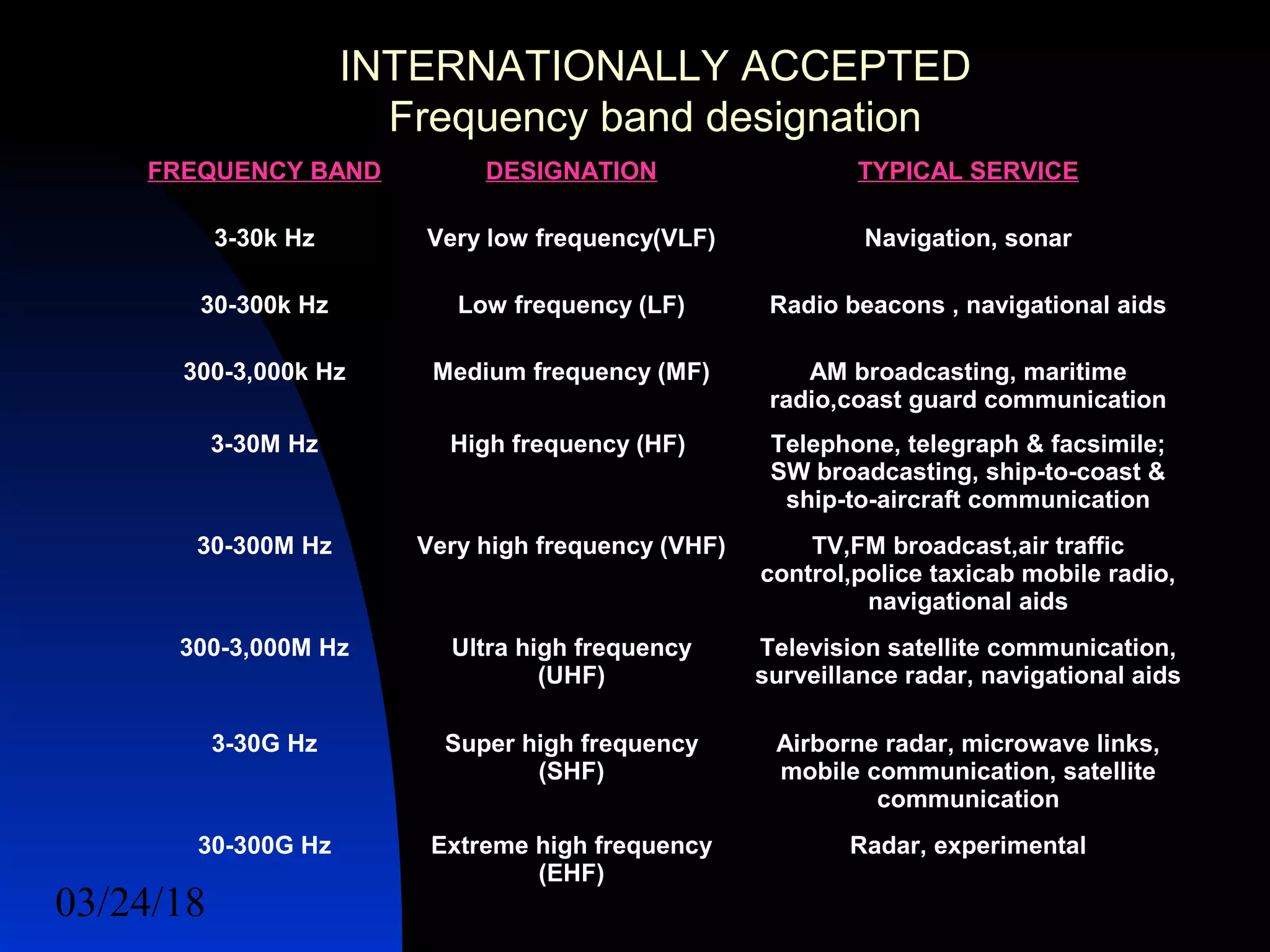
FREQUENCY BAND DESIGNATION TYPICAL SERVICE
3-30k Hz Very low frequency(VLF) Navigation, sonar
30-300k Hz Low frequency (LF) Radio beacons , navigational aids
300-3,000k Hz Medium frequency (MF) AM broadcasting, maritime
radio,coast guard communication
3-30M Hz High frequency (HF) Telephone, telegraph & facsimile;
SW broadcasting, ship-to-coast &
ship-to-aircraft communication
30-300M Hz Very high frequency (VHF) TV,FM broadcast,air traffic
control,police taxicab mobile radio,
navigational aids
300-3,000M Hz Ultra high frequency
(UHF)
Television satellite communication,
surveillance radar, navigational aids
3-30G Hz Super high frequency
(SHF)
Airborne radar, microwave links,
mobile communication, satellite
communication
30-300G Hz Extreme high frequency
(EHF)
Radar, experimental
INTERNATIONALLY ACCEPTED
Frequency band designation
03/24/18 4
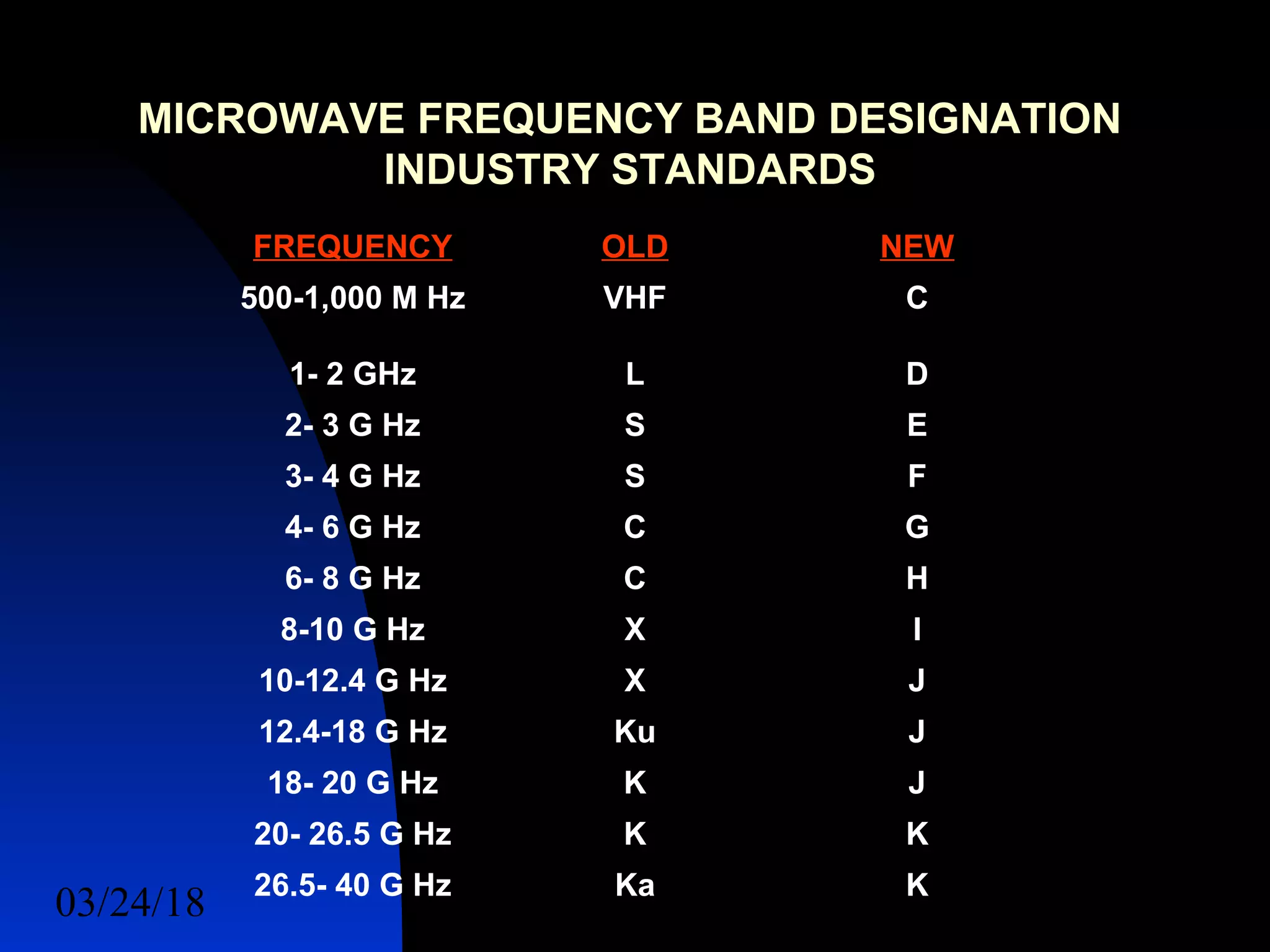
FREQUENCY OLD NEW
500-1,000 M Hz VHF C
1- 2 GHz L D
2- 3 G Hz S E
3- 4 G Hz S F
4- 6 G Hz C G
6- 8 G Hz C H
8-10 G Hz X I
10-12.4 G Hz X J
12.4-18 G Hz Ku J
18- 20 G Hz K J
20- 26.5 G Hz K K
26.5- 40 G Hz Ka K
MICROWAVE FREQUENCY BAND DESIGNATION
INDUSTRY STANDARDS
03/24/18 5
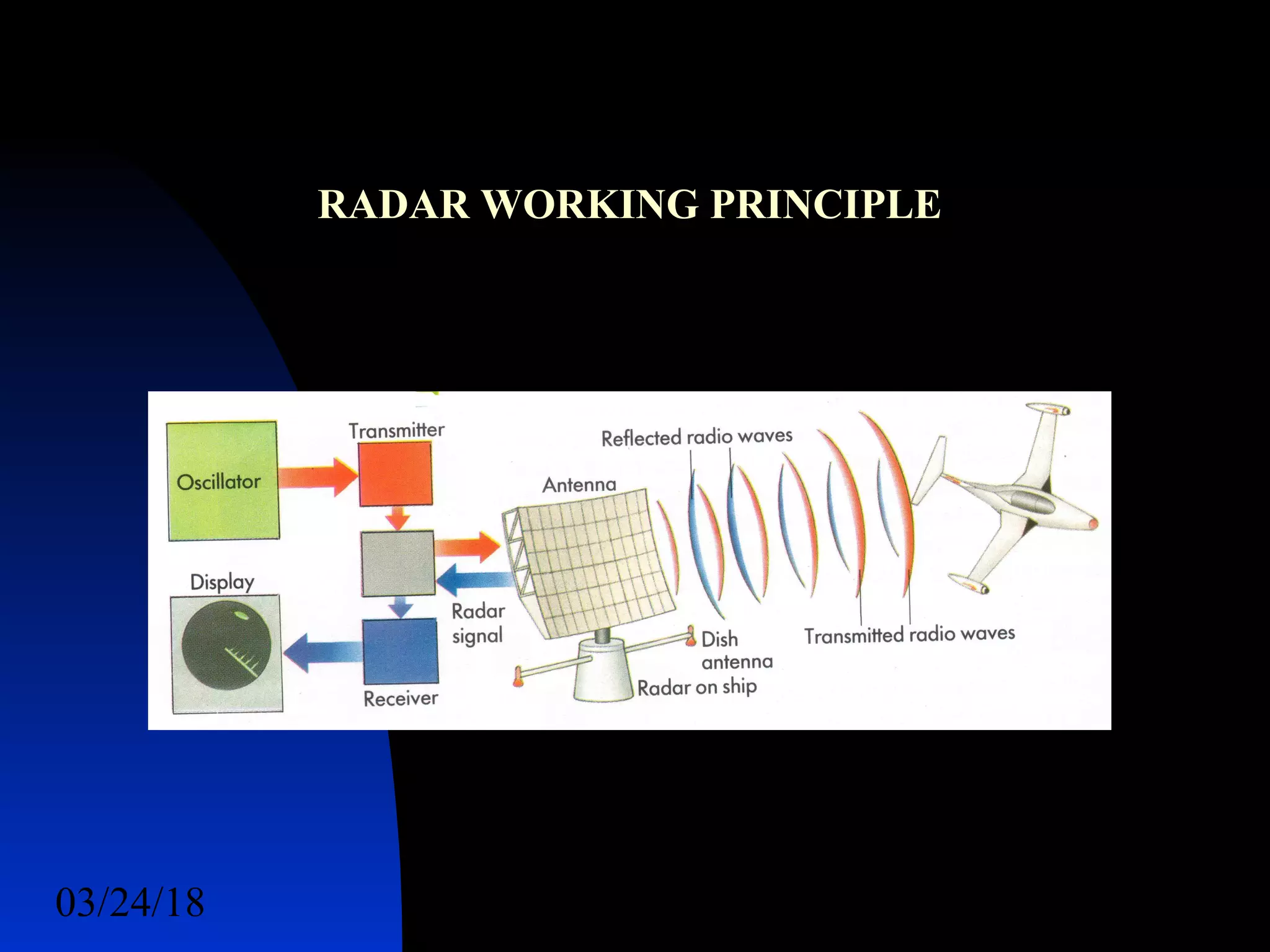
RADAR WORKING PRINCIPLE
03/24/18 6
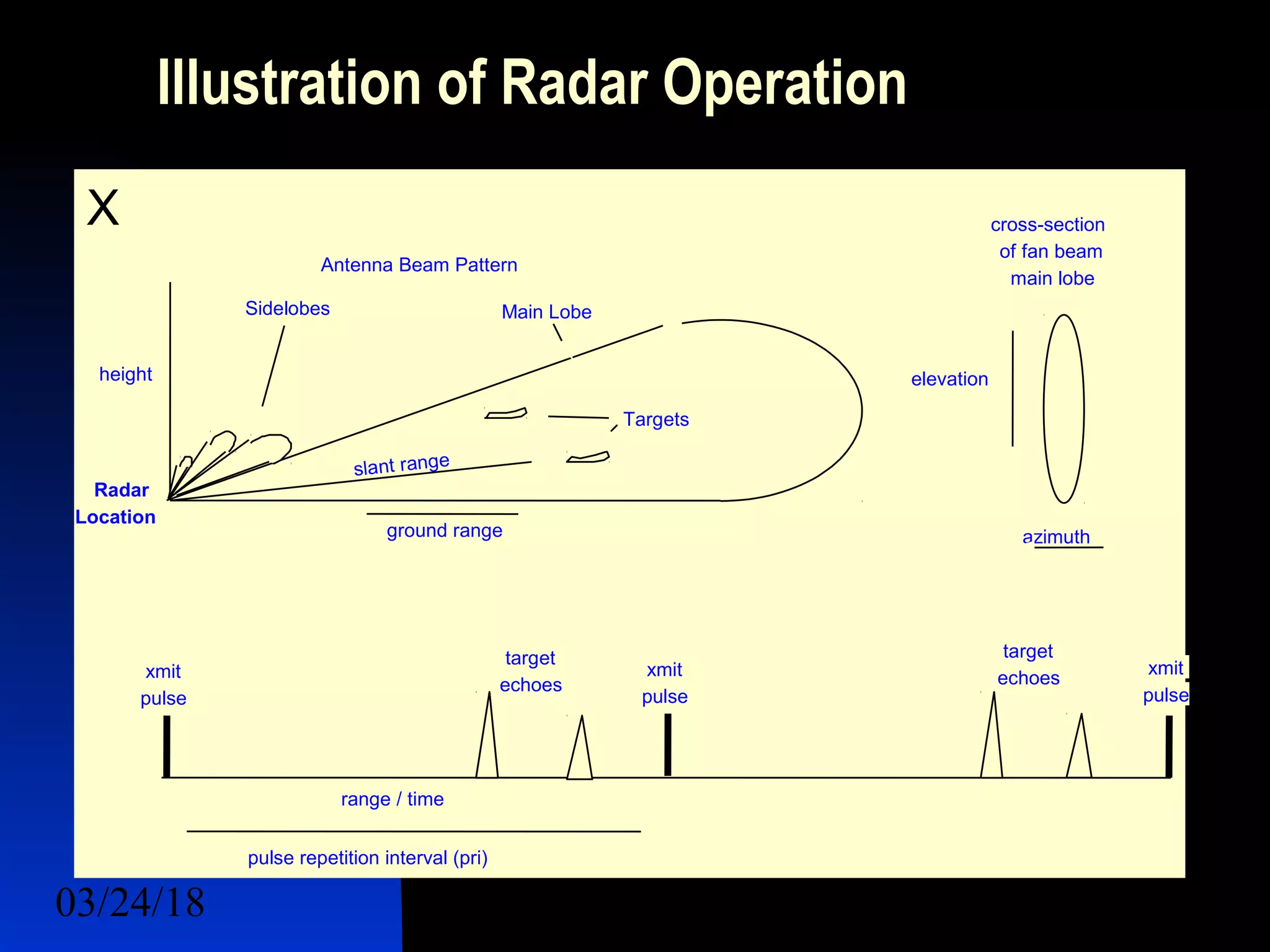
Illustration of Radar Operation
X
range / time
ground range
height
cross-section
of fan beam
main lobe
elevation
azimuth
xmit
pulse
xmit
pulse
xmit
pulse
target
echoes
target
echoes
pulse repetition interval (pri)
Antenna Beam Pattern
Sidelobes Main Lobe
Targets
slant range
Radar
Location
03/24/18 7
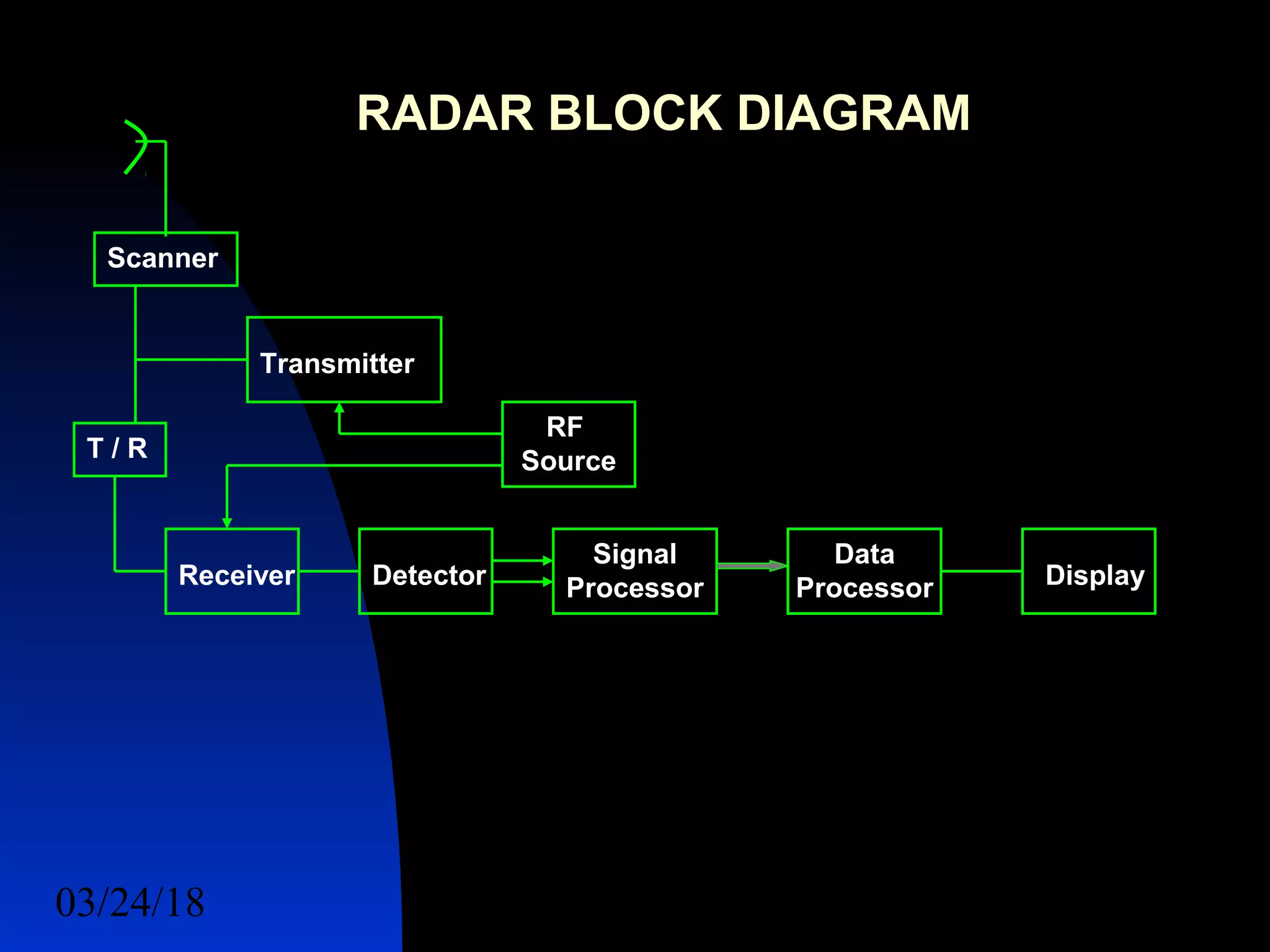
RADAR BLOCK DIAGRAM
Receiver Detector
Signal
Processor
Data
Processor Display
T / R
Scanner
Transmitter
RF
Source
03/24/18 8
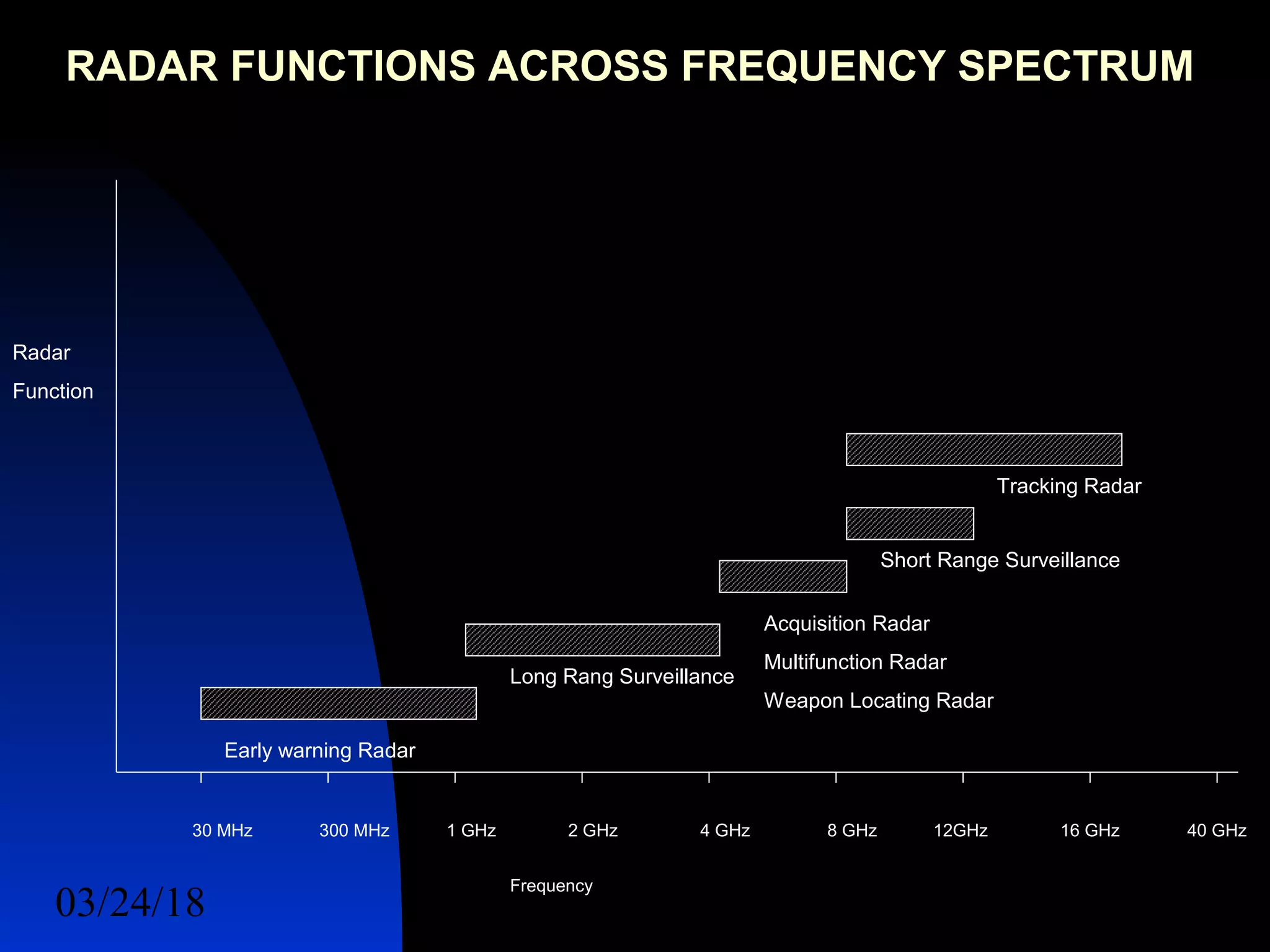
300 MHz30 MHz 1 GHz 2 GHz 4 GHz 8 GHz 12GHz 16 GHz 40 GHz
Early warning Radar
Long Rang Surveillance
Acquisition Radar
Multifunction Radar
Weapon Locating Radar
Short Range Surveillance
Tracking Radar
Radar
Function
Frequency
RADAR FUNCTIONS ACROSS FREQUENCY SPECTRUM
03/24/18 9
RADAR CROSS SECTION
 RCS is a measure of power scattered in
a given direction when a target is
illuminated by a incident wave. The
received power is normalized with the
incident power with the incident power at
the target so that RCS does not depend
on the distance between the target and
the illuminating source.
03/24/18 10
03/24/18 11
03/24/18 12
03/24/18 13
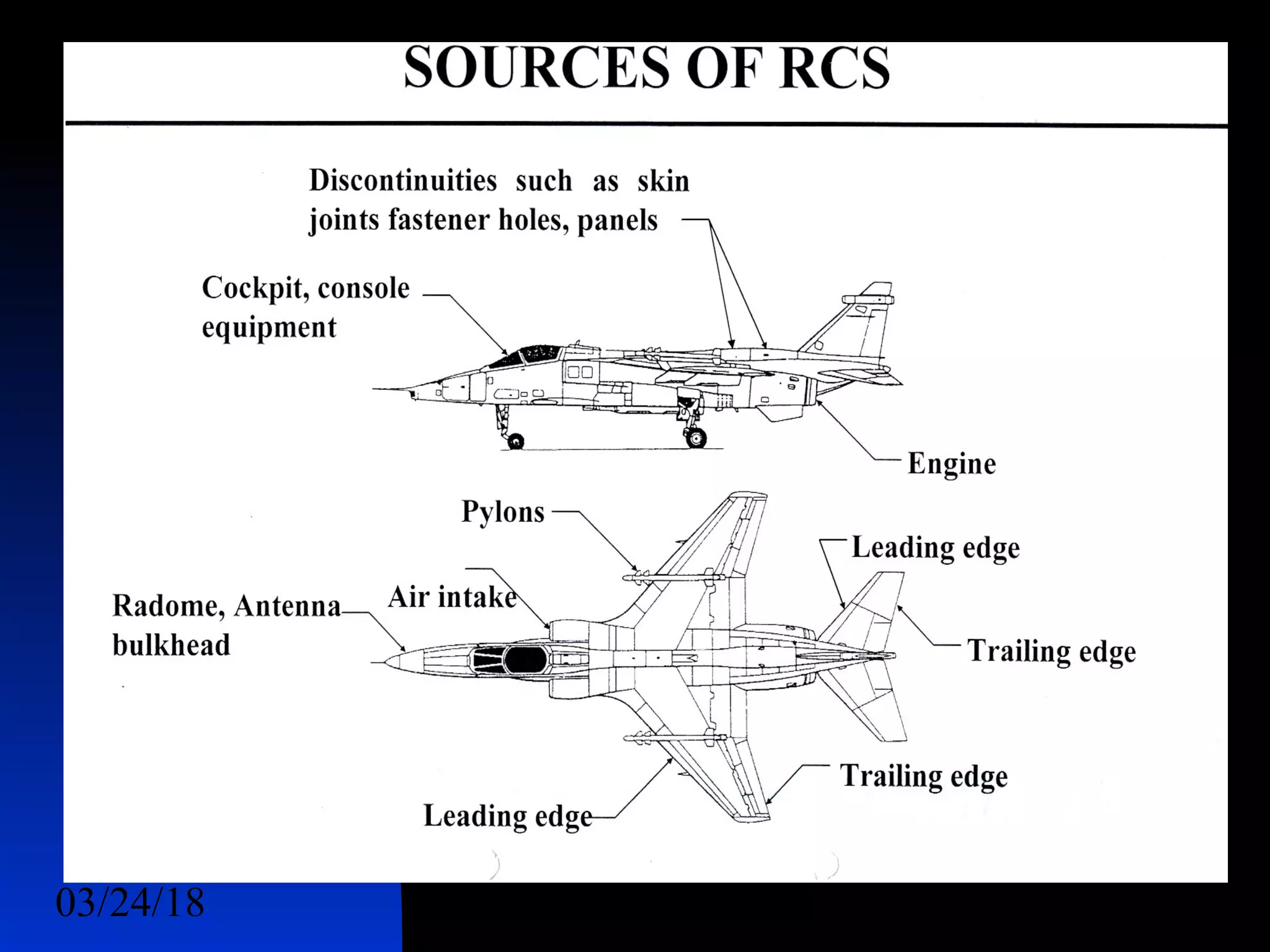
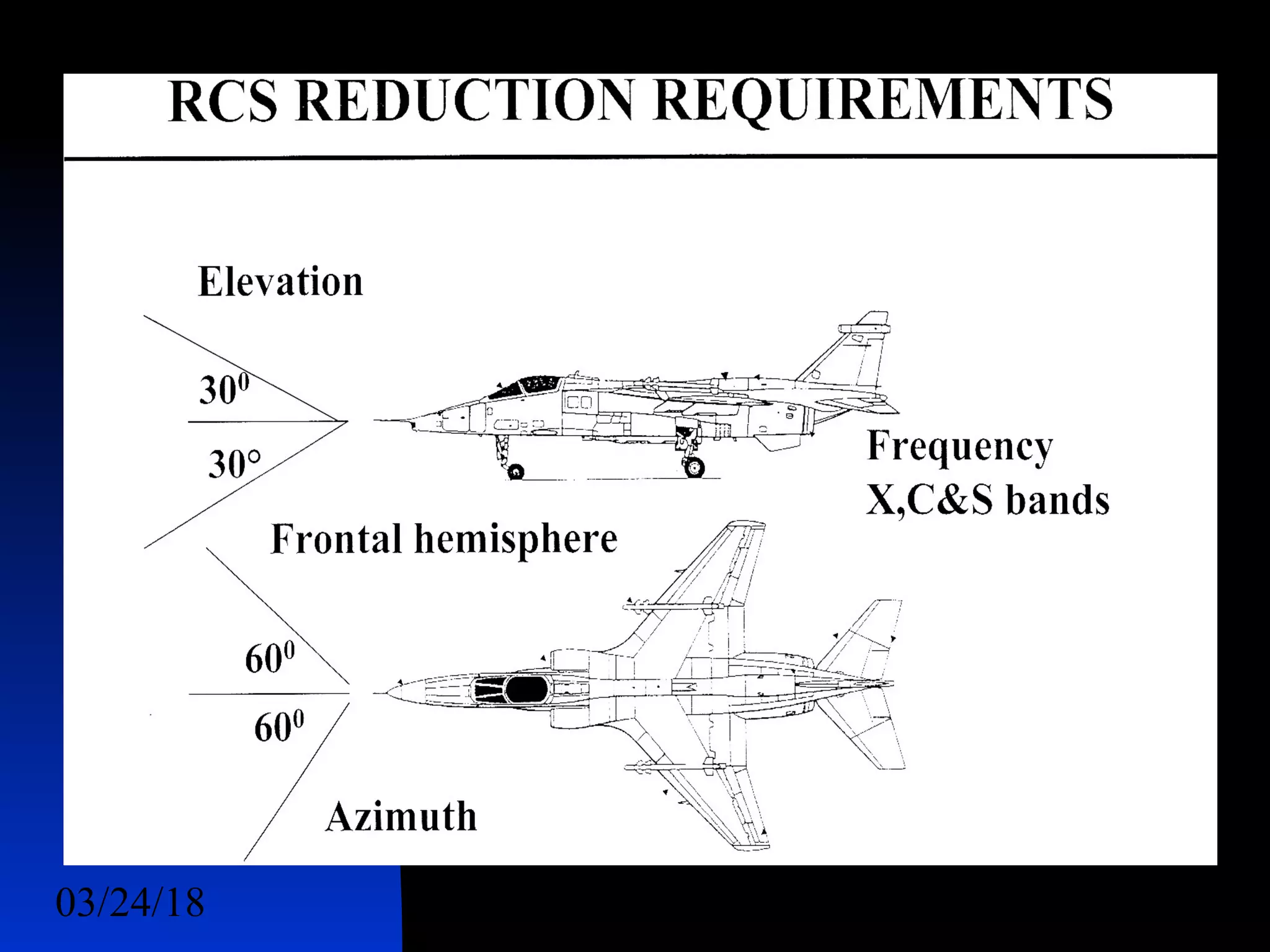
RCS is function of
 Frequency or wavelength
 Target geometry
 Material composition
 Aspect angle
03/24/18 14
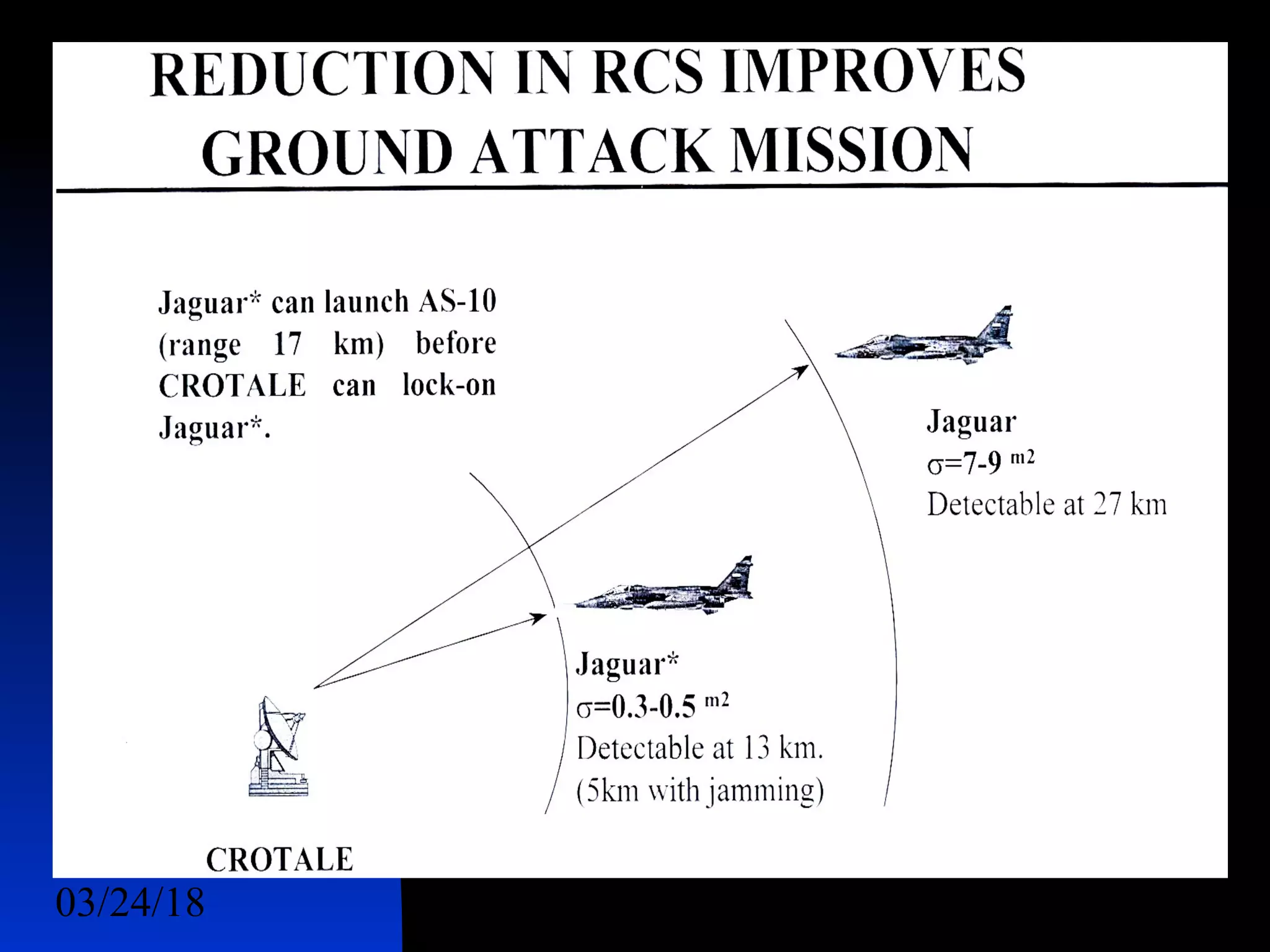
RCS to be reduced for
 To make the ships less vulnerable for
enemy radar detection
 To increase the effectiveness of chaff
 To make classification of our ship difficult
for enemy
03/24/18 15
RADAR CROSS SECTION
 PREDICTION
RCSPT (Radar Cross Section Prediction Tool)
 REDUCTION TECHNIQUES
Shaping. Using RAM, RAP
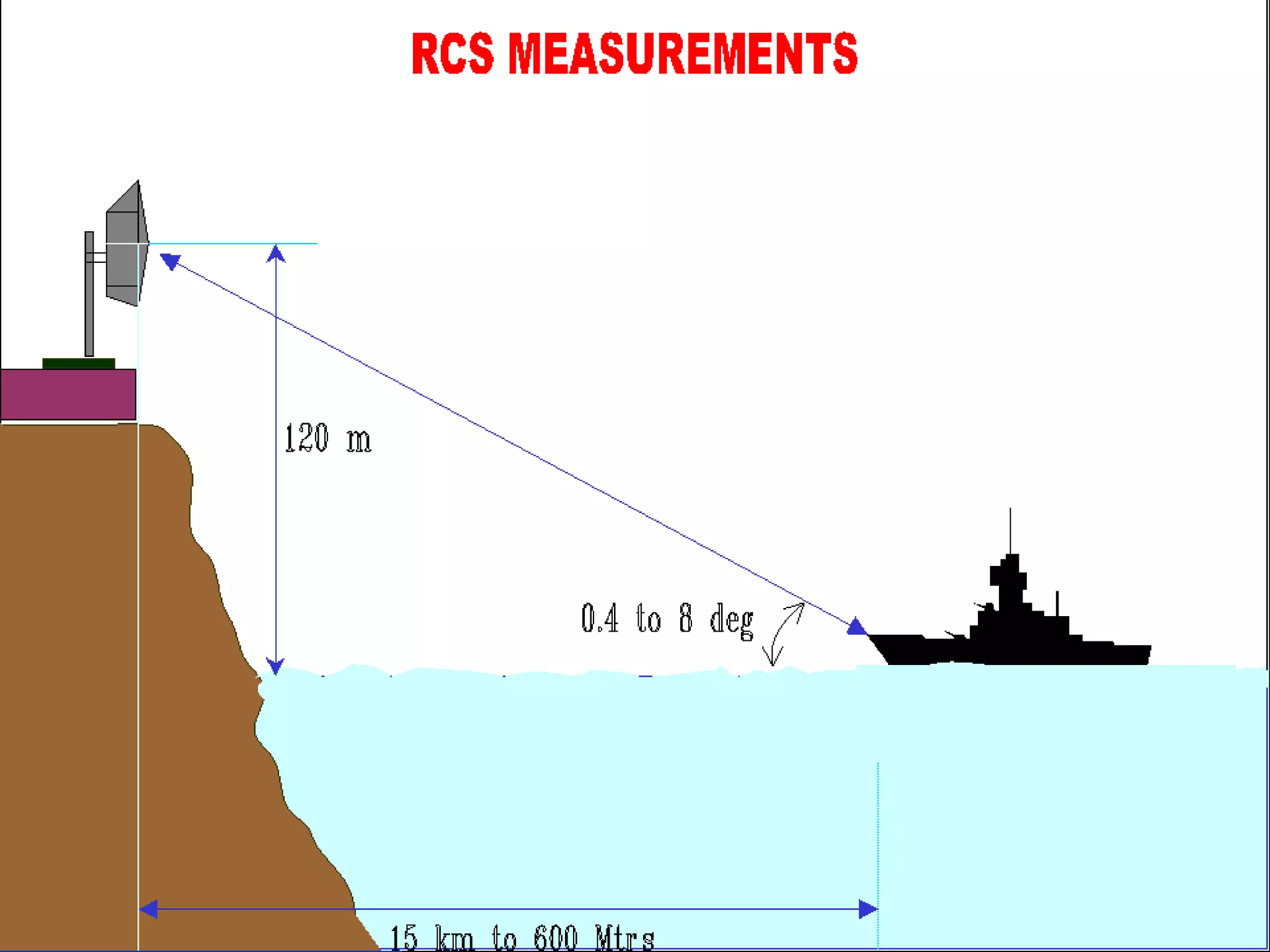
 MEASUREMENT
Using Radar
03/24/18 16
RCS s/w prediction
methods
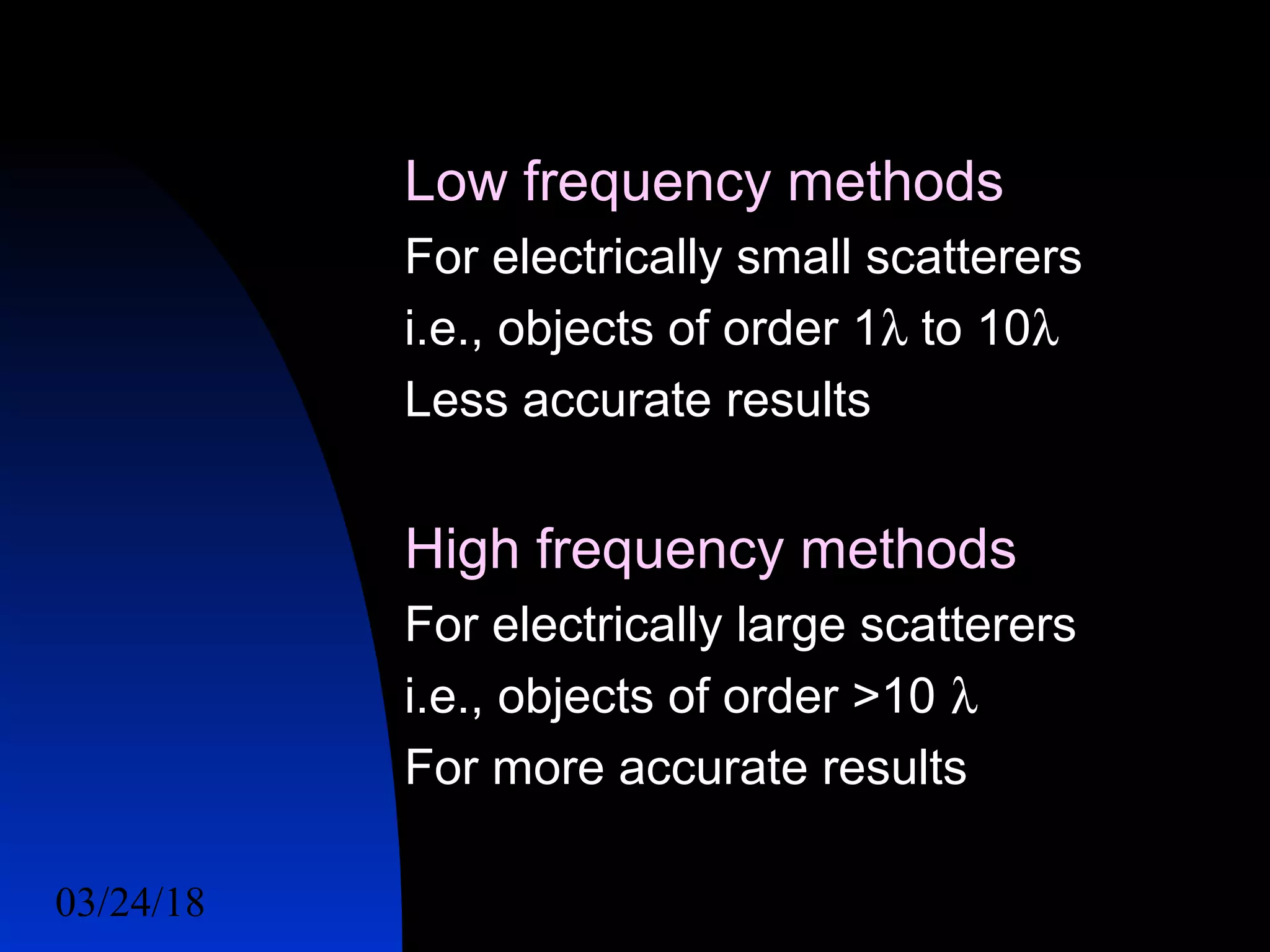
Low frequency methods
 Method of Moments (MoM)
 Finite Difference Time Domain (FDTD)
High frequency methods
 Geometrical Optics (GO)
 Physical Optics (PO)
 Physical Theory of Diffraction (PTD)
 Shooting and Bouncing Ray method
(SBR)
03/24/18 17
Low frequency methods
For electrically small scatterers
i.e., objects of order 1λ to 10λ
Less accurate results
High frequency methods
For electrically large scatterers
i.e., objects of order >10 λ
For more accurate results
03/24/18 18
Low frequency methods
03/24/18 19
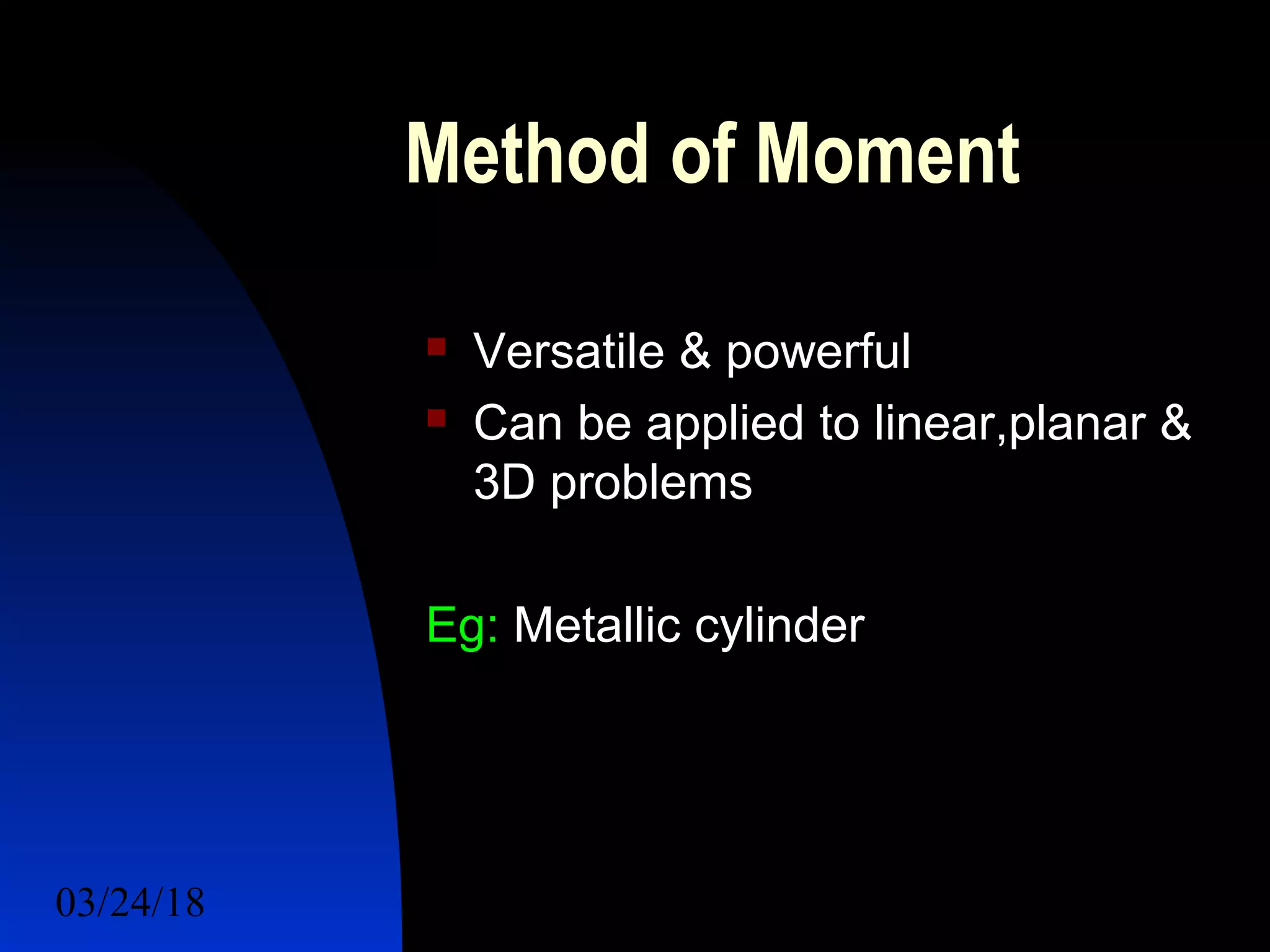
Method of Moment
 Versatile & powerful
 Can be applied to linear,planar &
3D problems
Eg: Metallic cylinder
03/24/18 20
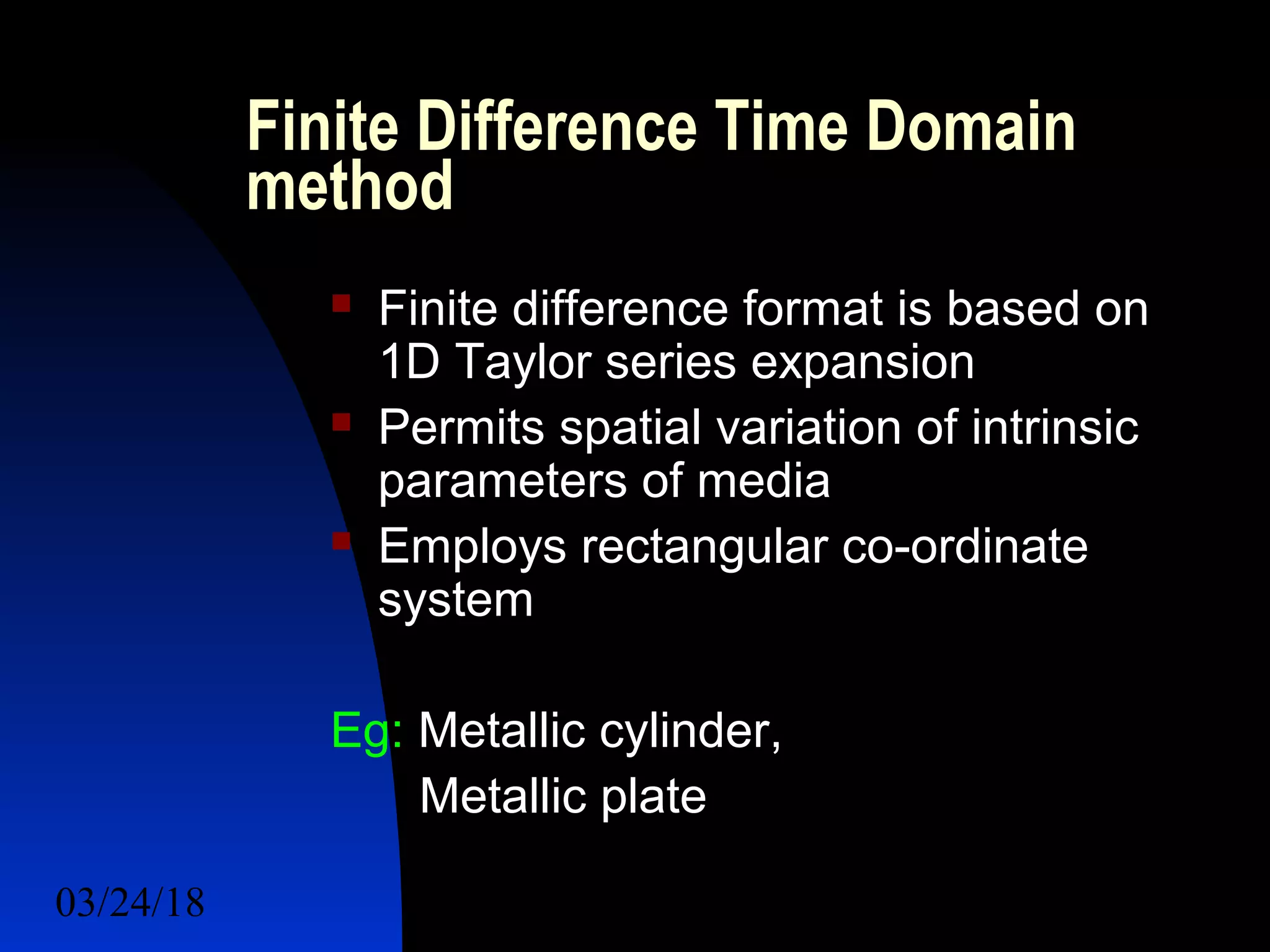
Finite Difference Time Domain
method
 Finite difference format is based on
1D Taylor series expansion
 Permits spatial variation of intrinsic
parameters of media
 Employs rectangular co-ordinate
system
Eg: Metallic cylinder,
Metallic plate
03/24/18 21
High frequency methods
03/24/18 22
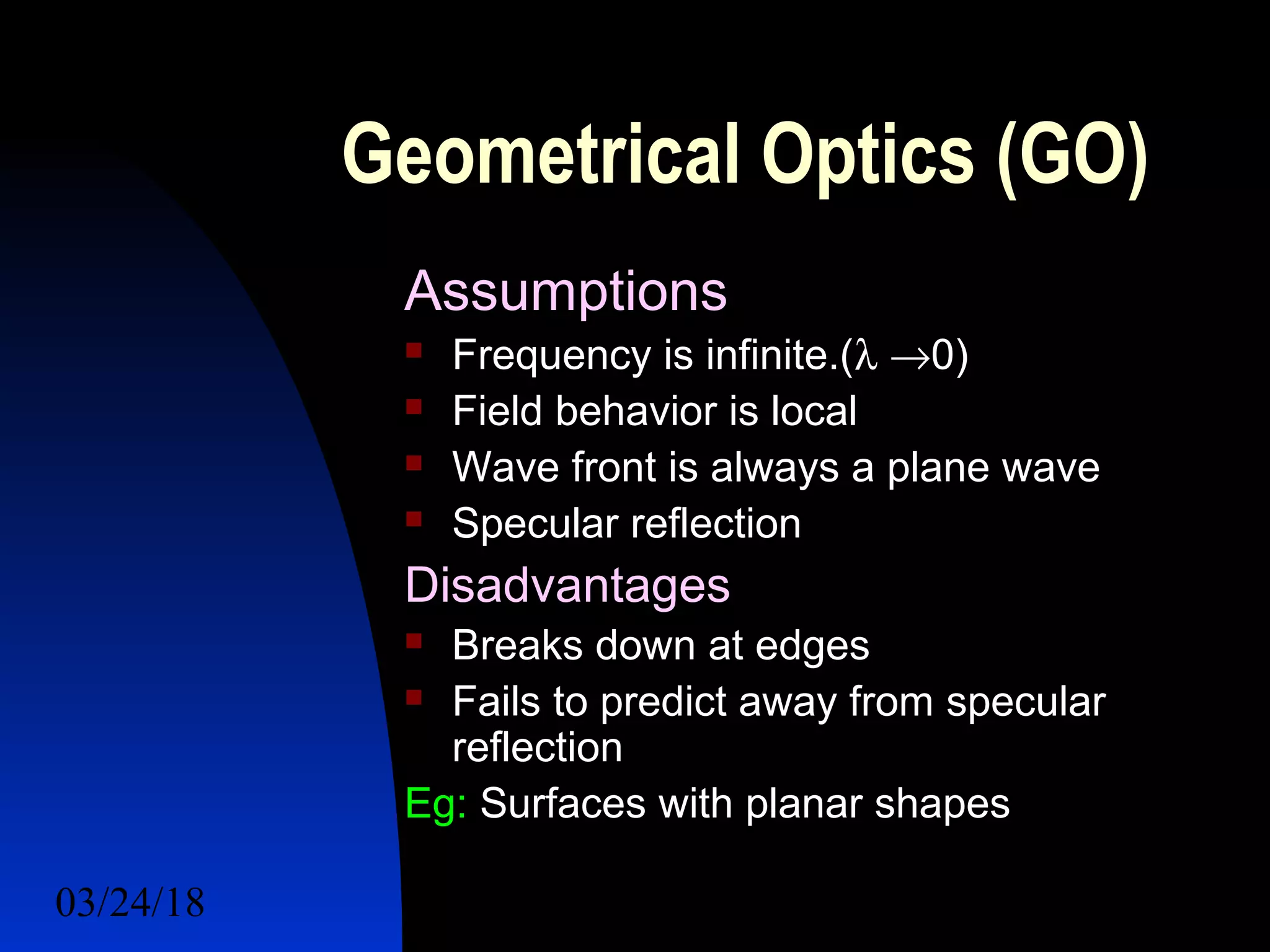
Geometrical Optics (GO)
Assumptions
 Frequency is infinite.(λ →0)
 Field behavior is local
 Wave front is always a plane wave
 Specular reflection
Disadvantages
 Breaks down at edges
 Fails to predict away from specular
reflection
Eg: Surfaces with planar shapes
03/24/18 23
Physical Optics(PO)
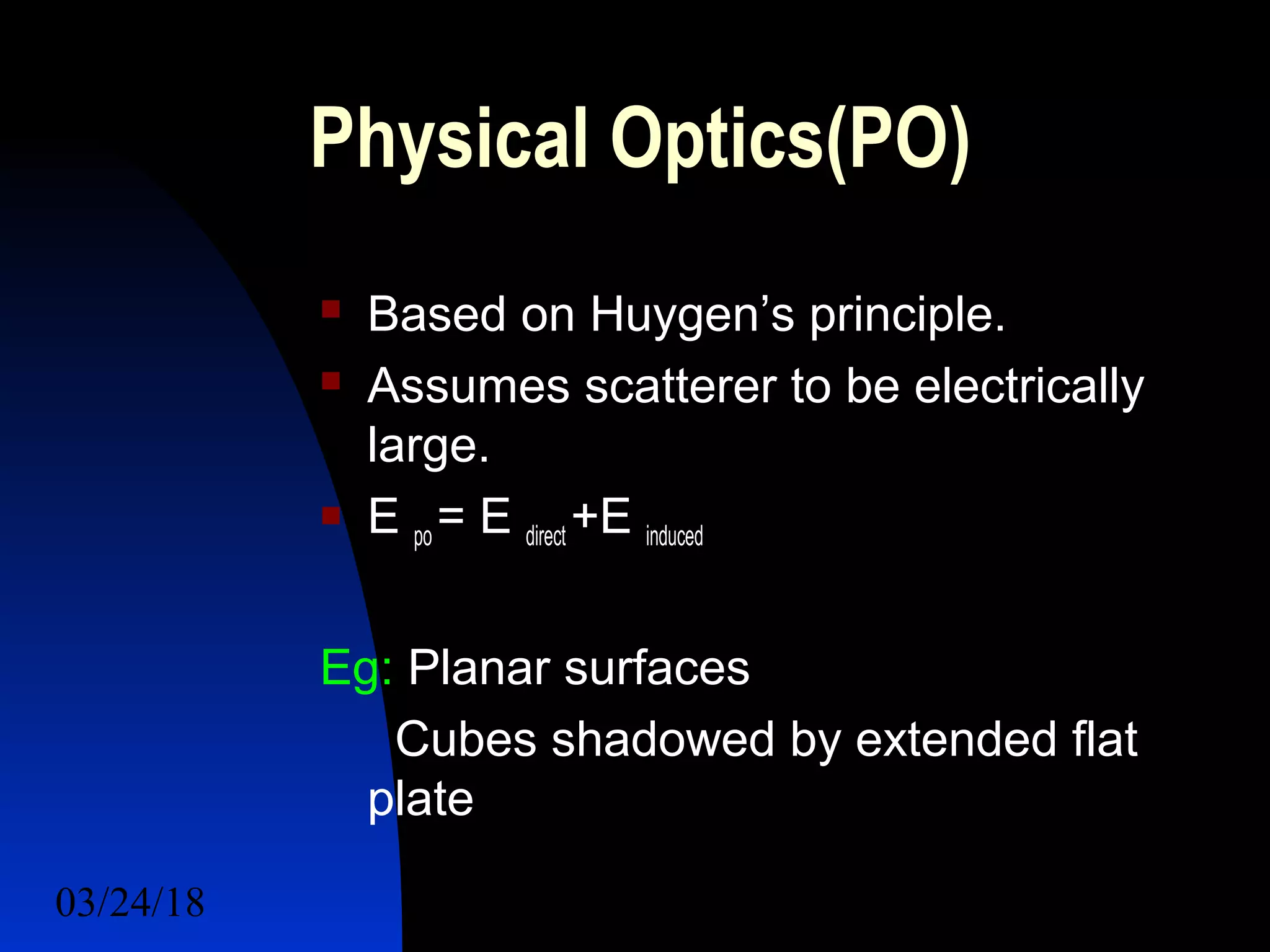
 Based on Huygen’s principle.
 Assumes scatterer to be electrically
large.
 E po = E direct +E induced
Eg: Planar surfaces
Cubes shadowed by extended flat
plate
03/24/18 24
Physical Theory of diffraction(PTD)
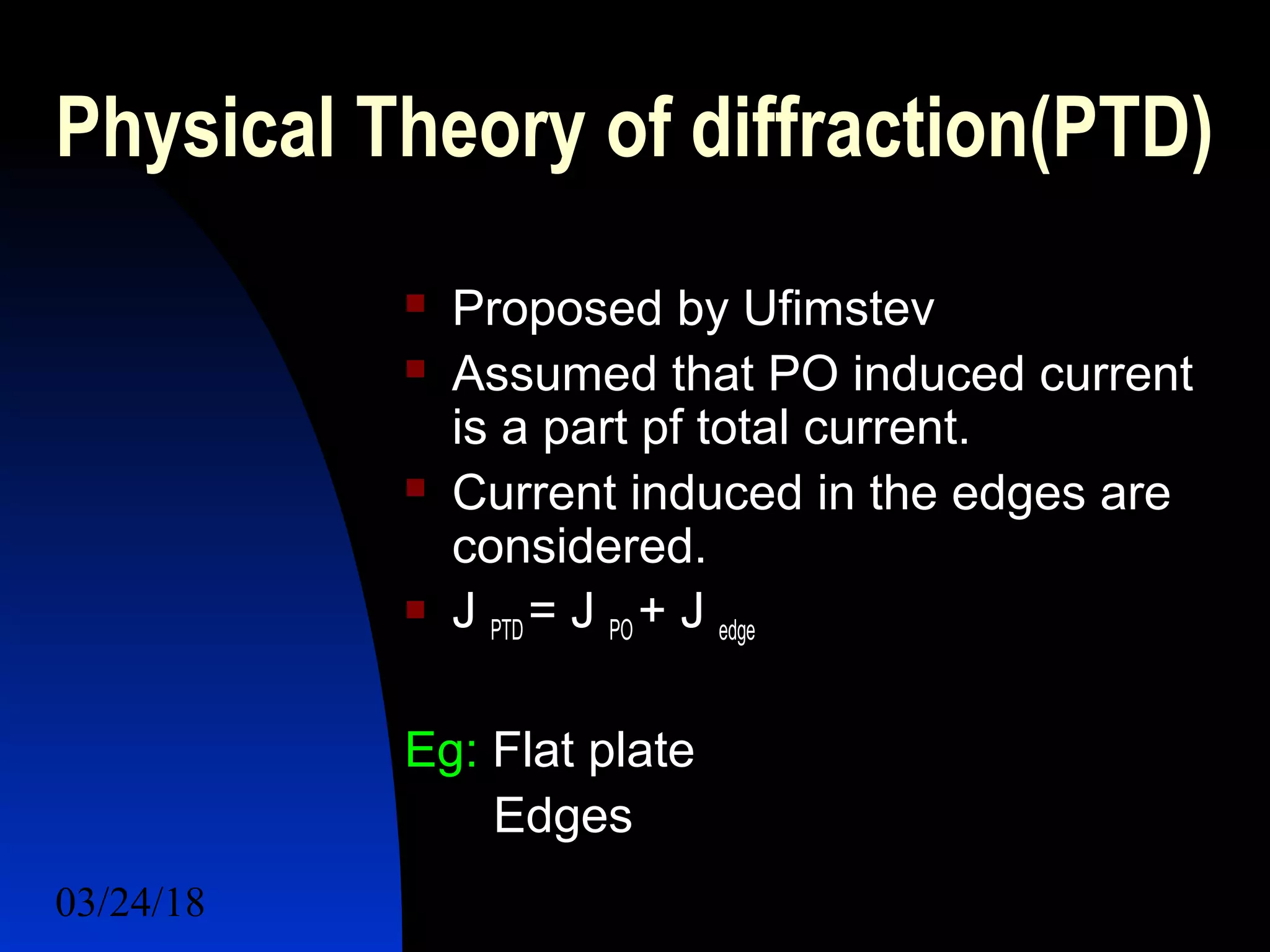
 Proposed by Ufimstev
 Assumed that PO induced current
is a part pf total current.
 Current induced in the edges are
considered.
 J PTD = J PO + J edge
Eg: Flat plate
Edges
03/24/18 25
Shooting and Bouncing Ray(SBR)
method
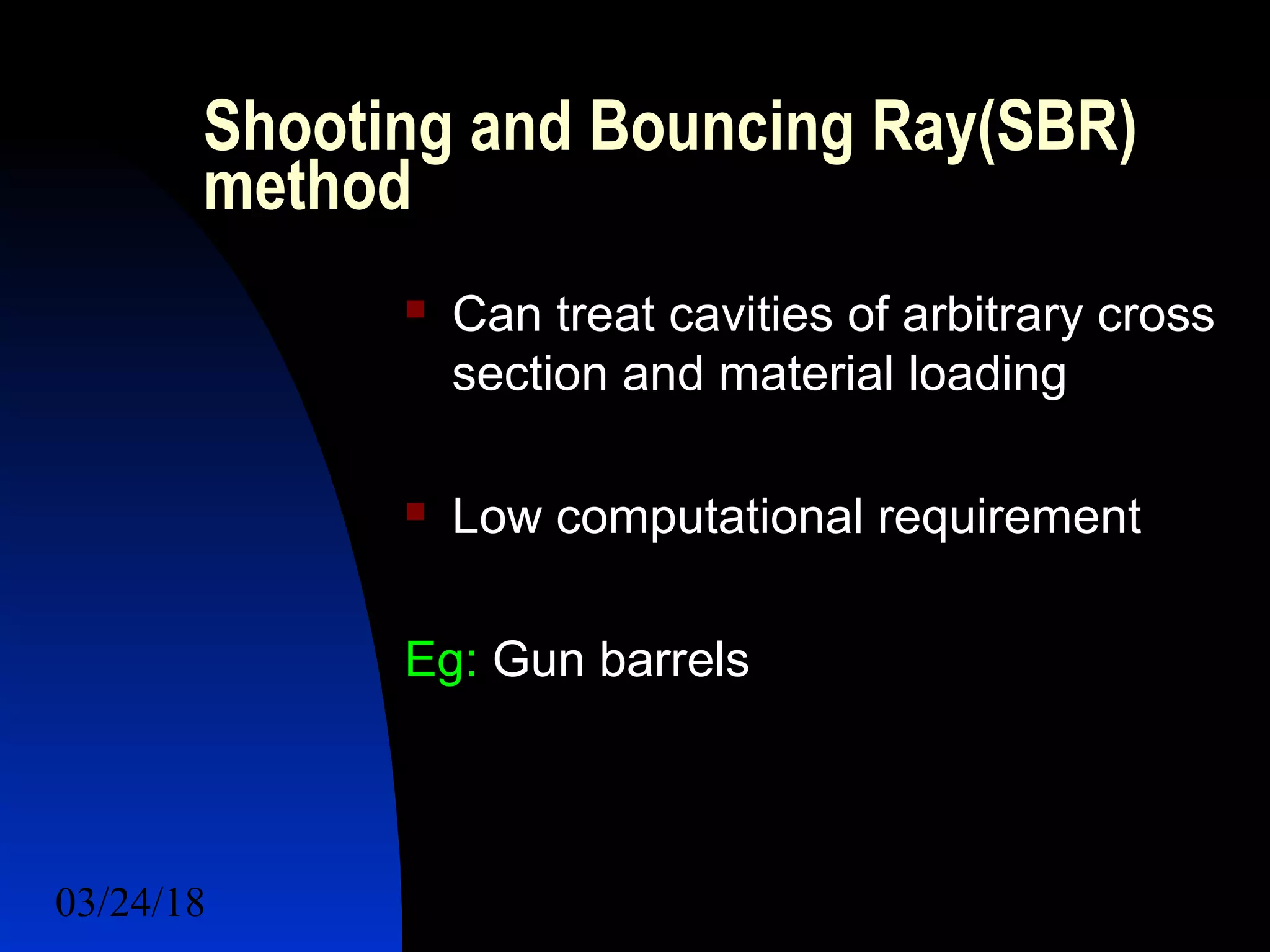
 Can treat cavities of arbitrary cross
section and material loading
 Low computational requirement
Eg: Gun barrels
03/24/18 26
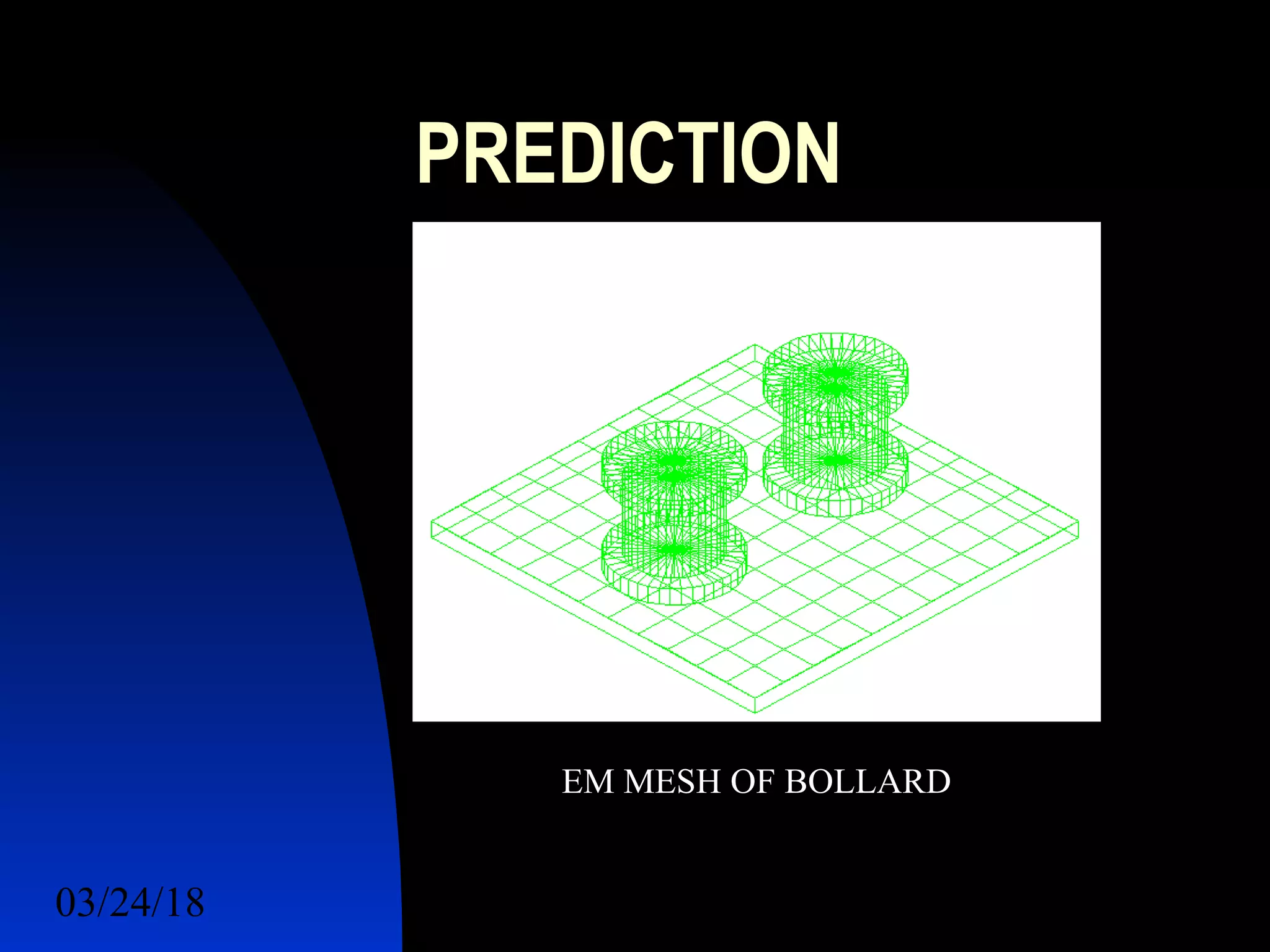
PREDICTION
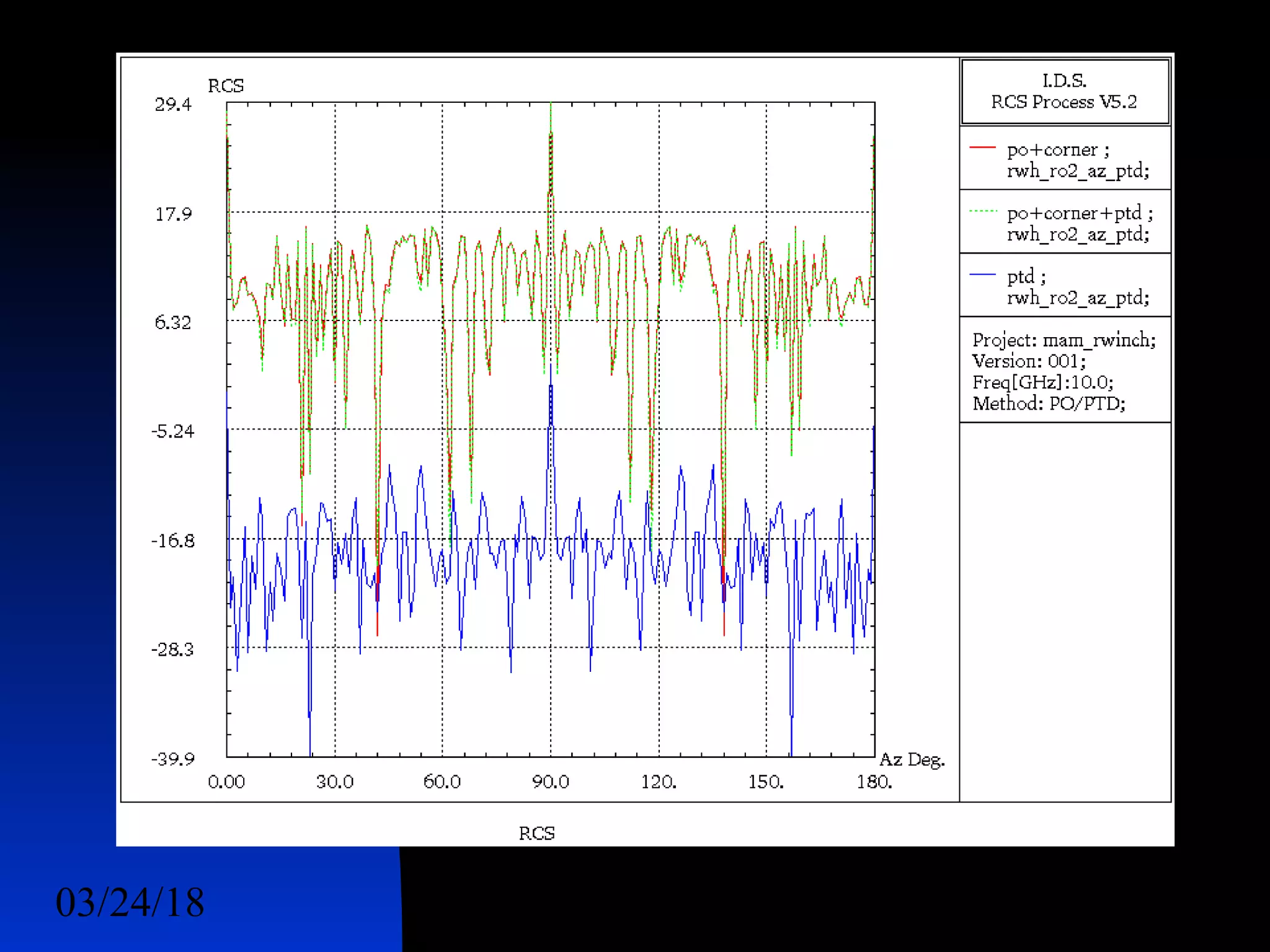
EM MESH OF BOLLARD
03/24/18 27
03/24/18 28
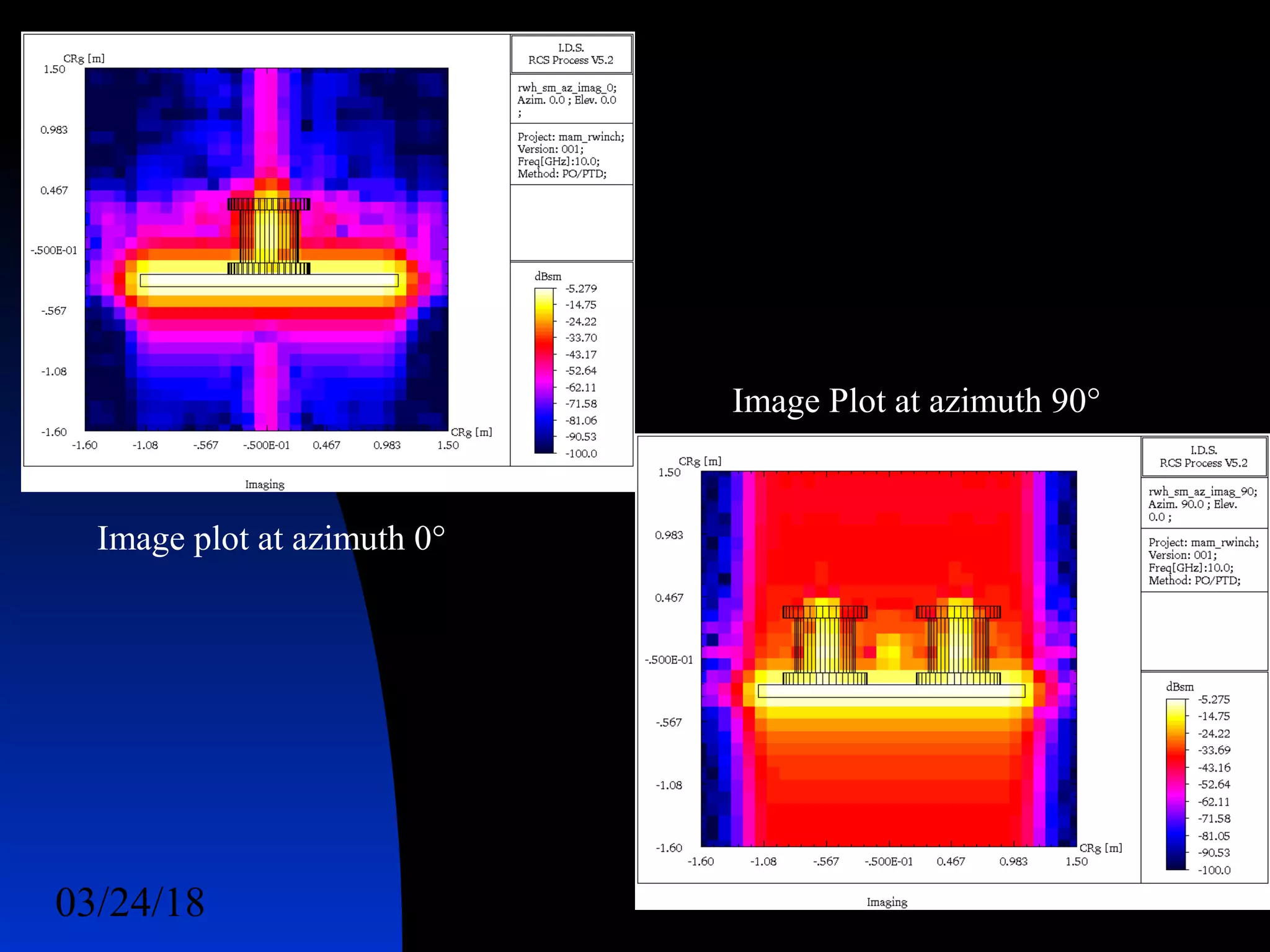
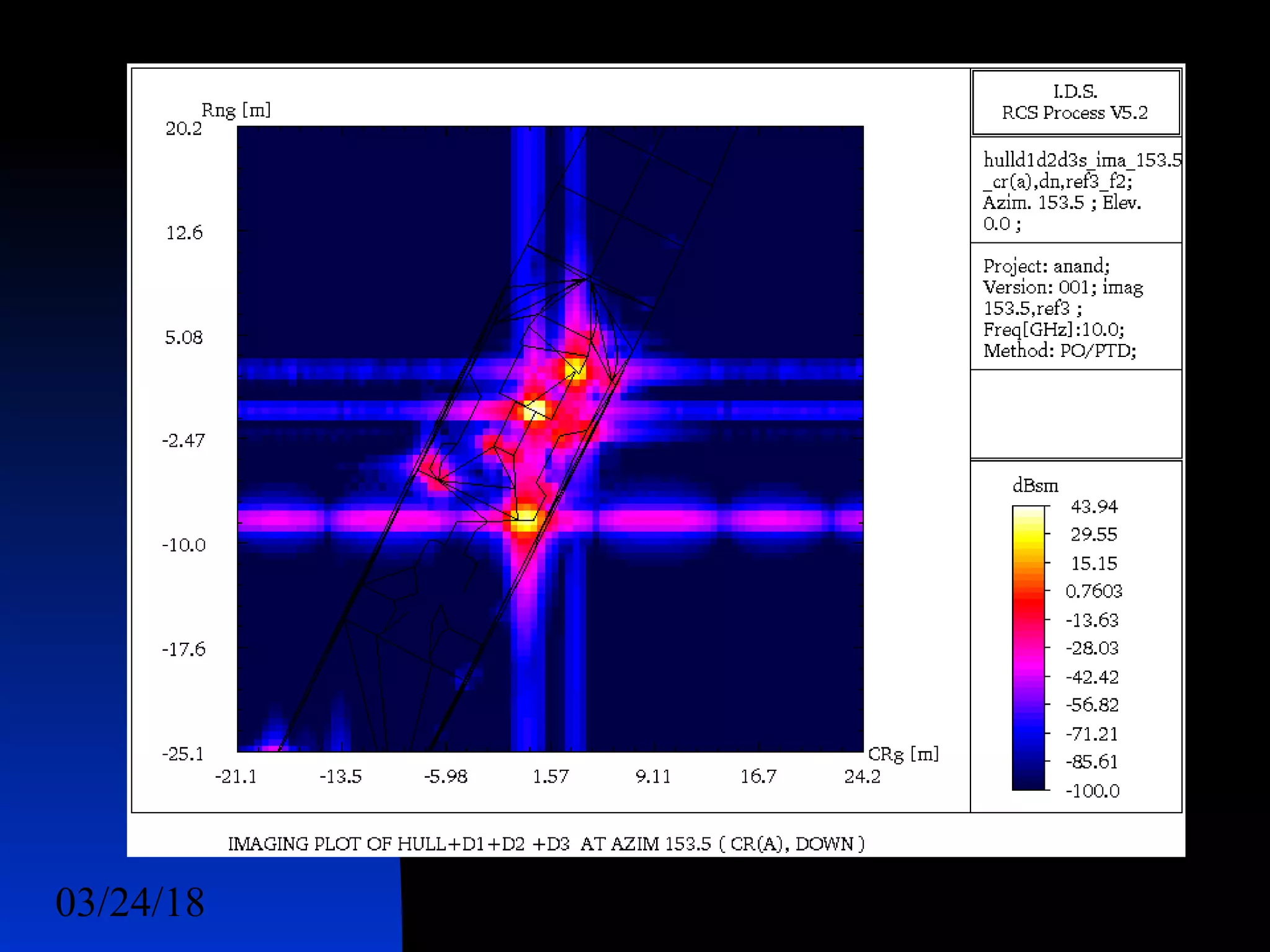
Image plot at azimuth 0°
Image Plot at azimuth 90°
03/24/18 29
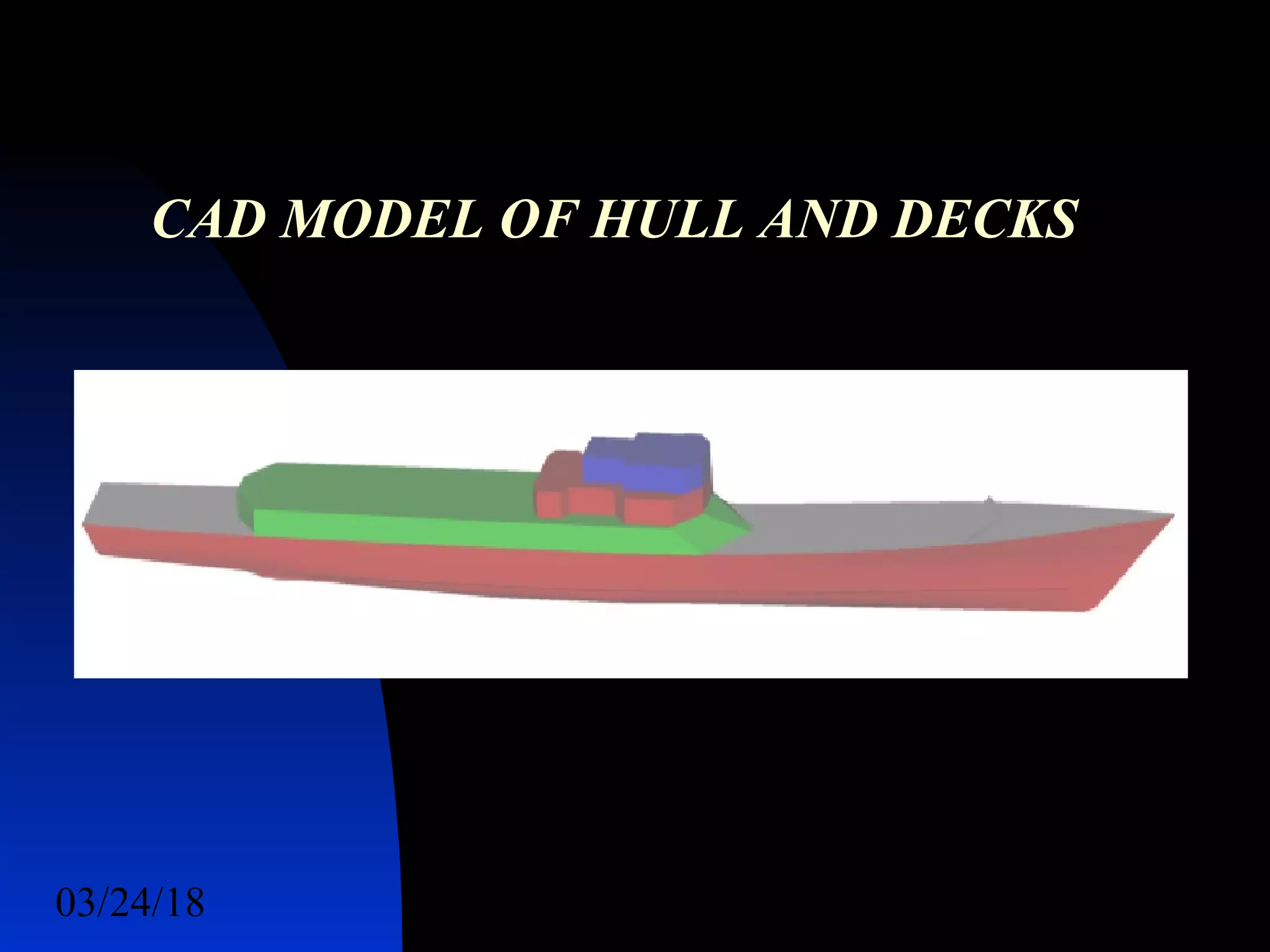
CAD MODEL OF HULL AND DECKS
03/24/18 30
03/24/18 31
03/24/18 32
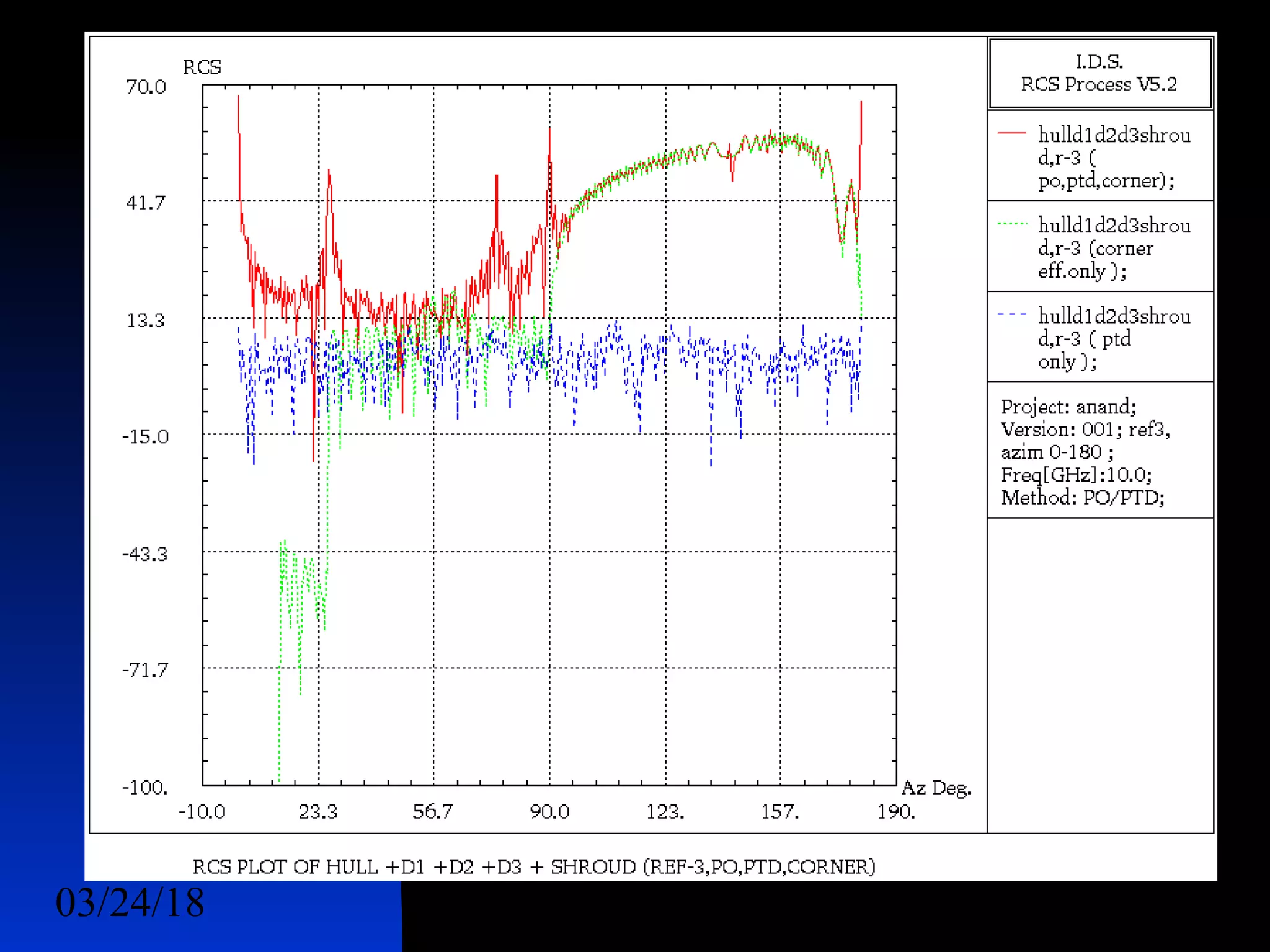
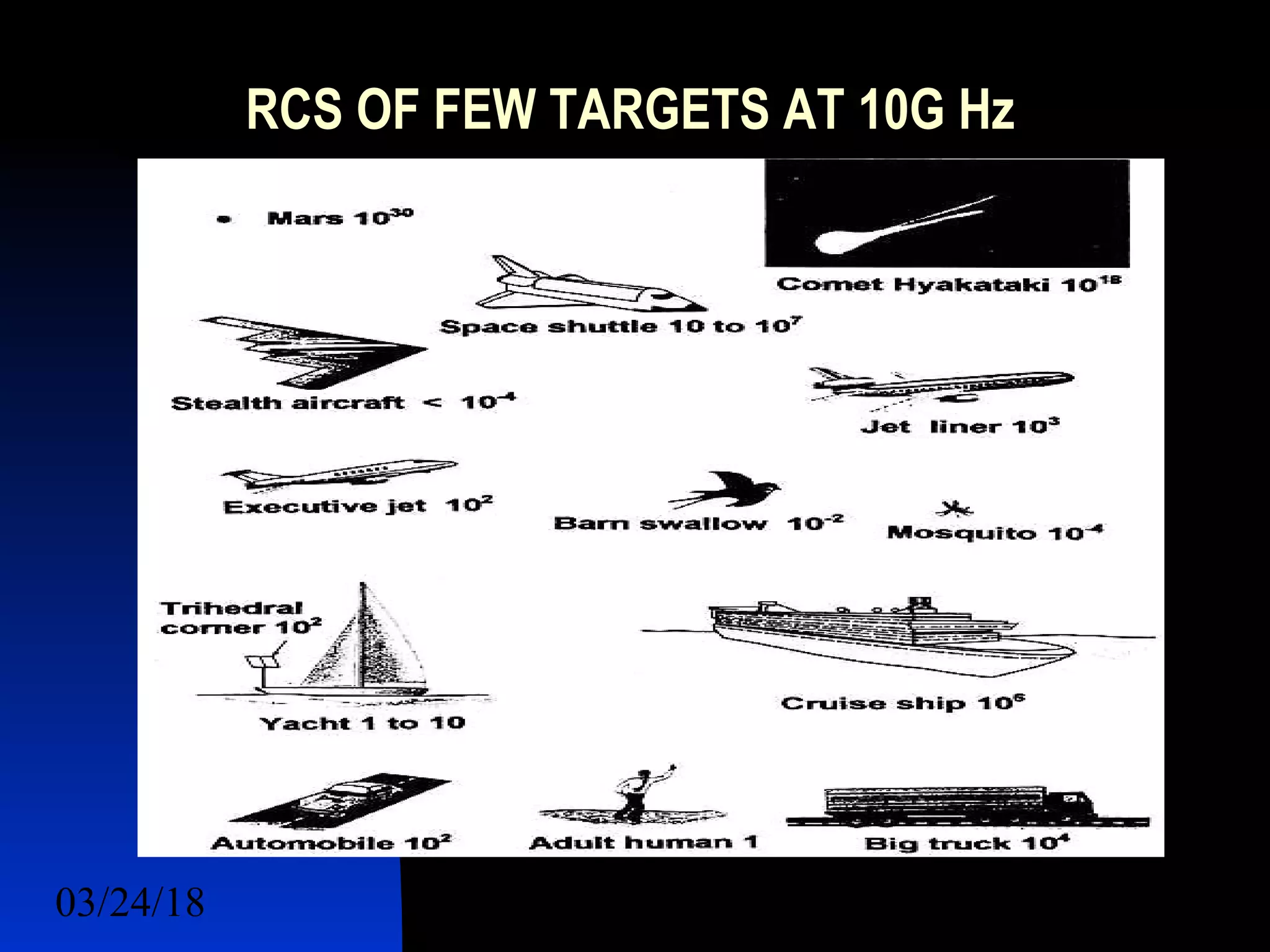
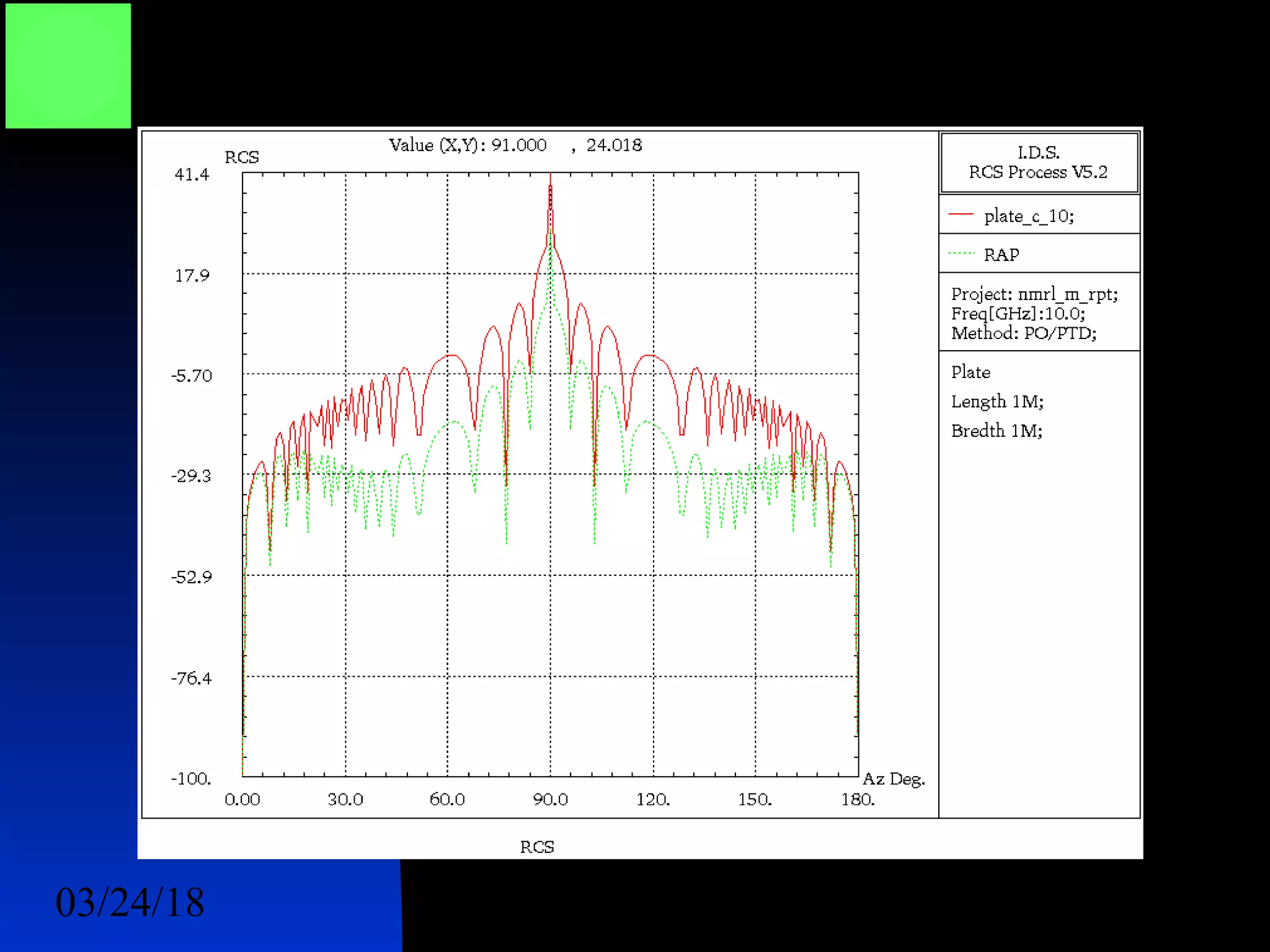
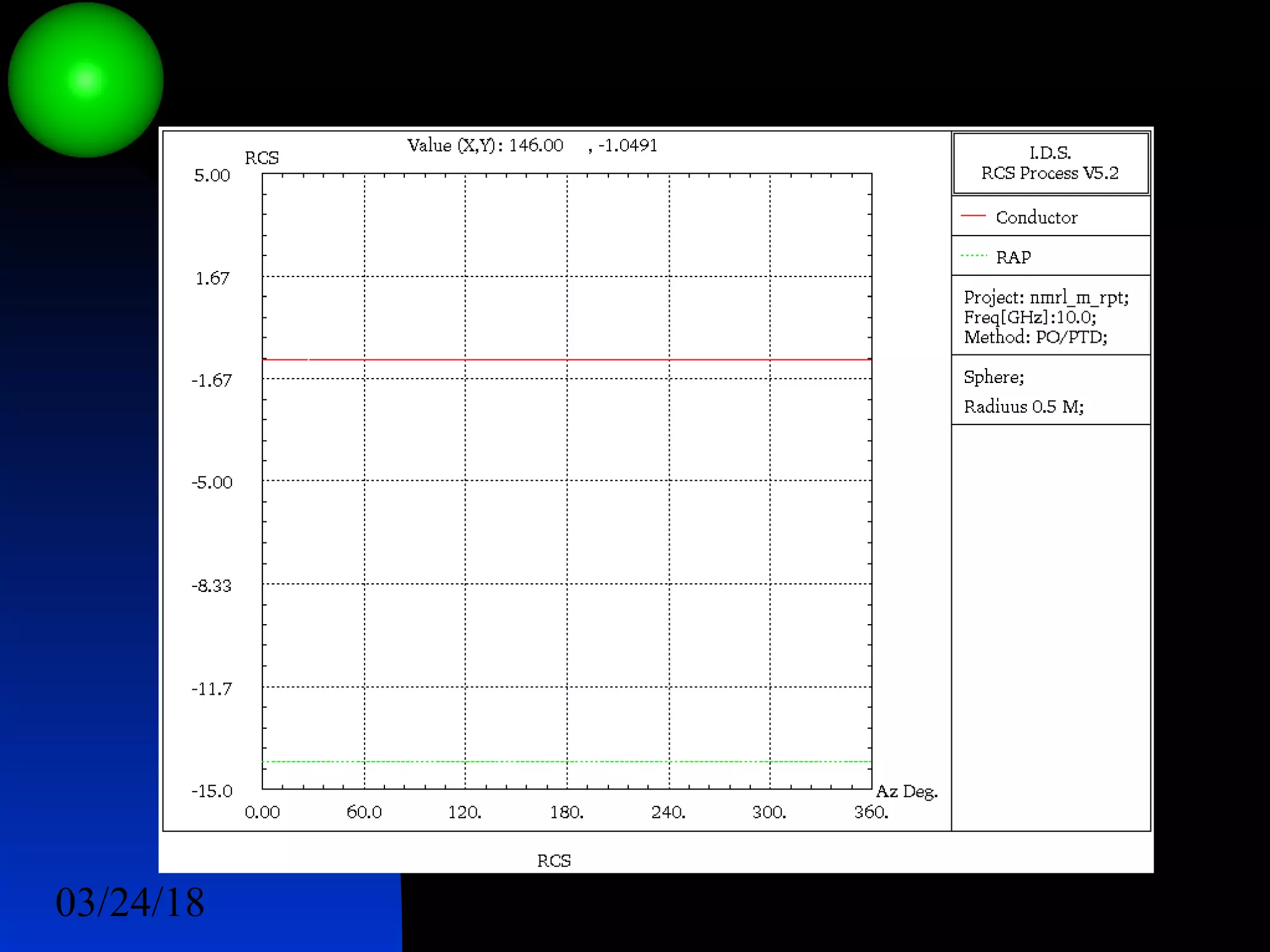
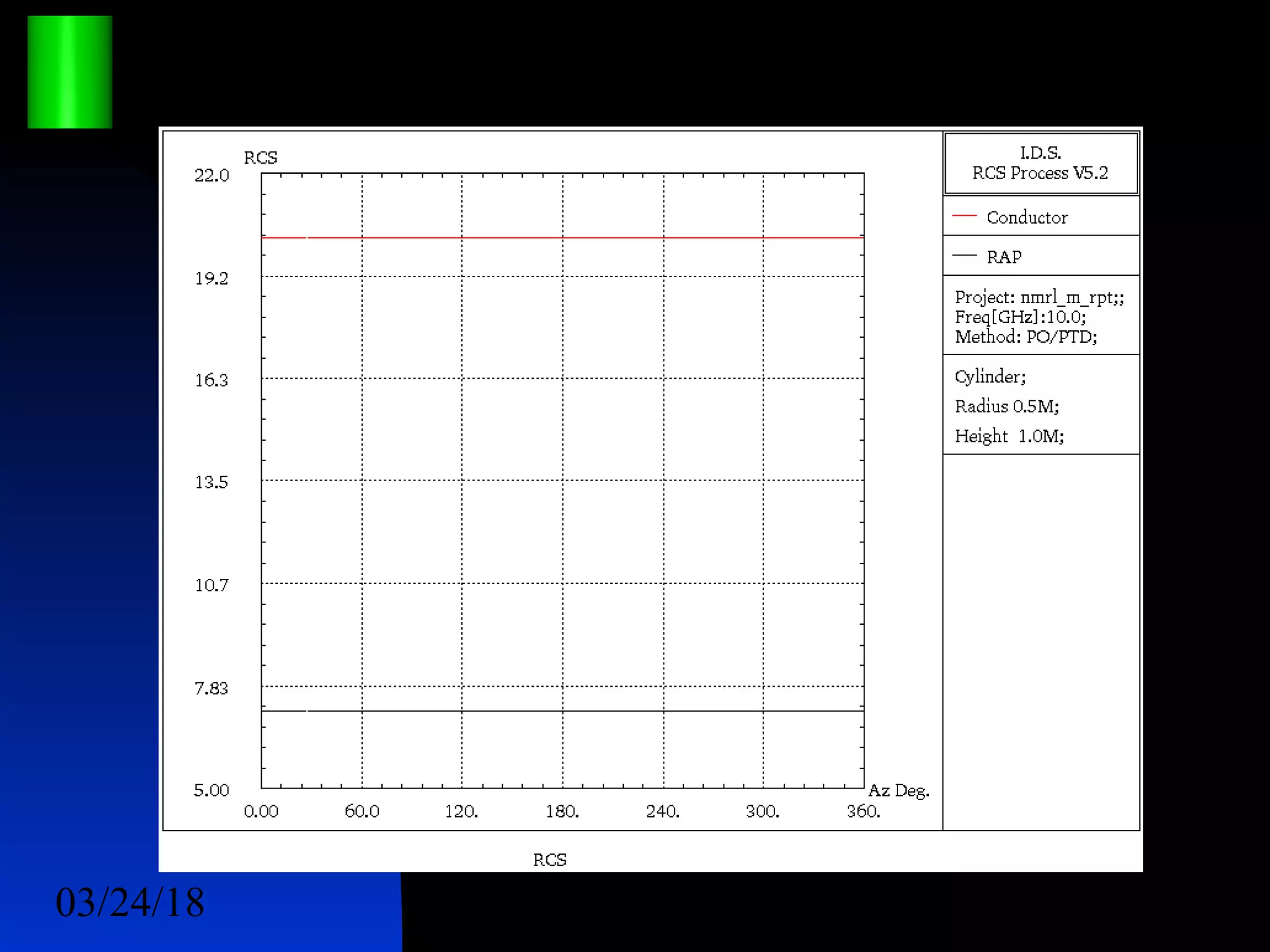
RCS OF FEW TARGETS AT 10G Hz
03/24/18 33
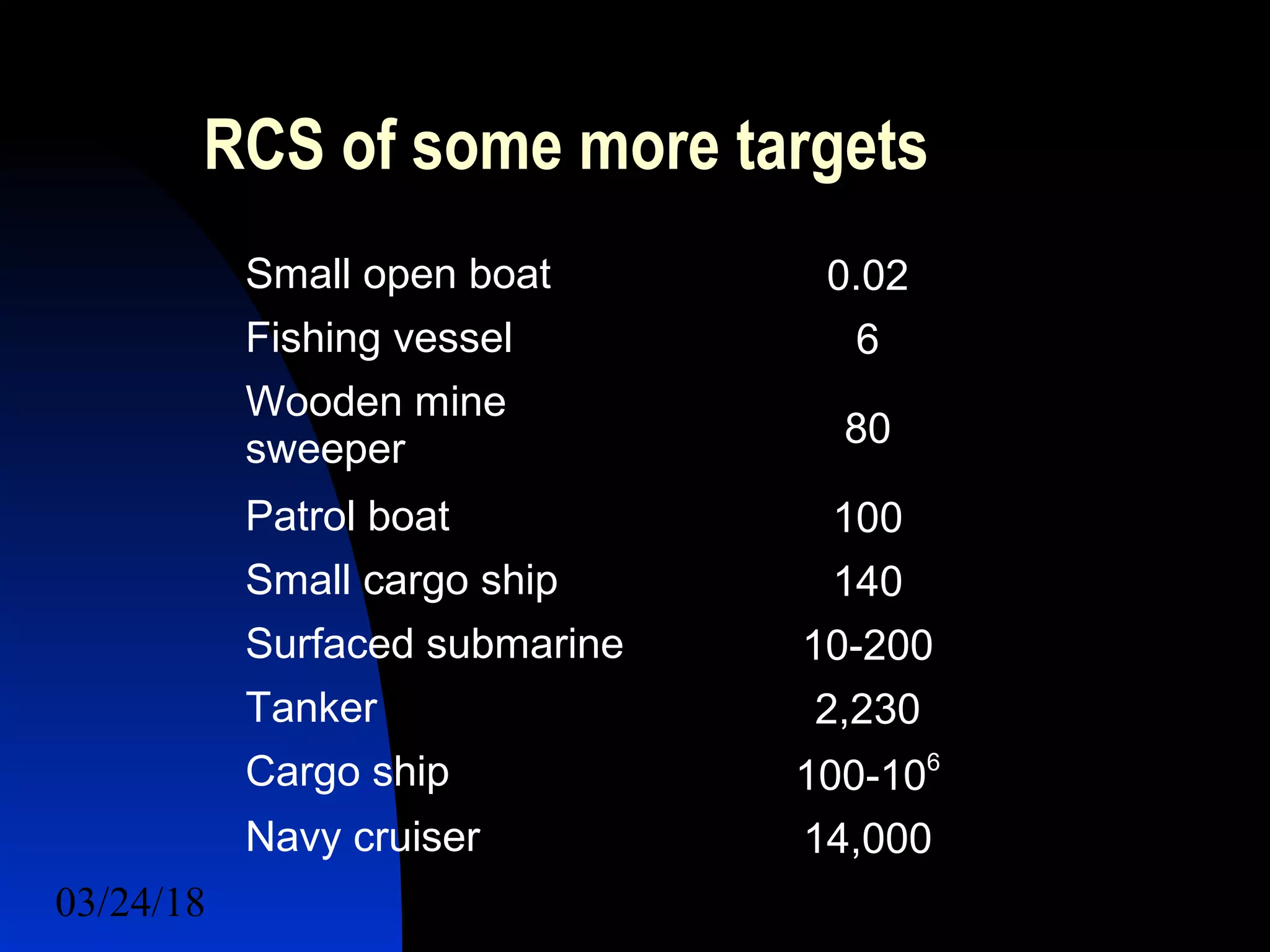
RCS of some more targets
Small open boat 0.02
Fishing vessel 6
Wooden mine
sweeper 80
Patrol boat 100
Small cargo ship 140
Surfaced submarine 10-200
Tanker 2,230
Cargo ship 100-106
Navy cruiser 14,000
03/24/18 34
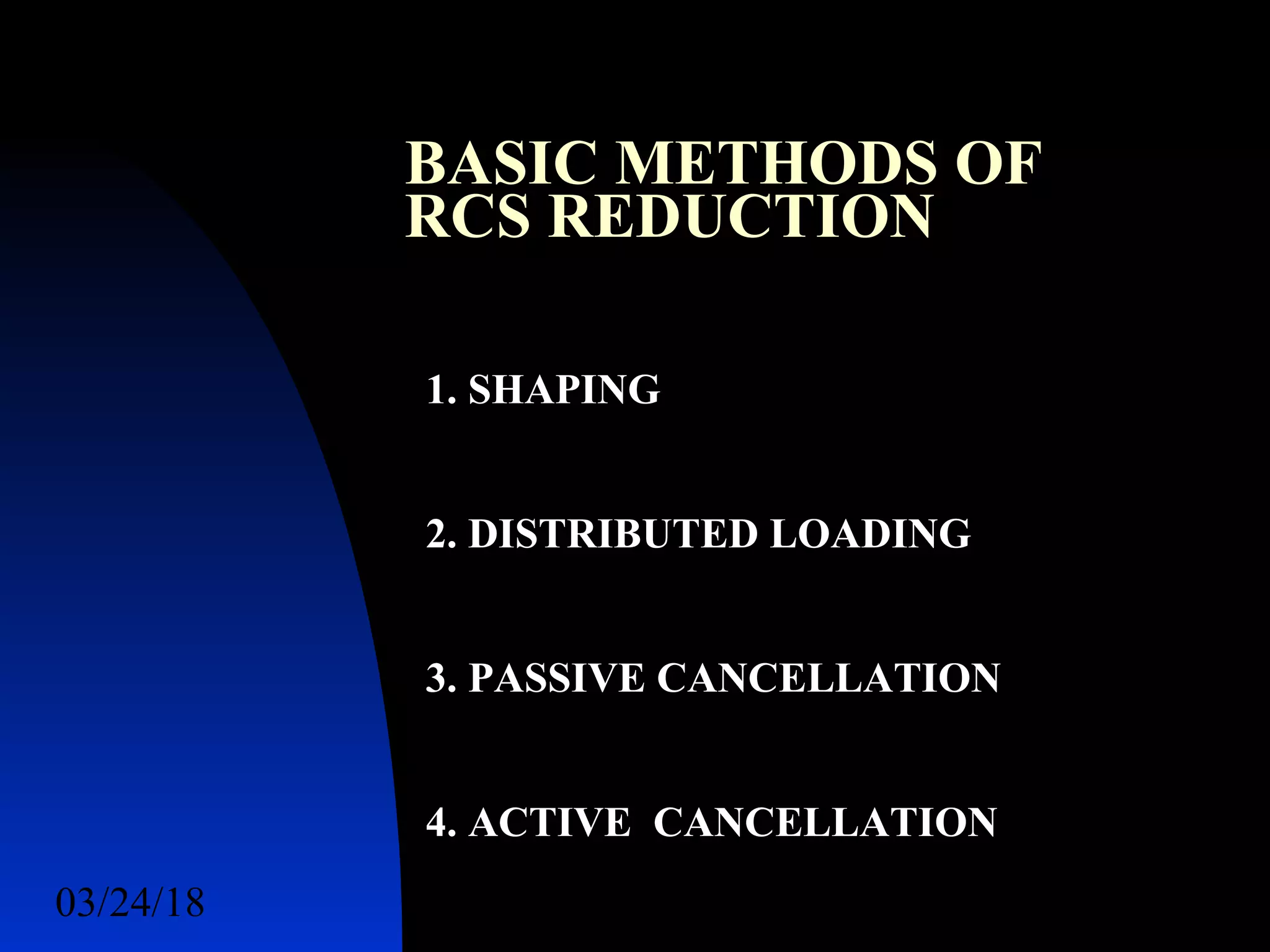
BASIC METHODS OF
RCS REDUCTION
1. SHAPING
2. DISTRIBUTED LOADING
3. PASSIVE CANCELLATION
4. ACTIVE CANCELLATION
03/24/18 35
SHAPING
THE OBJECTIVE OF SHAPING IS TO
ORIENT THE TARGET’S
SURFACES AND EDGES TO
DEFLECT THE SCATTERED
ENERGY IN THE DIRECTION
AWAY FROM THE RADAR.
03/24/18 36
RADAR ABSORBING
MATERIALS (RAM)
RAM REDUCE THE ENERGY
REFLECTED BACK TO THE RADAR
BY MEANS OF ABSORPTION AND
REDIRECTION OF EM ENERGY.
03/24/18 37
PASSIVE
CANCELLATION
RESISTIVE SHEETS ARE PLACED
OVER SCATTERING CENTERS TO
MODIFY THE SURFACE
IMPEDENCE IN ORDER TO
CANCEL THE REFLECTIONS
03/24/18 38
ACTIVE
CANCELLATION
ACTIVE DEVICES ARE
EMPLOYED TO SENSE THE
INCIDENT RADAR WAVE AND
SEND OUT SIGNALS TO CANCEL
THE ECHOS FROM THESE
POINTS.
03/24/18 39
APPLICATIONS OF SHAPING
03/24/18 40
03/24/18 41
APPLICATIONS OF
RADAR
ABSORBING PAINT
03/24/18 42
03/24/18 43
03/24/18 44
03/24/18 45
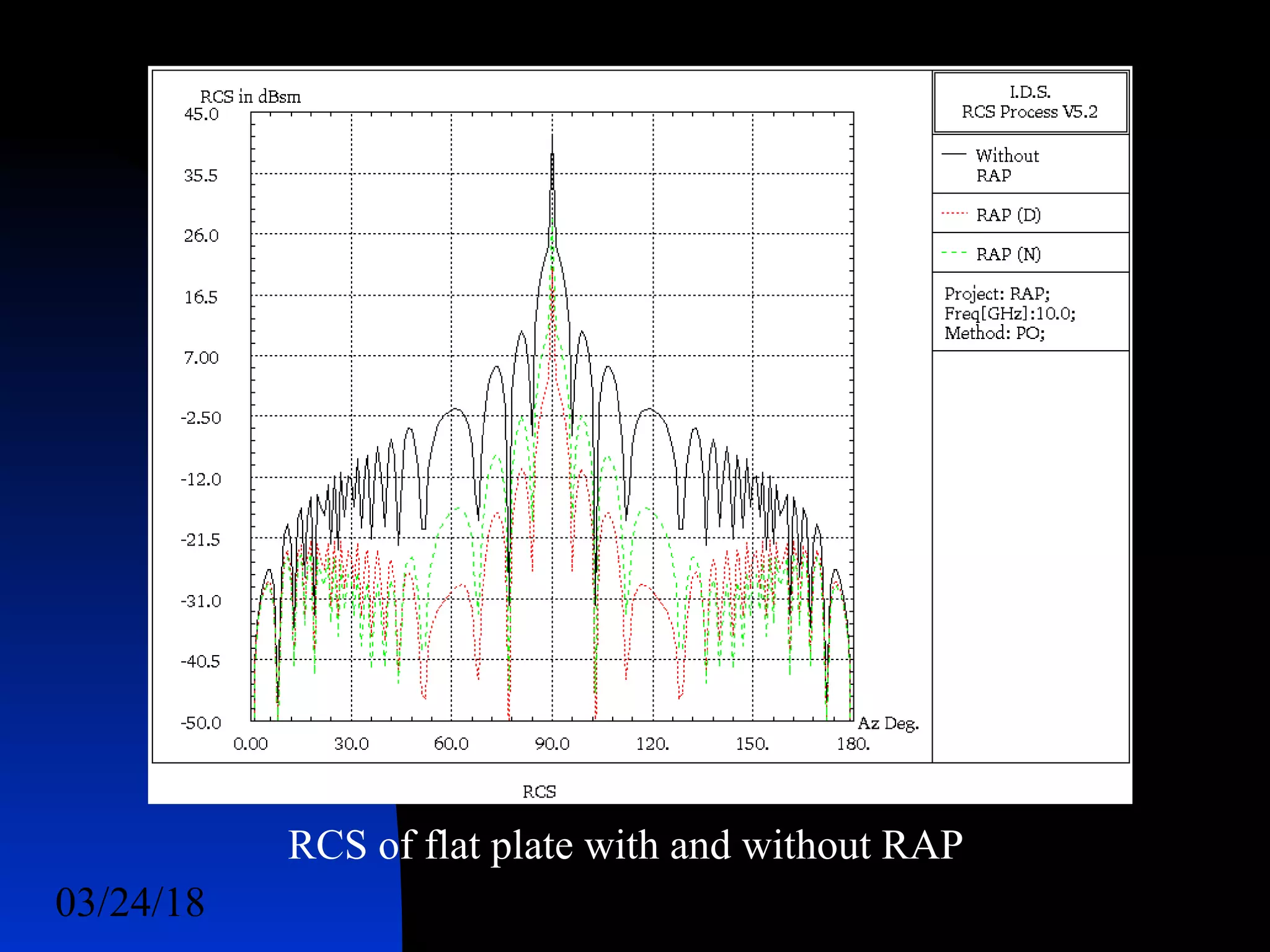
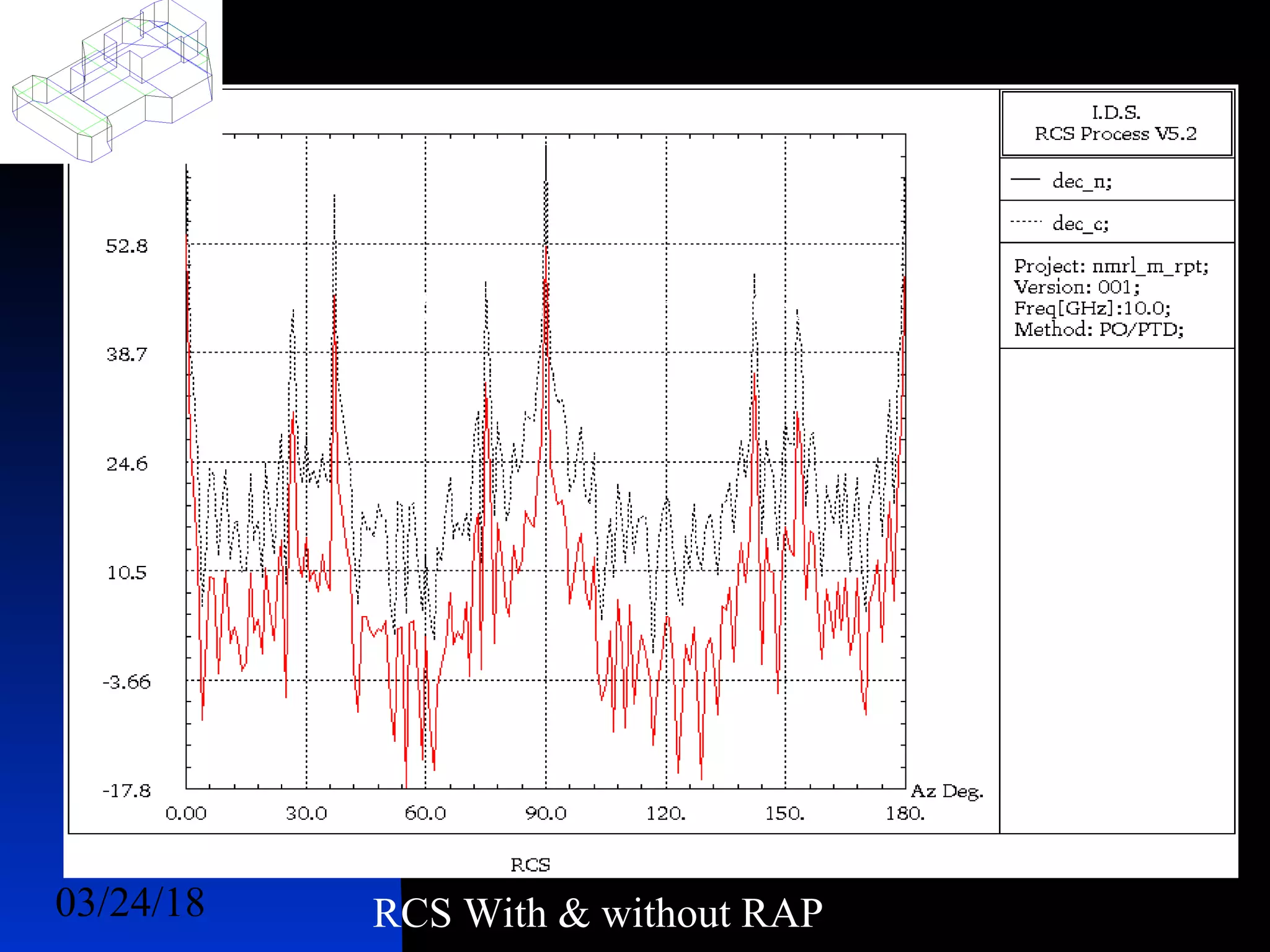
RCS of flat plate with and without RAP
03/24/18 46
RCS With & without RAP
03/24/18 47
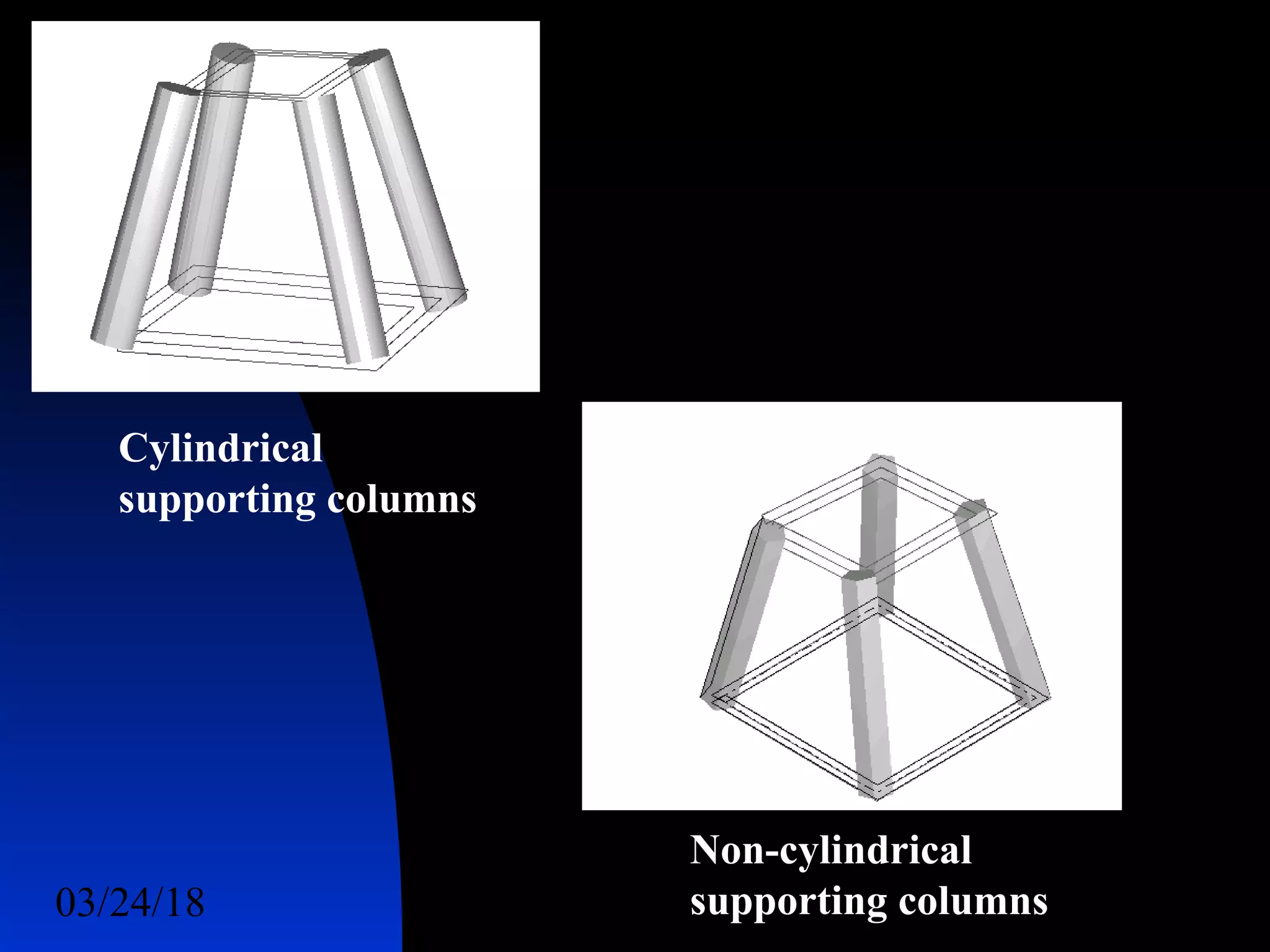
Cylindrical
supporting columns
Non-cylindrical
supporting columns
03/24/18 48
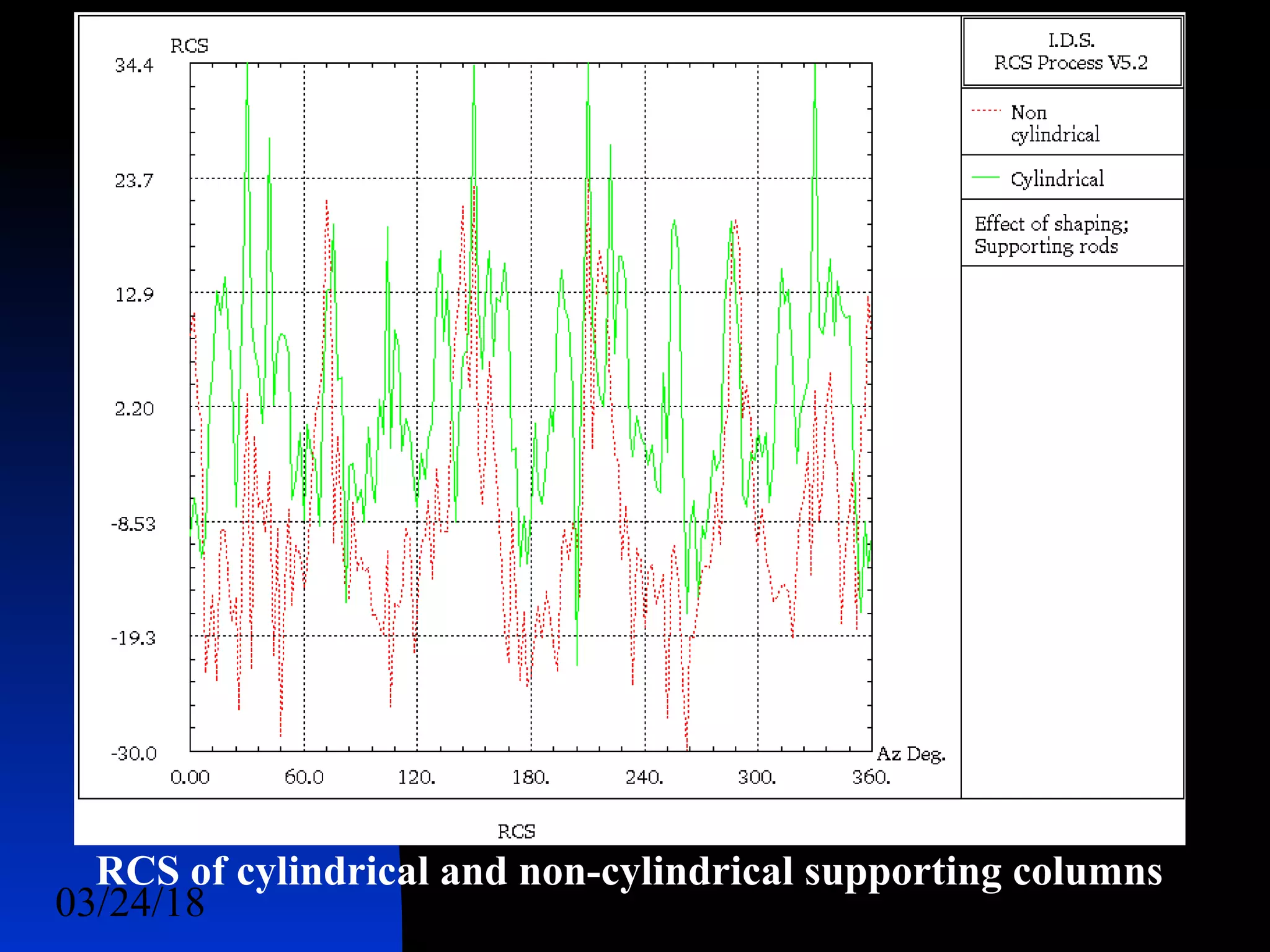
RCS of cylindrical and non-cylindrical supporting columns
03/24/18 49
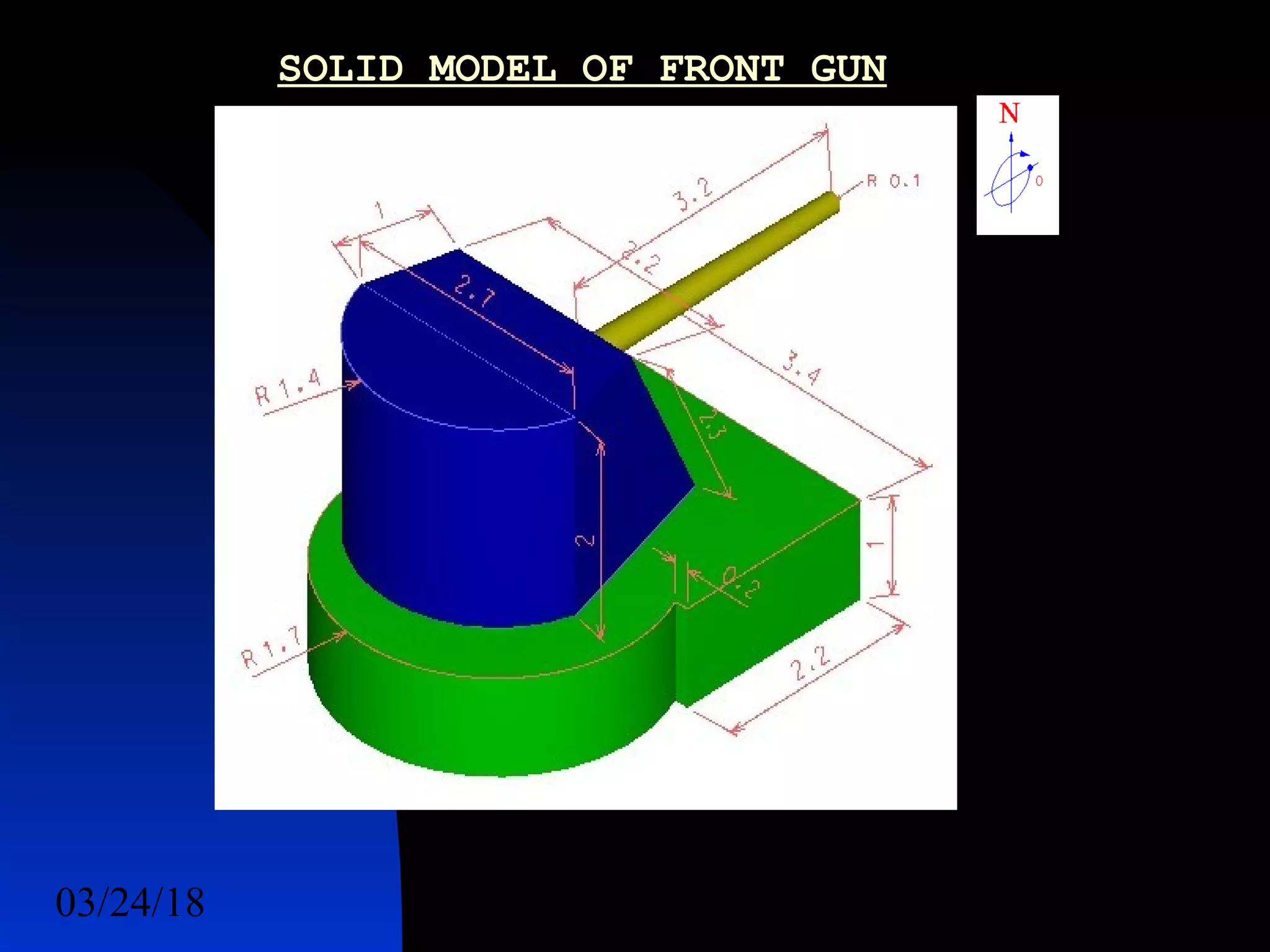
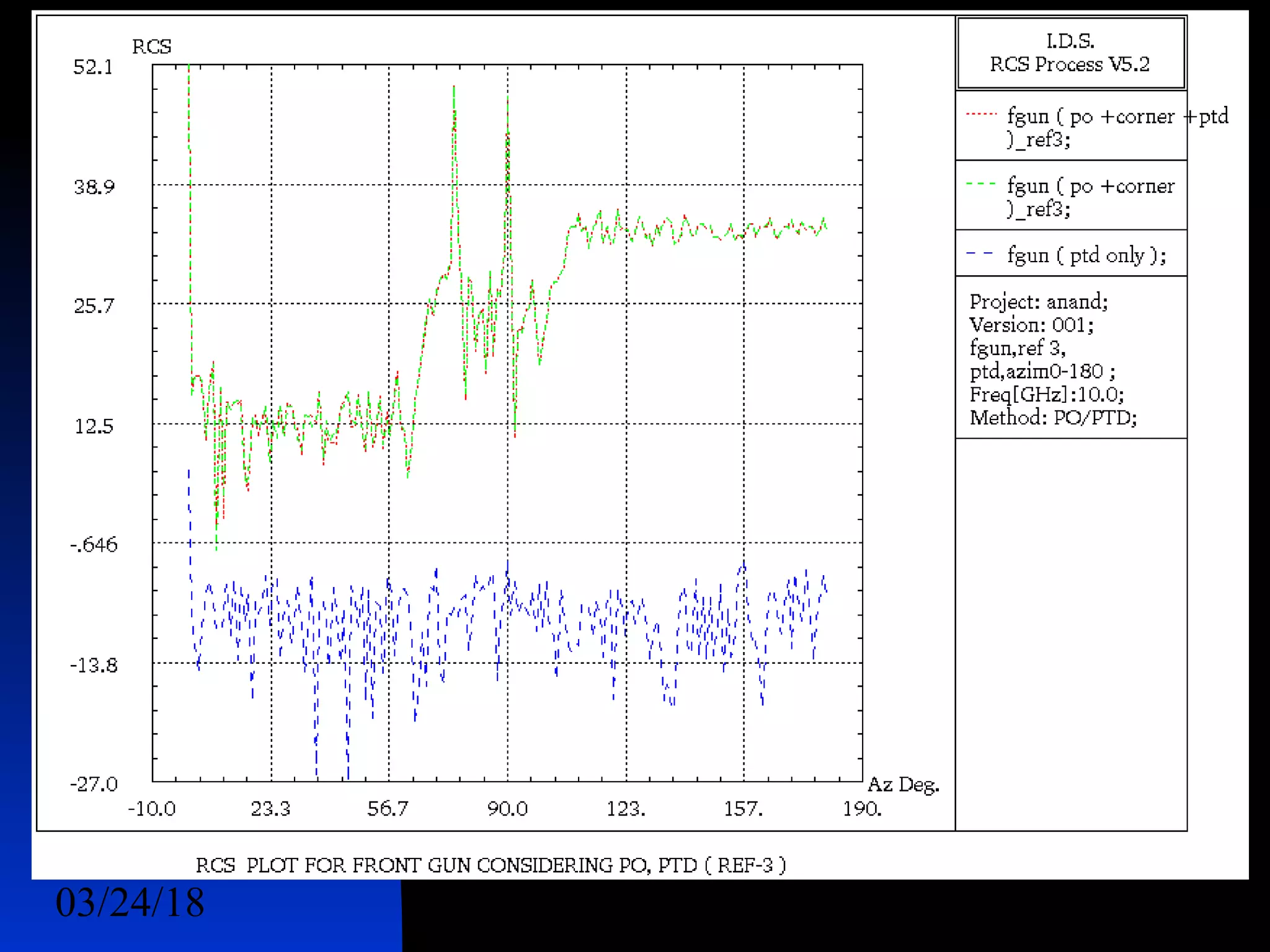
SOLID MODEL OF FRONT GUN
03/24/18 50
03/24/18 51
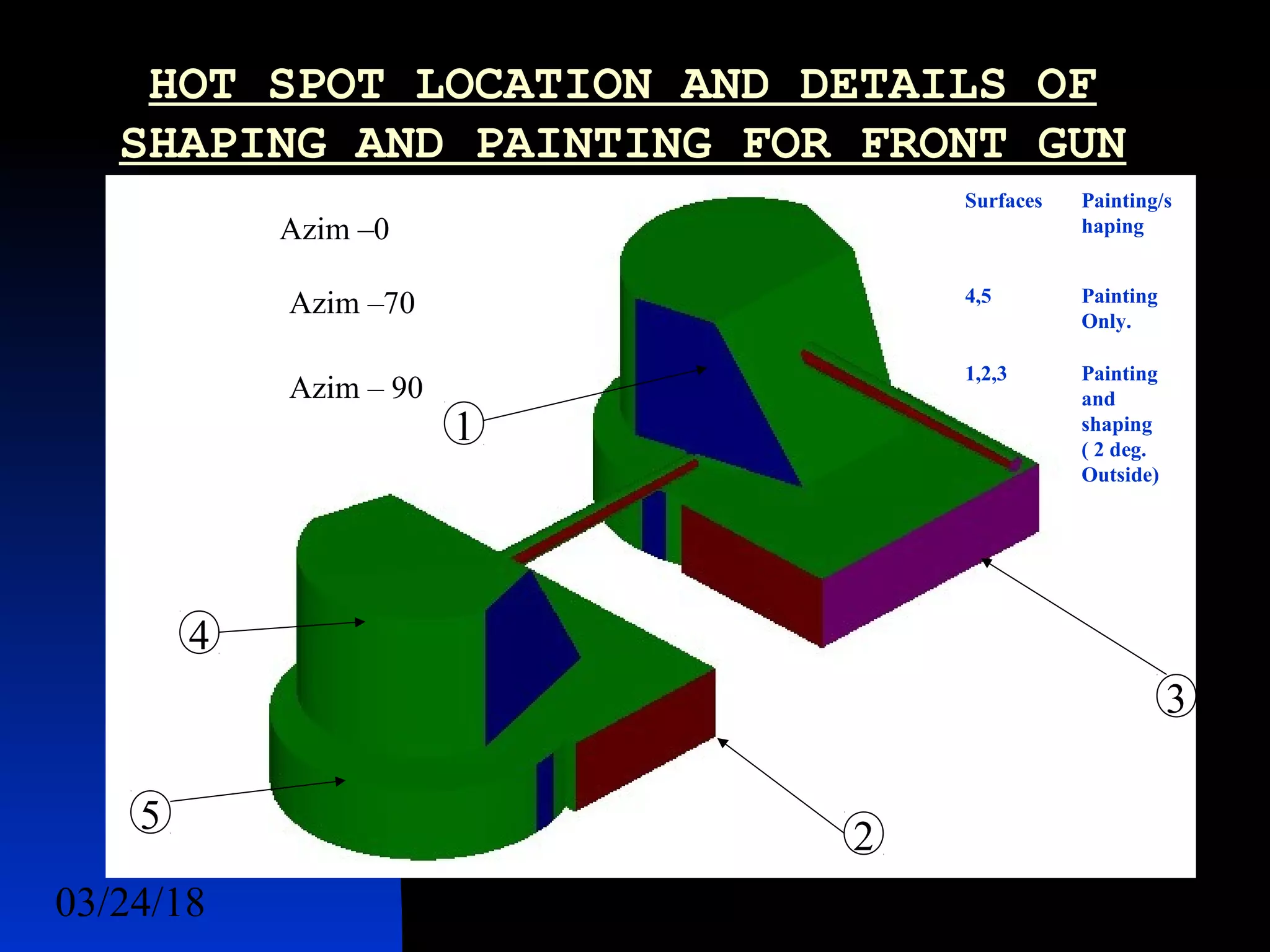
HOT SPOT LOCATION AND DETAILS OF
SHAPING AND PAINTING FOR FRONT GUN
Azim –0
Azim –70
Azim – 90
2
3
1
4
5
Painting
and
shaping
( 2 deg.
Outside)
1,2,3
Painting
Only.
4,5
Painting/s
haping
Surfaces
03/24/18 52
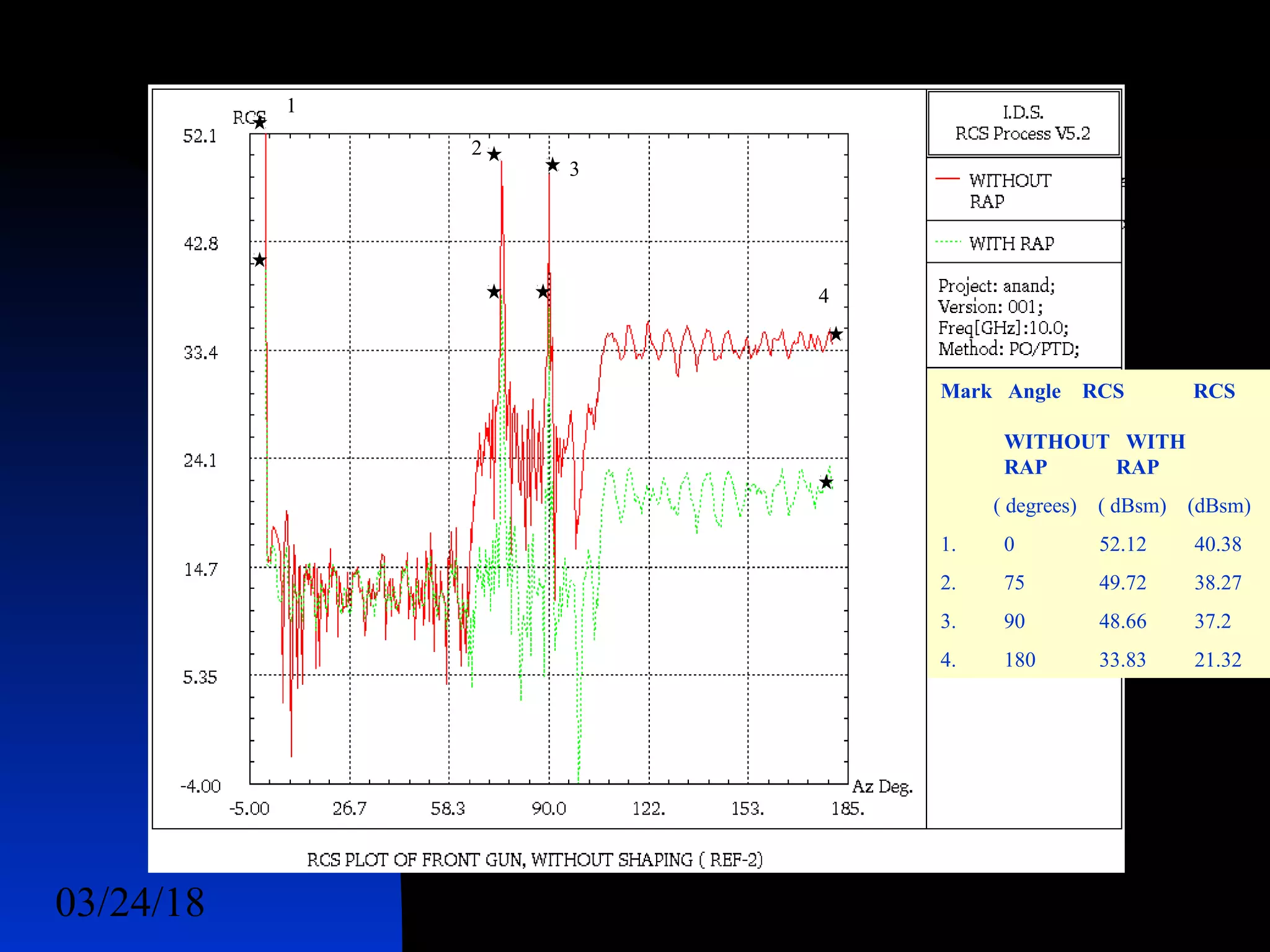
Mark Angle RCS RCS
WITHOUT WITH
RAP RAP
( degrees) ( dBsm) (dBsm)
1. 0 52.12 40.38
2. 75 49.72 38.27
3. 90 48.66 37.2
4. 180 33.83 21.32
2
3
4
1
03/24/18 53
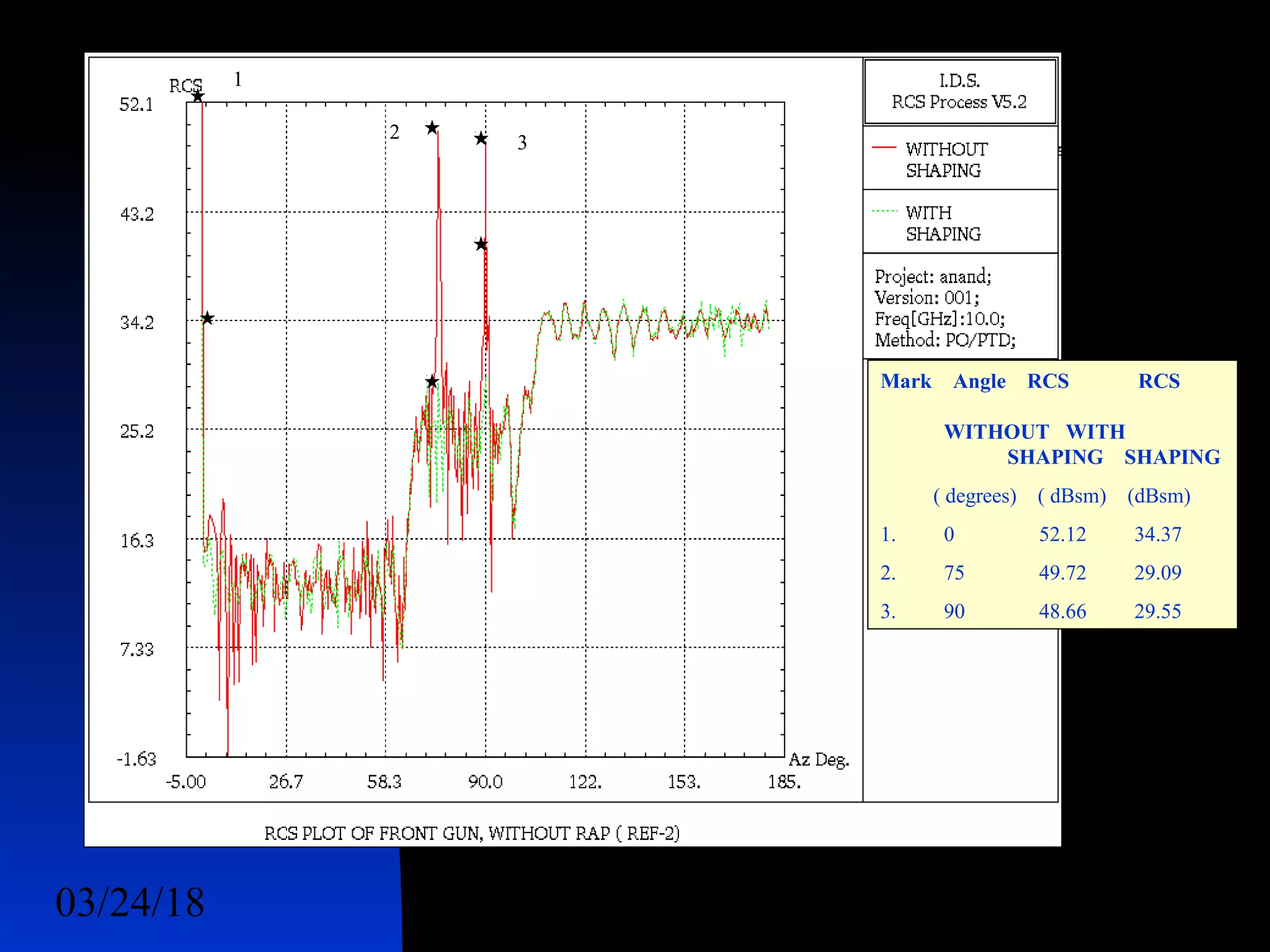
Mark Angle RCS RCS
WITHOUT WITH
SHAPING SHAPING
( degrees) ( dBsm) (dBsm)
1. 0 52.12 34.37
2. 75 49.72 29.09
3. 90 48.66 29.55
1
2
3
03/24/18 54
03/24/18 55
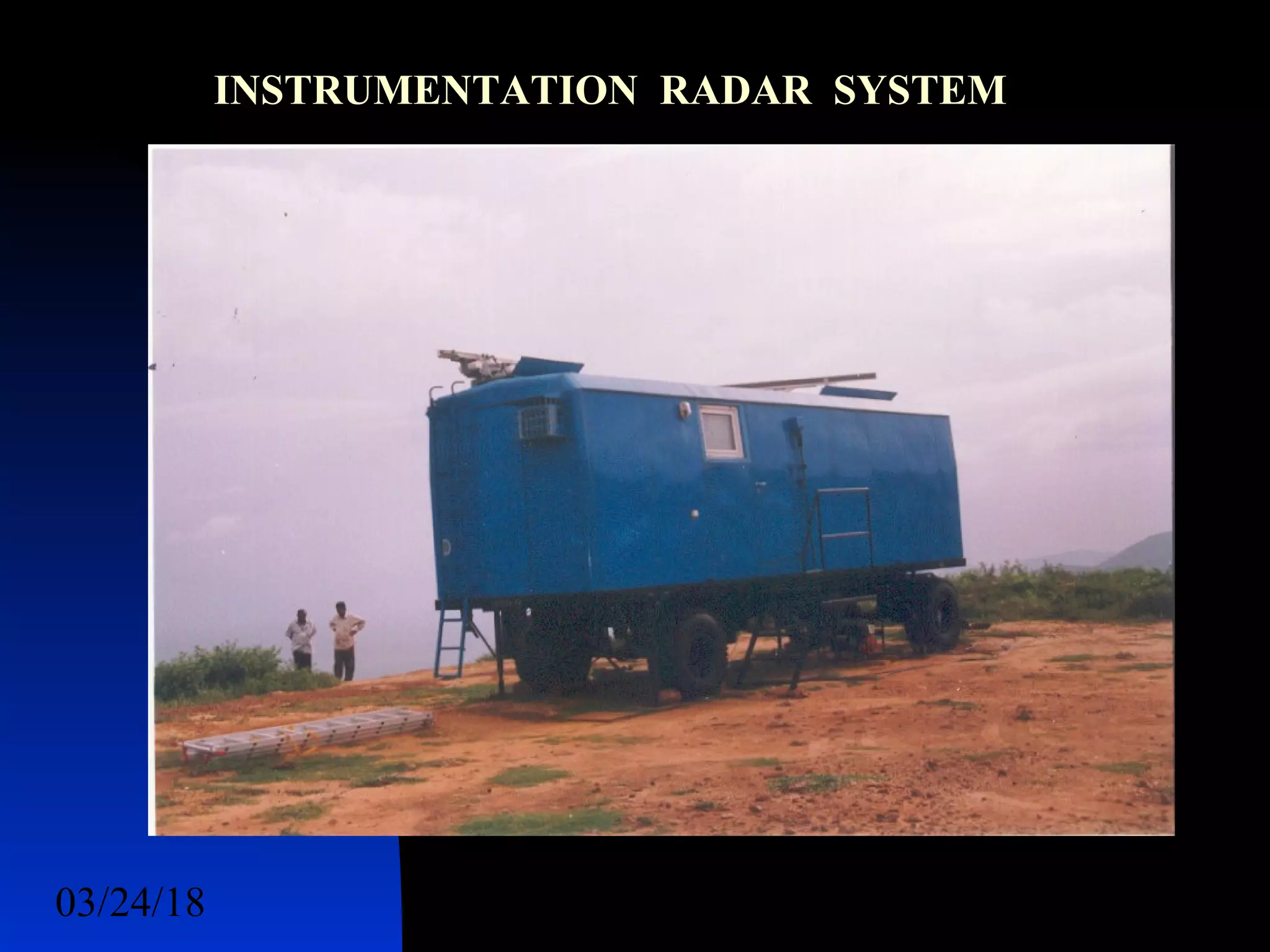
INSTRUMENTATION RADAR SYSTEM
03/24/18 56
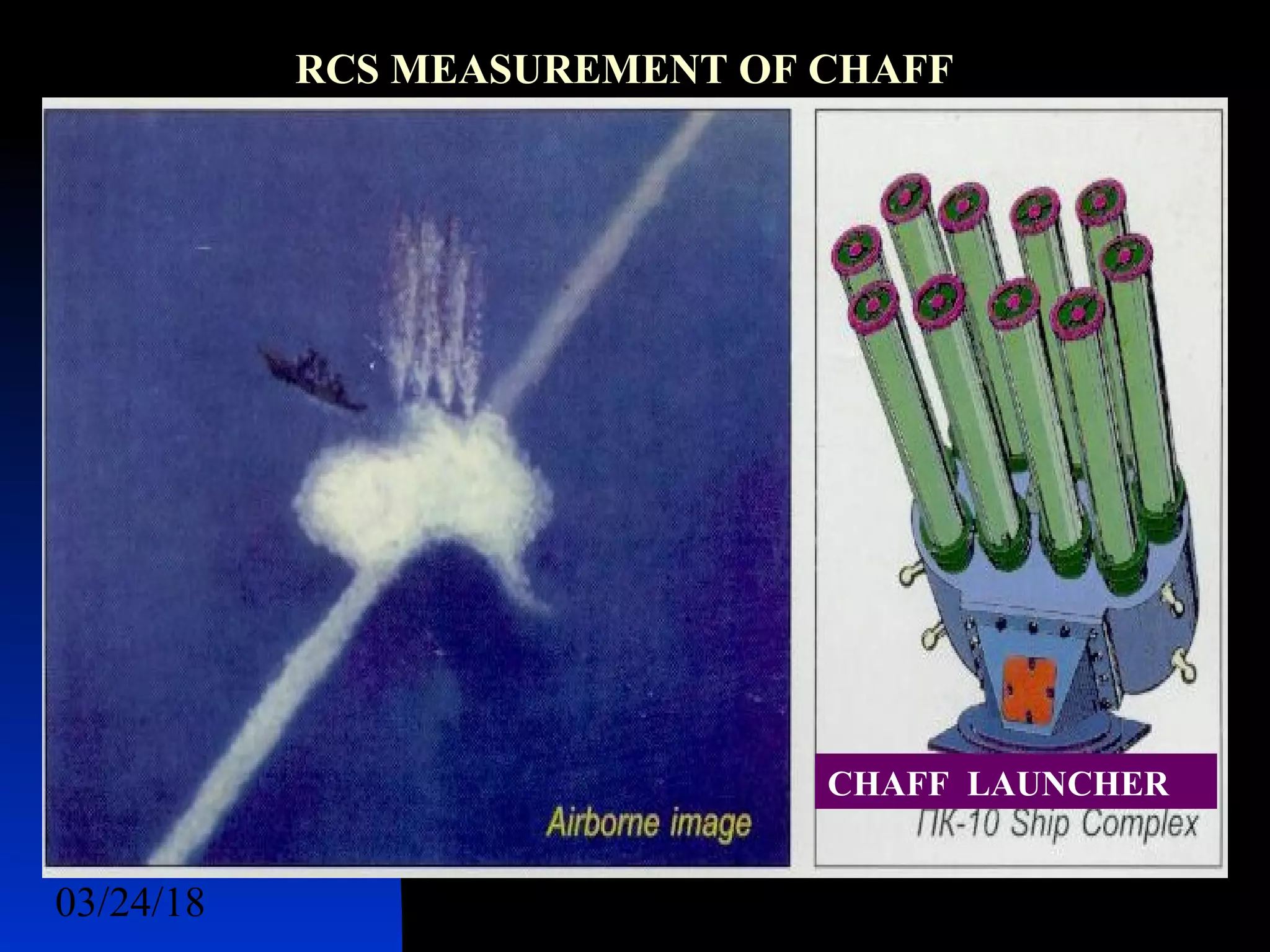
CHAFF LAUNCHER
RCS MEASUREMENT OF CHAFF
03/24/18 57
Few stealth ships
03/24/18 58
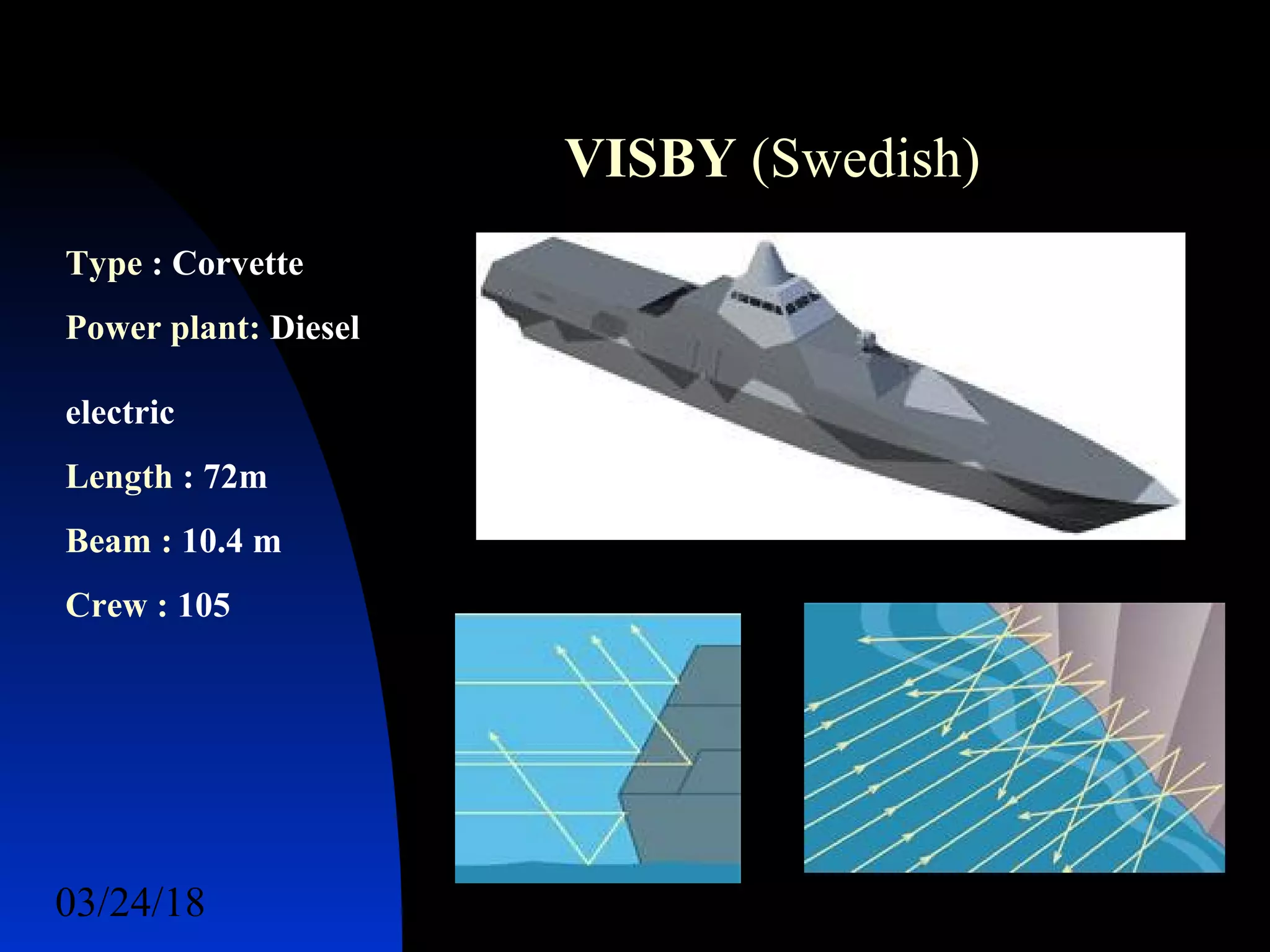
VISBY (Swedish)
Type : Corvette
Power plant: Diesel
electric
Length : 72m
Beam : 10.4 m
Crew : 105
03/24/18 59
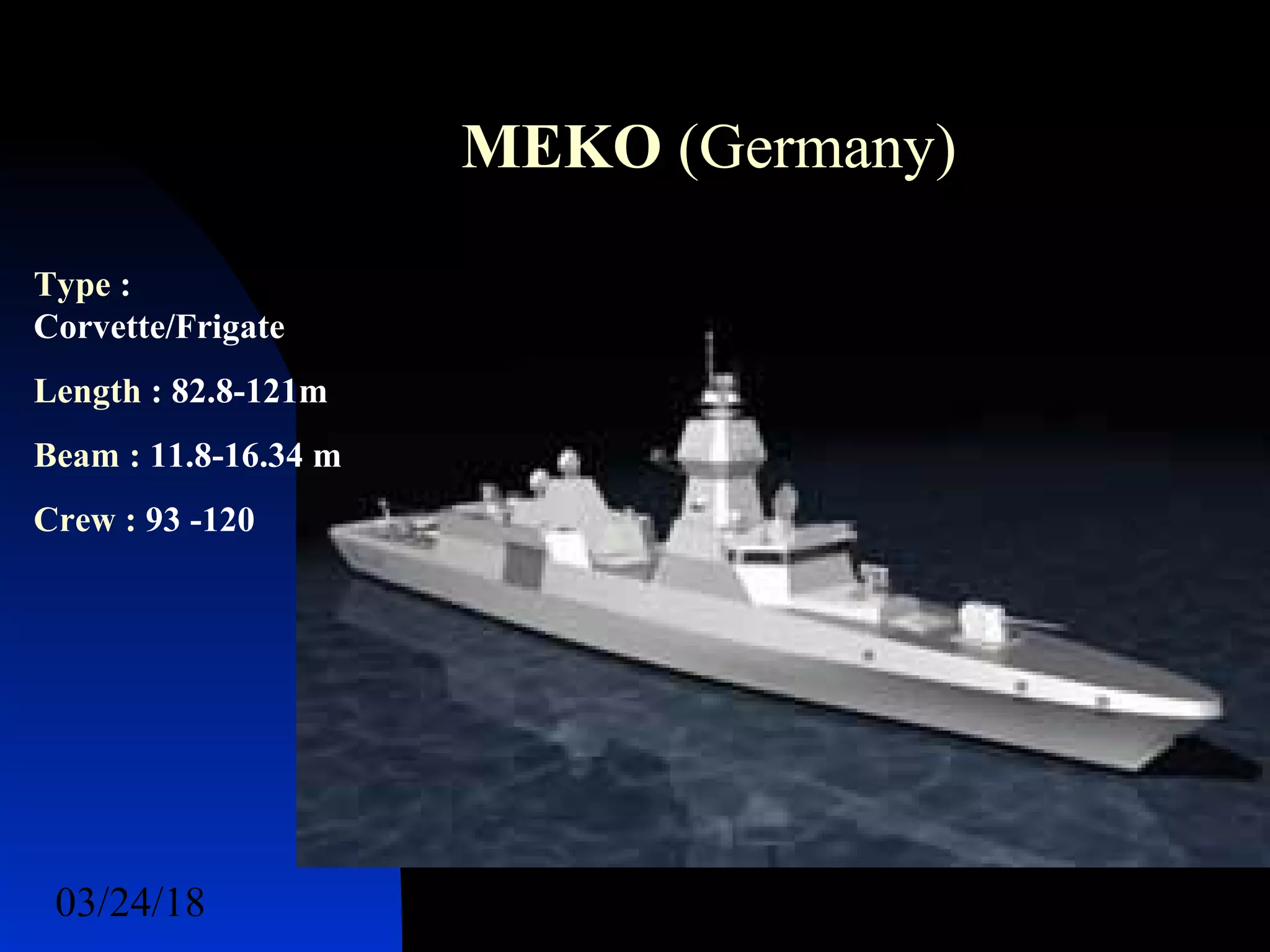
MEKO (Germany)
Type :
Corvette/Frigate
Length : 82.8-121m
Beam : 11.8-16.34 m
Crew : 93 -120
03/24/18 60
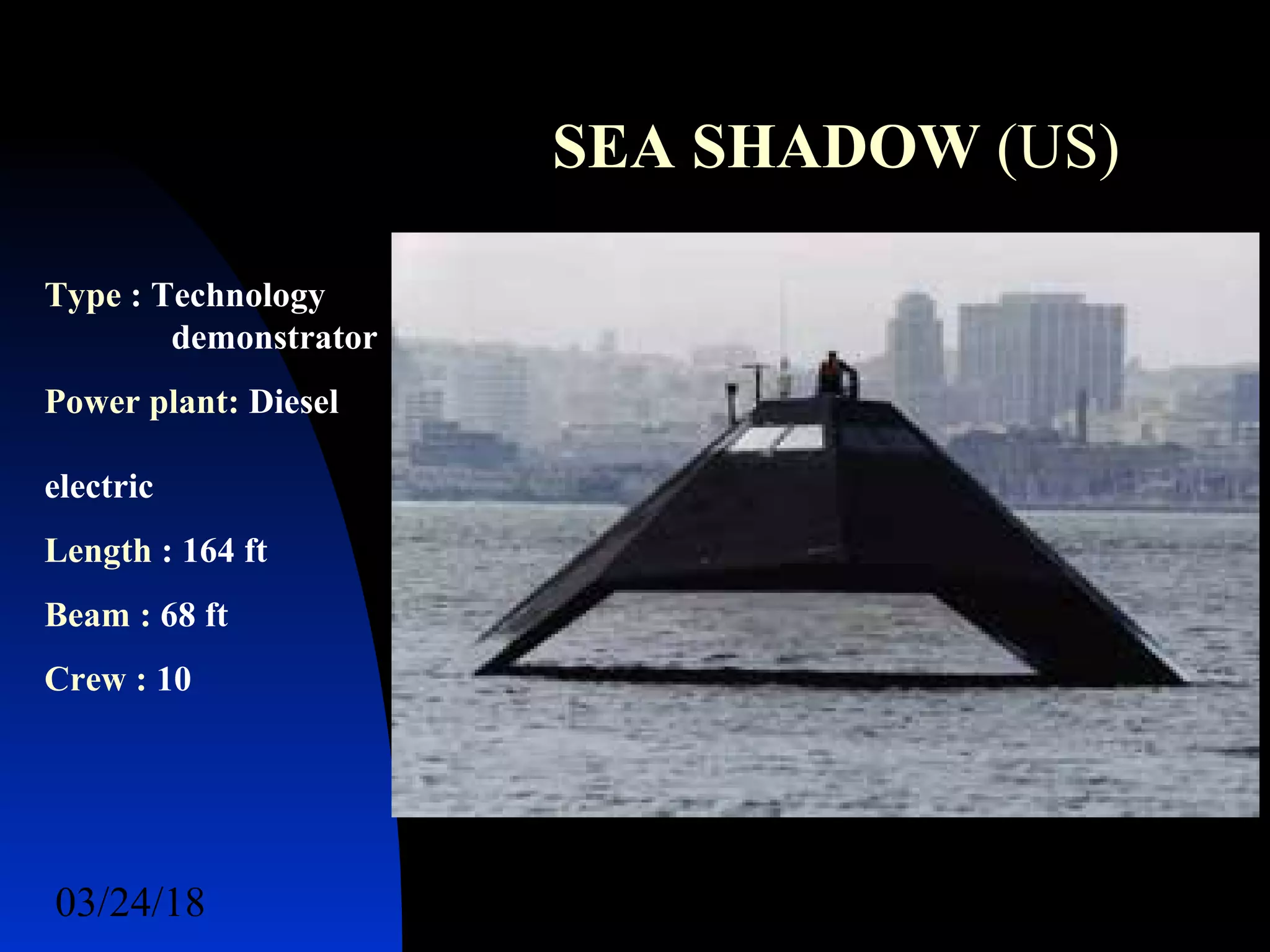
SEA SHADOW (US)
Type : Technology
demonstrator
Power plant: Diesel
electric
Length : 164 ft
Beam : 68 ft
Crew : 10
03/24/18 61
SMYGE (Swedish)
Type : Test platform
Power plant: Diesel
electric water jets
03/24/18 62
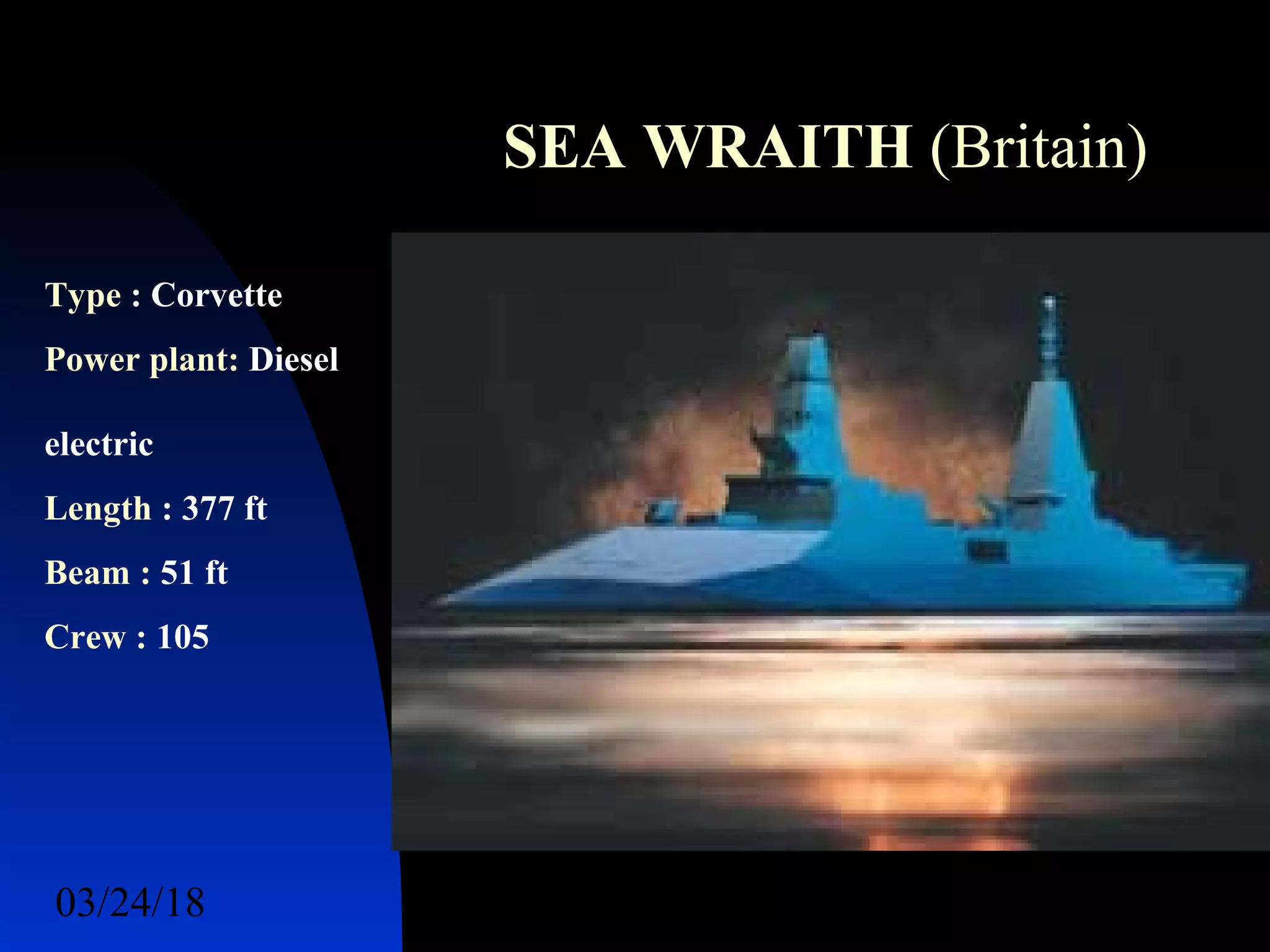
SEA WRAITH (Britain)
Type : Corvette
Power plant: Diesel
electric
Length : 377 ft
Beam : 51 ft
Crew : 105
03/24/18 63
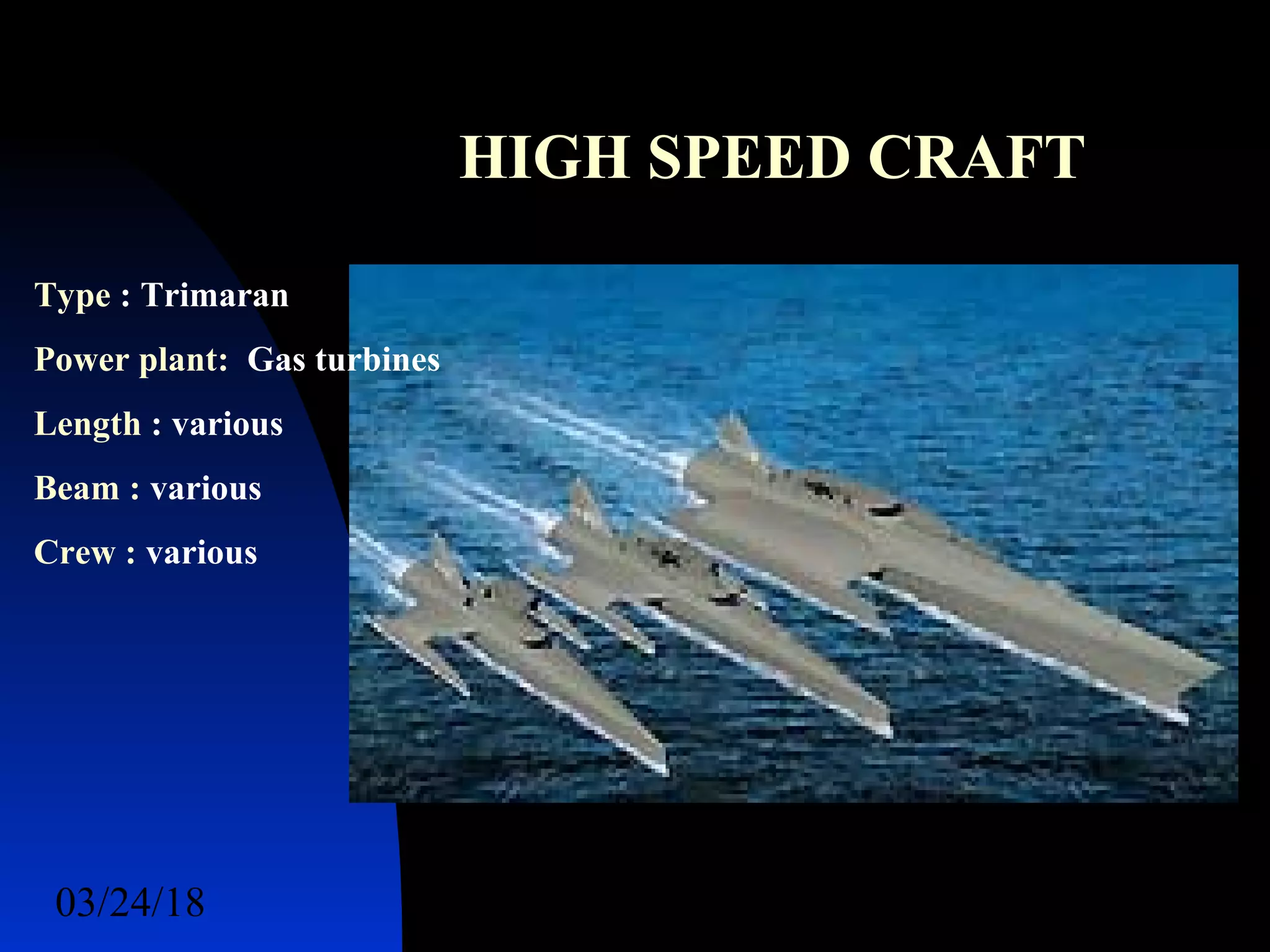
HIGH SPEED CRAFT
Type : Trimaran
Power plant: Gas turbines
Length : various
Beam : various
Crew : various
03/24/18 64
CLICK FORMAGNETIC STEALTH

Radar Cross Section

  • 1.
  • 2.
    03/24/18 2 NAVAL STEALTH ATECHNOLOGY FOR REDUCING SIGNATURES SUCH AS RCS, MAGNETIC, ELFE, ACOUSTICS , IR ETC. THEREBY REDUCING VULNERABILITY OF DETECTION BY ENEMY
  • 3.
    03/24/18 3 FREQUENCY BANDDESIGNATION TYPICAL SERVICE 3-30k Hz Very low frequency(VLF) Navigation, sonar 30-300k Hz Low frequency (LF) Radio beacons , navigational aids 300-3,000k Hz Medium frequency (MF) AM broadcasting, maritime radio,coast guard communication 3-30M Hz High frequency (HF) Telephone, telegraph & facsimile; SW broadcasting, ship-to-coast & ship-to-aircraft communication 30-300M Hz Very high frequency (VHF) TV,FM broadcast,air traffic control,police taxicab mobile radio, navigational aids 300-3,000M Hz Ultra high frequency (UHF) Television satellite communication, surveillance radar, navigational aids 3-30G Hz Super high frequency (SHF) Airborne radar, microwave links, mobile communication, satellite communication 30-300G Hz Extreme high frequency (EHF) Radar, experimental INTERNATIONALLY ACCEPTED Frequency band designation
  • 4.
    03/24/18 4 FREQUENCY OLDNEW 500-1,000 M Hz VHF C 1- 2 GHz L D 2- 3 G Hz S E 3- 4 G Hz S F 4- 6 G Hz C G 6- 8 G Hz C H 8-10 G Hz X I 10-12.4 G Hz X J 12.4-18 G Hz Ku J 18- 20 G Hz K J 20- 26.5 G Hz K K 26.5- 40 G Hz Ka K MICROWAVE FREQUENCY BAND DESIGNATION INDUSTRY STANDARDS
  • 5.
  • 6.
    03/24/18 6 Illustration ofRadar Operation X range / time ground range height cross-section of fan beam main lobe elevation azimuth xmit pulse xmit pulse xmit pulse target echoes target echoes pulse repetition interval (pri) Antenna Beam Pattern Sidelobes Main Lobe Targets slant range Radar Location
  • 7.
    03/24/18 7 RADAR BLOCKDIAGRAM Receiver Detector Signal Processor Data Processor Display T / R Scanner Transmitter RF Source
  • 8.
    03/24/18 8 300 MHz30MHz 1 GHz 2 GHz 4 GHz 8 GHz 12GHz 16 GHz 40 GHz Early warning Radar Long Rang Surveillance Acquisition Radar Multifunction Radar Weapon Locating Radar Short Range Surveillance Tracking Radar Radar Function Frequency RADAR FUNCTIONS ACROSS FREQUENCY SPECTRUM
  • 9.
    03/24/18 9 RADAR CROSSSECTION  RCS is a measure of power scattered in a given direction when a target is illuminated by a incident wave. The received power is normalized with the incident power with the incident power at the target so that RCS does not depend on the distance between the target and the illuminating source.
  • 10.
  • 11.
  • 12.
  • 13.
    03/24/18 13 RCS isfunction of  Frequency or wavelength  Target geometry  Material composition  Aspect angle
  • 14.
    03/24/18 14 RCS tobe reduced for  To make the ships less vulnerable for enemy radar detection  To increase the effectiveness of chaff  To make classification of our ship difficult for enemy
  • 15.
    03/24/18 15 RADAR CROSSSECTION  PREDICTION RCSPT (Radar Cross Section Prediction Tool)  REDUCTION TECHNIQUES Shaping. Using RAM, RAP  MEASUREMENT Using Radar
  • 16.
    03/24/18 16 RCS s/wprediction methods Low frequency methods  Method of Moments (MoM)  Finite Difference Time Domain (FDTD) High frequency methods  Geometrical Optics (GO)  Physical Optics (PO)  Physical Theory of Diffraction (PTD)  Shooting and Bouncing Ray method (SBR)
  • 17.
    03/24/18 17 Low frequencymethods For electrically small scatterers i.e., objects of order 1λ to 10λ Less accurate results High frequency methods For electrically large scatterers i.e., objects of order >10 λ For more accurate results
  • 18.
  • 19.
    03/24/18 19 Method ofMoment  Versatile & powerful  Can be applied to linear,planar & 3D problems Eg: Metallic cylinder
  • 20.
    03/24/18 20 Finite DifferenceTime Domain method  Finite difference format is based on 1D Taylor series expansion  Permits spatial variation of intrinsic parameters of media  Employs rectangular co-ordinate system Eg: Metallic cylinder, Metallic plate
  • 21.
  • 22.
    03/24/18 22 Geometrical Optics(GO) Assumptions  Frequency is infinite.(λ →0)  Field behavior is local  Wave front is always a plane wave  Specular reflection Disadvantages  Breaks down at edges  Fails to predict away from specular reflection Eg: Surfaces with planar shapes
  • 23.
    03/24/18 23 Physical Optics(PO) Based on Huygen’s principle.  Assumes scatterer to be electrically large.  E po = E direct +E induced Eg: Planar surfaces Cubes shadowed by extended flat plate
  • 24.
    03/24/18 24 Physical Theoryof diffraction(PTD)  Proposed by Ufimstev  Assumed that PO induced current is a part pf total current.  Current induced in the edges are considered.  J PTD = J PO + J edge Eg: Flat plate Edges
  • 25.
    03/24/18 25 Shooting andBouncing Ray(SBR) method  Can treat cavities of arbitrary cross section and material loading  Low computational requirement Eg: Gun barrels
  • 26.
  • 27.
  • 28.
    03/24/18 28 Image plotat azimuth 0° Image Plot at azimuth 90°
  • 29.
    03/24/18 29 CAD MODELOF HULL AND DECKS
  • 30.
  • 31.
  • 32.
    03/24/18 32 RCS OFFEW TARGETS AT 10G Hz
  • 33.
    03/24/18 33 RCS ofsome more targets Small open boat 0.02 Fishing vessel 6 Wooden mine sweeper 80 Patrol boat 100 Small cargo ship 140 Surfaced submarine 10-200 Tanker 2,230 Cargo ship 100-106 Navy cruiser 14,000
  • 34.
    03/24/18 34 BASIC METHODSOF RCS REDUCTION 1. SHAPING 2. DISTRIBUTED LOADING 3. PASSIVE CANCELLATION 4. ACTIVE CANCELLATION
  • 35.
    03/24/18 35 SHAPING THE OBJECTIVEOF SHAPING IS TO ORIENT THE TARGET’S SURFACES AND EDGES TO DEFLECT THE SCATTERED ENERGY IN THE DIRECTION AWAY FROM THE RADAR.
  • 36.
    03/24/18 36 RADAR ABSORBING MATERIALS(RAM) RAM REDUCE THE ENERGY REFLECTED BACK TO THE RADAR BY MEANS OF ABSORPTION AND REDIRECTION OF EM ENERGY.
  • 37.
    03/24/18 37 PASSIVE CANCELLATION RESISTIVE SHEETSARE PLACED OVER SCATTERING CENTERS TO MODIFY THE SURFACE IMPEDENCE IN ORDER TO CANCEL THE REFLECTIONS
  • 38.
    03/24/18 38 ACTIVE CANCELLATION ACTIVE DEVICESARE EMPLOYED TO SENSE THE INCIDENT RADAR WAVE AND SEND OUT SIGNALS TO CANCEL THE ECHOS FROM THESE POINTS.
  • 39.
  • 40.
  • 41.
  • 42.
  • 43.
  • 44.
  • 45.
    03/24/18 45 RCS offlat plate with and without RAP
  • 46.
    03/24/18 46 RCS With& without RAP RCS With & without RAP
  • 47.
  • 48.
    03/24/18 48 RCS ofcylindrical and non-cylindrical supporting columns
  • 49.
  • 50.
  • 51.
    03/24/18 51 HOT SPOTLOCATION AND DETAILS OF SHAPING AND PAINTING FOR FRONT GUN Azim –0 Azim –70 Azim – 90 2 3 1 4 5 Painting and shaping ( 2 deg. Outside) 1,2,3 Painting Only. 4,5 Painting/s haping Surfaces
  • 52.
    03/24/18 52 Mark AngleRCS RCS WITHOUT WITH RAP RAP ( degrees) ( dBsm) (dBsm) 1. 0 52.12 40.38 2. 75 49.72 38.27 3. 90 48.66 37.2 4. 180 33.83 21.32 2 3 4 1
  • 53.
    03/24/18 53 Mark AngleRCS RCS WITHOUT WITH SHAPING SHAPING ( degrees) ( dBsm) (dBsm) 1. 0 52.12 34.37 2. 75 49.72 29.09 3. 90 48.66 29.55 1 2 3
  • 54.
  • 55.
  • 56.
    03/24/18 56 CHAFF LAUNCHER RCSMEASUREMENT OF CHAFF
  • 57.
  • 58.
    03/24/18 58 VISBY (Swedish) Type: Corvette Power plant: Diesel electric Length : 72m Beam : 10.4 m Crew : 105
  • 59.
    03/24/18 59 MEKO (Germany) Type: Corvette/Frigate Length : 82.8-121m Beam : 11.8-16.34 m Crew : 93 -120
  • 60.
    03/24/18 60 SEA SHADOW(US) Type : Technology demonstrator Power plant: Diesel electric Length : 164 ft Beam : 68 ft Crew : 10
  • 61.
    03/24/18 61 SMYGE (Swedish) Type: Test platform Power plant: Diesel electric water jets
  • 62.
    03/24/18 62 SEA WRAITH(Britain) Type : Corvette Power plant: Diesel electric Length : 377 ft Beam : 51 ft Crew : 105
  • 63.
    03/24/18 63 HIGH SPEEDCRAFT Type : Trimaran Power plant: Gas turbines Length : various Beam : various Crew : various
  • 64.