BRAIN GATE
Government Polytechnic Mumbai
Kiran Yadav, Mohit Patil,
Vaibhavi Mestry, Sayali Patil
ABSTRACT:
The mind-to-movement system thatallows a quadriplegicman
to control a computer using onlyhis thoughts is a scientific milestone.It
was reached, in large part, through the brain gate system. This system
has becomea boon tothe paralyzed. The Brain Gate System is based on
Cyberkinetics platform technologyto sense, transmit, analyze and
apply the language of neurons. The principle ofoperation behind the
Brain Gate System is that with intactbrain function,brain signals are
generated even though theyare notsentto the arms,hands and legs.The
signals are interpreted and translated into cursor movements, offering
the useran alternate Brain Gate pathwayto control a computerwith
thought,justas individuals whohave the ability tomove their hands,
use a mouse.
INTRODUCTION:
The 'Brain Gate' contains tiny spikes that will
extend down about one millimetre into the brain after
being implanted beneath the skull, monitoring the
activity from a small group of neurons.It will now be
possible for a patient with spinal cord injury to produce
brain signals that relay the intention of moving the
paralyzed limbs, as signals to an implanted sensor,
which is then output as electronic impulses. These
impulses enable the user to operate mechanical devices
with the help of a computer cursor. Matthew Nagle,a
25- year-old Massachusetts man with a severe spinal
cord injury,has been paralyzed from the neck down
since 2001.After taking part in a clinical trial of this
system,he has opened e-mail,switched TV
channels,turned on lights.He even moved a robotic
hand from his wheelchair.This marks the first time that
neural movement signals have been recorded and
decoded in a human with spinal cord injury.The system
is also the first to allow a human to control his
surrounding environment using his mind.
HOWDOES THE BRAIN CONTROL MOTOR
FUNCTION?
The brain is "hardwired" with connections, which are
made by billions of neurons that make electricity
whenever they are stimulated. The electrical patterns
are called brain waves. Neurons act like the wires and
gates in a computer, gathering and transmitting
electrochemical signals over distances as far as several
feet. The brain encodes information not by relying on
single neurons, but by spreading it across large
populations of neurons, and by rapidly adapting to new
circumstances. Motor neurons carry signals from the
central nervous system to the muscles, skin and glands
of the body, while sensory neurons carry signals from
those outer parts of the body to the centralnervous
system. Receptors sense things like chemicals, light,
and sound and encode this information into
electrochemical signals transmitted by the sensory
neurons. And interneurons tie everything together by
connecting the various neurons within the brain and
spinal cord. The part of the brain that controls motor
skills is located at the ear of the frontal lobe.
HOWDOES THIS COMMUNICATION
HAPPEN?
Muscles in the body's limbs contain embedded
sensors called muscle spindles that measure the length
and speed of the muscles as they stretch and contract as
you move. Other sensors in the skin respond to
stretching and pressure. Even if paralysis or disease
damages the part of the brain that processes movement,
the brain still makes neural signals. They're just not
being sent to the arms, hands and legs. A technique
called neurofeedback uses connecting sensors on the
scalp to translate brain waves into information a person
can learn from. The sensors register different
frequencies of the signals produced in the brain. These
changes in brain wave patterns indicate whether
someone is concentrating or suppressing his impulses,
or whether he is relaxed or tense.
NEUROPROSTHETICDEVICE:
A neuroprosthetic device known as Braingate
converts brain activity into computer commands. A
sensor is implanted on the brain, and electrodes are
hooked up to wires that travel to a pedestalon the scalp.
From there, a fiber optic cable carries the brain activity
data to a nearby computer
PRINCIPLE:
"The principle operation of the BrainGate
Neural Interface System is that, with intact brain
function, neural signals are generated even though they
are not sent to the arms, hands and legs. These signals
are interpreted by the System and a cursor is shown to
the user on a computer screen that provides an alternate
"BrainGate pathway". The user can use that cursor to
control the computer, just as a mouse is used."
BrainGate is a system developed by the biotech
company in conjunction with the Department of
Neuroscience . The device was designed to help those
who have lost control of their or other bodily functions,
such as patients with ALS. It is a chip which is
implanted into the patient and converts the intention of
the user into computer commands.
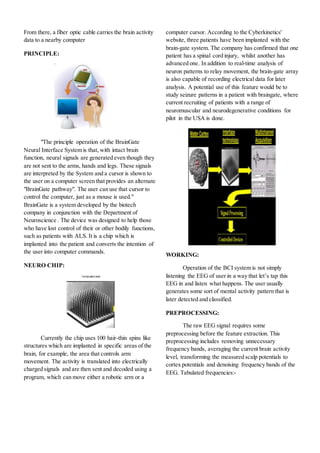
NEURO CHIP:
Currently the chip uses 100 hair-thin spins like
structures which are implanted in specific areas of the
brain, for example, the area that controls arm
movement. The activity is translated into electrically
charged signals and are then sent and decoded using a
program, which can move either a robotic arm or a
computer cursor. According to the Cyberkinetics'
website, three patients have been implanted with the
brain-gate system. The company has confirmed that one
patient has a spinal cord injury, whilst another has
advanced one. In addition to real-time analysis of
neuron patterns to relay movement, the brain-gate array
is also capable of recording electrical data for later
analysis. A potential use of this feature would be to
study seizure patterns in a patient with braingate, where
current recruiting of patients with a range of
neuromuscular and neurodegenerative conditions for
pilot in the USA is done.
WORKING:
Operation of the BCI system is not simply
listening the EEG of user in a way that let’s tap this
EEG in and listen what happens. The user usually
generates some sort of mental activity pattern that is
later detected and classified.
PREPROCESSING:
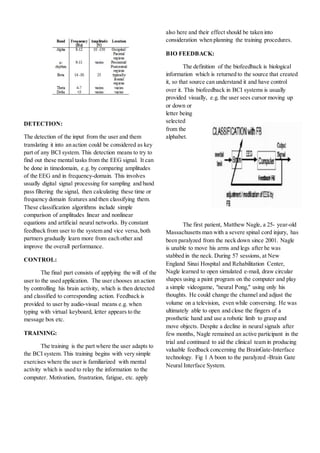
The raw EEG signal requires some
preprocessing before the feature extraction. This
preprocessing includes removing unnecessary
frequency bands, averaging the current brain activity
level, transforming the measured scalp potentials to
cortex potentials and denoising frequency bands of the
EEG. Tabulated frequencies:-
DETECTION:
The detection of the input from the user and them
translating it into an action could be considered as key
part of any BCI system. This detection means to try to
find out these mental tasks from the EEG signal. It can
be done in timedomain, e.g. by comparing amplitudes
of the EEG and in frequency-domain. This involves
usually digital signal processing for sampling and band
pass filtering the signal, then calculating these time or
frequency domain features and then classifying them.
These classification algorithms include simple
comparison of amplitudes linear and nonlinear
equations and artificial neural networks. By constant
feedback from user to the system and vice versa,both
partners gradually learn more from each other and
improve the overall performance.
CONTROL:
The final part consists of applying the will of the
user to the used application. The user chooses an action
by controlling his brain activity, which is then detected
and classified to corresponding action. Feedback is
provided to user by audio-visual means e.g. when
typing with virtual keyboard, letter appears to the
message box etc.
TRAINING:
The training is the part where the user adapts to
the BCI system. This training begins with very simple
exercises where the user is familiarized with mental
activity which is used to relay the information to the
computer. Motivation, frustration, fatigue, etc. apply
also here and their effect should be taken into
consideration when planning the training procedures.
BIO FEEDBACK:
The definition of the biofeedback is biological
information which is returned to the source that created
it, so that source can understand it and have control
over it. This biofeedback in BCI systems is usually
provided visually, e.g. the user sees cursor moving up
or down or
letter being
selected
from the
alphabet.
The first patient, Matthew Nagle, a 25- year-old
Massachusetts man with a severe spinal cord injury, has
been paralyzed from the neck down since 2001. Nagle
is unable to move his arms and legs after he was
stabbed in the neck. During 57 sessions, at New
England Sinai Hospital and Rehabilitation Center,
Nagle learned to open simulated e-mail, draw circular
shapes using a paint program on the computer and play
a simple videogame, "neural Pong," using only his
thoughts. He could change the channel and adjust the
volume on a television, even while conversing. He was
ultimately able to open and close the fingers of a
prosthetic hand and use a robotic limb to grasp and
move objects. Despite a decline in neural signals after
few months, Nagle remained an active participant in the
trial and continued to aid the clinical team in producing
valuable feedback concerning the BrainGate-Interface
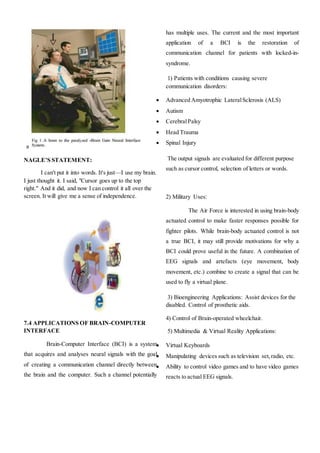
technology. Fig 1 A boon to the paralyzed -Brain Gate
Neural Interface System.
a
NAGLE’S STATEMENT:
I can't put it into words. It's just—I use my brain.
I just thought it. I said, "Cursor goes up to the top
right." And it did, and now I can control it all over the
screen. It will give me a sense of independence.
7.4 APPLICATIONS OF BRAIN-COMPUTER
INTERFACE
Brain-Computer Interface (BCI) is a system
that acquires and analyses neural signals with the goal
of creating a communication channel directly between
the brain and the computer. Such a channel potentially
has multiple uses. The current and the most important
application of a BCI is the restoration of
communication channel for patients with locked-in-
syndrome.
1) Patients with conditions causing severe
communication disorders:
 Advanced Amyotrophic LateralSclerosis (ALS)
 Autism
 CerebralPalsy
 Head Trauma
 Spinal Injury
The output signals are evaluated for different purpose
such as cursor control, selection of letters or words.
2) Military Uses:
The Air Force is interested in using brain-body
actuated control to make faster responses possible for
fighter pilots. While brain-body actuated control is not
a true BCI, it may still provide motivations for why a
BCI could prove useful in the future. A combination of
EEG signals and artefacts (eye movement, body
movement, etc.) combine to create a signal that can be
used to fly a virtual plane.
3) Bioengineering Applications: Assist devices for the
disabled. Control of prosthetic aids.
4) Control of Brain-operated wheelchair.
5) Multimedia & Virtual Reality Applications:
 Virtual Keyboards
 Manipulating devices such as television set,radio, etc.
 Ability to control video games and to have video games
reacts to actual EEG signals.
ADVANTAGES:
The brain crate system is based on cyber
kinetics platform technology to sense, transmit analyse
and apply the language of neurons.
The Brain Gate Neural Interface System is
being designed to one day allow the interface with a
computer and / or even faster than, what is possible
with the hands of a person. The Brain Gate System may
offer substantial improvement over existing
technologies.
Currently available assistive device has significant
limitations for both the pers and caregiver. For
example, even simple switches must be adjusted
frequent that can be time consuming. In addition, these
devices are often obtrusive and user from being able to
simultaneously use the device and at the same time
contact or carry on conversations with others. Potential
advantages of the Brain Gate System over other muscle
driven or brain computer interface approaches include:
 It’s potential to interface with a compute weeks or
months of training; its potential to be used in an
interactive environment user’s ability to operate the
device is not affected by their speech.
 Eye movement noise.
 The ability to provide significantly more usefulness
and utility than other approaches by connecting directly
to the part of the brain that controls hand gestures.
 DISADVANTAGES:
The U.S. Food means that it has been approved for
pre-market clinical trials. There are no estimates on cost
or insurance at this time and Drug Administration
(FDA) has not approved the Brain Gate Non Interface
System for general use. But has been approved for IDE
status
CONCLUSION:
The idea of moving robots or prosthetic devices not by
manual control, but by mere ―thinking (i.e., the brain
activity of human subjects) has been a fascinated
approach. Medical cures are unavailable for many
forms of neural and muscular paralysis. The enormity
of the deficits caused by paralysis is a strong motivation
to pursue BMI solutions. So this idea helps many
patients to control the prosthetic devices of their own
by simply thinking about the task. This technology is
well supported by the latest fields of Biomedical
Instrumentation, Microelectronics; signal processing,
Artificial Neural Networks and Robotics which has
overwhelming developments. Hope these systems will
be effectively implemented for many biomedical
applications.
REFERENCE:
[1]―Brain computer Interfaces:where Human and
Machine meet, Published by IEEE Computer Society,
IEEE 2007.
[2]―Real-world Applications for Brain-Computer
Interface Technology, Melody M.Moore, IEEE
Transactions on Neural Systems and Rehabilitation
Engineering, June 2003.
[3]http://www.en.wikipedia.com/braincomputerinterf
ace
[4] www.scribd.com
[5] www.youtube.com
[6]"Brain Computer Interface Technology." Emotiv,
2009. 03 Mar. 2010.

Braingate

  • 1.
    BRAIN GATE Government PolytechnicMumbai Kiran Yadav, Mohit Patil, Vaibhavi Mestry, Sayali Patil ABSTRACT: The mind-to-movement system thatallows a quadriplegicman to control a computer using onlyhis thoughts is a scientific milestone.It was reached, in large part, through the brain gate system. This system has becomea boon tothe paralyzed. The Brain Gate System is based on Cyberkinetics platform technologyto sense, transmit, analyze and apply the language of neurons. The principle ofoperation behind the Brain Gate System is that with intactbrain function,brain signals are generated even though theyare notsentto the arms,hands and legs.The signals are interpreted and translated into cursor movements, offering the useran alternate Brain Gate pathwayto control a computerwith thought,justas individuals whohave the ability tomove their hands, use a mouse. INTRODUCTION: The 'Brain Gate' contains tiny spikes that will extend down about one millimetre into the brain after being implanted beneath the skull, monitoring the activity from a small group of neurons.It will now be possible for a patient with spinal cord injury to produce brain signals that relay the intention of moving the paralyzed limbs, as signals to an implanted sensor, which is then output as electronic impulses. These impulses enable the user to operate mechanical devices with the help of a computer cursor. Matthew Nagle,a 25- year-old Massachusetts man with a severe spinal cord injury,has been paralyzed from the neck down since 2001.After taking part in a clinical trial of this system,he has opened e-mail,switched TV channels,turned on lights.He even moved a robotic hand from his wheelchair.This marks the first time that neural movement signals have been recorded and decoded in a human with spinal cord injury.The system is also the first to allow a human to control his surrounding environment using his mind. HOWDOES THE BRAIN CONTROL MOTOR FUNCTION? The brain is "hardwired" with connections, which are made by billions of neurons that make electricity whenever they are stimulated. The electrical patterns are called brain waves. Neurons act like the wires and gates in a computer, gathering and transmitting electrochemical signals over distances as far as several feet. The brain encodes information not by relying on single neurons, but by spreading it across large populations of neurons, and by rapidly adapting to new circumstances. Motor neurons carry signals from the central nervous system to the muscles, skin and glands of the body, while sensory neurons carry signals from those outer parts of the body to the centralnervous system. Receptors sense things like chemicals, light, and sound and encode this information into electrochemical signals transmitted by the sensory neurons. And interneurons tie everything together by connecting the various neurons within the brain and spinal cord. The part of the brain that controls motor skills is located at the ear of the frontal lobe. HOWDOES THIS COMMUNICATION HAPPEN? Muscles in the body's limbs contain embedded sensors called muscle spindles that measure the length and speed of the muscles as they stretch and contract as you move. Other sensors in the skin respond to stretching and pressure. Even if paralysis or disease damages the part of the brain that processes movement, the brain still makes neural signals. They're just not being sent to the arms, hands and legs. A technique called neurofeedback uses connecting sensors on the scalp to translate brain waves into information a person can learn from. The sensors register different frequencies of the signals produced in the brain. These changes in brain wave patterns indicate whether someone is concentrating or suppressing his impulses, or whether he is relaxed or tense. NEUROPROSTHETICDEVICE: A neuroprosthetic device known as Braingate converts brain activity into computer commands. A sensor is implanted on the brain, and electrodes are hooked up to wires that travel to a pedestalon the scalp.
  • 2.
    From there, afiber optic cable carries the brain activity data to a nearby computer PRINCIPLE: "The principle operation of the BrainGate Neural Interface System is that, with intact brain function, neural signals are generated even though they are not sent to the arms, hands and legs. These signals are interpreted by the System and a cursor is shown to the user on a computer screen that provides an alternate "BrainGate pathway". The user can use that cursor to control the computer, just as a mouse is used." BrainGate is a system developed by the biotech company in conjunction with the Department of Neuroscience . The device was designed to help those who have lost control of their or other bodily functions, such as patients with ALS. It is a chip which is implanted into the patient and converts the intention of the user into computer commands. NEURO CHIP: Currently the chip uses 100 hair-thin spins like structures which are implanted in specific areas of the brain, for example, the area that controls arm movement. The activity is translated into electrically charged signals and are then sent and decoded using a program, which can move either a robotic arm or a computer cursor. According to the Cyberkinetics' website, three patients have been implanted with the brain-gate system. The company has confirmed that one patient has a spinal cord injury, whilst another has advanced one. In addition to real-time analysis of neuron patterns to relay movement, the brain-gate array is also capable of recording electrical data for later analysis. A potential use of this feature would be to study seizure patterns in a patient with braingate, where current recruiting of patients with a range of neuromuscular and neurodegenerative conditions for pilot in the USA is done. WORKING: Operation of the BCI system is not simply listening the EEG of user in a way that let’s tap this EEG in and listen what happens. The user usually generates some sort of mental activity pattern that is later detected and classified. PREPROCESSING: The raw EEG signal requires some preprocessing before the feature extraction. This preprocessing includes removing unnecessary frequency bands, averaging the current brain activity level, transforming the measured scalp potentials to cortex potentials and denoising frequency bands of the EEG. Tabulated frequencies:-
  • 3.
    DETECTION: The detection ofthe input from the user and them translating it into an action could be considered as key part of any BCI system. This detection means to try to find out these mental tasks from the EEG signal. It can be done in timedomain, e.g. by comparing amplitudes of the EEG and in frequency-domain. This involves usually digital signal processing for sampling and band pass filtering the signal, then calculating these time or frequency domain features and then classifying them. These classification algorithms include simple comparison of amplitudes linear and nonlinear equations and artificial neural networks. By constant feedback from user to the system and vice versa,both partners gradually learn more from each other and improve the overall performance. CONTROL: The final part consists of applying the will of the user to the used application. The user chooses an action by controlling his brain activity, which is then detected and classified to corresponding action. Feedback is provided to user by audio-visual means e.g. when typing with virtual keyboard, letter appears to the message box etc. TRAINING: The training is the part where the user adapts to the BCI system. This training begins with very simple exercises where the user is familiarized with mental activity which is used to relay the information to the computer. Motivation, frustration, fatigue, etc. apply also here and their effect should be taken into consideration when planning the training procedures. BIO FEEDBACK: The definition of the biofeedback is biological information which is returned to the source that created it, so that source can understand it and have control over it. This biofeedback in BCI systems is usually provided visually, e.g. the user sees cursor moving up or down or letter being selected from the alphabet. The first patient, Matthew Nagle, a 25- year-old Massachusetts man with a severe spinal cord injury, has been paralyzed from the neck down since 2001. Nagle is unable to move his arms and legs after he was stabbed in the neck. During 57 sessions, at New England Sinai Hospital and Rehabilitation Center, Nagle learned to open simulated e-mail, draw circular shapes using a paint program on the computer and play a simple videogame, "neural Pong," using only his thoughts. He could change the channel and adjust the volume on a television, even while conversing. He was ultimately able to open and close the fingers of a prosthetic hand and use a robotic limb to grasp and move objects. Despite a decline in neural signals after few months, Nagle remained an active participant in the trial and continued to aid the clinical team in producing valuable feedback concerning the BrainGate-Interface technology. Fig 1 A boon to the paralyzed -Brain Gate Neural Interface System.
  • 4.
    a NAGLE’S STATEMENT: I can'tput it into words. It's just—I use my brain. I just thought it. I said, "Cursor goes up to the top right." And it did, and now I can control it all over the screen. It will give me a sense of independence. 7.4 APPLICATIONS OF BRAIN-COMPUTER INTERFACE Brain-Computer Interface (BCI) is a system that acquires and analyses neural signals with the goal of creating a communication channel directly between the brain and the computer. Such a channel potentially has multiple uses. The current and the most important application of a BCI is the restoration of communication channel for patients with locked-in- syndrome. 1) Patients with conditions causing severe communication disorders:  Advanced Amyotrophic LateralSclerosis (ALS)  Autism  CerebralPalsy  Head Trauma  Spinal Injury The output signals are evaluated for different purpose such as cursor control, selection of letters or words. 2) Military Uses: The Air Force is interested in using brain-body actuated control to make faster responses possible for fighter pilots. While brain-body actuated control is not a true BCI, it may still provide motivations for why a BCI could prove useful in the future. A combination of EEG signals and artefacts (eye movement, body movement, etc.) combine to create a signal that can be used to fly a virtual plane. 3) Bioengineering Applications: Assist devices for the disabled. Control of prosthetic aids. 4) Control of Brain-operated wheelchair. 5) Multimedia & Virtual Reality Applications:  Virtual Keyboards  Manipulating devices such as television set,radio, etc.  Ability to control video games and to have video games reacts to actual EEG signals.
  • 5.
    ADVANTAGES: The brain cratesystem is based on cyber kinetics platform technology to sense, transmit analyse and apply the language of neurons. The Brain Gate Neural Interface System is being designed to one day allow the interface with a computer and / or even faster than, what is possible with the hands of a person. The Brain Gate System may offer substantial improvement over existing technologies. Currently available assistive device has significant limitations for both the pers and caregiver. For example, even simple switches must be adjusted frequent that can be time consuming. In addition, these devices are often obtrusive and user from being able to simultaneously use the device and at the same time contact or carry on conversations with others. Potential advantages of the Brain Gate System over other muscle driven or brain computer interface approaches include:  It’s potential to interface with a compute weeks or months of training; its potential to be used in an interactive environment user’s ability to operate the device is not affected by their speech.  Eye movement noise.  The ability to provide significantly more usefulness and utility than other approaches by connecting directly to the part of the brain that controls hand gestures.  DISADVANTAGES: The U.S. Food means that it has been approved for pre-market clinical trials. There are no estimates on cost or insurance at this time and Drug Administration (FDA) has not approved the Brain Gate Non Interface System for general use. But has been approved for IDE status CONCLUSION: The idea of moving robots or prosthetic devices not by manual control, but by mere ―thinking (i.e., the brain activity of human subjects) has been a fascinated approach. Medical cures are unavailable for many forms of neural and muscular paralysis. The enormity of the deficits caused by paralysis is a strong motivation to pursue BMI solutions. So this idea helps many patients to control the prosthetic devices of their own by simply thinking about the task. This technology is well supported by the latest fields of Biomedical Instrumentation, Microelectronics; signal processing, Artificial Neural Networks and Robotics which has overwhelming developments. Hope these systems will be effectively implemented for many biomedical applications. REFERENCE: [1]―Brain computer Interfaces:where Human and Machine meet, Published by IEEE Computer Society, IEEE 2007. [2]―Real-world Applications for Brain-Computer Interface Technology, Melody M.Moore, IEEE Transactions on Neural Systems and Rehabilitation Engineering, June 2003. [3]http://www.en.wikipedia.com/braincomputerinterf ace [4] www.scribd.com [5] www.youtube.com [6]"Brain Computer Interface Technology." Emotiv, 2009. 03 Mar. 2010.