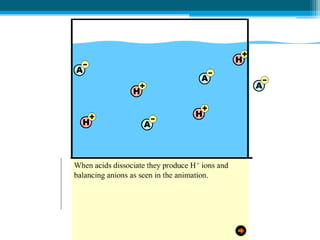
Acids and Bases
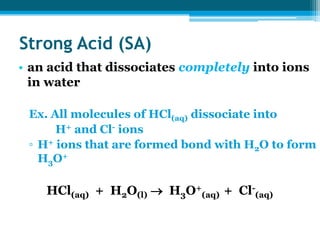
Strong Acid (SA)
• an acid that dissociates completely into ions
  in water

 Ex. All molecules of HCl(aq) dissociate into
      H+ and Cl- ions
 ▫ H+ ions that are formed bond with H2O to form
   H3O+

    HCl(aq) + H2O(l)  H3O+(aq) + Cl-(aq)
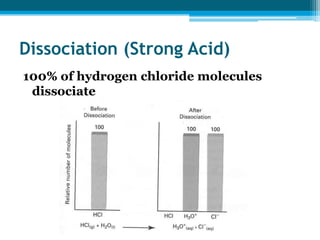
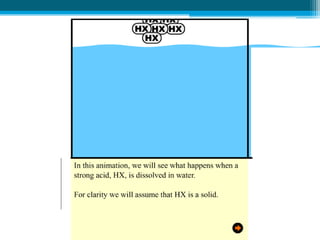
Dissociation (Strong Acid)
100% of hydrogen chloride molecules
 dissociate
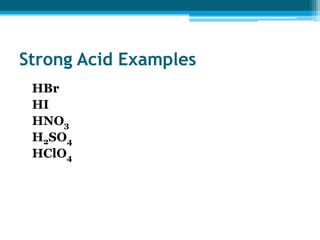
Strong Acid Examples
 HBr
 HI
 HNO3
 H2SO4
 HClO4
Weak Acid (WA)

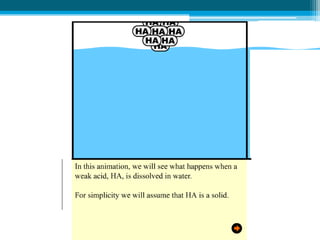
• an acid that dissociates very slightly into
  ions in water
 Ex. not all molecules of CH3COOH(aq) break
   apart, some remain intact
 • only about 1% of acetic acid molecules
   dissociate
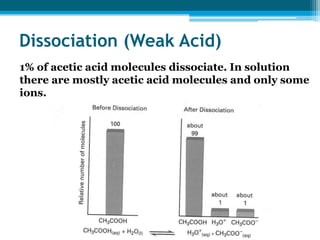
Dissociation (Weak Acid)
1% of acetic acid molecules dissociate. In solution
there are mostly acetic acid molecules and only some
ions.
Concentration
• the concentration of H3O+(aq) ions, [H3O+],
  in a dilute solution of a SA is equal to the
  concentration of the acid, [acid]
           [H3O+] = [strong acid]
• Ex. In a sample of 1.0 mol/L HCl(aq)
     [H3O+] = 1.0 mol/L
                                      Recall: C = n
                 square bracket                   V
                Molar Concentration
Concentration
• the concentration of H3O+(aq) ions, [H3O+],
  in a dilute solution of a WA is much less
  than the concentration of the acid, [acid]

 • Ex. In a sample of 1.0 mol/L CH3COOH (aq)
    [H3O+] <<< 1.0 mol/L
 • That is, [H3O+] < [weak acid]
Strong Base (SB)
• a base that dissociates completely into
  ions in water
 Ex. all molecules of NaOH(aq) dissociate into
       Na+ and OH- ions
 • other SB’s are…
    KOH
    Ca(OH)2
    Ba(OH)2
Weak Base (WB)
• most bases are weak
• WB dissociates very slightly into ions in
  water
 ▫ Ex. Ammonia  [OH1-] < [weak base]
Concentration
• the concentration of OH1-(aq) ions, [OH1-],
  in a dilute solution of a SB is equal to the
  conc. of the base, [base]
           [OH1-] = [strong base]

 Ex. In a sample of 1.0 mol/L NaOH(aq)
          [OH1-] = 1.0 mol/L
pH
16


pH    [H3O+ ]   [OH- ]
pOH
Measuring Strength – pH Scale
• In pure water,
     [H3O+] = [OH-] = 1.0 x 10⁻⁷ mol/L

• In acidic solution, [H3O+] > [OH-]

• In basic solution, [H3O+] < [OH-]
19

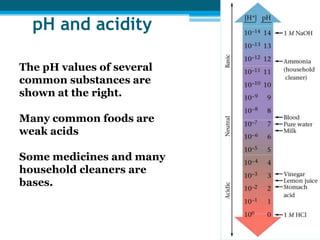
  pH and acidity

The pH values of several
common substances are
shown at the right.

Many common foods are
weak acids

Some medicines and many
household cleaners are
bases.
Indicators
• An acid-base indicator is a substance that
  changes colour in acid and base solutions. It is
  used to determine if neutralization is complete.

• ex. litmus
           phenolphthalein (phth)
           bromothymol blue (BTB)
           universal indicator
pH Scale Review
• Now that we know when an acid or base is dissolved in
  water it will produce either:
  ▫ OH-
  ▫ H+
• pH measures the concentration (how many) of H+ in the
  solution
• When pH is 7 that means the concentration of OH- is
  equal to H+
• When pH is less than 7 we have a higher concentration of
  H+
• When pH is bigger that 7 we have a higher concentration
  of OH-
Acid-Base Reactions
Neutralization
• Adding a base to an acid neutralizes the acid’s
  acidic properties.
• This is called a neutralization reaction.
 ▫ Ex. for an upset stomach, use an ANTACID
Neutralization
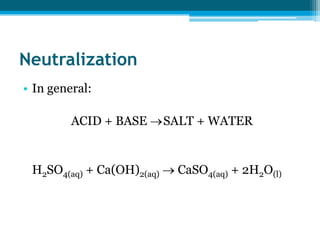
• In general:

         ACID + BASE SALT + WATER


 H2SO4(aq) + Ca(OH)2(aq)  CaSO4(aq) + 2H2O(l)
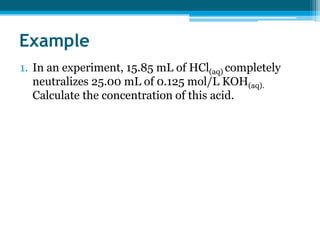
Example
1. In an experiment, 15.85 mL of HCl(aq) completely
   neutralizes 25.00 mL of 0.125 mol/L KOH(aq).
   Calculate the concentration of this acid.
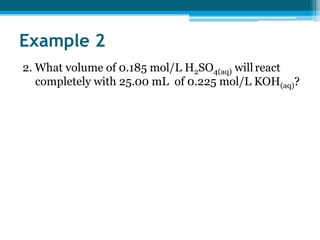
Example 2
2. What volume of 0.185 mol/L H2SO4(aq) will react
   completely with 25.00 mL of 0.225 mol/L KOH(aq)?
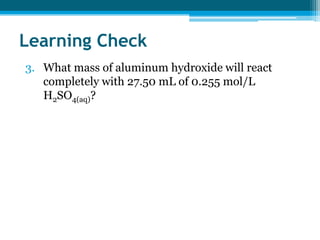
Learning Check
3. What mass of aluminum hydroxide will react
   completely with 27.50 mL of 0.255 mol/L
   H2SO4(aq)?
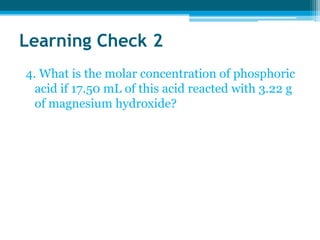
Learning Check 2
4. What is the molar concentration of phosphoric
  acid if 17.50 mL of this acid reacted with 3.22 g
  of magnesium hydroxide?
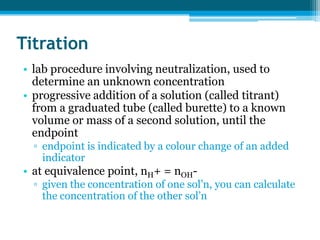
Titration
• lab procedure involving neutralization, used to
  determine an unknown concentration
• progressive addition of a solution (called titrant)
  from a graduated tube (called burette) to a known
  volume or mass of a second solution, until the
  endpoint
  ▫ endpoint is indicated by a colour change of an added
    indicator
• at equivalence point, nH+ = nOH-
  ▫ given the concentration of one sol’n, you can calculate
    the concentration of the other sol’n
Titration
• Read p468 - 469 to review procedure
Homework
•   pg 457 Q 1, 4
•   pg 462 Q 8, 9
•   pg 466 Q 1, 3, 4, 10
•   pg 467 Q 13, 16

4 acids & bases

  • 1.
  • 3.
    Strong Acid (SA) •an acid that dissociates completely into ions in water Ex. All molecules of HCl(aq) dissociate into H+ and Cl- ions ▫ H+ ions that are formed bond with H2O to form H3O+ HCl(aq) + H2O(l)  H3O+(aq) + Cl-(aq)
  • 4.
    Dissociation (Strong Acid) 100%of hydrogen chloride molecules dissociate
  • 6.
    Strong Acid Examples HBr HI HNO3 H2SO4 HClO4
  • 7.
    Weak Acid (WA) •an acid that dissociates very slightly into ions in water Ex. not all molecules of CH3COOH(aq) break apart, some remain intact • only about 1% of acetic acid molecules dissociate
  • 8.
    Dissociation (Weak Acid) 1%of acetic acid molecules dissociate. In solution there are mostly acetic acid molecules and only some ions.
  • 10.
    Concentration • the concentrationof H3O+(aq) ions, [H3O+], in a dilute solution of a SA is equal to the concentration of the acid, [acid] [H3O+] = [strong acid] • Ex. In a sample of 1.0 mol/L HCl(aq) [H3O+] = 1.0 mol/L Recall: C = n square bracket V Molar Concentration
  • 11.
    Concentration • the concentrationof H3O+(aq) ions, [H3O+], in a dilute solution of a WA is much less than the concentration of the acid, [acid] • Ex. In a sample of 1.0 mol/L CH3COOH (aq) [H3O+] <<< 1.0 mol/L • That is, [H3O+] < [weak acid]
  • 12.
    Strong Base (SB) •a base that dissociates completely into ions in water Ex. all molecules of NaOH(aq) dissociate into Na+ and OH- ions • other SB’s are… KOH Ca(OH)2 Ba(OH)2
  • 13.
    Weak Base (WB) •most bases are weak • WB dissociates very slightly into ions in water ▫ Ex. Ammonia  [OH1-] < [weak base]
  • 14.
    Concentration • the concentrationof OH1-(aq) ions, [OH1-], in a dilute solution of a SB is equal to the conc. of the base, [base] [OH1-] = [strong base] Ex. In a sample of 1.0 mol/L NaOH(aq) [OH1-] = 1.0 mol/L
  • 15.
  • 16.
    16 pH [H3O+ ] [OH- ] pOH
  • 17.
    Measuring Strength –pH Scale • In pure water, [H3O+] = [OH-] = 1.0 x 10⁻⁷ mol/L • In acidic solution, [H3O+] > [OH-] • In basic solution, [H3O+] < [OH-]
  • 19.
    19 pHand acidity The pH values of several common substances are shown at the right. Many common foods are weak acids Some medicines and many household cleaners are bases.
  • 20.
    Indicators • An acid-baseindicator is a substance that changes colour in acid and base solutions. It is used to determine if neutralization is complete. • ex. litmus phenolphthalein (phth) bromothymol blue (BTB) universal indicator
  • 21.
    pH Scale Review •Now that we know when an acid or base is dissolved in water it will produce either: ▫ OH- ▫ H+ • pH measures the concentration (how many) of H+ in the solution • When pH is 7 that means the concentration of OH- is equal to H+ • When pH is less than 7 we have a higher concentration of H+ • When pH is bigger that 7 we have a higher concentration of OH-
  • 22.
  • 23.
    Neutralization • Adding abase to an acid neutralizes the acid’s acidic properties. • This is called a neutralization reaction. ▫ Ex. for an upset stomach, use an ANTACID
  • 24.
    Neutralization • In general: ACID + BASE SALT + WATER H2SO4(aq) + Ca(OH)2(aq)  CaSO4(aq) + 2H2O(l)
  • 25.
    Example 1. In anexperiment, 15.85 mL of HCl(aq) completely neutralizes 25.00 mL of 0.125 mol/L KOH(aq). Calculate the concentration of this acid.
  • 26.
    Example 2 2. Whatvolume of 0.185 mol/L H2SO4(aq) will react completely with 25.00 mL of 0.225 mol/L KOH(aq)?
  • 27.
    Learning Check 3. Whatmass of aluminum hydroxide will react completely with 27.50 mL of 0.255 mol/L H2SO4(aq)?
  • 28.
    Learning Check 2 4.What is the molar concentration of phosphoric acid if 17.50 mL of this acid reacted with 3.22 g of magnesium hydroxide?
  • 29.
    Titration • lab procedureinvolving neutralization, used to determine an unknown concentration • progressive addition of a solution (called titrant) from a graduated tube (called burette) to a known volume or mass of a second solution, until the endpoint ▫ endpoint is indicated by a colour change of an added indicator • at equivalence point, nH+ = nOH- ▫ given the concentration of one sol’n, you can calculate the concentration of the other sol’n
  • 30.
    Titration • Read p468- 469 to review procedure
  • 31.
    Homework • pg 457 Q 1, 4 • pg 462 Q 8, 9 • pg 466 Q 1, 3, 4, 10 • pg 467 Q 13, 16