Learning Goals:
To understand what pH is
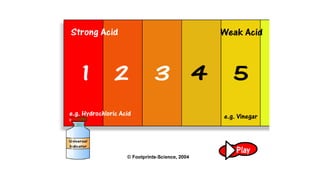
To understand what the colours and numbers
on the pH scale mean
To understand the pH of some household
examples
1.Name an acid
2.What element is common to all acids

3.Name a base
4.What makes a base different from an acid?
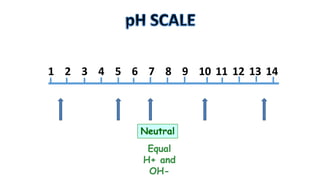
1 2 3 4 5 6 7 8 9 10 11 12 13 14

Neutral
Equal
H+ and
OH-
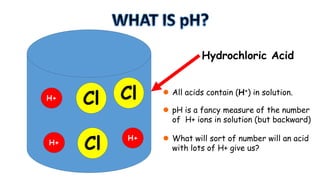
Hydrochloric Acid

H+

H+

Cl

Cl

Cl
H+

 All acids contain (H+) in solution.
 pH is a fancy measure of the number
of H+ ions in solution (but backward)
 What will sort of number will an acid
with lots of H+ give us?
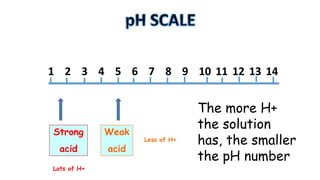
1 2 3 4 5 6 7 8 9 10 11 12 13 14

Strong

Weak

acid

acid

Lots of H+

Less of H+

The more H+
the solution
has, the smaller
the pH number
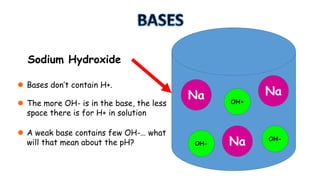
Sodium Hydroxide
 Bases don’t contain H+.
 The more OH- is in the base, the less
space there is for H+ in solution
 A weak base contains few OH-… what
will that mean about the pH?

Na

OH-

OH+

Na

Na

OH-
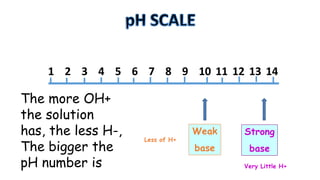
1 2 3 4 5 6 7 8 9 10 11 12 13 14

The more OH+
the solution
has, the less H-,
The bigger the
pH number is

Less of H+

Weak

Strong

base

base
Very Little H+
pH Quiz rules:

2 teams (either girls Vs boys or sides
of the room
First side with a hand up

If first hand up doesn’t get it, the
question goes to the other team
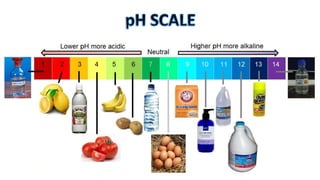
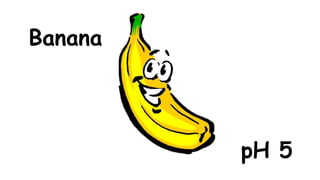
Banana

pH 5
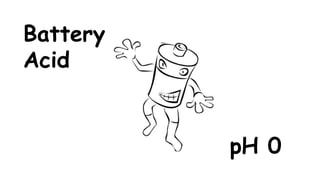
Battery
Acid

pH 0
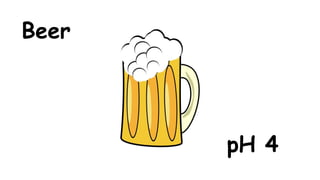
Beer

pH 4
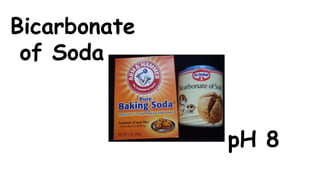
Bicarbonate
of Soda

pH 8
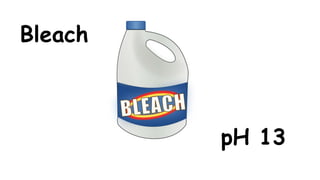
Bleach

pH 13
Blood

pH 7.5
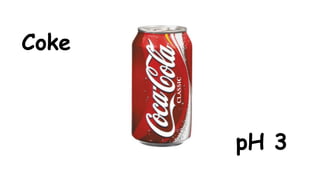
Coke

pH 3
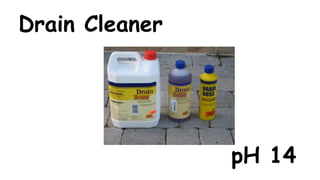
Drain Cleaner

pH 14
Hand Soap

pH 10
Lemon Juice

pH 2
Milk

pH 6
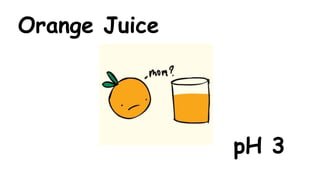
Orange Juice

pH 3
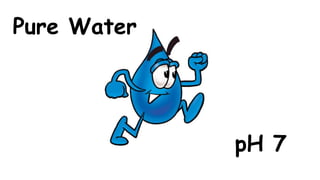
Pure Water

pH 7
Saliva

pH 6
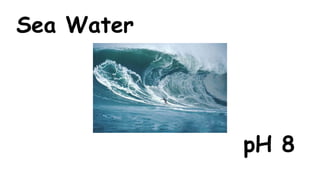
Sea Water

pH 8
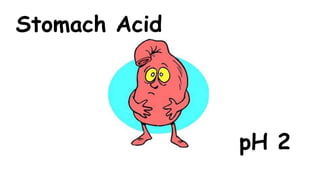
Stomach Acid

pH 2
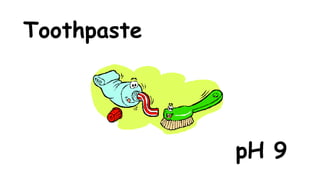
Toothpaste

pH 9
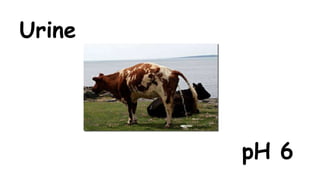
Urine

pH 6

pH