Bronsted-Lowry Acids andBases
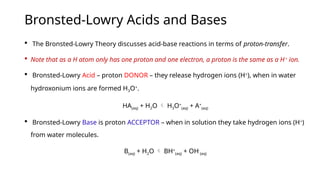
The Bronsted-Lowry Theory discusses acid-base reactions in terms of proton-transfer.
Note that as a H atom only has one proton and one electron, a proton is the same as a H+
ion.
Bronsted-Lowry Acid – proton DONOR – they release hydrogen ions (H+
), when in water
hydroxonium ions are formed H3O+
.
HA(aq) + H2O H3O+
(aq) + A+
(aq)
Bronsted-Lowry Base is proton ACCEPTOR – when in solution they take hydrogen ions (H+
)
from water molecules.
B(aq) + H2O BH+
(aq) + OH-
(aq)
4.
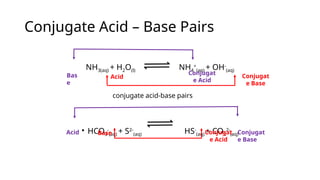
Conjugate Acid –Base Pairs
The Bronsted-Lowry Theory identifies acids and bases as conjugate pairs, which
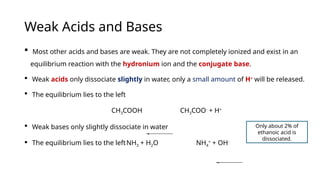
transform into each other with the loss or gain of a proton.
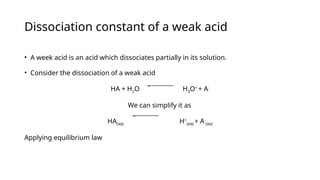
It views all acid-base reactions as equilibria.
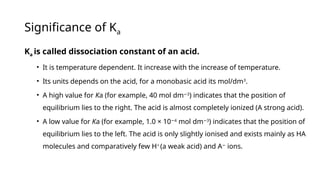
e.g. HA H+
+ A-
The general form of an acid can be written HA. When it donates a proton it becomes
the conjugate base A-
In the reverse reaction, when Base A-
accepts a proton, it becomes it’s conjugate
acid HA
5.
Conjugate Acid –Base Pairs
NH3(aq) + H2O(l) NH4
+
(aq) + OH-
(aq)
• HCO3
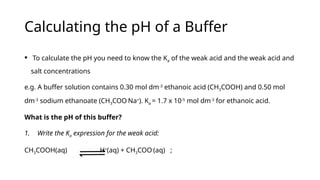
-
(aq) + S2-
(aq) HS-
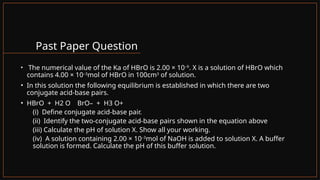
(aq) + CO3
2-
(aq)
Bas
e
Conjugat
e Acid
Conjugat
e Base
Acid
Acid Conjugat
e Base
Conjugat
e Acid
Base
conjugate acid-base pairs
6.
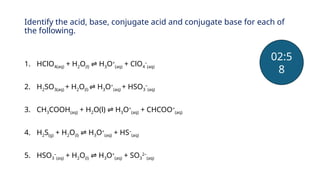
Identify the acid,base, conjugate acid and conjugate base for each of
the following.
1. HClO4(aq) + H2O(l) H
⇌ 3O+
(aq) + ClO4
–
(aq)
2. H2SO3(aq) + H2O(l) H
⇌ 3O+
(aq) + HSO3
–
(aq)
3. CH3COOH(aq) + H2O(l) H
⇌ 3O+
(aq) + CHCOO=
(aq)
4. H2S(g) + H2O(l) H
⇌ 3O+
(aq) + HS–
(aq)
5. HSO3
–
(aq) + H2O(l) H
⇌ 3O+
(aq) + SO3
2–
(aq)
02:5
8
7.
Dissociation of Water
Water can also dissociate slightly
The equilibrium below exists in water – lies well over to the left
H2O + H2O H3O+
+ OH-
We can simplify above equilibrium as
H2O(l) H+
(aq) + OH-
(aq)
We can write equilibrium expression for this dissociation:
8.
Continued...
The constantsare combined to give the ionic product of water – Kw
so
Kw is called the ionic product of water, the value of Kw = 1.0 x 10⁻¹⁴
mol2
dm-6
at 298 K
(25 °C).
Like any equilibrium constant, Kw varies with temperature.
In pure water [H+
] = [OH-
]
Therefore, in pure water Kw = [H+
]2
constant
9.
Therefore, in purewater Kw = [H+
]2
Rearranging this equation the [H+
] in pure water
• The range of possible hydrogen ion concentrations in different solutions is very
large (10 15
−
M to 10 M).
• To overcome the problem of dealing with a wide range of numbers, the Danish
chemist Soren Sorensen introduced the pH scale.
pH = -log10[H+
]
• We can use this equation to convert [H+] to pH or pH to [H+]
• The negative sign is introduced to make the pH values positive in most cases
10.
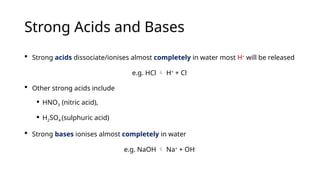
Strong Acids andBases
Strong acids dissociate/ionises almost completely in water most H+
will be released
e.g. HCl H+
+ Cl-
Other strong acids include
HNO3 (nitric acid),
H2SO4 (sulphuric acid)
Strong bases ionises almost completely in water
e.g. NaOH Na+
+ OH-
11.
Calculating pH ofa strong Acid
The pH of a solution is defined as the negative logarithm of the molar hydrogen-ion
concentration.
pH = -log10[H+
]
pH scale goes from 0 (very acidic) to 14 (very basic). pH 7 is neutral.
pH can be calculated if the hydrogen ion concentration is known.
e.g. The hydrogen ion concentration of a solution is 0.005 mol/dm3
. What is the pH of the
solution.
pH = -log10[H+
] = -log10(0.005) = 2.3
[H+
] – hydrogen ion
concentration (moldm-3
)
12.
Monoprotic Acids
Strongacids ionise fully in solution
Monoprotic – each molecule of acid releases one proton when it dissociates.
One mole of acid produces one mole of hydrogen ions. Therefore, the hydrogen
ions concentration is the same as the acid concentration.
e.g. Calculating the pH of a 0.05 mol dm-3
solution of hydrochloric acid.
HCl is a monoprotic acid therefore [HCl] = [H+
]
[H+
] = 0.05 mol dm-3
, pH = -log10(0.05) = 1.3
13.
Diprotic Acids
Forstrong diprotic acids, each molecule of acid will release 2 protons when
dissociated.
Each mole of diprotic acid produces 2 moles of hydrogen ions.
e.g. Calculating the pH of a 0.01 mol dm-3
solution of sulfuric acid (H2SO4)
Sulfuric acid is a strong diprotic acid therefore 2[H2SO4] = [H+
]
[H2SO4] = 0.01 mol dm-3
[H+
] = 2 x 0.01 mol dm-3
pH = -log10(0.02) = 1.7
14.
Try yourself..
Calculate thepH of
a solution whose H+
ion concentration is
5.32 × 10 4
−
mol
dm 3
−
.
Calculate the pH of
the 70 g of HCl
dissolved in 1 dm3
[H+
] = 3.00 × 10 4
−
mol dm 3
−
[H+
] = 5.40 × 10 12
−
mol dm 3
−
[H+
] = 7.80 × 10 10
−
mol dm 3
−
Calculate pH of a
soluiton containing
11.6 g H2SO4 in
1dm3
container.
04:58
15.
Calculating [H+
] frompH
Hydrogen ion concentration can also be calculated from pH.
The inverse of the pH equation can be used
[H+
] = antilog(-pH)
e.g. A solution of hydrochloric acid has a pH of 2.0. What is the hydrogen ion
concentration?
[H+
] = 10-pH
= 10-2.0
= 0.01 mol dm-3
16.
Try yourself
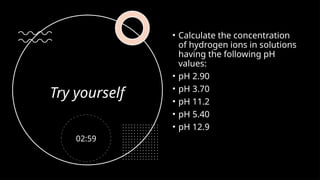
• Calculatethe concentration
of hydrogen ions in solutions
having the following pH
values:
• pH 2.90
• pH 3.70
• pH 11.2
• pH 5.40
• pH 12.9
02:59
17.
Calculating pH ofStrong Base
Strong bases fully ionise in water e.g. Sodium hydroxide (NaOH)
NaOH Na+
+ OH-
For one mole of strong base one mole of OH- ions are released.
The concentration of the base is the same as the concentration of OH-
ions.
To determine the pH the concentration of hydrogen ions is needed [H+
]
This can be found by using the Kw equation. Kw = [H+
][OH-
]
[H+
] = Kw/[OH-
]
18.
Base pH CalculationExample
Example: Determine the pH of 0.20 moldm-3
of NaOH at 298 K.
1. Firstly, remember from the earlier slide that Kw = 1.0 x 10⁻¹⁴
mol2
dm-6
at 298 K.
2. Put all known values in the Kw equation, Kw = [H+
][OH-
].
1.0 x 10-14
= [H+
] x 0.20 ;
4. Calculate pH using [H+
] value. pH = -log10[H+
] = log10(5 x 10-14
) = 13.3
19.
Try yourself…
• Calculateph of a solution
contain 0.001 00 mol dm 3
−
KOH
(Kw = 1.00 × 10 14
−
mol2
dm 6
−
)
• Calculate pH of an aqueous
solution containing 0.200 g of
NaOH per dm3
(Kw = 1.00 ×
10 14 mol
− 2
dm 6
−
).
02:58
20.
Weak Acids andBases
Most other acids and bases are weak. They are not completely ionized and exist in an
equilibrium reaction with the hydronium ion and the conjugate base.
Weak acids only dissociate slightly in water, only a small amount of H+
will be released.
The equilibrium lies to the left
CH3COOH CH3COO-
+ H+
Weak bases only slightly dissociate in water
The equilibrium lies to the leftNH3 + H2O NH4
+
+ OH-
Only about 2% of
ethanoic acid is
dissociated.
21.
Dissociation constant ofa weak acid
• A week acid is an acid which dissociates partially in its solution.
• Consider the dissociation of a weak acid
HA + H2O H3O+
+ A-
We can simplify it as
HA(aq) H+
(aq) + A-
(aq)
Applying equilibrium law
22.
Significance of Ka
Kais called dissociation constant of an acid.
• It is temperature dependent. It increase with the increase of temperature.
• Its units depends on the acid, for a monobasic acid its mol/dm3
.
• A high value for Ka (for example, 40 mol dm 3
−
) indicates that the position of
equilibrium lies to the right. The acid is almost completely ionized (A strong acid).
• A low value for Ka (for example, 1.0 × 10 4
−
mol dm 3
−
) indicates that the position of
equilibrium lies to the left. The acid is only slightly ionised and exists mainly as HA
molecules and comparatively few H+
(a weak acid) and A−
ions.
23.
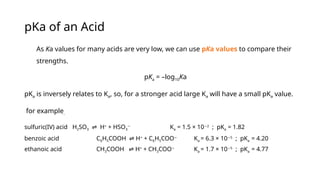
pKa of anAcid
As Ka values for many acids are very low, we can use pKa values to compare their
strengths.
pKa = –log10Ka
pKa is inversely relates to Ka, so, for a stronger acid large Ka will have a small pKa value.
for example.
sulfuric(IV) acid H2SO3 H
⇌ +
+ HSO3
−
Ka = 1.5 × 10 2
−
; pKa = 1.82
benzoic acid C6H5COOH H
⇌ +
+ C6H5COO−
Ka = 6.3 × 10 5
−
; pKa = 4.20
ethanoic acid CH3COOH H
⇌ +
+ CH3COO−
Ka = 1.7 × 10 5
−
; pKa = 4.77
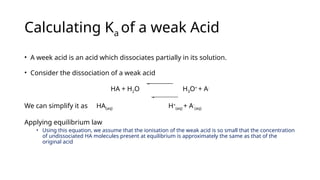
24.
• A weekacid is an acid which dissociates partially in its solution.
• Consider the dissociation of a weak acid
HA + H2O H3O+
+ A-
We can simplify it as HA(aq) H+
(aq) + A-
(aq)
Applying equilibrium law
• Using this equation, we assume that the ionisation of the weak acid is so small that the concentration
of undissociated HA molecules present at equilibrium is approximately the same as that of the
original acid
Calculating Ka of a weak Acid
25.
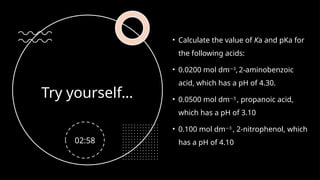
Try yourself…
• Calculatethe value of Ka and pKa for
the following acids:
• 0.0200 mol dm 3
−
, 2-aminobenzoic
acid, which has a pH of 4.30.
• 0.0500 mol dm 3
−
, propanoic acid,
which has a pH of 3.10
• 0.100 mol dm 3
−
, 2-nitrophenol, which
has a pH of 4.10
02:58
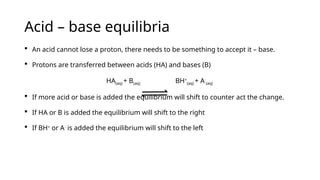
26.
Acid – baseequilibria
An acid cannot lose a proton, there needs to be something to accept it – base.
Protons are transferred between acids (HA) and bases (B)
HA(aq) + B(aq) BH+
(aq) + A-
(aq)
If more acid or base is added the equilibrium will shift to counter act the change.
If HA or B is added the equilibrium will shift to the right
If BH+
or A-
is added the equilibrium will shift to the left
27.
Ka and pHof weak Acids
Ka is the acid dissociation constant The Ka can be used to find the pH.
The equation of dissociation: HA(aq) H+
(aq) + A-
(aq)
Only a very small amount of HA dissociates so
it is assumed that [HA(aq)]equilibrium = [HA(aq)]start
Also assume that the acid dissociates much more than water therefore the H+
in
solution are from the acid [H+
(aq)] = [A-
(aq)]
28.
Using Ka tofind pH
Let’s Use the following information to calculate the hydrogen ions
concentration and pH of 0.030 mol dm-3
hydrogen fluoride at 298 K. Hydrogen
fluoride Ka at 298 K = 6.6 x 10⁻⁴
mol dm-3
1. Write down the expression for Ka
As HF(aq) H+
(aq) + F-
(aq)
2. Rearrange Ka expression to find [H+
]
3. Insert data given to find [H+
]; = 1.98 x 10⁻⁵
4. Calculate pH from [H+
]; pH = -log10(1.98 x 10⁻⁵
) = 4.70
29.
Using Ka tofind the Concentration
Calculate the molar concentration of a propanoic acid solution. The pH of
the solution is 3.30. Ka of propanoic acid at 298 K = 1.30 x 10⁻⁵
mol dm-3
.
1. Calculate [H+
] from the pH. [H+
] = 10-pH
[H+
] = 10-3.30
= 5.01 x 10⁻⁴
2. Write expression for Ka and rearrange to find [CH3CH2COOH]
so
= = 0.0193 mol dm-3
30.
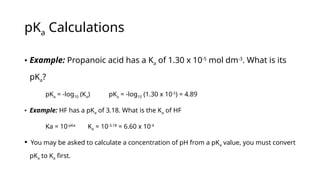
pKa Calculations
• Example:Propanoic acid has a Ka of 1.30 x 10⁻⁵
mol dm-3
. What is its
pKa?
pKa = -log10 (Ka) pKa = -log10 (1.30 x 10⁻⁵
) = 4.89
• Example: HF has a pKa of 3.18. What is the Ka of HF
Ka = 10-pKa
Ka = 10-3.18
= 6.60 x 10⁻⁴
You may be asked to calculate a concentration of pH from a pKa value, you must convert
pKa to Ka first.
31.
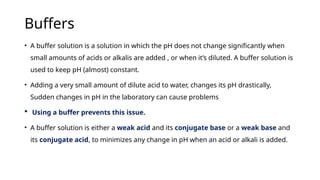
Buffers
• A buffersolution is a solution in which the pH does not change significantly when
small amounts of acids or alkalis are added , or when it’s diluted. A buffer solution is
used to keep pH (almost) constant.
• Adding a very small amount of dilute acid to water, changes its pH drastically,
Sudden changes in pH in the laboratory can cause problems
Using a buffer prevents this issue.
• A buffer solution is either a weak acid and its conjugate base or a weak base and
its conjugate acid, to minimizes any change in pH when an acid or alkali is added.
32.
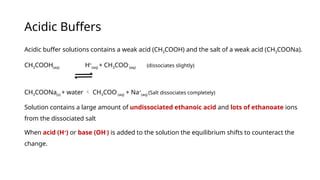
Acidic Buffers
Acidic buffersolutions contains a weak acid (CH3COOH) and the salt of a weak acid (CH3COONa).
CH3COOH(aq) H+
(aq) + CH3COO-
(aq) (dissociates slightly)
CH3COONa(s) + water CH3COO-
(aq) + Na+
(aq) (Salt dissociates completely)
Solution contains a large amount of undissociated ethanoic acid and lots of ethanoate ions
from the dissociated salt
When acid (H+
) or base (OH-
) is added to the solution the equilibrium shifts to counteract the
change.
33.
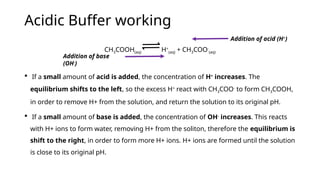
Acidic Buffer working
CH3COOH(aq)H+
(aq) + CH3COO-
(aq)
If a small amount of acid is added, the concentration of H+
increases. The
equilibrium shifts to the left, so the excess H+
react with CH3COO-
to form CH3COOH,
in order to remove H+ from the solution, and return the solution to its original pH.
If a small amount of base is added, the concentration of OH-
increases. This reacts
with H+ ions to form water, removing H+ from the soliton, therefore the equilibrium is
shift to the right, in order to form more H+ ions. H+ ions are formed until the solution
is close to its original pH.
Addition of acid (H+
)
Addition of base
(OH-
)
34.
Basic Buffers
Basicbuffer solutions contain a weak base and the salt of that weak base.
For example: Ammonia (NH3) and Ammonium chloride (NH4Cl).
NH3(aq) + H2O(l) NH4
+
(aq) + OH-
(aq) Weak base will hydrolyse partially.
NH4Cl(aq) NH4
+
(aq) + Cl-
(aq) Salt dissociates completely
Solution contains a large amount of undissociated ammonia and lots of
ammonium ions from the dissociated salt
When acid (H+
) or base (OH-
) is added to the solution the equilibrium shifts to
counteract the change
35.
Basic Buffers
NH3(aq) +H2O(l) N4H+
(aq) + OH-
(aq)
If a small amount of acid is added, the concentration of H+
increases. The H+ ions
react with OH-
to form water, this reduces the [OH-
] ions therefore the equilibrium
shifts to the right, to form more OH-
ions and to maintain its original pH.
If a small amount of base is added, the concentration of OH-
increases. This reacts
with NH4
+
ions forming NH3 and H2O. The equilibrium is shift to the left, to remove
OH-
ions from the solution, until the solution is close to its original pH.
Addition of acid (H+
)
Addition of base
(OH-
)
36.
Calculating the pHof a Buffer
To calculate the pH you need to know the Ka of the weak acid and the weak acid and
salt concentrations
e.g. A buffer solution contains 0.30 mol dm-3
ethanoic acid (CH3COOH) and 0.50 mol
dm-3
sodium ethanoate (CH3COO-
Na+
). Ka = 1.7 x 10⁻⁵
mol dm-3
for ethanoic acid.
What is the pH of this buffer?
1. Write the Ka expression for the weak acid:
CH3COOH(aq) H+
(aq) + CH3COO-
(aq) ;
37.
Calculating the pHof a Buffer
2. Rearrange the expression to make [H+
] the subject
taking -log on both sides.
-log
pH = pKa – log () = pKa + log ()
A few assumptions have to be made:
• CH3COO-
Na+
has fully dissociated –
assume that the equilibrium
concentration of CH3COO-
is equal
to the initial concentration of
CH3COO-
Na+
• CH3COOH has only slightly
dissociated therefore the
equilibrium concentration is the
same as the initial concentration
38.
Buffer Applications
Biologicalbuffers – blood needs to have a pH in the range of 7.35 to 7.45
therefore it contains a buffer system, to maintain this pH, to prevent damage to
cells and organs.
Hair care – Alkaline shampoos can damage hair, therefore a buffer is required to
prevent this – most shampoos contain a pH 5.5 buffer.
Biological washing powder – enzymes in the washing powder need to be in
solution which is at the optimal pH in order for them to work most effectively.
Therefore, buffers are added to washing powder to get the best results.
39.
Past Paper Question
•The numerical value of the Ka of HBrO is 2.00 × 10⁻⁹
. X is a solution of HBrO which
contains 4.00 × 10⁻³
mol of HBrO in 100cm3
of solution.
• In this solution the following equilibrium is established in which there are two
conjugate acid-base pairs.
• HBrO + H2 O BrO– + H3 O+
(i) Define conjugate acid-base pair.
(ii) Identify the two-conjugate acid-base pairs shown in the equation above
(iii) Calculate the pH of solution X. Show all your working.
(iv) A solution containing 2.00 × 10⁻³
mol of NaOH is added to solution X. A buffer
solution is formed. Calculate the pH of this buffer solution.
Recall
What is
meant by
solubility.
Whatis a
completely
soluble salt.
What is
meant by
partially
soluble salt.
What is an
example of
salt which in
less soluble in
water.
43.
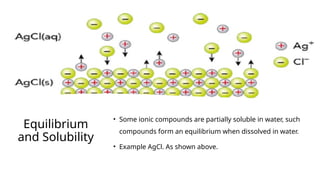
Equilibrium
and Solubility
• Someionic compounds are partially soluble in water, such
compounds form an equilibrium when dissolved in water.
• Example AgCl. As shown above.
44.
Solubility Product
• Whensolid silver chloride dissolves, it is in contact with saturated silver chloride
solution and the following equilibrium is set up:
AgCl(s) Ag
⇌ +
(aq) + Cl−
(aq) the equlibirum expression
• For AgCl(s) the concentration at equilibrium is unchanged. So we can write this
equilibrium expression as:
• Ksp is called the solubility product. Values are quoted at 298 K.
• Ksp = [Cy+
(aq)]a
[Ax−
(aq)]b
45.
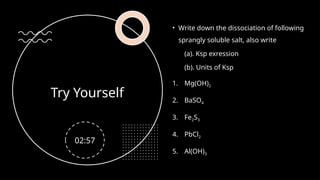
Try Yourself
• Writedown the dissociation of following
sprangly soluble salt, also write
(a). Ksp exression
(b). Units of Ksp
1. Mg(OH)2
2. BaSO4
3. Fe2S3
4. PbCl2
5. Al(OH)3
02:57
46.
Solubility product calculations
•Calculate the solubility product of a saturated solution of magnesium
fluoride, MgF2, has a solubility of 1.22 × 10 3
−
mol dm 3
−
.
• The dissociation of MgF2 is MgF2(s) Mg
⇌ 2+
(aq) + 2F−
(aq)
When 1.22 × 10 3 mol dissolves to form 1 dm3 of solution the concentration of each ion is:
−
[Mg2+
] = 1.22 × 10 3
−
mol dm 3
−
; [F−
] = 2 × 1.22 × 10 3
−
mol dm 3
−
= 2.44 × 10 3
−
M
Ksp = [Mg2+
] [F−
]2
; Ksp = (1.22 × 10 3
−
) × (2.44 × 10 3
−
)2
= 7.26 × 10 9
−
Ksp = 7.26 × 10 9
−
mol3
dm 9
−
47.
Solubility product calculations
Calculatethe solubility of copper(II) sulfide in mol dm 3
−
. (Ksp for CuS =
6.3 × 10 36
−
mol2
dm 6
−
).
Solution:
The equation: CuS(s) Cu
⇌ 2+
(aq) + S2−
(aq) so Ksp = [Cu2+
(aq)][S2−
(aq) ]
From the equilibrium equation [Cu2+
(aq)] = [S2−
(aq) ] So Ksp = [Cu2+
(aq)]2
Substitute the value of Ksp. (6.3 × 10 36
−
) = [Cu2+
]2
[Cu2+
] = (6.3 × 10 36
−
) = 2.5 × 10 18
−
mol dm 3
−
48.
Try yourself…
• Calculatethe solubility in mol dm 3
−
of zinc
sulfide, ZnS. (Ksp =1.6 × 10 23
−
mol2
dm 6
−
)
• Calculate the solubility of silver carbonate,
Ag2CO3. (Ksp = 6.3 × 10 12
−
mol3
dm 9
−
)
• Calculate the solubility product of the
following solutions:
• a saturated aqueous solution of
cadmium sulfide, CdS (solubility = 1.46
× 10 11
−
mol dm 3
−
)
• a saturated aqueous solution of
calcium fluoride, CaF2, containing
0.0168 g dm 3
−
CaF2
04:58
#11 A logarithmic scale is used as the concentration of hydrogen ions in aqueous solution covers a very wide range.
#13 If triprotic acids are also covered in the specification
#24 We ignore the concentration of hydrogen ions produced by the ionisation of the water molecules
present in the solution. This is reasonable because the ionic product of water (1.00 × 10⁻¹⁴ mol2 dm−6)
is negligible compared with the values for most weak acids.
#32 The shift in equilibrium is due to le chatliers princliple
#33 addition of H+ ions shifts the position of equilibrium to the left because H+ ions combine with CH3COO−
ions to form more CH3COOH until equilibrium is re-established
the large reserve supply of CH3COO− ensures that the concentration of CH3COO− ions in solution does
not change significantly
the large reserve supply of CH3COOH ensures that the concentration of CH3COOH molecules in solution
does not change significantly
#38 The pH of the blood is often checked by doctors as it can give information which helps identify problems in the working of body .
The cells in our body produce carbon dioxide as a product of aerobic respiration (the oxidation of glucose to
provide energy). Carbon dioxide combines with water in the blood to form a solution containing hydrogen
ions. CO2(aq) + H2O(aq) ⇌ H+(aq) + HCO3−(aq)
hydrogencarbonate ion. This reaction is catalysed by the enzyme carbonic anhydrase. When the blood passes through the small
blood vessels around our lungs, hydrogencarbonate ions are rapidly converted to carbon dioxide and water.
The carbon dioxide escapes into the lungs.
The production of H+ ions, if left unchecked, would lower the pH of the blood and cause ‘acidosis’. This may
disrupt some body functions and eventually lead to coma. The equilibrium between carbon dioxide and
hydrogencarbonate is the most important buffering system in the blood.



![Continued...
The constants are combined to give the ionic product of water – Kw
so
Kw is called the ionic product of water, the value of Kw = 1.0 x 10⁻¹⁴
mol2
dm-6
at 298 K
(25 °C).
Like any equilibrium constant, Kw varies with temperature.
In pure water [H+
] = [OH-
]
Therefore, in pure water Kw = [H+
]2
constant](https://image.slidesharecdn.com/acids-and-bases-250309104320-9b6a8695/85/Acids-and-Bases-Buffer-and-pH-calculation-8-320.jpg)
![Therefore, in pure water Kw = [H+
]2
Rearranging this equation the [H+
] in pure water
• The range of possible hydrogen ion concentrations in different solutions is very
large (10 15
−
M to 10 M).
• To overcome the problem of dealing with a wide range of numbers, the Danish
chemist Soren Sorensen introduced the pH scale.
pH = -log10[H+
]
• We can use this equation to convert [H+] to pH or pH to [H+]
• The negative sign is introduced to make the pH values positive in most cases](https://image.slidesharecdn.com/acids-and-bases-250309104320-9b6a8695/85/Acids-and-Bases-Buffer-and-pH-calculation-9-320.jpg)
![Calculating pH of a strong Acid
The pH of a solution is defined as the negative logarithm of the molar hydrogen-ion
concentration.
pH = -log10[H+
]
pH scale goes from 0 (very acidic) to 14 (very basic). pH 7 is neutral.
pH can be calculated if the hydrogen ion concentration is known.
e.g. The hydrogen ion concentration of a solution is 0.005 mol/dm3
. What is the pH of the
solution.
pH = -log10[H+
] = -log10(0.005) = 2.3
[H+
] – hydrogen ion
concentration (moldm-3
)](https://image.slidesharecdn.com/acids-and-bases-250309104320-9b6a8695/85/Acids-and-Bases-Buffer-and-pH-calculation-11-320.jpg)
![Monoprotic Acids
Strong acids ionise fully in solution
Monoprotic – each molecule of acid releases one proton when it dissociates.
One mole of acid produces one mole of hydrogen ions. Therefore, the hydrogen
ions concentration is the same as the acid concentration.
e.g. Calculating the pH of a 0.05 mol dm-3
solution of hydrochloric acid.
HCl is a monoprotic acid therefore [HCl] = [H+
]
[H+
] = 0.05 mol dm-3
, pH = -log10(0.05) = 1.3](https://image.slidesharecdn.com/acids-and-bases-250309104320-9b6a8695/85/Acids-and-Bases-Buffer-and-pH-calculation-12-320.jpg)
![Diprotic Acids
For strong diprotic acids, each molecule of acid will release 2 protons when
dissociated.
Each mole of diprotic acid produces 2 moles of hydrogen ions.
e.g. Calculating the pH of a 0.01 mol dm-3
solution of sulfuric acid (H2SO4)
Sulfuric acid is a strong diprotic acid therefore 2[H2SO4] = [H+
]
[H2SO4] = 0.01 mol dm-3
[H+
] = 2 x 0.01 mol dm-3
pH = -log10(0.02) = 1.7](https://image.slidesharecdn.com/acids-and-bases-250309104320-9b6a8695/85/Acids-and-Bases-Buffer-and-pH-calculation-13-320.jpg)
![Try yourself..
Calculate the pH of
a solution whose H+
ion concentration is
5.32 × 10 4
−
mol
dm 3
−
.
Calculate the pH of
the 70 g of HCl
dissolved in 1 dm3
[H+
] = 3.00 × 10 4
−
mol dm 3
−
[H+
] = 5.40 × 10 12
−
mol dm 3
−
[H+
] = 7.80 × 10 10
−
mol dm 3
−
Calculate pH of a
soluiton containing
11.6 g H2SO4 in
1dm3
container.
04:58](https://image.slidesharecdn.com/acids-and-bases-250309104320-9b6a8695/85/Acids-and-Bases-Buffer-and-pH-calculation-14-320.jpg)
![Calculating [H+
] from pH
Hydrogen ion concentration can also be calculated from pH.
The inverse of the pH equation can be used
[H+
] = antilog(-pH)
e.g. A solution of hydrochloric acid has a pH of 2.0. What is the hydrogen ion
concentration?
[H+
] = 10-pH
= 10-2.0
= 0.01 mol dm-3](https://image.slidesharecdn.com/acids-and-bases-250309104320-9b6a8695/85/Acids-and-Bases-Buffer-and-pH-calculation-15-320.jpg)
![Calculating pH of Strong Base
Strong bases fully ionise in water e.g. Sodium hydroxide (NaOH)
NaOH Na+
+ OH-
For one mole of strong base one mole of OH- ions are released.
The concentration of the base is the same as the concentration of OH-
ions.
To determine the pH the concentration of hydrogen ions is needed [H+
]
This can be found by using the Kw equation. Kw = [H+
][OH-
]
[H+
] = Kw/[OH-
]](https://image.slidesharecdn.com/acids-and-bases-250309104320-9b6a8695/85/Acids-and-Bases-Buffer-and-pH-calculation-17-320.jpg)
![Base pH Calculation Example
Example: Determine the pH of 0.20 moldm-3
of NaOH at 298 K.
1. Firstly, remember from the earlier slide that Kw = 1.0 x 10⁻¹⁴
mol2
dm-6
at 298 K.
2. Put all known values in the Kw equation, Kw = [H+
][OH-
].
1.0 x 10-14
= [H+
] x 0.20 ;
4. Calculate pH using [H+
] value. pH = -log10[H+
] = log10(5 x 10-14
) = 13.3](https://image.slidesharecdn.com/acids-and-bases-250309104320-9b6a8695/85/Acids-and-Bases-Buffer-and-pH-calculation-18-320.jpg)
![Ka and pH of weak Acids
Ka is the acid dissociation constant The Ka can be used to find the pH.
The equation of dissociation: HA(aq) H+
(aq) + A-
(aq)
Only a very small amount of HA dissociates so
it is assumed that [HA(aq)]equilibrium = [HA(aq)]start
Also assume that the acid dissociates much more than water therefore the H+
in
solution are from the acid [H+
(aq)] = [A-
(aq)]](https://image.slidesharecdn.com/acids-and-bases-250309104320-9b6a8695/85/Acids-and-Bases-Buffer-and-pH-calculation-27-320.jpg)
![Using Ka to find pH
Let’s Use the following information to calculate the hydrogen ions
concentration and pH of 0.030 mol dm-3
hydrogen fluoride at 298 K. Hydrogen
fluoride Ka at 298 K = 6.6 x 10⁻⁴
mol dm-3
1. Write down the expression for Ka
As HF(aq) H+
(aq) + F-
(aq)
2. Rearrange Ka expression to find [H+
]
3. Insert data given to find [H+
]; = 1.98 x 10⁻⁵
4. Calculate pH from [H+
]; pH = -log10(1.98 x 10⁻⁵
) = 4.70](https://image.slidesharecdn.com/acids-and-bases-250309104320-9b6a8695/85/Acids-and-Bases-Buffer-and-pH-calculation-28-320.jpg)
![Using Ka to find the Concentration
Calculate the molar concentration of a propanoic acid solution. The pH of
the solution is 3.30. Ka of propanoic acid at 298 K = 1.30 x 10⁻⁵
mol dm-3
.
1. Calculate [H+
] from the pH. [H+
] = 10-pH
[H+
] = 10-3.30
= 5.01 x 10⁻⁴
2. Write expression for Ka and rearrange to find [CH3CH2COOH]
so
= = 0.0193 mol dm-3](https://image.slidesharecdn.com/acids-and-bases-250309104320-9b6a8695/85/Acids-and-Bases-Buffer-and-pH-calculation-29-320.jpg)

![Basic Buffers
NH3(aq) + H2O(l) N4H+
(aq) + OH-
(aq)
If a small amount of acid is added, the concentration of H+
increases. The H+ ions
react with OH-
to form water, this reduces the [OH-
] ions therefore the equilibrium
shifts to the right, to form more OH-
ions and to maintain its original pH.
If a small amount of base is added, the concentration of OH-
increases. This reacts
with NH4
+
ions forming NH3 and H2O. The equilibrium is shift to the left, to remove
OH-
ions from the solution, until the solution is close to its original pH.
Addition of acid (H+
)
Addition of base
(OH-
)](https://image.slidesharecdn.com/acids-and-bases-250309104320-9b6a8695/85/Acids-and-Bases-Buffer-and-pH-calculation-35-320.jpg)
![Calculating the pH of a Buffer
2. Rearrange the expression to make [H+
] the subject
taking -log on both sides.
-log
pH = pKa – log () = pKa + log ()
A few assumptions have to be made:
• CH3COO-
Na+
has fully dissociated –
assume that the equilibrium
concentration of CH3COO-
is equal
to the initial concentration of
CH3COO-
Na+
• CH3COOH has only slightly
dissociated therefore the
equilibrium concentration is the
same as the initial concentration](https://image.slidesharecdn.com/acids-and-bases-250309104320-9b6a8695/85/Acids-and-Bases-Buffer-and-pH-calculation-37-320.jpg)

![Solubility Product
• When solid silver chloride dissolves, it is in contact with saturated silver chloride
solution and the following equilibrium is set up:
AgCl(s) Ag
⇌ +
(aq) + Cl−
(aq) the equlibirum expression
• For AgCl(s) the concentration at equilibrium is unchanged. So we can write this
equilibrium expression as:
• Ksp is called the solubility product. Values are quoted at 298 K.
• Ksp = [Cy+
(aq)]a
[Ax−
(aq)]b](https://image.slidesharecdn.com/acids-and-bases-250309104320-9b6a8695/85/Acids-and-Bases-Buffer-and-pH-calculation-44-320.jpg)
![Solubility product calculations
• Calculate the solubility product of a saturated solution of magnesium
fluoride, MgF2, has a solubility of 1.22 × 10 3
−
mol dm 3
−
.
• The dissociation of MgF2 is MgF2(s) Mg
⇌ 2+
(aq) + 2F−
(aq)
When 1.22 × 10 3 mol dissolves to form 1 dm3 of solution the concentration of each ion is:
−
[Mg2+
] = 1.22 × 10 3
−
mol dm 3
−
; [F−
] = 2 × 1.22 × 10 3
−
mol dm 3
−
= 2.44 × 10 3
−
M
Ksp = [Mg2+
] [F−
]2
; Ksp = (1.22 × 10 3
−
) × (2.44 × 10 3
−
)2
= 7.26 × 10 9
−
Ksp = 7.26 × 10 9
−
mol3
dm 9
−](https://image.slidesharecdn.com/acids-and-bases-250309104320-9b6a8695/85/Acids-and-Bases-Buffer-and-pH-calculation-46-320.jpg)
![Solubility product calculations
Calculate the solubility of copper(II) sulfide in mol dm 3
−
. (Ksp for CuS =
6.3 × 10 36
−
mol2
dm 6
−
).
Solution:
The equation: CuS(s) Cu
⇌ 2+
(aq) + S2−
(aq) so Ksp = [Cu2+
(aq)][S2−
(aq) ]
From the equilibrium equation [Cu2+
(aq)] = [S2−
(aq) ] So Ksp = [Cu2+
(aq)]2
Substitute the value of Ksp. (6.3 × 10 36
−
) = [Cu2+
]2
[Cu2+
] = (6.3 × 10 36
−
) = 2.5 × 10 18
−
mol dm 3
−](https://image.slidesharecdn.com/acids-and-bases-250309104320-9b6a8695/85/Acids-and-Bases-Buffer-and-pH-calculation-47-320.jpg)