HOMEOSTASIS & THE 
NERVOUS SYSTEM
Objective 
• F. Describe the structure of the brain, spinal cord, sensory 
and motor neurons and sensory receptors and relate to 
their function 
Guiding Ideas 
• The brain is the control center of the body. The numerous 
sections of the brain carry out specific tasks that function 
in maintaining homeostasis. 
• The nervous system is responsible for relaying messages 
to/from the brain to the body.
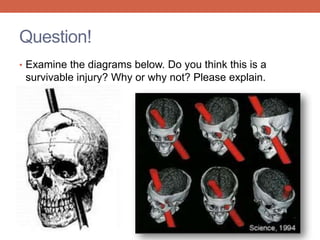
Question! 
• Examine the diagrams below. Do you think this is a 
survivable injury? Why or why not? Please explain.
Phineas Gage
THE BRAIN
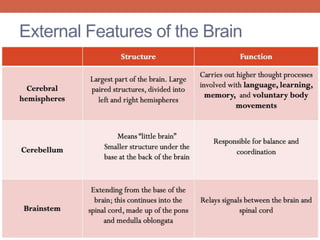
External Features of the Brain
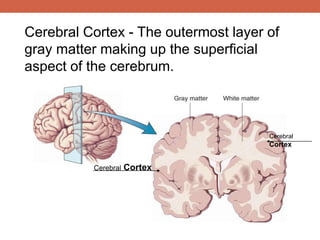
Cerebral Cortex - The outermost layer of 
gray matter making up the superficial 
aspect of the cerebrum. 
Cerebral Cortex 
Cerebral 
Cortex
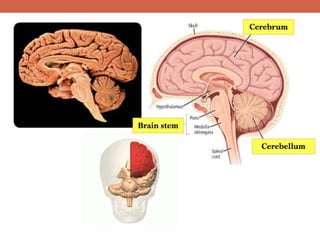
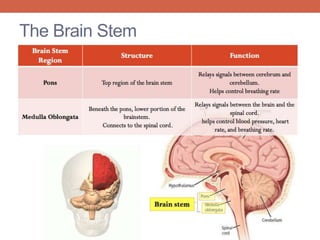
The Brain Stem
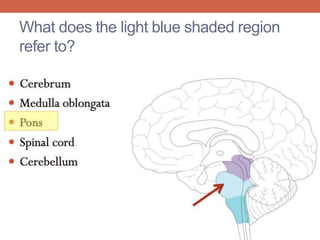
What does the light blue shaded region 
refer to?
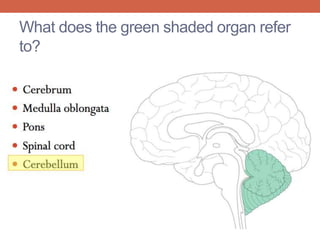
What does the green shaded organ refer 
to?
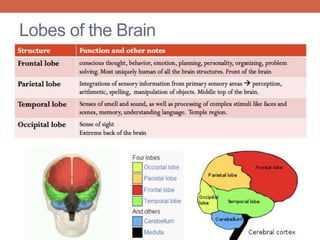
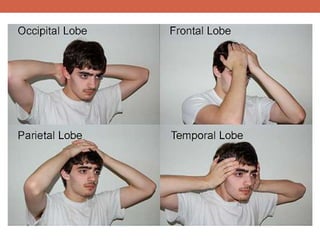
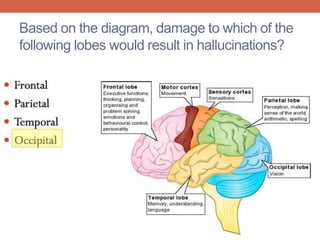
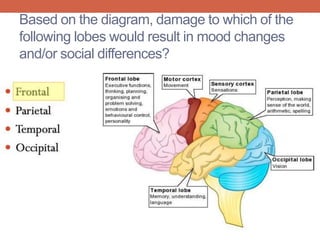
Lobes of the Brain
Based on the diagram, damage to which of the 
following lobes would result in hallucinations?
Based on the diagram, damage to which of the 
following lobes would result in mood changes 
and/or social differences?
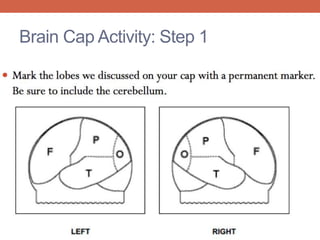
Brain Cap Activity: Step 1
Step 2: 
• Wear and share your caps!
NERVOUS SYSTEM
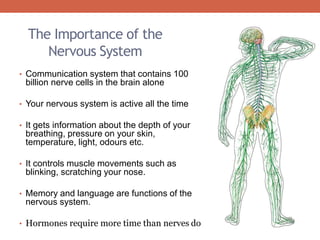
The Importance of the 
Nervous System 
• Communication system that contains 100 
billion nerve cells in the brain alone 
• Your nervous system is active all the time 
• It gets information about the depth of your 
breathing, pressure on your skin, 
temperature, light, odours etc. 
• It controls muscle movements such as 
blinking, scratching your nose. 
• Memory and language are functions of the 
nervous system. 
• Hormones require more time than nerves do
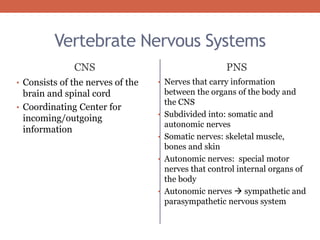
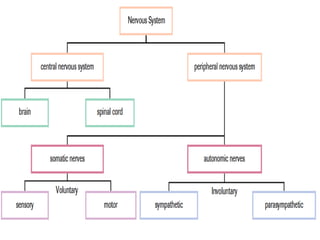
Vertebrate Nervous Systems 
CNS PNS 
• Consists of the nerves of the 
brain and spinal cord 
• Coordinating Center for 
incoming/outgoing 
information 
• Nerves that carry information 
between the organs of the body and 
the CNS 
• Subdivided into: somatic and 
autonomic nerves 
• Somatic nerves: skeletal muscle, 
bones and skin 
• Autonomic nerves: special motor 
nerves that control internal organs of 
the body 
• Autonomic nerves  sympathetic and 
parasympathetic nervous system
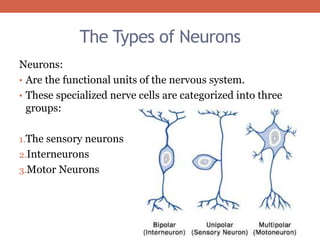
The Types of Neurons 
Neurons: 
• Are the functional units of the nervous system. 
• These specialized nerve cells are categorized into three 
groups: 
1.The sensory neurons 
2.Interneurons 
3.Motor Neurons
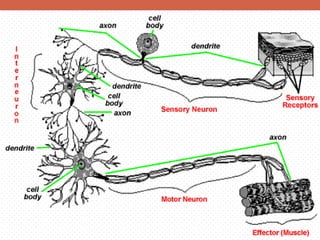
1. Sensory Neurons (afferent neurons) 
• Sense and relay information (stimuli) from the 
environment to the CNS for processing 
• Example: photoreceptors, chemoreceptors and 
thermoreceptors
2. Interneurons 
• Link neurons within the body 
• Predominantly located in the brain and spinal cord 
• Integrate and interpret sensory information and 
connect neurons to outgoing motor neurons 
3. Motor Neurons (efferent neurons) 
• Relay information to the effectors 
• Effectors include muscles, organs and glands  
because they produce responses
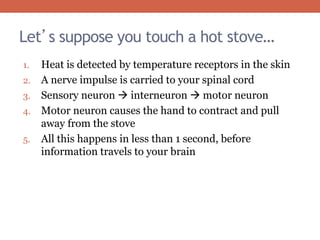
Let’s suppose you touch a hot stove… 
1. Heat is detected by temperature receptors in the skin 
2. A nerve impulse is carried to your spinal cord 
3. Sensory neuron  interneuron  motor neuron 
4. Motor neuron causes the hand to contract and pull 
away from the stove 
5. All this happens in less than 1 second, before 
information travels to your brain
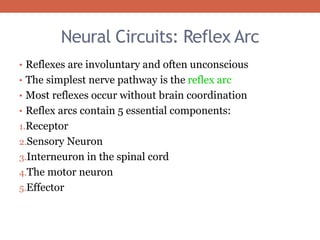
Neural Circuits: Reflex Arc 
• Reflexes are involuntary and often unconscious 
• The simplest nerve pathway is the reflex arc 
• Most reflexes occur without brain coordination 
• Reflex arcs contain 5 essential components: 
1.Receptor 
2.Sensory Neuron 
3.Interneuron in the spinal cord 
4.The motor neuron 
5.Effector
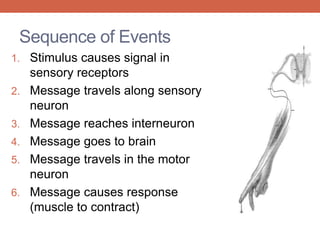
Sequence of Events 
1. Stimulus causes signal in 
sensory receptors 
2. Message travels along sensory 
neuron 
3. Message reaches interneuron 
4. Message goes to brain 
5. Message travels in the motor 
neuron 
6. Message causes response 
(muscle to contract)
Test your reflexes!! 
• http://reflextest.net/ 
• Extra practice and review 
• http://www.bbc.co.uk/schools/gcsebitesize/science/aqa/ne 
rvesandhormones/thenervoussystemact.shtml

F.1 nervous system homeostasis

  • 1.
    HOMEOSTASIS & THE NERVOUS SYSTEM
  • 2.
    Objective • F.Describe the structure of the brain, spinal cord, sensory and motor neurons and sensory receptors and relate to their function Guiding Ideas • The brain is the control center of the body. The numerous sections of the brain carry out specific tasks that function in maintaining homeostasis. • The nervous system is responsible for relaying messages to/from the brain to the body.
  • 3.
    Question! • Examinethe diagrams below. Do you think this is a survivable injury? Why or why not? Please explain.
  • 4.
  • 5.
  • 6.
  • 7.
    Cerebral Cortex -The outermost layer of gray matter making up the superficial aspect of the cerebrum. Cerebral Cortex Cerebral Cortex
  • 9.
  • 10.
    What does thelight blue shaded region refer to?
  • 11.
    What does thegreen shaded organ refer to?
  • 12.
  • 14.
    Based on thediagram, damage to which of the following lobes would result in hallucinations?
  • 15.
    Based on thediagram, damage to which of the following lobes would result in mood changes and/or social differences?
  • 16.
  • 17.
    Step 2: •Wear and share your caps!
  • 18.
  • 19.
    The Importance ofthe Nervous System • Communication system that contains 100 billion nerve cells in the brain alone • Your nervous system is active all the time • It gets information about the depth of your breathing, pressure on your skin, temperature, light, odours etc. • It controls muscle movements such as blinking, scratching your nose. • Memory and language are functions of the nervous system. • Hormones require more time than nerves do
  • 20.
    Vertebrate Nervous Systems CNS PNS • Consists of the nerves of the brain and spinal cord • Coordinating Center for incoming/outgoing information • Nerves that carry information between the organs of the body and the CNS • Subdivided into: somatic and autonomic nerves • Somatic nerves: skeletal muscle, bones and skin • Autonomic nerves: special motor nerves that control internal organs of the body • Autonomic nerves  sympathetic and parasympathetic nervous system
  • 22.
    The Types ofNeurons Neurons: • Are the functional units of the nervous system. • These specialized nerve cells are categorized into three groups: 1.The sensory neurons 2.Interneurons 3.Motor Neurons
  • 23.
    1. Sensory Neurons(afferent neurons) • Sense and relay information (stimuli) from the environment to the CNS for processing • Example: photoreceptors, chemoreceptors and thermoreceptors
  • 24.
    2. Interneurons •Link neurons within the body • Predominantly located in the brain and spinal cord • Integrate and interpret sensory information and connect neurons to outgoing motor neurons 3. Motor Neurons (efferent neurons) • Relay information to the effectors • Effectors include muscles, organs and glands  because they produce responses
  • 26.
    Let’s suppose youtouch a hot stove… 1. Heat is detected by temperature receptors in the skin 2. A nerve impulse is carried to your spinal cord 3. Sensory neuron  interneuron  motor neuron 4. Motor neuron causes the hand to contract and pull away from the stove 5. All this happens in less than 1 second, before information travels to your brain
  • 27.
    Neural Circuits: ReflexArc • Reflexes are involuntary and often unconscious • The simplest nerve pathway is the reflex arc • Most reflexes occur without brain coordination • Reflex arcs contain 5 essential components: 1.Receptor 2.Sensory Neuron 3.Interneuron in the spinal cord 4.The motor neuron 5.Effector
  • 28.
    Sequence of Events 1. Stimulus causes signal in sensory receptors 2. Message travels along sensory neuron 3. Message reaches interneuron 4. Message goes to brain 5. Message travels in the motor neuron 6. Message causes response (muscle to contract)
  • 29.
    Test your reflexes!! • http://reflextest.net/ • Extra practice and review • http://www.bbc.co.uk/schools/gcsebitesize/science/aqa/ne rvesandhormones/thenervoussystemact.shtml