Acid-Base Titration
Titration Analyte – the substance with an unknown value concentration that needs to be found Standard – a substance with a known concentration that can be used to determine the unknown value of the analyte
Acid-Base Titration acid + base    salt + water  HCl(aq) + NaOH(aq)    H 2 O(l) + NaCl(aq) H +  (aq) + OH - (aq)    H 2 O(l)  H 2 SO 4  (aq) +2NaOH (aq)    Na 2 SO 4  (aq) + 2H 2 O Why is this considered a neutralization titration?
Analyte Concentration Equivalence Point – the point in an acid-base titration when the moles of H +  equals the moles of OH -  H +  (aq) + OH - (aq)    H 2 O(l)
Equivalence Point pH sensor – a device that measures pH Indicator – a solution that changes colors with a change in pH Why is the determination of the equivalence point important?
 
PROCEDURE HINTS! Should have 3  good  sets of data Look at your graphs before you leave the lab Be sure to rinse the sensor well between trials Be careful with pH sensors, they are fragile and expensive
When the pH sensor is returned be sure the tip is submerged completely in the storage solution and that it is standing upright.
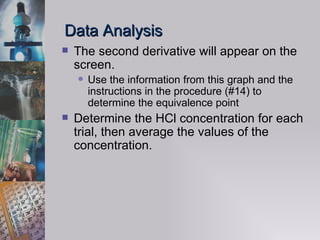
Data Analysis The second derivative will appear on the screen. Use the information from this graph and the instructions in the procedure (#14) to determine the equivalence point Determine the HCl concentration for each trial, then average the values of the concentration.
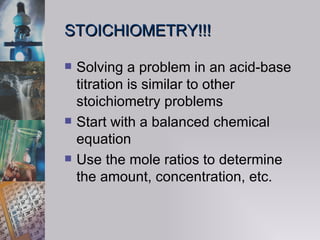
STOICHIOMETRY!!! Solving a problem in an acid-base titration is similar to other stoichiometry problems  Start with a balanced chemical equation Use the mole ratios to determine the amount, concentration, etc.
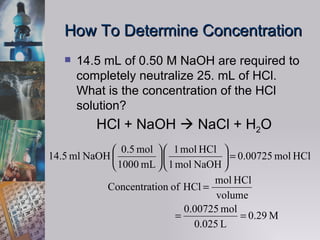
How To Determine Concentration 14.5 mL of 0.50 M NaOH are required to completely neutralize 25. mL of HCl.  What is the concentration of the HCl solution? HCl + NaOH    NaCl + H 2 O
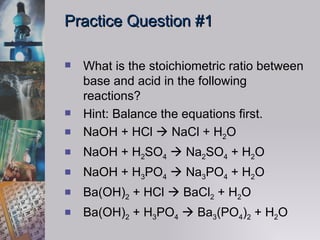
Practice Question #1 What is the stoichiometric ratio between base and acid in the following reactions?  Hint: Balance the equations first. NaOH + HCl    NaCl + H 2 O NaOH + H 2 SO 4     Na 2 SO 4  + H 2 O NaOH + H 3 PO 4     Na 3 PO 4  + H 2 O Ba(OH) 2  + HCl    BaCl 2  + H 2 O Ba(OH) 2  + H 3 PO 4     Ba 3 (PO 4 ) 2  + H 2 O
Practice Question #2 A solution contains 30.00 g of NaOH in 1000. ml of solution. What is the molarity of the solution?
Practice Question #3 How many ml of 0.10 M HCl would be required to neutralize 30ml of 0.10 M KOH?  30 mL of Ca(OH) 2 ?

06 microscale titration_fa06

  • 1.
  • 2.
    Titration Analyte –the substance with an unknown value concentration that needs to be found Standard – a substance with a known concentration that can be used to determine the unknown value of the analyte
  • 3.
    Acid-Base Titration acid+ base  salt + water HCl(aq) + NaOH(aq)  H 2 O(l) + NaCl(aq) H + (aq) + OH - (aq)  H 2 O(l) H 2 SO 4 (aq) +2NaOH (aq)  Na 2 SO 4 (aq) + 2H 2 O Why is this considered a neutralization titration?
  • 4.
    Analyte Concentration EquivalencePoint – the point in an acid-base titration when the moles of H + equals the moles of OH - H + (aq) + OH - (aq)  H 2 O(l)
  • 5.
    Equivalence Point pHsensor – a device that measures pH Indicator – a solution that changes colors with a change in pH Why is the determination of the equivalence point important?
  • 6.
  • 7.
    PROCEDURE HINTS! Shouldhave 3 good sets of data Look at your graphs before you leave the lab Be sure to rinse the sensor well between trials Be careful with pH sensors, they are fragile and expensive
  • 8.
    When the pHsensor is returned be sure the tip is submerged completely in the storage solution and that it is standing upright.
  • 9.
    Data Analysis Thesecond derivative will appear on the screen. Use the information from this graph and the instructions in the procedure (#14) to determine the equivalence point Determine the HCl concentration for each trial, then average the values of the concentration.
  • 10.
    STOICHIOMETRY!!! Solving aproblem in an acid-base titration is similar to other stoichiometry problems Start with a balanced chemical equation Use the mole ratios to determine the amount, concentration, etc.
  • 11.
    How To DetermineConcentration 14.5 mL of 0.50 M NaOH are required to completely neutralize 25. mL of HCl. What is the concentration of the HCl solution? HCl + NaOH  NaCl + H 2 O
  • 12.
    Practice Question #1What is the stoichiometric ratio between base and acid in the following reactions? Hint: Balance the equations first. NaOH + HCl  NaCl + H 2 O NaOH + H 2 SO 4  Na 2 SO 4 + H 2 O NaOH + H 3 PO 4  Na 3 PO 4 + H 2 O Ba(OH) 2 + HCl  BaCl 2 + H 2 O Ba(OH) 2 + H 3 PO 4  Ba 3 (PO 4 ) 2 + H 2 O
  • 13.
    Practice Question #2A solution contains 30.00 g of NaOH in 1000. ml of solution. What is the molarity of the solution?
  • 14.
    Practice Question #3How many ml of 0.10 M HCl would be required to neutralize 30ml of 0.10 M KOH? 30 mL of Ca(OH) 2 ?

Editor's Notes

  • #3 Analyte: Solution with the unknown concentration Standard: Solution with the unknown concentration You must have a BALANCED chemical equation before looking at the stoichiometry
  • #4 pH is a measurement of the H+ concentration, pH = - log (H+) pOH is a measurement of the OH- concentration, pOH = - log (OH-) pH + pOH = 14 If you start with a solution of HCl, is the pH going to be high or low? What happens to that pH as base is added? Before doing any calculations you must start with a balanced chemical equation. To predict the products of an acid-base reaction, ions change partners. Result is salt and water. Balance equation before doing calculations. Just about every exam for CHE 115 has had at least one titration calculation without a 1:1 ratio.
  • #5 The equivalence point is when the moles of H+ and OH- are equal, NOT when the moles of acid and base are equal. For an acid such as HCl and a base like NaOH, when the moles of H+ and OH- are equal, the moles of HCl and NaOH are equal. That is not the case for polyprotic acids such as H2SO4 or H3PO4 or bases such as Ba(OH)2 Endpoint is where the indicator changes color. This is *usually*, but not always after the equivalence point. It is always best to go past the end point to make sure you have completed the titration. If the indicator was chosen well, the endpoint and equivalence point will be very close to the same volume.
  • #6 The equivalence point can be determined in several ways. Measuring the pH is the most accurate method, but indicators can also be used. Indicators weak acids or bases that change color as the amount of H+ and OH- change. Typically change over 1-2 pH units and different indicators are used for to determine different pH changes. See Appendix in lab manual. The important thing is to understand why we need the equivalence point – to calculate the concentration of the unknown solution.
  • #7 Explain set-up.
  • #8 They can view the graph on their calculator or on the computer, but they should have three good titration curves before they leave the lab. What makes a good titration curve? A steep portion near the equivalence point with several data points in the region. If they have multiple outliers (i.e. pH goes up and then back down on the next drop), they should do another trial.
  • #9 Before leaving the lab, all pH sensors should be stored upright so that the tip is in the storage bottle, which is on the bottom, and the tip is immersed in the solution.
  • #10 - Students who have had calculus may be familiar with the term second derivative, others may not. It is okay if they don’t understand what it means, just follow the instructions.
  • #11 Make a big point that acid-base titration problems are just like other stoichiometry problems. Start with a balanced chemical equation, convert to moles, use mole rations, and convert to the desired units. The main difference is that instead of talking about a product and a reactant, you are looking at two reactants. If you start with a balanced chemical equation, it doesn’t matter what of the equation the substance is on.