Acids and Bases
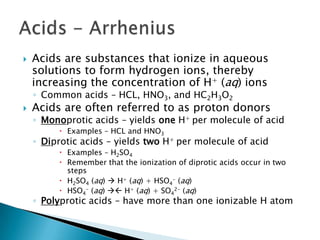
Acids are substances that ionize in aqueous solutions to form hydrogen ions, thereby increasing the concentration of H+ (aq) ionsCommon acids – HCL, HNO3, and HC2H3O2Acids are often referred to as proton donorsMonoprotic acids – yields oneH+ per molecule of acid Examples – HCL and HNO3Diprotic acids – yields two H+ per molecule of acidExamples – H2SO4Remember that the ionization of diprotic acids occur in two stepsH2SO4 (aq)  H+ (aq) + HSO4- (aq)HSO4- (aq)  H+ (aq) + SO42- (aq)Polyprotic acids – have more than one ionizable H atomAcids - Arrhenius
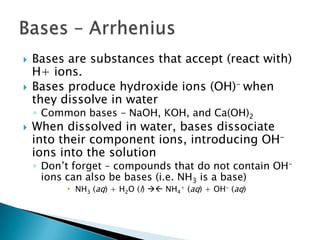
Bases are substances that accept (react with) H+ ions.Bases produce hydroxide ions (OH)- when they dissolve in waterCommon bases – NaOH, KOH, and Ca(OH)2When dissolved in water, bases dissociate into their component ions, introducing OH- ions into the solutionDon’t forget – compounds that do not contain OH- ions can also be bases (i.e. NH3 is a base)NH3 (aq) + H2O (l)  NH4+ (aq) + OH- (aq)Bases – Arrhenius
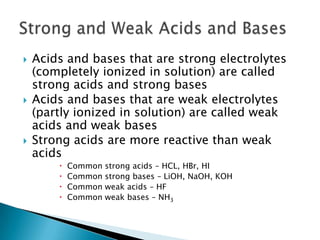
Acids and bases that are strong electrolytes (completely ionized in solution) are called strong acids and strong basesAcids and bases that are weak electrolytes (partly ionized in solution) are called weak acids and weak basesStrong acids are more reactive than weak acidsCommon strong acids – HCL, HBr, HICommon strong bases – LiOH, NaOH, KOHCommon weak acids – HFCommon weak bases – NH3Strong and Weak Acids and Bases
The name of an acid is related to the name of its anionRulesAcids based on anions whose name en in –ate or –ite.  Anions whose names end in –ate have associated acids with an –ic ending, whereas anions whose names end in –ite have acids with an-ous ending.  Prefixes in the name of the anion are retained in the name of the acids.Anion - ClO- (hypochlorite)   Corresponding Acid  - HClO (hypochlorous acidAnion – ClO4- (perchlorate)    Corresponding Acid – HClO4 (perchloric acid)Acids based on anions whose names end in –ide. Anions whose names end in –ide have associated acids that have the hydro- prefix and an –ic endingAnion – Cl- (chloride)      Corresponding Acid – HCl (hydrochloric acid)Names and Formulas of Acids
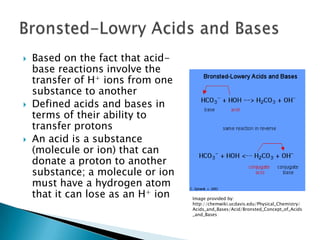
Based on the fact that acid-base reactions involve the transfer of H+ ions from one substance to anotherDefined acids and bases in terms of their ability to transfer protonsAn acid is a substance (molecule or ion) that can donate a proton to another substance; a molecule or ion must have a hydrogen atom that it can lose as an H+ ionBronsted-Lowry Acids and BasesImage provided by: http://chemwiki.ucdavis.edu/Physical_Chemistry/Acids_and_Bases/Acid/Bronsted_Concept_of_Acids_and_Bases
A base is a substance that can accept a proton; a molecule or ion must have a nonbonding pair of electrons that it can use to bind the H+ ionAn acid and a base always work together to transfer a protonSome substances can act as an acid in one reaction and as a base in another – called amphotericActs as a base when combined with something more strongly acidic than itself, and as an acid when combined with something more strongly basic than itselfBronsted-Lowry Acids and Bases
Because the molar concentration of H+ (aq) in an aqueous solution is usually very small, we usually express [H+] in terms of pH, which is the negative logarithm in base 10 of [H+]pH = -log[H+] A solution is neutral if [H+] = [OH-]Don’t forget your constants that can help calculate pH and concentrationsKw (ion-product) for water = 1.0 x 10⁻¹⁴ (at 25oC) Ka (acid-dissociation) – the larger the Ka value, the stronger the acidKb (base-dissociation) – refers the equilibrium in which a base reacts with water to form the corresponding conjugate acid and OH-The product of the acid-dissociation constant for an acid and the base-dissociation constant for its conjugate base is the ion-product constant for water (Ka x Kb = Kw)Measuring pH:pH meter, acid-base indicators – colored substance that itself can exist in either an acid or a base form; have different colors, indicator turns one color in an acid and another color in a baseThe pH Scale
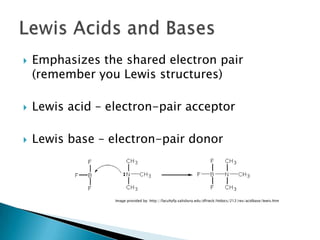
Emphasizes the shared electron pair (remember you Lewis structures)Lewis acid – electron-pair acceptorLewis base – electron-pair donorLewis Acids and BasesImage provided by: http://facultyfp.salisbury.edu/dfrieck/htdocs/212/rev/acidbase/lewis.htm
References

Acids and Bases

  • 1.
  • 2.
    Acids are substancesthat ionize in aqueous solutions to form hydrogen ions, thereby increasing the concentration of H+ (aq) ionsCommon acids – HCL, HNO3, and HC2H3O2Acids are often referred to as proton donorsMonoprotic acids – yields oneH+ per molecule of acid Examples – HCL and HNO3Diprotic acids – yields two H+ per molecule of acidExamples – H2SO4Remember that the ionization of diprotic acids occur in two stepsH2SO4 (aq)  H+ (aq) + HSO4- (aq)HSO4- (aq)  H+ (aq) + SO42- (aq)Polyprotic acids – have more than one ionizable H atomAcids - Arrhenius
  • 3.
    Bases are substancesthat accept (react with) H+ ions.Bases produce hydroxide ions (OH)- when they dissolve in waterCommon bases – NaOH, KOH, and Ca(OH)2When dissolved in water, bases dissociate into their component ions, introducing OH- ions into the solutionDon’t forget – compounds that do not contain OH- ions can also be bases (i.e. NH3 is a base)NH3 (aq) + H2O (l)  NH4+ (aq) + OH- (aq)Bases – Arrhenius
  • 4.
    Acids and basesthat are strong electrolytes (completely ionized in solution) are called strong acids and strong basesAcids and bases that are weak electrolytes (partly ionized in solution) are called weak acids and weak basesStrong acids are more reactive than weak acidsCommon strong acids – HCL, HBr, HICommon strong bases – LiOH, NaOH, KOHCommon weak acids – HFCommon weak bases – NH3Strong and Weak Acids and Bases
  • 5.
    The name ofan acid is related to the name of its anionRulesAcids based on anions whose name en in –ate or –ite. Anions whose names end in –ate have associated acids with an –ic ending, whereas anions whose names end in –ite have acids with an-ous ending. Prefixes in the name of the anion are retained in the name of the acids.Anion - ClO- (hypochlorite) Corresponding Acid - HClO (hypochlorous acidAnion – ClO4- (perchlorate) Corresponding Acid – HClO4 (perchloric acid)Acids based on anions whose names end in –ide. Anions whose names end in –ide have associated acids that have the hydro- prefix and an –ic endingAnion – Cl- (chloride) Corresponding Acid – HCl (hydrochloric acid)Names and Formulas of Acids
  • 6.
    Based on thefact that acid-base reactions involve the transfer of H+ ions from one substance to anotherDefined acids and bases in terms of their ability to transfer protonsAn acid is a substance (molecule or ion) that can donate a proton to another substance; a molecule or ion must have a hydrogen atom that it can lose as an H+ ionBronsted-Lowry Acids and BasesImage provided by: http://chemwiki.ucdavis.edu/Physical_Chemistry/Acids_and_Bases/Acid/Bronsted_Concept_of_Acids_and_Bases
  • 7.
    A base isa substance that can accept a proton; a molecule or ion must have a nonbonding pair of electrons that it can use to bind the H+ ionAn acid and a base always work together to transfer a protonSome substances can act as an acid in one reaction and as a base in another – called amphotericActs as a base when combined with something more strongly acidic than itself, and as an acid when combined with something more strongly basic than itselfBronsted-Lowry Acids and Bases
  • 8.
    Because the molarconcentration of H+ (aq) in an aqueous solution is usually very small, we usually express [H+] in terms of pH, which is the negative logarithm in base 10 of [H+]pH = -log[H+] A solution is neutral if [H+] = [OH-]Don’t forget your constants that can help calculate pH and concentrationsKw (ion-product) for water = 1.0 x 10⁻¹⁴ (at 25oC) Ka (acid-dissociation) – the larger the Ka value, the stronger the acidKb (base-dissociation) – refers the equilibrium in which a base reacts with water to form the corresponding conjugate acid and OH-The product of the acid-dissociation constant for an acid and the base-dissociation constant for its conjugate base is the ion-product constant for water (Ka x Kb = Kw)Measuring pH:pH meter, acid-base indicators – colored substance that itself can exist in either an acid or a base form; have different colors, indicator turns one color in an acid and another color in a baseThe pH Scale
  • 9.
    Emphasizes the sharedelectron pair (remember you Lewis structures)Lewis acid – electron-pair acceptorLewis base – electron-pair donorLewis Acids and BasesImage provided by: http://facultyfp.salisbury.edu/dfrieck/htdocs/212/rev/acidbase/lewis.htm
  • 10.