Predicting Solubilities
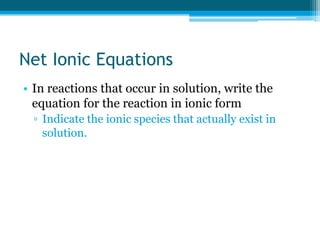
Net Ionic Equations
• In reactions that occur in solution, write the
  equation for the reaction in ionic form
  ▫ Indicate the ionic species that actually exist in
    solution.
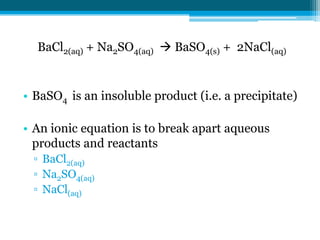
BaCl2(aq) + Na2SO4(aq)  BaSO4(s) + 2NaCl(aq)


• BaSO4 is an insoluble product (i.e. a precipitate)

• An ionic equation is to break apart aqueous
  products and reactants
  ▫ BaCl2(aq)
  ▫ Na2SO4(aq)
  ▫ NaCl(aq)
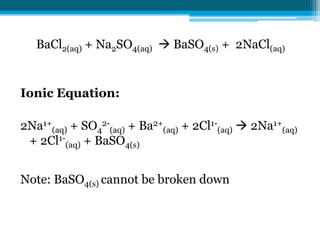
BaCl2(aq) + Na2SO4(aq)  BaSO4(s) + 2NaCl(aq)


Ionic Equation:

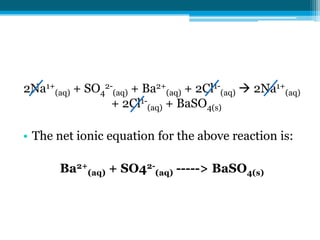
2Na1+(aq) + SO42-(aq) + Ba2+(aq) + 2Cl1-(aq)  2Na1+(aq)
 + 2Cl1-(aq) + BaSO4(s)


Note: BaSO4(s) cannot be broken down
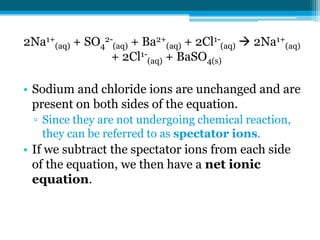
2Na1+(aq) + SO42-(aq) + Ba2+(aq) + 2Cl1-(aq)  2Na1+(aq)
                 + 2Cl1-(aq) + BaSO4(s)

• Sodium and chloride ions are unchanged and are
  present on both sides of the equation.
  ▫ Since they are not undergoing chemical reaction,
    they can be referred to as spectator ions.
• If we subtract the spectator ions from each side
  of the equation, we then have a net ionic
  equation.
2Na1+(aq) + SO42-(aq) + Ba2+(aq) + 2Cl1-(aq)  2Na1+(aq)
                 + 2Cl1-(aq) + BaSO4(s)

• The net ionic equation for the above reaction is:

       Ba2+(aq) + SO42-(aq) -----> BaSO4(s)
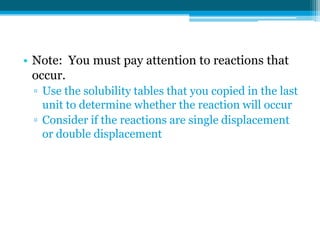
• Note: You must pay attention to reactions that
  occur.
 ▫ Use the solubility tables that you copied in the last
   unit to determine whether the reaction will occur
 ▫ Consider if the reactions are single displacement
   or double displacement
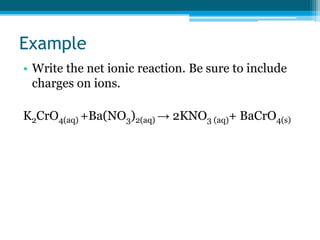
Example
• Write the net ionic reaction. Be sure to include
  charges on ions.

K2CrO4(aq) +Ba(NO3)2(aq) → 2KNO3 (aq)+ BaCrO4(s)
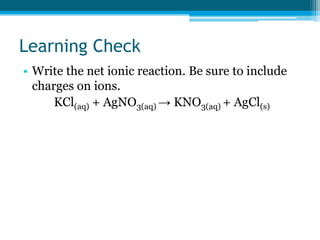
Learning Check
• Write the net ionic reaction. Be sure to include
  charges on ions.
      KCl(aq) + AgNO3(aq) → KNO3(aq) + AgCl(s)
Learning Check
• Write the net ionic reaction. Be sure to include
  charges on ions.

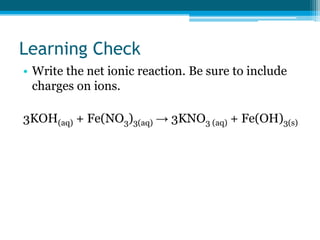
3KOH(aq) + Fe(NO3)3(aq) → 3KNO3 (aq) + Fe(OH)3(s)
Solubility Curves
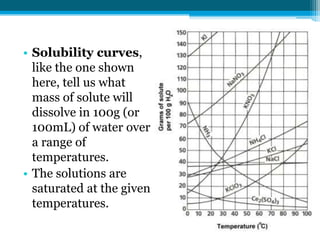
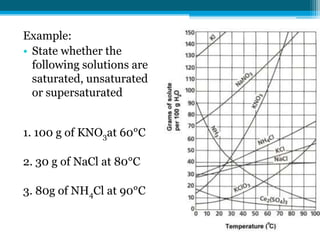
• Solubility curves,
  like the one shown
  here, tell us what
  mass of solute will
  dissolve in 100g (or
  100mL) of water over
  a range of
  temperatures.
• The solutions are
  saturated at the given
  temperatures.
Example:
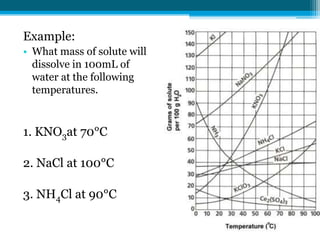
• What mass of solute will
  dissolve in 100mL of
  water at the following
  temperatures.


1. KNO3at 70°C

2. NaCl at 100°C

3. NH4Cl at 90°C
Example:
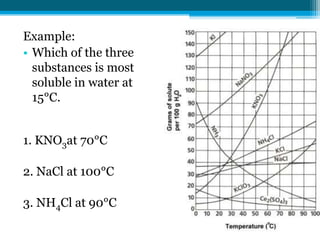
• Which of the three
  substances is most
  soluble in water at
  15°C.


1. KNO3at 70°C

2. NaCl at 100°C

3. NH4Cl at 90°C
Example:
• State whether the
  following solutions are
  saturated, unsaturated
  or supersaturated


1. 100 g of KNO3at 60°C

2. 30 g of NaCl at 80°C

3. 80g of NH4Cl at 90°C
• You'll notice that for most substances, solubility
  increases as temperature increases.

• In solutions involving liquids and solids typically
  more solute can be dissolved at higher
  temperatures.

• There are exceptions to this rule, however, we
  will not get into them in this course.
Homework
• Solubility Curve Worksheet
Concentration of a Solution from the
Mass of the Precipitate
• A student carefully measured 100 mL of a silver
  nitrate solution, AgNO3(aq), of unknown
  concentration and added a copper coil. When
  the reaction was complete, the solution was
  filtered to obtain all the silver. The dry
  precipitate had a mass of 1.65 g. What was the
  molar concentration of the silver nitrate
  solution?
Limiting Reactants and Precipitates
  In water purification, aluminum sulfate,
  Al2(SO4)3(aq), reacts with calcium hydroxide,
  Ca(OH)2(aq), to form a precipitate of aluminum
  hydroxide, Al(OH)3(s).
a) Write a balanced equation.
b) Find the mass of aluminum hydroxide that
 precipitates when 20.0 mL of 0.0150 mol/L
 aluminum sulfate is mixed with 30.0 mL of
 0.0185 mol/L aqueous calcium hydroxide.
Minimum Volume for a Complete
Reaction
  A kidney stone contains primarily calcium
  oxalate, CaC2O4(s). A chemist wants to react 60.0
  mL of 0.135 mol/L sodium oxalate, Na2C2O4(aq),
  with 0.226 mol/L calcium chloride, CaCl2(aq), to
  precipitate calcium oxalate.
a) Write a balanced equation.
b) What mass of calcium oxalate will be
 precipitated?
c) What is the minimum volume of calcium
  chloride solution required?
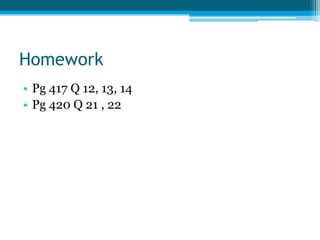
Homework
• Pg 417 Q 12, 13, 14
• Pg 420 Q 21 , 22

3 predicting solubilities

  • 1.
  • 2.
    Net Ionic Equations •In reactions that occur in solution, write the equation for the reaction in ionic form ▫ Indicate the ionic species that actually exist in solution.
  • 3.
    BaCl2(aq) + Na2SO4(aq) BaSO4(s) + 2NaCl(aq) • BaSO4 is an insoluble product (i.e. a precipitate) • An ionic equation is to break apart aqueous products and reactants ▫ BaCl2(aq) ▫ Na2SO4(aq) ▫ NaCl(aq)
  • 4.
    BaCl2(aq) + Na2SO4(aq) BaSO4(s) + 2NaCl(aq) Ionic Equation: 2Na1+(aq) + SO42-(aq) + Ba2+(aq) + 2Cl1-(aq)  2Na1+(aq) + 2Cl1-(aq) + BaSO4(s) Note: BaSO4(s) cannot be broken down
  • 5.
    2Na1+(aq) + SO42-(aq)+ Ba2+(aq) + 2Cl1-(aq)  2Na1+(aq) + 2Cl1-(aq) + BaSO4(s) • Sodium and chloride ions are unchanged and are present on both sides of the equation. ▫ Since they are not undergoing chemical reaction, they can be referred to as spectator ions. • If we subtract the spectator ions from each side of the equation, we then have a net ionic equation.
  • 6.
    2Na1+(aq) + SO42-(aq)+ Ba2+(aq) + 2Cl1-(aq)  2Na1+(aq) + 2Cl1-(aq) + BaSO4(s) • The net ionic equation for the above reaction is: Ba2+(aq) + SO42-(aq) -----> BaSO4(s)
  • 7.
    • Note: Youmust pay attention to reactions that occur. ▫ Use the solubility tables that you copied in the last unit to determine whether the reaction will occur ▫ Consider if the reactions are single displacement or double displacement
  • 8.
    Example • Write thenet ionic reaction. Be sure to include charges on ions. K2CrO4(aq) +Ba(NO3)2(aq) → 2KNO3 (aq)+ BaCrO4(s)
  • 9.
    Learning Check • Writethe net ionic reaction. Be sure to include charges on ions. KCl(aq) + AgNO3(aq) → KNO3(aq) + AgCl(s)
  • 10.
    Learning Check • Writethe net ionic reaction. Be sure to include charges on ions. 3KOH(aq) + Fe(NO3)3(aq) → 3KNO3 (aq) + Fe(OH)3(s)
  • 11.
  • 12.
    • Solubility curves, like the one shown here, tell us what mass of solute will dissolve in 100g (or 100mL) of water over a range of temperatures. • The solutions are saturated at the given temperatures.
  • 13.
    Example: • What massof solute will dissolve in 100mL of water at the following temperatures. 1. KNO3at 70°C 2. NaCl at 100°C 3. NH4Cl at 90°C
  • 14.
    Example: • Which ofthe three substances is most soluble in water at 15°C. 1. KNO3at 70°C 2. NaCl at 100°C 3. NH4Cl at 90°C
  • 15.
    Example: • State whetherthe following solutions are saturated, unsaturated or supersaturated 1. 100 g of KNO3at 60°C 2. 30 g of NaCl at 80°C 3. 80g of NH4Cl at 90°C
  • 16.
    • You'll noticethat for most substances, solubility increases as temperature increases. • In solutions involving liquids and solids typically more solute can be dissolved at higher temperatures. • There are exceptions to this rule, however, we will not get into them in this course.
  • 17.
  • 18.
    Concentration of aSolution from the Mass of the Precipitate • A student carefully measured 100 mL of a silver nitrate solution, AgNO3(aq), of unknown concentration and added a copper coil. When the reaction was complete, the solution was filtered to obtain all the silver. The dry precipitate had a mass of 1.65 g. What was the molar concentration of the silver nitrate solution?
  • 20.
    Limiting Reactants andPrecipitates In water purification, aluminum sulfate, Al2(SO4)3(aq), reacts with calcium hydroxide, Ca(OH)2(aq), to form a precipitate of aluminum hydroxide, Al(OH)3(s). a) Write a balanced equation.
  • 21.
    b) Find themass of aluminum hydroxide that precipitates when 20.0 mL of 0.0150 mol/L aluminum sulfate is mixed with 30.0 mL of 0.0185 mol/L aqueous calcium hydroxide.
  • 22.
    Minimum Volume fora Complete Reaction A kidney stone contains primarily calcium oxalate, CaC2O4(s). A chemist wants to react 60.0 mL of 0.135 mol/L sodium oxalate, Na2C2O4(aq), with 0.226 mol/L calcium chloride, CaCl2(aq), to precipitate calcium oxalate. a) Write a balanced equation.
  • 23.
    b) What massof calcium oxalate will be precipitated?
  • 24.
    c) What isthe minimum volume of calcium chloride solution required?
  • 25.
    Homework • Pg 417Q 12, 13, 14 • Pg 420 Q 21 , 22