16 Hours
18 Marks
Ms. Kavita Giri
Lecturer (ET)
Government Residential Womens Polytechnic,
Latur
1. Interpret necessity of the given type of modulation
technique.
2. Compare the working of the given type of AM generation
technique
3. Describe with sketches the given parameters of AM
signal.
4. Calculate modulation index and power distributions of the
given AM signal.
5. Describe with sketches the specified parameters of FM
and PM signal.
6. Calculate/ Find modulation Index of given FM signal.
22334 – Principles of Electronic Communication
Ms. Kavita Giri, Lecturer (ET), GRWP, Latur
 2.1 Need for modulation
 Types of Modulation techniques
 2.2 Amplitude Modulation:
 Mathematical representation of
AM wave
 Modulation Index, Bandwidth
requirement
 Representation of AM in time
domain.
 Frequency spectrum in AM wave
 Total power relation in AM-
derivation and simple numerical
 Power in side bands- derivation
and numerical.
 Types of AM- DSB, SSB and
VSB
 2.3 Frequency Modulation
 Representation of FM in time
domain
 Representation of FM in
frequency domain
 Frequency deviation ratio
 Modulation index
 Mathematical representation of
FM wave
 Bandwidth requirements
 Types of FM – Narrowband and
Wideband
 2.4 Phase Modulation
22334 – Principles of Electronic Communication
Ms. Kavita Giri, Lecturer (ET), GRWP, Latur
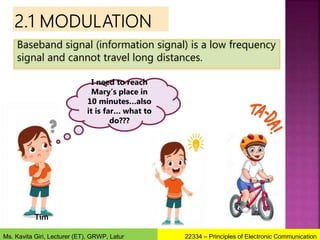
Baseband signal (information signal) is a low frequency
signal and cannot travel long distances.
I need to reach
Mary’s place in
10 minutes…also
it is far… what to
do???
Tim
22334 – Principles of Electronic Communication
Ms. Kavita Giri, Lecturer (ET), GRWP, Latur
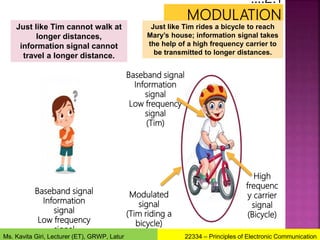
Baseband signal
Information
signal
Low frequency
signal
Baseband signal
Information
signal
Low frequency
signal
(Tim)
High
frequenc
y carrier
signal
(Bicycle)
Modulated
signal
(Tim riding a
bicycle)
Just like Tim cannot walk at
longer distances,
information signal cannot
travel a longer distance.
Just like Tim rides a bicycle to reach
Mary’s house; information signal takes
the help of a high frequency carrier to
be transmitted to longer distances.
22334 – Principles of Electronic Communication
Ms. Kavita Giri, Lecturer (ET), GRWP, Latur
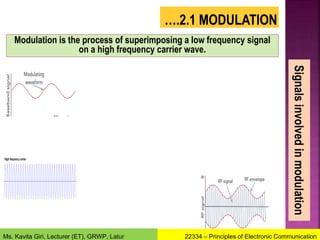
Modulation is the process of superimposing a low frequency signal
on a high frequency carrier wave.
Signals
involved
in
modulation
22334 – Principles of Electronic Communication
Ms. Kavita Giri, Lecturer (ET), GRWP, Latur
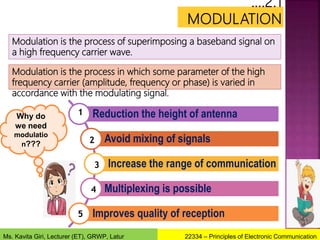
Modulation is the process of superimposing a baseband signal on
a high frequency carrier wave.
Modulation is the process in which some parameter of the high
frequency carrier (amplitude, frequency or phase) is varied in
accordance with the modulating signal.
Why do
we need
modulatio
n???
Reduction the height of antenna
Avoid mixing of signals
Increase the range of communication
Multiplexing is possible
Improves quality of reception
1
2
3
4
5
22334 – Principles of Electronic Communication
Ms. Kavita Giri, Lecturer (ET), GRWP, Latur
Without Modulation With Modulation
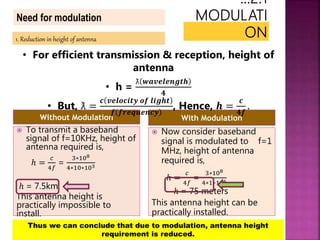
 Now consider baseband
signal is modulated to f=1
MHz, height of antenna
required is,
ℎ =
𝑐
4𝑓
=
3∗108
4∗1∗106
ℎ = 75 meters
This antenna height can be
practically installed.
Need for modulation
1. Reduction in height of antenna
 To transmit a baseband
signal of f=10KHz, height of
antenna required is,
ℎ =
𝑐
4𝑓
=
3∗108
4∗10∗103
ℎ = 7.5km
This antenna height is
practically impossible to
install.
• For efficient transmission & reception, height of
antenna
• h =
ƛ 𝒘𝒂𝒗𝒆𝒍𝒆𝒏𝒈𝒕𝒉
𝟒
• But, ƛ =
𝒄 𝒗𝒆𝒍𝒐𝒄𝒊𝒕𝒚 𝒐𝒇 𝒍𝒊𝒈𝒉𝒕
𝒇 𝒇𝒓𝒆𝒒𝒖𝒆𝒏𝒄𝒚
, Hence, 𝒉 =
𝒄
𝟒𝒇
.
Thus we can conclude that due to modulation, antenna height
requirement is reduced.
Need for modulation
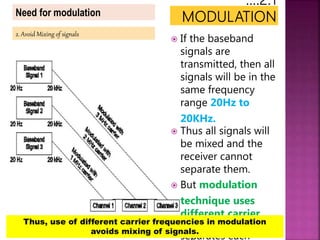
2. Avoid Mixing of signals
 If the baseband
signals are
transmitted, then all
signals will be in the
same frequency
range 20Hz to
20KHz.
 Thus all signals will
be mixed and the
receiver cannot
separate them.
 But modulation
technique uses
different carrier
frequency and
separates each
Thus, use of different carrier frequencies in modulation
avoids mixing of signals.
Need for modulation
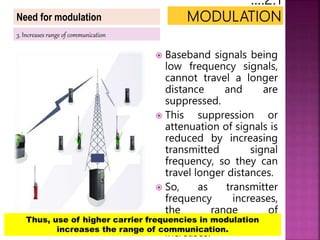
3. Increases range of communication
 Baseband signals being
low frequency signals,
cannot travel a longer
distance and are
suppressed.
 This suppression or
attenuation of signals is
reduced by increasing
transmitted signal
frequency, so they can
travel longer distances.
 So, as transmitter
frequency increases,
the range of
communication also
increases.
Thus, use of higher carrier frequencies in modulation
increases the range of communication.
Need for modulation
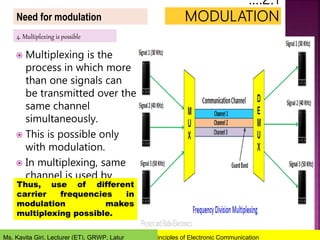
4. Multiplexing is possible
 Multiplexing is the
process in which more
than one signals can
be transmitted over the
same channel
simultaneously.
 This is possible only
with modulation.
 In multiplexing, same
channel is used by
many signals without
mixing.
Thus, use of different
carrier frequencies in
modulation makes
multiplexing possible.
22334 – Principles of Electronic Communication
Ms. Kavita Giri, Lecturer (ET), GRWP, Latur
Need for modulation
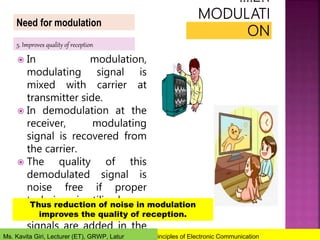
5. Improves quality of reception
 In modulation,
modulating signal is
mixed with carrier at
transmitter side.
 In demodulation at the
receiver, modulating
signal is recovered from
the carrier.
 The quality of this
demodulated signal is
noise free if proper
technique is utilised.
 No external unwanted
signals are added in the
Thus reduction of noise in modulation
improves the quality of reception.
22334 – Principles of Electronic Communication
Ms. Kavita Giri, Lecturer (ET), GRWP, Latur
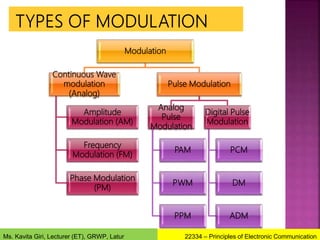
Modulation
Continuous Wave
modulation
(Analog)
Amplitude
Modulation (AM)
Frequency
Modulation (FM)
Phase Modulation
(PM)
Pulse Modulation
Analog
Pulse
Modulation
PAM
PWM
PPM
Digital Pulse
Modulation
PCM
DM
ADM
22334 – Principles of Electronic Communication
Ms. Kavita Giri, Lecturer (ET), GRWP, Latur
 Amplitude modulation or AM as it is often
called, is a form of modulation used for
radio transmissions for broadcasting and
two way radio communication applications.
 Although one of the earliest used forms of
modulation it is still used today, mainly for
long, medium and short wave broadcasting
and for some aeronautical point to point
communications.
22334 – Principles of Electronic Communication
Ms. Kavita Giri, Lecturer (ET), GRWP, Latur
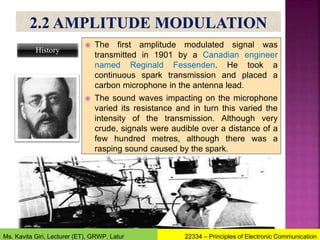
 The first amplitude modulated signal was
transmitted in 1901 by a Canadian engineer
named Reginald Fessenden. He took a
continuous spark transmission and placed a
carbon microphone in the antenna lead.
 The sound waves impacting on the microphone
varied its resistance and in turn this varied the
intensity of the transmission. Although very
crude, signals were audible over a distance of a
few hundred metres, although there was a
rasping sound caused by the spark.
History
22334 – Principles of Electronic Communication
Ms. Kavita Giri, Lecturer (ET), GRWP, Latur
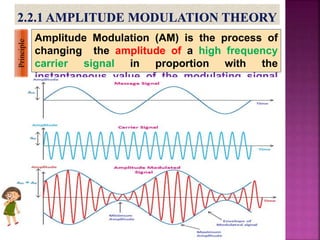
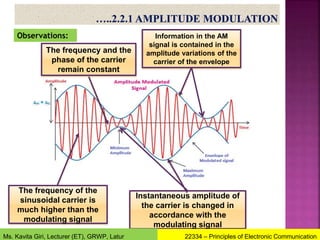
Amplitude Modulation (AM) is the process of
changing the amplitude of a high frequency
carrier signal in proportion with the
instantaneous value of the modulating signal
(information).
Principle
Observations:
The frequency of the
sinusoidal carrier is
much higher than the
modulating signal
Instantaneous amplitude of
the carrier is changed in
accordance with the
modulating signal
Information in the AM
signal is contained in the
amplitude variations of the
carrier of the envelope
The frequency and the
phase of the carrier
remain constant
22334 – Principles of Electronic Communication
Ms. Kavita Giri, Lecturer (ET), GRWP, Latur
https://academo.org/demos/amplitude-modulation/
22334 – Principles of Electronic Communication
Ms. Kavita Giri, Lecturer (ET), GRWP, Latur
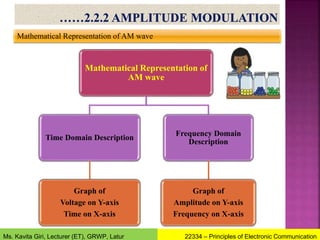
Mathematical Representation of
AM wave
Time Domain Description
Graph of
Voltage on Y-axis
Time on X-axis
Frequency Domain
Description
Graph of
Amplitude on Y-axis
Frequency on X-axis
Mathematical Representation of AM wave
22334 – Principles of Electronic Communication
Ms. Kavita Giri, Lecturer (ET), GRWP, Latur
Mathematical Representation of AM wave
Consider a sinusoidal modulating signal or message signal (em) of
frequency (ωm) and amplitude (Em) given by:
em = Em sin ωmt . . . . . . . . . . . . . . . . . . . . . . . . . . (1)
and carrier wave (ec) of frequency (ωc) and amplitude (Ec) given by:
ec = Ec sin ωct . . . . . . . . . . . . . . . . . . . . . . . . . . . . . . (2)
Where,
em is the modulating signal or message signal
ec is the carrier signal
Em is the maximum amplitude of the message signal
Ec is the maximum amplitude of the carrier signal
ωm is the frequency of the message signal
ωc is the frequency of the carrier signal
22334 – Principles of Electronic Communication
Ms. Kavita Giri, Lecturer (ET), GRWP, Latur
https://electronicscoach.com/amplitude-modulation.html
Mathematical Representation of AM wave
The AM wave is expressed by the following expression,
eAM = A sin (2πfct) …………………………………………. (3)
Where, A represents the instantaneous value of the envelope.
The modulating signal either adds or gets subtracted from the
peak carrier amplitude Ec.
Hence we can represent the instantaneous value of envelope
as, A = Ec + em
= Ec + Em sin ωmt ………………………………………….(4)
Hence the AM wave is given by,
eAM = A sin (2πfct)
eAM = [Ec + Em sin (2πfm t)] sin (2πfct)
eAM = Ec [1 + (Em/Ec)sin (2πfm t)] sin(2πfct)
Let m= Em/Ec be the modulation index.
eAM= Ec [1 + m sin (2πfm t)] sin (2πfct)……………(5)
22334 – Principles of Electronic Communication
Ms. Kavita Giri, Lecturer (ET), GRWP, Latur
Modulation Index or Modulation Factor
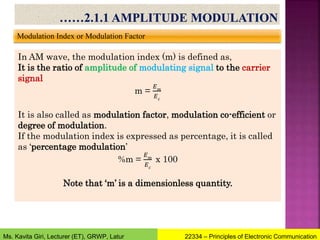
In AM wave, the modulation index (m) is defined as,
It is the ratio of amplitude of modulating signal to the carrier
signal
m =
𝐸𝑚
𝐸𝑐
It is also called as modulation factor, modulation co-efficient or
degree of modulation.
If the modulation index is expressed as percentage, it is called
as ‘percentage modulation’
%m =
𝐸𝑚
𝐸𝑐
x 100
Note that ‘m’ is a dimensionless quantity.
22334 – Principles of Electronic Communication
Ms. Kavita Giri, Lecturer (ET), GRWP, Latur
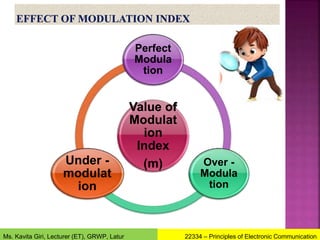
Value of
Modulat
ion
Index
(m)
Perfect
Modula
tion
Over -
Modula
tion
Under -
modulat
ion
22334 – Principles of Electronic Communication
Ms. Kavita Giri, Lecturer (ET), GRWP, Latur
EC403E– Basics of Communication
Ms. KavitaGiri,Lecturer (EC), Govt.Polytechnic,Nagpur
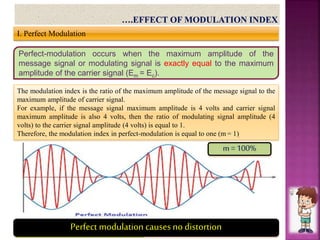
I. Perfect Modulation
The modulation index is the ratio of the maximum amplitude of the message signal to the
maximum amplitude of carrier signal.
For example, if the message signal maximum amplitude is 4 volts and carrier signal
maximum amplitude is also 4 volts, then the ratio of modulating signal amplitude (4
volts) to the carrier signal amplitude (4 volts) is equal to 1.
Therefore, the modulation index in perfect-modulation is equal to one (m = 1).
Perfect-modulation occurs when the maximum amplitude of the
message signal or modulating signal is exactly equal to the maximum
amplitude of the carrier signal (Em = Ec).
m =100%
Perfect modulation causes no distortion
EC403E– Basics of Communication
Ms. KavitaGiri,Lecturer (EC), Govt.Polytechnic,Nagpur
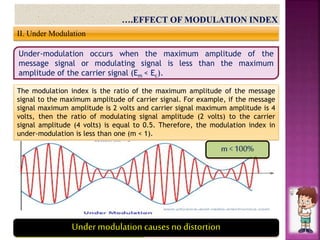
II. Under Modulation
The modulation index is the ratio of the maximum amplitude of the message
signal to the maximum amplitude of carrier signal. For example, if the message
signal maximum amplitude is 2 volts and carrier signal maximum amplitude is 4
volts, then the ratio of modulating signal amplitude (2 volts) to the carrier
signal amplitude (4 volts) is equal to 0.5. Therefore, the modulation index in
under-modulation is less than one (m < 1).
Under-modulation occurs when the maximum amplitude of the
message signal or modulating signal is less than the maximum
amplitude of the carrier signal (Em < Ec).
m < 100%
Under modulation causes no distortion
EC403E– Basics of Communication
Ms. KavitaGiri,Lecturer (EC), Govt.Polytechnic,Nagpur
III. Over Modulation
The modulation index is the ratio of the maximum amplitude of the message
signal to the maximum amplitude of carrier signal. For example, if the message
signal maximum amplitude is 6 volts and carrier signal maximum amplitude is 4
volts, then the ratio of modulating signal amplitude (6 volts) to the carrier
signal amplitude (4 volts) is equal to 1.5. Therefore, the modulation index in
over-modulation is greater than one (m > 1).
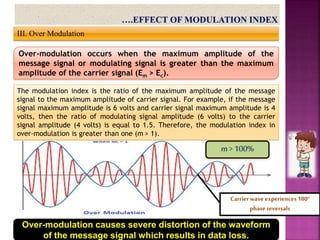
Over-modulation occurs when the maximum amplitude of the
message signal or modulating signal is greater than the maximum
amplitude of the carrier signal (Em > Ec).
m > 100%
Over-modulation causes severe distortion of the waveform
of the message signal which results in data loss.
Carrier wave experiences 180°
phase reversals
Frequency Spectrum of AM wave
Consider the equation for AM wave,
eAM = [Ec + Em cos (ωm t)] cos (ωct)
eAM = Ec [1 + (Em/Ec)cos (ωm t)] cos (ωct)
As per the definition of modulation index, m= Em/Ec
eAM= Ec [1 + mcos (ωm t)] cos (ωct)……………(5)
Simplifying we get,
eAM= Ec cos (ωct) + m Ec cos (ωm t). cos (ωct)………………(6)
For the second term we can use the following identity:
2 cos A cos B = cos (A+B) + cos (A-B)
Therefore, equation (6) gets simplified as follows:
eAM= Ec cos (ωct) + m
𝐄𝐜
𝟐
cos(ωc+ ωm)t + m
𝐄𝐜
𝟐
cos(ωc- ωm)t
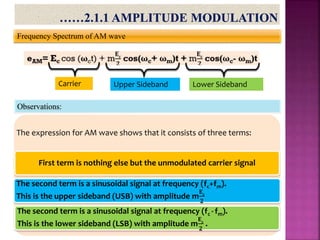
Carrier Upper Sideband Lower Sideband
22334 – Principles of Electronic Communication
Ms. Kavita Giri, Lecturer (ET), GRWP, Latur
Frequency Spectrum of AM wave
Carrier Upper Sideband Lower Sideband
The expression for AM wave shows that it consists of three terms:
First term is nothing else but the unmodulated carrier signal
The second term is a sinusoidal signal at frequency (fc+fm).
This is the upper sideband (USB) with amplitude m
𝐄𝐜
𝟐
The second term is a sinusoidal signal at frequency (fc -fm).
This is the lower sideband (LSB) with amplitude m
𝐄𝐜
𝟐
.
Observations:
Frequency Spectrum of AM wave
Carrier Upper Sideband Lower Sideband
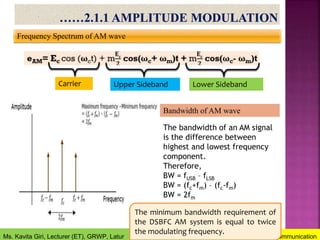
Bandwidth of AM wave
The bandwidth of an AM signal
is the difference between
highest and lowest frequency
component.
Therefore,
BW = fUSB – fLSB
BW = (fc+fm) – (fc-fm)
BW = 2fm
22334 – Principles of Electronic Communication
Ms. Kavita Giri, Lecturer (ET), GRWP, Latur
The minimum bandwidth requirement of
the DSBFC AM system is equal to twice
the modulating frequency.
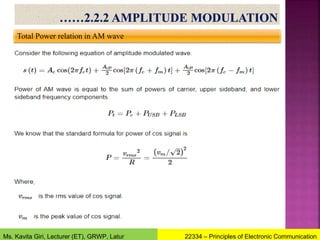
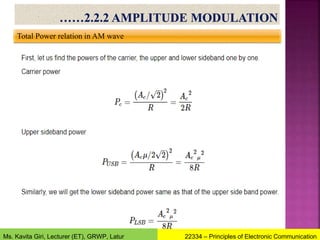
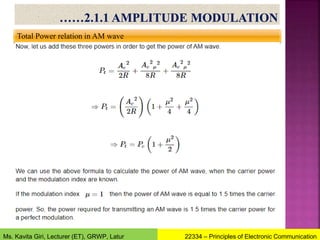
Total Power relation in AM wave
22334 – Principles of Electronic Communication
Ms. Kavita Giri, Lecturer (ET), GRWP, Latur
Total Power relation in AM wave
22334 – Principles of Electronic Communication
Ms. Kavita Giri, Lecturer (ET), GRWP, Latur
Total Power relation in AM wave
22334 – Principles of Electronic Communication
Ms. Kavita Giri, Lecturer (ET), GRWP, Latur
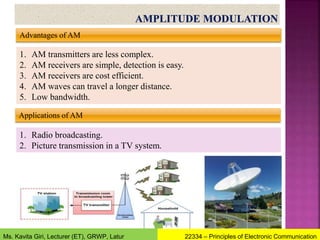
Advantages of AM
1. AM transmitters are less complex.
2. AM receivers are simple, detection is easy.
3. AM receivers are cost efficient.
4. AM waves can travel a longer distance.
5. Low bandwidth.
Applications of AM
1. Radio broadcasting.
2. Picture transmission in a TV system.
22334 – Principles of Electronic Communication
Ms. Kavita Giri, Lecturer (ET), GRWP, Latur
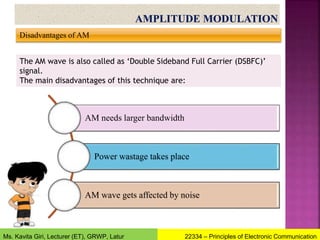
Disadvantages of AM
The AM wave is also called as ‘Double Sideband Full Carrier (DSBFC)’
signal.
The main disadvantages of this technique are:
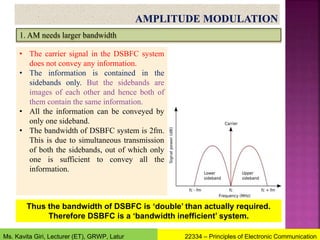
AM needs larger bandwidth
Power wastage takes place
AM wave gets affected by noise
22334 – Principles of Electronic Communication
Ms. Kavita Giri, Lecturer (ET), GRWP, Latur
1. AM needs larger bandwidth
• The carrier signal in the DSBFC system
does not convey any information.
• The information is contained in the
sidebands only. But the sidebands are
images of each other and hence both of
them contain the same information.
• All the information can be conveyed by
only one sideband.
• The bandwidth of DSBFC system is 2fm.
This is due to simultaneous transmission
of both the sidebands, out of which only
one is sufficient to convey all the
information.
Thus the bandwidth of DSBFC is ‘double’ than actually required.
Therefore DSBFC is a ‘bandwidth inefficient’ system.
22334 – Principles of Electronic Communication
Ms. Kavita Giri, Lecturer (ET), GRWP, Latur
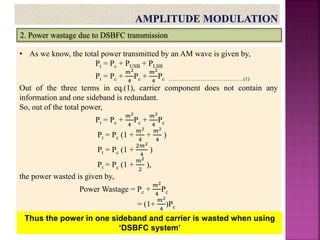
2. Power wastage due to DSBFC transmission
• As we know, the total power transmitted by an AM wave is given by,
Pt = Pc + PUSB + PLSB
Pt = Pc +
𝑚2
4
Pc +
𝑚2
4
Pc ……………………………………(1)
Out of the three terms in eq.(1), carrier component does not contain any
information and one sideband is redundant.
So, out of the total power,
Pt = Pc +
𝑚2
4
Pc +
𝑚2
4
Pc
Pt = Pc (1 +
𝑚2
4
+
𝑚2
4
)
Pt = Pc (1 +
2𝑚2
4
)
Pt = Pc (1 +
𝑚2
2
),
the power wasted is given by,
Power Wastage = Pc +
𝑚2
4
Pc
= (1+
𝑚2
4
)Pc
Thus the power in one sideband and carrier is wasted when using
‘DSBFC system’
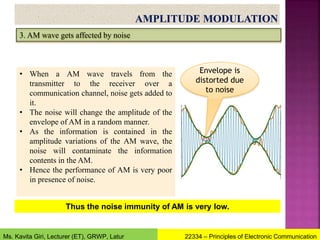
3. AM wave gets affected by noise
• When a AM wave travels from the
transmitter to the receiver over a
communication channel, noise gets added to
it.
• The noise will change the amplitude of the
envelope of AM in a random manner.
• As the information is contained in the
amplitude variations of the AM wave, the
noise will contaminate the information
contents in the AM.
• Hence the performance of AM is very poor
in presence of noise.
Thus the noise immunity of AM is very low.
Envelope is
distorted due
to noise
22334 – Principles of Electronic Communication
Ms. Kavita Giri, Lecturer (ET), GRWP, Latur
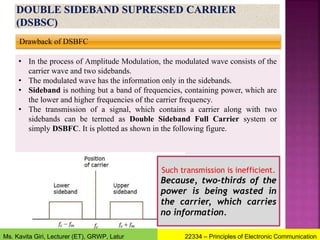
Drawback of DSBFC
• In the process of Amplitude Modulation, the modulated wave consists of the
carrier wave and two sidebands.
• The modulated wave has the information only in the sidebands.
• Sideband is nothing but a band of frequencies, containing power, which are
the lower and higher frequencies of the carrier frequency.
• The transmission of a signal, which contains a carrier along with two
sidebands can be termed as Double Sideband Full Carrier system or
simply DSBFC. It is plotted as shown in the following figure.
Such transmission is inefficient.
Because, two-thirds of the
power is being wasted in
the carrier, which carries
no information.
22334 – Principles of Electronic Communication
Ms. Kavita Giri, Lecturer (ET), GRWP, Latur
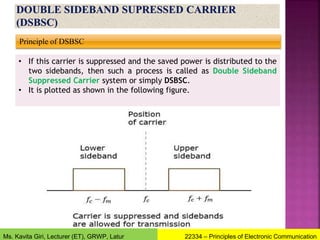
Principle of DSBSC
• If this carrier is suppressed and the saved power is distributed to the
two sidebands, then such a process is called as Double Sideband
Suppressed Carrier system or simply DSBSC.
• It is plotted as shown in the following figure.
22334 – Principles of Electronic Communication
Ms. Kavita Giri, Lecturer (ET), GRWP, Latur
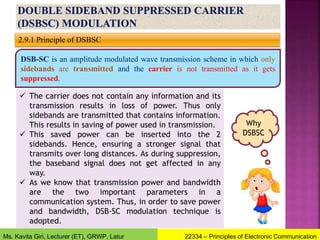
2.9.1 Principle of DSBSC
DSB-SC is an amplitude modulated wave transmission scheme in which only
sidebands are transmitted and the carrier is not transmitted as it gets
suppressed.
 The carrier does not contain any information and its
transmission results in loss of power. Thus only
sidebands are transmitted that contains information.
This results in saving of power used in transmission.
 This saved power can be inserted into the 2
sidebands. Hence, ensuring a stronger signal that
transmits over long distances. As during suppression,
the baseband signal does not get affected in any
way.
 As we know that transmission power and bandwidth
are the two important parameters in a
communication system. Thus, in order to save power
and bandwidth, DSB-SC modulation technique is
adopted.
Why
DSBSC
22334 – Principles of Electronic Communication
Ms. Kavita Giri, Lecturer (ET), GRWP, Latur
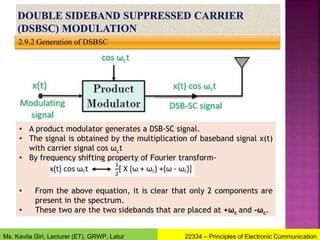
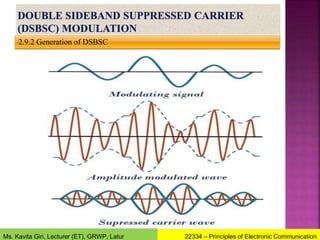
2.9.2 Generation of DSBSC
• A product modulator generates a DSB-SC signal.
• The signal is obtained by the multiplication of baseband signal x(t)
with carrier signal cos ωct
• By frequency shifting property of Fourier transform-
• From the above equation, it is clear that only 2 components are
present in the spectrum.
• These two are the two sidebands that are placed at +ωc and -ωc.
22334 – Principles of Electronic Communication
Ms. Kavita Giri, Lecturer (ET), GRWP, Latur
2.9.2 Generation of DSBSC
22334 – Principles of Electronic Communication
Ms. Kavita Giri, Lecturer (ET), GRWP, Latur
2.9.3 Mathematical Expression of DSBSC
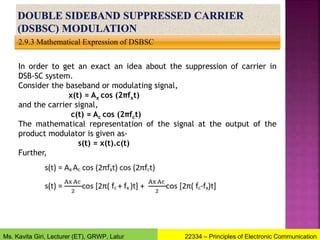
In order to get an exact an idea about the suppression of carrier in
DSB-SC system.
Consider the baseband or modulating signal,
x(t) = Ax cos (2πfxt)
and the carrier signal,
c(t) = Ac cos (2πfct)
The mathematical representation of the signal at the output of the
product modulator is given as-
s(t) = x(t).c(t)
Further,
22334 – Principles of Electronic Communication
Ms. Kavita Giri, Lecturer (ET), GRWP, Latur
2.9.3 Mathematical Expression of DSBSC
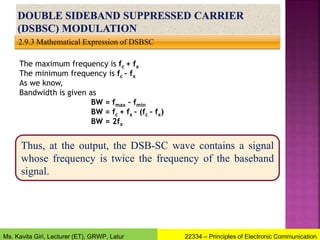
The maximum frequency is fc + fx
The minimum frequency is fc – fx
As we know,
Bandwidth is given as
BW = fmax – fmin
BW = fc + fx – (fc – fx)
BW = 2fx
Thus, at the output, the DSB-SC wave contains a signal
whose frequency is twice the frequency of the baseband
signal.
22334 – Principles of Electronic Communication
Ms. Kavita Giri, Lecturer (ET), GRWP, Latur
2.9.4 Carrier suppression in DSB-SC (Balanced Modulator)
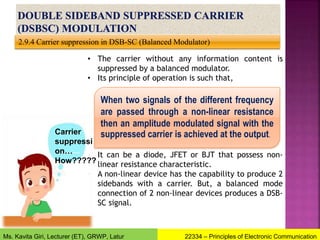
• The carrier without any information content is
suppressed by a balanced modulator.
• Its principle of operation is such that,
• It can be a diode, JFET or BJT that possess non-
linear resistance characteristic.
• A non-linear device has the capability to produce 2
sidebands with a carrier. But, a balanced mode
connection of 2 non-linear devices produces a DSB-
SC signal.
When two signals of the different frequency
are passed through a non-linear resistance
then an amplitude modulated signal with the
suppressed carrier is achieved at the output.
Carrier
suppressi
on…
How?????
22334 – Principles of Electronic Communication
Ms. Kavita Giri, Lecturer (ET), GRWP, Latur
2.9.5 Balanced Modulator using Diodes
22334 – Principles of Electronic Communication
Ms. Kavita Giri, Lecturer (ET), GRWP, Latur
2.9.5 Balanced Modulator using Diodes
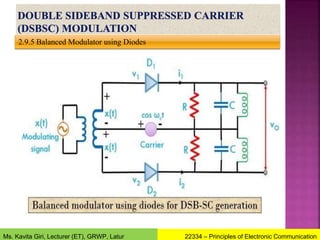
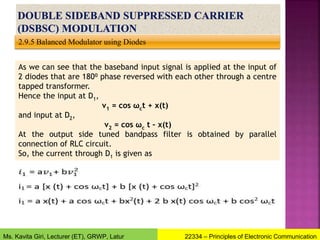
As we can see that the baseband input signal is applied at the input of
2 diodes that are 180⁰ phase reversed with each other through a centre
tapped transformer.
Hence the input at D1,
v1 = cos ωct + x(t)
and input at D2,
v2 = cos ωc t – x(t)
At the output side tuned bandpass filter is obtained by parallel
connection of RLC circuit.
So, the current through D1 is given as
22334 – Principles of Electronic Communication
Ms. Kavita Giri, Lecturer (ET), GRWP, Latur
2.9.5 Balanced Modulator using Diodes
Similarly,
the output voltage is given by
vo = i1 R – i2 R
On substituting the above-given value of i1 and i2 in the output
equation, we will have,
vo = R [2 a x(t)] (+ 4b x (t) cos ωct)]
Therefore, the output is,
vo = 2aR x(t) + 4bRx (t) cos ωct
modulating signal DSB-SC signal
22334 – Principles of Electronic Communication
Ms. Kavita Giri, Lecturer (ET), GRWP, Latur
2.9.5 Balanced Modulator using Diodes
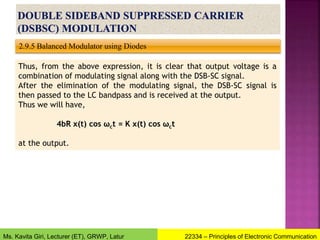
Thus, from the above expression, it is clear that output voltage is a
combination of modulating signal along with the DSB-SC signal.
After the elimination of the modulating signal, the DSB-SC signal is
then passed to the LC bandpass and is received at the output.
Thus we will have,
4bR x(t) cos ωct = K x(t) cos ωct
at the output.
22334 – Principles of Electronic Communication
Ms. Kavita Giri, Lecturer (ET), GRWP, Latur
Advantages Disadvantages
Applications
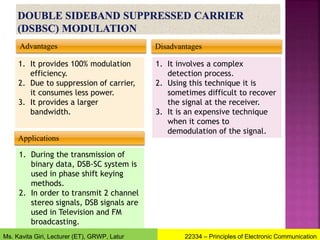
1. It provides 100% modulation
efficiency.
2. Due to suppression of carrier,
it consumes less power.
3. It provides a larger
bandwidth.
1. It involves a complex
detection process.
2. Using this technique it is
sometimes difficult to recover
the signal at the receiver.
3. It is an expensive technique
when it comes to
demodulation of the signal.
1. During the transmission of
binary data, DSB-SC system is
used in phase shift keying
methods.
2. In order to transmit 2 channel
stereo signals, DSB signals are
used in Television and FM
broadcasting.
22334 – Principles of Electronic Communication
Ms. Kavita Giri, Lecturer (ET), GRWP, Latur
2.10.1 Definition
• It is also known as SSB-SC which is an acronym for Single Sideband
Suppressed Carrier as it allows suppression of one sideband and
carrier completely.
• As we know, DSB-SC modulation technique generates an output wave
having twice the bandwidth as that of the original modulating signal.
• So, in order to avoid doubling factor of bandwidth in such
modulation system, the SSB-SC modulation technique was
introduced.
Single sideband modulation (SSB) is an amplitude
modulation scheme in which only a single sideband is
transmitted through the channel.
22334 – Principles of Electronic Communication
Ms. Kavita Giri, Lecturer (ET), GRWP, Latur
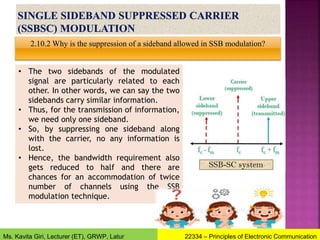
2.10.2 Why is the suppression of a sideband allowed in SSB modulation?
• The two sidebands of the modulated
signal are particularly related to each
other. In other words, we can say the two
sidebands carry similar information.
• Thus, for the transmission of information,
we need only one sideband.
• So, by suppressing one sideband along
with the carrier, no any information is
lost.
• Hence, the bandwidth requirement also
gets reduced to half and there are
chances for an accommodation of twice
number of channels using the SSB
modulation technique.
22334 – Principles of Electronic Communication
Ms. Kavita Giri, Lecturer (ET), GRWP, Latur
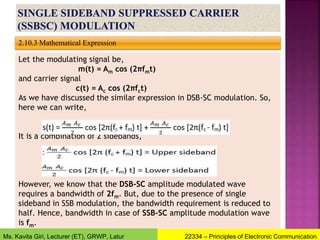
2.10.3 Mathematical Expression
Let the modulating signal be,
m(t) = Am cos (2πfmt)
and carrier signal
c(t) = Ac cos (2πfct)
As we have discussed the similar expression in DSB-SC modulation. So,
here we can write,
It is a combination of 2 sidebands,
However, we know that the DSB-SC amplitude modulated wave
requires a bandwidth of 2fm. But, due to the presence of single
sideband in SSB modulation, the bandwidth requirement is reduced to
half. Hence, bandwidth in case of SSB-SC amplitude modulation wave
is fm.
22334 – Principles of Electronic Communication
Ms. Kavita Giri, Lecturer (ET), GRWP, Latur
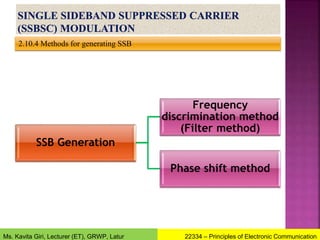
2.10.4 Methods for generating SSB
SSB Generation
Frequency
discrimination method
(Filter method)
Phase shift method
22334 – Principles of Electronic Communication
Ms. Kavita Giri, Lecturer (ET), GRWP, Latur
2.10.4 Methods for generating SSB
1. Frequency discrimination method (Filter method)
22334 – Principles of Electronic Communication
Ms. Kavita Giri, Lecturer (ET), GRWP, Latur
2.10.4 Methods for generating SSB
1. Frequency discrimination method (Filter method)
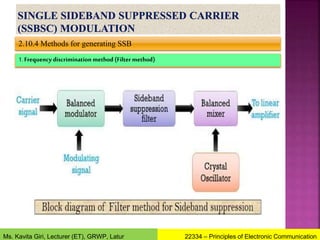
 The balanced modulator employed here generates DSB-SC
amplitude modulated wave as its output.
 As the DSB output contains the two sidebands, and only carrier
component is suppressed, so sideband suppression filter is needed
further in order to eliminate one of the 2 sidebands.
 The filter characteristics should be such that, it must have flat
passband and should possess high attenuation beyond the
passband. So, to have such a response, the tuned circuit must
have a very high Q factor.
 To have such a high Q factor it is needed that the difference
between modulating frequency and carrier frequency to be high.
There is no any practical way to achieve such a high value.
22334 – Principles of Electronic Communication
Ms. Kavita Giri, Lecturer (ET), GRWP, Latur
2.10.4 Methods for generating SSB
1. Frequency discrimination method (Filter method)
 Thus, modulation at the initial stage is carried out at a low
frequency of about 100 KHz by the balanced modulator. After this
one sideband is suppressed by the filter. But, as the SSB signal
frequency is very low in comparison to transmitter frequency. So, a
balanced mixer and crystal oscillator are employed in the circuit to
boost the frequency of SSB signal up to the level of transmitter
frequency.
 Then the SSB signal is fed to a linear amplifier for further
amplification. The process of frequency boosting is sometimes also
termed as Up-conversion.
 Basically to eliminate unwanted sideband- LC, ceramic, crystal or
mechanical filter are used. Though ceramic or crystal filters are low
in cost but provides better results at operating frequency above 1
MHz. Among all these mechanical filters possess the best
characteristics thus is widely used.
22334 – Principles of Electronic Communication
Ms. Kavita Giri, Lecturer (ET), GRWP, Latur
2.10.4 Methods for generating SSB
1. Frequency discrimination method (Filter method)
Advantages of Filter method:
1. It provides sufficiently flat and wide bandwidth.
2. By this method, we can have suitable sideband suppression.
Disadvantages of Filter method:
1. Frequency up-conversion at the end is necessary as the system does
not generate SSB at high frequencies.
2. Expensive filter increases the overall cost of the system.
22334 – Principles of Electronic Communication
Ms. Kavita Giri, Lecturer (ET), GRWP, Latur
2.10.4 Methods for generating SSB
2.Phase Shift Method
22334 – Principles of Electronic Communication
Ms. Kavita Giri, Lecturer (ET), GRWP, Latur
2.10.4 Methods for generating SSB
2.Phase Shift Method
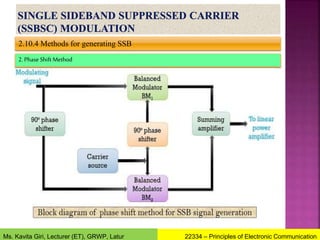
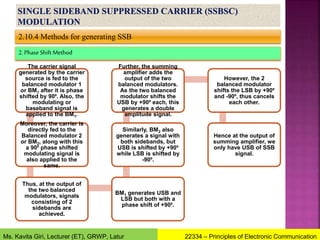
The carrier signal
generated by the carrier
source is fed to the
balanced modulator 1
or BM1 after it is phase
shifted by 90⁰. Also, the
modulating or
baseband signal is
applied to the BM1.
Moreover, the carrier is
directly fed to the
Balanced modulator 2
or BM2, along with this
a 90⁰ phase shifted
modulating signal is
also applied to the
same.
Thus, at the output of
the two balanced
modulators, signals
consisting of 2
sidebands are
achieved.
BM1 generates USB and
LSB but both with a
phase shift of +90⁰.
Similarly, BM2 also
generates a signal with
both sidebands, but
USB is shifted by +90⁰
while LSB is shifted by
-90⁰.
Further, the summing
amplifier adds the
output of the two
balanced modulators.
As the two balanced
modulator shifts the
USB by +90⁰ each, this
generates a double
amplitude signal.
However, the 2
balanced modulator
shifts the LSB by +90⁰
and -90⁰, thus cancels
each other.
Hence at the output of
summing amplifier, we
only have USB of SSB
signal.
22334 – Principles of Electronic Communication
Ms. Kavita Giri, Lecturer (ET), GRWP, Latur
2.10.4 Methods for generating SSB
2.Phase Shift Method
Advantages of Phase shift method:
1. It does not require a frequency up-conversion stage.
2. The modulating signal can be a low-frequency audio signal.
3. Switching between the sidebands is easier.
Disadvantages of Phase shift method:
1. The designing of phase shifting circuitry is complex.
2. It requires phase shifting to be accurate, which is a difficult task.
22334 – Principles of Electronic Communication
Ms. Kavita Giri, Lecturer (ET), GRWP, Latur
Advantages Disadvantages
Applications
1. It allows multiple signals to
transmit.
2. SSB technique requires less
bandwidth as compared to
DSB technique.
3. Less power is consumed.
4. It allows transmission of the
high power signal.
5. It provides less interference to
noise due to the reduction in
bandwidth.
1. Implementation of SSB holds
complex nature.
2. It is expensive.
3. SSB technique requires a
transmitter and receiver to be
highly frequency stable. As
some slight change in
frequency will deteriorate the
quality of the signal.
1. It is needed in all such applications where power saving and low
bandwidth is required.
2. The technique is utilized in point to point communication.
3. It is also used in land and air mobile communication.
4. It also finds its applications in telemetry and radar communication.
22334 – Principles of Electronic Communication
Ms. Kavita Giri, Lecturer (ET), GRWP, Latur

Amplitude Modulation and Frequency Modulation

  • 1.
    16 Hours 18 Marks Ms.Kavita Giri Lecturer (ET) Government Residential Womens Polytechnic, Latur
  • 2.
    1. Interpret necessityof the given type of modulation technique. 2. Compare the working of the given type of AM generation technique 3. Describe with sketches the given parameters of AM signal. 4. Calculate modulation index and power distributions of the given AM signal. 5. Describe with sketches the specified parameters of FM and PM signal. 6. Calculate/ Find modulation Index of given FM signal. 22334 – Principles of Electronic Communication Ms. Kavita Giri, Lecturer (ET), GRWP, Latur
  • 3.
     2.1 Needfor modulation  Types of Modulation techniques  2.2 Amplitude Modulation:  Mathematical representation of AM wave  Modulation Index, Bandwidth requirement  Representation of AM in time domain.  Frequency spectrum in AM wave  Total power relation in AM- derivation and simple numerical  Power in side bands- derivation and numerical.  Types of AM- DSB, SSB and VSB  2.3 Frequency Modulation  Representation of FM in time domain  Representation of FM in frequency domain  Frequency deviation ratio  Modulation index  Mathematical representation of FM wave  Bandwidth requirements  Types of FM – Narrowband and Wideband  2.4 Phase Modulation 22334 – Principles of Electronic Communication Ms. Kavita Giri, Lecturer (ET), GRWP, Latur
  • 4.
    Baseband signal (informationsignal) is a low frequency signal and cannot travel long distances. I need to reach Mary’s place in 10 minutes…also it is far… what to do??? Tim 22334 – Principles of Electronic Communication Ms. Kavita Giri, Lecturer (ET), GRWP, Latur
  • 5.
    Baseband signal Information signal Low frequency signal Basebandsignal Information signal Low frequency signal (Tim) High frequenc y carrier signal (Bicycle) Modulated signal (Tim riding a bicycle) Just like Tim cannot walk at longer distances, information signal cannot travel a longer distance. Just like Tim rides a bicycle to reach Mary’s house; information signal takes the help of a high frequency carrier to be transmitted to longer distances. 22334 – Principles of Electronic Communication Ms. Kavita Giri, Lecturer (ET), GRWP, Latur
  • 6.
    Modulation is theprocess of superimposing a low frequency signal on a high frequency carrier wave. Signals involved in modulation 22334 – Principles of Electronic Communication Ms. Kavita Giri, Lecturer (ET), GRWP, Latur
  • 7.
    Modulation is theprocess of superimposing a baseband signal on a high frequency carrier wave. Modulation is the process in which some parameter of the high frequency carrier (amplitude, frequency or phase) is varied in accordance with the modulating signal. Why do we need modulatio n??? Reduction the height of antenna Avoid mixing of signals Increase the range of communication Multiplexing is possible Improves quality of reception 1 2 3 4 5 22334 – Principles of Electronic Communication Ms. Kavita Giri, Lecturer (ET), GRWP, Latur
  • 8.
    Without Modulation WithModulation  Now consider baseband signal is modulated to f=1 MHz, height of antenna required is, ℎ = 𝑐 4𝑓 = 3∗108 4∗1∗106 ℎ = 75 meters This antenna height can be practically installed. Need for modulation 1. Reduction in height of antenna  To transmit a baseband signal of f=10KHz, height of antenna required is, ℎ = 𝑐 4𝑓 = 3∗108 4∗10∗103 ℎ = 7.5km This antenna height is practically impossible to install. • For efficient transmission & reception, height of antenna • h = ƛ 𝒘𝒂𝒗𝒆𝒍𝒆𝒏𝒈𝒕𝒉 𝟒 • But, ƛ = 𝒄 𝒗𝒆𝒍𝒐𝒄𝒊𝒕𝒚 𝒐𝒇 𝒍𝒊𝒈𝒉𝒕 𝒇 𝒇𝒓𝒆𝒒𝒖𝒆𝒏𝒄𝒚 , Hence, 𝒉 = 𝒄 𝟒𝒇 . Thus we can conclude that due to modulation, antenna height requirement is reduced.
  • 9.
    Need for modulation 2.Avoid Mixing of signals  If the baseband signals are transmitted, then all signals will be in the same frequency range 20Hz to 20KHz.  Thus all signals will be mixed and the receiver cannot separate them.  But modulation technique uses different carrier frequency and separates each Thus, use of different carrier frequencies in modulation avoids mixing of signals.
  • 10.
    Need for modulation 3.Increases range of communication  Baseband signals being low frequency signals, cannot travel a longer distance and are suppressed.  This suppression or attenuation of signals is reduced by increasing transmitted signal frequency, so they can travel longer distances.  So, as transmitter frequency increases, the range of communication also increases. Thus, use of higher carrier frequencies in modulation increases the range of communication.
  • 11.
    Need for modulation 4.Multiplexing is possible  Multiplexing is the process in which more than one signals can be transmitted over the same channel simultaneously.  This is possible only with modulation.  In multiplexing, same channel is used by many signals without mixing. Thus, use of different carrier frequencies in modulation makes multiplexing possible. 22334 – Principles of Electronic Communication Ms. Kavita Giri, Lecturer (ET), GRWP, Latur
  • 12.
    Need for modulation 5.Improves quality of reception  In modulation, modulating signal is mixed with carrier at transmitter side.  In demodulation at the receiver, modulating signal is recovered from the carrier.  The quality of this demodulated signal is noise free if proper technique is utilised.  No external unwanted signals are added in the Thus reduction of noise in modulation improves the quality of reception. 22334 – Principles of Electronic Communication Ms. Kavita Giri, Lecturer (ET), GRWP, Latur
  • 13.
    Modulation Continuous Wave modulation (Analog) Amplitude Modulation (AM) Frequency Modulation(FM) Phase Modulation (PM) Pulse Modulation Analog Pulse Modulation PAM PWM PPM Digital Pulse Modulation PCM DM ADM 22334 – Principles of Electronic Communication Ms. Kavita Giri, Lecturer (ET), GRWP, Latur
  • 14.
     Amplitude modulationor AM as it is often called, is a form of modulation used for radio transmissions for broadcasting and two way radio communication applications.  Although one of the earliest used forms of modulation it is still used today, mainly for long, medium and short wave broadcasting and for some aeronautical point to point communications. 22334 – Principles of Electronic Communication Ms. Kavita Giri, Lecturer (ET), GRWP, Latur
  • 15.
     The firstamplitude modulated signal was transmitted in 1901 by a Canadian engineer named Reginald Fessenden. He took a continuous spark transmission and placed a carbon microphone in the antenna lead.  The sound waves impacting on the microphone varied its resistance and in turn this varied the intensity of the transmission. Although very crude, signals were audible over a distance of a few hundred metres, although there was a rasping sound caused by the spark. History 22334 – Principles of Electronic Communication Ms. Kavita Giri, Lecturer (ET), GRWP, Latur
  • 16.
    Amplitude Modulation (AM)is the process of changing the amplitude of a high frequency carrier signal in proportion with the instantaneous value of the modulating signal (information). Principle
  • 17.
    Observations: The frequency ofthe sinusoidal carrier is much higher than the modulating signal Instantaneous amplitude of the carrier is changed in accordance with the modulating signal Information in the AM signal is contained in the amplitude variations of the carrier of the envelope The frequency and the phase of the carrier remain constant 22334 – Principles of Electronic Communication Ms. Kavita Giri, Lecturer (ET), GRWP, Latur
  • 18.
    https://academo.org/demos/amplitude-modulation/ 22334 – Principlesof Electronic Communication Ms. Kavita Giri, Lecturer (ET), GRWP, Latur
  • 19.
    Mathematical Representation of AMwave Time Domain Description Graph of Voltage on Y-axis Time on X-axis Frequency Domain Description Graph of Amplitude on Y-axis Frequency on X-axis Mathematical Representation of AM wave 22334 – Principles of Electronic Communication Ms. Kavita Giri, Lecturer (ET), GRWP, Latur
  • 20.
    Mathematical Representation ofAM wave Consider a sinusoidal modulating signal or message signal (em) of frequency (ωm) and amplitude (Em) given by: em = Em sin ωmt . . . . . . . . . . . . . . . . . . . . . . . . . . (1) and carrier wave (ec) of frequency (ωc) and amplitude (Ec) given by: ec = Ec sin ωct . . . . . . . . . . . . . . . . . . . . . . . . . . . . . . (2) Where, em is the modulating signal or message signal ec is the carrier signal Em is the maximum amplitude of the message signal Ec is the maximum amplitude of the carrier signal ωm is the frequency of the message signal ωc is the frequency of the carrier signal 22334 – Principles of Electronic Communication Ms. Kavita Giri, Lecturer (ET), GRWP, Latur https://electronicscoach.com/amplitude-modulation.html
  • 21.
    Mathematical Representation ofAM wave The AM wave is expressed by the following expression, eAM = A sin (2πfct) …………………………………………. (3) Where, A represents the instantaneous value of the envelope. The modulating signal either adds or gets subtracted from the peak carrier amplitude Ec. Hence we can represent the instantaneous value of envelope as, A = Ec + em = Ec + Em sin ωmt ………………………………………….(4) Hence the AM wave is given by, eAM = A sin (2πfct) eAM = [Ec + Em sin (2πfm t)] sin (2πfct) eAM = Ec [1 + (Em/Ec)sin (2πfm t)] sin(2πfct) Let m= Em/Ec be the modulation index. eAM= Ec [1 + m sin (2πfm t)] sin (2πfct)……………(5) 22334 – Principles of Electronic Communication Ms. Kavita Giri, Lecturer (ET), GRWP, Latur
  • 22.
    Modulation Index orModulation Factor In AM wave, the modulation index (m) is defined as, It is the ratio of amplitude of modulating signal to the carrier signal m = 𝐸𝑚 𝐸𝑐 It is also called as modulation factor, modulation co-efficient or degree of modulation. If the modulation index is expressed as percentage, it is called as ‘percentage modulation’ %m = 𝐸𝑚 𝐸𝑐 x 100 Note that ‘m’ is a dimensionless quantity. 22334 – Principles of Electronic Communication Ms. Kavita Giri, Lecturer (ET), GRWP, Latur
  • 23.
    Value of Modulat ion Index (m) Perfect Modula tion Over - Modula tion Under- modulat ion 22334 – Principles of Electronic Communication Ms. Kavita Giri, Lecturer (ET), GRWP, Latur
  • 24.
    EC403E– Basics ofCommunication Ms. KavitaGiri,Lecturer (EC), Govt.Polytechnic,Nagpur I. Perfect Modulation The modulation index is the ratio of the maximum amplitude of the message signal to the maximum amplitude of carrier signal. For example, if the message signal maximum amplitude is 4 volts and carrier signal maximum amplitude is also 4 volts, then the ratio of modulating signal amplitude (4 volts) to the carrier signal amplitude (4 volts) is equal to 1. Therefore, the modulation index in perfect-modulation is equal to one (m = 1). Perfect-modulation occurs when the maximum amplitude of the message signal or modulating signal is exactly equal to the maximum amplitude of the carrier signal (Em = Ec). m =100% Perfect modulation causes no distortion
  • 25.
    EC403E– Basics ofCommunication Ms. KavitaGiri,Lecturer (EC), Govt.Polytechnic,Nagpur II. Under Modulation The modulation index is the ratio of the maximum amplitude of the message signal to the maximum amplitude of carrier signal. For example, if the message signal maximum amplitude is 2 volts and carrier signal maximum amplitude is 4 volts, then the ratio of modulating signal amplitude (2 volts) to the carrier signal amplitude (4 volts) is equal to 0.5. Therefore, the modulation index in under-modulation is less than one (m < 1). Under-modulation occurs when the maximum amplitude of the message signal or modulating signal is less than the maximum amplitude of the carrier signal (Em < Ec). m < 100% Under modulation causes no distortion
  • 26.
    EC403E– Basics ofCommunication Ms. KavitaGiri,Lecturer (EC), Govt.Polytechnic,Nagpur III. Over Modulation The modulation index is the ratio of the maximum amplitude of the message signal to the maximum amplitude of carrier signal. For example, if the message signal maximum amplitude is 6 volts and carrier signal maximum amplitude is 4 volts, then the ratio of modulating signal amplitude (6 volts) to the carrier signal amplitude (4 volts) is equal to 1.5. Therefore, the modulation index in over-modulation is greater than one (m > 1). Over-modulation occurs when the maximum amplitude of the message signal or modulating signal is greater than the maximum amplitude of the carrier signal (Em > Ec). m > 100% Over-modulation causes severe distortion of the waveform of the message signal which results in data loss. Carrier wave experiences 180° phase reversals
  • 27.
    Frequency Spectrum ofAM wave Consider the equation for AM wave, eAM = [Ec + Em cos (ωm t)] cos (ωct) eAM = Ec [1 + (Em/Ec)cos (ωm t)] cos (ωct) As per the definition of modulation index, m= Em/Ec eAM= Ec [1 + mcos (ωm t)] cos (ωct)……………(5) Simplifying we get, eAM= Ec cos (ωct) + m Ec cos (ωm t). cos (ωct)………………(6) For the second term we can use the following identity: 2 cos A cos B = cos (A+B) + cos (A-B) Therefore, equation (6) gets simplified as follows: eAM= Ec cos (ωct) + m 𝐄𝐜 𝟐 cos(ωc+ ωm)t + m 𝐄𝐜 𝟐 cos(ωc- ωm)t Carrier Upper Sideband Lower Sideband 22334 – Principles of Electronic Communication Ms. Kavita Giri, Lecturer (ET), GRWP, Latur
  • 28.
    Frequency Spectrum ofAM wave Carrier Upper Sideband Lower Sideband The expression for AM wave shows that it consists of three terms: First term is nothing else but the unmodulated carrier signal The second term is a sinusoidal signal at frequency (fc+fm). This is the upper sideband (USB) with amplitude m 𝐄𝐜 𝟐 The second term is a sinusoidal signal at frequency (fc -fm). This is the lower sideband (LSB) with amplitude m 𝐄𝐜 𝟐 . Observations:
  • 29.
    Frequency Spectrum ofAM wave Carrier Upper Sideband Lower Sideband Bandwidth of AM wave The bandwidth of an AM signal is the difference between highest and lowest frequency component. Therefore, BW = fUSB – fLSB BW = (fc+fm) – (fc-fm) BW = 2fm 22334 – Principles of Electronic Communication Ms. Kavita Giri, Lecturer (ET), GRWP, Latur The minimum bandwidth requirement of the DSBFC AM system is equal to twice the modulating frequency.
  • 30.
    Total Power relationin AM wave 22334 – Principles of Electronic Communication Ms. Kavita Giri, Lecturer (ET), GRWP, Latur
  • 31.
    Total Power relationin AM wave 22334 – Principles of Electronic Communication Ms. Kavita Giri, Lecturer (ET), GRWP, Latur
  • 32.
    Total Power relationin AM wave 22334 – Principles of Electronic Communication Ms. Kavita Giri, Lecturer (ET), GRWP, Latur
  • 33.
    Advantages of AM 1.AM transmitters are less complex. 2. AM receivers are simple, detection is easy. 3. AM receivers are cost efficient. 4. AM waves can travel a longer distance. 5. Low bandwidth. Applications of AM 1. Radio broadcasting. 2. Picture transmission in a TV system. 22334 – Principles of Electronic Communication Ms. Kavita Giri, Lecturer (ET), GRWP, Latur
  • 34.
    Disadvantages of AM TheAM wave is also called as ‘Double Sideband Full Carrier (DSBFC)’ signal. The main disadvantages of this technique are: AM needs larger bandwidth Power wastage takes place AM wave gets affected by noise 22334 – Principles of Electronic Communication Ms. Kavita Giri, Lecturer (ET), GRWP, Latur
  • 35.
    1. AM needslarger bandwidth • The carrier signal in the DSBFC system does not convey any information. • The information is contained in the sidebands only. But the sidebands are images of each other and hence both of them contain the same information. • All the information can be conveyed by only one sideband. • The bandwidth of DSBFC system is 2fm. This is due to simultaneous transmission of both the sidebands, out of which only one is sufficient to convey all the information. Thus the bandwidth of DSBFC is ‘double’ than actually required. Therefore DSBFC is a ‘bandwidth inefficient’ system. 22334 – Principles of Electronic Communication Ms. Kavita Giri, Lecturer (ET), GRWP, Latur
  • 36.
    2. Power wastagedue to DSBFC transmission • As we know, the total power transmitted by an AM wave is given by, Pt = Pc + PUSB + PLSB Pt = Pc + 𝑚2 4 Pc + 𝑚2 4 Pc ……………………………………(1) Out of the three terms in eq.(1), carrier component does not contain any information and one sideband is redundant. So, out of the total power, Pt = Pc + 𝑚2 4 Pc + 𝑚2 4 Pc Pt = Pc (1 + 𝑚2 4 + 𝑚2 4 ) Pt = Pc (1 + 2𝑚2 4 ) Pt = Pc (1 + 𝑚2 2 ), the power wasted is given by, Power Wastage = Pc + 𝑚2 4 Pc = (1+ 𝑚2 4 )Pc Thus the power in one sideband and carrier is wasted when using ‘DSBFC system’
  • 37.
    3. AM wavegets affected by noise • When a AM wave travels from the transmitter to the receiver over a communication channel, noise gets added to it. • The noise will change the amplitude of the envelope of AM in a random manner. • As the information is contained in the amplitude variations of the AM wave, the noise will contaminate the information contents in the AM. • Hence the performance of AM is very poor in presence of noise. Thus the noise immunity of AM is very low. Envelope is distorted due to noise 22334 – Principles of Electronic Communication Ms. Kavita Giri, Lecturer (ET), GRWP, Latur
  • 38.
    Drawback of DSBFC •In the process of Amplitude Modulation, the modulated wave consists of the carrier wave and two sidebands. • The modulated wave has the information only in the sidebands. • Sideband is nothing but a band of frequencies, containing power, which are the lower and higher frequencies of the carrier frequency. • The transmission of a signal, which contains a carrier along with two sidebands can be termed as Double Sideband Full Carrier system or simply DSBFC. It is plotted as shown in the following figure. Such transmission is inefficient. Because, two-thirds of the power is being wasted in the carrier, which carries no information. 22334 – Principles of Electronic Communication Ms. Kavita Giri, Lecturer (ET), GRWP, Latur
  • 39.
    Principle of DSBSC •If this carrier is suppressed and the saved power is distributed to the two sidebands, then such a process is called as Double Sideband Suppressed Carrier system or simply DSBSC. • It is plotted as shown in the following figure. 22334 – Principles of Electronic Communication Ms. Kavita Giri, Lecturer (ET), GRWP, Latur
  • 40.
    2.9.1 Principle ofDSBSC DSB-SC is an amplitude modulated wave transmission scheme in which only sidebands are transmitted and the carrier is not transmitted as it gets suppressed.  The carrier does not contain any information and its transmission results in loss of power. Thus only sidebands are transmitted that contains information. This results in saving of power used in transmission.  This saved power can be inserted into the 2 sidebands. Hence, ensuring a stronger signal that transmits over long distances. As during suppression, the baseband signal does not get affected in any way.  As we know that transmission power and bandwidth are the two important parameters in a communication system. Thus, in order to save power and bandwidth, DSB-SC modulation technique is adopted. Why DSBSC 22334 – Principles of Electronic Communication Ms. Kavita Giri, Lecturer (ET), GRWP, Latur
  • 41.
    2.9.2 Generation ofDSBSC • A product modulator generates a DSB-SC signal. • The signal is obtained by the multiplication of baseband signal x(t) with carrier signal cos ωct • By frequency shifting property of Fourier transform- • From the above equation, it is clear that only 2 components are present in the spectrum. • These two are the two sidebands that are placed at +ωc and -ωc. 22334 – Principles of Electronic Communication Ms. Kavita Giri, Lecturer (ET), GRWP, Latur
  • 42.
    2.9.2 Generation ofDSBSC 22334 – Principles of Electronic Communication Ms. Kavita Giri, Lecturer (ET), GRWP, Latur
  • 43.
    2.9.3 Mathematical Expressionof DSBSC In order to get an exact an idea about the suppression of carrier in DSB-SC system. Consider the baseband or modulating signal, x(t) = Ax cos (2πfxt) and the carrier signal, c(t) = Ac cos (2πfct) The mathematical representation of the signal at the output of the product modulator is given as- s(t) = x(t).c(t) Further, 22334 – Principles of Electronic Communication Ms. Kavita Giri, Lecturer (ET), GRWP, Latur
  • 44.
    2.9.3 Mathematical Expressionof DSBSC The maximum frequency is fc + fx The minimum frequency is fc – fx As we know, Bandwidth is given as BW = fmax – fmin BW = fc + fx – (fc – fx) BW = 2fx Thus, at the output, the DSB-SC wave contains a signal whose frequency is twice the frequency of the baseband signal. 22334 – Principles of Electronic Communication Ms. Kavita Giri, Lecturer (ET), GRWP, Latur
  • 45.
    2.9.4 Carrier suppressionin DSB-SC (Balanced Modulator) • The carrier without any information content is suppressed by a balanced modulator. • Its principle of operation is such that, • It can be a diode, JFET or BJT that possess non- linear resistance characteristic. • A non-linear device has the capability to produce 2 sidebands with a carrier. But, a balanced mode connection of 2 non-linear devices produces a DSB- SC signal. When two signals of the different frequency are passed through a non-linear resistance then an amplitude modulated signal with the suppressed carrier is achieved at the output. Carrier suppressi on… How????? 22334 – Principles of Electronic Communication Ms. Kavita Giri, Lecturer (ET), GRWP, Latur
  • 46.
    2.9.5 Balanced Modulatorusing Diodes 22334 – Principles of Electronic Communication Ms. Kavita Giri, Lecturer (ET), GRWP, Latur
  • 47.
    2.9.5 Balanced Modulatorusing Diodes As we can see that the baseband input signal is applied at the input of 2 diodes that are 180⁰ phase reversed with each other through a centre tapped transformer. Hence the input at D1, v1 = cos ωct + x(t) and input at D2, v2 = cos ωc t – x(t) At the output side tuned bandpass filter is obtained by parallel connection of RLC circuit. So, the current through D1 is given as 22334 – Principles of Electronic Communication Ms. Kavita Giri, Lecturer (ET), GRWP, Latur
  • 48.
    2.9.5 Balanced Modulatorusing Diodes Similarly, the output voltage is given by vo = i1 R – i2 R On substituting the above-given value of i1 and i2 in the output equation, we will have, vo = R [2 a x(t)] (+ 4b x (t) cos ωct)] Therefore, the output is, vo = 2aR x(t) + 4bRx (t) cos ωct modulating signal DSB-SC signal 22334 – Principles of Electronic Communication Ms. Kavita Giri, Lecturer (ET), GRWP, Latur
  • 49.
    2.9.5 Balanced Modulatorusing Diodes Thus, from the above expression, it is clear that output voltage is a combination of modulating signal along with the DSB-SC signal. After the elimination of the modulating signal, the DSB-SC signal is then passed to the LC bandpass and is received at the output. Thus we will have, 4bR x(t) cos ωct = K x(t) cos ωct at the output. 22334 – Principles of Electronic Communication Ms. Kavita Giri, Lecturer (ET), GRWP, Latur
  • 50.
    Advantages Disadvantages Applications 1. Itprovides 100% modulation efficiency. 2. Due to suppression of carrier, it consumes less power. 3. It provides a larger bandwidth. 1. It involves a complex detection process. 2. Using this technique it is sometimes difficult to recover the signal at the receiver. 3. It is an expensive technique when it comes to demodulation of the signal. 1. During the transmission of binary data, DSB-SC system is used in phase shift keying methods. 2. In order to transmit 2 channel stereo signals, DSB signals are used in Television and FM broadcasting. 22334 – Principles of Electronic Communication Ms. Kavita Giri, Lecturer (ET), GRWP, Latur
  • 51.
    2.10.1 Definition • Itis also known as SSB-SC which is an acronym for Single Sideband Suppressed Carrier as it allows suppression of one sideband and carrier completely. • As we know, DSB-SC modulation technique generates an output wave having twice the bandwidth as that of the original modulating signal. • So, in order to avoid doubling factor of bandwidth in such modulation system, the SSB-SC modulation technique was introduced. Single sideband modulation (SSB) is an amplitude modulation scheme in which only a single sideband is transmitted through the channel. 22334 – Principles of Electronic Communication Ms. Kavita Giri, Lecturer (ET), GRWP, Latur
  • 52.
    2.10.2 Why isthe suppression of a sideband allowed in SSB modulation? • The two sidebands of the modulated signal are particularly related to each other. In other words, we can say the two sidebands carry similar information. • Thus, for the transmission of information, we need only one sideband. • So, by suppressing one sideband along with the carrier, no any information is lost. • Hence, the bandwidth requirement also gets reduced to half and there are chances for an accommodation of twice number of channels using the SSB modulation technique. 22334 – Principles of Electronic Communication Ms. Kavita Giri, Lecturer (ET), GRWP, Latur
  • 53.
    2.10.3 Mathematical Expression Letthe modulating signal be, m(t) = Am cos (2πfmt) and carrier signal c(t) = Ac cos (2πfct) As we have discussed the similar expression in DSB-SC modulation. So, here we can write, It is a combination of 2 sidebands, However, we know that the DSB-SC amplitude modulated wave requires a bandwidth of 2fm. But, due to the presence of single sideband in SSB modulation, the bandwidth requirement is reduced to half. Hence, bandwidth in case of SSB-SC amplitude modulation wave is fm. 22334 – Principles of Electronic Communication Ms. Kavita Giri, Lecturer (ET), GRWP, Latur
  • 54.
    2.10.4 Methods forgenerating SSB SSB Generation Frequency discrimination method (Filter method) Phase shift method 22334 – Principles of Electronic Communication Ms. Kavita Giri, Lecturer (ET), GRWP, Latur
  • 55.
    2.10.4 Methods forgenerating SSB 1. Frequency discrimination method (Filter method) 22334 – Principles of Electronic Communication Ms. Kavita Giri, Lecturer (ET), GRWP, Latur
  • 56.
    2.10.4 Methods forgenerating SSB 1. Frequency discrimination method (Filter method)  The balanced modulator employed here generates DSB-SC amplitude modulated wave as its output.  As the DSB output contains the two sidebands, and only carrier component is suppressed, so sideband suppression filter is needed further in order to eliminate one of the 2 sidebands.  The filter characteristics should be such that, it must have flat passband and should possess high attenuation beyond the passband. So, to have such a response, the tuned circuit must have a very high Q factor.  To have such a high Q factor it is needed that the difference between modulating frequency and carrier frequency to be high. There is no any practical way to achieve such a high value. 22334 – Principles of Electronic Communication Ms. Kavita Giri, Lecturer (ET), GRWP, Latur
  • 57.
    2.10.4 Methods forgenerating SSB 1. Frequency discrimination method (Filter method)  Thus, modulation at the initial stage is carried out at a low frequency of about 100 KHz by the balanced modulator. After this one sideband is suppressed by the filter. But, as the SSB signal frequency is very low in comparison to transmitter frequency. So, a balanced mixer and crystal oscillator are employed in the circuit to boost the frequency of SSB signal up to the level of transmitter frequency.  Then the SSB signal is fed to a linear amplifier for further amplification. The process of frequency boosting is sometimes also termed as Up-conversion.  Basically to eliminate unwanted sideband- LC, ceramic, crystal or mechanical filter are used. Though ceramic or crystal filters are low in cost but provides better results at operating frequency above 1 MHz. Among all these mechanical filters possess the best characteristics thus is widely used. 22334 – Principles of Electronic Communication Ms. Kavita Giri, Lecturer (ET), GRWP, Latur
  • 58.
    2.10.4 Methods forgenerating SSB 1. Frequency discrimination method (Filter method) Advantages of Filter method: 1. It provides sufficiently flat and wide bandwidth. 2. By this method, we can have suitable sideband suppression. Disadvantages of Filter method: 1. Frequency up-conversion at the end is necessary as the system does not generate SSB at high frequencies. 2. Expensive filter increases the overall cost of the system. 22334 – Principles of Electronic Communication Ms. Kavita Giri, Lecturer (ET), GRWP, Latur
  • 59.
    2.10.4 Methods forgenerating SSB 2.Phase Shift Method 22334 – Principles of Electronic Communication Ms. Kavita Giri, Lecturer (ET), GRWP, Latur
  • 60.
    2.10.4 Methods forgenerating SSB 2.Phase Shift Method The carrier signal generated by the carrier source is fed to the balanced modulator 1 or BM1 after it is phase shifted by 90⁰. Also, the modulating or baseband signal is applied to the BM1. Moreover, the carrier is directly fed to the Balanced modulator 2 or BM2, along with this a 90⁰ phase shifted modulating signal is also applied to the same. Thus, at the output of the two balanced modulators, signals consisting of 2 sidebands are achieved. BM1 generates USB and LSB but both with a phase shift of +90⁰. Similarly, BM2 also generates a signal with both sidebands, but USB is shifted by +90⁰ while LSB is shifted by -90⁰. Further, the summing amplifier adds the output of the two balanced modulators. As the two balanced modulator shifts the USB by +90⁰ each, this generates a double amplitude signal. However, the 2 balanced modulator shifts the LSB by +90⁰ and -90⁰, thus cancels each other. Hence at the output of summing amplifier, we only have USB of SSB signal. 22334 – Principles of Electronic Communication Ms. Kavita Giri, Lecturer (ET), GRWP, Latur
  • 61.
    2.10.4 Methods forgenerating SSB 2.Phase Shift Method Advantages of Phase shift method: 1. It does not require a frequency up-conversion stage. 2. The modulating signal can be a low-frequency audio signal. 3. Switching between the sidebands is easier. Disadvantages of Phase shift method: 1. The designing of phase shifting circuitry is complex. 2. It requires phase shifting to be accurate, which is a difficult task. 22334 – Principles of Electronic Communication Ms. Kavita Giri, Lecturer (ET), GRWP, Latur
  • 62.
    Advantages Disadvantages Applications 1. Itallows multiple signals to transmit. 2. SSB technique requires less bandwidth as compared to DSB technique. 3. Less power is consumed. 4. It allows transmission of the high power signal. 5. It provides less interference to noise due to the reduction in bandwidth. 1. Implementation of SSB holds complex nature. 2. It is expensive. 3. SSB technique requires a transmitter and receiver to be highly frequency stable. As some slight change in frequency will deteriorate the quality of the signal. 1. It is needed in all such applications where power saving and low bandwidth is required. 2. The technique is utilized in point to point communication. 3. It is also used in land and air mobile communication. 4. It also finds its applications in telemetry and radar communication. 22334 – Principles of Electronic Communication Ms. Kavita Giri, Lecturer (ET), GRWP, Latur