1 
EENG 3810 Chapter 4 
Amplitude Modulation 
(AM)
2 
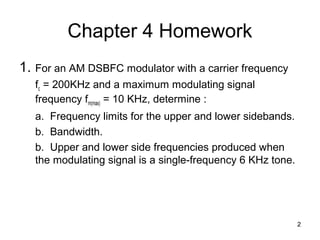
Chapter 4 Homework 
1. For an AM DSBFC modulator with a carrier frequency 
fc = 200KHz and a maximum modulating signal 
frequency fm(max) = 10 KHz, determine : 
a. Frequency limits for the upper and lower sidebands. 
b. Bandwidth. 
b. Upper and lower side frequencies produced when 
the modulating signal is a single-frequency 6 KHz tone.
3 
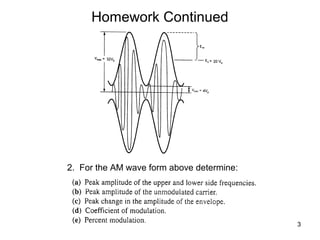
Homework Continued 
2. For the AM wave form above determine:
4 
Homework Continued 
3. 400 25 
5 
6
5 
Homework Continued 
4. Repeat steps (a) through (d) in Example 
4 in these lecture slides for a modulation 
coefficient of 0.5. 
5. For an AM DSBFC wave with a peak 
unmodulated carrier voltage Vc = 20 Vp, a 
load resistance RL = 20 W, and a 
modulation coefficient m = 0.8, 
determine the power of the modulated 
wave
Homework Continued 
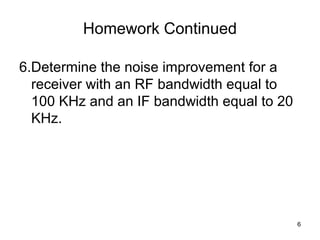
6.Determine the noise improvement for a 
receiver with an RF bandwidth equal to 
100 KHz and an IF bandwidth equal to 20 
KHz. 
6
7 
Amplitude Modulation Transmission
8 
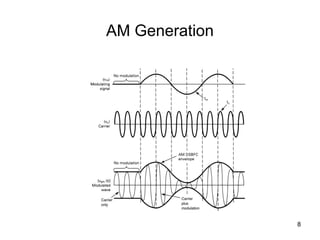
AM Generation
9 
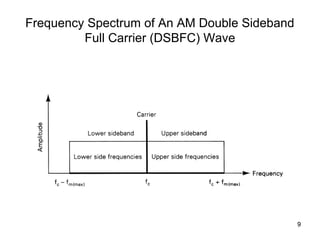
Frequency Spectrum of An AM Double Sideband 
Full Carrier (DSBFC) Wave
10 
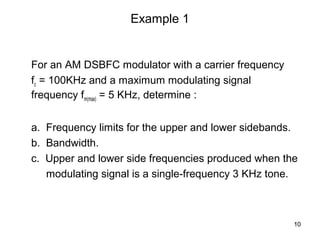
Example 1 
For an AM DSBFC modulator with a carrier frequency 
fc = 100KHz and a maximum modulating signal 
frequency fm(max) = 5 KHz, determine : 
a. Frequency limits for the upper and lower sidebands. 
b. Bandwidth. 
c. Upper and lower side frequencies produced when the 
modulating signal is a single-frequency 3 KHz tone.
11 
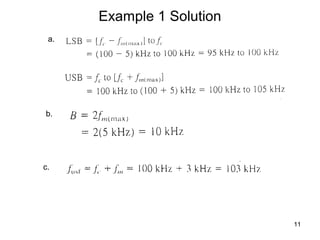
Example 1 Solution 
a. 
b. 
c.
12 
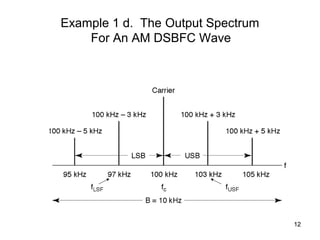
Example 1 d. The Output Spectrum 
For An AM DSBFC Wave
13 
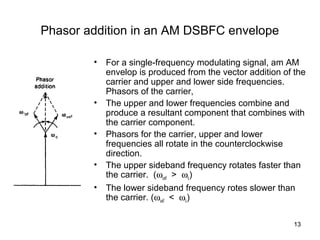
Phasor addition in an AM DSBFC envelope 
• For a single-frequency modulating signal, am AM 
envelop is produced from the vector addition of the 
carrier and upper and lower side frequencies. 
Phasors of the carrier, 
• The upper and lower frequencies combine and 
produce a resultant component that combines with 
the carrier component. 
• Phasors for the carrier, upper and lower 
frequencies all rotate in the counterclockwise 
direction. 
• The upper sideband frequency rotates faster than 
the carrier. (wusf > wc) 
• The lower sideband frequency rotes slower than 
the carrier. (wusf < wc)
14 
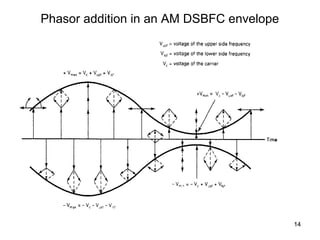
Phasor addition in an AM DSBFC envelope
15 
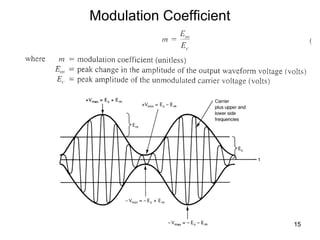
Modulation Coefficient
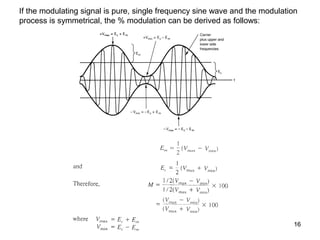
If the modulating signal is pure, single frequency sine wave and the modulation 
process is symmetrical, the % modulation can be derived as follows: 
16
17 
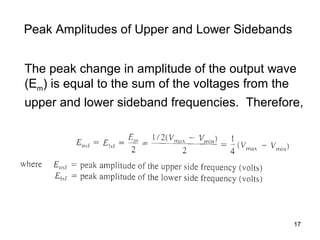
Peak Amplitudes of Upper and Lower Sidebands 
The peak change in amplitude of the output wave 
(Em) is equal to the sum of the voltages from the 
upper and lower sideband frequencies. Therefore,
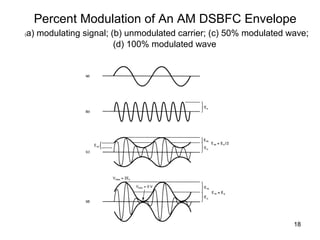
Percent Modulation of An AM DSBFC Envelope 
(a) modulating signal; (b) unmodulated carrier; (c) 50% modulated wave; 
18 
(d) 100% modulated wave
19 
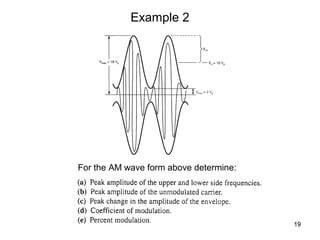
Example 2 
For the AM wave form above determine:
20 
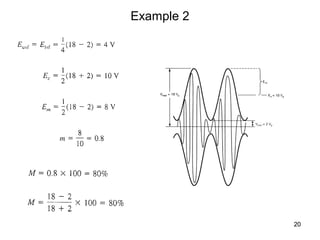
Example 2
21 
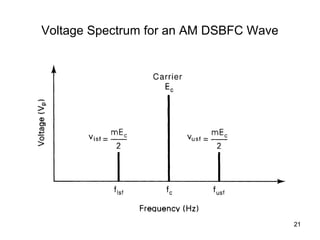
Voltage Spectrum for an AM DSBFC Wave
22 
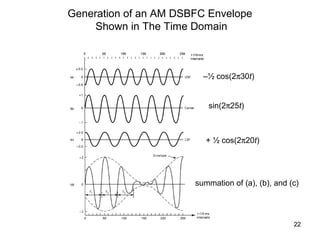
Generation of an AM DSBFC Envelope 
Shown in The Time Domain 
–½ cos(2p30t) 
sin(2p25t) 
+ ½ cos(2p20t) 
summation of (a), (b), and (c)
23 
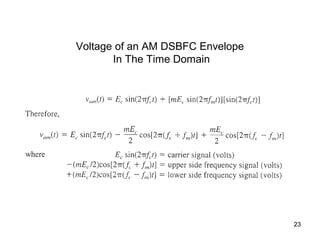
Voltage of an AM DSBFC Envelope 
In The Time Domain
24 
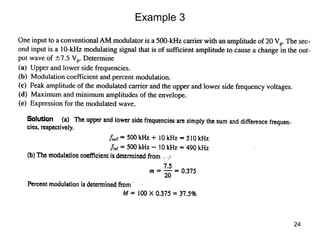
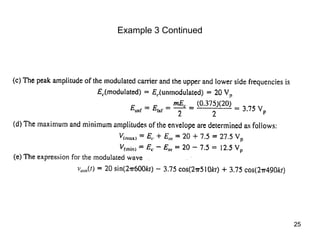
Example 3
25 
Example 3 Continued
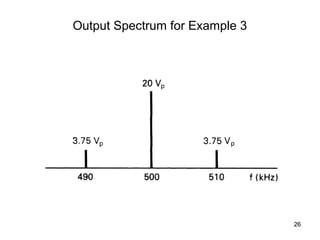
26 
Output Spectrum for Example 3
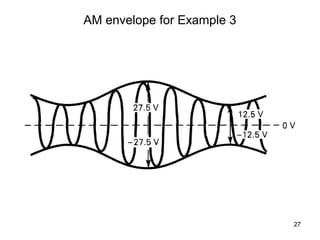
27 
AM envelope for Example 3
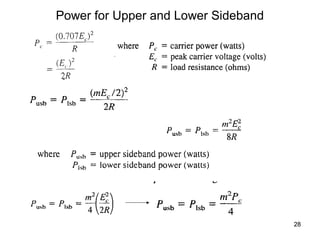
28 
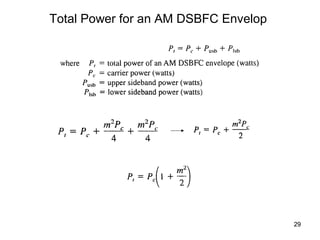
Power for Upper and Lower Sideband
29 
Total Power for an AM DSBFC Envelop
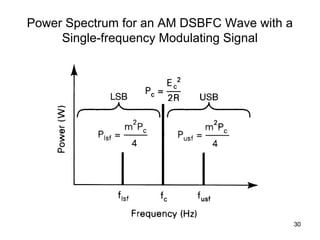
30 
Power Spectrum for an AM DSBFC Wave with a 
Single-frequency Modulating Signal
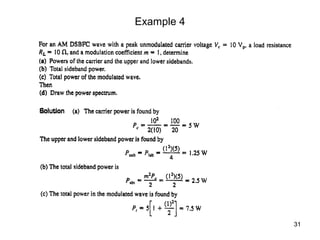
31 
Example 4
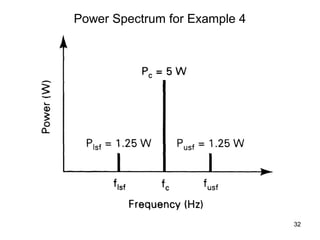
32 
Power Spectrum for Example 4
33 
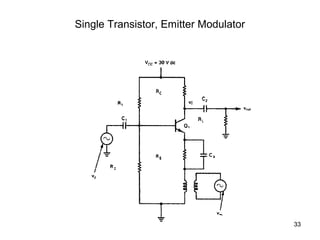
Single Transistor, Emitter Modulator
34 
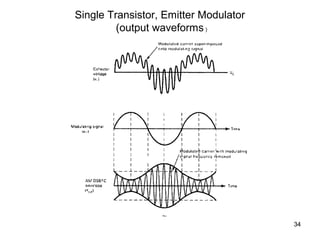
Single Transistor, Emitter Modulator 
(output waveforms )
35 
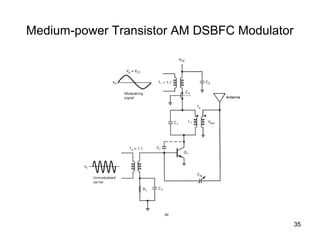
Medium-power Transistor AM DSBFC Modulator
36 
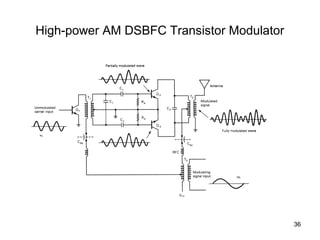
High-power AM DSBFC Transistor Modulator
37 
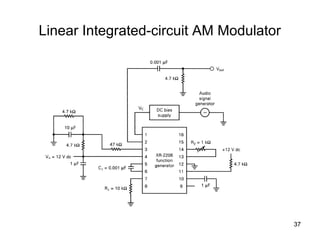
Linear Integrated-circuit AM Modulator
38 
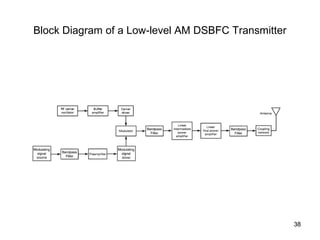
Block Diagram of a Low-level AM DSBFC Transmitter
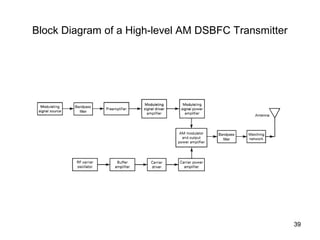
39 
Block Diagram of a High-level AM DSBFC Transmitter
40 
Single-Sideband
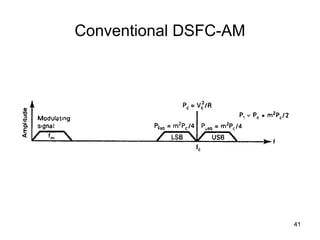
41 
Conventional DSFC-AM
42 
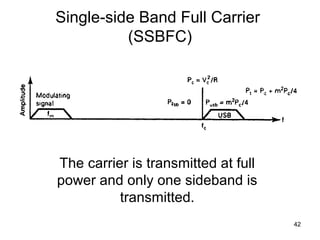
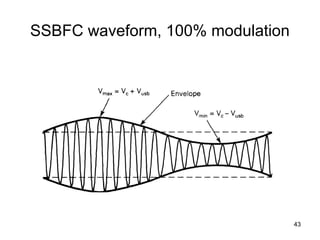
Single-side Band Full Carrier 
(SSBFC) 
The carrier is transmitted at full 
power and only one sideband is 
transmitted.
43 
SSBFC waveform, 100% modulation
44 
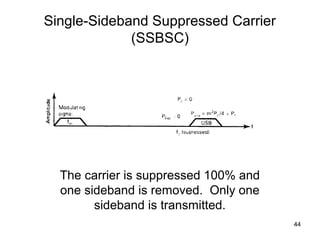
Single-Sideband Suppressed Carrier 
(SSBSC) 
The carrier is suppressed 100% and 
one sideband is removed. Only one 
sideband is transmitted.
45 
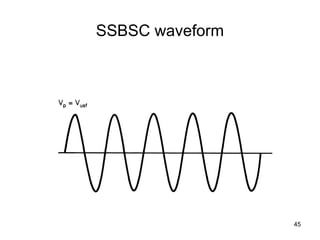
SSBSC waveform
46 
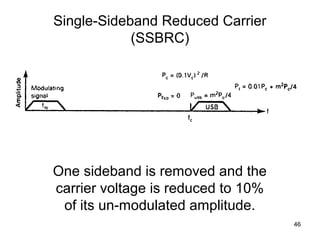
Single-Sideband Reduced Carrier 
(SSBRC) 
One sideband is removed and the 
carrier voltage is reduced to 10% 
of its un-modulated amplitude.
47 
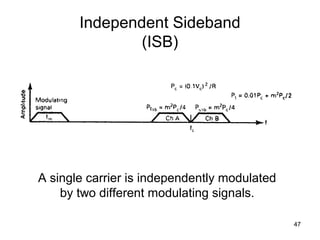
Independent Sideband 
(ISB) 
A single carrier is independently modulated 
by two different modulating signals.
48 
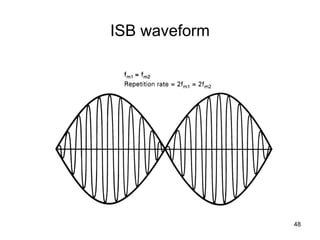
ISB waveform
49 
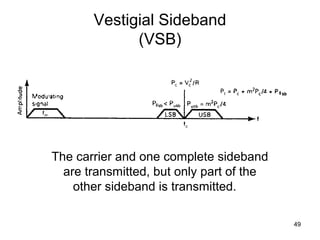
Vestigial Sideband 
(VSB) 
The carrier and one complete sideband 
are transmitted, but only part of the 
other sideband is transmitted.
50
51 
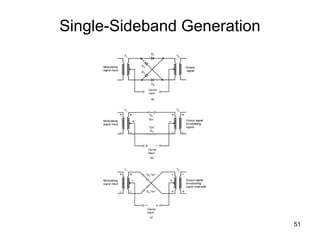
Single-Sideband Generation
52 
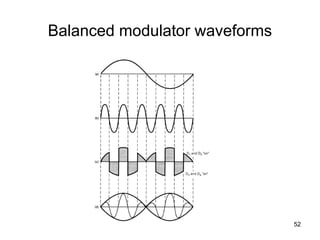
Balanced modulator waveforms
53 
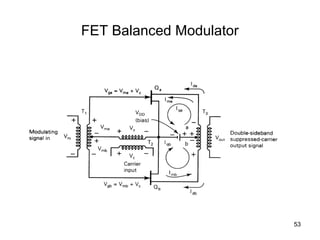
FET Balanced Modulator
54 
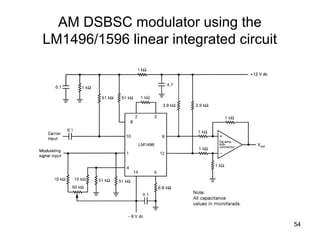
AM DSBSC modulator using the 
LM1496/1596 linear integrated circuit
55 
Amplitude Modulation Reception
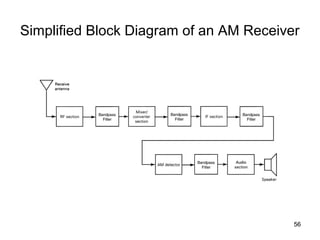
Simplified Block Diagram of an AM Receiver 
56
57 
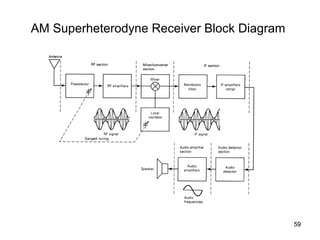
Simplified Block Diagram of an AM Receiver 
• Receiver front end = RF section 
– Detecting the signal 
– Band-limiting the signal 
– Amplifying the Band-limited signal 
• Mixer/converter 
– Down converts the RF signal to an IF signal 
• Intermediate frequency (IF) signal 
– Amplification 
– Selectivity 
• Ability of a receiver to accept assigned frequency 
• Ability of a receiver to reject other frequencies 
• AM detector demodulates the IF signal to the original signal 
• Audio section amplifies the recovered signal.
58 
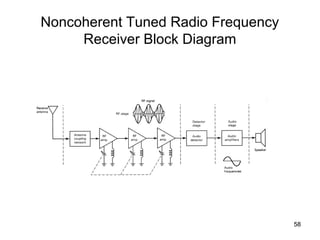
Noncoherent Tuned Radio Frequency 
Receiver Block Diagram
59 
AM Superheterodyne Receiver Block Diagram
60 
Bandwidth Improvement (BI) 
• Noise reduction ratio 
• BI = BRF / BIF 
• Noise figure improvement 
• NFIMP = 10 log BI 
• Determine the noise improvement for a receiver with an 
RF bandwidth equal to 200 KHz and an IF bandwidth 
equal to 10 KHz. 
– BI = 200 KHz / 10 KHZ = 20 
– NFImp = 10 log 20 = 13 dB
61 
Sensitivity 
• Sensitivity: minimum RF signal level that the 
receiver can detect at the RF input. 
• AM broadcast receivers 
– 10 dB signal to noise ratio 
– ½ watt (27 dBm) of power at the audio output 
– 50 uV Sensitivity 
• Microwave receivers 
– 40 dB signal to noise ratio 
– 5 mw (7 dBm) of power at the output 
• Aa
62 
Dynamic Range 
• Dynamic Range 
– Difference in dB between the minimum input level and 
the level that will over drive the receiver (produce 
distortion). 
– Input power range that the receiver is useful. 
– 100 dB is about the highest posible. 
• Low Dynamic Range 
– Causes desensitizing of the RF amplifiers 
– Results in sever inter-modulation distortion of weaker 
signals
63 
Fidelity 
• Ability to produce an exact replica of the original signal. 
• Forms of distortion 
– Amplitude 
• Results from non-uniform gain in amplifiers and filters. 
• Output signal differs from the original signal 
– Frequency: frequencies are in the output that were 
not in the orginal signal 
– Phase 
• Not important for voice transmission 
• Devastating for digital transmission
64 
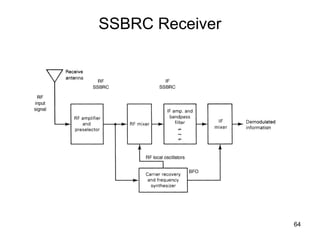
SSBRC Receiver
65 
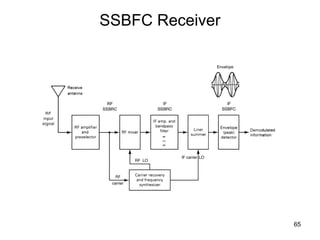
SSBFC Receiver

Eeng 3810 chapter 4

  • 1.
    1 EENG 3810Chapter 4 Amplitude Modulation (AM)
  • 2.
    2 Chapter 4Homework 1. For an AM DSBFC modulator with a carrier frequency fc = 200KHz and a maximum modulating signal frequency fm(max) = 10 KHz, determine : a. Frequency limits for the upper and lower sidebands. b. Bandwidth. b. Upper and lower side frequencies produced when the modulating signal is a single-frequency 6 KHz tone.
  • 3.
    3 Homework Continued 2. For the AM wave form above determine:
  • 4.
    4 Homework Continued 3. 400 25 5 6
  • 5.
    5 Homework Continued 4. Repeat steps (a) through (d) in Example 4 in these lecture slides for a modulation coefficient of 0.5. 5. For an AM DSBFC wave with a peak unmodulated carrier voltage Vc = 20 Vp, a load resistance RL = 20 W, and a modulation coefficient m = 0.8, determine the power of the modulated wave
  • 6.
    Homework Continued 6.Determinethe noise improvement for a receiver with an RF bandwidth equal to 100 KHz and an IF bandwidth equal to 20 KHz. 6
  • 7.
  • 8.
  • 9.
    9 Frequency Spectrumof An AM Double Sideband Full Carrier (DSBFC) Wave
  • 10.
    10 Example 1 For an AM DSBFC modulator with a carrier frequency fc = 100KHz and a maximum modulating signal frequency fm(max) = 5 KHz, determine : a. Frequency limits for the upper and lower sidebands. b. Bandwidth. c. Upper and lower side frequencies produced when the modulating signal is a single-frequency 3 KHz tone.
  • 11.
    11 Example 1Solution a. b. c.
  • 12.
    12 Example 1d. The Output Spectrum For An AM DSBFC Wave
  • 13.
    13 Phasor additionin an AM DSBFC envelope • For a single-frequency modulating signal, am AM envelop is produced from the vector addition of the carrier and upper and lower side frequencies. Phasors of the carrier, • The upper and lower frequencies combine and produce a resultant component that combines with the carrier component. • Phasors for the carrier, upper and lower frequencies all rotate in the counterclockwise direction. • The upper sideband frequency rotates faster than the carrier. (wusf > wc) • The lower sideband frequency rotes slower than the carrier. (wusf < wc)
  • 14.
    14 Phasor additionin an AM DSBFC envelope
  • 15.
  • 16.
    If the modulatingsignal is pure, single frequency sine wave and the modulation process is symmetrical, the % modulation can be derived as follows: 16
  • 17.
    17 Peak Amplitudesof Upper and Lower Sidebands The peak change in amplitude of the output wave (Em) is equal to the sum of the voltages from the upper and lower sideband frequencies. Therefore,
  • 18.
    Percent Modulation ofAn AM DSBFC Envelope (a) modulating signal; (b) unmodulated carrier; (c) 50% modulated wave; 18 (d) 100% modulated wave
  • 19.
    19 Example 2 For the AM wave form above determine:
  • 20.
  • 21.
    21 Voltage Spectrumfor an AM DSBFC Wave
  • 22.
    22 Generation ofan AM DSBFC Envelope Shown in The Time Domain –½ cos(2p30t) sin(2p25t) + ½ cos(2p20t) summation of (a), (b), and (c)
  • 23.
    23 Voltage ofan AM DSBFC Envelope In The Time Domain
  • 24.
  • 25.
    25 Example 3Continued
  • 26.
    26 Output Spectrumfor Example 3
  • 27.
    27 AM envelopefor Example 3
  • 28.
    28 Power forUpper and Lower Sideband
  • 29.
    29 Total Powerfor an AM DSBFC Envelop
  • 30.
    30 Power Spectrumfor an AM DSBFC Wave with a Single-frequency Modulating Signal
  • 31.
  • 32.
    32 Power Spectrumfor Example 4
  • 33.
    33 Single Transistor,Emitter Modulator
  • 34.
    34 Single Transistor,Emitter Modulator (output waveforms )
  • 35.
    35 Medium-power TransistorAM DSBFC Modulator
  • 36.
    36 High-power AMDSBFC Transistor Modulator
  • 37.
  • 38.
    38 Block Diagramof a Low-level AM DSBFC Transmitter
  • 39.
    39 Block Diagramof a High-level AM DSBFC Transmitter
  • 40.
  • 41.
  • 42.
    42 Single-side BandFull Carrier (SSBFC) The carrier is transmitted at full power and only one sideband is transmitted.
  • 43.
    43 SSBFC waveform,100% modulation
  • 44.
    44 Single-Sideband SuppressedCarrier (SSBSC) The carrier is suppressed 100% and one sideband is removed. Only one sideband is transmitted.
  • 45.
  • 46.
    46 Single-Sideband ReducedCarrier (SSBRC) One sideband is removed and the carrier voltage is reduced to 10% of its un-modulated amplitude.
  • 47.
    47 Independent Sideband (ISB) A single carrier is independently modulated by two different modulating signals.
  • 48.
  • 49.
    49 Vestigial Sideband (VSB) The carrier and one complete sideband are transmitted, but only part of the other sideband is transmitted.
  • 50.
  • 51.
  • 52.
  • 53.
    53 FET BalancedModulator
  • 54.
    54 AM DSBSCmodulator using the LM1496/1596 linear integrated circuit
  • 55.
  • 56.
    Simplified Block Diagramof an AM Receiver 56
  • 57.
    57 Simplified BlockDiagram of an AM Receiver • Receiver front end = RF section – Detecting the signal – Band-limiting the signal – Amplifying the Band-limited signal • Mixer/converter – Down converts the RF signal to an IF signal • Intermediate frequency (IF) signal – Amplification – Selectivity • Ability of a receiver to accept assigned frequency • Ability of a receiver to reject other frequencies • AM detector demodulates the IF signal to the original signal • Audio section amplifies the recovered signal.
  • 58.
    58 Noncoherent TunedRadio Frequency Receiver Block Diagram
  • 59.
    59 AM SuperheterodyneReceiver Block Diagram
  • 60.
    60 Bandwidth Improvement(BI) • Noise reduction ratio • BI = BRF / BIF • Noise figure improvement • NFIMP = 10 log BI • Determine the noise improvement for a receiver with an RF bandwidth equal to 200 KHz and an IF bandwidth equal to 10 KHz. – BI = 200 KHz / 10 KHZ = 20 – NFImp = 10 log 20 = 13 dB
  • 61.
    61 Sensitivity •Sensitivity: minimum RF signal level that the receiver can detect at the RF input. • AM broadcast receivers – 10 dB signal to noise ratio – ½ watt (27 dBm) of power at the audio output – 50 uV Sensitivity • Microwave receivers – 40 dB signal to noise ratio – 5 mw (7 dBm) of power at the output • Aa
  • 62.
    62 Dynamic Range • Dynamic Range – Difference in dB between the minimum input level and the level that will over drive the receiver (produce distortion). – Input power range that the receiver is useful. – 100 dB is about the highest posible. • Low Dynamic Range – Causes desensitizing of the RF amplifiers – Results in sever inter-modulation distortion of weaker signals
  • 63.
    63 Fidelity •Ability to produce an exact replica of the original signal. • Forms of distortion – Amplitude • Results from non-uniform gain in amplifiers and filters. • Output signal differs from the original signal – Frequency: frequencies are in the output that were not in the orginal signal – Phase • Not important for voice transmission • Devastating for digital transmission
  • 64.
  • 65.