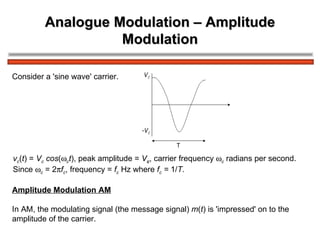
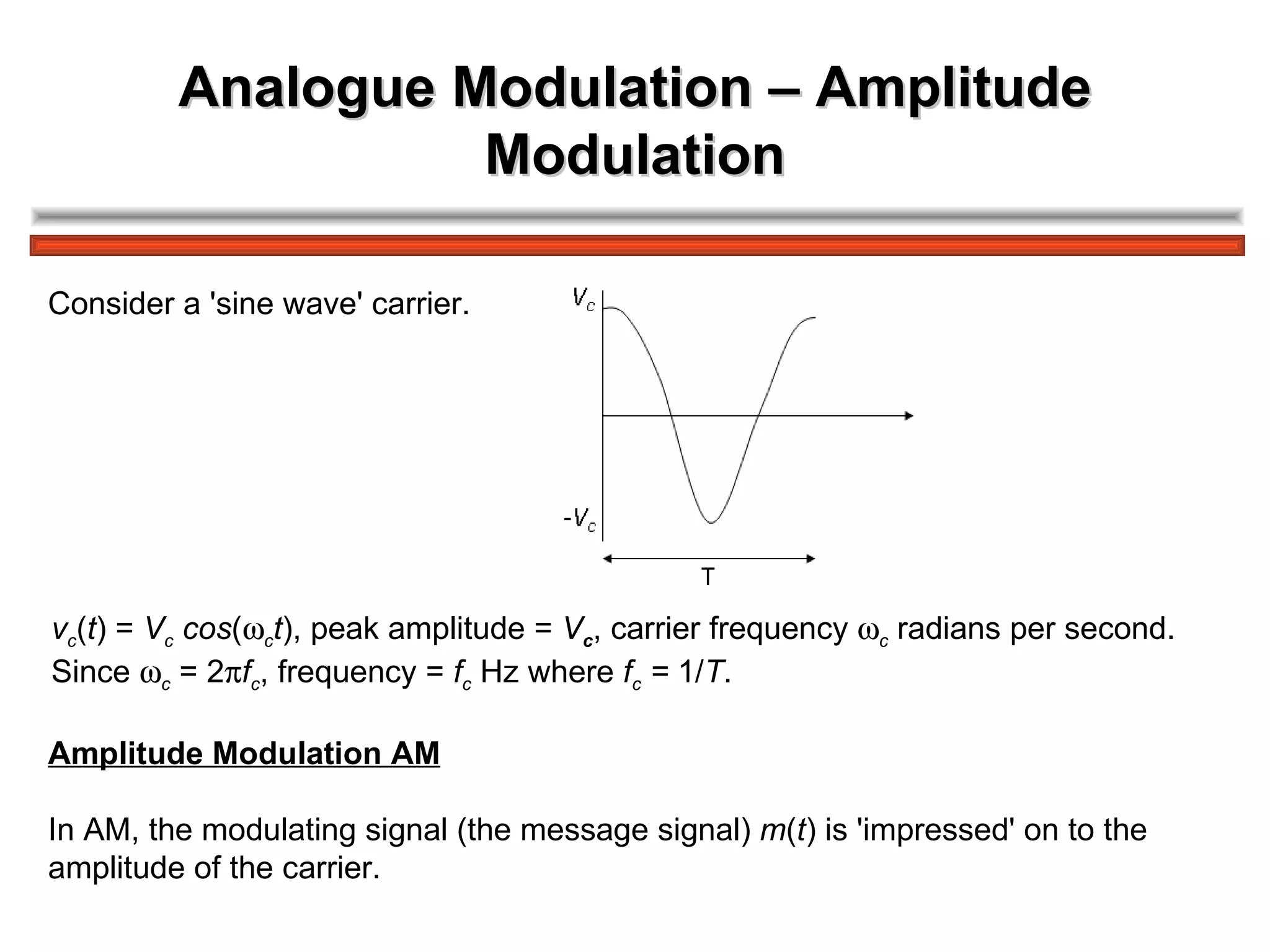
Analogue Modulation – Amplitude Modulation v c ( t ) =  V c  cos (  c t ), peak amplitude =  V c , carrier frequency   c  radians per second. Since   c  = 2  f c , frequency =  f c  Hz where  f c  =  1/ T . Consider a 'sine wave' carrier. Amplitude Modulation AM In AM, the modulating signal (the message signal)  m ( t ) is 'impressed' on to the  amplitude of the carrier.
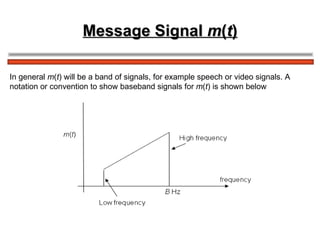
Message Signal  m ( t ) In general  m ( t ) will be a band of signals, for example speech or video signals. A  notation or convention to show baseband signals for  m ( t ) is shown below
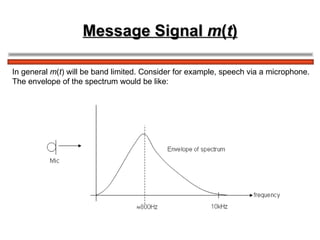
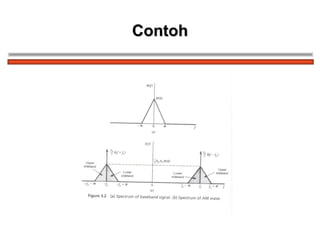
Message Signal  m ( t ) In general  m ( t ) will be band limited. Consider for example, speech via a microphone.  The envelope of the spectrum would be like:
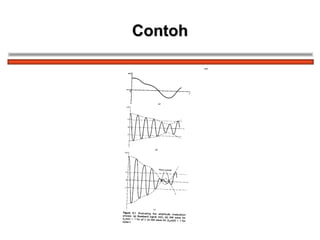
Contoh
Contoh
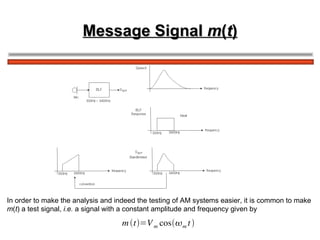
Message Signal  m ( t ) In order to make the analysis and indeed the testing of AM systems easier, it is common to make  m ( t ) a test signal,  i.e.  a signal with a constant amplitude and frequency given by
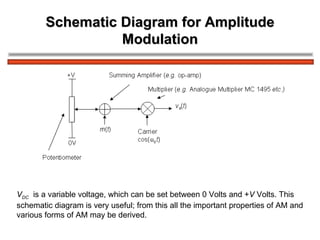
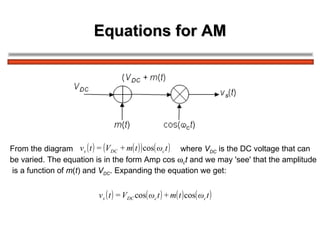
Schematic Diagram for Amplitude Modulation V DC   is a variable voltage, which can be set between 0 Volts and + V  Volts. This  schematic diagram is very useful; from this all the important properties of AM and  various forms of AM may be derived.
Equations for AM From the diagram  where  V DC  is the DC voltage that can be varied. The equation is in the form Amp cos   c t  and we may 'see' that the amplitude is a function of  m ( t ) and  V DC . Expanding the equation we get:
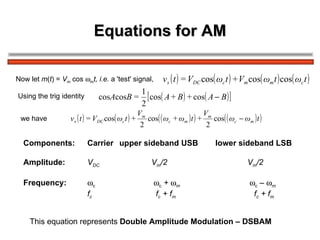
Equations for AM Now let  m ( t ) =  V m   cos   m t, i.e.  a 'test' signal, Using the trig identity   we have   Components: Carrier upper sideband USB lower sideband LSB Amplitude: V DC V m /2 V m /2 Frequency:  c    c  +   m    c  –   m f c   f c  + f m   f c  + f m This equation represents  Double Amplitude Modulation – DSBAM
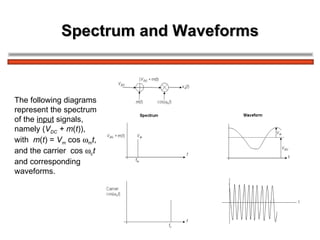
Spectrum and Waveforms The following diagrams  represent the spectrum of the  input  signals,  namely ( V DC  + m ( t )),  with  m ( t ) =  V m   cos   m t ,  and the carrier  cos   c t  and corresponding  waveforms.
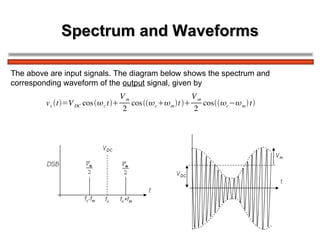
Spectrum and Waveforms The above are input signals. The diagram below shows the spectrum and  corresponding waveform of the  output  signal, given by
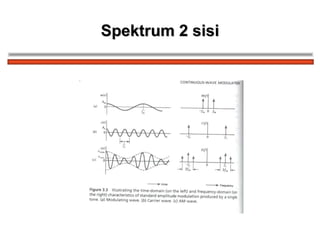
Spektrum 2 sisi
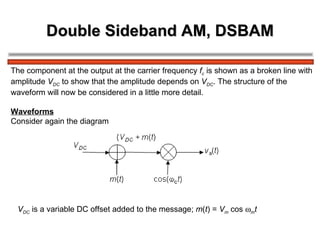
Double Sideband AM, DSBAM The component at the output at the carrier frequency  f c  is shown as a broken line with amplitude  V DC  to show that the amplitude depends on  V DC . The structure of the  waveform will now be considered in a little more detail. Waveforms Consider again the diagram V DC  is a variable DC offset added to the message;  m ( t ) =  V m  cos   m t
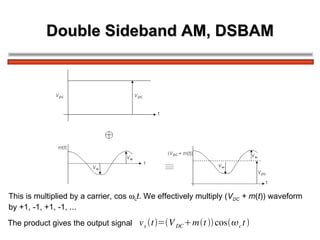
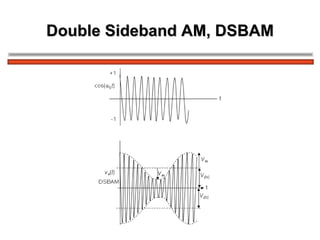
Double Sideband AM, DSBAM This is multiplied by a carrier, cos   c t . We effectively multiply ( V DC  + m ( t )) waveform by +1, -1, +1, -1, ... The product gives the output signal
Double Sideband AM, DSBAM
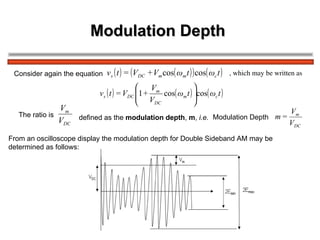
Modulation Depth  Consider again the equation   , which may be written as   The ratio is  defined as the  modulation depth ,  m ,  i.e.   Modulation Depth   From an oscilloscope display the modulation depth for Double Sideband AM may be  determined as follows:
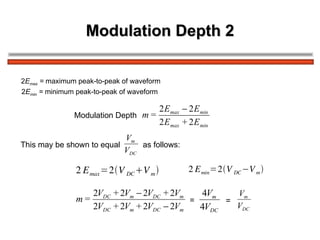
Modulation Depth 2 2 E max  =  maximum peak-to-peak of waveform 2 E min  =  minimum peak-to-peak of waveform   Modulation Depth  This may be shown to equal  as follows:  = =
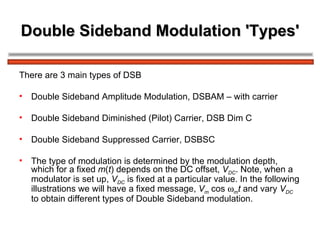
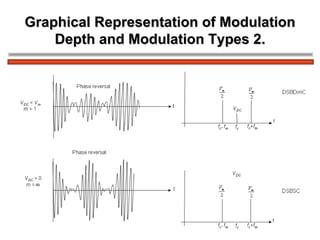
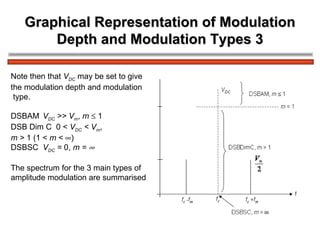
Double Sideband Modulation 'Types' There are 3 main types of DSB Double Sideband Amplitude Modulation, DSBAM – with carrier Double Sideband Diminished (Pilot) Carrier, DSB Dim C Double Sideband Suppressed Carrier, DSBSC The type of modulation is determined by the modulation depth, which for a fixed  m ( t ) depends on the DC offset,  V DC . Note, when a modulator is set up,  V DC  is fixed at a particular value. In the following illustrations we will have a fixed message,  V m  cos   m t  and vary  V DC  to obtain different types of Double Sideband modulation.
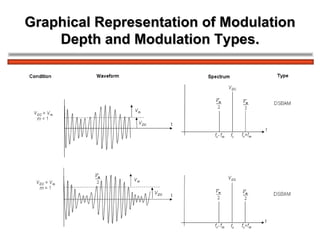
Graphical Representation of Modulation Depth and Modulation Types.
Graphical Representation of Modulation Depth and Modulation Types 2.
Graphical Representation of Modulation Depth and Modulation Types 3 Note then that  V DC   may be set to give  the modulation depth and modulation type. DSBAM V DC  >> V m ,  m    1 DSB Dim C  0 <  V DC  < V m ,  m >  1 (1 <  m  <   ) DSBSC V DC  =  0,  m =   The spectrum for the 3 main types of  amplitude modulation are summarised
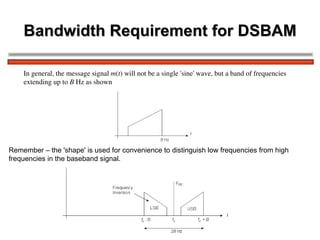
Bandwidth Requirement for DSBAM In general, the message signal  m ( t ) will not be a single 'sine' wave, but a band of frequencies  extending up to  B  Hz as shown Remember – the 'shape' is used for convenience to distinguish low frequencies from high  frequencies in the baseband signal.
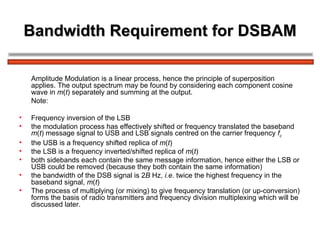
Bandwidth Requirement for DSBAM Amplitude Modulation is a linear process, hence the principle of superposition applies. The output spectrum may be found by considering each component cosine wave in  m ( t ) separately and summing at the output. Note:  Frequency inversion of the LSB the modulation process has effectively shifted or frequency translated the baseband  m ( t ) message signal to USB and LSB signals centred on the carrier frequency  f c the USB is a frequency shifted replica of  m ( t ) the LSB is a frequency inverted/shifted replica of  m ( t ) both sidebands each contain the same message information, hence either the LSB or USB could be removed (because they both contain the same information) the bandwidth of the DSB signal is 2 B  Hz,  i.e.  twice the highest frequency in the baseband signal,  m ( t ) The process of multiplying (or mixing) to give frequency translation (or up-conversion) forms the basis of radio transmitters and frequency division multiplexing which will be discussed later.
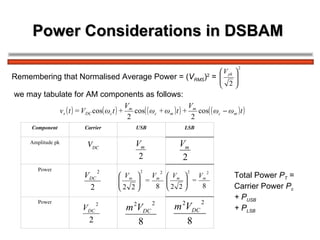
Power Considerations in DSBAM  Remembering that Normalised Average Power = ( V RMS ) 2  =  we may tabulate for AM components as follows: Total Power  P T  =  Carrier Power  P c   + P USB + P LSB Power Power V DC Amplitude pk LSB USB Carrier Component
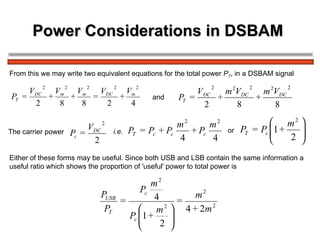
Power Considerations in DSBAM  From this we may write two equivalent equations for the total power  P T , in a DSBAM signal The carrier power   and or i.e. Either of these forms may be useful. Since both USB and LSB contain the same information a  useful ratio which shows the proportion of 'useful' power to total power is
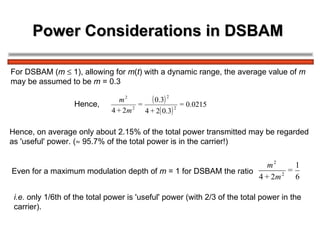
Power Considerations in DSBAM  For DSBAM ( m     1), allowing for  m ( t ) with a dynamic range, the average value of  m   may be assumed to be  m  = 0.3 Hence, on average only about 2.15% of the total power transmitted may be regarded  as 'useful' power. (   95.7% of the total power is in the carrier!) Hence,  Even for a maximum modulation depth of  m  = 1 for DSBAM the ratio  i.e.  only 1/6th of the total power is 'useful' power (with 2/3 of the total power in the  carrier).
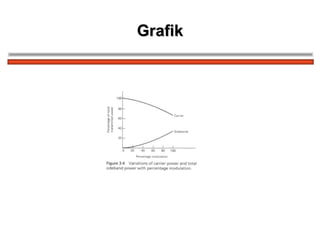
Grafik
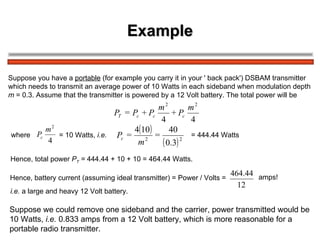
Example Suppose you have a  portable  (for example you carry it in your ' back pack') DSBAM transmitter  which needs to transmit an average power of 10 Watts in each sideband when modulation depth  m  = 0.3. Assume that the transmitter is powered by a 12 Volt battery. The total power will be  where  = 10 Watts,  i.e.   = 444.44 Watts   Hence, total power  P T  =  444.44 + 10 + 10 = 464.44 Watts.  Hence, battery current (assuming ideal transmitter) = Power / Volts =  i.e.  a large and heavy 12 Volt battery.   amps! Suppose we could remove one sideband and the carrier, power transmitted would be  10 Watts,  i.e.  0.833 amps from a 12 Volt battery, which is more reasonable for a  portable radio transmitter.
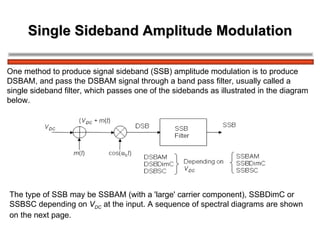
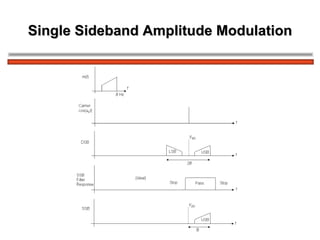
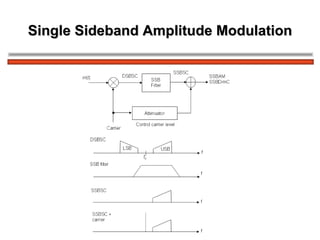
Single Sideband Amplitude Modulation One method to produce signal sideband (SSB) amplitude modulation is to produce  DSBAM, and pass the DSBAM signal through a band pass filter, usually called a  single sideband filter, which passes one of the sidebands as illustrated in the diagram  below. The type of SSB may be SSBAM (with a 'large' carrier component), SSBDimC or  SSBSC depending on  V DC  at the input. A sequence of spectral diagrams are shown  on the next page.
Single Sideband Amplitude Modulation
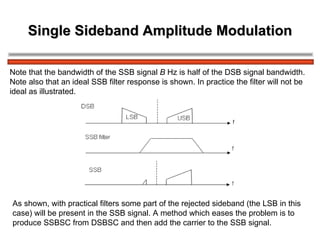
Single Sideband Amplitude Modulation Note that the bandwidth of the SSB signal  B  Hz is half of the DSB signal bandwidth.  Note also that an ideal SSB filter response is shown. In practice the filter will not be  ideal as illustrated. As shown, with practical filters some part of the rejected sideband (the LSB in this  case) will be present in the SSB signal. A method which eases the problem is to  produce SSBSC from DSBSC and then add the carrier to the SSB signal.
Single Sideband Amplitude Modulation
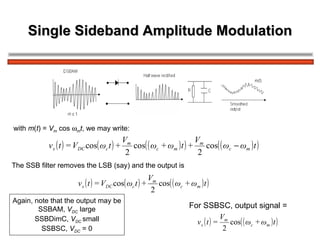
Single Sideband Amplitude Modulation with  m ( t ) =  V m  cos   m t , we may write: The SSB filter removes the LSB (say) and the output is Again, note that the output may be SSBAM,  V DC  large SSBDimC,  V DC   small SSBSC,  V DC  = 0 For SSBSC, output signal =
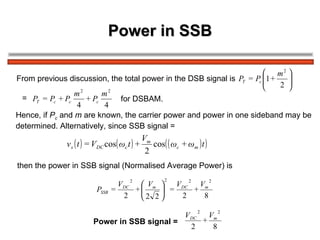
Power in SSB From previous discussion, the total power in the DSB signal is  Hence, if  P c  and  m  are known, the carrier power and power in one sideband may be  determined. Alternatively, since SSB signal =  then the power in SSB signal (Normalised Average Power) is  Power in SSB signal =   = for DSBAM.
Demodulation of Amplitude Modulated Signals There are 2 main methods of AM Demodulation: Envelope or non-coherent Detection/Demodulation. Synchronised or coherent Demodulation.
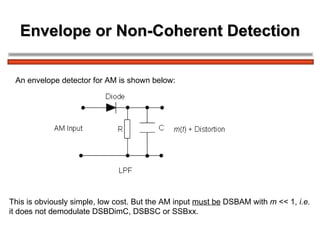
Envelope or Non-Coherent Detection This is obviously simple, low cost. But the AM input  must be  DSBAM with  m  << 1,  i.e.   it does not demodulate DSBDimC, DSBSC or SSBxx. An envelope detector for AM is shown below:
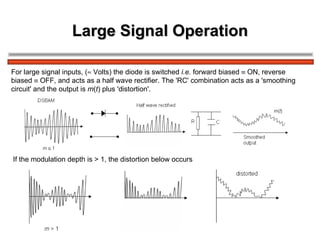
Large Signal Operation For large signal inputs, (   Volts) the diode is switched  i.e.  forward biased    ON, reverse  biased    OFF, and acts as a half wave rectifier. The 'RC' combination acts as a 'smoothing  circuit' and the output is  m ( t ) plus 'distortion'. If the modulation depth is > 1, the distortion below occurs
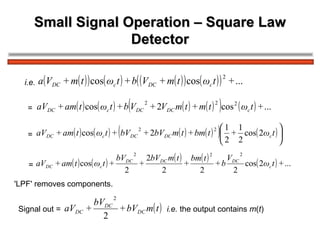
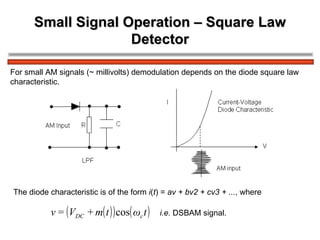
Small Signal Operation – Square Law Detector For small AM signals (~ millivolts) demodulation depends on the diode square law  characteristic. The diode characteristic is of the form  i ( t ) =  av + bv2 + cv3 + ... , where  i.e.  DSBAM signal.
Small Signal Operation – Square Law Detector = = = 'LPF' removes components. Signal out =  i.e.  the output contains  m ( t ) i.e.
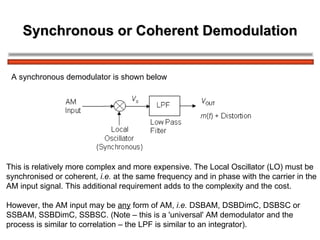
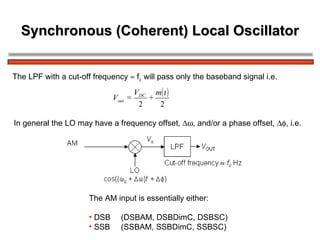
Synchronous or Coherent Demodulation A synchronous demodulator is shown below This is relatively more complex and more expensive. The Local Oscillator (LO) must be  synchronised or coherent,  i.e.  at the same frequency and in phase with the carrier in the AM input signal. This additional requirement adds to the complexity and the cost. However, the AM input may be  any  form of AM,  i.e.  DSBAM, DSBDimC, DSBSC or  SSBAM, SSBDimC, SSBSC. (Note – this is a 'universal' AM demodulator and the  process is similar to correlation – the LPF is similar to an integrator).
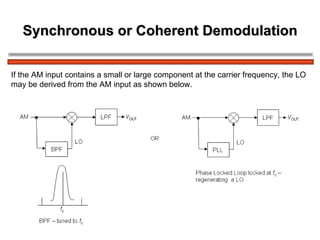
Synchronous or Coherent Demodulation If the AM input contains a small or large component at the carrier frequency, the LO  may be derived from the AM input as shown below.
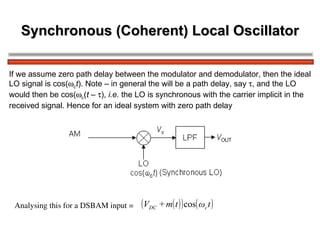
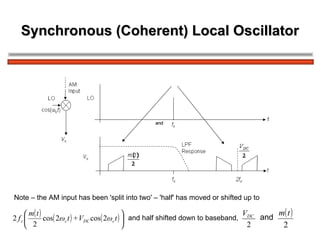
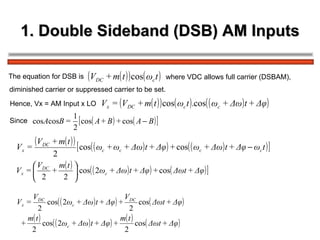
Synchronous (Coherent) Local Oscillator If we assume zero path delay between the modulator and demodulator, then the ideal  LO signal is cos(  c t ). Note – in general the will be a path delay, say   , and the LO  would then be cos(  c ( t –   ),  i.e.  the LO is synchronous with the carrier implicit in the received signal. Hence for an ideal system with zero path delay Analysing this for a DSBAM input =
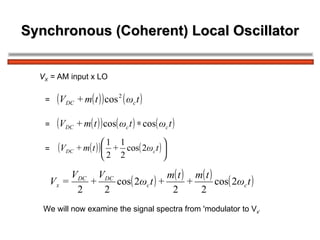
Synchronous (Coherent) Local Oscillator V X  =  AM input x LO = We will now examine the signal spectra from 'modulator to V x' = =
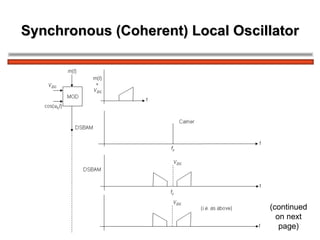
Synchronous (Coherent) Local Oscillator (continued on next page)
Synchronous (Coherent) Local Oscillator Note – the AM input has been 'split into two' – 'half' has moved or shifted up to   and half shifted down to baseband,   and  and  and  and  and  and
Synchronous (Coherent) Local Oscillator The LPF with a cut-off frequency    f c  will pass only the baseband signal i.e.  In general the LO may have a frequency offset,   , and/or a phase offset,   , i.e. The AM input is essentially either: DSB (DSBAM, DSBDimC, DSBSC) SSB (SSBAM, SSBDimC, SSBSC)
1. Double Sideband (DSB) AM Inputs The equation for DSB is  diminished carrier or suppressed carrier to be set.  where VDC allows full carrier (DSBAM), Hence, Vx = AM Input x LO Since
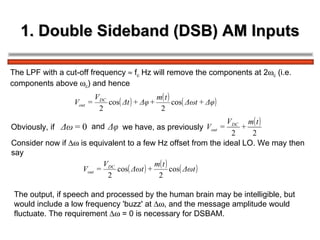
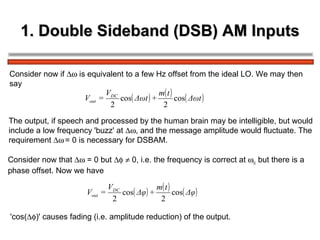
1. Double Sideband (DSB) AM Inputs The LPF with a cut-off frequency    f c  Hz will remove the components at 2  c  (i.e.  components above   c ) and hence Obviously, if  and   we have, as previously  Consider now if    is equivalent to a few Hz offset from the ideal LO. We may then  say The output, if speech and processed by the human brain may be intelligible, but  would include a low frequency 'buzz' at   , and the message amplitude would  fluctuate. The requirement    = 0 is necessary for DSBAM.
1. Double Sideband (DSB) AM Inputs Consider now if    is equivalent to a few Hz offset from the ideal LO. We may then  say The output, if speech and processed by the human brain may be intelligible, but would  include a low frequency 'buzz' at   , and the message amplitude would fluctuate. The  requirement     = 0 is necessary for DSBAM. Consider now that    = 0 but       0, i.e. the frequency is correct at   c  but there is a phase offset. Now we have  'cos(  )' causes fading (i.e. amplitude reduction) of the output.
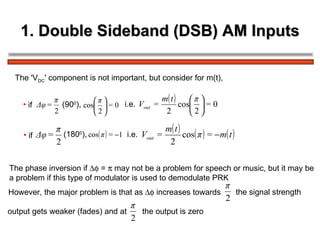
1. Double Sideband (DSB) AM Inputs The 'V DC ' component is not important, but consider for m(t), if  (90 0 ),   i.e.   (180 0 ),   if  i.e.   The phase inversion if    =    may not be a problem for speech or music, but it may be  a problem if this type of modulator is used to demodulate PRK  However, the major problem is that as    increases towards  the signal strength  output gets weaker (fades) and at  the output is zero
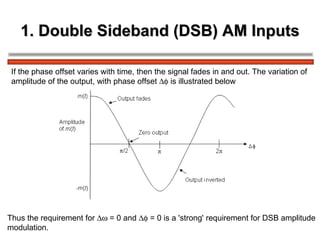
1. Double Sideband (DSB) AM Inputs If the phase offset varies with time, then the signal fades in and out. The variation of  amplitude of the output, with phase offset    is illustrated below Thus the requirement for    = 0 and    = 0 is a 'strong' requirement for DSB amplitude  modulation.
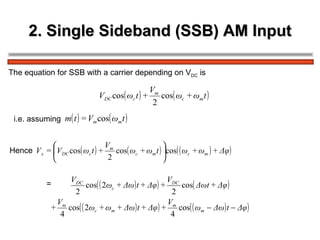
2. Single Sideband (SSB) AM Input The equation for SSB with a carrier depending on V DC  is i.e. assuming  Hence  =
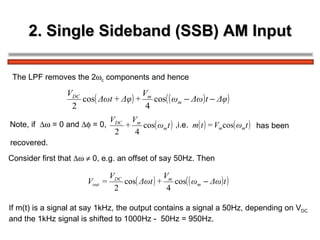
2. Single Sideband (SSB) AM Input The LPF removes the 2  c  components and hence Note, if    = 0 and    = 0,  ,i.e.   has been recovered. Consider first that       0, e.g. an offset of say 50Hz. Then If m(t) is a signal at say 1kHz, the output contains a signal a 50Hz, depending on V DC   and the 1kHz signal is shifted to 1000Hz -  50Hz = 950Hz.
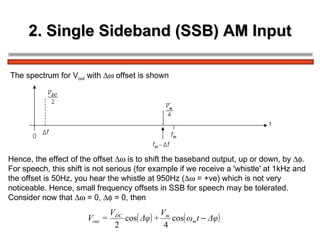
2. Single Sideband (SSB) AM Input The spectrum for V out  with    offset is shown Hence, the effect of the offset    is to shift the baseband output, up or down, by   .  For speech, this shift is not serious (for example if we receive a 'whistle' at 1kHz and  the offset is 50Hz, you hear the whistle at 950Hz (   = +ve) which is not very  noticeable. Hence, small frequency offsets in SSB for speech may be tolerated.  Consider now that    = 0,    = 0, then
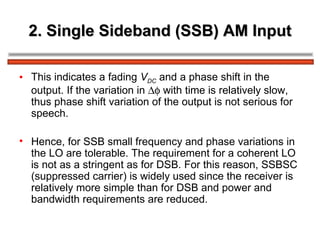
2. Single Sideband (SSB) AM Input This indicates a fading  V DC   and a phase shift in the output. If the variation in    with time is relatively slow, thus phase shift variation of the output is not serious for speech. Hence, for SSB small frequency and phase variations in the LO are tolerable. The requirement for a coherent LO is not as a stringent as for DSB. For this reason, SSBSC (suppressed carrier) is widely used since the receiver is relatively more simple than for DSB and power and bandwidth requirements are reduced.
Comments In terms of 'evolution', early radio schemes and radio on long wave (LW) and medium wave (MW) to this day use DSBAM with  m  < 1. The reason for this was the reduced complexity and cost of 'millions' of receivers compared to the extra cost and power requirements of a few large LW/MW transmitters for broadcast radio,  i.e.  simple envelope detectors only are required. Nowadays, with modern integrated circuits, the cost and complexity of synchronous demodulators is much reduced especially compared to the additional features such as synthesised LO, display, FM  etc.  available in modern receivers. Amplitude Modulation forms the basis for: Digital Modulation – Amplitude Shift Keying ASK Digital Modulation – Phase Reversal Keying PRK Multiplexing – Frequency Division Multiplexing FDM Up conversion – Radio transmitters Down conversion – Radio receivers
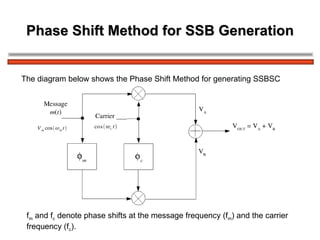
Phase Shift Method for SSB Generation The diagram below shows the Phase Shift Method for generating SSBSC f m  and f c  denote phase shifts at the message frequency (f m ) and the carrier  frequency (f c ).
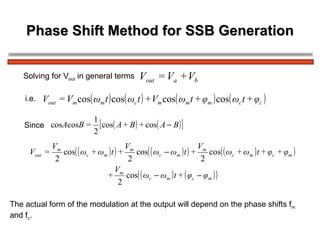
Phase Shift Method for SSB Generation Solving for V out  in general terms  i.e.   Since  The actual form of the modulation at the output will depend on the phase shifts f m   and f c .
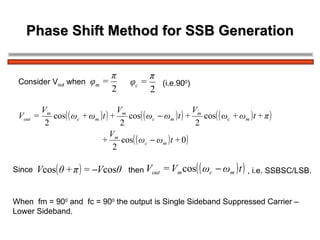
Phase Shift Method for SSB Generation Consider V out  when  (i.e.90 0 )  Since  then  When  fm = 90 0  and  fc = 90 0  the output is Single Sideband Suppressed Carrier –  Lower Sideband. , i.e. SSBSC/LSB.
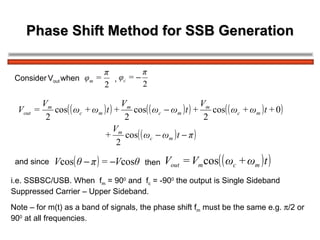
Phase Shift Method for SSB Generation Consider   V out   when  ,  and since  then   i.e. SSBSC/USB. When  f m  = 90 0  and  f c  = -90 0  the output is Single Sideband  Suppressed Carrier – Upper Sideband. Note – for m(t) as a band of signals, the phase shift f m  must be the same e.g.   /2 or  90 0  at all frequencies.
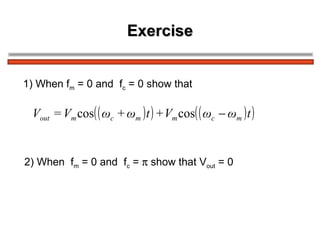
Exercise 1) When f m  = 0 and  f c  = 0 show that  2) When  f m  = 0 and  f c  =    show that V out  = 0
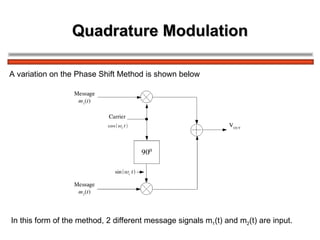
Quadrature Modulation A variation on the Phase Shift Method is shown below In this form of the method, 2 different message signals m 1 (t) and m 2 (t) are input.
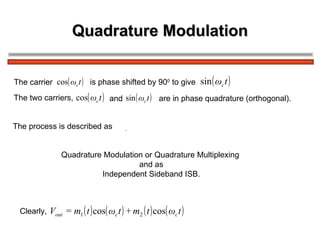
Quadrature Modulation The carrier  is phase shifted by 90 0  to give  The two carriers,  and   are in phase quadrature (orthogonal).  Quadrature Modulation or Quadrature Multiplexing  and as Independent Sideband ISB. The process is described as Clearly,  .
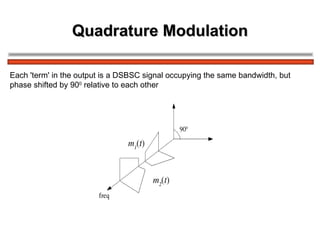
Quadrature Modulation Each 'term' in the output is a DSBSC signal occupying the same bandwidth, but  phase shifted by 90 0  relative to each other
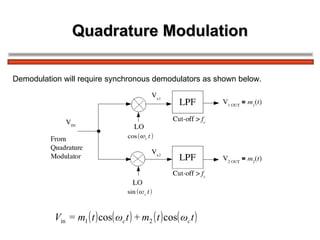
Quadrature Modulation Demodulation will require synchronous demodulators as shown below.
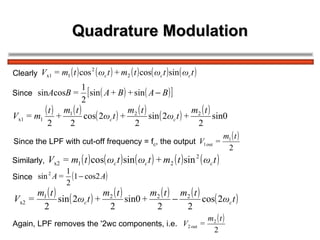
Quadrature Modulation Clearly   Since   Since the LPF with cut-off frequency = f c , the output  Similarly,  Since Again, LPF removes the '2wc components, i.e.
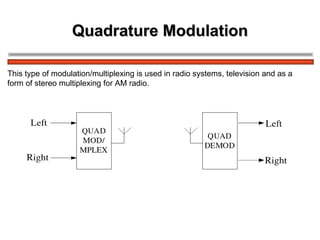
Quadrature Modulation This type of modulation/multiplexing is used in radio systems, television and as a  form of stereo multiplexing for AM radio.
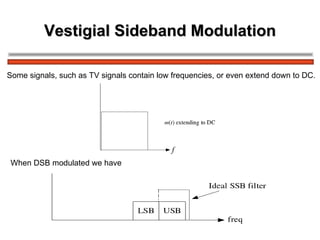
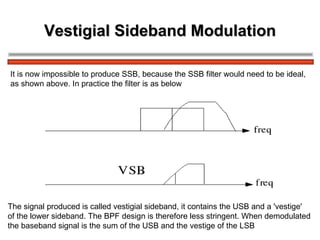
Vestigial Sideband Modulation Some signals, such as TV signals contain low frequencies, or even extend down to DC. When DSB modulated we have
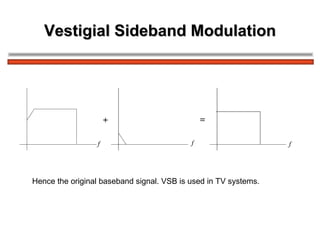
Vestigial Sideband Modulation It is now impossible to produce SSB, because the SSB filter would need to be ideal,  as shown above. In practice the filter is as below The signal produced is called vestigial sideband, it contains the USB and a 'vestige'  of the lower sideband. The BPF design is therefore less stringent. When demodulated  the baseband signal is the sum of the USB and the vestige of the LSB
Vestigial Sideband Modulation Hence the original baseband signal. VSB is used in TV systems.

Amplitude modulation

  • 1.
    Analogue Modulation –Amplitude Modulation v c ( t ) = V c cos (  c t ), peak amplitude = V c , carrier frequency  c radians per second. Since  c = 2  f c , frequency = f c Hz where f c = 1/ T . Consider a 'sine wave' carrier. Amplitude Modulation AM In AM, the modulating signal (the message signal) m ( t ) is 'impressed' on to the amplitude of the carrier.
  • 2.
    Message Signal m ( t ) In general m ( t ) will be a band of signals, for example speech or video signals. A notation or convention to show baseband signals for m ( t ) is shown below
  • 3.
    Message Signal m ( t ) In general m ( t ) will be band limited. Consider for example, speech via a microphone. The envelope of the spectrum would be like:
  • 4.
  • 5.
  • 6.
    Message Signal m ( t ) In order to make the analysis and indeed the testing of AM systems easier, it is common to make m ( t ) a test signal, i.e. a signal with a constant amplitude and frequency given by
  • 7.
    Schematic Diagram forAmplitude Modulation V DC is a variable voltage, which can be set between 0 Volts and + V Volts. This schematic diagram is very useful; from this all the important properties of AM and various forms of AM may be derived.
  • 8.
    Equations for AMFrom the diagram where V DC is the DC voltage that can be varied. The equation is in the form Amp cos  c t and we may 'see' that the amplitude is a function of m ( t ) and V DC . Expanding the equation we get:
  • 9.
    Equations for AMNow let m ( t ) = V m cos  m t, i.e. a 'test' signal, Using the trig identity we have Components: Carrier upper sideband USB lower sideband LSB Amplitude: V DC V m /2 V m /2 Frequency:  c  c +  m  c –  m f c f c + f m f c + f m This equation represents Double Amplitude Modulation – DSBAM
  • 10.
    Spectrum and WaveformsThe following diagrams represent the spectrum of the input signals, namely ( V DC + m ( t )), with m ( t ) = V m cos  m t , and the carrier cos  c t and corresponding waveforms.
  • 11.
    Spectrum and WaveformsThe above are input signals. The diagram below shows the spectrum and corresponding waveform of the output signal, given by
  • 12.
  • 13.
    Double Sideband AM,DSBAM The component at the output at the carrier frequency f c is shown as a broken line with amplitude V DC to show that the amplitude depends on V DC . The structure of the waveform will now be considered in a little more detail. Waveforms Consider again the diagram V DC is a variable DC offset added to the message; m ( t ) = V m cos  m t
  • 14.
    Double Sideband AM,DSBAM This is multiplied by a carrier, cos  c t . We effectively multiply ( V DC + m ( t )) waveform by +1, -1, +1, -1, ... The product gives the output signal
  • 15.
  • 16.
    Modulation Depth Consider again the equation , which may be written as The ratio is defined as the modulation depth , m , i.e. Modulation Depth From an oscilloscope display the modulation depth for Double Sideband AM may be determined as follows:
  • 17.
    Modulation Depth 22 E max = maximum peak-to-peak of waveform 2 E min = minimum peak-to-peak of waveform Modulation Depth This may be shown to equal as follows: = =
  • 18.
    Double Sideband Modulation'Types' There are 3 main types of DSB Double Sideband Amplitude Modulation, DSBAM – with carrier Double Sideband Diminished (Pilot) Carrier, DSB Dim C Double Sideband Suppressed Carrier, DSBSC The type of modulation is determined by the modulation depth, which for a fixed m ( t ) depends on the DC offset, V DC . Note, when a modulator is set up, V DC is fixed at a particular value. In the following illustrations we will have a fixed message, V m cos  m t and vary V DC to obtain different types of Double Sideband modulation.
  • 19.
    Graphical Representation ofModulation Depth and Modulation Types.
  • 20.
    Graphical Representation ofModulation Depth and Modulation Types 2.
  • 21.
    Graphical Representation ofModulation Depth and Modulation Types 3 Note then that V DC may be set to give the modulation depth and modulation type. DSBAM V DC >> V m , m  1 DSB Dim C 0 < V DC < V m , m > 1 (1 < m <  ) DSBSC V DC = 0, m =  The spectrum for the 3 main types of amplitude modulation are summarised
  • 22.
    Bandwidth Requirement forDSBAM In general, the message signal m ( t ) will not be a single 'sine' wave, but a band of frequencies extending up to B Hz as shown Remember – the 'shape' is used for convenience to distinguish low frequencies from high frequencies in the baseband signal.
  • 23.
    Bandwidth Requirement forDSBAM Amplitude Modulation is a linear process, hence the principle of superposition applies. The output spectrum may be found by considering each component cosine wave in m ( t ) separately and summing at the output. Note: Frequency inversion of the LSB the modulation process has effectively shifted or frequency translated the baseband m ( t ) message signal to USB and LSB signals centred on the carrier frequency f c the USB is a frequency shifted replica of m ( t ) the LSB is a frequency inverted/shifted replica of m ( t ) both sidebands each contain the same message information, hence either the LSB or USB could be removed (because they both contain the same information) the bandwidth of the DSB signal is 2 B Hz, i.e. twice the highest frequency in the baseband signal, m ( t ) The process of multiplying (or mixing) to give frequency translation (or up-conversion) forms the basis of radio transmitters and frequency division multiplexing which will be discussed later.
  • 24.
    Power Considerations inDSBAM Remembering that Normalised Average Power = ( V RMS ) 2 = we may tabulate for AM components as follows: Total Power P T = Carrier Power P c + P USB + P LSB Power Power V DC Amplitude pk LSB USB Carrier Component
  • 25.
    Power Considerations inDSBAM From this we may write two equivalent equations for the total power P T , in a DSBAM signal The carrier power and or i.e. Either of these forms may be useful. Since both USB and LSB contain the same information a useful ratio which shows the proportion of 'useful' power to total power is
  • 26.
    Power Considerations inDSBAM For DSBAM ( m  1), allowing for m ( t ) with a dynamic range, the average value of m may be assumed to be m = 0.3 Hence, on average only about 2.15% of the total power transmitted may be regarded as 'useful' power. (  95.7% of the total power is in the carrier!) Hence, Even for a maximum modulation depth of m = 1 for DSBAM the ratio i.e. only 1/6th of the total power is 'useful' power (with 2/3 of the total power in the carrier).
  • 27.
  • 28.
    Example Suppose youhave a portable (for example you carry it in your ' back pack') DSBAM transmitter which needs to transmit an average power of 10 Watts in each sideband when modulation depth m = 0.3. Assume that the transmitter is powered by a 12 Volt battery. The total power will be where = 10 Watts, i.e. = 444.44 Watts Hence, total power P T = 444.44 + 10 + 10 = 464.44 Watts. Hence, battery current (assuming ideal transmitter) = Power / Volts = i.e. a large and heavy 12 Volt battery. amps! Suppose we could remove one sideband and the carrier, power transmitted would be 10 Watts, i.e. 0.833 amps from a 12 Volt battery, which is more reasonable for a portable radio transmitter.
  • 29.
    Single Sideband AmplitudeModulation One method to produce signal sideband (SSB) amplitude modulation is to produce DSBAM, and pass the DSBAM signal through a band pass filter, usually called a single sideband filter, which passes one of the sidebands as illustrated in the diagram below. The type of SSB may be SSBAM (with a 'large' carrier component), SSBDimC or SSBSC depending on V DC at the input. A sequence of spectral diagrams are shown on the next page.
  • 30.
  • 31.
    Single Sideband AmplitudeModulation Note that the bandwidth of the SSB signal B Hz is half of the DSB signal bandwidth. Note also that an ideal SSB filter response is shown. In practice the filter will not be ideal as illustrated. As shown, with practical filters some part of the rejected sideband (the LSB in this case) will be present in the SSB signal. A method which eases the problem is to produce SSBSC from DSBSC and then add the carrier to the SSB signal.
  • 32.
  • 33.
    Single Sideband AmplitudeModulation with m ( t ) = V m cos  m t , we may write: The SSB filter removes the LSB (say) and the output is Again, note that the output may be SSBAM, V DC large SSBDimC, V DC small SSBSC, V DC = 0 For SSBSC, output signal =
  • 34.
    Power in SSBFrom previous discussion, the total power in the DSB signal is Hence, if P c and m are known, the carrier power and power in one sideband may be determined. Alternatively, since SSB signal = then the power in SSB signal (Normalised Average Power) is Power in SSB signal = = for DSBAM.
  • 35.
    Demodulation of AmplitudeModulated Signals There are 2 main methods of AM Demodulation: Envelope or non-coherent Detection/Demodulation. Synchronised or coherent Demodulation.
  • 36.
    Envelope or Non-CoherentDetection This is obviously simple, low cost. But the AM input must be DSBAM with m << 1, i.e. it does not demodulate DSBDimC, DSBSC or SSBxx. An envelope detector for AM is shown below:
  • 37.
    Large Signal OperationFor large signal inputs, (  Volts) the diode is switched i.e. forward biased  ON, reverse biased  OFF, and acts as a half wave rectifier. The 'RC' combination acts as a 'smoothing circuit' and the output is m ( t ) plus 'distortion'. If the modulation depth is > 1, the distortion below occurs
  • 38.
    Small Signal Operation– Square Law Detector For small AM signals (~ millivolts) demodulation depends on the diode square law characteristic. The diode characteristic is of the form i ( t ) = av + bv2 + cv3 + ... , where i.e. DSBAM signal.
  • 39.
    Small Signal Operation– Square Law Detector = = = 'LPF' removes components. Signal out = i.e. the output contains m ( t ) i.e.
  • 40.
    Synchronous or CoherentDemodulation A synchronous demodulator is shown below This is relatively more complex and more expensive. The Local Oscillator (LO) must be synchronised or coherent, i.e. at the same frequency and in phase with the carrier in the AM input signal. This additional requirement adds to the complexity and the cost. However, the AM input may be any form of AM, i.e. DSBAM, DSBDimC, DSBSC or SSBAM, SSBDimC, SSBSC. (Note – this is a 'universal' AM demodulator and the process is similar to correlation – the LPF is similar to an integrator).
  • 41.
    Synchronous or CoherentDemodulation If the AM input contains a small or large component at the carrier frequency, the LO may be derived from the AM input as shown below.
  • 42.
    Synchronous (Coherent) LocalOscillator If we assume zero path delay between the modulator and demodulator, then the ideal LO signal is cos(  c t ). Note – in general the will be a path delay, say  , and the LO would then be cos(  c ( t –  ), i.e. the LO is synchronous with the carrier implicit in the received signal. Hence for an ideal system with zero path delay Analysing this for a DSBAM input =
  • 43.
    Synchronous (Coherent) LocalOscillator V X = AM input x LO = We will now examine the signal spectra from 'modulator to V x' = =
  • 44.
    Synchronous (Coherent) LocalOscillator (continued on next page)
  • 45.
    Synchronous (Coherent) LocalOscillator Note – the AM input has been 'split into two' – 'half' has moved or shifted up to and half shifted down to baseband, and and and and and and
  • 46.
    Synchronous (Coherent) LocalOscillator The LPF with a cut-off frequency  f c will pass only the baseband signal i.e. In general the LO may have a frequency offset,  , and/or a phase offset,  , i.e. The AM input is essentially either: DSB (DSBAM, DSBDimC, DSBSC) SSB (SSBAM, SSBDimC, SSBSC)
  • 47.
    1. Double Sideband(DSB) AM Inputs The equation for DSB is diminished carrier or suppressed carrier to be set. where VDC allows full carrier (DSBAM), Hence, Vx = AM Input x LO Since
  • 48.
    1. Double Sideband(DSB) AM Inputs The LPF with a cut-off frequency  f c Hz will remove the components at 2  c (i.e. components above  c ) and hence Obviously, if and we have, as previously Consider now if  is equivalent to a few Hz offset from the ideal LO. We may then say The output, if speech and processed by the human brain may be intelligible, but would include a low frequency 'buzz' at  , and the message amplitude would fluctuate. The requirement  = 0 is necessary for DSBAM.
  • 49.
    1. Double Sideband(DSB) AM Inputs Consider now if  is equivalent to a few Hz offset from the ideal LO. We may then say The output, if speech and processed by the human brain may be intelligible, but would include a low frequency 'buzz' at  , and the message amplitude would fluctuate. The requirement  = 0 is necessary for DSBAM. Consider now that  = 0 but   0, i.e. the frequency is correct at  c but there is a phase offset. Now we have 'cos(  )' causes fading (i.e. amplitude reduction) of the output.
  • 50.
    1. Double Sideband(DSB) AM Inputs The 'V DC ' component is not important, but consider for m(t), if (90 0 ), i.e. (180 0 ), if i.e. The phase inversion if  =  may not be a problem for speech or music, but it may be a problem if this type of modulator is used to demodulate PRK However, the major problem is that as  increases towards the signal strength output gets weaker (fades) and at the output is zero
  • 51.
    1. Double Sideband(DSB) AM Inputs If the phase offset varies with time, then the signal fades in and out. The variation of amplitude of the output, with phase offset  is illustrated below Thus the requirement for  = 0 and  = 0 is a 'strong' requirement for DSB amplitude modulation.
  • 52.
    2. Single Sideband(SSB) AM Input The equation for SSB with a carrier depending on V DC is i.e. assuming Hence =
  • 53.
    2. Single Sideband(SSB) AM Input The LPF removes the 2  c components and hence Note, if  = 0 and  = 0, ,i.e. has been recovered. Consider first that   0, e.g. an offset of say 50Hz. Then If m(t) is a signal at say 1kHz, the output contains a signal a 50Hz, depending on V DC and the 1kHz signal is shifted to 1000Hz - 50Hz = 950Hz.
  • 54.
    2. Single Sideband(SSB) AM Input The spectrum for V out with  offset is shown Hence, the effect of the offset  is to shift the baseband output, up or down, by  . For speech, this shift is not serious (for example if we receive a 'whistle' at 1kHz and the offset is 50Hz, you hear the whistle at 950Hz (  = +ve) which is not very noticeable. Hence, small frequency offsets in SSB for speech may be tolerated. Consider now that  = 0,  = 0, then
  • 55.
    2. Single Sideband(SSB) AM Input This indicates a fading V DC and a phase shift in the output. If the variation in  with time is relatively slow, thus phase shift variation of the output is not serious for speech. Hence, for SSB small frequency and phase variations in the LO are tolerable. The requirement for a coherent LO is not as a stringent as for DSB. For this reason, SSBSC (suppressed carrier) is widely used since the receiver is relatively more simple than for DSB and power and bandwidth requirements are reduced.
  • 56.
    Comments In termsof 'evolution', early radio schemes and radio on long wave (LW) and medium wave (MW) to this day use DSBAM with m < 1. The reason for this was the reduced complexity and cost of 'millions' of receivers compared to the extra cost and power requirements of a few large LW/MW transmitters for broadcast radio, i.e. simple envelope detectors only are required. Nowadays, with modern integrated circuits, the cost and complexity of synchronous demodulators is much reduced especially compared to the additional features such as synthesised LO, display, FM etc. available in modern receivers. Amplitude Modulation forms the basis for: Digital Modulation – Amplitude Shift Keying ASK Digital Modulation – Phase Reversal Keying PRK Multiplexing – Frequency Division Multiplexing FDM Up conversion – Radio transmitters Down conversion – Radio receivers
  • 57.
    Phase Shift Methodfor SSB Generation The diagram below shows the Phase Shift Method for generating SSBSC f m and f c denote phase shifts at the message frequency (f m ) and the carrier frequency (f c ).
  • 58.
    Phase Shift Methodfor SSB Generation Solving for V out in general terms i.e. Since The actual form of the modulation at the output will depend on the phase shifts f m and f c .
  • 59.
    Phase Shift Methodfor SSB Generation Consider V out when (i.e.90 0 ) Since then When fm = 90 0 and fc = 90 0 the output is Single Sideband Suppressed Carrier – Lower Sideband. , i.e. SSBSC/LSB.
  • 60.
    Phase Shift Methodfor SSB Generation Consider V out when , and since then i.e. SSBSC/USB. When f m = 90 0 and f c = -90 0 the output is Single Sideband Suppressed Carrier – Upper Sideband. Note – for m(t) as a band of signals, the phase shift f m must be the same e.g.  /2 or 90 0 at all frequencies.
  • 61.
    Exercise 1) Whenf m = 0 and f c = 0 show that 2) When f m = 0 and f c =  show that V out = 0
  • 62.
    Quadrature Modulation Avariation on the Phase Shift Method is shown below In this form of the method, 2 different message signals m 1 (t) and m 2 (t) are input.
  • 63.
    Quadrature Modulation Thecarrier is phase shifted by 90 0 to give The two carriers, and are in phase quadrature (orthogonal). Quadrature Modulation or Quadrature Multiplexing and as Independent Sideband ISB. The process is described as Clearly, .
  • 64.
    Quadrature Modulation Each'term' in the output is a DSBSC signal occupying the same bandwidth, but phase shifted by 90 0 relative to each other
  • 65.
    Quadrature Modulation Demodulationwill require synchronous demodulators as shown below.
  • 66.
    Quadrature Modulation Clearly Since Since the LPF with cut-off frequency = f c , the output Similarly, Since Again, LPF removes the '2wc components, i.e.
  • 67.
    Quadrature Modulation Thistype of modulation/multiplexing is used in radio systems, television and as a form of stereo multiplexing for AM radio.
  • 68.
    Vestigial Sideband ModulationSome signals, such as TV signals contain low frequencies, or even extend down to DC. When DSB modulated we have
  • 69.
    Vestigial Sideband ModulationIt is now impossible to produce SSB, because the SSB filter would need to be ideal, as shown above. In practice the filter is as below The signal produced is called vestigial sideband, it contains the USB and a 'vestige' of the lower sideband. The BPF design is therefore less stringent. When demodulated the baseband signal is the sum of the USB and the vestige of the LSB
  • 70.
    Vestigial Sideband ModulationHence the original baseband signal. VSB is used in TV systems.