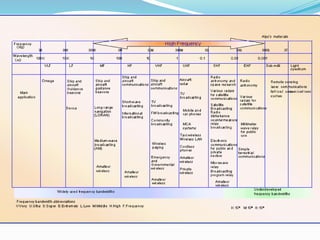
RADIO WAVE PROPAGATION
TOC:
INTRO
RADIO WAVES
POLARIZATION
LINE OF SIGHT, GROUND & SKY WAVES
IONOSPHERE REGIONS
IONOSPHERIC LAYERS
PROPAGATION, HOPS, SKIPS ZONES
ABSORPTION AND FADING
SOLAR ACTIVITY AND SUN SPOTS
MF, HF CRITICAL FREQUENCIES
SCATTER, HF, VHF,UHF
PROPAGATION - INTRO
Propagation: How radio waves travel from point A to point B;
and the events occurring in the transmission path that affect the
communications between the points, stations, or operators.
When the electrons in a conductor, (antenna wire) are made to
oscillate back and forth, Electromagnetic Waves (EM waves) are
produced.
These waves radiate outwards from the source at the speed of
light, 300 million meters per second.
Light waves (waves we see) and radio waves (waves we hear)are
both EM waves, differing only in frequency and wavelength.
PROPAGATION – INTRO CONT’D
EM waves travel in straight lines, unless acted upon by some outside force. They
travel faster through a vacuum than through any other medium.
As EM waves spread out from the point of origin, they decrease in strength in
what is described as an "inverse square relationship".
Inverse-Square Law
In physics, an inverse-square law is any physical law stating that a specified
physical quantity or strength is inversely proportional to the square of the distance
from the source of that physical quantity.
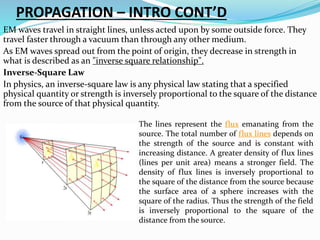
The lines represent the flux emanating from the
source. The total number of flux lines depends on
the strength of the source and is constant with
increasing distance. A greater density of flux lines
(lines per unit area) means a stronger field. The
density of flux lines is inversely proportional to
the square of the distance from the source because
the surface area of a sphere increases with the
square of the radius. Thus the strength of the field
is inversely proportional to the square of the
distance from the source.
 For example: a signal 2 km from its starting point will be only 1/4 as strong as
that 1 km from the source. A signal 3 km from the source will be only 1/9 that at
the 1 km point.
 HOWEVER…..
 Modern receivers are very sensitive and extremely
 small power provides usable signals. Waves can
 be received many thousands of kilometers from the
 transmitting station. For Example, Voyager 2 transmitted signals over many
billions of kilometers from outer space with only 25 W of power!
RADIO WAVES
RADIO WAVES
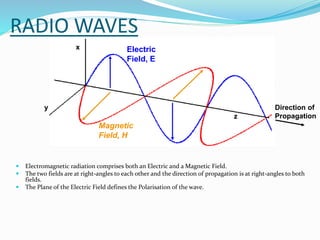
 Electromagnetic radiation comprises both an Electric and a Magnetic Field.
 The two fields are at right-angles to each other and the direction of propagation is at right-angles to both
fields.
 The Plane of the Electric Field defines the Polarisation of the wave.
z
x
y
Electric
Field, E
Magnetic
Field, H
Direction of
Propagation
RADIO WAVES CONT’D
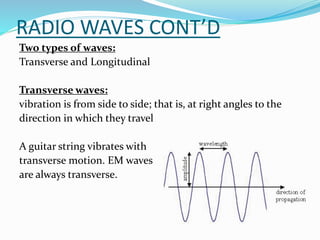
Two types of waves:
Transverse and Longitudinal
Transverse waves:
vibration is from side to side; that is, at right angles to the
direction in which they travel
A guitar string vibrates with
transverse motion. EM waves
are always transverse.
RADIO WAVES CONT’D
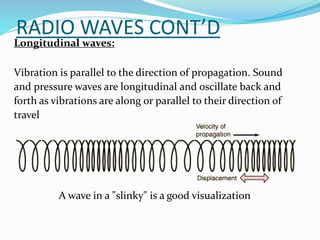
Longitudinal waves:
Vibration is parallel to the direction of propagation. Sound
and pressure waves are longitudinal and oscillate back and
forth as vibrations are along or parallel to their direction of
travel
A wave in a "slinky" is a good visualization
POLARIZATION
 The polarization of an antenna is the orientation of
the electric field with respect to the Earth's surface
and is determined by the physical structure of the
antenna and by its orientation
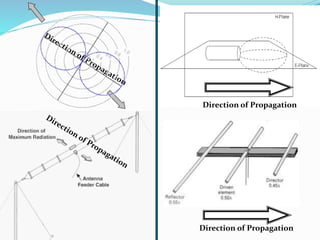
 Radio waves from a vertical antenna will usually be
vertically polarized.
 Radio waves from a horizontal antenna are usually
horizontally polarized.
Direction of Propagation
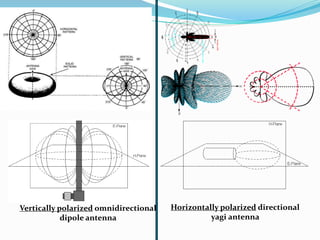
Horizontally polarized directional
yagi antenna
Vertically polarized omnidirectional
dipole antenna
RADIO WAVES CONT’D
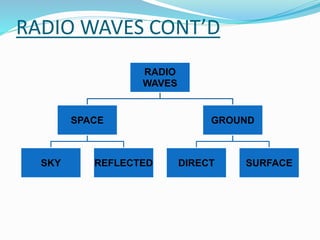
RADIO
WAVES
SPACE
SKY REFLECTED
GROUND
DIRECT SURFACE
LINE OF SIGHT, GROUND WAVE, SKY WAVE
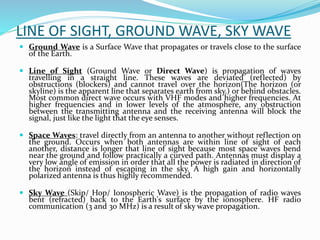
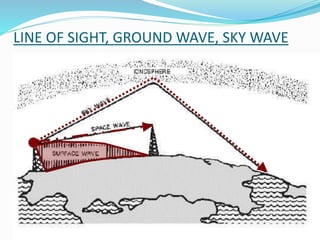
 Ground Wave is a Surface Wave that propagates or travels close to the surface
of the Earth.
 Line of Sight (Ground Wave or Direct Wave) is propagation of waves
travelling in a straight line. These waves are deviated (reflected) by
obstructions (blockers) and cannot travel over the horizon(The horizon (or
skyline) is the apparent line that separates earth from sky.) or behind obstacles.
Most common direct wave occurs with VHF modes and higher frequencies. At
higher frequencies and in lower levels of the atmosphere, any obstruction
between the transmitting antenna and the receiving antenna will block the
signal, just like the light that the eye senses.
 Space Waves: travel directly from an antenna to another without reflection on
the ground. Occurs when both antennas are within line of sight of each
another, distance is longer that line of sight because most space waves bend
near the ground and follow practically a curved path. Antennas must display a
very low angle of emission in order that all the power is radiated in direction of
the horizon instead of escaping in the sky. A high gain and horizontally
polarized antenna is thus highly recommended.
 Sky Wave (Skip/ Hop/ Ionospheric Wave) is the propagation of radio waves
bent (refracted) back to the Earth's surface by the ionosphere. HF radio
communication (3 and 30 MHz) is a result of sky wave propagation.
LINE OF SIGHT, GROUND WAVE, SKY WAVE
PROPAGATION, HOPS, SKIPS ZONES
IONOSPHERE REGIONS
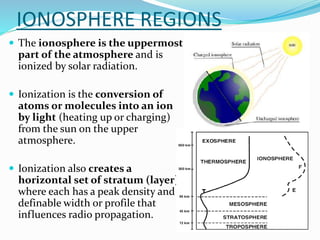
 The ionosphere is the uppermost
part of the atmosphere and is
ionized by solar radiation.
 Ionization is the conversion of
atoms or molecules into an ion
by light (heating up or charging)
from the sun on the upper
atmosphere.
 Ionization also creates a
horizontal set of stratum (layer)
where each has a peak density and a
definable width or profile that
influences radio propagation.
IONOSPHERE REGIONS
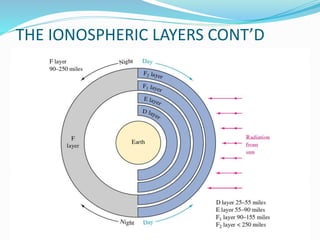
THE IONOSPHERIC LAYERS
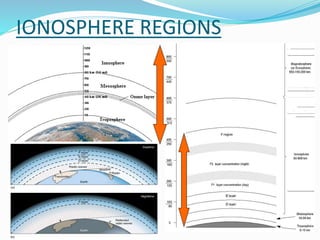
The F layer: or region, is 120 km to 400 km above the surface of the Earth. It is the top most layer of
the ionosphere. Here extreme ultraviolet (UV) (10-100 nm) solar radiation ionizes atomic oxygen (O).
The F region is the most important part of the ionosphere in terms of HF communications. The F
layer combines into one layer at night, and in the presence of sunlight (during daytime), it divides
into two layers, the F1 and F2. The F layers are responsible for most sky wave propagation of radio
waves, and are thickest and most reflective of radio on the side of the Earth facing the sun.
The E layer: is the middle layer, 90 km to 120 km above the surface of the Earth. This layer can only
reflect radio waves having frequencies less than about 10 MHz. It has a negative effect on frequencies
above 10 MHz due to its partial absorption of these waves. At night the E layer begins to disappear
because the primary source of ionization is no longer present. The increase in the height of
the E layer maximum increases the range to which radio waves can travel by reflection from the
layer
The D layer: is the innermost layer, 50 km to 90 km above the surface of the Earth. when the sun is
active with 50 or more sunspots, During the night cosmic rays (A ray of radiation of extra-terrestrial
origin, consisting of one or more charged particles such as protons, alpha particles, and larger atomic
nuclei. Cosmic rays entering the atmosphere collide with atoms, producing secondary radiation, such as
electrons, and gamma rays). Cosmic rays (and secondary radiation) can be easily seen in a cloud
chamber) produce a residual amount of ionization as a result high-frequency (HF) radio waves aren't
reflected by the D layer. The D layer is mainly responsible for absorption of HF radio waves,
particularly at 10 MHz and below, with progressively smaller absorption as the frequency gets higher.
The absorption is small at night and greatest about midday. The layer reduces greatly after sunset.
A common example of the D layer in action is the disappearance of distant AM broadcast band
stations in the daytime.
THE IONOSPHERIC LAYERS CONT’D
Ionospheric Storms: Solar activity such as flares (A solar flare is a sudden brightening
observed over the Sun's surface, which is interpreted as a large energy release) and coronal
mass ejections (A coronal mass ejection (CME) is a massive burst of solar wind and magnetic
fields rising above the solar corona or being released into space) produce large
electromagnetic radiation incidents upon the earth and leads to disturbances of the
ionosphere; changes the density distribution, electron content, and the ionospheric
current system. These storms can also disrupt satellite communications and cause a loss of
radio frequencies which would otherwise reflect off the ionosphere. Ionospheric storms can
last typically for a day or so.
D layer Absorption: Occurs when the ionosphere is strongly charged (daytime, summer,
heavy solar activity) longer waves will be absorbed and never return to earth. You
don't hear distant AM broadcast stations during the day. Shorter waves will be
reflected and travel further. Absorption occurs in the D layer which is the lowest layer in
the ionosphere. The intensity of this layer is increased as the sun climbs above the horizon
and is greatest at noon. Radio waves below 3 or 4 MHz are absorbed by the D layer when it is
present.
When the ionosphere is weakly charged (night time, winter, low solar activity)
longer waves will travel a considerable distance but shorter waves may pass through the
ionosphere and escape into space. VHF waves pull this trick all the time, hence their short
range and usefulness for communicating with satellites.
Faraday rotation: EM waves passing through the ionosphere may have their
polarizations changed to random directions (refraction) and propagate at different
speeds. Since most radio waves are either vertically or horizonally polarized, it is difficult to
predict what the polarization of the waves will be when they arrive at a receiver after
reflection in the ionosphere.
THE IONOSPHERIC LAYERS CONT’D
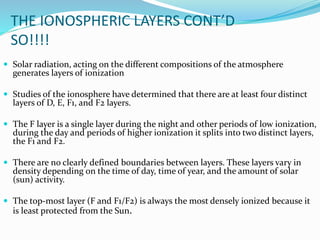
SO!!!!
 Solar radiation, acting on the different compositions of the atmosphere
generates layers of ionization
 Studies of the ionosphere have determined that there are at least four distinct
layers of D, E, F1, and F2 layers.
 The F layer is a single layer during the night and other periods of low ionization,
during the day and periods of higher ionization it splits into two distinct layers,
the F1 and F2.
 There are no clearly defined boundaries between layers. These layers vary in
density depending on the time of day, time of year, and the amount of solar
(sun) activity.
 The top-most layer (F and F1/F2) is always the most densely ionized because it
is least protected from the Sun.
PROPAGATION, HOPS, SKIPS ZONES
DEFINITIONS
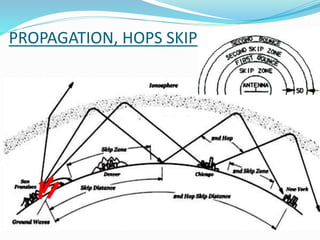
 Multihop: Via the F2-layer signals can reach DX (distant stations) by
doing several hops to the other side of the Earth.
 Skip Zone: The region between the furthest transmission points
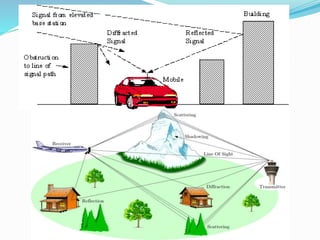
and the nearest point refracted waves can be received. Within this
region, no signal can be received as there are no radio waves to receive.
 Skip Distance: The least distance between point of transmission
and the point of reception
 Diffraction: High frequency radio waves can bend around the edge
of an object such as a spot located out of sight from a transmitter (i.e.
behind a hill), the remote radio is able to receive weak emissions
because its signals are bending gradually by diffraction. This effect has
practically no influence on HF since waves arrive usually to the receiver
by many other means such as refraction or reflection in the upper
atmosphere including sometimes ground waves if the transmitter is not
too far (150-200 km away).
PROPAGATION, HOPS, SKIPS ZONES
 Reflection: HF or long waves are reflected by the ground and upper
atmosphere. As long wavelengths enter in contact with a surface, (80 meters
and above) don't practically "see" small obstacles like cars, trees or buildings.
These objects are proportionally too small and can't reflect its energy. The long
waves pass across these materials without being reflected.
 VHF & UHF waves are very sensitive to small obstacles and depending of their
thickness metal objects can be used as reflectors.
 Refraction: the bending of waves that occurs when they pass through a
medium (air or the ionosphere) and produce a variation in the velocity (change
of speed) of waves making them go further, or dropping sooner that expected.
 For example, a wave will refract and bend gradually given the appearance that
the path is curved.
 Attenuation: When the distance doubles (remember inverse square
relationship), or has obstacles placed between the emitter, receiver, and/or
travelling around the earth, the signal becomes half as strong. Radio waves
lose their energy as they are forced to bend to follow the earth curvature.
PROPAGATION, HOPS, SKIPS ZONES
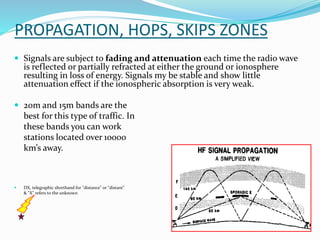
 Signals are subject to fading and attenuation each time the radio wave
is reflected or partially refracted at either the ground or ionosphere
resulting in loss of energy. Signals my be stable and show little
attenuation effect if the ionospheric absorption is very weak.
 20m and 15m bands are the
best for this type of traffic. In
these bands you can work
stations located over 10000
km’s away.
 DX, telegraphic shorthand for "distance" or "distant”
& "X" refers to the unknown
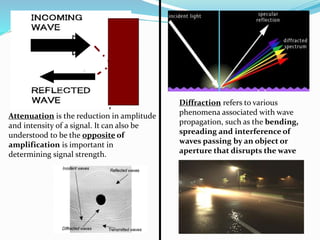
Diffraction refers to various
phenomena associated with wave
propagation, such as the bending,
spreading and interference of
waves passing by an object or
aperture that disrupts the wave
Attenuation is the reduction in amplitude
and intensity of a signal. It can also be
understood to be the opposite of
amplification is important in
determining signal strength.
PROPAGATION, HOPS SKIPS ZONES
PROPAGATION, HOPS SKIPS ZONES CONT’D
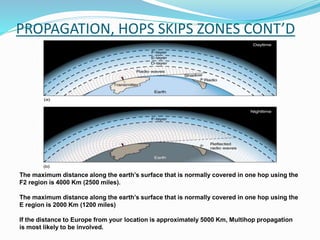
The maximum distance along the earth’s surface that is normally covered in one hop using the
F2 region is 4000 Km (2500 miles).
The maximum distance along the earth’s surface that is normally covered in one hop using the
E region is 2000 Km (1200 miles)
If the distance to Europe from your location is approximately 5000 Km, Multihop propagation
is most likely to be involved.
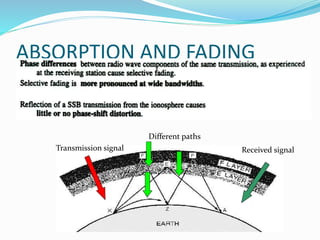
ABSORPTION AND FADING
Fading
Received signal level varies substantially with the location of the receiver, caused by multipath
propagation and motion.
a. Multipath
b. Multiple copies of signals with varying delays are received from the same source:
a. Reflection
b. Diffraction
c. Scattering
c. Multi-path propagation: some of the signal is being reflected by one layer of the ionosphere and
some by another layer. The signal gets to the receiver by two different routes The received
signal may be enhanced or reduced by the wave interactions. In essence, radio signals' reaching
the receiving antenna by two or more paths. Causes include ionospheric reflection and
refraction, and reflection from terrestrial objects, such as mountains and buildings.
d. Increased absorption as the D layer builds up during the morning hours.
e. Difference in path lengths caused by changing levels of ionization in the reflecting layer.
f. E layer starts to disappear, radio waves will pass through and be reflected by the F layer, thus
causing the skip zone to fall at the receiving station.
g. Selective fading: similar to Multi-path propagation, creates a hollow tone common on
international shortwave AM reception. The signal arrives at the receiver by two different paths,
and at least one of the paths is changing (lengthening or shortening). This typically happens in the
early evening or early morning as the various layers in the ionosphere move, separate, and combine.
The two paths can both be sky wave or one can be ground wave.
ABSORPTION AND FADING
Received signalTransmission signal
Different paths
 MF, HF CRITICAL FREQUENCIES
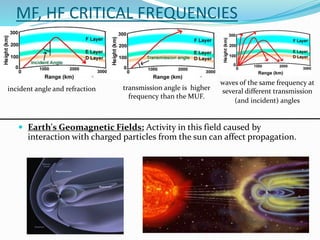
MF, HF CRITICAL FREQUENCIES
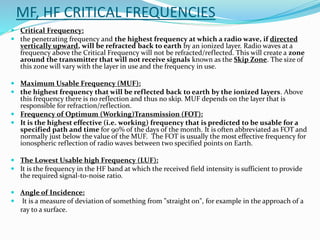
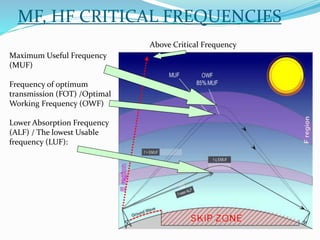
 Critical Frequency:
 the penetrating frequency and the highest frequency at which a radio wave, if directed
vertically upward, will be refracted back to earth by an ionized layer. Radio waves at a
frequency above the Critical Frequency will not be refracted/reflected. This will create a zone
around the transmitter that will not receive signals known as the Skip Zone. The size of
this zone will vary with the layer in use and the frequency in use.
 Maximum Usable Frequency (MUF):
 the highest frequency that will be reflected back to earth by the ionized layers. Above
this frequency there is no reflection and thus no skip. MUF depends on the layer that is
responsible for refraction/reflection.
 Frequency of Optimum (Working)Transmission (FOT):
 It is the highest effective (i.e. working) frequency that is predicted to be usable for a
specified path and time for 90% of the days of the month. It is often abbreviated as FOT and
normally just below the value of the MUF. The FOT is usually the most effective frequency for
ionospheric reflection of radio waves between two specified points on Earth.
 The Lowest Usable high Frequency (LUF):
 It is the frequency in the HF band at which the received field intensity is sufficient to provide
the required signal-to-noise ratio.
 Angle of Incidence:
 It is a measure of deviation of something from "straight on", for example in the approach of a
ray to a surface.
MF, HF CRITICAL FREQUENCIES
Maximum Useful Frequency
(MUF)
Frequency of optimum
transmission (FOT) /Optimal
Working Frequency (OWF)
Lower Absorption Frequency
(ALF) / The lowest Usable
frequency (LUF):
Above Critical Frequency
MF, HF CRITICAL FREQUENCIES
 Earth's Geomagnetic Fields: Activity in this field caused by
interaction with charged particles from the sun can affect propagation.
incident angle and refraction transmission angle is higher
frequency than the MUF.
waves of the same frequency at
several different transmission
(and incident) angles
 SCATTER, HF, VHF,UHF
SCATTER, HF, VHF,UHF
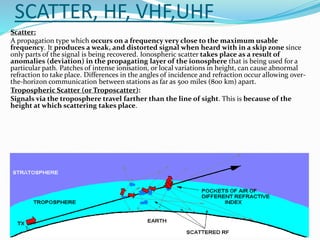
Scatter:
A propagation type which occurs on a frequency very close to the maximum usable
frequency. It produces a weak, and distorted signal when heard with in a skip zone since
only parts of the signal is being recovered. Ionospheric scatter takes place as a result of
anomalies (deviation) in the propagating layer of the ionosphere that is being used for a
particular path. Patches of intense ionisation, or local variations in height, can cause abnormal
refraction to take place. Differences in the angles of incidence and refraction occur allowing over-
the-horizon communication between stations as far as 500 miles (800 km) apart.
Tropospheric Scatter (or Troposcatter):
Signals via the troposphere travel farther than the line of sight. This is because of the
height at which scattering takes place.
SCATTER, HF, VHF,UHF
Trans-Equatorial Scatter: It’s possible for DX
reception of television and radio stations
between 3000–5000 miles or 4827–8045 km
across the equator on frequencies as high as
432MHz. DX reception of lower frequencies in
the 30–70MHz range is far more common. For
this mode to work both transmitting and
receiving stations should be almost the same
distance from the equator.
Aircraft Scatter (Tropospheric Reflection):
Reflection off aircraft, (reflections from birds are
also possible).
Rain Scatter : A band of very heavy rain or (or rain and hail) can scatter or even reflect
signals. Distances are typically around 160 km though up to 650 km (400 mi) is
theoretically possible.
Ice Pellet Scatter (called Sleet Scatter in the US) is
similar to Rain Scatter but is caused by bands of
Ice Pellets in the wintertime.
SCATTER, HF, VHF,UHF
Chaff Scatter (strips of metal foil sent out by the military during training exercises).
Chaff helps to confuse enemy radars but also helps to produce DX.
Maximum distances for all reflection modes are again up to 800 km (500 mi).

radio-wave-propagation

  • 1.
  • 2.
    TOC: INTRO RADIO WAVES POLARIZATION LINE OFSIGHT, GROUND & SKY WAVES IONOSPHERE REGIONS IONOSPHERIC LAYERS PROPAGATION, HOPS, SKIPS ZONES ABSORPTION AND FADING SOLAR ACTIVITY AND SUN SPOTS MF, HF CRITICAL FREQUENCIES SCATTER, HF, VHF,UHF
  • 3.
    PROPAGATION - INTRO Propagation:How radio waves travel from point A to point B; and the events occurring in the transmission path that affect the communications between the points, stations, or operators. When the electrons in a conductor, (antenna wire) are made to oscillate back and forth, Electromagnetic Waves (EM waves) are produced. These waves radiate outwards from the source at the speed of light, 300 million meters per second. Light waves (waves we see) and radio waves (waves we hear)are both EM waves, differing only in frequency and wavelength.
  • 4.
    PROPAGATION – INTROCONT’D EM waves travel in straight lines, unless acted upon by some outside force. They travel faster through a vacuum than through any other medium. As EM waves spread out from the point of origin, they decrease in strength in what is described as an "inverse square relationship". Inverse-Square Law In physics, an inverse-square law is any physical law stating that a specified physical quantity or strength is inversely proportional to the square of the distance from the source of that physical quantity. The lines represent the flux emanating from the source. The total number of flux lines depends on the strength of the source and is constant with increasing distance. A greater density of flux lines (lines per unit area) means a stronger field. The density of flux lines is inversely proportional to the square of the distance from the source because the surface area of a sphere increases with the square of the radius. Thus the strength of the field is inversely proportional to the square of the distance from the source.
  • 5.
     For example:a signal 2 km from its starting point will be only 1/4 as strong as that 1 km from the source. A signal 3 km from the source will be only 1/9 that at the 1 km point.  HOWEVER…..  Modern receivers are very sensitive and extremely  small power provides usable signals. Waves can  be received many thousands of kilometers from the  transmitting station. For Example, Voyager 2 transmitted signals over many billions of kilometers from outer space with only 25 W of power!
  • 6.
  • 7.
    RADIO WAVES  Electromagneticradiation comprises both an Electric and a Magnetic Field.  The two fields are at right-angles to each other and the direction of propagation is at right-angles to both fields.  The Plane of the Electric Field defines the Polarisation of the wave. z x y Electric Field, E Magnetic Field, H Direction of Propagation
  • 8.
    RADIO WAVES CONT’D Twotypes of waves: Transverse and Longitudinal Transverse waves: vibration is from side to side; that is, at right angles to the direction in which they travel A guitar string vibrates with transverse motion. EM waves are always transverse.
  • 9.
    RADIO WAVES CONT’D Longitudinalwaves: Vibration is parallel to the direction of propagation. Sound and pressure waves are longitudinal and oscillate back and forth as vibrations are along or parallel to their direction of travel A wave in a "slinky" is a good visualization
  • 10.
    POLARIZATION  The polarizationof an antenna is the orientation of the electric field with respect to the Earth's surface and is determined by the physical structure of the antenna and by its orientation  Radio waves from a vertical antenna will usually be vertically polarized.  Radio waves from a horizontal antenna are usually horizontally polarized.
  • 11.
  • 12.
    Horizontally polarized directional yagiantenna Vertically polarized omnidirectional dipole antenna
  • 15.
    RADIO WAVES CONT’D RADIO WAVES SPACE SKYREFLECTED GROUND DIRECT SURFACE
  • 16.
    LINE OF SIGHT,GROUND WAVE, SKY WAVE  Ground Wave is a Surface Wave that propagates or travels close to the surface of the Earth.  Line of Sight (Ground Wave or Direct Wave) is propagation of waves travelling in a straight line. These waves are deviated (reflected) by obstructions (blockers) and cannot travel over the horizon(The horizon (or skyline) is the apparent line that separates earth from sky.) or behind obstacles. Most common direct wave occurs with VHF modes and higher frequencies. At higher frequencies and in lower levels of the atmosphere, any obstruction between the transmitting antenna and the receiving antenna will block the signal, just like the light that the eye senses.  Space Waves: travel directly from an antenna to another without reflection on the ground. Occurs when both antennas are within line of sight of each another, distance is longer that line of sight because most space waves bend near the ground and follow practically a curved path. Antennas must display a very low angle of emission in order that all the power is radiated in direction of the horizon instead of escaping in the sky. A high gain and horizontally polarized antenna is thus highly recommended.  Sky Wave (Skip/ Hop/ Ionospheric Wave) is the propagation of radio waves bent (refracted) back to the Earth's surface by the ionosphere. HF radio communication (3 and 30 MHz) is a result of sky wave propagation.
  • 17.
    LINE OF SIGHT,GROUND WAVE, SKY WAVE
  • 18.
  • 19.
    IONOSPHERE REGIONS  Theionosphere is the uppermost part of the atmosphere and is ionized by solar radiation.  Ionization is the conversion of atoms or molecules into an ion by light (heating up or charging) from the sun on the upper atmosphere.  Ionization also creates a horizontal set of stratum (layer) where each has a peak density and a definable width or profile that influences radio propagation.
  • 20.
  • 21.
    THE IONOSPHERIC LAYERS TheF layer: or region, is 120 km to 400 km above the surface of the Earth. It is the top most layer of the ionosphere. Here extreme ultraviolet (UV) (10-100 nm) solar radiation ionizes atomic oxygen (O). The F region is the most important part of the ionosphere in terms of HF communications. The F layer combines into one layer at night, and in the presence of sunlight (during daytime), it divides into two layers, the F1 and F2. The F layers are responsible for most sky wave propagation of radio waves, and are thickest and most reflective of radio on the side of the Earth facing the sun. The E layer: is the middle layer, 90 km to 120 km above the surface of the Earth. This layer can only reflect radio waves having frequencies less than about 10 MHz. It has a negative effect on frequencies above 10 MHz due to its partial absorption of these waves. At night the E layer begins to disappear because the primary source of ionization is no longer present. The increase in the height of the E layer maximum increases the range to which radio waves can travel by reflection from the layer The D layer: is the innermost layer, 50 km to 90 km above the surface of the Earth. when the sun is active with 50 or more sunspots, During the night cosmic rays (A ray of radiation of extra-terrestrial origin, consisting of one or more charged particles such as protons, alpha particles, and larger atomic nuclei. Cosmic rays entering the atmosphere collide with atoms, producing secondary radiation, such as electrons, and gamma rays). Cosmic rays (and secondary radiation) can be easily seen in a cloud chamber) produce a residual amount of ionization as a result high-frequency (HF) radio waves aren't reflected by the D layer. The D layer is mainly responsible for absorption of HF radio waves, particularly at 10 MHz and below, with progressively smaller absorption as the frequency gets higher. The absorption is small at night and greatest about midday. The layer reduces greatly after sunset. A common example of the D layer in action is the disappearance of distant AM broadcast band stations in the daytime.
  • 22.
  • 23.
    THE IONOSPHERIC LAYERSCONT’D Ionospheric Storms: Solar activity such as flares (A solar flare is a sudden brightening observed over the Sun's surface, which is interpreted as a large energy release) and coronal mass ejections (A coronal mass ejection (CME) is a massive burst of solar wind and magnetic fields rising above the solar corona or being released into space) produce large electromagnetic radiation incidents upon the earth and leads to disturbances of the ionosphere; changes the density distribution, electron content, and the ionospheric current system. These storms can also disrupt satellite communications and cause a loss of radio frequencies which would otherwise reflect off the ionosphere. Ionospheric storms can last typically for a day or so. D layer Absorption: Occurs when the ionosphere is strongly charged (daytime, summer, heavy solar activity) longer waves will be absorbed and never return to earth. You don't hear distant AM broadcast stations during the day. Shorter waves will be reflected and travel further. Absorption occurs in the D layer which is the lowest layer in the ionosphere. The intensity of this layer is increased as the sun climbs above the horizon and is greatest at noon. Radio waves below 3 or 4 MHz are absorbed by the D layer when it is present. When the ionosphere is weakly charged (night time, winter, low solar activity) longer waves will travel a considerable distance but shorter waves may pass through the ionosphere and escape into space. VHF waves pull this trick all the time, hence their short range and usefulness for communicating with satellites. Faraday rotation: EM waves passing through the ionosphere may have their polarizations changed to random directions (refraction) and propagate at different speeds. Since most radio waves are either vertically or horizonally polarized, it is difficult to predict what the polarization of the waves will be when they arrive at a receiver after reflection in the ionosphere.
  • 24.
    THE IONOSPHERIC LAYERSCONT’D SO!!!!  Solar radiation, acting on the different compositions of the atmosphere generates layers of ionization  Studies of the ionosphere have determined that there are at least four distinct layers of D, E, F1, and F2 layers.  The F layer is a single layer during the night and other periods of low ionization, during the day and periods of higher ionization it splits into two distinct layers, the F1 and F2.  There are no clearly defined boundaries between layers. These layers vary in density depending on the time of day, time of year, and the amount of solar (sun) activity.  The top-most layer (F and F1/F2) is always the most densely ionized because it is least protected from the Sun.
  • 25.
  • 26.
    DEFINITIONS  Multihop: Viathe F2-layer signals can reach DX (distant stations) by doing several hops to the other side of the Earth.  Skip Zone: The region between the furthest transmission points and the nearest point refracted waves can be received. Within this region, no signal can be received as there are no radio waves to receive.  Skip Distance: The least distance between point of transmission and the point of reception  Diffraction: High frequency radio waves can bend around the edge of an object such as a spot located out of sight from a transmitter (i.e. behind a hill), the remote radio is able to receive weak emissions because its signals are bending gradually by diffraction. This effect has practically no influence on HF since waves arrive usually to the receiver by many other means such as refraction or reflection in the upper atmosphere including sometimes ground waves if the transmitter is not too far (150-200 km away).
  • 27.
    PROPAGATION, HOPS, SKIPSZONES  Reflection: HF or long waves are reflected by the ground and upper atmosphere. As long wavelengths enter in contact with a surface, (80 meters and above) don't practically "see" small obstacles like cars, trees or buildings. These objects are proportionally too small and can't reflect its energy. The long waves pass across these materials without being reflected.  VHF & UHF waves are very sensitive to small obstacles and depending of their thickness metal objects can be used as reflectors.  Refraction: the bending of waves that occurs when they pass through a medium (air or the ionosphere) and produce a variation in the velocity (change of speed) of waves making them go further, or dropping sooner that expected.  For example, a wave will refract and bend gradually given the appearance that the path is curved.  Attenuation: When the distance doubles (remember inverse square relationship), or has obstacles placed between the emitter, receiver, and/or travelling around the earth, the signal becomes half as strong. Radio waves lose their energy as they are forced to bend to follow the earth curvature.
  • 28.
    PROPAGATION, HOPS, SKIPSZONES  Signals are subject to fading and attenuation each time the radio wave is reflected or partially refracted at either the ground or ionosphere resulting in loss of energy. Signals my be stable and show little attenuation effect if the ionospheric absorption is very weak.  20m and 15m bands are the best for this type of traffic. In these bands you can work stations located over 10000 km’s away.  DX, telegraphic shorthand for "distance" or "distant” & "X" refers to the unknown
  • 29.
    Diffraction refers tovarious phenomena associated with wave propagation, such as the bending, spreading and interference of waves passing by an object or aperture that disrupts the wave Attenuation is the reduction in amplitude and intensity of a signal. It can also be understood to be the opposite of amplification is important in determining signal strength.
  • 31.
  • 32.
    PROPAGATION, HOPS SKIPSZONES CONT’D The maximum distance along the earth’s surface that is normally covered in one hop using the F2 region is 4000 Km (2500 miles). The maximum distance along the earth’s surface that is normally covered in one hop using the E region is 2000 Km (1200 miles) If the distance to Europe from your location is approximately 5000 Km, Multihop propagation is most likely to be involved.
  • 33.
  • 34.
    ABSORPTION AND FADING Fading Receivedsignal level varies substantially with the location of the receiver, caused by multipath propagation and motion. a. Multipath b. Multiple copies of signals with varying delays are received from the same source: a. Reflection b. Diffraction c. Scattering c. Multi-path propagation: some of the signal is being reflected by one layer of the ionosphere and some by another layer. The signal gets to the receiver by two different routes The received signal may be enhanced or reduced by the wave interactions. In essence, radio signals' reaching the receiving antenna by two or more paths. Causes include ionospheric reflection and refraction, and reflection from terrestrial objects, such as mountains and buildings. d. Increased absorption as the D layer builds up during the morning hours. e. Difference in path lengths caused by changing levels of ionization in the reflecting layer. f. E layer starts to disappear, radio waves will pass through and be reflected by the F layer, thus causing the skip zone to fall at the receiving station. g. Selective fading: similar to Multi-path propagation, creates a hollow tone common on international shortwave AM reception. The signal arrives at the receiver by two different paths, and at least one of the paths is changing (lengthening or shortening). This typically happens in the early evening or early morning as the various layers in the ionosphere move, separate, and combine. The two paths can both be sky wave or one can be ground wave.
  • 35.
    ABSORPTION AND FADING ReceivedsignalTransmission signal Different paths
  • 36.
     MF, HFCRITICAL FREQUENCIES
  • 37.
    MF, HF CRITICALFREQUENCIES  Critical Frequency:  the penetrating frequency and the highest frequency at which a radio wave, if directed vertically upward, will be refracted back to earth by an ionized layer. Radio waves at a frequency above the Critical Frequency will not be refracted/reflected. This will create a zone around the transmitter that will not receive signals known as the Skip Zone. The size of this zone will vary with the layer in use and the frequency in use.  Maximum Usable Frequency (MUF):  the highest frequency that will be reflected back to earth by the ionized layers. Above this frequency there is no reflection and thus no skip. MUF depends on the layer that is responsible for refraction/reflection.  Frequency of Optimum (Working)Transmission (FOT):  It is the highest effective (i.e. working) frequency that is predicted to be usable for a specified path and time for 90% of the days of the month. It is often abbreviated as FOT and normally just below the value of the MUF. The FOT is usually the most effective frequency for ionospheric reflection of radio waves between two specified points on Earth.  The Lowest Usable high Frequency (LUF):  It is the frequency in the HF band at which the received field intensity is sufficient to provide the required signal-to-noise ratio.  Angle of Incidence:  It is a measure of deviation of something from "straight on", for example in the approach of a ray to a surface.
  • 38.
    MF, HF CRITICALFREQUENCIES Maximum Useful Frequency (MUF) Frequency of optimum transmission (FOT) /Optimal Working Frequency (OWF) Lower Absorption Frequency (ALF) / The lowest Usable frequency (LUF): Above Critical Frequency
  • 39.
    MF, HF CRITICALFREQUENCIES  Earth's Geomagnetic Fields: Activity in this field caused by interaction with charged particles from the sun can affect propagation. incident angle and refraction transmission angle is higher frequency than the MUF. waves of the same frequency at several different transmission (and incident) angles
  • 40.
  • 41.
    SCATTER, HF, VHF,UHF Scatter: Apropagation type which occurs on a frequency very close to the maximum usable frequency. It produces a weak, and distorted signal when heard with in a skip zone since only parts of the signal is being recovered. Ionospheric scatter takes place as a result of anomalies (deviation) in the propagating layer of the ionosphere that is being used for a particular path. Patches of intense ionisation, or local variations in height, can cause abnormal refraction to take place. Differences in the angles of incidence and refraction occur allowing over- the-horizon communication between stations as far as 500 miles (800 km) apart. Tropospheric Scatter (or Troposcatter): Signals via the troposphere travel farther than the line of sight. This is because of the height at which scattering takes place.
  • 42.
    SCATTER, HF, VHF,UHF Trans-EquatorialScatter: It’s possible for DX reception of television and radio stations between 3000–5000 miles or 4827–8045 km across the equator on frequencies as high as 432MHz. DX reception of lower frequencies in the 30–70MHz range is far more common. For this mode to work both transmitting and receiving stations should be almost the same distance from the equator. Aircraft Scatter (Tropospheric Reflection): Reflection off aircraft, (reflections from birds are also possible). Rain Scatter : A band of very heavy rain or (or rain and hail) can scatter or even reflect signals. Distances are typically around 160 km though up to 650 km (400 mi) is theoretically possible. Ice Pellet Scatter (called Sleet Scatter in the US) is similar to Rain Scatter but is caused by bands of Ice Pellets in the wintertime.
  • 43.
    SCATTER, HF, VHF,UHF ChaffScatter (strips of metal foil sent out by the military during training exercises). Chaff helps to confuse enemy radars but also helps to produce DX. Maximum distances for all reflection modes are again up to 800 km (500 mi).