3. Well Planning 
Habiburrohman abdullah
Well Planning 
• Pore Pressure and Fracture Gradient 
• Casing Depth Selection
Types of Well Planning 
• Exploration well planning. 
• Development well planning. 
• Completion/workover programme planning.
Well Planning 
• Close interaction between Drilling and the 
Exploration, Petroleum Engineering, Design 
and Construction Departments is vital to 
optimise total project costs. Rig/platform 
interaction, well reach and well design 
options should be fully evaluated in the 
conceptual stage. All platform options and 
well design options should be considered and 
all possibilities for reducing costs should be 
examined.
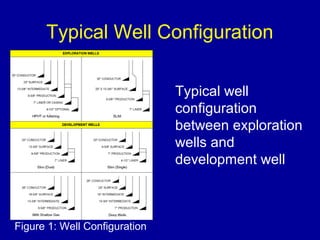
Typical Well Configuration 
Typical well 
configuration 
between exploration 
wells and 
development well 
Figure 1: Well Configuration
Pore Pressure and Fracture 
Gradient 
Parameters like pore pressure and formation 
strength determine aspects like: 
1. Choice of mud weight profile, 
2. Determination of casing setting depths, 
3. Design of optimal casing strings, 
4. Selection of the drill bit, 
5. Cementing additives and procedures.
RKB & MSL 
• Within drilling engineering, the drilling floor or 
rotary table (RKB) is the most often used 
reference depth. 
• Geologists and geophysicists generally prefer 
to use their data in reference to ground floor 
or mean sea level (MSL).
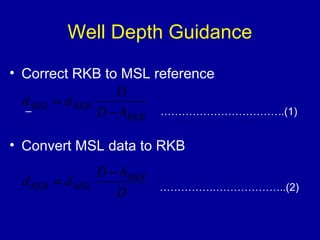
Well Depth Guidance 
• Correct RKB to MSL reference 
MSL RKB D h 
– ……………………………..(1) 
• Convert MSL data to RKB 
…………….………………..(2) 
RKB 
d d D 
- 
= 
d = d D - 
hRKB 
RKB MSL 
D
Wildcat to Development Well 
Correlation 
• Another common problem is when data referenced 
to one RKB (e.g. rig used to drill the wildcat well) 
has to be applied for further/later calculations (e.g. 
drilling development wells from a production 
platform). Here the data have to be corrected from 
RKB1 to RKB2 . 
• Correct from RKB1 to RKB2: 
d d D h RKB RKB 
= - D 2 1 
……………………………..(D 3)
Wildcat to Development Well 
Correlation 
where: 
• D [m or ft] ... total depth of point of interest in 
reference to RKB 
• hRKB [m or ft] ... height of RKB above MSL 
• Δh [m or ft] ... difference of elevation of RKB1 
to RKB2
Geology Prediction 
• Normally when a well is to be 
drilled, the drilling engineer is 
supplied from the geology 
department with a sequence 
of predicted subsurface 
formations, their 
characteristics and markers, 
as well as knowledge about 
where special care has to be 
taken. 
Figure 2: Typical geological 
profile to plan a well
Pore pressure Prediction- 
Hydrostatic Pressure 
• By definition, a hydrostatic pressure is 
developed due to the own weight of a fluid at 
a certain depth. 
……………………………..(4) 
p = r g h = 9.81r h 
• Or in field units: 
……………………………………..(5) 
p = 0.052 r fl D
Pore pressure Prediction- 
Hydrostatic Pressure 
Where 
• ρfl [ppg] ... density of the fluid causing hydrostatic 
pressure 
• ρ [kg/m3] ... average fluid density 
• D [ft] ... depth at which hydrostatic pressure occurs 
(TVD) 
• h [m] ... vertical height of column of liquid 
• p [psi] ... hydrostatic pressure 
• g [m/s2] ... acceleration due to gravity
Pore pressure Prediction- 
Hydrostatic Pressure 
When the burial depth 
increases, the overlaying 
pressure (overburden 
stress) increases. This 
decreases the pore space 
between the grains and 
thus the porosity of the 
formation. 
Figure 3: Porosity profile with 
increasing depth
Pore pressure Prediction- 
Hydrostatic Pressure 
• When drilling a well, formations are often 
encountered that are under a different pressure 
regime. These formations are named to be 
“abnormally pressured”. Abnormal pressures can be 
positive (actual formation pressures are higher than 
hydrostatic pressure) or negative (actual formation 
pressures are lower than hydrostatic pressure). 
Sometimes the term “subnormal pressure” is used 
when the formation pressure is lower than the 
hydrostatic one.
Pore pressure Prediction- 
Hydrostatic Pressure 
• Some mechanisms that lead to abnormally 
pressured formations are: 
• 1. Compaction effects, 
• 2. Artesian System 
• 3. Uplift 
• 4. Salt Beds 
• 5. Differential density effects (Osmosis) 
• 6. Salt Domes
Pore pressure Prediction- 
Hydrostatic Pressure 
Compaction effects 
A sealing mechanism must be present to trap abnormal 
pressure environment. The common sealing mechanism is a 
shale section. The shale reduces normal fluid escape, 
causing undercompaction and abnormal fluid pressure. 
….(6) 
0.465 / 1.0 / ( ) B 1 B P = psi ft D + psi ft D - D 
Where: 
D1 = depth of interest below the barrier, ft. 
DB = depth of the barrier, i.e., low permeability section, ft 
P = formation pressure at D1, psi
Pore pressure Prediction- 
Hydrostatic Pressure 
• While burying of the sediments, formation water is 
expelled with increasing depth and temperatures 
due to reduction in pore space and diagenesis of 
the rock materials. 
• As long as the permeability and the effective 
porosity of the rock is high enough so that the 
formation water can escape as quickly as the 
natural compaction takes place, the formations are 
normally pressured. The (vertical) pressures acting 
inside formations can be modelled as:
Pore pressure Prediction- 
Hydrostatic Pressure 
……………………………………(7) 
ob z p s =s + 
Where : 
σob [psi] ... overburden stress 
σz [psi] ... vertical stress supported by the grain-to-grain 
connections 
p [psi] ... formation pore pressure
Pore pressure Prediction- 
Hydrostatic Pressure 
• The bulk density [ppg] of a formation is 
estimated by equation: 
……………………………….(8) 
r r f r f b g fl = (1- ) + 
where: 
ρg [ppg] ... grain density 
ρfl [ppg] ... formation fluid density 
f [1] ... total porosity of the formation
Casing Depth Selection 
Type of casing : 
• Conductor casing 
• Surface casing 
• Intermediate casing 
• Production casing.
Casing Depth Selection 
A. Conductor casing 
Applications: 
- to provide a fluid conduit from the bit to the surface. 
- to minimize hole caving. 
B. Surface Casing 
Applications: 
- cover freshwater sands 
- maintain hole integrity by preventing caving 
- minimize lost circulation into shallow, permeable zones 
- cover weak zone that are incompetent to control kick-imposed 
pressure 
- provide a means of attaching of BOP 
- support the weight of all casings run below the surface pipe
Casing Depth Selection 
C. Intermediate casing 
Applications: 
- used to isolate salt zones or zones that cause hole problems, such as 
heaving and sloughing shales. 
D. Production casing. 
Applications: 
- isolate the producing zones from the other formations. 
- provide a work shaft of a known diameter to the pay zones. 
- protect the production tubing equipment.
Setting Depth Design Procedures 
• Casing seat depth are directly affected by 
geological conditions. In some cases, the 
prime criterion for selecting casing seats is to 
cover exposed, severe lost circulation zones, 
differential sticking problems, pressure 
depletion, controlling abnormal pressure and 
preventing their exposure to weaker shallow 
zones.
Setting Depth Selection for 
Intermediate and Deeper Strings 
Criteria: 
1.Let the mud weight control formation pressure 
without fracturing shallow formations (this 
considerations are made from bottom to up) 
2.Differential pressure sticking determination to be 
made to verify the casing string will become 
stuck when running it to the well (this 
considerations are made from top to bottom)
Setting Depth Selection for 
Intermediate and Deeper Strings 
General values for the amount of differential 
pressure that can be tolerated before sticking 
occurs: 
- Normal pressure zones: 2,000 – 2,300 psi 
- Abnormal pressure zones: 3,000 – 3,300 psi
Setting Depth Selection for 
Intermediate and Deeper Strings 
Equation to determine the new intermediate 
depth if sticking is a concern: 
…………………………..(9) 
DP = (MW -9)(0.052)(D) 
Where : 
MW = mud weight, lb/gal 
D = depth to deepest normal zone, ft 
DP = differential pressure, psi
Setting Depth Selection for 
Intermediate and Deeper Strings 
An arbitrary limit of 2,000 – 2,300 psi is normally 
used for DP. The mud weight, MW from equation 
(9) can be used to locate the depth where the DP 
value will exist: 
……………………………………….(10) 
MW -TM = P 
Where : 
MW = mud weight, lb/gal 
TM = trip margin, lb/gal 
P = formation pressure, lb/gal
Surface Casing Depth Selection 
The most problem at this section is a “kick”. Kick imposed 
equivalent mud weights are the cause for most underground 
blowouts. 
………………….(11) 
ö 
æ 
= 
EMW total depth kick + D ÷ ÷ø 
( M) OMW 
depth of erest 
ç çè 
int 
Where : 
EMWkick = equivalent mud weight at the depth of interest, lb/gal 
total depth = deepest interval, ft 
depth of interest = ft 
DM = incremental kick mud weight increase, lb/gal 
OMW = original mud weight, lb/gal
END

Well Planning

  • 1.
    3. Well Planning Habiburrohman abdullah
  • 2.
    Well Planning •Pore Pressure and Fracture Gradient • Casing Depth Selection
  • 3.
    Types of WellPlanning • Exploration well planning. • Development well planning. • Completion/workover programme planning.
  • 4.
    Well Planning •Close interaction between Drilling and the Exploration, Petroleum Engineering, Design and Construction Departments is vital to optimise total project costs. Rig/platform interaction, well reach and well design options should be fully evaluated in the conceptual stage. All platform options and well design options should be considered and all possibilities for reducing costs should be examined.
  • 5.
    Typical Well Configuration Typical well configuration between exploration wells and development well Figure 1: Well Configuration
  • 6.
    Pore Pressure andFracture Gradient Parameters like pore pressure and formation strength determine aspects like: 1. Choice of mud weight profile, 2. Determination of casing setting depths, 3. Design of optimal casing strings, 4. Selection of the drill bit, 5. Cementing additives and procedures.
  • 7.
    RKB & MSL • Within drilling engineering, the drilling floor or rotary table (RKB) is the most often used reference depth. • Geologists and geophysicists generally prefer to use their data in reference to ground floor or mean sea level (MSL).
  • 8.
    Well Depth Guidance • Correct RKB to MSL reference MSL RKB D h – ……………………………..(1) • Convert MSL data to RKB …………….………………..(2) RKB d d D - = d = d D - hRKB RKB MSL D
  • 9.
    Wildcat to DevelopmentWell Correlation • Another common problem is when data referenced to one RKB (e.g. rig used to drill the wildcat well) has to be applied for further/later calculations (e.g. drilling development wells from a production platform). Here the data have to be corrected from RKB1 to RKB2 . • Correct from RKB1 to RKB2: d d D h RKB RKB = - D 2 1 ……………………………..(D 3)
  • 10.
    Wildcat to DevelopmentWell Correlation where: • D [m or ft] ... total depth of point of interest in reference to RKB • hRKB [m or ft] ... height of RKB above MSL • Δh [m or ft] ... difference of elevation of RKB1 to RKB2
  • 11.
    Geology Prediction •Normally when a well is to be drilled, the drilling engineer is supplied from the geology department with a sequence of predicted subsurface formations, their characteristics and markers, as well as knowledge about where special care has to be taken. Figure 2: Typical geological profile to plan a well
  • 12.
    Pore pressure Prediction- Hydrostatic Pressure • By definition, a hydrostatic pressure is developed due to the own weight of a fluid at a certain depth. ……………………………..(4) p = r g h = 9.81r h • Or in field units: ……………………………………..(5) p = 0.052 r fl D
  • 13.
    Pore pressure Prediction- Hydrostatic Pressure Where • ρfl [ppg] ... density of the fluid causing hydrostatic pressure • ρ [kg/m3] ... average fluid density • D [ft] ... depth at which hydrostatic pressure occurs (TVD) • h [m] ... vertical height of column of liquid • p [psi] ... hydrostatic pressure • g [m/s2] ... acceleration due to gravity
  • 14.
    Pore pressure Prediction- Hydrostatic Pressure When the burial depth increases, the overlaying pressure (overburden stress) increases. This decreases the pore space between the grains and thus the porosity of the formation. Figure 3: Porosity profile with increasing depth
  • 15.
    Pore pressure Prediction- Hydrostatic Pressure • When drilling a well, formations are often encountered that are under a different pressure regime. These formations are named to be “abnormally pressured”. Abnormal pressures can be positive (actual formation pressures are higher than hydrostatic pressure) or negative (actual formation pressures are lower than hydrostatic pressure). Sometimes the term “subnormal pressure” is used when the formation pressure is lower than the hydrostatic one.
  • 16.
    Pore pressure Prediction- Hydrostatic Pressure • Some mechanisms that lead to abnormally pressured formations are: • 1. Compaction effects, • 2. Artesian System • 3. Uplift • 4. Salt Beds • 5. Differential density effects (Osmosis) • 6. Salt Domes
  • 17.
    Pore pressure Prediction- Hydrostatic Pressure Compaction effects A sealing mechanism must be present to trap abnormal pressure environment. The common sealing mechanism is a shale section. The shale reduces normal fluid escape, causing undercompaction and abnormal fluid pressure. ….(6) 0.465 / 1.0 / ( ) B 1 B P = psi ft D + psi ft D - D Where: D1 = depth of interest below the barrier, ft. DB = depth of the barrier, i.e., low permeability section, ft P = formation pressure at D1, psi
  • 18.
    Pore pressure Prediction- Hydrostatic Pressure • While burying of the sediments, formation water is expelled with increasing depth and temperatures due to reduction in pore space and diagenesis of the rock materials. • As long as the permeability and the effective porosity of the rock is high enough so that the formation water can escape as quickly as the natural compaction takes place, the formations are normally pressured. The (vertical) pressures acting inside formations can be modelled as:
  • 19.
    Pore pressure Prediction- Hydrostatic Pressure ……………………………………(7) ob z p s =s + Where : σob [psi] ... overburden stress σz [psi] ... vertical stress supported by the grain-to-grain connections p [psi] ... formation pore pressure
  • 20.
    Pore pressure Prediction- Hydrostatic Pressure • The bulk density [ppg] of a formation is estimated by equation: ……………………………….(8) r r f r f b g fl = (1- ) + where: ρg [ppg] ... grain density ρfl [ppg] ... formation fluid density f [1] ... total porosity of the formation
  • 21.
    Casing Depth Selection Type of casing : • Conductor casing • Surface casing • Intermediate casing • Production casing.
  • 22.
    Casing Depth Selection A. Conductor casing Applications: - to provide a fluid conduit from the bit to the surface. - to minimize hole caving. B. Surface Casing Applications: - cover freshwater sands - maintain hole integrity by preventing caving - minimize lost circulation into shallow, permeable zones - cover weak zone that are incompetent to control kick-imposed pressure - provide a means of attaching of BOP - support the weight of all casings run below the surface pipe
  • 23.
    Casing Depth Selection C. Intermediate casing Applications: - used to isolate salt zones or zones that cause hole problems, such as heaving and sloughing shales. D. Production casing. Applications: - isolate the producing zones from the other formations. - provide a work shaft of a known diameter to the pay zones. - protect the production tubing equipment.
  • 24.
    Setting Depth DesignProcedures • Casing seat depth are directly affected by geological conditions. In some cases, the prime criterion for selecting casing seats is to cover exposed, severe lost circulation zones, differential sticking problems, pressure depletion, controlling abnormal pressure and preventing their exposure to weaker shallow zones.
  • 25.
    Setting Depth Selectionfor Intermediate and Deeper Strings Criteria: 1.Let the mud weight control formation pressure without fracturing shallow formations (this considerations are made from bottom to up) 2.Differential pressure sticking determination to be made to verify the casing string will become stuck when running it to the well (this considerations are made from top to bottom)
  • 26.
    Setting Depth Selectionfor Intermediate and Deeper Strings General values for the amount of differential pressure that can be tolerated before sticking occurs: - Normal pressure zones: 2,000 – 2,300 psi - Abnormal pressure zones: 3,000 – 3,300 psi
  • 27.
    Setting Depth Selectionfor Intermediate and Deeper Strings Equation to determine the new intermediate depth if sticking is a concern: …………………………..(9) DP = (MW -9)(0.052)(D) Where : MW = mud weight, lb/gal D = depth to deepest normal zone, ft DP = differential pressure, psi
  • 28.
    Setting Depth Selectionfor Intermediate and Deeper Strings An arbitrary limit of 2,000 – 2,300 psi is normally used for DP. The mud weight, MW from equation (9) can be used to locate the depth where the DP value will exist: ……………………………………….(10) MW -TM = P Where : MW = mud weight, lb/gal TM = trip margin, lb/gal P = formation pressure, lb/gal
  • 29.
    Surface Casing DepthSelection The most problem at this section is a “kick”. Kick imposed equivalent mud weights are the cause for most underground blowouts. ………………….(11) ö æ = EMW total depth kick + D ÷ ÷ø ( M) OMW depth of erest ç çè int Where : EMWkick = equivalent mud weight at the depth of interest, lb/gal total depth = deepest interval, ft depth of interest = ft DM = incremental kick mud weight increase, lb/gal OMW = original mud weight, lb/gal
  • 30.