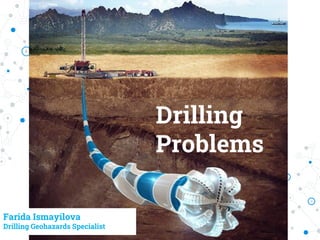
Drilling
Problems
Farida Ismayilova
Drilling Geohazards Specialist
Why we might have problems:
•Uncertainty in PPFG
•Mud volcanoes/Mud flows
•Depletion
•Wellbore stability
•Geological properties of rocks
•Potential water and gas flow
•Operational issues
•Integrity issues
2
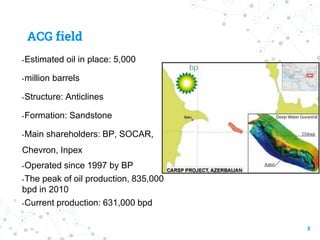
ACG field
• Estimated oil in place: 5,000
•million barrels
• Structure: Anticlines
• Formation: Sandstone
• Main shareholders: BP, SOCAR,
Chevron, Inpex
• Operated since 1997 by BP
• The peak of oil production, 835,000
bpd in 2010
• Current production: 631,000 bpd
3
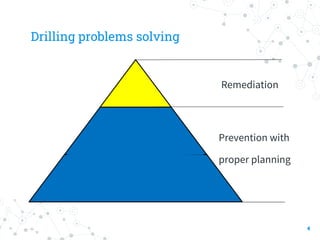
Drilling problems solving
4
Prevention with
proper planning
Remediation
Pore Pressure-Fracture Gradient (PPFG) plot
PPFG uncertainties due to the
uncertainty and quality of:
• MDT(Modular formation
Dynamic Tester)
•Logs
• Seismic velocities
• LOT/FIT measurements
•And etc.
5
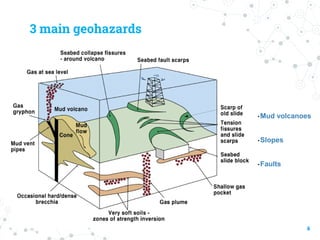
3 main geohazards
•Mud volcanoes
•Slopes
•Faults
6
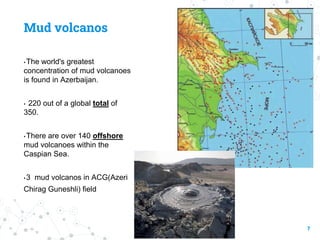
Mud volcanos
• The world's greatest
concentration of mud volcanoes
is found in Azerbaijan.
• 220 out of a global total of
350.
• There are over 140 offshore
mud volcanoes within the
Caspian Sea.
• 3 mud volcanos in ACG(Azeri
Chirag Guneshli) field
7
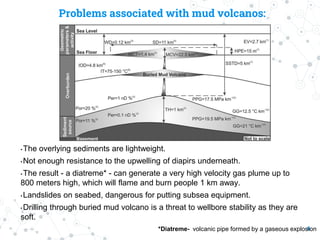
Problems associated with mud volcanos:
• The overlying sediments are lightweight.
• Not enough resistance to the upwelling of diapirs underneath.
• The result - a diatreme* - can generate a very high velocity gas plume up to
800 meters high, which will flame and burn people 1 km away.
• Landslides on seabed, dangerous for putting subsea equipment.
• Drilling through buried mud volcano is a threat to wellbore stability as they are
soft.
8
*Diatreme- volcanic pipe formed by a gaseous explosion
9
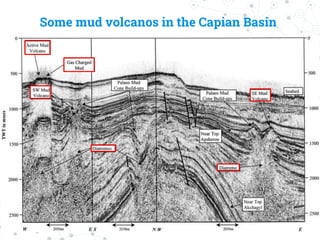
Some mud volcanos in the Capian Basin
What can be done to identify or mitigate risks:
Using regional geophysical survey to evaluate
the extent of mud volcanos
Determination of geotechnical properties of mud
volcano deposits using geotechnical boreholes
Mapping of mud volcanoes, their activity and
using already existing databases
Study of geotechnical properties, physical
processes, relation of diapirs to faulting, hazards
relating to mudflows, ground disruption and gas
emissions
Setting a casing shoe there should be avoided.
Usually it is placed above buried mud flows.
10
Faults
Faulting is prevalent along large parts of the
Apsheron Ridge.
5 fault types in the region:
• tectonic faults
• gravity failures
• faults associated with mud volcanoes
• growth faults
•constant offset faults.
Possible origins:
• tectonic in origin
• others are caused by near-surface and deep-
seated gravity failures
• uncertain, because faults of different types can
occur in the same area (for instance, tectonic
faults acting as planes of weakness along which
subsequent gravitational failures occur).
11
Problems associated with faults
• Can cause massive losses as the fracture is already in place
• Small induced fractures can lower the Fracture Gradient leading to losses
• A dangerous place to set the shoe due to instability and losses
• Possible conduit for gas or water flow from deeper sections causing
overpressure, thus flow or kick
•P.S. ACG has numerous faults in the hinge area due to its anticlinal structure. 12
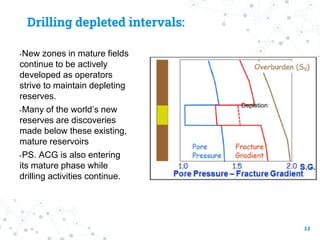
Drilling depleted intervals:
• New zones in mature fields
continue to be actively
developed as operators
strive to maintain depleting
reserves.
• Many of the world’s new
reserves are discoveries
made below these existing,
mature reservoirs
• PS. ACG is also entering
its mature phase while
drilling activities continue.
13
Depletion
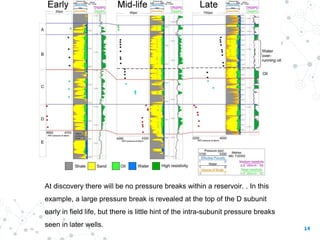
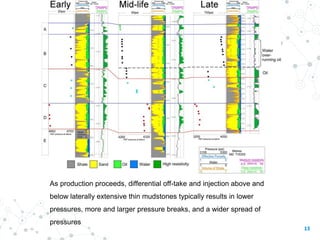
At discovery there will be no pressure breaks within a reservoir. . In this
example, a large pressure break is revealed at the top of the D subunit
early in field life, but there is little hint of the intra-subunit pressure breaks
seen in later wells. 14
As production proceeds, differential off-take and injection above and
below laterally extensive thin mudstones typically results in lower
pressures, more and larger pressure breaks, and a wider spread of
pressures
15
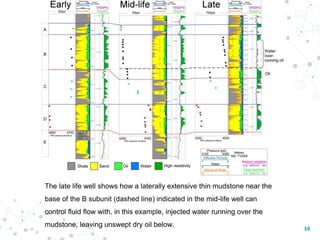
The late life well shows how a laterally extensive thin mudstone near the
base of the B subunit (dashed line) indicated in the mid-life well can
control fluid flow with, in this example, injected water running over the
mudstone, leaving unswept dry oil below. 16
Problem with drilling depleted intervals
If we use conventional
drilling techniques are used,
then the higher mud weight
used to hold back the target
interval may result in:
• massive losses (lost
circulation),
• differential sticking,
• sloughing, or collapsing
formations in the lower-
pressure zone.
17
Depletion
Drilling depleted intervals:
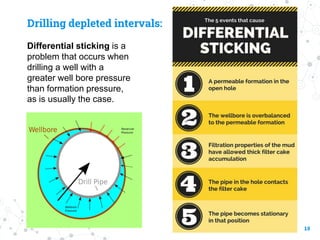
Differential sticking is a
problem that occurs when
drilling a well with a
greater well bore pressure
than formation pressure,
as is usually the case.
18
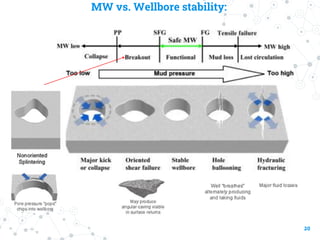
Wellbore stability
Maintaining a stable wellbore is of primary importance
during both drilling and production:
• The shape and direction of the hole must be controlled
during drilling
•Hole collapse and solid particle influx must be prevented
during production.
Wellbore stability requires:
• a proper balance between pressure while drilling and
pore/fracture pressure.
•A proper balance between the uncontrollable factors of
earth stresses, rock strength
•Mud chemical composition. – inhibition, overgauge,
undergauge
19
MW vs. Wellbore stability:
20
Wellbore stability
Maintaining a stable wellbore is of primary importance
during both drilling and production:
• The shape and direction of the hole must be controlled
during drilling
•Hole collapse and solid particle influx must be prevented
during production.
Wellbore stability requires:
• a proper balance between pressure while drilling and
pore/fracture pressure.
•A proper balance between the uncontrollable factors of
earth stresses, rock strength
•Mud chemical composition. – inhibition, overgauge,
undergauge
21
Gumbo
22
Inhibition helps slowing the hydration ,
swelling and disintegration of clays and
shales.
Shale inhibitive agents: polymer
encapsulator, Inorganic inhibitors or
electrolytes, asphaltic products and so on.
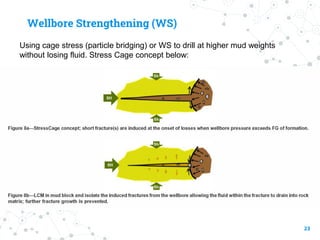
Wellbore Strengthening (WS)
Using cage stress (particle bridging) or WS to drill at higher mud weights
without losing fluid. Stress Cage concept below:
23
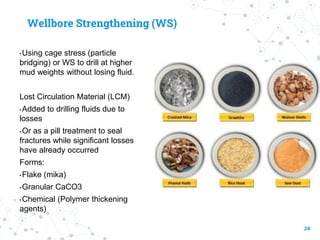
Wellbore Strengthening (WS)
• Using cage stress (particle
bridging) or WS to drill at higher
mud weights without losing fluid.
Lost Circulation Material (LCM)
• Added to drilling fluids due to
losses
• Or as a pill treatment to seal
fractures while significant losses
have already occurred
Forms:
• Flake (mika)
• Granular CaCO3
• Chemical (Polymer thickening
agents)
24
LCM
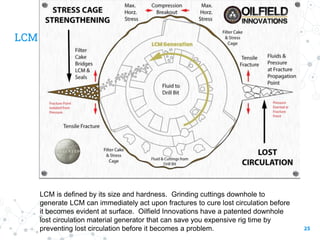
25
LCM is defined by its size and hardness. Grinding cuttings downhole to
generate LCM can immediately act upon fractures to cure lost circulation before
it becomes evident at surface. Oilfield Innovations have a patented downhole
lost circulation material generator that can save you expensive rig time by
preventing lost circulation before it becomes a problem.
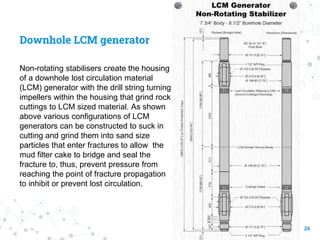
Downhole LCM generator
26
Non-rotating stabilisers create the housing
of a downhole lost circulation material
(LCM) generator with the drill string turning
impellers within the housing that grind rock
cuttings to LCM sized material. As shown
above various configurations of LCM
generators can be constructed to suck in
cutting and grind them into sand size
particles that enter fractures to allow the
mud filter cake to bridge and seal the
fracture to, thus, prevent pressure from
reaching the point of fracture propagation
to inhibit or prevent lost circulation.
27

Problems during Drilling a Well

  • 1.
  • 2.
    Why we mighthave problems: •Uncertainty in PPFG •Mud volcanoes/Mud flows •Depletion •Wellbore stability •Geological properties of rocks •Potential water and gas flow •Operational issues •Integrity issues 2
  • 3.
    ACG field • Estimatedoil in place: 5,000 •million barrels • Structure: Anticlines • Formation: Sandstone • Main shareholders: BP, SOCAR, Chevron, Inpex • Operated since 1997 by BP • The peak of oil production, 835,000 bpd in 2010 • Current production: 631,000 bpd 3
  • 4.
    Drilling problems solving 4 Preventionwith proper planning Remediation
  • 5.
    Pore Pressure-Fracture Gradient(PPFG) plot PPFG uncertainties due to the uncertainty and quality of: • MDT(Modular formation Dynamic Tester) •Logs • Seismic velocities • LOT/FIT measurements •And etc. 5
  • 6.
    3 main geohazards •Mudvolcanoes •Slopes •Faults 6
  • 7.
    Mud volcanos • Theworld's greatest concentration of mud volcanoes is found in Azerbaijan. • 220 out of a global total of 350. • There are over 140 offshore mud volcanoes within the Caspian Sea. • 3 mud volcanos in ACG(Azeri Chirag Guneshli) field 7
  • 8.
    Problems associated withmud volcanos: • The overlying sediments are lightweight. • Not enough resistance to the upwelling of diapirs underneath. • The result - a diatreme* - can generate a very high velocity gas plume up to 800 meters high, which will flame and burn people 1 km away. • Landslides on seabed, dangerous for putting subsea equipment. • Drilling through buried mud volcano is a threat to wellbore stability as they are soft. 8 *Diatreme- volcanic pipe formed by a gaseous explosion
  • 9.
    9 Some mud volcanosin the Capian Basin
  • 10.
    What can bedone to identify or mitigate risks: Using regional geophysical survey to evaluate the extent of mud volcanos Determination of geotechnical properties of mud volcano deposits using geotechnical boreholes Mapping of mud volcanoes, their activity and using already existing databases Study of geotechnical properties, physical processes, relation of diapirs to faulting, hazards relating to mudflows, ground disruption and gas emissions Setting a casing shoe there should be avoided. Usually it is placed above buried mud flows. 10
  • 11.
    Faults Faulting is prevalentalong large parts of the Apsheron Ridge. 5 fault types in the region: • tectonic faults • gravity failures • faults associated with mud volcanoes • growth faults •constant offset faults. Possible origins: • tectonic in origin • others are caused by near-surface and deep- seated gravity failures • uncertain, because faults of different types can occur in the same area (for instance, tectonic faults acting as planes of weakness along which subsequent gravitational failures occur). 11
  • 12.
    Problems associated withfaults • Can cause massive losses as the fracture is already in place • Small induced fractures can lower the Fracture Gradient leading to losses • A dangerous place to set the shoe due to instability and losses • Possible conduit for gas or water flow from deeper sections causing overpressure, thus flow or kick •P.S. ACG has numerous faults in the hinge area due to its anticlinal structure. 12
  • 13.
    Drilling depleted intervals: •New zones in mature fields continue to be actively developed as operators strive to maintain depleting reserves. • Many of the world’s new reserves are discoveries made below these existing, mature reservoirs • PS. ACG is also entering its mature phase while drilling activities continue. 13 Depletion
  • 14.
    At discovery therewill be no pressure breaks within a reservoir. . In this example, a large pressure break is revealed at the top of the D subunit early in field life, but there is little hint of the intra-subunit pressure breaks seen in later wells. 14
  • 15.
    As production proceeds,differential off-take and injection above and below laterally extensive thin mudstones typically results in lower pressures, more and larger pressure breaks, and a wider spread of pressures 15
  • 16.
    The late lifewell shows how a laterally extensive thin mudstone near the base of the B subunit (dashed line) indicated in the mid-life well can control fluid flow with, in this example, injected water running over the mudstone, leaving unswept dry oil below. 16
  • 17.
    Problem with drillingdepleted intervals If we use conventional drilling techniques are used, then the higher mud weight used to hold back the target interval may result in: • massive losses (lost circulation), • differential sticking, • sloughing, or collapsing formations in the lower- pressure zone. 17 Depletion
  • 18.
    Drilling depleted intervals: Differentialsticking is a problem that occurs when drilling a well with a greater well bore pressure than formation pressure, as is usually the case. 18
  • 19.
    Wellbore stability Maintaining astable wellbore is of primary importance during both drilling and production: • The shape and direction of the hole must be controlled during drilling •Hole collapse and solid particle influx must be prevented during production. Wellbore stability requires: • a proper balance between pressure while drilling and pore/fracture pressure. •A proper balance between the uncontrollable factors of earth stresses, rock strength •Mud chemical composition. – inhibition, overgauge, undergauge 19
  • 20.
    MW vs. Wellborestability: 20
  • 21.
    Wellbore stability Maintaining astable wellbore is of primary importance during both drilling and production: • The shape and direction of the hole must be controlled during drilling •Hole collapse and solid particle influx must be prevented during production. Wellbore stability requires: • a proper balance between pressure while drilling and pore/fracture pressure. •A proper balance between the uncontrollable factors of earth stresses, rock strength •Mud chemical composition. – inhibition, overgauge, undergauge 21
  • 22.
    Gumbo 22 Inhibition helps slowingthe hydration , swelling and disintegration of clays and shales. Shale inhibitive agents: polymer encapsulator, Inorganic inhibitors or electrolytes, asphaltic products and so on.
  • 23.
    Wellbore Strengthening (WS) Usingcage stress (particle bridging) or WS to drill at higher mud weights without losing fluid. Stress Cage concept below: 23
  • 24.
    Wellbore Strengthening (WS) •Using cage stress (particle bridging) or WS to drill at higher mud weights without losing fluid. Lost Circulation Material (LCM) • Added to drilling fluids due to losses • Or as a pill treatment to seal fractures while significant losses have already occurred Forms: • Flake (mika) • Granular CaCO3 • Chemical (Polymer thickening agents) 24
  • 25.
    LCM 25 LCM is definedby its size and hardness. Grinding cuttings downhole to generate LCM can immediately act upon fractures to cure lost circulation before it becomes evident at surface. Oilfield Innovations have a patented downhole lost circulation material generator that can save you expensive rig time by preventing lost circulation before it becomes a problem.
  • 26.
    Downhole LCM generator 26 Non-rotatingstabilisers create the housing of a downhole lost circulation material (LCM) generator with the drill string turning impellers within the housing that grind rock cuttings to LCM sized material. As shown above various configurations of LCM generators can be constructed to suck in cutting and grind them into sand size particles that enter fractures to allow the mud filter cake to bridge and seal the fracture to, thus, prevent pressure from reaching the point of fracture propagation to inhibit or prevent lost circulation.
  • 27.