Week 13, Lesson 2 Wave Motion 1 
Wave Motion 
Week 13, Lesson 2 
• 
Wave Propagation, Wave Types 
• 
Wave Terminology 
• 
Speed of a Transverse Wave 
• 
Standing Waves 
• 
Resonance 
References/Reading Preparation: 
Schaum’s Outline Ch. 22 
Principles of Physics by Beuche – Ch.14
Week 13, Lesson 2 Wave Motion 2 
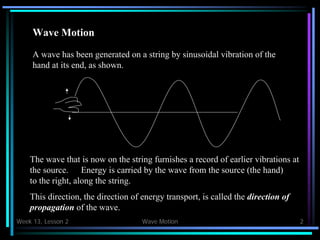
Wave Motion 
A wave has been generated on a string by sinusoidal vibration of the 
hand at its end, as shown. 
The wave that is now on the string furnishes a record of earlier vibrations at 
the source. 
Energy is carried by the wave from the source (the hand) to the right, along the string. 
This direction, the direction of energy transport, is called the direction of 
propagation of the wave.
Week 13, Lesson 2 Wave Motion 3 
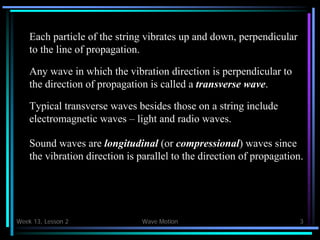
Each particle of the string vibrates up and down, perpendicular 
to the line of propagation. 
Any wave in which the vibration direction is perpendicular to 
the direction of propagation is called a transverse wave. 
Typical transverse waves besides those on a string include 
electromagnetic waves – light and radio waves. 
Sound waves are longitudinal (or compressional) waves since 
the vibration direction is parallel to the direction of propagation.
Week 13, Lesson 2 Wave Motion 4 
Wave Terminology 
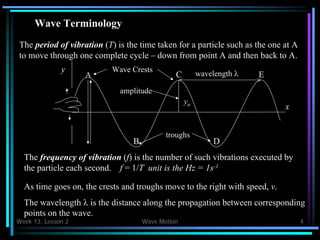
The period of vibration (T) is the time taken for a particle such as the one at A 
to move through one complete cycle – down from point A and then back to A. 
x 
y 
A 
The frequency of vibration (f) is the number of such vibrations executed by 
the particle each second. 
f = 1/T unit is the Hz = 1s-1 
B 
C 
D 
E 
Wave Crests 
troughs 
As time goes on, the crests and troughs move to the right with speed, v. 
amplitude 
yo 
wavelength  
The wavelength  is the distance along the propagation between corresponding 
points on the wave.
Week 13, Lesson 2 Wave Motion 5 
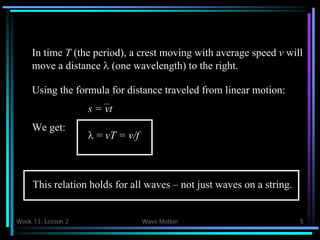
In time T (the period), a crest moving with average speed v will 
move a distance  (one wavelength) to the right. 
Using the formula for distance traveled from linear motion: 
s = vt 
We get: 
 = vT = v/f 
This relation holds for all waves – not just waves on a string.
Week 13, Lesson 2 Wave Motion 6 
In-Phase Vibrations 
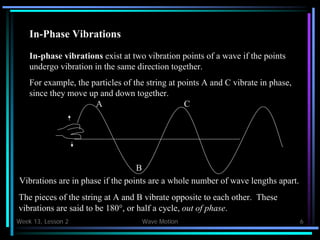
In-phase vibrations exist at two vibration points of a wave if the points 
undergo vibration in the same direction together. 
For example, the particles of the string at points A and C vibrate in phase, 
since they move up and down together. 
A 
C 
Vibrations are in phase if the points are a whole number of wave lengths apart. 
B 
The pieces of the string at A and B vibrate opposite to each other. These 
vibrations are said to be 180, or half a cycle, out of phase.
Week 13, Lesson 2 Wave Motion 7 
Speed of a Transverse Wave 
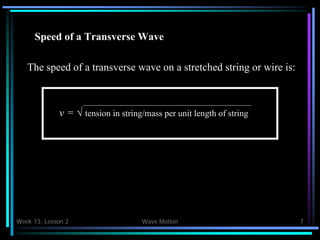
The speed of a transverse wave on a stretched string or wire is: 
v =  tension in string/mass per unit length of string
Week 13, Lesson 2 Wave Motion 8 
Standing Waves 
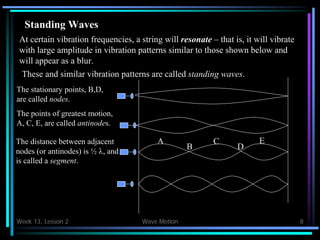
At certain vibration frequencies, a string will resonate – that is, it will vibrate 
with large amplitude in vibration patterns similar to those shown below and 
will appear as a blur. 
These and similar vibration patterns are called standing waves. 
A 
B 
C 
D 
E 
The stationary points, B,D, 
are called nodes. 
The points of greatest motion, 
A, C, E, are called antinodes. 
The distance between adjacent 
nodes (or antinodes) is ½ , and 
is called a segment.
Week 13, Lesson 2 Wave Motion 9 
A 
B 
C 
D 
E 
Conditions for Resonance 
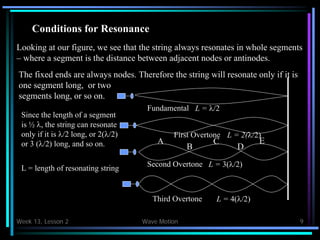
Looking at our figure, we see that the string always resonates in whole segments 
– where a segment is the distance between adjacent nodes or antinodes. 
The fixed ends are always nodes. Therefore the string will resonate only if it is 
one segment long, or two 
segments long, or so on. 
Since the length of a segment 
is ½ , the string can resonate 
only if it is /2 long, or 2(/2) 
or 3 (/2) long, and so on. 
L = /2 
L = 2(/2) 
L = 3(/2) 
L = 4(/2) 
Fundamental 
First Overtone 
Second Overtone 
Third Overtone 
L = length of resonating string
Week 13, Lesson 2 Wave Motion 10 
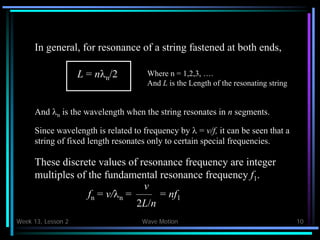
In general, for resonance of a string fastened at both ends, 
L = nn /2 
Where n = 1,2,3, …. 
And L is the Length of the resonating string 
And n is the wavelength when the string resonates in n segments. 
Since wavelength is related to frequency by  = v/f, it can be seen that a 
string of fixed length resonates only to certain special frequencies. 
These discrete values of resonance frequency are integer 
multiples of the fundamental resonance frequency f1 . 
fn = v/n = 
v 
2L/n 
= nf1
Week 13, Lesson 2 Wave Motion 11 
Often the resonance frequencies of a taut string are connected 
with the production of music. 
The fundamental frequency f1 is sometimes referred to as the 
first harmonic, with f2 , f3 , f4 , and fn as the second, third, forth, 
and nth harmonics. 
Thus the term harmonic in general refers to a vibration of a 
single sinusoidal wave frequency, and the term simple harmonic 
motion refers to periodic motion that can be described by a sine 
or cosine function with a single frequency. 
Harmonics
Week 13, Lesson 2 Wave Motion 12 
Harmonics example 
The speed of a wave on a particular string is 24 m/s. If the string is 6.0 m 
long, to what driving frequencies will it resonate? 
Answer: 
For resonance to occur, the length of the string must be an integral number 
of half wavelengths. Or, n = 2L/n 
Therefore, 1 = 12m/1 = 12.0 m; 2 = 12 m/2 = 6.0 m; 3 =12m/3 = 4.0 m 
Now, fn = v/n 
Therefore, 
f1 = 24 m/s / 12 m = 2.0 Hz 
f2 = 24 m/s / 6.0 m = 4.0 Hz 
f3 = 24 m/s / 4.0 m = 6.0 Hz
Week 13, Lesson 2 Wave Motion 13 
Worked example 
A 
C 
B 
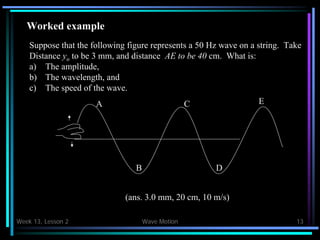
Suppose that the following figure represents a 50 Hz wave on a string. Take 
Distance yo to be 3 mm, and distance AE to be 40 cm. What is: 
a) 
The amplitude, 
b) 
The wavelength, and 
c) 
The speed of the wave. 
D 
E 
(ans. 3.0 mm, 20 cm, 10 m/s)
Week 13, Lesson 2 Wave Motion 14 
Worked example 
A horizontal cord 5 m long has a mass of 1.45 g. What must be the tension 
in the cord if the wavelength of a 129 Hz on it is to be 60 cm? How large a 
mass must be hung from its end (say, over a pulley) to give it this tension? 
(ans. 1.50 N, 0.153 kg)
Week 13, Lesson 2 Wave Motion 15 
Worked example 
A string vibrates in five segments to a frequency of 460 Hz. 
a) 
What is its fundamental frequency? 
b) 
What will cause it to vibrate in three segments?
Week 13, Lesson 2 Wave Motion 16 
Longitudinal Waves 
Longitudinal (Compressional Waves) occur as lengthwise vibrations of air 
columns, solid bars, and the like. 
At resonance, nodes exist at fixed points, such as the closed end of an air 
column in a tube, or the location of a clamp on a bar. 
The resonance diagrams shown earlier are used to display the resonance of 
longitudinal waves as well as transverse waves. However, for longitudinal 
waves, the diagrams are mainly schematic and are used simply to indicate 
the locations of nodes and antinodes. 
In analyzing these diagrams, we use th fact that the distance between node 
and adjacent antinode is ¼ .
Week 13, Lesson 2 Wave Motion 17 
Worked example 
Compressional (sound) waves are sent down an air-filled tube 90 cm long 
and closed at one end. The tube resonates at several frequencies, the 
lowest of which is 95 Hz. Find the speed of sound waves in air. 
(ans. 342 m/s)

Physics 17-2

  • 1.
    Week 13, Lesson2 Wave Motion 1 Wave Motion Week 13, Lesson 2 • Wave Propagation, Wave Types • Wave Terminology • Speed of a Transverse Wave • Standing Waves • Resonance References/Reading Preparation: Schaum’s Outline Ch. 22 Principles of Physics by Beuche – Ch.14
  • 2.
    Week 13, Lesson2 Wave Motion 2 Wave Motion A wave has been generated on a string by sinusoidal vibration of the hand at its end, as shown. The wave that is now on the string furnishes a record of earlier vibrations at the source. Energy is carried by the wave from the source (the hand) to the right, along the string. This direction, the direction of energy transport, is called the direction of propagation of the wave.
  • 3.
    Week 13, Lesson2 Wave Motion 3 Each particle of the string vibrates up and down, perpendicular to the line of propagation. Any wave in which the vibration direction is perpendicular to the direction of propagation is called a transverse wave. Typical transverse waves besides those on a string include electromagnetic waves – light and radio waves. Sound waves are longitudinal (or compressional) waves since the vibration direction is parallel to the direction of propagation.
  • 4.
    Week 13, Lesson2 Wave Motion 4 Wave Terminology The period of vibration (T) is the time taken for a particle such as the one at A to move through one complete cycle – down from point A and then back to A. x y A The frequency of vibration (f) is the number of such vibrations executed by the particle each second. f = 1/T unit is the Hz = 1s-1 B C D E Wave Crests troughs As time goes on, the crests and troughs move to the right with speed, v. amplitude yo wavelength  The wavelength  is the distance along the propagation between corresponding points on the wave.
  • 5.
    Week 13, Lesson2 Wave Motion 5 In time T (the period), a crest moving with average speed v will move a distance  (one wavelength) to the right. Using the formula for distance traveled from linear motion: s = vt We get:  = vT = v/f This relation holds for all waves – not just waves on a string.
  • 6.
    Week 13, Lesson2 Wave Motion 6 In-Phase Vibrations In-phase vibrations exist at two vibration points of a wave if the points undergo vibration in the same direction together. For example, the particles of the string at points A and C vibrate in phase, since they move up and down together. A C Vibrations are in phase if the points are a whole number of wave lengths apart. B The pieces of the string at A and B vibrate opposite to each other. These vibrations are said to be 180, or half a cycle, out of phase.
  • 7.
    Week 13, Lesson2 Wave Motion 7 Speed of a Transverse Wave The speed of a transverse wave on a stretched string or wire is: v =  tension in string/mass per unit length of string
  • 8.
    Week 13, Lesson2 Wave Motion 8 Standing Waves At certain vibration frequencies, a string will resonate – that is, it will vibrate with large amplitude in vibration patterns similar to those shown below and will appear as a blur. These and similar vibration patterns are called standing waves. A B C D E The stationary points, B,D, are called nodes. The points of greatest motion, A, C, E, are called antinodes. The distance between adjacent nodes (or antinodes) is ½ , and is called a segment.
  • 9.
    Week 13, Lesson2 Wave Motion 9 A B C D E Conditions for Resonance Looking at our figure, we see that the string always resonates in whole segments – where a segment is the distance between adjacent nodes or antinodes. The fixed ends are always nodes. Therefore the string will resonate only if it is one segment long, or two segments long, or so on. Since the length of a segment is ½ , the string can resonate only if it is /2 long, or 2(/2) or 3 (/2) long, and so on. L = /2 L = 2(/2) L = 3(/2) L = 4(/2) Fundamental First Overtone Second Overtone Third Overtone L = length of resonating string
  • 10.
    Week 13, Lesson2 Wave Motion 10 In general, for resonance of a string fastened at both ends, L = nn /2 Where n = 1,2,3, …. And L is the Length of the resonating string And n is the wavelength when the string resonates in n segments. Since wavelength is related to frequency by  = v/f, it can be seen that a string of fixed length resonates only to certain special frequencies. These discrete values of resonance frequency are integer multiples of the fundamental resonance frequency f1 . fn = v/n = v 2L/n = nf1
  • 11.
    Week 13, Lesson2 Wave Motion 11 Often the resonance frequencies of a taut string are connected with the production of music. The fundamental frequency f1 is sometimes referred to as the first harmonic, with f2 , f3 , f4 , and fn as the second, third, forth, and nth harmonics. Thus the term harmonic in general refers to a vibration of a single sinusoidal wave frequency, and the term simple harmonic motion refers to periodic motion that can be described by a sine or cosine function with a single frequency. Harmonics
  • 12.
    Week 13, Lesson2 Wave Motion 12 Harmonics example The speed of a wave on a particular string is 24 m/s. If the string is 6.0 m long, to what driving frequencies will it resonate? Answer: For resonance to occur, the length of the string must be an integral number of half wavelengths. Or, n = 2L/n Therefore, 1 = 12m/1 = 12.0 m; 2 = 12 m/2 = 6.0 m; 3 =12m/3 = 4.0 m Now, fn = v/n Therefore, f1 = 24 m/s / 12 m = 2.0 Hz f2 = 24 m/s / 6.0 m = 4.0 Hz f3 = 24 m/s / 4.0 m = 6.0 Hz
  • 13.
    Week 13, Lesson2 Wave Motion 13 Worked example A C B Suppose that the following figure represents a 50 Hz wave on a string. Take Distance yo to be 3 mm, and distance AE to be 40 cm. What is: a) The amplitude, b) The wavelength, and c) The speed of the wave. D E (ans. 3.0 mm, 20 cm, 10 m/s)
  • 14.
    Week 13, Lesson2 Wave Motion 14 Worked example A horizontal cord 5 m long has a mass of 1.45 g. What must be the tension in the cord if the wavelength of a 129 Hz on it is to be 60 cm? How large a mass must be hung from its end (say, over a pulley) to give it this tension? (ans. 1.50 N, 0.153 kg)
  • 15.
    Week 13, Lesson2 Wave Motion 15 Worked example A string vibrates in five segments to a frequency of 460 Hz. a) What is its fundamental frequency? b) What will cause it to vibrate in three segments?
  • 16.
    Week 13, Lesson2 Wave Motion 16 Longitudinal Waves Longitudinal (Compressional Waves) occur as lengthwise vibrations of air columns, solid bars, and the like. At resonance, nodes exist at fixed points, such as the closed end of an air column in a tube, or the location of a clamp on a bar. The resonance diagrams shown earlier are used to display the resonance of longitudinal waves as well as transverse waves. However, for longitudinal waves, the diagrams are mainly schematic and are used simply to indicate the locations of nodes and antinodes. In analyzing these diagrams, we use th fact that the distance between node and adjacent antinode is ¼ .
  • 17.
    Week 13, Lesson2 Wave Motion 17 Worked example Compressional (sound) waves are sent down an air-filled tube 90 cm long and closed at one end. The tube resonates at several frequencies, the lowest of which is 95 Hz. Find the speed of sound waves in air. (ans. 342 m/s)