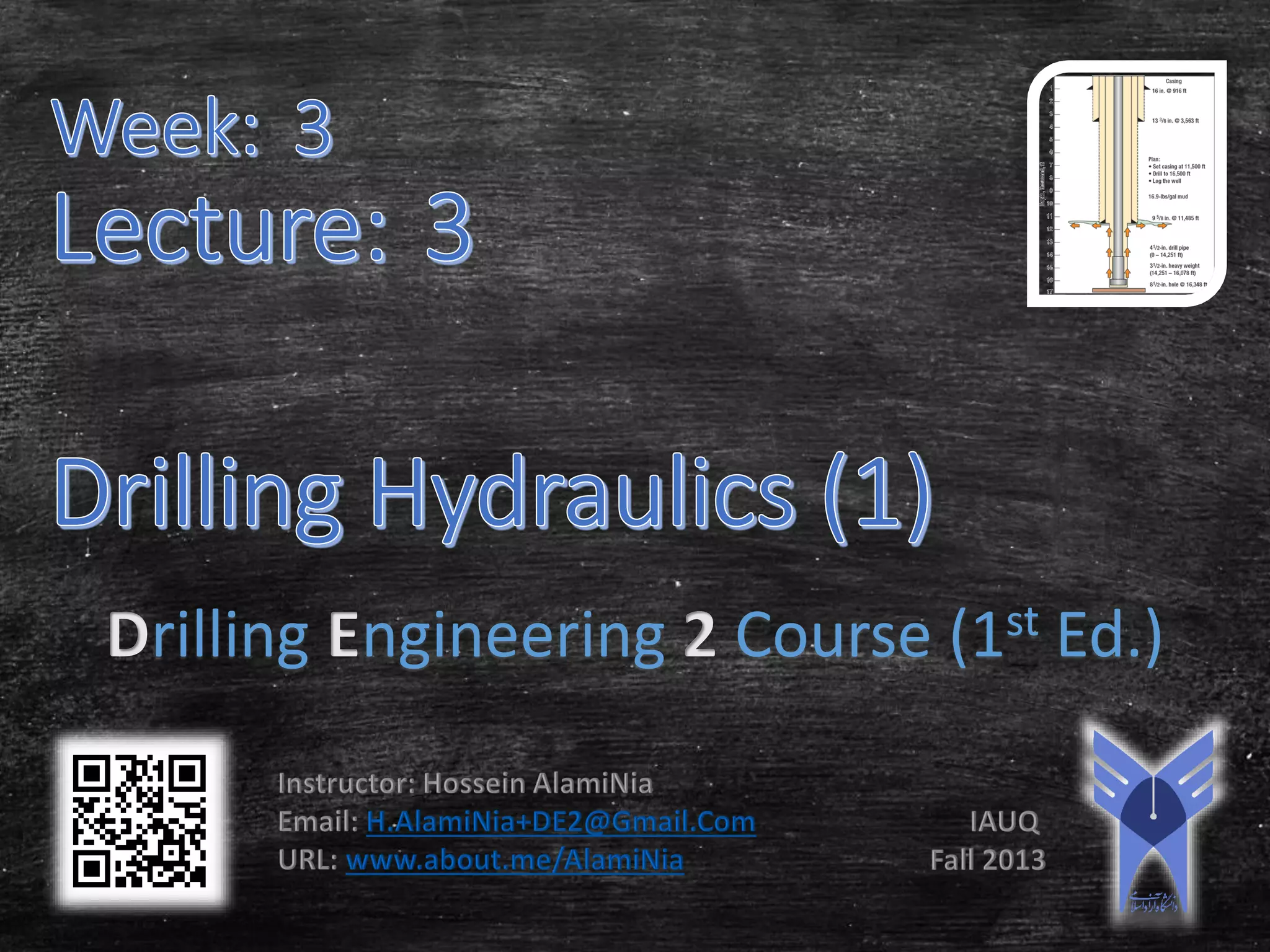
Drilling Engineering 2 Course (1st Ed.)
1.
2.
3.
4.

General Notes
Pore Pressure Prediction
Abnormal vs. normal Pressure
Fracture Gradient determination
1. Mud Weight Planning
2. drilling hydraulics:
A. the hydrostatic pressure
mud weight selection
Selecting the correct mud weight
for drilling the individual sections comprises
a key factor to realize a
in-gauge hole and avoid various borehole problems.
Too low mud weight may result in
collapse and
fill problems (well cleaning),
while too high mud weight may result in
mud losses or
pipe sticking

Fall 13 H. AlamiNia

Drilling Engineering 2 Course:

5
constant mud weight program
Practice has also shown that
excessive variations in mud weight may lead to
borehole failure (fatigue type effect), thus
a more constant mud weight program should be aimed.

Along with a more constant mud weight program,
the equivalent circulation density (ECD)
as well as
the surge and swab pressures
shall be kept within limits.

Fall 13 H. AlamiNia

Drilling Engineering 2 Course:

6
Benefits of higher mud weight
Washouts of the borehole are
sometimes caused by jet actions of the bit nozzles
but also sometimes by to low mud weight
causing a breakdown of the borehole wall.
A higher mud weight will therefore
balance the rock stresses better and
tend to keep the borehole more in-gauge.

A decease in hole diameter is often due to swelling
(clay swelling) requiring wiper trips or backreaming.
This necessity is sometimes reduced by
higher mud weights.
Fall 13 H. AlamiNia

Drilling Engineering 2 Course:

7
differential stuck
An increased mud weight
increases the danger of becoming differential stuck
at permeable formations.
Therefore mud weight shall not be chosen to be to high.
However, what is sometimes believed to be
a differentially stuck drillstring is sometimes
due to a borehole collapse which
packs the hole around the bottom-hole assembly.

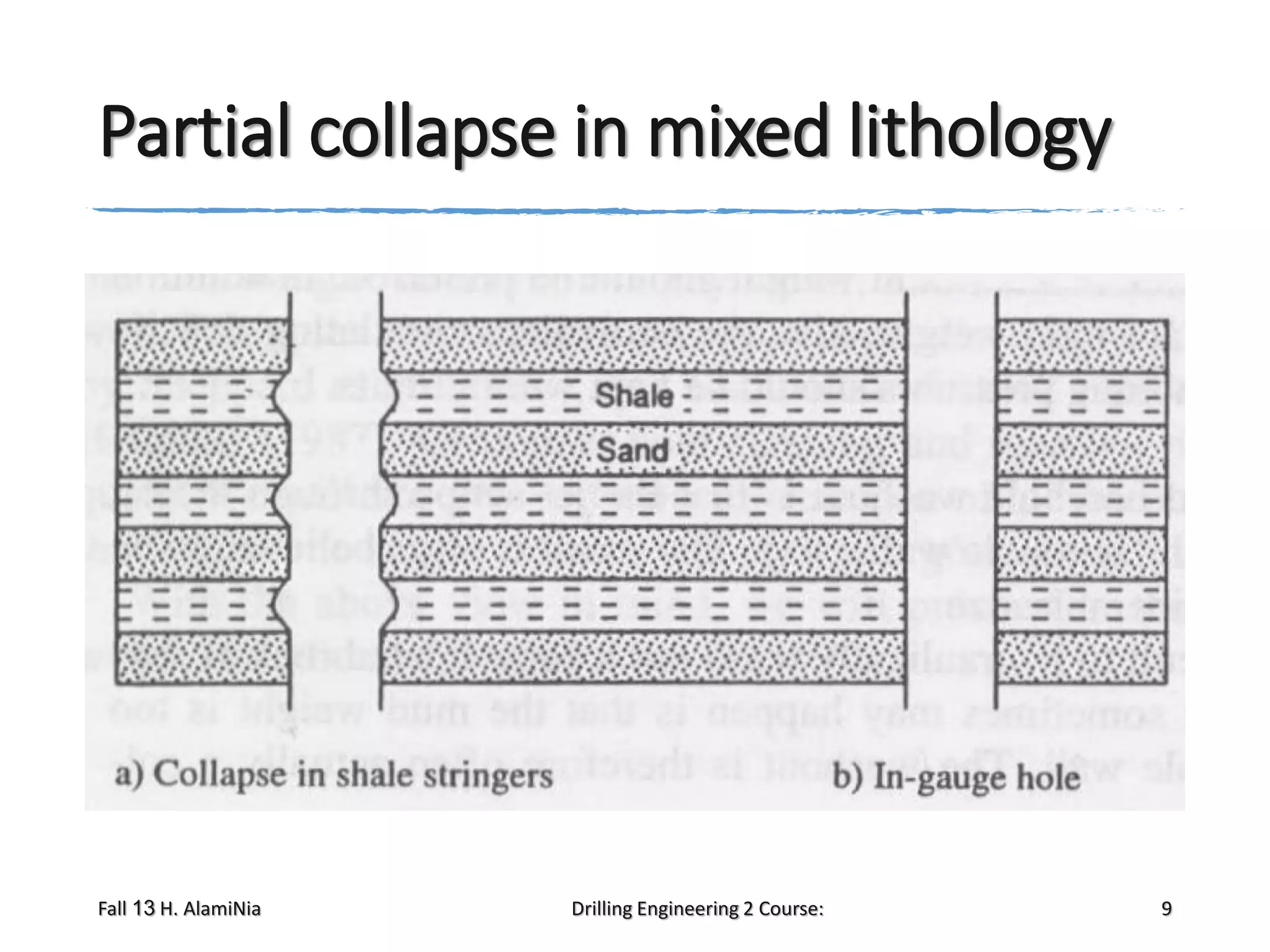
A lower mud weight also causes
breakouts of shale layers
leaving sand formations in-gauge, (next fig).
This can increase the danger of
getting differential stuck at the exposed sand stringers.
Fall 13 H. AlamiNia

Drilling Engineering 2 Course:

8
Partial collapse in mixed lithology

Fall 13 H. AlamiNia

Drilling Engineering 2 Course:

9
lost circulation
Thus when considering
the danger of differential sticking,
it is recommended to keep the mud weight
below a certain value but
it shall not be as low as possible.

The same is true for lost circulation problems.
As long as the mud weight is kept below a critical value,
lost circulation will not occur.

Fall 13 H. AlamiNia

Drilling Engineering 2 Course:

10
Mud weight vs. penetration rate
It is often argued that to have
a as high as possible rate of penetration,
the mud weight shall be kept as close as possible
to the formation pressure gradient
plus a safety margin of around 100 [psi].

Although it is true that a small reduction in mud weight
increases the penetration rate,
but this increases has to be weighted against the possible
induction of hole problems and additional lost time.

A higher mud weight requires the use of more mud
additives which makes the well more expensive,
but it was found that
these extra costs are usually neglectable.
Fall 13 H. AlamiNia

Drilling Engineering 2 Course:

11
drilling for a kick
When drilling within areas where
the subsurface pressure regimes are not well known,
it is often argued that a lower mud weight
easies the detection of abnormal pressures.

In some locations,
a practice called “drilling for a kick” was applied to
detect overpressured formations.

For this, a relatively low mud weight was applied
until a kick was detected
(pressure gradient at this depth was equal to the used mud
weight)
and handling the kick, the mud weight was increased.
Therefore and since
a higher mud weight also suppresses high gas readings,
the mud weight of exploration wells are often
designed to be lighter than the ones for development wells.

Fall 13 H. AlamiNia

Drilling Engineering 2 Course:

12
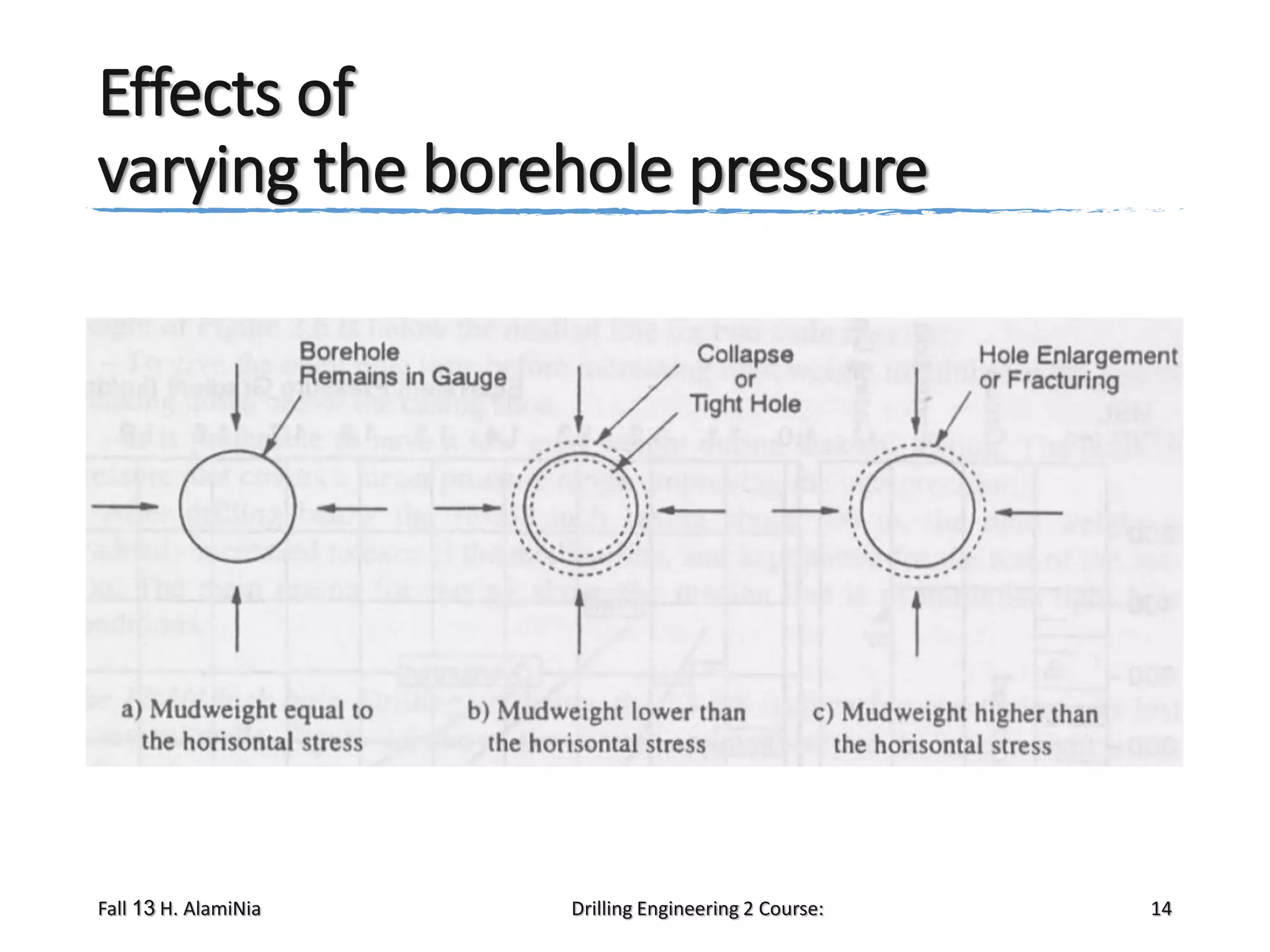
median line concept
Based on all these considerations,
the “median line concept” is recommended
generally for mud weight planning.
Thereto, the mid-point between
the fracture pressure and
the pore pressure
defines the borehole pressure that is
equal to the ideal in-situ stress.

Maintaining the mud pressure close to this level
causes least disturbances on the borehole wall.
This principle is sketched in next two slides
Fall 13 H. AlamiNia

Drilling Engineering 2 Course:

13
Effects of
varying the borehole pressure

Fall 13 H. AlamiNia

Drilling Engineering 2 Course:

14
average horizontal in-situ stress
Mentioned principle is
mathematically found
with following
equation:
𝜎 𝑎 =

𝑃 𝑤𝑓 +𝑃 𝑜
2

 𝜎 𝑎 [psi] average
horizontal in-situ stress,
Pwf [psi] fracture stress,
Po [psi] pore pressure

Pressure gradients for a well
Fall 13 H. AlamiNia

Drilling Engineering 2 Course:

15
Changing mud weight
Experience had shown that
new drilling fluid exacerbates fracturing/lost circulation
and
leakoff tests applying used drilling muds give higher
leak-off values than when carried out with new ones.

Therefore it is a good practice that,
when the mud weight has to be changed
after setting casing,
drilling is usually started with a lower mud weight.

After drilling about 100 [m] below the casing shoe,
the mud weight is then gradually increased
to the desired value.
Fall 13 H. AlamiNia

Drilling Engineering 2 Course:

16
Changing mud weight (Cont.)
Furthermore it should be noticed that
within an open-hole section,
the mud weight shall only be increased and
not decreased since tight hole may result.

An increase of mud weight in steps of 0.05 [g/cm3]
is good practice and in convenience of the mud
engineer.

Fall 13 H. AlamiNia

Drilling Engineering 2 Course:

17
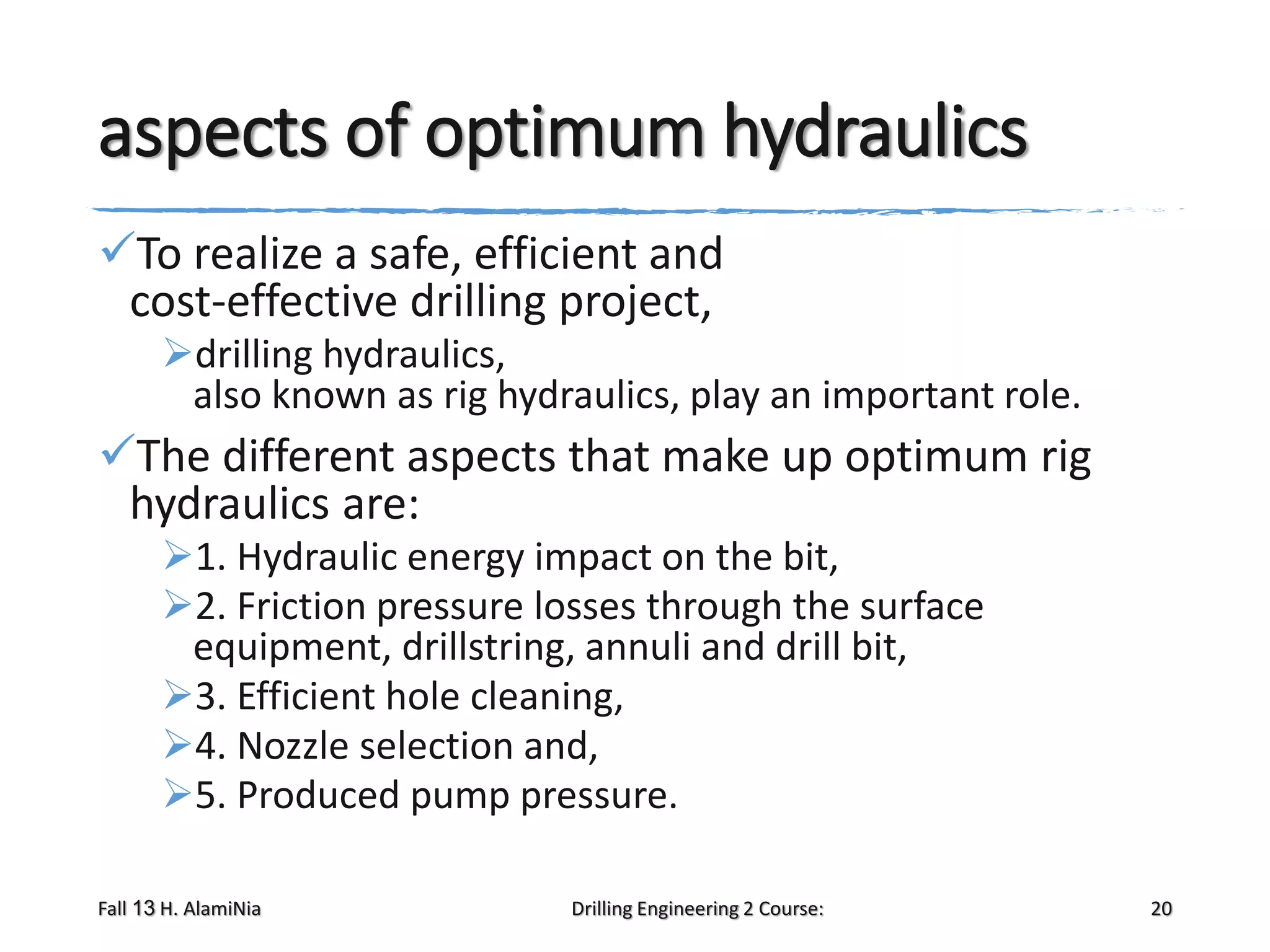
aspects of optimum hydraulics
To realize a safe, efficient and
cost-effective drilling project,
drilling hydraulics,
also known as rig hydraulics, play an important role.

The different aspects that make up optimum rig
hydraulics are:
1. Hydraulic energy impact on the bit,
2. Friction pressure losses through the surface
equipment, drillstring, annuli and drill bit,
3. Efficient hole cleaning,
4. Nozzle selection and,
5. Produced pump pressure.
Fall 13 H. AlamiNia

Drilling Engineering 2 Course:

20
improper drilling hydraulics
consequences
Some of the drilling problems that are
due to improperly designed drilling hydraulics are
failure of sufficient hole cleaning
leaving cuttings in the hole and
lead to stuck pipe,

lost circulation causing kicks and slow penetration rates.

To understand
the various dependencies of efficient drilling hydraulics,
following concepts should be known
the hydrostatic pressure inside the wellbore,
types of fluid flow,
criteria of fluid flow and
commonly used fluid types for different drilling operations
Fall 13 H. AlamiNia

Drilling Engineering 2 Course:

21
Hydrostatic Pressure
Inside the Wellbore
Hydrostatic definition:
relating to or denoting the equilibrium of liquids and
the pressure exerted by liquid at rest.

For oil well applications, the fluid may be
mud, foam, mist, air or natural gas.
For a complex fluid column consisting of multiple
fluids, the hydrostatic pressure is given in field units
by:
𝜌

𝑚𝑖

Fall 13 H. AlamiNia

[ppg] mud weight of the ith fluid column
Drilling Engineering 2 Course:

22
barometric formula
When gas is present in the well, the hydrostatic
pressure developed by the gas column is calculated
with:
z [1] ... real gas deviation factor
po [psi] ... surface pressure
D [ft] ... total depth (TVD)
Tf [F] ... bottom hole temperature of the formation
The molecular weight M of the gas is found as:
• where:
o 𝜌 𝑔 [ppg] ... density of the gas
o T [F] ... average gas density
Fall 13 H. AlamiNia

Drilling Engineering 2 Course:

23
equivalent mud weight
For practical purposes, the hydrostatics due to a
complex fluid column are converted to an
equivalent single-fluid hydrostatic pressure.
To do this,
all individual hydrostatic pressures are summed up for a
specific depth pd and
then converted to an equivalent mud weight 𝜌 𝑒 [ppg]
that would cause the same hydrostatic pressure.

Therefore the equivalent mud weight
has to be always referenced to a specific depth.
Fall 13 H. AlamiNia

Drilling Engineering 2 Course:

24
average mud weight
As the mud is used to transport the cuttings from
the bottom of the hole to the surface and
penetrated formations often contain a certain
amount of formation gas, the mud column at the
annulus is usually mixed with solids and gas.
This alters the weight of the mud at the annulus.
The new average mud weight m of a mixture containing
mud and solids can be calculated as:
mi [lbm] mass of component i
Vi [gal] volume of component i
𝜌 𝑖 [ppg] density of component i
fi [1] volume fraction of component i
Fall 13 H. AlamiNia

Drilling Engineering 2 Course:

25
Notes about mud weight
only solids that are suspended within the mud
do alter the mud weight.
Settled particles do not affect the hydrostatic pressure.

If gas is present in the mud column as well,
the density of the gas component is
a function of the depth and
will decrease with decreasing pressure.
In this way, the density of mud containing gas is
decreasing with decreasing depth.

Fall 13 H. AlamiNia

Drilling Engineering 2 Course:

26
over-balanced drilling techniques
(OBD)
well control and the safety of drilling operations are
strongly depended on
the maintenance of proper hydrostatic pressure.

 This pressure is needed to counterbalance the formation pressure.

In case the hydrostatic pressure in the borehole is
higher than the formation pressure,
the situation is called “over-balanced”.

 This prevents kicks (fluid flow from the formation into the borehole)
and causes at permeable formations an intrusion of some mud
(water component) into the formation.
 The intrusion is stopped by the built up of mud cake
that seals off permeable formations.

 On the other hand, the hydrostatic pressure inside the borehole
must not be higher than
the fracture pressure of the formations penetrated
 since this would fracture the formation artificially,
 cause loss of circulation and lead to well control problems.

Fall 13 H. AlamiNia

Drilling Engineering 2 Course:

27
underbalanced drilling techniques
(UBD)
To obtain maximum penetration rates
the hydrostatic pressure should be kept
as close as practical to the formation pressure

since a higher differential pressure
(hydrostatic pressure - formation pressure)
leads to worst cutting removal from the bottom of the well.

Due to this circumstance,
UBD techniques have been developed that use
air, foam or mist as drilling fluids.

Here the formation pressure is higher than the hydrostatic
pressure caused by the mud and thus the well is constantly
kicking.
With UBD techniques much higher penetration rates are
possible but well control can be a problem.
Therefore UBD is prohibited
by some governments and/or in some areas.

Fall 13 H. AlamiNia

Drilling Engineering 2 Course:

28
1. Dipl.-Ing. Wolfgang F. Prassl. “Drilling
Engineering.” Master of Petroleum
Engineering. Curtin University of Technology,
2001. Chapter 3 and 4
Q921 de2 lec3 v1
Q921 de2 lec3 v1

Q921 de2 lec3 v1

  • 1.
    Drilling Engineering 2Course (1st Ed.)
  • 2.
    1. 2. 3. 4. General Notes Pore PressurePrediction Abnormal vs. normal Pressure Fracture Gradient determination
  • 3.
    1. Mud WeightPlanning 2. drilling hydraulics: A. the hydrostatic pressure
  • 5.
    mud weight selection Selectingthe correct mud weight for drilling the individual sections comprises a key factor to realize a in-gauge hole and avoid various borehole problems. Too low mud weight may result in collapse and fill problems (well cleaning), while too high mud weight may result in mud losses or pipe sticking Fall 13 H. AlamiNia Drilling Engineering 2 Course: 5
  • 6.
    constant mud weightprogram Practice has also shown that excessive variations in mud weight may lead to borehole failure (fatigue type effect), thus a more constant mud weight program should be aimed. Along with a more constant mud weight program, the equivalent circulation density (ECD) as well as the surge and swab pressures shall be kept within limits. Fall 13 H. AlamiNia Drilling Engineering 2 Course: 6
  • 7.
    Benefits of highermud weight Washouts of the borehole are sometimes caused by jet actions of the bit nozzles but also sometimes by to low mud weight causing a breakdown of the borehole wall. A higher mud weight will therefore balance the rock stresses better and tend to keep the borehole more in-gauge. A decease in hole diameter is often due to swelling (clay swelling) requiring wiper trips or backreaming. This necessity is sometimes reduced by higher mud weights. Fall 13 H. AlamiNia Drilling Engineering 2 Course: 7
  • 8.
    differential stuck An increasedmud weight increases the danger of becoming differential stuck at permeable formations. Therefore mud weight shall not be chosen to be to high. However, what is sometimes believed to be a differentially stuck drillstring is sometimes due to a borehole collapse which packs the hole around the bottom-hole assembly. A lower mud weight also causes breakouts of shale layers leaving sand formations in-gauge, (next fig). This can increase the danger of getting differential stuck at the exposed sand stringers. Fall 13 H. AlamiNia Drilling Engineering 2 Course: 8
  • 9.
    Partial collapse inmixed lithology Fall 13 H. AlamiNia Drilling Engineering 2 Course: 9
  • 10.
    lost circulation Thus whenconsidering the danger of differential sticking, it is recommended to keep the mud weight below a certain value but it shall not be as low as possible. The same is true for lost circulation problems. As long as the mud weight is kept below a critical value, lost circulation will not occur. Fall 13 H. AlamiNia Drilling Engineering 2 Course: 10
  • 11.
    Mud weight vs.penetration rate It is often argued that to have a as high as possible rate of penetration, the mud weight shall be kept as close as possible to the formation pressure gradient plus a safety margin of around 100 [psi]. Although it is true that a small reduction in mud weight increases the penetration rate, but this increases has to be weighted against the possible induction of hole problems and additional lost time. A higher mud weight requires the use of more mud additives which makes the well more expensive, but it was found that these extra costs are usually neglectable. Fall 13 H. AlamiNia Drilling Engineering 2 Course: 11
  • 12.
    drilling for akick When drilling within areas where the subsurface pressure regimes are not well known, it is often argued that a lower mud weight easies the detection of abnormal pressures. In some locations, a practice called “drilling for a kick” was applied to detect overpressured formations. For this, a relatively low mud weight was applied until a kick was detected (pressure gradient at this depth was equal to the used mud weight) and handling the kick, the mud weight was increased. Therefore and since a higher mud weight also suppresses high gas readings, the mud weight of exploration wells are often designed to be lighter than the ones for development wells. Fall 13 H. AlamiNia Drilling Engineering 2 Course: 12
  • 13.
    median line concept Basedon all these considerations, the “median line concept” is recommended generally for mud weight planning. Thereto, the mid-point between the fracture pressure and the pore pressure defines the borehole pressure that is equal to the ideal in-situ stress. Maintaining the mud pressure close to this level causes least disturbances on the borehole wall. This principle is sketched in next two slides Fall 13 H. AlamiNia Drilling Engineering 2 Course: 13
  • 14.
    Effects of varying theborehole pressure Fall 13 H. AlamiNia Drilling Engineering 2 Course: 14
  • 15.
    average horizontal in-situstress Mentioned principle is mathematically found with following equation: 𝜎 𝑎 = 𝑃 𝑤𝑓 +𝑃 𝑜 2  𝜎 𝑎 [psi] average horizontal in-situ stress, Pwf [psi] fracture stress, Po [psi] pore pressure Pressure gradients for a well Fall 13 H. AlamiNia Drilling Engineering 2 Course: 15
  • 16.
    Changing mud weight Experiencehad shown that new drilling fluid exacerbates fracturing/lost circulation and leakoff tests applying used drilling muds give higher leak-off values than when carried out with new ones. Therefore it is a good practice that, when the mud weight has to be changed after setting casing, drilling is usually started with a lower mud weight. After drilling about 100 [m] below the casing shoe, the mud weight is then gradually increased to the desired value. Fall 13 H. AlamiNia Drilling Engineering 2 Course: 16
  • 17.
    Changing mud weight(Cont.) Furthermore it should be noticed that within an open-hole section, the mud weight shall only be increased and not decreased since tight hole may result. An increase of mud weight in steps of 0.05 [g/cm3] is good practice and in convenience of the mud engineer. Fall 13 H. AlamiNia Drilling Engineering 2 Course: 17
  • 20.
    aspects of optimumhydraulics To realize a safe, efficient and cost-effective drilling project, drilling hydraulics, also known as rig hydraulics, play an important role. The different aspects that make up optimum rig hydraulics are: 1. Hydraulic energy impact on the bit, 2. Friction pressure losses through the surface equipment, drillstring, annuli and drill bit, 3. Efficient hole cleaning, 4. Nozzle selection and, 5. Produced pump pressure. Fall 13 H. AlamiNia Drilling Engineering 2 Course: 20
  • 21.
    improper drilling hydraulics consequences Someof the drilling problems that are due to improperly designed drilling hydraulics are failure of sufficient hole cleaning leaving cuttings in the hole and lead to stuck pipe, lost circulation causing kicks and slow penetration rates. To understand the various dependencies of efficient drilling hydraulics, following concepts should be known the hydrostatic pressure inside the wellbore, types of fluid flow, criteria of fluid flow and commonly used fluid types for different drilling operations Fall 13 H. AlamiNia Drilling Engineering 2 Course: 21
  • 22.
    Hydrostatic Pressure Inside theWellbore Hydrostatic definition: relating to or denoting the equilibrium of liquids and the pressure exerted by liquid at rest. For oil well applications, the fluid may be mud, foam, mist, air or natural gas. For a complex fluid column consisting of multiple fluids, the hydrostatic pressure is given in field units by: 𝜌 𝑚𝑖 Fall 13 H. AlamiNia [ppg] mud weight of the ith fluid column Drilling Engineering 2 Course: 22
  • 23.
    barometric formula When gasis present in the well, the hydrostatic pressure developed by the gas column is calculated with: z [1] ... real gas deviation factor po [psi] ... surface pressure D [ft] ... total depth (TVD) Tf [F] ... bottom hole temperature of the formation The molecular weight M of the gas is found as: • where: o 𝜌 𝑔 [ppg] ... density of the gas o T [F] ... average gas density Fall 13 H. AlamiNia Drilling Engineering 2 Course: 23
  • 24.
    equivalent mud weight Forpractical purposes, the hydrostatics due to a complex fluid column are converted to an equivalent single-fluid hydrostatic pressure. To do this, all individual hydrostatic pressures are summed up for a specific depth pd and then converted to an equivalent mud weight 𝜌 𝑒 [ppg] that would cause the same hydrostatic pressure. Therefore the equivalent mud weight has to be always referenced to a specific depth. Fall 13 H. AlamiNia Drilling Engineering 2 Course: 24
  • 25.
    average mud weight Asthe mud is used to transport the cuttings from the bottom of the hole to the surface and penetrated formations often contain a certain amount of formation gas, the mud column at the annulus is usually mixed with solids and gas. This alters the weight of the mud at the annulus. The new average mud weight m of a mixture containing mud and solids can be calculated as: mi [lbm] mass of component i Vi [gal] volume of component i 𝜌 𝑖 [ppg] density of component i fi [1] volume fraction of component i Fall 13 H. AlamiNia Drilling Engineering 2 Course: 25
  • 26.
    Notes about mudweight only solids that are suspended within the mud do alter the mud weight. Settled particles do not affect the hydrostatic pressure. If gas is present in the mud column as well, the density of the gas component is a function of the depth and will decrease with decreasing pressure. In this way, the density of mud containing gas is decreasing with decreasing depth. Fall 13 H. AlamiNia Drilling Engineering 2 Course: 26
  • 27.
    over-balanced drilling techniques (OBD) wellcontrol and the safety of drilling operations are strongly depended on the maintenance of proper hydrostatic pressure.  This pressure is needed to counterbalance the formation pressure. In case the hydrostatic pressure in the borehole is higher than the formation pressure, the situation is called “over-balanced”.  This prevents kicks (fluid flow from the formation into the borehole) and causes at permeable formations an intrusion of some mud (water component) into the formation.  The intrusion is stopped by the built up of mud cake that seals off permeable formations.  On the other hand, the hydrostatic pressure inside the borehole must not be higher than the fracture pressure of the formations penetrated  since this would fracture the formation artificially,  cause loss of circulation and lead to well control problems. Fall 13 H. AlamiNia Drilling Engineering 2 Course: 27
  • 28.
    underbalanced drilling techniques (UBD) Toobtain maximum penetration rates the hydrostatic pressure should be kept as close as practical to the formation pressure since a higher differential pressure (hydrostatic pressure - formation pressure) leads to worst cutting removal from the bottom of the well. Due to this circumstance, UBD techniques have been developed that use air, foam or mist as drilling fluids. Here the formation pressure is higher than the hydrostatic pressure caused by the mud and thus the well is constantly kicking. With UBD techniques much higher penetration rates are possible but well control can be a problem. Therefore UBD is prohibited by some governments and/or in some areas. Fall 13 H. AlamiNia Drilling Engineering 2 Course: 28
  • 29.
    1. Dipl.-Ing. WolfgangF. Prassl. “Drilling Engineering.” Master of Petroleum Engineering. Curtin University of Technology, 2001. Chapter 3 and 4