WEEK NO.3 
Lesson 1 
WORKING ON A TEAM PROJECT[1] 
Special Challenges 
Guideline 1 – Defining Objectives 
Guideline 2 – Involve the Whole Team 
Guideline 3 – Make a Project Schedule 
Guideline 4 – Share Leadership Responsibilities 
Guideline 5 – Make Meetings Efficient 
Guideline 6 – Encourage Debate & Diversity of Ideas 
Guideline 7 – Be Sensitive to Cultural & Gender Differences 
Guideline 8 – Use Computer Support when Available 
[1] Summarized from the textbook “Technical Communication – A Reader-Centred Approach”, 4th Edition by Paul 
V. Anderson, McGraw-Hill, Chapter 17 
Week 3, Lesson 1 Working in a Team 1
SPECIAL CHALLENGES OF TEAM PROJECTS 
Communicating as a team (collaboratively) 
involves exactly the same process as 
communicating independently – you need to : 
•Define your objectives, 
• Plan a strategy for meeting those objectives, 
•Then draft, evaluate, and revise the 
communication in which you carry out that 
strategy. 
Week 3, Lesson 1 Working in a Team 2
However, when you join with others to form 
a team, you and your teammates have some 
additional tasks to perform. 
You have to: 
• Discuss and reach a unanimous conclusion 
• Divide the tasks 
• Prepare drafts of each section 
• Work together and independently 
• Coordinate the group efforts Etc. 
Week 3, Lesson 1 Working in a Team 3
The guidelines presented will help 
you and your teammates work 
productively together on either 
written or oral communications. 
The guidelines form the basis of our 
today’s subject: 
Week 3, Lesson 1 Working in a Team 4
Guideline 1 
Begin by: 
Creating a Consensus Concerning the 
Communication's Objectives 
Week 3, Lesson 1 Working in a Team 5
The first activity of the communication 
process - ddeeffiinniinngg oobbjjeeccttiivveess - is even 
more important when you are participating 
on a team than when you are preparing a 
communication individually. 
Week 3, Lesson 1 Working in a Team 6
Defining Objectives as a Team 
1.Take time to explore the diverse views of all team 
members regarding your communication's objectives. 
2.Keep talking until consensus is reached. 
3.Discuss communication strategies the team might use to 
achieve its objectives. Such discussion may reveal 
unexpected differences among team members that can 
then be addressed openly. 
4.Remain open to new insights about your readers and 
purposes as your work progresses. But remember that 
individual team members must share these insights so 
all can agree on the modified definition of objectives. 
Week 3, Lesson 1 Working in a Team 7
Guideline 2 – 
Involve the Whole Team in Planning 
Week 3, Lesson 1 Working in a Team 8
One major advantage of planning as a 
team is identical with a major advantage 
of defining objectives as a team: 
many minds working together will 
almost always generate better results 
than could one person working alone. 
Week 3, Lesson 1 Working in a Team 9
• Another major advantage stems from the 
way teams often organize their work. 
• On team projects, teams often divide 
research, drafting, and other tasks among 
their members. When this is done, each 
team member must be clear about what the 
team wants him or her to produce – 
otherwise a lot of time can be wasted on 
work NOT wanted by the team. 
Week 3, Lesson 1 Working in a Team 10
Here are four suggestions for avoiding 
problems when working in a team: 
1. Discuss plans in detail. 
2. Write an outline. 
3. Create a storyboard. 
4. Use a style guide. 
Week 3, Lesson 1 Working in a Team 11
Guideline 3 – 
Make a Project Schedule 
Week 3, Lesson 1 Working in a Team 12
Schedules are helpful for almost any team 
project that requires more than one 
meeting, but especially for projects in 
which individual team members working 
independently will perform some of the tasks. 
Week 3, Lesson 1 Working in a Team 13
The schedule lets each person know 
exactly when his or her work must be 
completed, and it enables every team 
member to see adverse consequences 
of missing any deadline along the way. 
Week 3, Lesson 1 Working in a Team 14
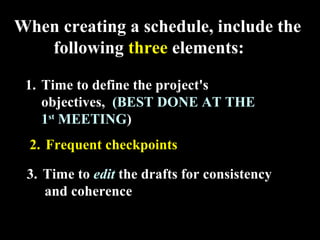
When creating a schedule, include the 
following three elements: 
1. Time to define the project's 
objectives, (BEST DONE AT THE 
1st MEETING) 
2. Frequent checkpoints 
3. Time to edit the drafts for consistency 
and coherence 
Week 3, Lesson 1 Working in a Team 15
Guideline 4 – 
Share Leadership Responsibilities 
Week 3, Lesson 1 Working in a Team 16
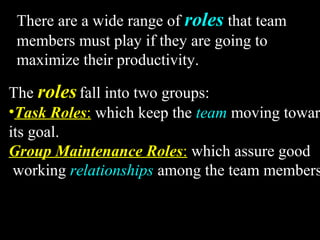
There are a wide range of roles that team 
members must play if they are going to 
maximize their productivity. 
The roles fall into two groups: 
•Task Roles: which keep the team moving toward 
its goal. 
Group Maintenance Roles: which assure good 
working relationships among the team members. 
Week 3, Lesson 1 Working in a Team 17
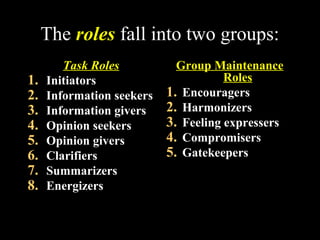
The roles fall into two groups: 
Task Roles 
1. Initiators 
2. Information seekers 
3. Information givers 
4. Opinion seekers 
5. Opinion givers 
6. Clarifiers 
7. Summarizers 
8. Energizers 
Group Maintenance 
Roles 
1. Encouragers 
2. Harmonizers 
3. Feeling expressers 
4. Compromisers 
5. Gatekeepers 
Week 3, Lesson 1 Working in a Team 18
Task Roles: 
1. Initiators: offer new ideas, propose new 
solutions and restate old issues in a novel 
way. They provide creativity and direction as 
the team ponders its subject matter and the 
strategies for communicating about it. 
2. Information seekers: request clarification 
and additional information. They ensure that 
the team members understand all relevant 
factors - including their subject matter, 
readers and communication alternatives. 
Week 3, Lesson 1 Working in a Team 19
Task Roles: 
3. Information givers furnish the facts 
needed by the team, sometimes on 
their own initiative, sometimes in 
response to information seekers. 
4. Opinion seekers: ask others to 
express their judgments, values and 
opinions. 
Week 3, Lesson 1 Working in a Team 20
Task Roles: 
5. Opinion givers:share their views 
about what the team's decisions 
should be. 
6. Clarifiers: clear up misunderstanding 
or confusion by explaining points or 
providing additional information. 
Week 3, Lesson 1 Working in a Team 21
Task Roles: 
7. Summarizers: consolidate the team's 
deliberations by stating concisely what 
has been said or decided. They help 
team members see what has been 
accomplished so the team can proceed 
to the next task 
8. Energizers: motivate the team to take 
action, often by communicating a sense 
of enthusiasm or by emphasizing its 
commitment to its goals. 
Week 3, Lesson 1 Working in a Team 22
Group Maintenance Roles: 
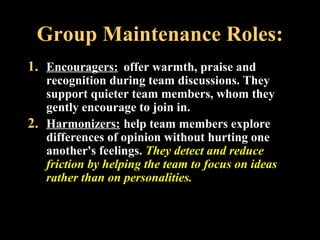
1. Encouragers: offer warmth, praise and 
recognition during team discussions. They 
support quieter team members, whom they 
gently encourage to join in. 
2. Harmonizers: help team members explore 
differences of opinion without hurting one 
another's feelings. They detect and reduce 
friction by helping the team to focus on ideas 
rather than on personalities. 
Week 3, Lesson 1 Working in a Team 23
Group Maintenance Roles: 
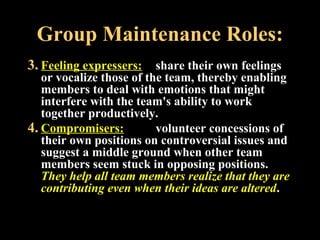
3. Feeling expressers: share their own feelings 
or vocalize those of the team, thereby enabling 
members to deal with emotions that might 
interfere with the team's ability to work 
together productively. 
4. Compromisers: volunteer concessions of 
their own positions on controversial issues and 
suggest a middle ground when other team 
members seem stuck in opposing positions. 
They help all team members realize that they are 
contributing even when their ideas are altered. 
Week 3, Lesson 1 Working in a Team 24
Group Maintenance Roles: 
5. Gatekeepers: encourage all team 
members to participate, and they 
create opportunities for silent 
members to speak. 
Week 3, Lesson 1 Working in a Team 25
Guideline 5 – 
Make Meetings Efficient 
Week 3, Lesson 1 Working in a Team 26
Nothing is more precious to a communication 
team than TIME. Because it's usually so hard 
to find moments when ALL members are free, 
every one of these moments should be used well. 
Here are four strategies for making 
meetings productive: 
1. Prepare an agenda 
2. Bring the discussion to a close 
3. Sum up 
4. Set goals for next meeting 
Week 3, Lesson 1 Working in a Team 27
Guideline 6 – 
Encourage Debate and Diversity of Ideas 
Week 3, Lesson 1 Working in a Team 28
To promote healthy debate and the consideration 
of a rich diversity of ideas, you and your 
teammates can use these four strategies: 
1. Invite everyone to speak 
2. Listen with interest and respect 
3. Be considerate when discussing drafts 
4. Treat drafts as a team property, not individual 
property. 
Week 3, Lesson 1 Working in a Team 29
Guideline 7 – 
Be Sensitive to Possible Cultural and Gender 
Differences in Team Interactions 
Week 3, Lesson 1 Working in a Team 30
Different people approach team projects in 
different ways. The team's goal should be to 
interact in ways that allow each member to 
make his or her maximum contribution. 
To succeed in encouraging maximum 
participation by all team members, each 
teammate must be sensitive and responsive to 
the individual styles of everyone else. 
Week 3, Lesson 1 Working in a Team 31
Gender and Collaboration 
Research shows that many men state their ideas 
and opinions as assertions of fact. When exploring 
ideas, they may argue over them in a competitive 
manner. 
In contrast, many women offer their ideas 
tentatively, introducing them with statements such 
as "I think" or "I'm not sure about this, but …..". 
If there is disagreement, they may support part or 
all of the other person's ideas and seek to reach 
consensus . 
Week 3, Lesson 1 Working in a Team 32
Culture and Collaboration 
People from non-Western cultures may behave 
differently than people from Western cultures 
when working on writing teams: 
1. May not say 'no' even when 'no' is really what 
they mean. 
In some cultures, people do not say 'no' even in 
response to direct questions. Instead, they indicate 
no' only indirectly in order to save face for himself 
or herself and for the other person. 
Week 3, Lesson 1 Working in a Team 33
Culture and Collaboration 
2. May avoid making alternative 
suggestions. 
To avoid embarrassing others, people in 
some cultures avoid saying anything that 
might be interpreted as disagreement. 
Week 3, Lesson 1 Working in a Team 34
Culture and Collaboration 
3. May be reluctant to admit a lack of 
understanding or ask for clarification. 
In some cultures, people avoid asking questions 
Because it would be rude to imply that the speaker 
doesn't know what he or she is talking about or 
hasn't succeeded in explaining things clearly. 
Week 3, Lesson 1 Working in a Team 35
Culture and Collaboration 
4. May avoid debating ideas. 
Whereas members of work teams in some 
Western cultures debate ideas freely as a 
way of exploring ideas, people from certain 
other cultures regard such behavior as 
disloyal and unacceptable. 
Week 3, Lesson 1 Working in a Team 36
Guideline 8 – 
Use Computer Support for Collaboration 
When It's Available 
Week 3, Lesson 1 Working in a Team 37
Use Computer Support for 
Collaboration 
A fascinating variety of computer programs offer 
support for teams that are creating communications 
together. Here are some examples: 
1. E-mail allows teams members to share ideas 
and drafts without meeting 
2. Some software allows all team members to 
participate simultaneously in an online discussion 
even though each person is in a different location. 
Week 3, Lesson 1 Working in a Team 38
Use Computer Support for 
Collaboration 
3. Word-processing programs allow all team 
members to work on a single draft. 
4. Some corporations use teleconferencing 
rooms so team members in locations 
distant from one another can converse 
even as they use computer software to 
draft or edit a document together. 
Week 3, Lesson 1 Working in a Team 39
CONCLUSION 
Team writing is very common in the workplace. 
Although all the guidelines presented in this 
course apply to team writing as well as to 
individual writing, team projects require some 
additional skills. 
The guidelines just presented will help you 
Participate in team efforts in which the team 
members work together productively and enjoy 
their mutual effort. 
Week 3, Lesson 1 Working in a Team 40

Technical Communication

  • 1.
    WEEK NO.3 Lesson1 WORKING ON A TEAM PROJECT[1] Special Challenges Guideline 1 – Defining Objectives Guideline 2 – Involve the Whole Team Guideline 3 – Make a Project Schedule Guideline 4 – Share Leadership Responsibilities Guideline 5 – Make Meetings Efficient Guideline 6 – Encourage Debate & Diversity of Ideas Guideline 7 – Be Sensitive to Cultural & Gender Differences Guideline 8 – Use Computer Support when Available [1] Summarized from the textbook “Technical Communication – A Reader-Centred Approach”, 4th Edition by Paul V. Anderson, McGraw-Hill, Chapter 17 Week 3, Lesson 1 Working in a Team 1
  • 2.
    SPECIAL CHALLENGES OFTEAM PROJECTS Communicating as a team (collaboratively) involves exactly the same process as communicating independently – you need to : •Define your objectives, • Plan a strategy for meeting those objectives, •Then draft, evaluate, and revise the communication in which you carry out that strategy. Week 3, Lesson 1 Working in a Team 2
  • 3.
    However, when youjoin with others to form a team, you and your teammates have some additional tasks to perform. You have to: • Discuss and reach a unanimous conclusion • Divide the tasks • Prepare drafts of each section • Work together and independently • Coordinate the group efforts Etc. Week 3, Lesson 1 Working in a Team 3
  • 4.
    The guidelines presentedwill help you and your teammates work productively together on either written or oral communications. The guidelines form the basis of our today’s subject: Week 3, Lesson 1 Working in a Team 4
  • 5.
    Guideline 1 Beginby: Creating a Consensus Concerning the Communication's Objectives Week 3, Lesson 1 Working in a Team 5
  • 6.
    The first activityof the communication process - ddeeffiinniinngg oobbjjeeccttiivveess - is even more important when you are participating on a team than when you are preparing a communication individually. Week 3, Lesson 1 Working in a Team 6
  • 7.
    Defining Objectives asa Team 1.Take time to explore the diverse views of all team members regarding your communication's objectives. 2.Keep talking until consensus is reached. 3.Discuss communication strategies the team might use to achieve its objectives. Such discussion may reveal unexpected differences among team members that can then be addressed openly. 4.Remain open to new insights about your readers and purposes as your work progresses. But remember that individual team members must share these insights so all can agree on the modified definition of objectives. Week 3, Lesson 1 Working in a Team 7
  • 8.
    Guideline 2 – Involve the Whole Team in Planning Week 3, Lesson 1 Working in a Team 8
  • 9.
    One major advantageof planning as a team is identical with a major advantage of defining objectives as a team: many minds working together will almost always generate better results than could one person working alone. Week 3, Lesson 1 Working in a Team 9
  • 10.
    • Another majoradvantage stems from the way teams often organize their work. • On team projects, teams often divide research, drafting, and other tasks among their members. When this is done, each team member must be clear about what the team wants him or her to produce – otherwise a lot of time can be wasted on work NOT wanted by the team. Week 3, Lesson 1 Working in a Team 10
  • 11.
    Here are foursuggestions for avoiding problems when working in a team: 1. Discuss plans in detail. 2. Write an outline. 3. Create a storyboard. 4. Use a style guide. Week 3, Lesson 1 Working in a Team 11
  • 12.
    Guideline 3 – Make a Project Schedule Week 3, Lesson 1 Working in a Team 12
  • 13.
    Schedules are helpfulfor almost any team project that requires more than one meeting, but especially for projects in which individual team members working independently will perform some of the tasks. Week 3, Lesson 1 Working in a Team 13
  • 14.
    The schedule letseach person know exactly when his or her work must be completed, and it enables every team member to see adverse consequences of missing any deadline along the way. Week 3, Lesson 1 Working in a Team 14
  • 15.
    When creating aschedule, include the following three elements: 1. Time to define the project's objectives, (BEST DONE AT THE 1st MEETING) 2. Frequent checkpoints 3. Time to edit the drafts for consistency and coherence Week 3, Lesson 1 Working in a Team 15
  • 16.
    Guideline 4 – Share Leadership Responsibilities Week 3, Lesson 1 Working in a Team 16
  • 17.
    There are awide range of roles that team members must play if they are going to maximize their productivity. The roles fall into two groups: •Task Roles: which keep the team moving toward its goal. Group Maintenance Roles: which assure good working relationships among the team members. Week 3, Lesson 1 Working in a Team 17
  • 18.
    The roles fallinto two groups: Task Roles 1. Initiators 2. Information seekers 3. Information givers 4. Opinion seekers 5. Opinion givers 6. Clarifiers 7. Summarizers 8. Energizers Group Maintenance Roles 1. Encouragers 2. Harmonizers 3. Feeling expressers 4. Compromisers 5. Gatekeepers Week 3, Lesson 1 Working in a Team 18
  • 19.
    Task Roles: 1.Initiators: offer new ideas, propose new solutions and restate old issues in a novel way. They provide creativity and direction as the team ponders its subject matter and the strategies for communicating about it. 2. Information seekers: request clarification and additional information. They ensure that the team members understand all relevant factors - including their subject matter, readers and communication alternatives. Week 3, Lesson 1 Working in a Team 19
  • 20.
    Task Roles: 3.Information givers furnish the facts needed by the team, sometimes on their own initiative, sometimes in response to information seekers. 4. Opinion seekers: ask others to express their judgments, values and opinions. Week 3, Lesson 1 Working in a Team 20
  • 21.
    Task Roles: 5.Opinion givers:share their views about what the team's decisions should be. 6. Clarifiers: clear up misunderstanding or confusion by explaining points or providing additional information. Week 3, Lesson 1 Working in a Team 21
  • 22.
    Task Roles: 7.Summarizers: consolidate the team's deliberations by stating concisely what has been said or decided. They help team members see what has been accomplished so the team can proceed to the next task 8. Energizers: motivate the team to take action, often by communicating a sense of enthusiasm or by emphasizing its commitment to its goals. Week 3, Lesson 1 Working in a Team 22
  • 23.
    Group Maintenance Roles: 1. Encouragers: offer warmth, praise and recognition during team discussions. They support quieter team members, whom they gently encourage to join in. 2. Harmonizers: help team members explore differences of opinion without hurting one another's feelings. They detect and reduce friction by helping the team to focus on ideas rather than on personalities. Week 3, Lesson 1 Working in a Team 23
  • 24.
    Group Maintenance Roles: 3. Feeling expressers: share their own feelings or vocalize those of the team, thereby enabling members to deal with emotions that might interfere with the team's ability to work together productively. 4. Compromisers: volunteer concessions of their own positions on controversial issues and suggest a middle ground when other team members seem stuck in opposing positions. They help all team members realize that they are contributing even when their ideas are altered. Week 3, Lesson 1 Working in a Team 24
  • 25.
    Group Maintenance Roles: 5. Gatekeepers: encourage all team members to participate, and they create opportunities for silent members to speak. Week 3, Lesson 1 Working in a Team 25
  • 26.
    Guideline 5 – Make Meetings Efficient Week 3, Lesson 1 Working in a Team 26
  • 27.
    Nothing is moreprecious to a communication team than TIME. Because it's usually so hard to find moments when ALL members are free, every one of these moments should be used well. Here are four strategies for making meetings productive: 1. Prepare an agenda 2. Bring the discussion to a close 3. Sum up 4. Set goals for next meeting Week 3, Lesson 1 Working in a Team 27
  • 28.
    Guideline 6 – Encourage Debate and Diversity of Ideas Week 3, Lesson 1 Working in a Team 28
  • 29.
    To promote healthydebate and the consideration of a rich diversity of ideas, you and your teammates can use these four strategies: 1. Invite everyone to speak 2. Listen with interest and respect 3. Be considerate when discussing drafts 4. Treat drafts as a team property, not individual property. Week 3, Lesson 1 Working in a Team 29
  • 30.
    Guideline 7 – Be Sensitive to Possible Cultural and Gender Differences in Team Interactions Week 3, Lesson 1 Working in a Team 30
  • 31.
    Different people approachteam projects in different ways. The team's goal should be to interact in ways that allow each member to make his or her maximum contribution. To succeed in encouraging maximum participation by all team members, each teammate must be sensitive and responsive to the individual styles of everyone else. Week 3, Lesson 1 Working in a Team 31
  • 32.
    Gender and Collaboration Research shows that many men state their ideas and opinions as assertions of fact. When exploring ideas, they may argue over them in a competitive manner. In contrast, many women offer their ideas tentatively, introducing them with statements such as "I think" or "I'm not sure about this, but …..". If there is disagreement, they may support part or all of the other person's ideas and seek to reach consensus . Week 3, Lesson 1 Working in a Team 32
  • 33.
    Culture and Collaboration People from non-Western cultures may behave differently than people from Western cultures when working on writing teams: 1. May not say 'no' even when 'no' is really what they mean. In some cultures, people do not say 'no' even in response to direct questions. Instead, they indicate no' only indirectly in order to save face for himself or herself and for the other person. Week 3, Lesson 1 Working in a Team 33
  • 34.
    Culture and Collaboration 2. May avoid making alternative suggestions. To avoid embarrassing others, people in some cultures avoid saying anything that might be interpreted as disagreement. Week 3, Lesson 1 Working in a Team 34
  • 35.
    Culture and Collaboration 3. May be reluctant to admit a lack of understanding or ask for clarification. In some cultures, people avoid asking questions Because it would be rude to imply that the speaker doesn't know what he or she is talking about or hasn't succeeded in explaining things clearly. Week 3, Lesson 1 Working in a Team 35
  • 36.
    Culture and Collaboration 4. May avoid debating ideas. Whereas members of work teams in some Western cultures debate ideas freely as a way of exploring ideas, people from certain other cultures regard such behavior as disloyal and unacceptable. Week 3, Lesson 1 Working in a Team 36
  • 37.
    Guideline 8 – Use Computer Support for Collaboration When It's Available Week 3, Lesson 1 Working in a Team 37
  • 38.
    Use Computer Supportfor Collaboration A fascinating variety of computer programs offer support for teams that are creating communications together. Here are some examples: 1. E-mail allows teams members to share ideas and drafts without meeting 2. Some software allows all team members to participate simultaneously in an online discussion even though each person is in a different location. Week 3, Lesson 1 Working in a Team 38
  • 39.
    Use Computer Supportfor Collaboration 3. Word-processing programs allow all team members to work on a single draft. 4. Some corporations use teleconferencing rooms so team members in locations distant from one another can converse even as they use computer software to draft or edit a document together. Week 3, Lesson 1 Working in a Team 39
  • 40.
    CONCLUSION Team writingis very common in the workplace. Although all the guidelines presented in this course apply to team writing as well as to individual writing, team projects require some additional skills. The guidelines just presented will help you Participate in team efforts in which the team members work together productively and enjoy their mutual effort. Week 3, Lesson 1 Working in a Team 40