Week 14, Lesson 1 Sound 1 
Sound 
Week 14, Lesson 1 
• 
The Origin of Sound 
• 
Sound Waves in Air 
• 
Equations for Sound Speed 
• 
Speed of Sound in Air 
• 
Intensity, Loudness 
• 
Beats, Doppler Effect 
References/Reading Preparation: 
Schaum’s Outline Ch. 23 
Principles of Physics by Beuche – Ch.15
Week 14, Lesson 1 Sound 2 
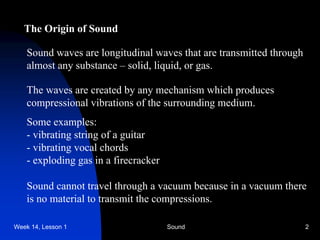
The Origin of Sound 
Sound waves are longitudinal waves that are transmitted through 
almost any substance – solid, liquid, or gas. 
The waves are created by any mechanism which produces 
compressional vibrations of the surrounding medium. 
Some examples: 
- 
vibrating string of a guitar 
- 
vibrating vocal chords 
- 
exploding gas in a firecracker 
Sound cannot travel through a vacuum because in a vacuum there 
is no material to transmit the compressions.
Week 14, Lesson 1 Sound 3 
We are most often concerned with sound waves in air since that is 
the basis of our sense of hearing. 
However, sound travels faster and with less energy loss in liquids 
and solids than in air. 
Although we usually refer to sound as those waves we can hear, 
sound can have frequencies far above and far below those to which 
our ears are sensitive.
Week 14, Lesson 1 Sound 4 
Sound Waves in Air 
Let us now consider the action of a loudspeaker generating a simple 
sound. 
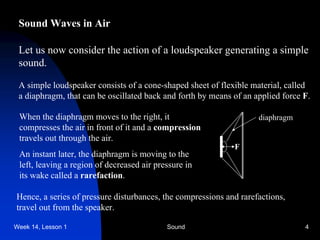
A simple loudspeaker consists of a cone-shaped sheet of flexible material, called 
a diaphragm, that can be oscillated back and forth by means of an applied force F. 
diaphragm 
F 
When the diaphragm moves to the right, it 
compresses the air in front of it and a compression 
travels out through the air. 
An instant later, the diaphragm is moving to the 
left, leaving a region of decreased air pressure in 
its wake called a rarefaction. 
Hence, a series of pressure disturbances, the compressions and rarefactions, 
travel out from the speaker.
Week 14, Lesson 1 Sound 5 
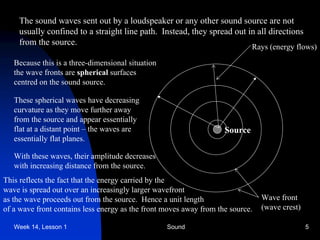
The sound waves sent out by a loudspeaker or any other sound source are not 
usually confined to a straight line path. Instead, they spread out in all directions 
from the source. 
Source 
Rays (energy flows) 
Wave front 
(wave crest) 
Because this is a three-dimensional situation 
the wave fronts are spherical surfaces 
centred on the sound source. 
These spherical waves have decreasing 
curvature as they move further away 
from the source and appear essentially 
flat at a distant point – the waves are 
essentially flat planes. 
With these waves, their amplitude decreases 
with increasing distance from the source. 
This reflects the fact that the energy carried by the 
wave is spread out over an increasingly larger wavefront 
as the wave proceeds out from the source. Hence a unit length 
of a wave front contains less energy as the front moves away from the source.
Week 14, Lesson 1 Sound 6 
Hearing 
When the compressions and rarefactions of the waves strike the 
eardrum, they result in the sensation of sound – provided the 
frequency of the waves is between about 20 Hz and 20,000 Hz. 
Waves with frequencies above 20 kHz are called ultrasonic waves. 
Waves with frequencies below 20Hz are called infrasonic waves.
Week 14, Lesson 1 Sound 7 
The Speed of Sound 
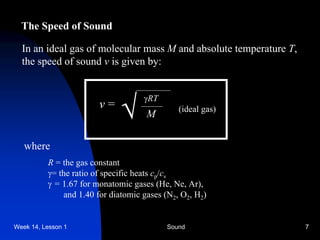
In an ideal gas of molecular mass Mand absolute temperature T, 
the speed of sound v is given by: 
v = 
 
RT 
M 
(ideal gas) 
where 
R = the gas constant 
 
= the ratio of specific heats cp /cv 
 
= 1.67 for monatomic gases (He, Ne, Ar), 
and 1.40 for diatomic gases (N2 , O2 , H2 )
Week 14, Lesson 1 Sound 8 
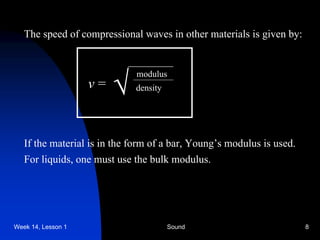
The speed of compressional waves in other materials is given by: 
v = 
 
modulus 
density 
If the material is in the form of a bar, Young’s modulus is used. 
For liquids, one must use the bulk modulus.
Week 14, Lesson 1 Sound 9 
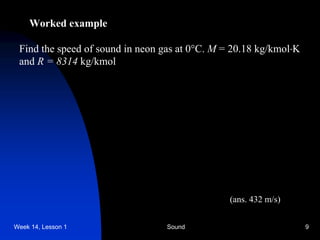
Worked example 
Find the speed of sound in neon gas at 0C. M= 20.18 kg/kmolK 
and R = 8314 kg/kmol 
(ans. 432 m/s)
Week 14, Lesson 1 Sound 10 
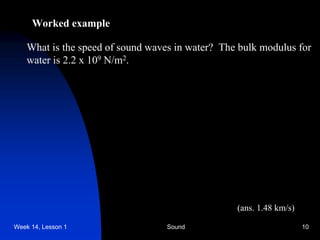
Worked example 
What is the speed of sound waves in water? The bulk modulus for 
water is 2.2 x 10⁹ N/m2. 
(ans. 1.48 km/s)
Week 14, Lesson 1 Sound 11 
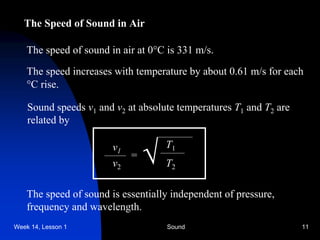
The Speed of Sound in Air 
The speed of sound in air at 0C is 331 m/s. 
The speed increases with temperature by about 0.61 m/s for each 
C rise. 
Sound speeds v1 and v2 at absolute temperatures T1 and T2 are 
related by 
v1 
v2 
= 
 
T1 
T2 
The speed of sound is essentially independent of pressure, 
frequency and wavelength.
Week 14, Lesson 1 Sound 12 
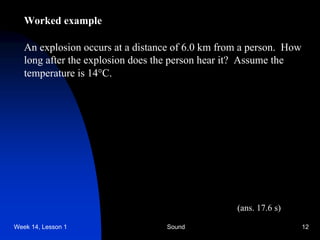
Worked example 
An explosion occurs at a distance of 6.0 km from a person. How 
long after the explosion does the person hear it? Assume the 
temperature is 14C. 
(ans. 17.6 s)
Week 14, Lesson 1 Sound 13 
Intensity and Intensity Level 
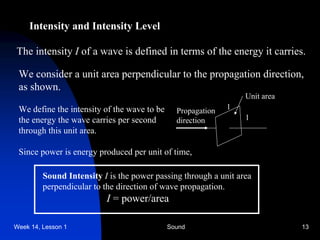
The intensity I of a wave is defined in terms of the energy it carries. 
We consider a unit area perpendicular to the propagation direction, 
as shown. 
Unit area 
1 
1 
Propagation 
direction 
We define the intensity of the wave to be 
the energy the wave carries per second 
through this unit area. 
Since power is energy produced per unit of time, 
Sound Intensity I is the power passing through a unit area 
perpendicular to the direction of wave propagation. 
I = power/area
Week 14, Lesson 1 Sound 14 
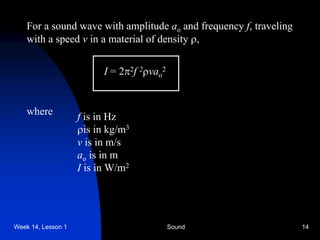
For a sound wave with amplitude ao and frequency f, traveling 
with a speed v in a material of density , 
I =22f 2vao2 
where 
f is in Hz 
 
is in kg/m3 
v is in m/s 
ao is in m 
I is in W/m2
Week 14, Lesson 1 Sound 15 
Loudness 
Loudness is a measure of the human perception of sound. 
Although a sound of high intensity is perceived as louder than a 
wave with lower intensity, the relation is far from being linear. 
The sensation of sound is roughly proportional to the logarithm 
of the sound intensity. 
Intensity level (or sound level) is defined by an arbitrary scale 
that corresponds roughly to the sensation of loudness. 
The zero on this scale is taken at the sound-wave intensity 
Io = 1 x 10-12 W/m2, which corresponds roughly to the weakest 
audible sound.
Week 14, Lesson 1 Sound 16 
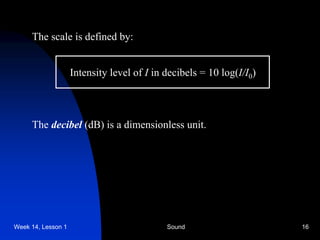
The scale is defined by: 
Intensity level of I in decibels = 10 log(I/I0 ) 
The decibel (dB) is a dimensionless unit.
Week 14, Lesson 1 Sound 17 
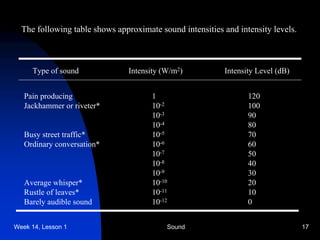
The following table shows approximate sound intensities and intensity levels. 
Type of sound Intensity (W/m2) Intensity Level (dB) 
Pain producing 1 120 
Jackhammer or riveter* 10-2 100 
10-3 90 
10-4 80 
Busy street traffic* 10-5 70 
Ordinary conversation* 10-6 60 
10-7 50 
10-8 40 
10-9 30 
Average whisper* 10-10 20 
Rustle of leaves* 10-11 10 
Barely audible sound 10-12 0
Week 14, Lesson 1 Sound 18 
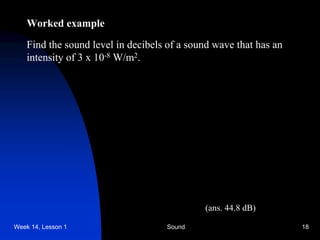
Worked example 
Find the sound level in decibels of a sound wave that has an 
intensity of 3 x 10⁻⁸ W/m2. 
(ans. 44.8 dB)
Week 14, Lesson 1 Sound 19 
Beats 
The alternations of maximum and minimum sound intensity 
produced by the superposition of two sound waves of slightly 
different frequencies are called beats. 
The number of beats per second is equal to the difference between 
the frequencies of the two sound waves that are combined.
Week 14, Lesson 1 Sound 20 
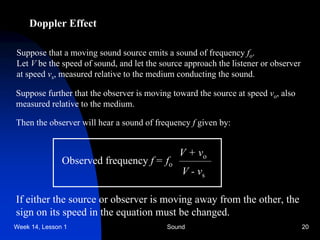
Doppler Effect 
Suppose that a moving sound source emits a sound of frequency fo . 
Let V be the speed of sound, and let the source approach the listener or observer 
at speed vs , measured relative to the medium conducting the sound. 
Suppose further that the observer is moving toward the source at speed vo , also 
measured relative to the medium. 
Then the observer will hear a sound of frequency f given by: 
Observed frequency f = 
fo 
V + vo 
V - vs 
If either the source or observer is moving away from the other, the 
sign on its speed in the equation must be changed.
Week 14, Lesson 1 Sound 21 
Doppler Effect (cont’d) 
When the source and observer are approaching each other, more 
wave crests strike the ear each second than when both are at rest. 
This causes the ear to perceive a higher frequency than that emitted 
by the source. 
When the two are receding, the opposite effect occurs – the 
frequency appears to be lowered.
Week 14, Lesson 1 Sound 22 
Worked example 
An automobile moving at 30 m/s is approaching a factory whistle 
that has a frequency of 500 Hz. If the speed of sound in air is 
340 m/s, what is the apparent frequency of the whistle as heard of 
by the driver? 
(ans. 544 Hz)
Week 14, Lesson 1 Sound 23 
Interference Effects 
Self-study – read the appropriate sections in the textbooks.

Physics 18

  • 1.
    Week 14, Lesson1 Sound 1 Sound Week 14, Lesson 1 • The Origin of Sound • Sound Waves in Air • Equations for Sound Speed • Speed of Sound in Air • Intensity, Loudness • Beats, Doppler Effect References/Reading Preparation: Schaum’s Outline Ch. 23 Principles of Physics by Beuche – Ch.15
  • 2.
    Week 14, Lesson1 Sound 2 The Origin of Sound Sound waves are longitudinal waves that are transmitted through almost any substance – solid, liquid, or gas. The waves are created by any mechanism which produces compressional vibrations of the surrounding medium. Some examples: - vibrating string of a guitar - vibrating vocal chords - exploding gas in a firecracker Sound cannot travel through a vacuum because in a vacuum there is no material to transmit the compressions.
  • 3.
    Week 14, Lesson1 Sound 3 We are most often concerned with sound waves in air since that is the basis of our sense of hearing. However, sound travels faster and with less energy loss in liquids and solids than in air. Although we usually refer to sound as those waves we can hear, sound can have frequencies far above and far below those to which our ears are sensitive.
  • 4.
    Week 14, Lesson1 Sound 4 Sound Waves in Air Let us now consider the action of a loudspeaker generating a simple sound. A simple loudspeaker consists of a cone-shaped sheet of flexible material, called a diaphragm, that can be oscillated back and forth by means of an applied force F. diaphragm F When the diaphragm moves to the right, it compresses the air in front of it and a compression travels out through the air. An instant later, the diaphragm is moving to the left, leaving a region of decreased air pressure in its wake called a rarefaction. Hence, a series of pressure disturbances, the compressions and rarefactions, travel out from the speaker.
  • 5.
    Week 14, Lesson1 Sound 5 The sound waves sent out by a loudspeaker or any other sound source are not usually confined to a straight line path. Instead, they spread out in all directions from the source. Source Rays (energy flows) Wave front (wave crest) Because this is a three-dimensional situation the wave fronts are spherical surfaces centred on the sound source. These spherical waves have decreasing curvature as they move further away from the source and appear essentially flat at a distant point – the waves are essentially flat planes. With these waves, their amplitude decreases with increasing distance from the source. This reflects the fact that the energy carried by the wave is spread out over an increasingly larger wavefront as the wave proceeds out from the source. Hence a unit length of a wave front contains less energy as the front moves away from the source.
  • 6.
    Week 14, Lesson1 Sound 6 Hearing When the compressions and rarefactions of the waves strike the eardrum, they result in the sensation of sound – provided the frequency of the waves is between about 20 Hz and 20,000 Hz. Waves with frequencies above 20 kHz are called ultrasonic waves. Waves with frequencies below 20Hz are called infrasonic waves.
  • 7.
    Week 14, Lesson1 Sound 7 The Speed of Sound In an ideal gas of molecular mass Mand absolute temperature T, the speed of sound v is given by: v =  RT M (ideal gas) where R = the gas constant  = the ratio of specific heats cp /cv  = 1.67 for monatomic gases (He, Ne, Ar), and 1.40 for diatomic gases (N2 , O2 , H2 )
  • 8.
    Week 14, Lesson1 Sound 8 The speed of compressional waves in other materials is given by: v =  modulus density If the material is in the form of a bar, Young’s modulus is used. For liquids, one must use the bulk modulus.
  • 9.
    Week 14, Lesson1 Sound 9 Worked example Find the speed of sound in neon gas at 0C. M= 20.18 kg/kmolK and R = 8314 kg/kmol (ans. 432 m/s)
  • 10.
    Week 14, Lesson1 Sound 10 Worked example What is the speed of sound waves in water? The bulk modulus for water is 2.2 x 10⁹ N/m2. (ans. 1.48 km/s)
  • 11.
    Week 14, Lesson1 Sound 11 The Speed of Sound in Air The speed of sound in air at 0C is 331 m/s. The speed increases with temperature by about 0.61 m/s for each C rise. Sound speeds v1 and v2 at absolute temperatures T1 and T2 are related by v1 v2 =  T1 T2 The speed of sound is essentially independent of pressure, frequency and wavelength.
  • 12.
    Week 14, Lesson1 Sound 12 Worked example An explosion occurs at a distance of 6.0 km from a person. How long after the explosion does the person hear it? Assume the temperature is 14C. (ans. 17.6 s)
  • 13.
    Week 14, Lesson1 Sound 13 Intensity and Intensity Level The intensity I of a wave is defined in terms of the energy it carries. We consider a unit area perpendicular to the propagation direction, as shown. Unit area 1 1 Propagation direction We define the intensity of the wave to be the energy the wave carries per second through this unit area. Since power is energy produced per unit of time, Sound Intensity I is the power passing through a unit area perpendicular to the direction of wave propagation. I = power/area
  • 14.
    Week 14, Lesson1 Sound 14 For a sound wave with amplitude ao and frequency f, traveling with a speed v in a material of density , I =22f 2vao2 where f is in Hz  is in kg/m3 v is in m/s ao is in m I is in W/m2
  • 15.
    Week 14, Lesson1 Sound 15 Loudness Loudness is a measure of the human perception of sound. Although a sound of high intensity is perceived as louder than a wave with lower intensity, the relation is far from being linear. The sensation of sound is roughly proportional to the logarithm of the sound intensity. Intensity level (or sound level) is defined by an arbitrary scale that corresponds roughly to the sensation of loudness. The zero on this scale is taken at the sound-wave intensity Io = 1 x 10-12 W/m2, which corresponds roughly to the weakest audible sound.
  • 16.
    Week 14, Lesson1 Sound 16 The scale is defined by: Intensity level of I in decibels = 10 log(I/I0 ) The decibel (dB) is a dimensionless unit.
  • 17.
    Week 14, Lesson1 Sound 17 The following table shows approximate sound intensities and intensity levels. Type of sound Intensity (W/m2) Intensity Level (dB) Pain producing 1 120 Jackhammer or riveter* 10-2 100 10-3 90 10-4 80 Busy street traffic* 10-5 70 Ordinary conversation* 10-6 60 10-7 50 10-8 40 10-9 30 Average whisper* 10-10 20 Rustle of leaves* 10-11 10 Barely audible sound 10-12 0
  • 18.
    Week 14, Lesson1 Sound 18 Worked example Find the sound level in decibels of a sound wave that has an intensity of 3 x 10⁻⁸ W/m2. (ans. 44.8 dB)
  • 19.
    Week 14, Lesson1 Sound 19 Beats The alternations of maximum and minimum sound intensity produced by the superposition of two sound waves of slightly different frequencies are called beats. The number of beats per second is equal to the difference between the frequencies of the two sound waves that are combined.
  • 20.
    Week 14, Lesson1 Sound 20 Doppler Effect Suppose that a moving sound source emits a sound of frequency fo . Let V be the speed of sound, and let the source approach the listener or observer at speed vs , measured relative to the medium conducting the sound. Suppose further that the observer is moving toward the source at speed vo , also measured relative to the medium. Then the observer will hear a sound of frequency f given by: Observed frequency f = fo V + vo V - vs If either the source or observer is moving away from the other, the sign on its speed in the equation must be changed.
  • 21.
    Week 14, Lesson1 Sound 21 Doppler Effect (cont’d) When the source and observer are approaching each other, more wave crests strike the ear each second than when both are at rest. This causes the ear to perceive a higher frequency than that emitted by the source. When the two are receding, the opposite effect occurs – the frequency appears to be lowered.
  • 22.
    Week 14, Lesson1 Sound 22 Worked example An automobile moving at 30 m/s is approaching a factory whistle that has a frequency of 500 Hz. If the speed of sound in air is 340 m/s, what is the apparent frequency of the whistle as heard of by the driver? (ans. 544 Hz)
  • 23.
    Week 14, Lesson1 Sound 23 Interference Effects Self-study – read the appropriate sections in the textbooks.