1 
7. Drill Bits 
Habiburrohman abdullah
2 
Drill Bits 
• Types and Codes 
• Dull Grading 
• Economic and Optimization
3 
Bit Selection Guidelines 
• During the planning stage, the drilling engineer 
makes a thorough review of offset well data and 
record bit performance and bit grading 
characteristics in formation comparable to the well 
be designed. 
• Data required for the correct bit selection include the 
following: 
- Prognosed lithology column with detailed 
description of each formation. 
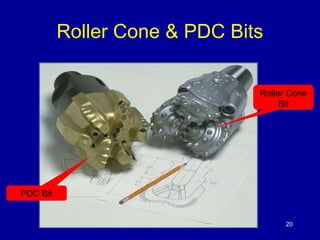
- Drilling fluid details. 
- Well profile
4 
Type of Drillbits 
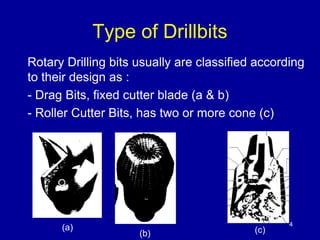
Rotary Drilling bits usually are classified according 
to their design as : 
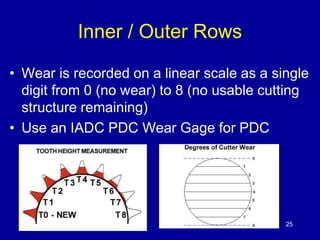
- Drag Bits, fixed cutter blade (a & b) 
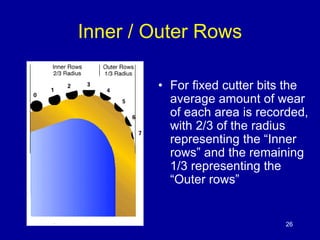
- Roller Cutter Bits, has two or more cone (c) 
(a) 
(b) (c)
Type of Bits – Roller Cone Bits 
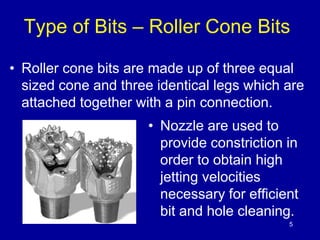
• Roller cone bits are made up of three equal 
sized cone and three identical legs which are 
attached together with a pin connection. 
• Nozzle are used to 
provide constriction in 
order to obtain high 
jetting velocities 
necessary for efficient 
bit and hole cleaning. 
5
Type of Bits – Roller Cone Bits 
6 
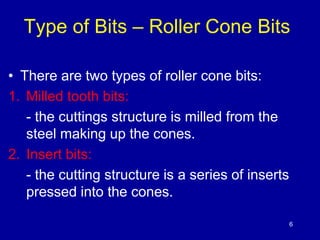
• There are two types of roller cone bits: 
1. Milled tooth bits: 
- the cuttings structure is milled from the 
steel making up the cones. 
2. Insert bits: 
- the cutting structure is a series of inserts 
pressed into the cones.
Design Factors - Roller Cone Bits 
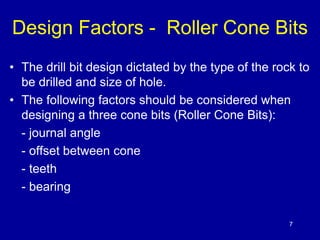
• The drill bit design dictated by the type of the rock to 
7 
be drilled and size of hole. 
• The following factors should be considered when 
designing a three cone bits (Roller Cone Bits): 
- journal angle 
- offset between cone 
- teeth 
- bearing
8 
DESIGN FACTORS 
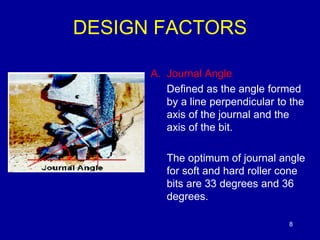
A. Journal Angle 
Defined as the angle formed 
by a line perpendicular to the 
axis of the journal and the 
axis of the bit. 
The optimum of journal angle 
for soft and hard roller cone 
bits are 33 degrees and 36 
degrees.
9 
Design Factors 
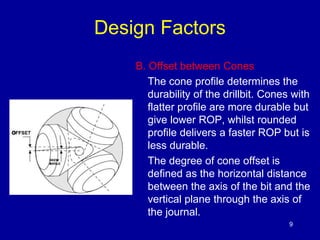
B. Offset between Cones 
The cone profile determines the 
durability of the drillbit. Cones with 
flatter profile are more durable but 
give lower ROP, whilst rounded 
profile delivers a faster ROP but is 
less durable. 
The degree of cone offset is 
defined as the horizontal distance 
between the axis of the bit and the 
vertical plane through the axis of 
the journal.
10 
Design Factors 
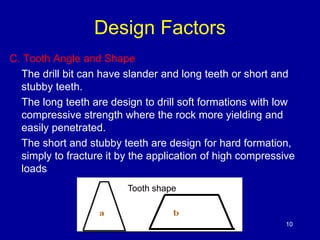
C. Tooth Angle and Shape 
The drill bit can have slander and long teeth or short and 
stubby teeth. 
The long teeth are design to drill soft formations with low 
compressive strength where the rock more yielding and 
easily penetrated. 
The short and stubby teeth are design for hard formation, 
simply to fracture it by the application of high compressive 
loads 
Tooth shape
11 
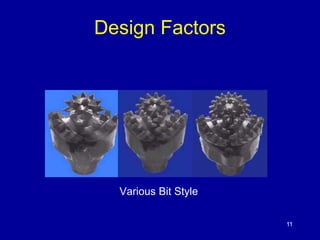
Design Factors 
Various Bit Style
12 
Design Factors 
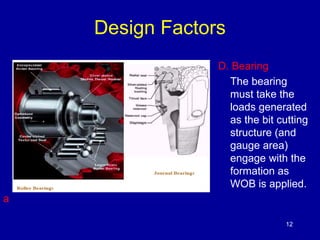
D. Bearing 
The bearing 
must take the 
loads generated 
as the bit cutting 
structure (and 
gauge area) 
engage with the 
formation as 
WOB is applied. 
a
13 
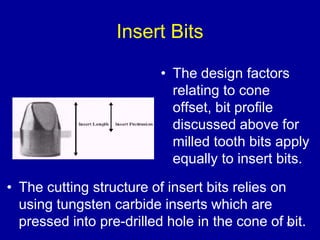
Insert Bits 
• The design factors 
relating to cone 
offset, bit profile 
discussed above for 
milled tooth bits apply 
equally to insert bits. 
• The cutting structure of insert bits relies on 
using tungsten carbide inserts which are 
pressed into pre-drilled hole in the cone of bit.
14 
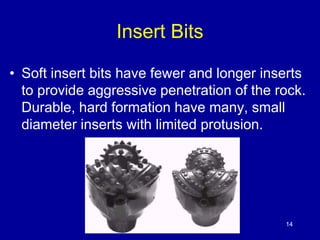
Insert Bits 
• Soft insert bits have fewer and longer inserts 
to provide aggressive penetration of the rock. 
Durable, hard formation have many, small 
diameter inserts with limited protusion.
15 
IADC Classification 
for Roller Cone Bits 
• IADC established a three code system for roller 
cone bits. 
• The first code define the series classification relating 
to the cutting structure (carries the number 1 to 8). 
• The second code related to the formation hardness 
subdivision within each group and carries the 
number 1 to 4. 
• The third code defines the mechanical features of 
the bit such as non-sealed or sealed bearing.
16 
Bit Classification 
A. The First Code 
- For milled tooth bits carries the number 1 to 3 (soft, 
medium and hard rock respectively). 
- For insert bits carries the number 4 to 8. 
B. The Second Code 
- The numbers signify formation hardness, from softest to 
hardest within each series. 
C. The Third Code 
- There are seven subdivisions within third code.
17 
Bit Classification 
Third code subdivision: 
- non-sealed roller bearing 
- roller bearing air cooled 
- sealed roller bearing 
- sealed roller bearing with gauge protection 
- sealed friction bearing 
- sealed friction bearing with gauge protection 
- special features – category now obselete
18 
Bit Classification 
Example : 
A Code of 1-2-1 indicates : 
Code 1: long, slim and widely spaced milled 
tooth bit 
Code 2: medium soft formation 
Code 3: non-sealed bearing
19 
PDC Bits 
• A Polycrystalline Diamond Compact (PDC) bit 
employs no moving part and is design to 
break the rock in shear and not in 
compression as is done with roller cone bits. 
• A PDC bit employs a large number of cutting 
elements, each called PDC cutter. The PDC 
cutter is made by bonding a layer of 
polycrystalline man-made diamond to a 
cemented
20 
Roller Cone & PDC Bits 
Roller Cone 
Bit 
PDC Bit
21 
Bit Grading 
• It is the procedure for describing the condition 
of a bit after it has drilled a section of rock 
and has been pulled out of the hole. 
• It is directed at 2 areas: 
– Determining the amount of physical wear 
– Analysis of the cause of the wear
Reasons for Having Accurate 
22 
Bit Grading 
• Will provide reliable info for future well 
planning (better bit selection) 
• Will improve drilling practices. It gives clues 
as to what is happening down hole 
• Provides the basis for determining optimum 
bit life 
• Will improve bit design
23 
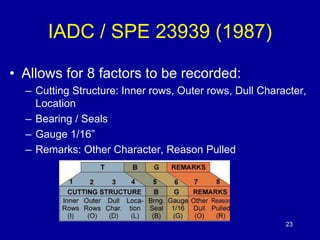
IADC / SPE 23939 (1987) 
• Allows for 8 factors to be recorded: 
– Cutting Structure: Inner rows, Outer rows, Dull Character, 
Location 
– Bearing / Seals 
– Gauge 1/16” 
– Remarks: Other Character, Reason Pulled
24 
Inner Rows 
• Used to report the conditions of the cutters 
not touching the borehole walls. 
Outer Rows 
• Used to report the conditions of the cutting 
elements that touch the borehole walls.
25 
Inner / Outer Rows 
• Wear is recorded on a linear scale as a single 
digit from 0 (no wear) to 8 (no usable cutting 
structure remaining) 
• Use an IADC PDC Wear Gage for PDC
26 
Inner / Outer Rows 
• For fixed cutter bits the 
average amount of wear 
of each area is recorded, 
with 2/3 of the radius 
representing the “Inner 
rows” and the remaining 
1/3 representing the 
“Outer rows”
27 
Dull Character 
• The code for the most prominent or primary 
characteristic of the dull bit should be entered 
here. Any secondary dull characteristics of 
the bit can be entered in “Other 
Characteristic”.
28 
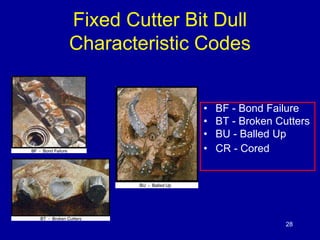
Fixed Cutter Bit Dull 
Characteristic Codes 
• BF - Bond Failure 
• BT - Broken Cutters 
• BU - Balled Up 
• CR - Cored
29 
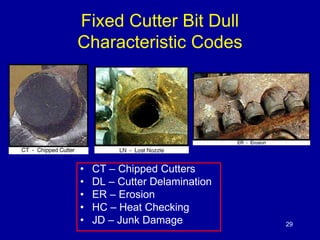
Fixed Cutter Bit Dull 
Characteristic Codes 
• CT – Chipped Cutters 
• DL – Cutter Delamination 
• ER – Erosion 
• HC – Heat Checking 
• JD – Junk Damage
30 
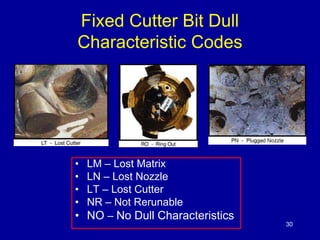
Fixed Cutter Bit Dull 
Characteristic Codes 
• LM – Lost Matrix 
• LN – Lost Nozzle 
• LT – Lost Cutter 
• NR – Not Rerunable 
• NO – No Dull Characteristics
31 
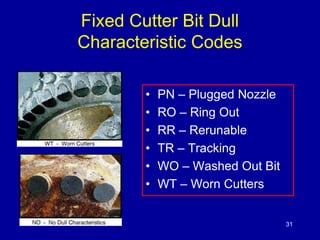
Fixed Cutter Bit Dull 
Characteristic Codes 
• PN – Plugged Nozzle 
• RO – Ring Out 
• RR – Rerunable 
• TR – Tracking 
• WO – Washed Out Bit 
• WT – Worn Cutters
32 
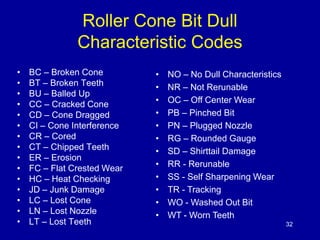
Roller Cone Bit Dull 
Characteristic Codes 
• BC – Broken Cone 
• BT – Broken Teeth 
• BU – Balled Up 
• CC – Cracked Cone 
• CD – Cone Dragged 
• CI – Cone Interference 
• CR – Cored 
• CT – Chipped Teeth 
• ER – Erosion 
• FC – Flat Crested Wear 
• HC – Heat Checking 
• JD – Junk Damage 
• LC – Lost Cone 
• LN – Lost Nozzle 
• LT – Lost Teeth 
• NO – No Dull Characteristics 
• NR – Not Rerunable 
• OC – Off Center Wear 
• PB – Pinched Bit 
• PN – Plugged Nozzle 
• RG – Rounded Gauge 
• SD – Shirttail Damage 
• RR - Rerunable 
• SS - Self Sharpening Wear 
• TR - Tracking 
• WO - Washed Out Bit 
• WT - Worn Teeth
33 
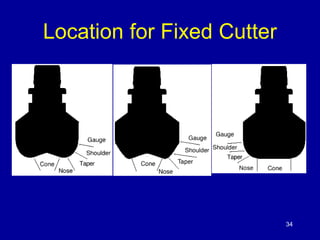
Location for Fixed Cutter 
• This is the location of the primary dull 
characteristic. 
• Use the codes: 
– C - cone 
– N - nose 
– T - taper 
– S - shoulder 
– G – gauge 
– A – All
34 
Location for Fixed Cutter
35 
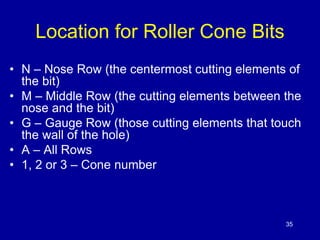
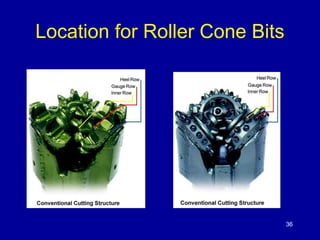
Location for Roller Cone Bits 
• N – Nose Row (the centermost cutting elements of 
the bit) 
• M – Middle Row (the cutting elements between the 
nose and the bit) 
• G – Gauge Row (those cutting elements that touch 
the wall of the hole) 
• A – All Rows 
• 1, 2 or 3 – Cone number
36 
Location for Roller Cone Bits
37 
Bearing / Seals 
• Indicates the condition of the bearing and 
seal assembly. 
• Fixed cutter bits will always be designated 
"X". 
• Equivalent to the B of the old TBG grading.
38 
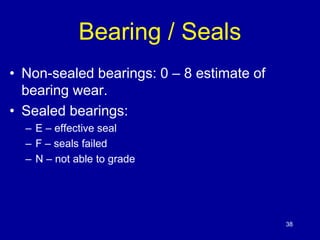
Bearing / Seals 
• Non-sealed bearings: 0 – 8 estimate of 
bearing wear. 
• Sealed bearings: 
– E – effective seal 
– F – seals failed 
– N – not able to grade
39 
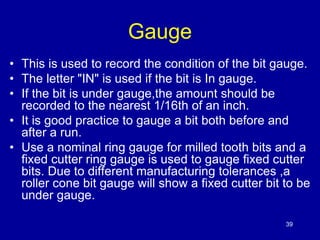
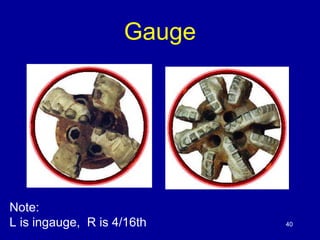
Gauge 
• This is used to record the condition of the bit gauge. 
• The letter "IN" is used if the bit is In gauge. 
• If the bit is under gauge,the amount should be 
recorded to the nearest 1/16th of an inch. 
• It is good practice to gauge a bit both before and 
after a run. 
• Use a nominal ring gauge for milled tooth bits and a 
fixed cutter ring gauge is used to gauge fixed cutter 
bits. Due to different manufacturing tolerances ,a 
roller cone bit gauge will show a fixed cutter bit to be 
under gauge.
40 
Gauge 
Note: 
L is ingauge, R is 4/16th
41 
Other Characteristic 
• This is used to record secondary bit wear. This 
could relate specifically to cutting structure wear or 
may identify wear to the bit as a whole, such as 
erosion. 
• This is in addition to the wear identified and 
recorded in Dull Characteristic and may highlight 
the "cause" of this wear. 
• "Other characteristics" can be used to record 
whether a bit is re-runable "RR" or not "NR". 
• The codes for both "primary" and "secondary" wear 
are the same.
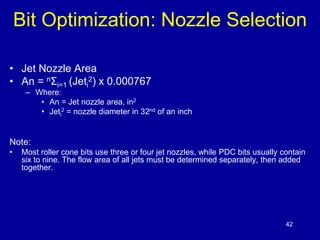
Bit Optimization: Nozzle Selection 
42 
• Jet Nozzle Area 
• An = nΣi=1 (Jeti 
2) x 0.000767 
– Where: 
• An = Jet nozzle area, in2 
• Jeti 
2 = nozzle diameter in 32nd of an inch 
Note: 
• Most roller cone bits use three or four jet nozzles, while PDC bits usually contain 
six to nine. The flow area of all jets must be determined separately, then added 
together.
43 
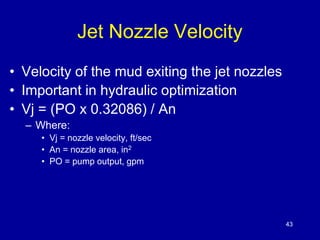
Jet Nozzle Velocity 
• Velocity of the mud exiting the jet nozzles 
• Important in hydraulic optimization 
• Vj = (PO x 0.32086) / An 
– Where: 
• Vj = nozzle velocity, ft/sec 
• An = nozzle area, in2 
• PO = pump output, gpm
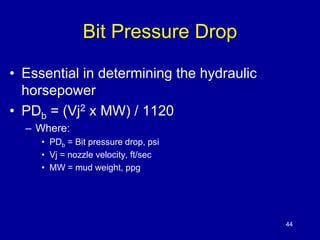
44 
Bit Pressure Drop 
• Essential in determining the hydraulic 
horsepower 
• PDb = (Vj2 x MW) / 1120 
– Where: 
• PDb = Bit pressure drop, psi 
• Vj = nozzle velocity, ft/sec 
• MW = mud weight, ppg
45 
Bottom Hole Cleaning 
• Proper bottom hole cleaning will: 
– Eliminate excessive regrinding of drilled solids 
– Result in improved ROPs 
• Bottom hole cleaning efficiency is achieved 
through proper bit jet size selection
46 
Bit Optimization 
• Through proper nozzle selection, optimization 
may be based on maximizing one of the 
following: 
– Jet Impact Force 
– Bit Hydraulic Horsepower 
• There is no agreement on which of these two 
parameters should be maximized
47 
Max Bit Hydraulic 
Horsepower: Basis 
• Based on the theory that cuttings are best 
removed from beneath the bit by delivering 
the most power to the bottom of the hole 
• To optimize Bottom Hole Cleaning and Bit 
Hydraulic Horsepower, it is necessary to 
select a circulation rate and nozzle sizes 
which will cause appx 65% of the pump 
pressure to be expended forcing the fluid 
through the jet nozzles of the bit
48 
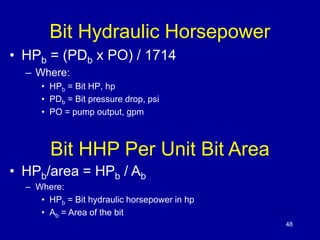
Bit Hydraulic Horsepower 
• HPb = (PDb x PO) / 1714 
– Where: 
• HPb = Bit HP, hp 
• PDb = Bit pressure drop, psi 
• PO = pump output, gpm 
Bit HHP Per Unit Bit Area 
• HPb/area = HPb / Ab 
– Where: 
• HPb = Bit hydraulic horsepower in hp 
• Ab = Area of the bit
49 
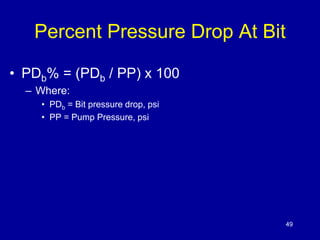
Percent Pressure Drop At Bit 
• PDb% = (PDb / PP) x 100 
– Where: 
• PDb = Bit pressure drop, psi 
• PP = Pump Pressure, psi
50 
Max Bit Hydraulic 
Horsepower: Conclusion 
• In general, the hydraulic horsepower is not 
optimized at all times 
• It is usually more convenient to select a pump 
liner size that will be suitable for the entire 
well 
• Note that at no time should the flow rate be 
allowed to drop below the minimum required 
for proper cuttings removal
51 
Max Jet Impact Force: Basis 
• Based on the theory that cuttings are best 
removed from beneath the bit when the force 
of the fluid leaving the jet nozzles and striking 
the bottom of the hole is the greatest
52 
Max Jet Impact Force: 
Optimization 
• High flow rates impacting with moderate force 
rather than a small volume impacting at a 
high pressure 
• Optimized when circulating rates and bit 
nozzle sizes are chosen which will cause 
48% of the pump pressure to be used to force 
fluid through the jet nozzles
53 
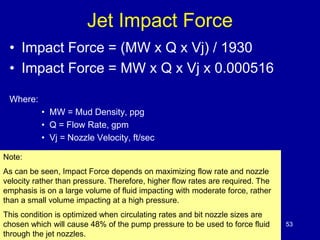
Jet Impact Force 
• Impact Force = (MW x Q x Vj) / 1930 
• Impact Force = MW x Q x Vj x 0.000516 
Where: 
• MW = Mud Density, ppg 
• Q = Flow Rate, gpm 
• Vj = Nozzle Velocity, ft/sec 
Note: 
As can be seen, Impact Force depends on maximizing flow rate and nozzle 
velocity rather than pressure. Therefore, higher flow rates are required. The 
emphasis is on a large volume of fluid impacting with moderate force, rather 
than a small volume impacting at a high pressure. 
This condition is optimized when circulating rates and bit nozzle sizes are 
chosen which will cause 48% of the pump pressure to be used to force fluid 
through the jet nozzles.
54 
END

Drill Bits

  • 1.
    1 7. DrillBits Habiburrohman abdullah
  • 2.
    2 Drill Bits • Types and Codes • Dull Grading • Economic and Optimization
  • 3.
    3 Bit SelectionGuidelines • During the planning stage, the drilling engineer makes a thorough review of offset well data and record bit performance and bit grading characteristics in formation comparable to the well be designed. • Data required for the correct bit selection include the following: - Prognosed lithology column with detailed description of each formation. - Drilling fluid details. - Well profile
  • 4.
    4 Type ofDrillbits Rotary Drilling bits usually are classified according to their design as : - Drag Bits, fixed cutter blade (a & b) - Roller Cutter Bits, has two or more cone (c) (a) (b) (c)
  • 5.
    Type of Bits– Roller Cone Bits • Roller cone bits are made up of three equal sized cone and three identical legs which are attached together with a pin connection. • Nozzle are used to provide constriction in order to obtain high jetting velocities necessary for efficient bit and hole cleaning. 5
  • 6.
    Type of Bits– Roller Cone Bits 6 • There are two types of roller cone bits: 1. Milled tooth bits: - the cuttings structure is milled from the steel making up the cones. 2. Insert bits: - the cutting structure is a series of inserts pressed into the cones.
  • 7.
    Design Factors -Roller Cone Bits • The drill bit design dictated by the type of the rock to 7 be drilled and size of hole. • The following factors should be considered when designing a three cone bits (Roller Cone Bits): - journal angle - offset between cone - teeth - bearing
  • 8.
    8 DESIGN FACTORS A. Journal Angle Defined as the angle formed by a line perpendicular to the axis of the journal and the axis of the bit. The optimum of journal angle for soft and hard roller cone bits are 33 degrees and 36 degrees.
  • 9.
    9 Design Factors B. Offset between Cones The cone profile determines the durability of the drillbit. Cones with flatter profile are more durable but give lower ROP, whilst rounded profile delivers a faster ROP but is less durable. The degree of cone offset is defined as the horizontal distance between the axis of the bit and the vertical plane through the axis of the journal.
  • 10.
    10 Design Factors C. Tooth Angle and Shape The drill bit can have slander and long teeth or short and stubby teeth. The long teeth are design to drill soft formations with low compressive strength where the rock more yielding and easily penetrated. The short and stubby teeth are design for hard formation, simply to fracture it by the application of high compressive loads Tooth shape
  • 11.
    11 Design Factors Various Bit Style
  • 12.
    12 Design Factors D. Bearing The bearing must take the loads generated as the bit cutting structure (and gauge area) engage with the formation as WOB is applied. a
  • 13.
    13 Insert Bits • The design factors relating to cone offset, bit profile discussed above for milled tooth bits apply equally to insert bits. • The cutting structure of insert bits relies on using tungsten carbide inserts which are pressed into pre-drilled hole in the cone of bit.
  • 14.
    14 Insert Bits • Soft insert bits have fewer and longer inserts to provide aggressive penetration of the rock. Durable, hard formation have many, small diameter inserts with limited protusion.
  • 15.
    15 IADC Classification for Roller Cone Bits • IADC established a three code system for roller cone bits. • The first code define the series classification relating to the cutting structure (carries the number 1 to 8). • The second code related to the formation hardness subdivision within each group and carries the number 1 to 4. • The third code defines the mechanical features of the bit such as non-sealed or sealed bearing.
  • 16.
    16 Bit Classification A. The First Code - For milled tooth bits carries the number 1 to 3 (soft, medium and hard rock respectively). - For insert bits carries the number 4 to 8. B. The Second Code - The numbers signify formation hardness, from softest to hardest within each series. C. The Third Code - There are seven subdivisions within third code.
  • 17.
    17 Bit Classification Third code subdivision: - non-sealed roller bearing - roller bearing air cooled - sealed roller bearing - sealed roller bearing with gauge protection - sealed friction bearing - sealed friction bearing with gauge protection - special features – category now obselete
  • 18.
    18 Bit Classification Example : A Code of 1-2-1 indicates : Code 1: long, slim and widely spaced milled tooth bit Code 2: medium soft formation Code 3: non-sealed bearing
  • 19.
    19 PDC Bits • A Polycrystalline Diamond Compact (PDC) bit employs no moving part and is design to break the rock in shear and not in compression as is done with roller cone bits. • A PDC bit employs a large number of cutting elements, each called PDC cutter. The PDC cutter is made by bonding a layer of polycrystalline man-made diamond to a cemented
  • 20.
    20 Roller Cone& PDC Bits Roller Cone Bit PDC Bit
  • 21.
    21 Bit Grading • It is the procedure for describing the condition of a bit after it has drilled a section of rock and has been pulled out of the hole. • It is directed at 2 areas: – Determining the amount of physical wear – Analysis of the cause of the wear
  • 22.
    Reasons for HavingAccurate 22 Bit Grading • Will provide reliable info for future well planning (better bit selection) • Will improve drilling practices. It gives clues as to what is happening down hole • Provides the basis for determining optimum bit life • Will improve bit design
  • 23.
    23 IADC /SPE 23939 (1987) • Allows for 8 factors to be recorded: – Cutting Structure: Inner rows, Outer rows, Dull Character, Location – Bearing / Seals – Gauge 1/16” – Remarks: Other Character, Reason Pulled
  • 24.
    24 Inner Rows • Used to report the conditions of the cutters not touching the borehole walls. Outer Rows • Used to report the conditions of the cutting elements that touch the borehole walls.
  • 25.
    25 Inner /Outer Rows • Wear is recorded on a linear scale as a single digit from 0 (no wear) to 8 (no usable cutting structure remaining) • Use an IADC PDC Wear Gage for PDC
  • 26.
    26 Inner /Outer Rows • For fixed cutter bits the average amount of wear of each area is recorded, with 2/3 of the radius representing the “Inner rows” and the remaining 1/3 representing the “Outer rows”
  • 27.
    27 Dull Character • The code for the most prominent or primary characteristic of the dull bit should be entered here. Any secondary dull characteristics of the bit can be entered in “Other Characteristic”.
  • 28.
    28 Fixed CutterBit Dull Characteristic Codes • BF - Bond Failure • BT - Broken Cutters • BU - Balled Up • CR - Cored
  • 29.
    29 Fixed CutterBit Dull Characteristic Codes • CT – Chipped Cutters • DL – Cutter Delamination • ER – Erosion • HC – Heat Checking • JD – Junk Damage
  • 30.
    30 Fixed CutterBit Dull Characteristic Codes • LM – Lost Matrix • LN – Lost Nozzle • LT – Lost Cutter • NR – Not Rerunable • NO – No Dull Characteristics
  • 31.
    31 Fixed CutterBit Dull Characteristic Codes • PN – Plugged Nozzle • RO – Ring Out • RR – Rerunable • TR – Tracking • WO – Washed Out Bit • WT – Worn Cutters
  • 32.
    32 Roller ConeBit Dull Characteristic Codes • BC – Broken Cone • BT – Broken Teeth • BU – Balled Up • CC – Cracked Cone • CD – Cone Dragged • CI – Cone Interference • CR – Cored • CT – Chipped Teeth • ER – Erosion • FC – Flat Crested Wear • HC – Heat Checking • JD – Junk Damage • LC – Lost Cone • LN – Lost Nozzle • LT – Lost Teeth • NO – No Dull Characteristics • NR – Not Rerunable • OC – Off Center Wear • PB – Pinched Bit • PN – Plugged Nozzle • RG – Rounded Gauge • SD – Shirttail Damage • RR - Rerunable • SS - Self Sharpening Wear • TR - Tracking • WO - Washed Out Bit • WT - Worn Teeth
  • 33.
    33 Location forFixed Cutter • This is the location of the primary dull characteristic. • Use the codes: – C - cone – N - nose – T - taper – S - shoulder – G – gauge – A – All
  • 34.
    34 Location forFixed Cutter
  • 35.
    35 Location forRoller Cone Bits • N – Nose Row (the centermost cutting elements of the bit) • M – Middle Row (the cutting elements between the nose and the bit) • G – Gauge Row (those cutting elements that touch the wall of the hole) • A – All Rows • 1, 2 or 3 – Cone number
  • 36.
    36 Location forRoller Cone Bits
  • 37.
    37 Bearing /Seals • Indicates the condition of the bearing and seal assembly. • Fixed cutter bits will always be designated "X". • Equivalent to the B of the old TBG grading.
  • 38.
    38 Bearing /Seals • Non-sealed bearings: 0 – 8 estimate of bearing wear. • Sealed bearings: – E – effective seal – F – seals failed – N – not able to grade
  • 39.
    39 Gauge •This is used to record the condition of the bit gauge. • The letter "IN" is used if the bit is In gauge. • If the bit is under gauge,the amount should be recorded to the nearest 1/16th of an inch. • It is good practice to gauge a bit both before and after a run. • Use a nominal ring gauge for milled tooth bits and a fixed cutter ring gauge is used to gauge fixed cutter bits. Due to different manufacturing tolerances ,a roller cone bit gauge will show a fixed cutter bit to be under gauge.
  • 40.
    40 Gauge Note: L is ingauge, R is 4/16th
  • 41.
    41 Other Characteristic • This is used to record secondary bit wear. This could relate specifically to cutting structure wear or may identify wear to the bit as a whole, such as erosion. • This is in addition to the wear identified and recorded in Dull Characteristic and may highlight the "cause" of this wear. • "Other characteristics" can be used to record whether a bit is re-runable "RR" or not "NR". • The codes for both "primary" and "secondary" wear are the same.
  • 42.
    Bit Optimization: NozzleSelection 42 • Jet Nozzle Area • An = nΣi=1 (Jeti 2) x 0.000767 – Where: • An = Jet nozzle area, in2 • Jeti 2 = nozzle diameter in 32nd of an inch Note: • Most roller cone bits use three or four jet nozzles, while PDC bits usually contain six to nine. The flow area of all jets must be determined separately, then added together.
  • 43.
    43 Jet NozzleVelocity • Velocity of the mud exiting the jet nozzles • Important in hydraulic optimization • Vj = (PO x 0.32086) / An – Where: • Vj = nozzle velocity, ft/sec • An = nozzle area, in2 • PO = pump output, gpm
  • 44.
    44 Bit PressureDrop • Essential in determining the hydraulic horsepower • PDb = (Vj2 x MW) / 1120 – Where: • PDb = Bit pressure drop, psi • Vj = nozzle velocity, ft/sec • MW = mud weight, ppg
  • 45.
    45 Bottom HoleCleaning • Proper bottom hole cleaning will: – Eliminate excessive regrinding of drilled solids – Result in improved ROPs • Bottom hole cleaning efficiency is achieved through proper bit jet size selection
  • 46.
    46 Bit Optimization • Through proper nozzle selection, optimization may be based on maximizing one of the following: – Jet Impact Force – Bit Hydraulic Horsepower • There is no agreement on which of these two parameters should be maximized
  • 47.
    47 Max BitHydraulic Horsepower: Basis • Based on the theory that cuttings are best removed from beneath the bit by delivering the most power to the bottom of the hole • To optimize Bottom Hole Cleaning and Bit Hydraulic Horsepower, it is necessary to select a circulation rate and nozzle sizes which will cause appx 65% of the pump pressure to be expended forcing the fluid through the jet nozzles of the bit
  • 48.
    48 Bit HydraulicHorsepower • HPb = (PDb x PO) / 1714 – Where: • HPb = Bit HP, hp • PDb = Bit pressure drop, psi • PO = pump output, gpm Bit HHP Per Unit Bit Area • HPb/area = HPb / Ab – Where: • HPb = Bit hydraulic horsepower in hp • Ab = Area of the bit
  • 49.
    49 Percent PressureDrop At Bit • PDb% = (PDb / PP) x 100 – Where: • PDb = Bit pressure drop, psi • PP = Pump Pressure, psi
  • 50.
    50 Max BitHydraulic Horsepower: Conclusion • In general, the hydraulic horsepower is not optimized at all times • It is usually more convenient to select a pump liner size that will be suitable for the entire well • Note that at no time should the flow rate be allowed to drop below the minimum required for proper cuttings removal
  • 51.
    51 Max JetImpact Force: Basis • Based on the theory that cuttings are best removed from beneath the bit when the force of the fluid leaving the jet nozzles and striking the bottom of the hole is the greatest
  • 52.
    52 Max JetImpact Force: Optimization • High flow rates impacting with moderate force rather than a small volume impacting at a high pressure • Optimized when circulating rates and bit nozzle sizes are chosen which will cause 48% of the pump pressure to be used to force fluid through the jet nozzles
  • 53.
    53 Jet ImpactForce • Impact Force = (MW x Q x Vj) / 1930 • Impact Force = MW x Q x Vj x 0.000516 Where: • MW = Mud Density, ppg • Q = Flow Rate, gpm • Vj = Nozzle Velocity, ft/sec Note: As can be seen, Impact Force depends on maximizing flow rate and nozzle velocity rather than pressure. Therefore, higher flow rates are required. The emphasis is on a large volume of fluid impacting with moderate force, rather than a small volume impacting at a high pressure. This condition is optimized when circulating rates and bit nozzle sizes are chosen which will cause 48% of the pump pressure to be used to force fluid through the jet nozzles.
  • 54.