Drilling Beds
Problems
• Abnormal pressure
• Unconsolidated Formation
• Shale Instability
• Key Seat
• Ledges
 Abnormal pressure:
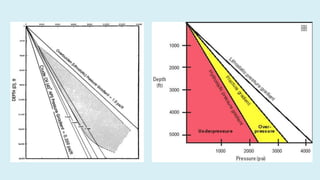
Formation pressure tends to increase with depth according to the hydrostatic
pressure gradient, in this case 0.433 psi/ft. Deviations from the normal
pressure gradient and its associated pressure at a given depth are considered
abnormal pressure.
 Abnormal pressure
• Depositional Effects
• Piezometric surface
• Diagenesis
• Tectonic Effects
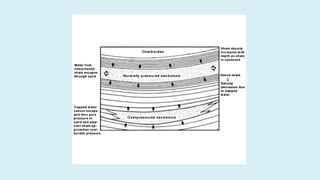
Depositational effect: Rapid Sedimentation
In this situation the sediment cannot compact and the contained
water is subjected not only to hydrostatic forces, but also to the
weight of newly deposited sediment, therefore it will created high
pressure zone
Depositional Effects:Deposition of Evaporites
The deposition of evaporites can create high abnormal
pore pressures in the surrounding zones .When salt is
deposited, the pore fluids in the underlying formations
cannot escape and therefore become trapped and
abnormally pressured.
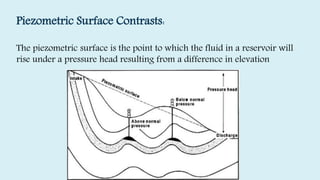
Piezometric Surface Contrasts:
The piezometric surface is the point to which the fluid in a reservoir will
rise under a pressure head resulting from a difference in elevation
Diagenesis Processes:
Diagenesis is a term that refers to the chemical alteration of rock
minerals by geological processes. Diagenesis of montmorillonite clays to
illite clays results in an expulsion of interlayer bound water . If this
water cannot escape from the compressing shales abnormal pressure
can develop.
Tectonic Effects:
Tectonic activity can result in the development of abnormal pore
pressure as a result of a variety of mechanisms including: folding,
faulting, uplift and salt Salt Diaparism.
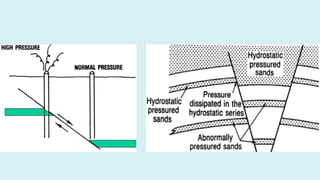
Tectonic Effects: Fault
When crossing faults it is possible to go from normal pressure to
abnormally high pressure in a short interval.
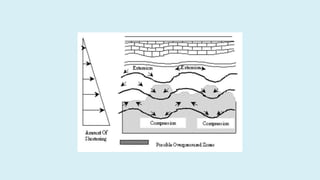
Tectonic: fold
The additional horizontal tectonic stress created by folding compacts
the clays laterally. For the formation to remain normally pressured, the
increased compaction must be balanced by pore water expulsion. If
the formation water cannot escape, abnormal pressure results.
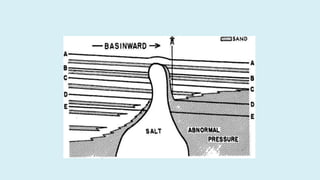
Tectonic: Salt Diapirism
Salt exhibits plastic behaviour at elevated temperatures and pressures
and due to its low density will move upwards to form salt domes in
overlying formations. Salt has no porosity and no permeability and
therefore can be a perfect seal
Tectonic:Uplifit
If a normally pressured formation is uplifted to a
shallower depth then the formation will appear to have
an abnormal pressure due to the fact that the
formation pressure has more hydrostatic pressure than
a corresponding normally pressured zone at the same
depth.
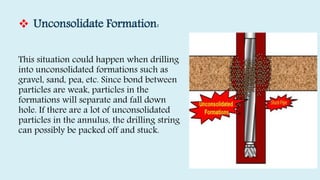
 Unconsolidate Formation:
This situation could happen when drilling
into unconsolidated formations such as
gravel, sand, pea, etc. Since bond between
particles are weak, particles in the
formations will separate and fall down
hole. If there are a lot of unconsolidated
particles in the annulus, the drilling string
can possibly be packed off and stuck.
Shale instability:
Reaction between the shale and drilling fluid causes
the shale to swell, weaken, and eventually fall/collapse
into the wellbore.
Shale Instability: Mechanical Instability
mechanical rock instability can occur because the in-situ stress state of
equilibrium has been disturbed after drilling. The mud in use with a
certain density may not bring the altered stresses to the original state;
therefore, shale may become mechanically unstable.
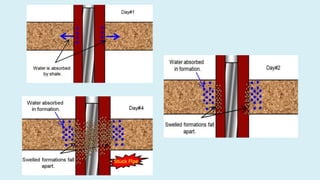
Shale instability: Chemical Instability
Water in the mud absorbed by shale formations causes swelling effect
on formations. When there is a lot of water, shale will not be able to
hold their particles together and finally falls apart into the well. Finally
shale particles will jam a drill string.The shale instability is a chemical
reaction which is time dependent.
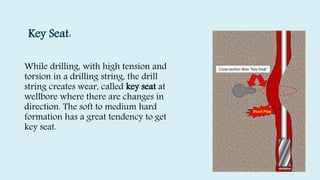
Key Seat:
While drilling, with high tension and
torsion in a drilling string, the drill
string creates wear, called key seat at
wellbore where there are changes in
direction. The soft to medium hard
formation has a great tendency to get
key seat.
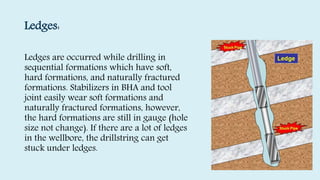
Ledges:
Ledges are occurred while drilling in
sequential formations which have soft,
hard formations, and naturally fractured
formations. Stabilizers in BHA and tool
joint easily wear soft formations and
naturally fractured formations, however,
the hard formations are still in gauge (hole
size not change). If there are a lot of ledges
in the wellbore, the drillstring can get
stuck under ledges.

Drilling Beds Problems

  • 1.
  • 2.
    • Abnormal pressure •Unconsolidated Formation • Shale Instability • Key Seat • Ledges
  • 3.
     Abnormal pressure: Formationpressure tends to increase with depth according to the hydrostatic pressure gradient, in this case 0.433 psi/ft. Deviations from the normal pressure gradient and its associated pressure at a given depth are considered abnormal pressure.
  • 5.
     Abnormal pressure •Depositional Effects • Piezometric surface • Diagenesis • Tectonic Effects
  • 6.
    Depositational effect: RapidSedimentation In this situation the sediment cannot compact and the contained water is subjected not only to hydrostatic forces, but also to the weight of newly deposited sediment, therefore it will created high pressure zone
  • 8.
    Depositional Effects:Deposition ofEvaporites The deposition of evaporites can create high abnormal pore pressures in the surrounding zones .When salt is deposited, the pore fluids in the underlying formations cannot escape and therefore become trapped and abnormally pressured.
  • 9.
    Piezometric Surface Contrasts: Thepiezometric surface is the point to which the fluid in a reservoir will rise under a pressure head resulting from a difference in elevation
  • 10.
    Diagenesis Processes: Diagenesis isa term that refers to the chemical alteration of rock minerals by geological processes. Diagenesis of montmorillonite clays to illite clays results in an expulsion of interlayer bound water . If this water cannot escape from the compressing shales abnormal pressure can develop.
  • 11.
    Tectonic Effects: Tectonic activitycan result in the development of abnormal pore pressure as a result of a variety of mechanisms including: folding, faulting, uplift and salt Salt Diaparism.
  • 12.
    Tectonic Effects: Fault Whencrossing faults it is possible to go from normal pressure to abnormally high pressure in a short interval.
  • 14.
    Tectonic: fold The additionalhorizontal tectonic stress created by folding compacts the clays laterally. For the formation to remain normally pressured, the increased compaction must be balanced by pore water expulsion. If the formation water cannot escape, abnormal pressure results.
  • 16.
    Tectonic: Salt Diapirism Saltexhibits plastic behaviour at elevated temperatures and pressures and due to its low density will move upwards to form salt domes in overlying formations. Salt has no porosity and no permeability and therefore can be a perfect seal
  • 18.
    Tectonic:Uplifit If a normallypressured formation is uplifted to a shallower depth then the formation will appear to have an abnormal pressure due to the fact that the formation pressure has more hydrostatic pressure than a corresponding normally pressured zone at the same depth.
  • 19.
     Unconsolidate Formation: Thissituation could happen when drilling into unconsolidated formations such as gravel, sand, pea, etc. Since bond between particles are weak, particles in the formations will separate and fall down hole. If there are a lot of unconsolidated particles in the annulus, the drilling string can possibly be packed off and stuck.
  • 20.
    Shale instability: Reaction betweenthe shale and drilling fluid causes the shale to swell, weaken, and eventually fall/collapse into the wellbore.
  • 21.
    Shale Instability: MechanicalInstability mechanical rock instability can occur because the in-situ stress state of equilibrium has been disturbed after drilling. The mud in use with a certain density may not bring the altered stresses to the original state; therefore, shale may become mechanically unstable.
  • 22.
    Shale instability: ChemicalInstability Water in the mud absorbed by shale formations causes swelling effect on formations. When there is a lot of water, shale will not be able to hold their particles together and finally falls apart into the well. Finally shale particles will jam a drill string.The shale instability is a chemical reaction which is time dependent.
  • 24.
    Key Seat: While drilling,with high tension and torsion in a drilling string, the drill string creates wear, called key seat at wellbore where there are changes in direction. The soft to medium hard formation has a great tendency to get key seat.
  • 25.
    Ledges: Ledges are occurredwhile drilling in sequential formations which have soft, hard formations, and naturally fractured formations. Stabilizers in BHA and tool joint easily wear soft formations and naturally fractured formations, however, the hard formations are still in gauge (hole size not change). If there are a lot of ledges in the wellbore, the drillstring can get stuck under ledges.