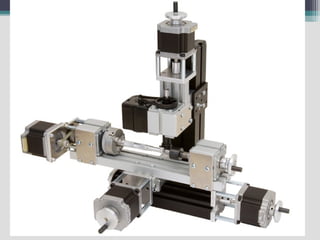
NUMERICAL CONTROL
1
HISTORICAL DEVELOPMENT
• 15th century - machining metal.
• 18th century - industrialization, production-type machine tools.
• 20th century - F.W. Taylor - tool metal - HSS
Automated production equipment -
Screw machines
Transfer lines
Assembly lines
using cams and preset stops
Programmable automation -
NC
PLC
Robots
3
A Definition:A Definition:
• Numerical Control is a system
in which actions are controlled by
the direct insertion of numerical
data at some point.
• In other words, Programmable
automation in which the
mechanical actions of a ‘machine
tool’ are controlled by a program
4
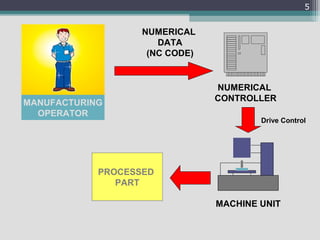
MACHINE UNIT
NUMERICAL
CONTROLLER
NUMERICAL
DATA
(NC CODE)
MANUFACTURING
OPERATOR
PROCESSED
PART
Drive Control
5
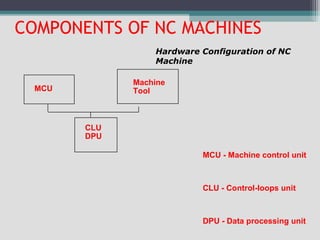
COMPONENTS OF NC MACHINES
MCU
Machine
Tool
CLU
DPU
MCU - Machine control unit
CLU - Control-loops unit
DPU - Data processing unit
Hardware Configuration of NC
Machine
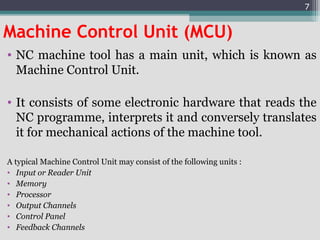
Machine Control Unit (MCU)
• NC machine tool has a main unit, which is known as
Machine Control Unit.
• It consists of some electronic hardware that reads the
NC programme, interprets it and conversely translates
it for mechanical actions of the machine tool.
A typical Machine Control Unit may consist of the following units :
• Input or Reader Unit
• Memory
• Processor
• Output Channels
• Control Panel
• Feedback Channels
7
8
Machine Tool
•Machine tool is the main components of a numerical control
system, which executes the operations.
•It may consist of worktable, cutting tools, jigs and fixtures,
motors for driving spindle and coolant and lubricating
system.
•The latest development in the numerical control machine
tool is the versatile machining center.
•This is a single machine capable of doing a number of
operations such as milling, boring, drilling, reaming, and
tapping by Automatic Tool Changer (ATC) under the control
of tool selection instruction.
9
The MCU may be of three types :
•Housed MCU
Machine Control Unit may be mounted on the machine tool or
may be built in the casing of the machine.
•Swing Around MCU
Machine Control Unit is directly mounted on the machine, which
can swing around it and can be adjusted as per requirement of the
operator’s position.
•Stand Alone MCU
Machine Control Unit is enclosed in a separate cabinet which is
installed at some remote or same place near to the machine.
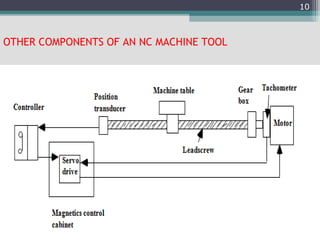
OTHER COMPONENTS OF AN NC MACHINE TOOL
10
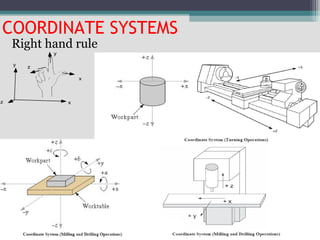
COORDINATE SYSTEMS
Right hand rule
x
y
z
x
y
z
BASIC REQUIREMENT OF NC MACHINE CONTROL
a. Preparatory functions: which unit, which interpolator,
absolute or incremental programming, which circular
interpolation plane, cutter compensation, etc.
b. Coordinates: three translational, and three rotational axes.
c. Machining parameters: feed, and speed.
d. Tool control: tool diameter, next tool number, tool change.
e. Cycle functions: drill cycle, ream cycle, bore cycle, mill
cycle, clearance plane.
f. Coolant control: coolant on/off, flood, mist.
g. Miscellaneous control: spindle on/off, tape rewind, spindle
rotation direction, pallet change, clamps control, etc.
h. Interpolators: linear, circular interpolation
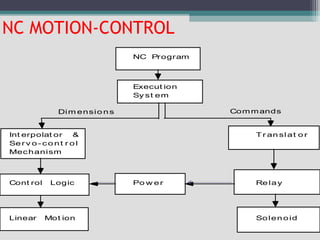
NC MOTION-CONTROL
NC Program
Execut ion
Sy st em
Int erpolat or &
Ser v o - co nt r o l
Mechanism
Cont rol Logic
Linear Mot ion
Po w er
Tr an slat o r
Relay
Solenoid
CommandsDim ensio ns
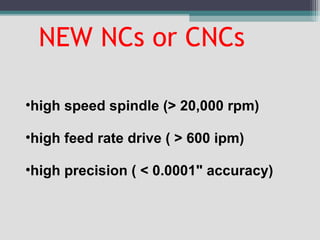
NEW NCs or CNCs
•high speed spindle (> 20,000 rpm)
•high feed rate drive ( > 600 ipm)
•high precision ( < 0.0001" accuracy)
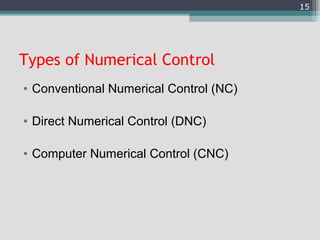
Types of Numerical Control
• Conventional Numerical Control (NC)
• Direct Numerical Control (DNC)
• Computer Numerical Control (CNC)
15
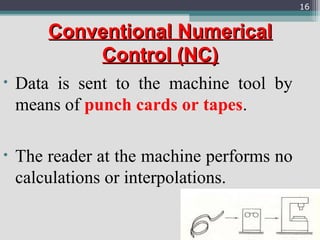
ConventionalConventional NumericalNumerical
Control (NC)Control (NC)
• Data is sent to the machine tool by
means of punch cards or tapes.
• The reader at the machine performs no
calculations or interpolations.
16
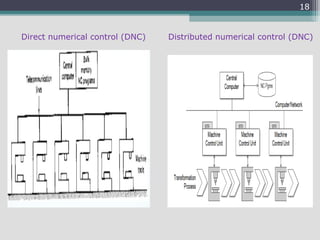
DNC
• Direct numerical control (DNC) – control of multiple
machine tools by a single (mainframe) computer
through direct connection and in real time
▫ 1960s technology
▫ Two way communication
• Distributed numerical control (DNC) – network
consisting of central computer connected to machine
tool MCUs, which are CNC
▫ Present technology
▫ Two way communication
18
Direct numerical control (DNC) Distributed numerical control (DNC)
Computer Numerical ControlComputer Numerical Control
(CNC)(CNC)
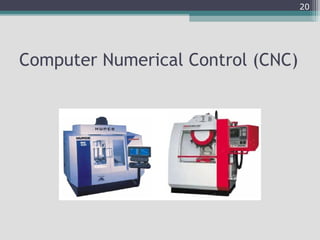
• The idea of computer numerical control is
to position a computer right at the
machine tool.
• Most, if not all machine tools that are
numericaly controlled are CNC machine
tools.
19
Computer Numerical Control (CNC)
20
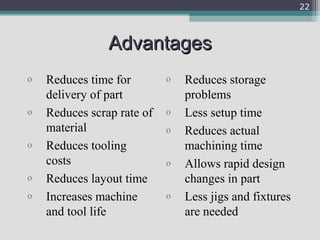
AdvantagesAdvantages
o Reduces time for
delivery of part
o Reduces scrap rate of
material
o Reduces tooling
costs
o Reduces layout time
o Increases machine
and tool life
o Reduces storage
problems
o Less setup time
o Reduces actual
machining time
o Allows rapid design
changes in part
o Less jigs and fixtures
are needed
22
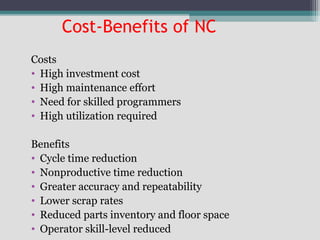
Cost-Benefits of NC
Costs
• High investment cost
• High maintenance effort
• Need for skilled programmers
• High utilization required
Benefits
• Cycle time reduction
• Nonproductive time reduction
• Greater accuracy and repeatability
• Lower scrap rates
• Reduced parts inventory and floor space
• Operator skill-level reduced
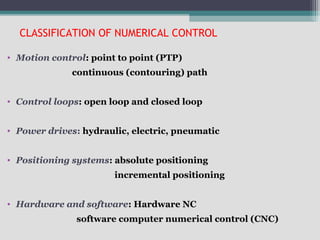
CLASSIFICATION OF NUMERICAL CONTROL
• Motion control: point to point (PTP)
continuous (contouring) path
• Control loops: open loop and closed loop
• Power drives: hydraulic, electric, pneumatic
• Positioning systems: absolute positioning
incremental positioning
• Hardware and software: Hardware NC
software computer numerical control (CNC)
1.Motion Control
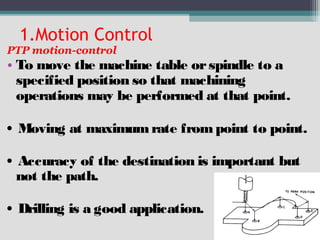
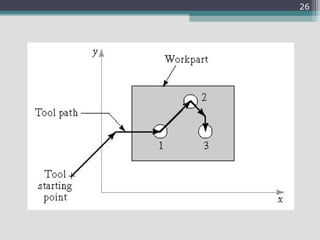
PTP motion-control
• To move the machine table orspindle to a
specified position so that machining
operations may be performed at that point.
• Moving at maximumrate frompoint to point.
• Accuracy of the destination is important but
not the path.
• Drilling is a good application.
26
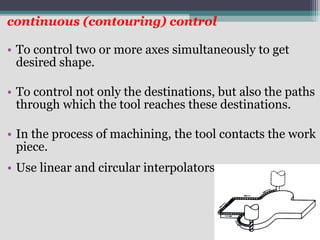
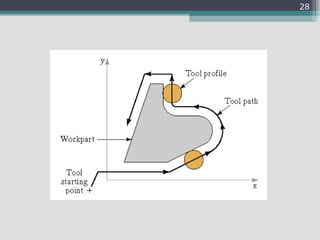
continuous (contouring) control
• To control two or more axes simultaneously to get
desired shape.
• To control not only the destinations, but also the paths
through which the tool reaches these destinations.
• In the process of machining, the tool contacts the work
piece.
• Use linear and circular interpolators
.
28
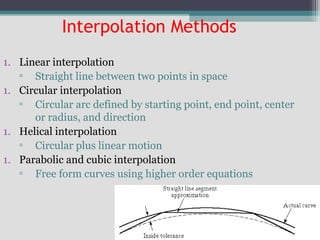
Interpolation Methods
1. Linear interpolation
▫ Straight line between two points in space
1. Circular interpolation
▫ Circular arc defined by starting point, end point, center
or radius, and direction
1. Helical interpolation
▫ Circular plus linear motion
1. Parabolic and cubic interpolation
▫ Free form curves using higher order equations
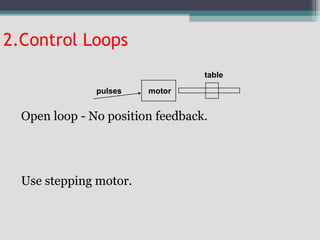
Open loop - No position feedback.
Use stepping motor.
motor
table
pulses
2.Control Loops
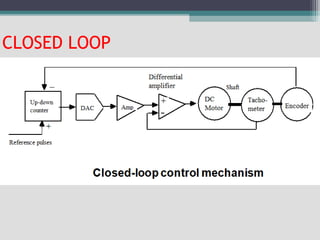
CLOSED LOOP
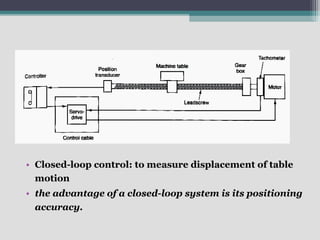
• Closed-loop control: to measure displacement of table
motion
• the advantage of a closed-loop system is its positioning
accuracy.
3.Power Drives
• Electric motor
▫ widely used
▫ small size, ease of control, low cost
• Hydraulic drive
▫ much larger power/size ratio
• Pneumatic drive
▫ rarely used in NC positioning system
▫ can be used to drive the auxiliary devices
4.Positioning system
•Incremental positioning system
•absolute positioning system
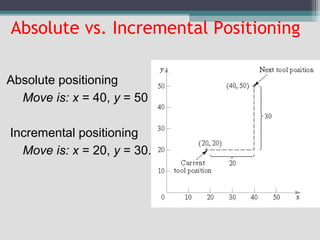
Absolute vs. Incremental Positioning
Absolute positioning
Move is: x = 40, y = 50
Incremental positioning
Move is: x = 20, y = 30.
NC MACHINE
RATING• Accuracy
• Repeatability
• Spindle and axis motor horsepower
• Number of controlled axes
• Dimension of workspace
• Features of the machine and the controller.
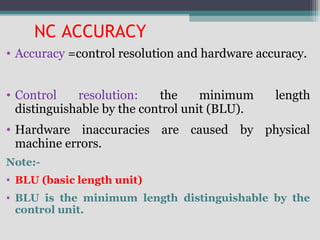
NC ACCURACY
• Accuracy =control resolution and hardware accuracy.
• Control resolution: the minimum length
distinguishable by the control unit (BLU).
• Hardware inaccuracies are caused by physical
machine errors.
Note:-
• BLU (basic length unit)
• BLU is the minimum length distinguishable by the
control unit.
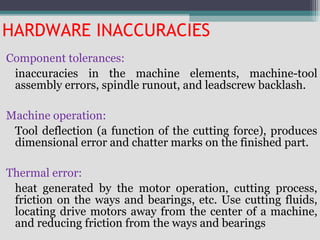
HARDWARE INACCURACIES
Component tolerances:
inaccuracies in the machine elements, machine-tool
assembly errors, spindle runout, and leadscrew backlash.
Machine operation:
Tool deflection (a function of the cutting force), produces
dimensional error and chatter marks on the finished part.
Thermal error:
heat generated by the motor operation, cutting process,
friction on the ways and bearings, etc. Use cutting fluids,
locating drive motors away from the center of a machine,
and reducing friction from the ways and bearings
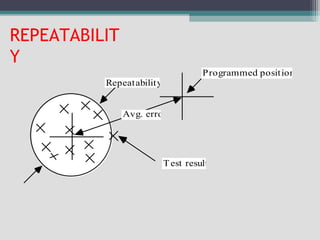
REPEATABILIT
Y
Avg. error
Programmed position
Test result
Repeatability
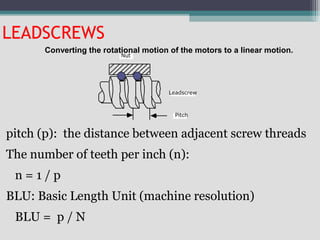
LEADSCREWS
Leadscrew
Pitch
Nut
Converting the rotational motion of the motors to a linear motion.
pitch (p): the distance between adjacent screw threads
The number of teeth per inch (n):
n = 1 / p
BLU: Basic Length Unit (machine resolution)
BLU = p / N
Example
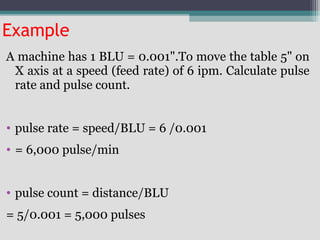
A machine has 1 BLU = 0.001".To move the table 5" on
X axis at a speed (feed rate) of 6 ipm. Calculate pulse
rate and pulse count.
• pulse rate = speed/BLU = 6 /0.001
• = 6,000 pulse/min
• pulse count = distance/BLU
= 5/0.001 = 5,000 pulses

3 numerical control

  • 1.
  • 2.
    HISTORICAL DEVELOPMENT • 15thcentury - machining metal. • 18th century - industrialization, production-type machine tools. • 20th century - F.W. Taylor - tool metal - HSS Automated production equipment - Screw machines Transfer lines Assembly lines using cams and preset stops Programmable automation - NC PLC Robots
  • 3.
  • 4.
    A Definition:A Definition: •Numerical Control is a system in which actions are controlled by the direct insertion of numerical data at some point. • In other words, Programmable automation in which the mechanical actions of a ‘machine tool’ are controlled by a program 4
  • 5.
  • 6.
    COMPONENTS OF NCMACHINES MCU Machine Tool CLU DPU MCU - Machine control unit CLU - Control-loops unit DPU - Data processing unit Hardware Configuration of NC Machine
  • 7.
    Machine Control Unit(MCU) • NC machine tool has a main unit, which is known as Machine Control Unit. • It consists of some electronic hardware that reads the NC programme, interprets it and conversely translates it for mechanical actions of the machine tool. A typical Machine Control Unit may consist of the following units : • Input or Reader Unit • Memory • Processor • Output Channels • Control Panel • Feedback Channels 7
  • 8.
    8 Machine Tool •Machine toolis the main components of a numerical control system, which executes the operations. •It may consist of worktable, cutting tools, jigs and fixtures, motors for driving spindle and coolant and lubricating system. •The latest development in the numerical control machine tool is the versatile machining center. •This is a single machine capable of doing a number of operations such as milling, boring, drilling, reaming, and tapping by Automatic Tool Changer (ATC) under the control of tool selection instruction.
  • 9.
    9 The MCU maybe of three types : •Housed MCU Machine Control Unit may be mounted on the machine tool or may be built in the casing of the machine. •Swing Around MCU Machine Control Unit is directly mounted on the machine, which can swing around it and can be adjusted as per requirement of the operator’s position. •Stand Alone MCU Machine Control Unit is enclosed in a separate cabinet which is installed at some remote or same place near to the machine.
  • 10.
    OTHER COMPONENTS OFAN NC MACHINE TOOL 10
  • 11.
  • 12.
    BASIC REQUIREMENT OFNC MACHINE CONTROL a. Preparatory functions: which unit, which interpolator, absolute or incremental programming, which circular interpolation plane, cutter compensation, etc. b. Coordinates: three translational, and three rotational axes. c. Machining parameters: feed, and speed. d. Tool control: tool diameter, next tool number, tool change. e. Cycle functions: drill cycle, ream cycle, bore cycle, mill cycle, clearance plane. f. Coolant control: coolant on/off, flood, mist. g. Miscellaneous control: spindle on/off, tape rewind, spindle rotation direction, pallet change, clamps control, etc. h. Interpolators: linear, circular interpolation
  • 13.
    NC MOTION-CONTROL NC Program Execution Sy st em Int erpolat or & Ser v o - co nt r o l Mechanism Cont rol Logic Linear Mot ion Po w er Tr an slat o r Relay Solenoid CommandsDim ensio ns
  • 14.
    NEW NCs orCNCs •high speed spindle (> 20,000 rpm) •high feed rate drive ( > 600 ipm) •high precision ( < 0.0001" accuracy)
  • 15.
    Types of NumericalControl • Conventional Numerical Control (NC) • Direct Numerical Control (DNC) • Computer Numerical Control (CNC) 15
  • 16.
    ConventionalConventional NumericalNumerical Control (NC)Control(NC) • Data is sent to the machine tool by means of punch cards or tapes. • The reader at the machine performs no calculations or interpolations. 16
  • 17.
    DNC • Direct numericalcontrol (DNC) – control of multiple machine tools by a single (mainframe) computer through direct connection and in real time ▫ 1960s technology ▫ Two way communication • Distributed numerical control (DNC) – network consisting of central computer connected to machine tool MCUs, which are CNC ▫ Present technology ▫ Two way communication
  • 18.
    18 Direct numerical control(DNC) Distributed numerical control (DNC)
  • 19.
    Computer Numerical ControlComputerNumerical Control (CNC)(CNC) • The idea of computer numerical control is to position a computer right at the machine tool. • Most, if not all machine tools that are numericaly controlled are CNC machine tools. 19
  • 20.
  • 22.
    AdvantagesAdvantages o Reduces timefor delivery of part o Reduces scrap rate of material o Reduces tooling costs o Reduces layout time o Increases machine and tool life o Reduces storage problems o Less setup time o Reduces actual machining time o Allows rapid design changes in part o Less jigs and fixtures are needed 22
  • 23.
    Cost-Benefits of NC Costs •High investment cost • High maintenance effort • Need for skilled programmers • High utilization required Benefits • Cycle time reduction • Nonproductive time reduction • Greater accuracy and repeatability • Lower scrap rates • Reduced parts inventory and floor space • Operator skill-level reduced
  • 24.
    CLASSIFICATION OF NUMERICALCONTROL • Motion control: point to point (PTP) continuous (contouring) path • Control loops: open loop and closed loop • Power drives: hydraulic, electric, pneumatic • Positioning systems: absolute positioning incremental positioning • Hardware and software: Hardware NC software computer numerical control (CNC)
  • 25.
    1.Motion Control PTP motion-control •To move the machine table orspindle to a specified position so that machining operations may be performed at that point. • Moving at maximumrate frompoint to point. • Accuracy of the destination is important but not the path. • Drilling is a good application.
  • 26.
  • 27.
    continuous (contouring) control •To control two or more axes simultaneously to get desired shape. • To control not only the destinations, but also the paths through which the tool reaches these destinations. • In the process of machining, the tool contacts the work piece. • Use linear and circular interpolators .
  • 28.
  • 29.
    Interpolation Methods 1. Linearinterpolation ▫ Straight line between two points in space 1. Circular interpolation ▫ Circular arc defined by starting point, end point, center or radius, and direction 1. Helical interpolation ▫ Circular plus linear motion 1. Parabolic and cubic interpolation ▫ Free form curves using higher order equations
  • 30.
    Open loop -No position feedback. Use stepping motor. motor table pulses 2.Control Loops
  • 31.
  • 32.
    • Closed-loop control:to measure displacement of table motion • the advantage of a closed-loop system is its positioning accuracy.
  • 33.
    3.Power Drives • Electricmotor ▫ widely used ▫ small size, ease of control, low cost • Hydraulic drive ▫ much larger power/size ratio • Pneumatic drive ▫ rarely used in NC positioning system ▫ can be used to drive the auxiliary devices
  • 34.
    4.Positioning system •Incremental positioningsystem •absolute positioning system
  • 35.
    Absolute vs. IncrementalPositioning Absolute positioning Move is: x = 40, y = 50 Incremental positioning Move is: x = 20, y = 30.
  • 36.
    NC MACHINE RATING• Accuracy •Repeatability • Spindle and axis motor horsepower • Number of controlled axes • Dimension of workspace • Features of the machine and the controller.
  • 37.
    NC ACCURACY • Accuracy=control resolution and hardware accuracy. • Control resolution: the minimum length distinguishable by the control unit (BLU). • Hardware inaccuracies are caused by physical machine errors. Note:- • BLU (basic length unit) • BLU is the minimum length distinguishable by the control unit.
  • 38.
    HARDWARE INACCURACIES Component tolerances: inaccuraciesin the machine elements, machine-tool assembly errors, spindle runout, and leadscrew backlash. Machine operation: Tool deflection (a function of the cutting force), produces dimensional error and chatter marks on the finished part. Thermal error: heat generated by the motor operation, cutting process, friction on the ways and bearings, etc. Use cutting fluids, locating drive motors away from the center of a machine, and reducing friction from the ways and bearings
  • 39.
  • 40.
    LEADSCREWS Leadscrew Pitch Nut Converting the rotationalmotion of the motors to a linear motion. pitch (p): the distance between adjacent screw threads The number of teeth per inch (n): n = 1 / p BLU: Basic Length Unit (machine resolution) BLU = p / N
  • 41.
    Example A machine has1 BLU = 0.001".To move the table 5" on X axis at a speed (feed rate) of 6 ipm. Calculate pulse rate and pulse count. • pulse rate = speed/BLU = 6 /0.001 • = 6,000 pulse/min • pulse count = distance/BLU = 5/0.001 = 5,000 pulses

Editor's Notes

  • #33 Tachometer:n.转速计, 流速计