TYRE
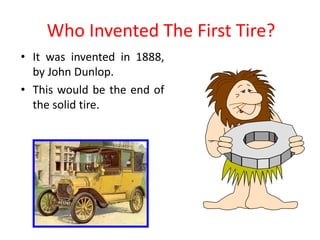
Who Invented The First Tire?
• It was invented in 1888,
by John Dunlop.
• This would be the end of
the solid tire.
Why are Tires Black?
• To protect the rubber from
the harmful UV rays.
• A common type of UV
stabilizer called a competitive
absorber is added to capture
and absorb these harmful UV
light wave energy.
TYRE
• A tyre is a cushion provided with an automobile wheel.
• It consists of mainly the outer cover i.e., the tyre
proper and the tube inside.
• The tyre-tube assembly is mounted over the wheel rim.
• It is the air inside the tube that carriers the entire load
and provides the cushion.
The type performs the following
functions
1. To support the vehicle load.
2. To provide cushion against shocks.
3. To transmit driving and braking forces to the road.
4. To provide cornering power for smooth steering.
DESIRABLE TYRE PROPERTIES
1. Non-skidding
2. Uniform Wear
3. Load-carrying
4. Cushioning
5. Power consumption
6. Tyre Noise
7. Balancing
1.Non-skidding
• This is one of the most important tyre properties.
• The tread pattern on the tyre must be suitably
designed to permit least amount of skidding
even on wet road.
2.Uniform Wear
• To maintain the non-skidding property, it is
very essential that the wear on the tyre tread
must be uniform.
• The ribbed tread patterns help to achieve this.
3.Load-carrying
• The tyre is subjected to alternating stresses during
each revolution of the wheel.
• The tyre material and design must be able to
ensure that the tyre is able to sustain these
stresses.
4.Cushioning
• The tyre should be able to absorb small high
frequency vibrations set up by the road
surface and thus provide cushioning effect.
5. Power consumption
• The automotive tyre does absorb some power which is
due to friction between the tread rubber and road
surface.
• And also due to hysteresis loss on account of the tyre
being continuously fixed and released this power
comes from the engine fuel and should be the least
possible.
• It is seen that the synthetic tyres Consume more
power while rolling than the ones made out of natural
rubber.
6.Tyre Noise
• The tyre noise may be in the form of definite
pattern sing, a sequel or a loud road.
• In all these cases, the noise should be
minimum.
7.Balancing
• This is very important consideration.
• The tyre being a rotating part of the automobile, it
must be balanced statically a well as dynamically.
• The absence of balance gives rise to peculiar
oscillations called wheel wobble.

2 tyre

  • 1.
  • 2.
    Who Invented TheFirst Tire? • It was invented in 1888, by John Dunlop. • This would be the end of the solid tire.
  • 3.
    Why are TiresBlack? • To protect the rubber from the harmful UV rays. • A common type of UV stabilizer called a competitive absorber is added to capture and absorb these harmful UV light wave energy.
  • 4.
    TYRE • A tyreis a cushion provided with an automobile wheel. • It consists of mainly the outer cover i.e., the tyre proper and the tube inside. • The tyre-tube assembly is mounted over the wheel rim. • It is the air inside the tube that carriers the entire load and provides the cushion.
  • 5.
    The type performsthe following functions 1. To support the vehicle load. 2. To provide cushion against shocks. 3. To transmit driving and braking forces to the road. 4. To provide cornering power for smooth steering.
  • 6.
    DESIRABLE TYRE PROPERTIES 1.Non-skidding 2. Uniform Wear 3. Load-carrying 4. Cushioning 5. Power consumption 6. Tyre Noise 7. Balancing
  • 7.
    1.Non-skidding • This isone of the most important tyre properties. • The tread pattern on the tyre must be suitably designed to permit least amount of skidding even on wet road.
  • 8.
    2.Uniform Wear • Tomaintain the non-skidding property, it is very essential that the wear on the tyre tread must be uniform. • The ribbed tread patterns help to achieve this.
  • 9.
    3.Load-carrying • The tyreis subjected to alternating stresses during each revolution of the wheel. • The tyre material and design must be able to ensure that the tyre is able to sustain these stresses.
  • 10.
    4.Cushioning • The tyreshould be able to absorb small high frequency vibrations set up by the road surface and thus provide cushioning effect.
  • 11.
    5. Power consumption •The automotive tyre does absorb some power which is due to friction between the tread rubber and road surface. • And also due to hysteresis loss on account of the tyre being continuously fixed and released this power comes from the engine fuel and should be the least possible. • It is seen that the synthetic tyres Consume more power while rolling than the ones made out of natural rubber.
  • 12.
    6.Tyre Noise • Thetyre noise may be in the form of definite pattern sing, a sequel or a loud road. • In all these cases, the noise should be minimum.
  • 13.
    7.Balancing • This isvery important consideration. • The tyre being a rotating part of the automobile, it must be balanced statically a well as dynamically. • The absence of balance gives rise to peculiar oscillations called wheel wobble.