




SPONSOR DS IP
TYRES AND TUBES
I RODUCT I O N
TN
4
AIM
To teach student offrs about the construction
of tyres and tubes
SEQ
STAGE 1
TYRE CONST
TREAD PATTERNS, TYPES OF TYRE AND TUBES
TYRE MARKING
LOADING INDEX AND SPEED RATING
5
6
STAGE 2
LATEST TRENDS
SAFETY MEASURES
RECOMMENDATIONS
CONCL
SEQ
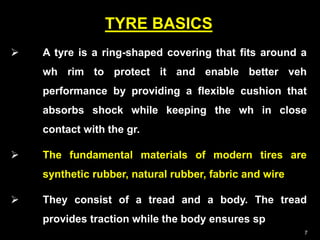
TYRE BASICS
 A tyre is a ring-shaped covering that fits around a
wh rim to protect it and enable better veh
performance by providing a flexible cushion that
absorbs shock while keeping the wh in close
contact with the gr.
 The fundamental materials of modern tires are
synthetic rubber, natural rubber, fabric and wire
 They consist of a tread and a body. The tread
provides traction while the body ensures sp
7
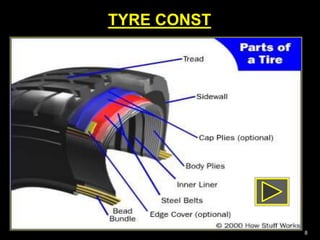
TYRE CONST
8
TYRE CONST
10
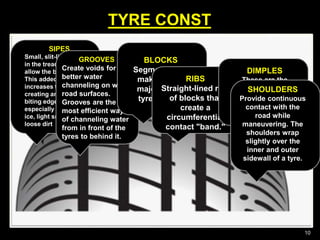
SIPES
Small, slit-like grooves
in the tread blocks that
allow the blocks to flex.
This added flexibility
increases traction by
creating an additional
biting edge. Sipes are
especially helpful on
ice, light snow and
loose dirt
GROOVES
Create voids for
better water
channeling on wet
road surfaces.
Grooves are the
most efficient way
of channeling water
from in front of the
tyres to behind it.
BLOCKS
Segments that
make up the
majority of a
tyre's tread.
RIBS
Straight-lined row
of blocks that
create a
circumferential
contact "band."
DIMPLES
These are the
indentations in the
tread, normally
towards the outer
edge of the tyre
SHOULDERS
Provide continuous
contact with the
road while
maneuvering. The
shoulders wrap
slightly over the
inner and outer
sidewall of a tyre.
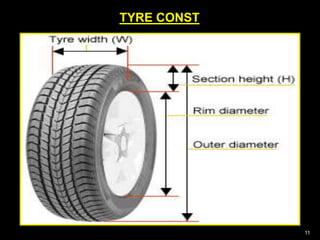
TYRE CONST
11
13
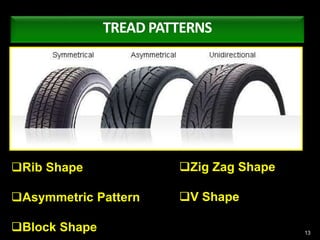
TREAD PATTERNS
Rib Shape
Asymmetric Pattern
Block Shape
Zig Zag Shape
V Shape
TREAD PATTERNS
NON-DIRECTIONAL
MUD AND SNOW
DIRECTIONAL MUD AND SNOW
14
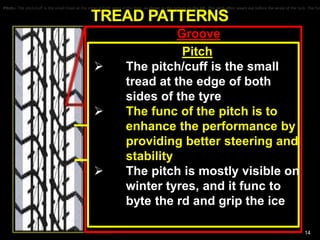
Groove
The groove is the hollow part or
the tread.
The grooves are cut which makes
the tyre pattern. The hollow part
(the groove) is designed to
channel the water out and away.
When tread wears the groove
becomes less hollow and
apparent.
Design of the groove effects the
performance and the quality of the
tyre.
Pitch:- The pitch/cuff is the small tread at the edge of both sides of the tyre, as shown in the picture on the left. The pitch often wears out before the wrest of the tyre. The funPitch:- The pitch/cuff is the small tread at the edge of both sides of the tyre, as shown in the picture on the left. The pitch often wears out before the wrest of the tyre. The fun
Pitch
 The pitch/cuff is the small
tread at the edge of both
sides of the tyre
 The func of the pitch is to
enhance the performance by
providing better steering and
stability
 The pitch is mostly visible on
winter tyres, and it func to
byte the rd and grip the ice
NON-DIRECTIONAL
MUD AND SNOW
DIRECTIONAL MUD AND SNOW
15
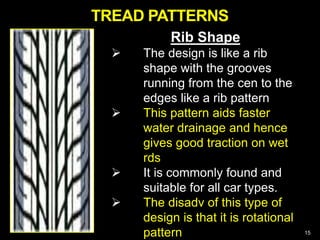
Rib Shape
 The design is like a rib
shape with the grooves
running from the cen to the
edges like a rib pattern
 This pattern aids faster
water drainage and hence
gives good traction on wet
rds
 It is commonly found and
suitable for all car types.
 The disadv of this type of
design is that it is rotational
pattern
TREAD PATTERNS
NON-DIRECTIONAL
MUD AND SNOW
DIRECTIONAL MUD AND SNOW
16
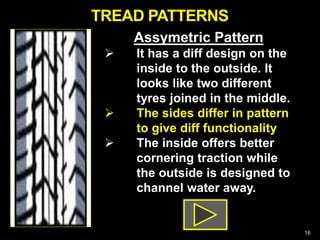
Assymetric Pattern
 It has a diff design on the
inside to the outside. It
looks like two different
tyres joined in the middle.
 The sides differ in pattern
to give diff functionality
 The inside offers better
cornering traction while
the outside is designed to
channel water away.
TREAD PATTERNS
18
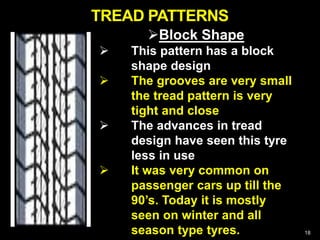
Block Shape
 This pattern has a block
shape design
 The grooves are very small
the tread pattern is very
tight and close
 The advances in tread
design have seen this tyre
less in use
 It was very common on
passenger cars up till the
90’s. Today it is mostly
seen on winter and all
season type tyres.
TREAD PATTERNS
19
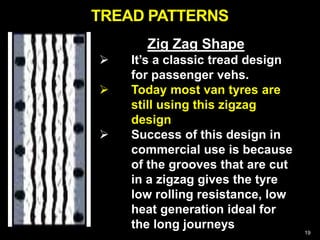
Zig Zag Shape
 It’s a classic tread design
for passenger vehs.
 Today most van tyres are
still using this zigzag
design
 Success of this design in
commercial use is because
of the grooves that are cut
in a zigzag gives the tyre
low rolling resistance, low
heat generation ideal for
the long journeys
TREAD PATTERNS
20
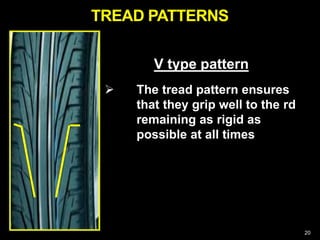
V type pattern
 The tread pattern ensures
that they grip well to the rd
remaining as rigid as
possible at all times
TREAD PATTERNS
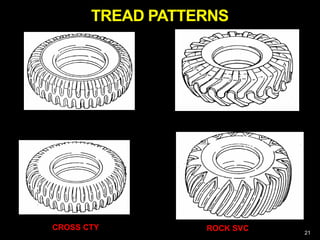
NON-DIRECTIONAL
MUD AND SNOW
CROSS CTY ROCK SVC
DIRECTIONAL MUD AND SNOW
21
TREAD PATTERNS
22
Radial tyres
Bias Tyres
Performance tyres
All round tyres
Wet-weather tyres
Winter or snow tyres
All terrain tyres
TYPES OF TYRES
Truck or Van tyres
Combat tyres
Passenger tyres
Rock svc tyres
Earthmover tyres
Grader tyres
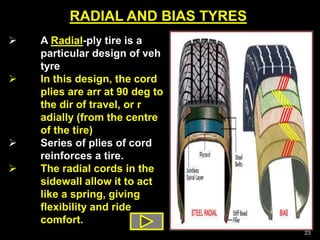
RADIAL AND BIAS TYRES
23
 A Radial-ply tire is a
particular design of veh
tyre
 In this design, the cord
plies are arr at 90 deg to
the dir of travel, or r
adially (from the centre
of the tire)
 Series of plies of cord
reinforces a tire.
 The radial cords in the
sidewall allow it to act
like a spring, giving
flexibility and ride
comfort.
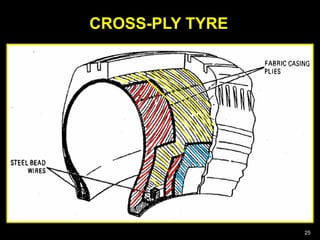
CROSS-PLY TYRE
25
TYPE OF TYRES
26
Performance tyres
Performance tyres are designed for grip and
driving performance rather than longevity,
and use softer rubber compounds.
The tread pattern utilised in performance
tyres will often utilise an asymmetric pattern,
as the outside tread pattern is designed to
channel water away and the inside pattern
offers better handling. Performance tyres are
often wider than the normal tyre and are often
used on larger rim size wheels.
TYPE OF TYRES
27
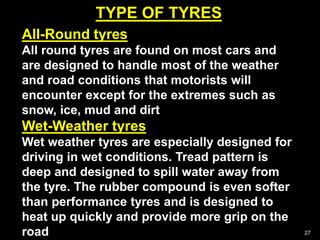
All-Round tyres
All round tyres are found on most cars and
are designed to handle most of the weather
and road conditions that motorists will
encounter except for the extremes such as
snow, ice, mud and dirt
Wet-Weather tyres
Wet weather tyres are especially designed for
driving in wet conditions. Tread pattern is
deep and designed to spill water away from
the tyre. The rubber compound is even softer
than performance tyres and is designed to
heat up quickly and provide more grip on the
road
TYPE OF TYRES
28
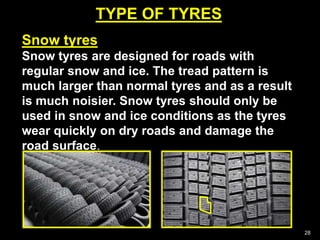
Snow tyres
Snow tyres are designed for roads with
regular snow and ice. The tread pattern is
much larger than normal tyres and as a result
is much noisier. Snow tyres should only be
used in snow and ice conditions as the tyres
wear quickly on dry roads and damage the
road surface.
TYPE OF TYRES
29
All-terrain tyres
All terrain tyres are used on 4WD vehicles. Designed for
handling a wide range of on-road and off-road conditions.
They have stiffer sidewalls and large tread patterns. All
terrain tyres fall into two main groups
– soft off-road and off-road tyres.
Soft off road tyres are designed primarily to be used on
sealed roads, with the tread patterns resembling normal
car tyres. They are engineered to be quieter on sealed
roads but are able to handle some off-road conditions like
gravel, dirt and sand.
Off-road tyres are designed to handle unsealed roads and
off-the-beaten track envmts.Off-road tyes are noisy and
wear more quickly on dry, sealed roads.
TYPE OF TYRES
30
Truck or Van tyres
Tyres used in commercial vehicles will often
employ a classic zig zag pattern and are
designed to offer low rolling resistance and
low heat generation, which makes them ideal
for the long distances that commercial vans
and trucks travel. The disadvantages of the
zig zag pattern include poor cornering and a
lack of grip in wet conditions
TYPE OF TYRES
31
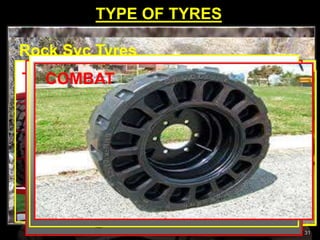
Earth Mover Tyres
Rock Svc Tyres
Truck Tyres (4x4 Vehs)
Solid Tyres
Earthmover TyresGrader TyresCOMBAT
32
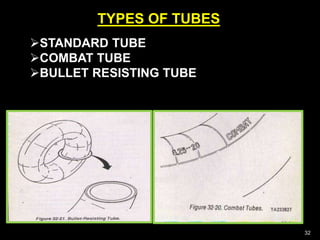
TYPES OF TUBES
STANDARD TUBE
COMBAT TUBE
BULLET RESISTING TUBE.
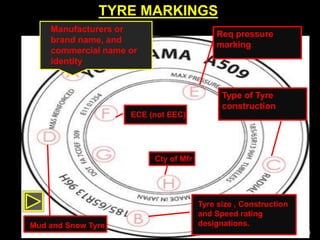
TYRE MARKINGS
33
Manufacturers or
brand name, and
commercial name or
identity
Req pressure
marking
Type of Tyre
construction
Tyre size , Construction
and Speed rating
designations.
Cty of Mfr
ECE (not EEC)
Mud and Snow Tyre
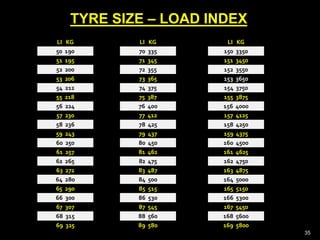
35
LI KG
50 190
51 195
52 200
53 206
54 212
55 218
56 224
57 230
58 236
59 243
60 250
61 257
62 265
63 272
64 280
65 290
66 300
67 307
68 315
69 325
LI KG
70 335
71 345
72 355
73 365
74 375
75 387
76 400
77 412
78 425
79 437
80 450
81 462
82 475
83 487
84 500
85 515
86 530
87 545
88 560
89 580
LI KG
150 3350
151 3450
152 3550
153 3650
154 3750
155 3875
156 4000
157 4125
158 4250
159 4375
160 4500
161 4625
162 4750
163 4875
164 5000
165 5150
166 5300
167 5450
168 5600
169 5800
TYRE SIZE – LOAD INDEX
36
STAGE 2
LATEST TRENDS
37
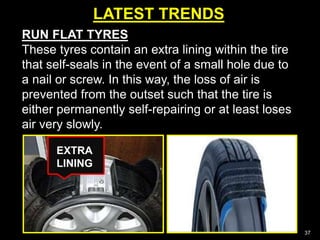
RUN FLAT TYRES
These tyres contain an extra lining within the tire
that self-seals in the event of a small hole due to
a nail or screw. In this way, the loss of air is
prevented from the outset such that the tire is
either permanently self-repairing or at least loses
air very slowly.
EXTRA
LINING
LATEST TRENDS
38
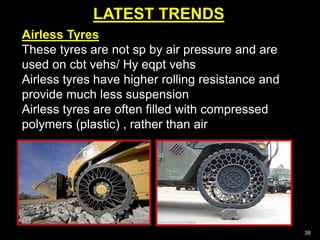
Airless Tyres
These tyres are not sp by air pressure and are
used on cbt vehs/ Hy eqpt vehs
Airless tyres have higher rolling resistance and
provide much less suspension
Airless tyres are often filled with compressed
polymers (plastic) , rather than air
LATEST TRENDS
39
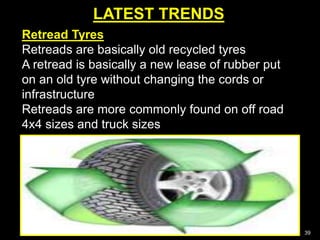
Retread Tyres
Retreads are basically old recycled tyres
A retread is basically a new lease of rubber put
on an old tyre without changing the cords or
infrastructure
Retreads are more commonly found on off road
4x4 sizes and truck sizes
SAFETY MEASURES
40
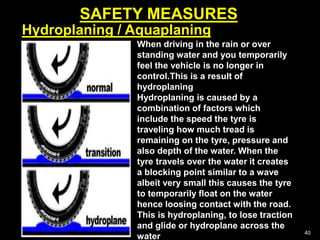
Hydroplaning / Aquaplaning
When driving in the rain or over
standing water and you temporarily
feel the vehicle is no longer in
control.This is a result of
hydroplaning
Hydroplaning is caused by a
combination of factors which
include the speed the tyre is
traveling how much tread is
remaining on the tyre, pressure and
also depth of the water. When the
tyre travels over the water it creates
a blocking point similar to a wave
albeit very small this causes the tyre
to temporarily float on the water
hence loosing contact with the road.
This is hydroplaning, to lose traction
and glide or hydroplane across the
water
SAFETY MEASURES
41
Wheel Balancing
Steering vibrations is a consequence of Veh’s
tyres not being balanced
In most cases if you feel the vibration and
shaking on the steering then it’s your front wheels
that need balancing and for those that feel it on
their rear then it’s the rear wheels that need
balancing
If the wheels are not balanced, driving can
be very annoying and this imbalance has a
knock on effect on other components
including suspension and tyres
SAFETY MEASURES
43
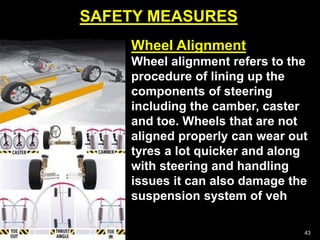
Wheel Alignment
Wheel alignment refers to the
procedure of lining up the
components of steering
including the camber, caster
and toe. Wheels that are not
aligned properly can wear out
tyres a lot quicker and along
with steering and handling
issues it can also damage the
suspension system of veh
SAFETY MEASURES
44
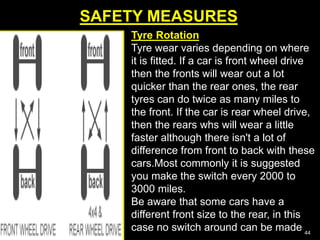
Tyre Rotation
Tyre wear varies depending on where
it is fitted. If a car is front wheel drive
then the fronts will wear out a lot
quicker than the rear ones, the rear
tyres can do twice as many miles to
the front. If the car is rear wheel drive,
then the rears whs will wear a little
faster although there isn't a lot of
difference from front to back with these
cars.Most commonly it is suggested
you make the switch every 2000 to
3000 miles.
Be aware that some cars have a
different front size to the rear, in this
case no switch around can be made
SAFETY MEASURES
45
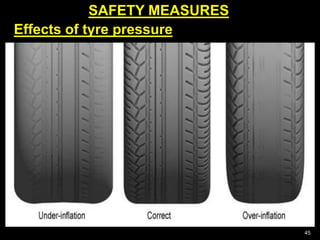
Effects of tyre pressure
RECOMMENDATIONS
46
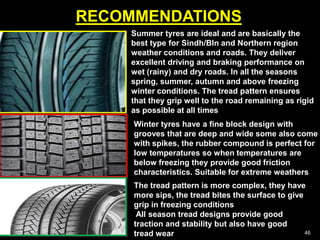
Summer tyres are ideal and are basically the
best type for Sindh/Bln and Northern region
weather conditions and roads. They deliver
excellent driving and braking performance on
wet (rainy) and dry roads. In all the seasons
spring, summer, autumn and above freezing
winter conditions. The tread pattern ensures
that they grip well to the road remaining as rigid
as possible at all times
Winter tyres have a fine block design with
grooves that are deep and wide some also come
with spikes, the rubber compound is perfect for
low temperatures so when temperatures are
below freezing they provide good friction
characteristics. Suitable for extreme weathers
The tread pattern is more complex, they have
more sips, the tread bites the surface to give
grip in freezing conditions
All season tread designs provide good
traction and stability but also have good
tread wear
CONCL
47
CONCL
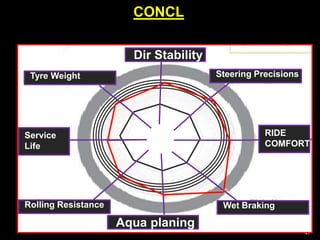
Dir Stability
Steering Precisions
RIDE
COMFORT
Wet Braking
Aqua planing
Rolling Resistance
Service
Life
Tyre Weight
48
THANKYOU
49

Tyres and tubes

  • 2.
  • 3.
    I RODUCT IO N TN
  • 4.
    4 AIM To teach studentoffrs about the construction of tyres and tubes
  • 5.
    SEQ STAGE 1 TYRE CONST TREADPATTERNS, TYPES OF TYRE AND TUBES TYRE MARKING LOADING INDEX AND SPEED RATING 5
  • 6.
    6 STAGE 2 LATEST TRENDS SAFETYMEASURES RECOMMENDATIONS CONCL SEQ
  • 7.
    TYRE BASICS  Atyre is a ring-shaped covering that fits around a wh rim to protect it and enable better veh performance by providing a flexible cushion that absorbs shock while keeping the wh in close contact with the gr.  The fundamental materials of modern tires are synthetic rubber, natural rubber, fabric and wire  They consist of a tread and a body. The tread provides traction while the body ensures sp 7
  • 8.
  • 9.
    TYRE CONST 10 SIPES Small, slit-likegrooves in the tread blocks that allow the blocks to flex. This added flexibility increases traction by creating an additional biting edge. Sipes are especially helpful on ice, light snow and loose dirt GROOVES Create voids for better water channeling on wet road surfaces. Grooves are the most efficient way of channeling water from in front of the tyres to behind it. BLOCKS Segments that make up the majority of a tyre's tread. RIBS Straight-lined row of blocks that create a circumferential contact "band." DIMPLES These are the indentations in the tread, normally towards the outer edge of the tyre SHOULDERS Provide continuous contact with the road while maneuvering. The shoulders wrap slightly over the inner and outer sidewall of a tyre.
  • 10.
  • 11.
    13 TREAD PATTERNS Rib Shape AsymmetricPattern Block Shape Zig Zag Shape V Shape
  • 12.
    TREAD PATTERNS NON-DIRECTIONAL MUD ANDSNOW DIRECTIONAL MUD AND SNOW 14 Groove The groove is the hollow part or the tread. The grooves are cut which makes the tyre pattern. The hollow part (the groove) is designed to channel the water out and away. When tread wears the groove becomes less hollow and apparent. Design of the groove effects the performance and the quality of the tyre. Pitch:- The pitch/cuff is the small tread at the edge of both sides of the tyre, as shown in the picture on the left. The pitch often wears out before the wrest of the tyre. The funPitch:- The pitch/cuff is the small tread at the edge of both sides of the tyre, as shown in the picture on the left. The pitch often wears out before the wrest of the tyre. The fun Pitch  The pitch/cuff is the small tread at the edge of both sides of the tyre  The func of the pitch is to enhance the performance by providing better steering and stability  The pitch is mostly visible on winter tyres, and it func to byte the rd and grip the ice
  • 13.
    NON-DIRECTIONAL MUD AND SNOW DIRECTIONALMUD AND SNOW 15 Rib Shape  The design is like a rib shape with the grooves running from the cen to the edges like a rib pattern  This pattern aids faster water drainage and hence gives good traction on wet rds  It is commonly found and suitable for all car types.  The disadv of this type of design is that it is rotational pattern TREAD PATTERNS
  • 14.
    NON-DIRECTIONAL MUD AND SNOW DIRECTIONALMUD AND SNOW 16 Assymetric Pattern  It has a diff design on the inside to the outside. It looks like two different tyres joined in the middle.  The sides differ in pattern to give diff functionality  The inside offers better cornering traction while the outside is designed to channel water away. TREAD PATTERNS
  • 15.
    18 Block Shape  Thispattern has a block shape design  The grooves are very small the tread pattern is very tight and close  The advances in tread design have seen this tyre less in use  It was very common on passenger cars up till the 90’s. Today it is mostly seen on winter and all season type tyres. TREAD PATTERNS
  • 16.
    19 Zig Zag Shape It’s a classic tread design for passenger vehs.  Today most van tyres are still using this zigzag design  Success of this design in commercial use is because of the grooves that are cut in a zigzag gives the tyre low rolling resistance, low heat generation ideal for the long journeys TREAD PATTERNS
  • 17.
    20 V type pattern The tread pattern ensures that they grip well to the rd remaining as rigid as possible at all times TREAD PATTERNS
  • 18.
    NON-DIRECTIONAL MUD AND SNOW CROSSCTY ROCK SVC DIRECTIONAL MUD AND SNOW 21 TREAD PATTERNS
  • 19.
    22 Radial tyres Bias Tyres Performancetyres All round tyres Wet-weather tyres Winter or snow tyres All terrain tyres TYPES OF TYRES Truck or Van tyres Combat tyres Passenger tyres Rock svc tyres Earthmover tyres Grader tyres
  • 20.
    RADIAL AND BIASTYRES 23  A Radial-ply tire is a particular design of veh tyre  In this design, the cord plies are arr at 90 deg to the dir of travel, or r adially (from the centre of the tire)  Series of plies of cord reinforces a tire.  The radial cords in the sidewall allow it to act like a spring, giving flexibility and ride comfort.
  • 21.
  • 22.
    TYPE OF TYRES 26 Performancetyres Performance tyres are designed for grip and driving performance rather than longevity, and use softer rubber compounds. The tread pattern utilised in performance tyres will often utilise an asymmetric pattern, as the outside tread pattern is designed to channel water away and the inside pattern offers better handling. Performance tyres are often wider than the normal tyre and are often used on larger rim size wheels.
  • 23.
    TYPE OF TYRES 27 All-Roundtyres All round tyres are found on most cars and are designed to handle most of the weather and road conditions that motorists will encounter except for the extremes such as snow, ice, mud and dirt Wet-Weather tyres Wet weather tyres are especially designed for driving in wet conditions. Tread pattern is deep and designed to spill water away from the tyre. The rubber compound is even softer than performance tyres and is designed to heat up quickly and provide more grip on the road
  • 24.
    TYPE OF TYRES 28 Snowtyres Snow tyres are designed for roads with regular snow and ice. The tread pattern is much larger than normal tyres and as a result is much noisier. Snow tyres should only be used in snow and ice conditions as the tyres wear quickly on dry roads and damage the road surface.
  • 25.
    TYPE OF TYRES 29 All-terraintyres All terrain tyres are used on 4WD vehicles. Designed for handling a wide range of on-road and off-road conditions. They have stiffer sidewalls and large tread patterns. All terrain tyres fall into two main groups – soft off-road and off-road tyres. Soft off road tyres are designed primarily to be used on sealed roads, with the tread patterns resembling normal car tyres. They are engineered to be quieter on sealed roads but are able to handle some off-road conditions like gravel, dirt and sand. Off-road tyres are designed to handle unsealed roads and off-the-beaten track envmts.Off-road tyes are noisy and wear more quickly on dry, sealed roads.
  • 26.
    TYPE OF TYRES 30 Truckor Van tyres Tyres used in commercial vehicles will often employ a classic zig zag pattern and are designed to offer low rolling resistance and low heat generation, which makes them ideal for the long distances that commercial vans and trucks travel. The disadvantages of the zig zag pattern include poor cornering and a lack of grip in wet conditions
  • 27.
    TYPE OF TYRES 31 EarthMover Tyres Rock Svc Tyres Truck Tyres (4x4 Vehs) Solid Tyres Earthmover TyresGrader TyresCOMBAT
  • 28.
    32 TYPES OF TUBES STANDARDTUBE COMBAT TUBE BULLET RESISTING TUBE.
  • 29.
    TYRE MARKINGS 33 Manufacturers or brandname, and commercial name or identity Req pressure marking Type of Tyre construction Tyre size , Construction and Speed rating designations. Cty of Mfr ECE (not EEC) Mud and Snow Tyre
  • 30.
    35 LI KG 50 190 51195 52 200 53 206 54 212 55 218 56 224 57 230 58 236 59 243 60 250 61 257 62 265 63 272 64 280 65 290 66 300 67 307 68 315 69 325 LI KG 70 335 71 345 72 355 73 365 74 375 75 387 76 400 77 412 78 425 79 437 80 450 81 462 82 475 83 487 84 500 85 515 86 530 87 545 88 560 89 580 LI KG 150 3350 151 3450 152 3550 153 3650 154 3750 155 3875 156 4000 157 4125 158 4250 159 4375 160 4500 161 4625 162 4750 163 4875 164 5000 165 5150 166 5300 167 5450 168 5600 169 5800 TYRE SIZE – LOAD INDEX
  • 31.
  • 32.
    LATEST TRENDS 37 RUN FLATTYRES These tyres contain an extra lining within the tire that self-seals in the event of a small hole due to a nail or screw. In this way, the loss of air is prevented from the outset such that the tire is either permanently self-repairing or at least loses air very slowly. EXTRA LINING
  • 33.
    LATEST TRENDS 38 Airless Tyres Thesetyres are not sp by air pressure and are used on cbt vehs/ Hy eqpt vehs Airless tyres have higher rolling resistance and provide much less suspension Airless tyres are often filled with compressed polymers (plastic) , rather than air
  • 34.
    LATEST TRENDS 39 Retread Tyres Retreadsare basically old recycled tyres A retread is basically a new lease of rubber put on an old tyre without changing the cords or infrastructure Retreads are more commonly found on off road 4x4 sizes and truck sizes
  • 35.
    SAFETY MEASURES 40 Hydroplaning /Aquaplaning When driving in the rain or over standing water and you temporarily feel the vehicle is no longer in control.This is a result of hydroplaning Hydroplaning is caused by a combination of factors which include the speed the tyre is traveling how much tread is remaining on the tyre, pressure and also depth of the water. When the tyre travels over the water it creates a blocking point similar to a wave albeit very small this causes the tyre to temporarily float on the water hence loosing contact with the road. This is hydroplaning, to lose traction and glide or hydroplane across the water
  • 36.
    SAFETY MEASURES 41 Wheel Balancing Steeringvibrations is a consequence of Veh’s tyres not being balanced In most cases if you feel the vibration and shaking on the steering then it’s your front wheels that need balancing and for those that feel it on their rear then it’s the rear wheels that need balancing If the wheels are not balanced, driving can be very annoying and this imbalance has a knock on effect on other components including suspension and tyres
  • 37.
    SAFETY MEASURES 43 Wheel Alignment Wheelalignment refers to the procedure of lining up the components of steering including the camber, caster and toe. Wheels that are not aligned properly can wear out tyres a lot quicker and along with steering and handling issues it can also damage the suspension system of veh
  • 38.
    SAFETY MEASURES 44 Tyre Rotation Tyrewear varies depending on where it is fitted. If a car is front wheel drive then the fronts will wear out a lot quicker than the rear ones, the rear tyres can do twice as many miles to the front. If the car is rear wheel drive, then the rears whs will wear a little faster although there isn't a lot of difference from front to back with these cars.Most commonly it is suggested you make the switch every 2000 to 3000 miles. Be aware that some cars have a different front size to the rear, in this case no switch around can be made
  • 39.
  • 40.
    RECOMMENDATIONS 46 Summer tyres areideal and are basically the best type for Sindh/Bln and Northern region weather conditions and roads. They deliver excellent driving and braking performance on wet (rainy) and dry roads. In all the seasons spring, summer, autumn and above freezing winter conditions. The tread pattern ensures that they grip well to the road remaining as rigid as possible at all times Winter tyres have a fine block design with grooves that are deep and wide some also come with spikes, the rubber compound is perfect for low temperatures so when temperatures are below freezing they provide good friction characteristics. Suitable for extreme weathers The tread pattern is more complex, they have more sips, the tread bites the surface to give grip in freezing conditions All season tread designs provide good traction and stability but also have good tread wear
  • 41.
    CONCL 47 CONCL Dir Stability Steering Precisions RIDE COMFORT WetBraking Aqua planing Rolling Resistance Service Life Tyre Weight
  • 42.
  • 43.