Chapter 5
Thermochemistry
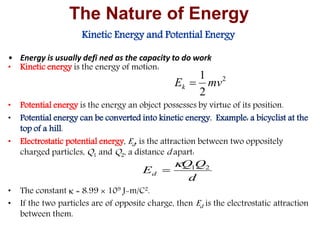
Kinetic Energy and Potential Energy
• Energy is usually defi ned as the capacity to do work
• Kinetic energy is the energy of motion:
• Potential energy is the energy an object possesses by virtue of its position.
• Potential energy can be converted into kinetic energy. Example: a bicyclist at the
top of a hill.
• Electrostatic potential energy, Ed, is the attraction between two oppositely
charged particles, Q1 and Q2, a distance d apart:
• The constant  = 8.99  109 J-m/C2.
• If the two particles are of opposite charge, then Ed is the electrostatic attraction
between them.
2
2
1
mvEk 
The Nature of Energy
d
QQ
Ed
21

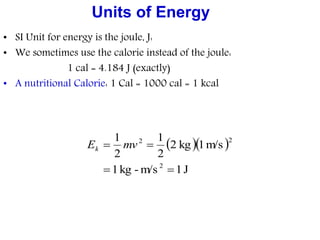
Units of Energy
• SI Unit for energy is the joule, J:
• We sometimes use the calorie instead of the joule:
1 cal = 4.184 J (exactly)
• A nutritional Calorie: 1 Cal = 1000 cal = 1 kcal
  
J1m/s-kg1
m/s1kg2
2
1
2
1
2
22

 mvEk
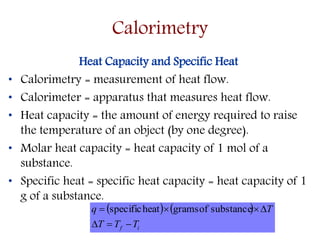
Heat Capacity and Specific Heat
• Calorimetry = measurement of heat flow.
• Calorimeter = apparatus that measures heat flow.
• Heat capacity = the amount of energy required to raise
the temperature of an object (by one degree).
• Molar heat capacity = heat capacity of 1 mol of a
substance.
• Specific heat = specific heat capacity = heat capacity of 1
g of a substance.
   
if TTT
Tq

 substanceofgramsheatspecific
Calorimetry
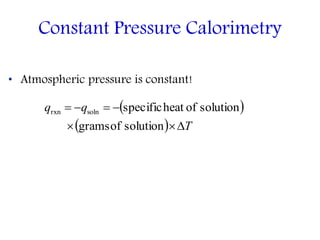
• Atmospheric pressure is constant!
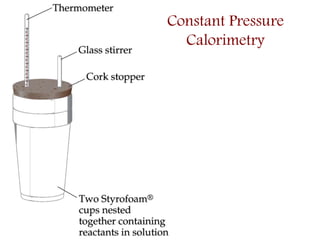
Constant Pressure Calorimetry
 
  T
qq


solutionofgrams
solutionofheatspecificsolnrxn
Constant Pressure
Calorimetry
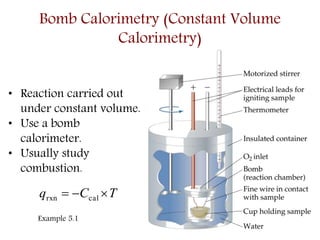
• Reaction carried out
under constant volume.
• Use a bomb
calorimeter.
• Usually study
combustion.
Bomb Calorimetry (Constant Volume
Calorimetry)
TCq  calrxn
Example 5.1
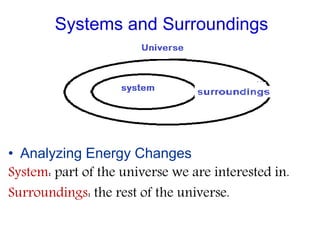
Systems and Surroundings
• Analyzing Energy Changes
System: part of the universe we are interested in.
Surroundings: the rest of the universe.
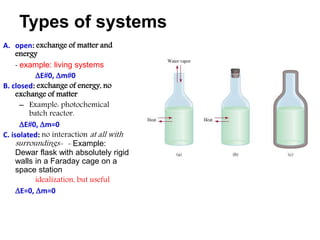
Types of systems
A. open: exchange of matter and
energy
- example: living systems
E0, m0
B. closed: exchange of energy, no
exchange of matter
– Example: photochemical
batch reactor.
E0, m=0
C. isolated: no interaction at all with
surroundings- - Example:
Dewar flask with absolutely rigid
walls in a Faraday cage on a
space station
idealization, but useful
E=0, m=0
Thermochemical Equations
• Enthalpy, H: Heat transferred between the system
and surroundings carried out under constant
pressure.
• Enthalpies of reactions
• H = Hproducts - Hreactants
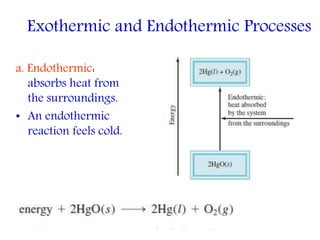
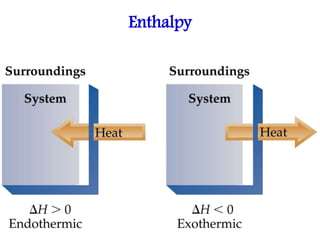
Exothermic and Endothermic Processes
a. Endothermic:
absorbs heat from
the surroundings.
• An endothermic
reaction feels cold.
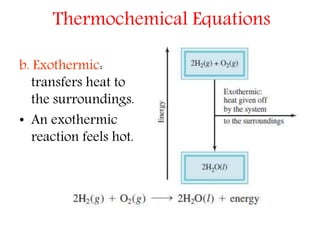
Thermochemical Equations
b. Exothermic:
transfers heat to
the surroundings.
• An exothermic
reaction feels hot.
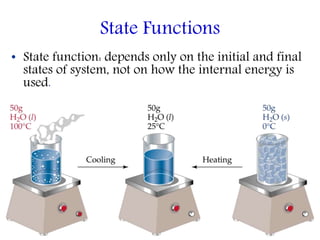
State Functions
• State function: depends only on the initial and final
states of system, not on how the internal energy is
used.
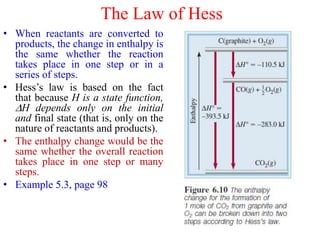
The Law of Hess
• When reactants are converted to
products, the change in enthalpy is
the same whether the reaction
takes place in one step or in a
series of steps.
• Hess’s law is based on the fact
that because H is a state function,
H depends only on the initial
and final state (that is, only on the
nature of reactants and products).
• The enthalpy change would be the
same whether the overall reaction
takes place in one step or many
steps.
• Example 5.3, page 98
Enthalpies of formation
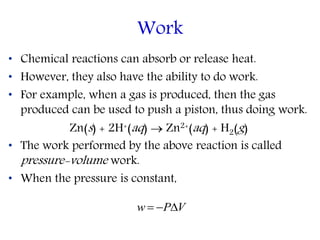
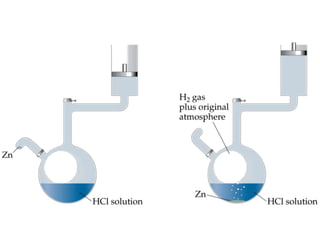
• Chemical reactions can absorb or release heat.
• However, they also have the ability to do work.
• For example, when a gas is produced, then the gas
produced can be used to push a piston, thus doing work.
Zn(s) + 2H+(aq)  Zn2+(aq) + H2(g)
• The work performed by the above reaction is called
pressure-volume work.
• When the pressure is constant,
Work
VPw 
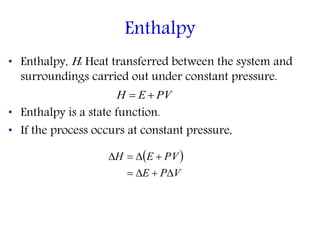
• Enthalpy, H: Heat transferred between the system and
surroundings carried out under constant pressure.
• Enthalpy is a state function.
• If the process occurs at constant pressure,
Enthalpy
PVEH 
 
VPE
PVEH


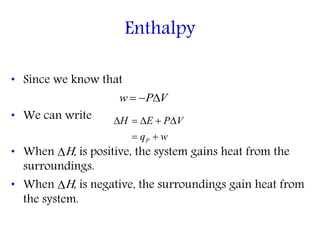
• Since we know that
• We can write
• When H, is positive, the system gains heat from the
surroundings.
• When H, is negative, the surroundings gain heat from
the system.
Enthalpy
VPw 
wq
VPEH
P 

Enthalpy
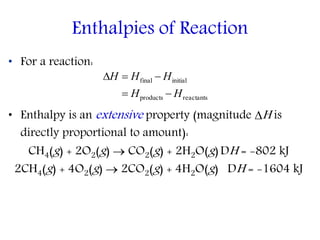
• For a reaction:
• Enthalpy is an extensive property (magnitude H is
directly proportional to amount):
CH4(g) + 2O2(g)  CO2(g) + 2H2O(g)DH = -802 kJ
2CH4(g) + 4O2(g)  2CO2(g) + 4H2O(g) DH = -1604 kJ
Enthalpies of Reaction
reactantsproducts
initialfinal
HH
HHH


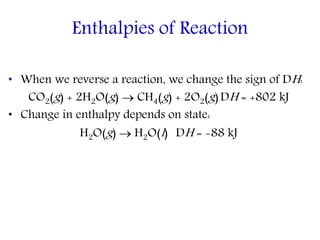
• When we reverse a reaction, we change the sign of DH:
CO2(g) + 2H2O(g)  CH4(g) + 2O2(g)DH = +802 kJ
• Change in enthalpy depends on state:
H2O(g)  H2O(l) DH = -88 kJ
Enthalpies of Reaction
Transferring Energy
Work and Heat
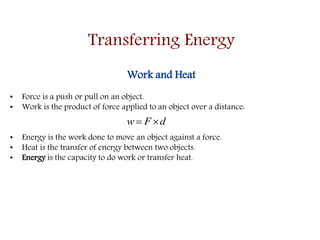
• Force is a push or pull on an object.
• Work is the product of force applied to an object over a distance:
• Energy is the work done to move an object against a force.
• Heat is the transfer of energy between two objects.
• Energy is the capacity to do work or transfer heat.
dFw 
The First Law of Thermodynamics
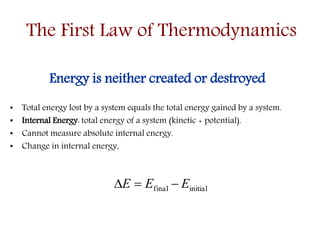
Energy is neither created or destroyed
• Total energy lost by a system equals the total energy gained by a system.
• Internal Energy: total energy of a system (kinetic + potential).
• Cannot measure absolute internal energy.
• Change in internal energy,
initialfinal EEE 
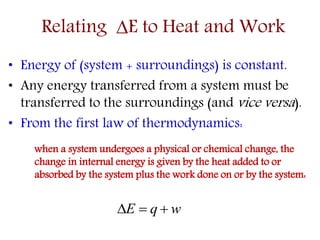
• Energy of (system + surroundings) is constant.
• Any energy transferred from a system must be
transferred to the surroundings (and vice versa).
• From the first law of thermodynamics:
when a system undergoes a physical or chemical change, the
change in internal energy is given by the heat added to or
absorbed by the system plus the work done on or by the system:
Relating E to Heat and Work
wqE 
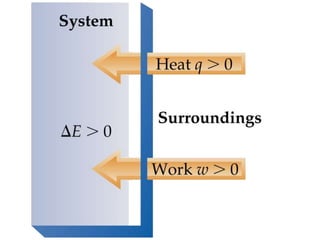
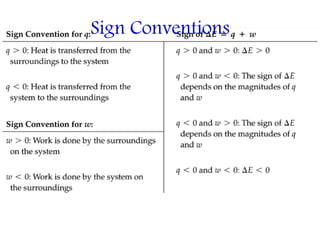
Sign Conventions
Chapter5

Chapter5

  • 1.
  • 2.
    Kinetic Energy andPotential Energy • Energy is usually defi ned as the capacity to do work • Kinetic energy is the energy of motion: • Potential energy is the energy an object possesses by virtue of its position. • Potential energy can be converted into kinetic energy. Example: a bicyclist at the top of a hill. • Electrostatic potential energy, Ed, is the attraction between two oppositely charged particles, Q1 and Q2, a distance d apart: • The constant  = 8.99  109 J-m/C2. • If the two particles are of opposite charge, then Ed is the electrostatic attraction between them. 2 2 1 mvEk  The Nature of Energy d QQ Ed 21 
  • 3.
    Units of Energy •SI Unit for energy is the joule, J: • We sometimes use the calorie instead of the joule: 1 cal = 4.184 J (exactly) • A nutritional Calorie: 1 Cal = 1000 cal = 1 kcal    J1m/s-kg1 m/s1kg2 2 1 2 1 2 22   mvEk
  • 4.
    Heat Capacity andSpecific Heat • Calorimetry = measurement of heat flow. • Calorimeter = apparatus that measures heat flow. • Heat capacity = the amount of energy required to raise the temperature of an object (by one degree). • Molar heat capacity = heat capacity of 1 mol of a substance. • Specific heat = specific heat capacity = heat capacity of 1 g of a substance.     if TTT Tq   substanceofgramsheatspecific Calorimetry
  • 5.
    • Atmospheric pressureis constant! Constant Pressure Calorimetry     T qq   solutionofgrams solutionofheatspecificsolnrxn
  • 6.
  • 7.
    • Reaction carriedout under constant volume. • Use a bomb calorimeter. • Usually study combustion. Bomb Calorimetry (Constant Volume Calorimetry) TCq  calrxn Example 5.1
  • 8.
    Systems and Surroundings •Analyzing Energy Changes System: part of the universe we are interested in. Surroundings: the rest of the universe.
  • 9.
    Types of systems A.open: exchange of matter and energy - example: living systems E0, m0 B. closed: exchange of energy, no exchange of matter – Example: photochemical batch reactor. E0, m=0 C. isolated: no interaction at all with surroundings- - Example: Dewar flask with absolutely rigid walls in a Faraday cage on a space station idealization, but useful E=0, m=0
  • 10.
    Thermochemical Equations • Enthalpy,H: Heat transferred between the system and surroundings carried out under constant pressure. • Enthalpies of reactions • H = Hproducts - Hreactants
  • 11.
    Exothermic and EndothermicProcesses a. Endothermic: absorbs heat from the surroundings. • An endothermic reaction feels cold.
  • 12.
    Thermochemical Equations b. Exothermic: transfersheat to the surroundings. • An exothermic reaction feels hot.
  • 13.
    State Functions • Statefunction: depends only on the initial and final states of system, not on how the internal energy is used.
  • 14.
    The Law ofHess • When reactants are converted to products, the change in enthalpy is the same whether the reaction takes place in one step or in a series of steps. • Hess’s law is based on the fact that because H is a state function, H depends only on the initial and final state (that is, only on the nature of reactants and products). • The enthalpy change would be the same whether the overall reaction takes place in one step or many steps. • Example 5.3, page 98
  • 15.
  • 16.
    • Chemical reactionscan absorb or release heat. • However, they also have the ability to do work. • For example, when a gas is produced, then the gas produced can be used to push a piston, thus doing work. Zn(s) + 2H+(aq)  Zn2+(aq) + H2(g) • The work performed by the above reaction is called pressure-volume work. • When the pressure is constant, Work VPw 
  • 18.
    • Enthalpy, H:Heat transferred between the system and surroundings carried out under constant pressure. • Enthalpy is a state function. • If the process occurs at constant pressure, Enthalpy PVEH    VPE PVEH  
  • 19.
    • Since weknow that • We can write • When H, is positive, the system gains heat from the surroundings. • When H, is negative, the surroundings gain heat from the system. Enthalpy VPw  wq VPEH P  
  • 20.
  • 21.
    • For areaction: • Enthalpy is an extensive property (magnitude H is directly proportional to amount): CH4(g) + 2O2(g)  CO2(g) + 2H2O(g)DH = -802 kJ 2CH4(g) + 4O2(g)  2CO2(g) + 4H2O(g) DH = -1604 kJ Enthalpies of Reaction reactantsproducts initialfinal HH HHH  
  • 22.
    • When wereverse a reaction, we change the sign of DH: CO2(g) + 2H2O(g)  CH4(g) + 2O2(g)DH = +802 kJ • Change in enthalpy depends on state: H2O(g)  H2O(l) DH = -88 kJ Enthalpies of Reaction
  • 23.
    Transferring Energy Work andHeat • Force is a push or pull on an object. • Work is the product of force applied to an object over a distance: • Energy is the work done to move an object against a force. • Heat is the transfer of energy between two objects. • Energy is the capacity to do work or transfer heat. dFw 
  • 24.
    The First Lawof Thermodynamics Energy is neither created or destroyed • Total energy lost by a system equals the total energy gained by a system. • Internal Energy: total energy of a system (kinetic + potential). • Cannot measure absolute internal energy. • Change in internal energy, initialfinal EEE 
  • 25.
    • Energy of(system + surroundings) is constant. • Any energy transferred from a system must be transferred to the surroundings (and vice versa). • From the first law of thermodynamics: when a system undergoes a physical or chemical change, the change in internal energy is given by the heat added to or absorbed by the system plus the work done on or by the system: Relating E to Heat and Work wqE 
  • 27.