THERMOCHEMISTRY Chapter 5
WARNING There is a high risk of me assuming you know or understand things that you do not.  Stop me as necessary.
The Nature of Energy Section 5.1 is really physics Let’s look at those parts that are germane to chemistry
Kinetic energy E k = ½ mv 2 Kinetic energy depends on mass and velocity Temperature is a measure of the average kinetic energy of the molecules in a sample Question: why does an iceberg have more energy, then a bucket of molten iron? The Nature of Energy
Potential energy Usually associated with positional E p ; the rock on top of the hill In chemistry, we care more about chemical and electrostatic potential energies Chemical energies will be covered later in the chapter  The Nature of Energy
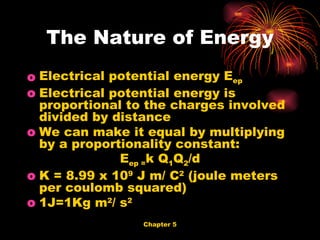
Electrical potential energy E ep Electrical potential energy is proportional to the charges involved divided by distance We can make it equal by multiplying by a proportionality constant: E ep = k Q 1 Q 2 /d K = 8.99 x 10 9  J m/ C 2  (joule meters per coulomb squared) 1J=1Kg m 2 / s 2 The Nature of Energy
Calorie: a measure of heat Capitalization is IMPORTANT: 1c =4.184 J 1C = 1000c Food wrappers use C One c is the energy required to heat 1g of water one Kelvin Yes, in thermodynamics K and R must be used instead of C and F The Nature of Energy
Transferring energy: work & heat Work  w = F orce  x d istance Heat is energy transferred between objects of different temperatures (you DO NOT want to know the equations for heat transfer yet) The Nature of Energy
Stoichiometry is accounting for mass (atoms in must equal atoms out) Thermodynamics is accounting for energy Thermodynamics
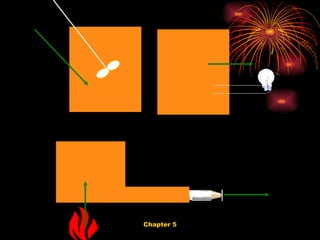
System & Surroundings - The system is what we are looking at, the surroundings are the rest of the universe If work or energy are  POSITIVE , work or heat go  INTO  the system,  NEGATIVE  work or heat go  OUT Thermodynamics
`
Internal Energy – the sum of ALL types of energy contained in a system In thermodynamics, we look at the changes in energy, ∆E ∆ E = E final  – E start If ∆E is negative, energy left the system Thermodynamics
The first law of thermodynamics equates energy, heat and work ∆ E = ∆q (heat)  + ∆w (work) In English    the change in energy of a system is the sum of the change in heat and the work done It means “You can only get out what you put in” TANSTAAFL (There aint no such thing as a free lunch) Thermodynamics
∆ E of reactions: ∆E rxn Some reactions liberate heat, others require heat to go HCl aq + NaOH aq    H 2 O+ NaCl+ HEAT This is exothermic (heat exits) HgS (s)  + HEAT    Hg (l)  + S 9s) This is endothermic Thermodynamics
State functions (and I DON’T mean dinner with Barak) State functions ONLY depend on what the state system is in NOW.  I’m in front of the room. That’s a state system.  It doesn’t mater how I got here, right now, I’m here. Thermodynamics
The distance I traveled to get here is NOT a state function.  I could have went right from the door to here.  I could have come in, put my stuff down on the first desk, went to the bathroom (washed my hands for 20 sec), came back, and walked to the front. Thermodynamics
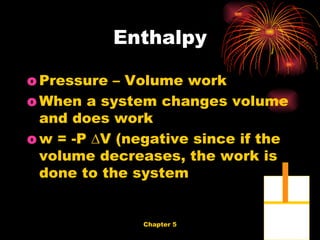
Pressure – Volume work When a system changes volume and does work w = -P ∆V (negative since if the volume decreases, the work is done to the system Enthalpy
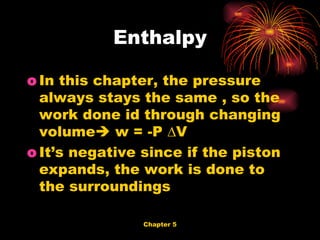
In this chapter, the pressure always stays the same , so the work done id through changing volume   w = -P ∆V It’s negative since if the piston expands, the work is done to the surroundings Enthalpy
Enthalpy (H) is from the Greek word  enthalpein  meaning to warm It equals the heat flow when P-V work is the only work done H = E + PV or ∆H = ∆ E + P ∆ V  Enthalpy
If  E = q + w ,  then we can put it in the enthalpy reaction as: ∆ H =  ∆E  – w ∆ H = ∆( q +w )  -w ∆ H = ∆q p Enthalpy
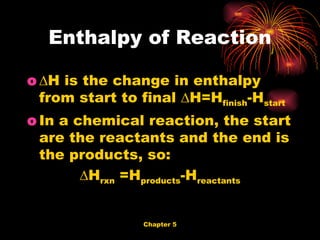
∆ H is the change in enthalpy from start to final ∆H=H finish -H start In a chemical reaction, the start are the reactants and the end is the products, so: ∆ H rxn  =H products -H reactants Enthalpy of Reaction
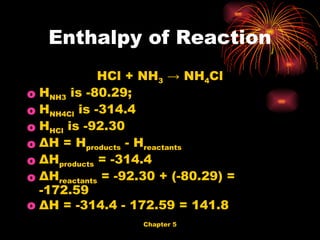
HCl + NH 3  -> NH 4 Cl H NH3  is -80.29;  H NH4Cl  is -314.4 H HCl  is -92.30  ΔH = H products  - H reactants    ΔH products  = -314.4   ΔH reactants  = -92.30 + (-80.29) = -172.59   ΔH = -314.4 - 172.59 = 141.8 Enthalpy of Reaction
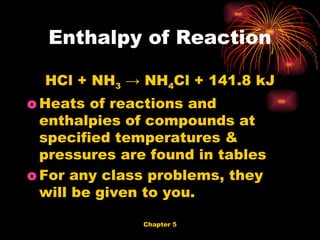
HCl + NH 3  -> NH 4 Cl + 141.8 kJ Heats of reactions and enthalpies of compounds at specified temperatures & pressures are found in tables For any class problems, they will be given to you. Enthalpy of Reaction
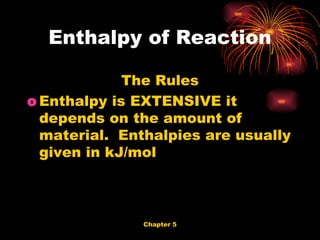
The Rules Enthalpy is EXTENSIVE it depends on the amount of material.  Enthalpies are usually given in kJ/mol Enthalpy of Reaction
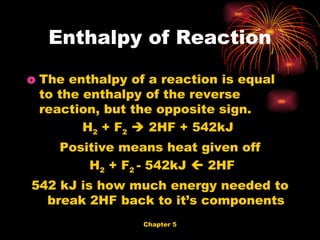
The enthalpy of a reaction is equal to the enthalpy of the reverse reaction, but the opposite sign. H 2  + F 2     2HF + 542kJ  Positive means heat given off H 2  + F 2  - 542kJ    2HF 542 kJ is how much energy needed to break 2HF back to it’s components Enthalpy of Reaction
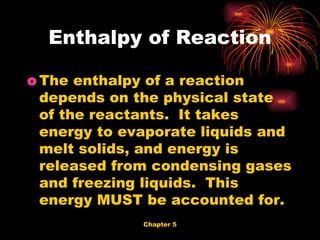
The enthalpy of a reaction depends on the physical state of the reactants.  It takes energy to evaporate liquids and melt solids, and energy is released from condensing gases and freezing liquids.  This energy MUST be accounted for. Enthalpy of Reaction
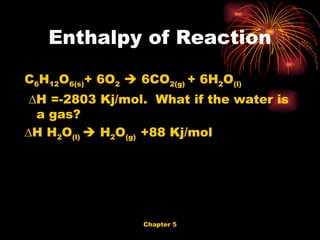
Enthalpy of Reaction C 6 H 12 O 6(s) + 6O 2     6CO 2(g)  + 6H 2 O (l)  ∆ H =-2803 Kj/mol.  What if the water is a gas? ∆ H H 2 O (l)    H 2 O (g)  +88 Kj/mol
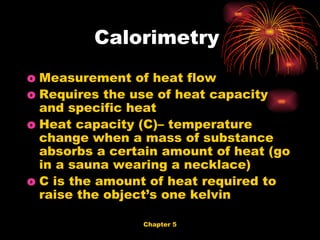
Measurement of heat flow Requires the use of heat capacity and specific heat Heat capacity (C)– temperature change when a mass of substance absorbs a certain amount of heat (go in a sauna wearing a necklace) C is the amount of heat required to raise the object’s one kelvin Calorimetry
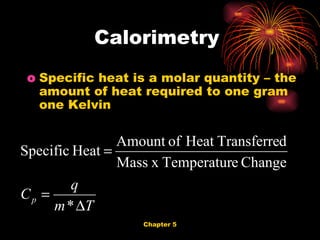
Calorimetry  Specific heat is a molar quantity – the amount of heat required to one gram one Kelvin
How J are required to raise the temperature of 250g of Fe from 25 o C to 100 o C? 25 o C = 298K, 100 o C = 373K C s Fe= 0.45 J/gK C s = q/m∆T    0.45= q/250*75 q= 8437.5J Calorimetry
Works for solutions too. How J are required to raise the temperature of 250g of 2M NaCl from 25 o C to 100 o C?  C s sol= 1.2 J/gK C s = q/m∆T    1.2= q/250*75 q= 22,500J Calorimetry
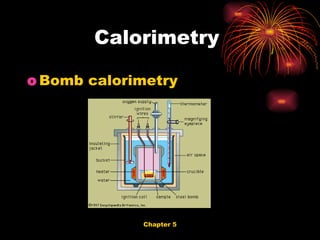
Bomb calorimetry  Calorimetry
In a calorimeter, all the energy entering the system can be accounted for. If we subtract the energy inputs, the only other heat source is the burning sample. So the heat derived from the sample is the ∆H rxn Calorimetry
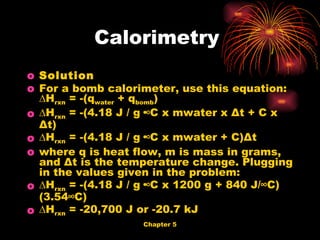
When a 1.000 g sample of the rocket fuel hydrazine, N 2 H 4 , is burned in a bomb calorimeter which contains 1200 g of water, the temperature rises from 24.62°C to 28.16°C. If the C for the bomb is 840 J/°C, calculate ∆ H rxn  reaction for combustion of a one-gram sample  ∆ H rxn  for combustion of one mole of hydrazine in the bomb calorimeter  Calorimetry
Solution   For a bomb calorimeter, use this equation: ∆H rxn  = -(q water  + q bomb ) ∆ H rxn  = -(4.18 J / g·°C x mwater x Δt + C x Δt) ∆ H rxn  = -(4.18 J / g·°C x mwater + C)Δt  where q is heat flow, m is mass in grams, and Δt is the temperature change. Plugging in the values given in the problem: ∆ H rxn  = -(4.18 J / g·°C x 1200 g + 840 J/°C)(3.54°C) ∆ H rxn  = -20,700 J or -20.7 kJ  Calorimetry
Hess’s Law If a reaction is carried out in a series of steps, the ∆H rxn   is the sum of all the intermediate ∆Hs\ The works if you can artificially separate a reaction into a number of steps. There are tables of ∆H rxn  to help
Sometimes the tables of ∆H rxn  use fractions in the chemical equation. If you have a problem using Hess’s law, you have to look at the tables and try to break your reaction into steps that are listed there. Hess’s Law
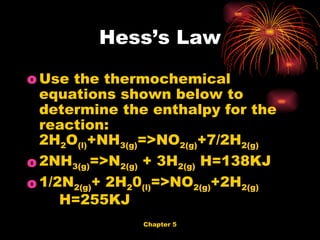
Use the thermochemical equations shown below to determine the enthalpy for the reaction: 2H 2 O (l) +NH 3(g) =>NO 2(g) +7/2H 2(g)   2NH 3(g) =>N 2(g)  + 3H 2(g)  H=138KJ  1/2N 2(g) + 2H 2 0 (l) =>NO 2(g) +2H 2(g)   H=255KJ  Hess’s Law
Hess’s Law 2H 2 O (l) +NH 3(g) =>NO 2(g) +7/2H 2(g)   2NH 3(g) =>N 2(g)  + 3H 2(g)  H=138KJ We only have 1 NH 3(g) , let’s divide the equation in half: NH 3(g) => ½ N 2(g)  + 3/2 H 2(g)  H=69KJ ½ N 2(g) + 2H 2 0 (l) =>NO2 (g) +2H 2(g)   H=255KJ
NH 3(g) => ½ N 2(g)  + 3/2 H 2(g)  H=69KJ Eq. 2: ½ N 2(g) + 2H 2 0 (l) =>NO 2(g) +2H 2(g)   H=255KJ  Now add eq. 1 to eq. 2: NH 3(g) +½ N 2(g) + 2H 2 0 (l)     ½ N 2(g)  + 3/2 H 2(g)  NO 2(g) +2H 2(g)  69KJ+255Kj Hess’s Law
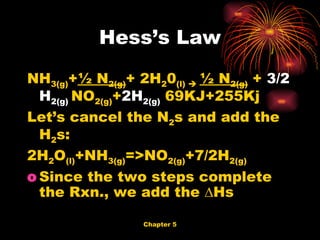
NH 3(g) + ½ N 2(g) + 2H 2 0 (l)     ½ N 2(g)  +  3/2 H 2(g)   NO 2(g) + 2H 2(g)   69KJ+255Kj Let’s cancel the N 2 s and add the H 2 s: 2H 2 O (l) +NH 3(g) =>NO 2(g) +7/2H 2(g) Since the two steps complete the Rxn., we add the ∆Hs Hess’s Law
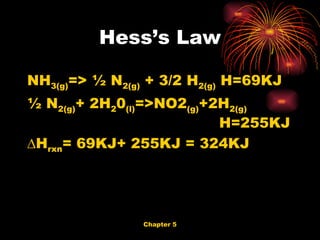
NH 3(g) => ½ N 2(g)  + 3/2 H 2(g)  H=69KJ ½ N 2(g) + 2H 2 0 (l) =>NO2 (g) +2H 2(g)   H=255KJ ∆ H rxn = 69KJ+ 255KJ = 324KJ Hess’s Law
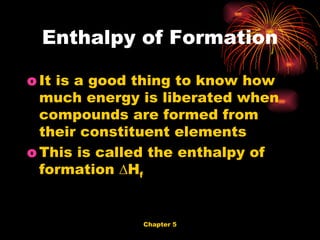
It is a good thing to know how much energy is liberated when compounds are formed from their constituent elements This is called the enthalpy of formation ∆H f Enthalpy of Formation
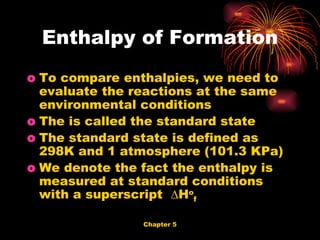
To compare enthalpies, we need to evaluate the reactions at the same environmental conditions The is called the standard state The standard state is defined as 298K and 1 atmosphere (101.3 KPa) We denote the fact the enthalpy is measured at standard conditions with a superscript  ∆H o f Enthalpy of Formation
Elements in their LOWEST ENERGY STATE have enthalpies of 0 The lowest energy state for oxygen is O 2  NOT O.  Energy must be added (495 Kj/mol) to break the molecules, os the enthalpy is not 0 Enthalpy of Formation
Negative  ∆H o f  indicate that heat is given off during formation Positive  ∆H o f  indicate energy must be added during formation Compounds that require energy to be formed are those that will give off energy when decomposing (fuels)  Enthalpy of Formation
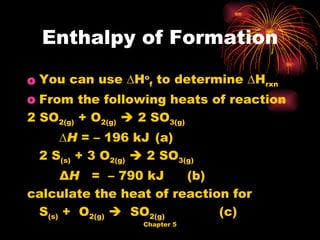
You can use ∆H o f  to determine ∆H rxn From the following heats of reaction 2 SO 2(g)  + O 2(g)     2 SO 3(g)  ∆ H  = – 196 kJ (a) 2 S (s)  + 3 O 2(g)     2 SO 3(g) ∆ H  =  – 790 kJ (b) calculate the heat of reaction for S (s)  +  O 2(g)      SO 2(g) (c) Enthalpy of Formation
Enthalpy of Formation Eq a 2 SO 2(g)  + O 2(g)     2 SO 3(g)  has the 2 SO 2(g)  on the   left.   We can re-write the equation as the reverse reaction if we change the sign of the ∆H   2 SO 3(g)     2 SO 2(g)  + O 2(g)   ∆ H= +196KJ
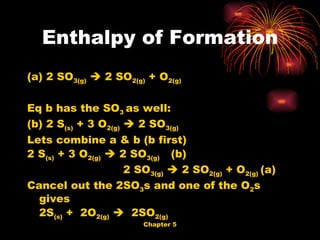
(a) 2 SO 3(g)     2 SO 2(g)  + O 2(g) Eq b has the SO 3  as well: (b) 2 S (s)  + 3 O 2(g)     2 SO 3(g)  Lets combine a & b (b first) 2 S (s)  + 3 O 2(g)     2 SO 3(g)  (b) 2 SO 3(g)     2 SO 2(g)  + O 2(g)  (a) Cancel out the 2SO 3 s and one of the O 2 s gives 2S (s)  +  2O 2(g)      2SO 2(g) Enthalpy of Formation
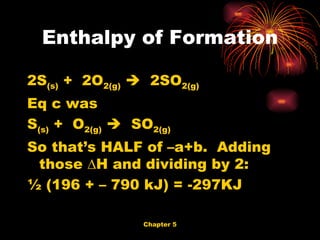
2S (s)  +  2O 2(g)      2SO 2(g) Eq c was  S (s)  +  O 2(g)      SO 2(g) So that’s HALF of –a+b.  Adding those ∆H and dividing by 2: ½ (196 + – 790 kJ) = -297KJ Enthalpy of Formation
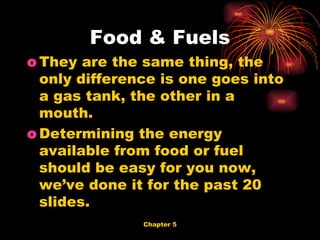
They are the same thing, the only difference is one goes into a gas tank, the other in a mouth. Determining the energy available from food or fuel should be easy for you now, we’ve done it for the past 20 slides. Food & Fuels

C H5

  • 1.
  • 2.
    WARNING There isa high risk of me assuming you know or understand things that you do not. Stop me as necessary.
  • 3.
    The Nature ofEnergy Section 5.1 is really physics Let’s look at those parts that are germane to chemistry
  • 4.
    Kinetic energy Ek = ½ mv 2 Kinetic energy depends on mass and velocity Temperature is a measure of the average kinetic energy of the molecules in a sample Question: why does an iceberg have more energy, then a bucket of molten iron? The Nature of Energy
  • 5.
    Potential energy Usuallyassociated with positional E p ; the rock on top of the hill In chemistry, we care more about chemical and electrostatic potential energies Chemical energies will be covered later in the chapter The Nature of Energy
  • 6.
    Electrical potential energyE ep Electrical potential energy is proportional to the charges involved divided by distance We can make it equal by multiplying by a proportionality constant: E ep = k Q 1 Q 2 /d K = 8.99 x 10 9 J m/ C 2 (joule meters per coulomb squared) 1J=1Kg m 2 / s 2 The Nature of Energy
  • 7.
    Calorie: a measureof heat Capitalization is IMPORTANT: 1c =4.184 J 1C = 1000c Food wrappers use C One c is the energy required to heat 1g of water one Kelvin Yes, in thermodynamics K and R must be used instead of C and F The Nature of Energy
  • 8.
    Transferring energy: work& heat Work w = F orce x d istance Heat is energy transferred between objects of different temperatures (you DO NOT want to know the equations for heat transfer yet) The Nature of Energy
  • 9.
    Stoichiometry is accountingfor mass (atoms in must equal atoms out) Thermodynamics is accounting for energy Thermodynamics
  • 10.
    System & Surroundings- The system is what we are looking at, the surroundings are the rest of the universe If work or energy are POSITIVE , work or heat go INTO the system, NEGATIVE work or heat go OUT Thermodynamics
  • 11.
  • 12.
    Internal Energy –the sum of ALL types of energy contained in a system In thermodynamics, we look at the changes in energy, ∆E ∆ E = E final – E start If ∆E is negative, energy left the system Thermodynamics
  • 13.
    The first lawof thermodynamics equates energy, heat and work ∆ E = ∆q (heat) + ∆w (work) In English  the change in energy of a system is the sum of the change in heat and the work done It means “You can only get out what you put in” TANSTAAFL (There aint no such thing as a free lunch) Thermodynamics
  • 14.
    ∆ E ofreactions: ∆E rxn Some reactions liberate heat, others require heat to go HCl aq + NaOH aq  H 2 O+ NaCl+ HEAT This is exothermic (heat exits) HgS (s) + HEAT  Hg (l) + S 9s) This is endothermic Thermodynamics
  • 15.
    State functions (andI DON’T mean dinner with Barak) State functions ONLY depend on what the state system is in NOW. I’m in front of the room. That’s a state system. It doesn’t mater how I got here, right now, I’m here. Thermodynamics
  • 16.
    The distance Itraveled to get here is NOT a state function. I could have went right from the door to here. I could have come in, put my stuff down on the first desk, went to the bathroom (washed my hands for 20 sec), came back, and walked to the front. Thermodynamics
  • 17.
    Pressure – Volumework When a system changes volume and does work w = -P ∆V (negative since if the volume decreases, the work is done to the system Enthalpy
  • 18.
    In this chapter,the pressure always stays the same , so the work done id through changing volume  w = -P ∆V It’s negative since if the piston expands, the work is done to the surroundings Enthalpy
  • 19.
    Enthalpy (H) isfrom the Greek word enthalpein meaning to warm It equals the heat flow when P-V work is the only work done H = E + PV or ∆H = ∆ E + P ∆ V Enthalpy
  • 20.
    If E= q + w , then we can put it in the enthalpy reaction as: ∆ H = ∆E – w ∆ H = ∆( q +w ) -w ∆ H = ∆q p Enthalpy
  • 21.
    ∆ H isthe change in enthalpy from start to final ∆H=H finish -H start In a chemical reaction, the start are the reactants and the end is the products, so: ∆ H rxn =H products -H reactants Enthalpy of Reaction
  • 22.
    HCl + NH3 -> NH 4 Cl H NH3 is -80.29; H NH4Cl is -314.4 H HCl is -92.30 ΔH = H products - H reactants   ΔH products = -314.4  ΔH reactants = -92.30 + (-80.29) = -172.59  ΔH = -314.4 - 172.59 = 141.8 Enthalpy of Reaction
  • 23.
    HCl + NH3 -> NH 4 Cl + 141.8 kJ Heats of reactions and enthalpies of compounds at specified temperatures & pressures are found in tables For any class problems, they will be given to you. Enthalpy of Reaction
  • 24.
    The Rules Enthalpyis EXTENSIVE it depends on the amount of material. Enthalpies are usually given in kJ/mol Enthalpy of Reaction
  • 25.
    The enthalpy ofa reaction is equal to the enthalpy of the reverse reaction, but the opposite sign. H 2 + F 2  2HF + 542kJ Positive means heat given off H 2 + F 2 - 542kJ  2HF 542 kJ is how much energy needed to break 2HF back to it’s components Enthalpy of Reaction
  • 26.
    The enthalpy ofa reaction depends on the physical state of the reactants. It takes energy to evaporate liquids and melt solids, and energy is released from condensing gases and freezing liquids. This energy MUST be accounted for. Enthalpy of Reaction
  • 27.
    Enthalpy of ReactionC 6 H 12 O 6(s) + 6O 2  6CO 2(g) + 6H 2 O (l) ∆ H =-2803 Kj/mol. What if the water is a gas? ∆ H H 2 O (l)  H 2 O (g) +88 Kj/mol
  • 28.
    Measurement of heatflow Requires the use of heat capacity and specific heat Heat capacity (C)– temperature change when a mass of substance absorbs a certain amount of heat (go in a sauna wearing a necklace) C is the amount of heat required to raise the object’s one kelvin Calorimetry
  • 29.
    Calorimetry Specificheat is a molar quantity – the amount of heat required to one gram one Kelvin
  • 30.
    How J arerequired to raise the temperature of 250g of Fe from 25 o C to 100 o C? 25 o C = 298K, 100 o C = 373K C s Fe= 0.45 J/gK C s = q/m∆T  0.45= q/250*75 q= 8437.5J Calorimetry
  • 31.
    Works for solutionstoo. How J are required to raise the temperature of 250g of 2M NaCl from 25 o C to 100 o C? C s sol= 1.2 J/gK C s = q/m∆T  1.2= q/250*75 q= 22,500J Calorimetry
  • 32.
    Bomb calorimetry Calorimetry
  • 33.
    In a calorimeter,all the energy entering the system can be accounted for. If we subtract the energy inputs, the only other heat source is the burning sample. So the heat derived from the sample is the ∆H rxn Calorimetry
  • 34.
    When a 1.000g sample of the rocket fuel hydrazine, N 2 H 4 , is burned in a bomb calorimeter which contains 1200 g of water, the temperature rises from 24.62°C to 28.16°C. If the C for the bomb is 840 J/°C, calculate ∆ H rxn reaction for combustion of a one-gram sample ∆ H rxn for combustion of one mole of hydrazine in the bomb calorimeter Calorimetry
  • 35.
    Solution For a bomb calorimeter, use this equation: ∆H rxn = -(q water + q bomb ) ∆ H rxn = -(4.18 J / g·°C x mwater x Δt + C x Δt) ∆ H rxn = -(4.18 J / g·°C x mwater + C)Δt where q is heat flow, m is mass in grams, and Δt is the temperature change. Plugging in the values given in the problem: ∆ H rxn = -(4.18 J / g·°C x 1200 g + 840 J/°C)(3.54°C) ∆ H rxn = -20,700 J or -20.7 kJ Calorimetry
  • 36.
    Hess’s Law Ifa reaction is carried out in a series of steps, the ∆H rxn is the sum of all the intermediate ∆Hs\ The works if you can artificially separate a reaction into a number of steps. There are tables of ∆H rxn to help
  • 37.
    Sometimes the tablesof ∆H rxn use fractions in the chemical equation. If you have a problem using Hess’s law, you have to look at the tables and try to break your reaction into steps that are listed there. Hess’s Law
  • 38.
    Use the thermochemicalequations shown below to determine the enthalpy for the reaction: 2H 2 O (l) +NH 3(g) =>NO 2(g) +7/2H 2(g) 2NH 3(g) =>N 2(g) + 3H 2(g) H=138KJ 1/2N 2(g) + 2H 2 0 (l) =>NO 2(g) +2H 2(g) H=255KJ Hess’s Law
  • 39.
    Hess’s Law 2H2 O (l) +NH 3(g) =>NO 2(g) +7/2H 2(g) 2NH 3(g) =>N 2(g) + 3H 2(g) H=138KJ We only have 1 NH 3(g) , let’s divide the equation in half: NH 3(g) => ½ N 2(g) + 3/2 H 2(g) H=69KJ ½ N 2(g) + 2H 2 0 (l) =>NO2 (g) +2H 2(g) H=255KJ
  • 40.
    NH 3(g) =>½ N 2(g) + 3/2 H 2(g) H=69KJ Eq. 2: ½ N 2(g) + 2H 2 0 (l) =>NO 2(g) +2H 2(g) H=255KJ Now add eq. 1 to eq. 2: NH 3(g) +½ N 2(g) + 2H 2 0 (l)  ½ N 2(g) + 3/2 H 2(g) NO 2(g) +2H 2(g) 69KJ+255Kj Hess’s Law
  • 41.
    NH 3(g) +½ N 2(g) + 2H 2 0 (l)  ½ N 2(g) + 3/2 H 2(g) NO 2(g) + 2H 2(g) 69KJ+255Kj Let’s cancel the N 2 s and add the H 2 s: 2H 2 O (l) +NH 3(g) =>NO 2(g) +7/2H 2(g) Since the two steps complete the Rxn., we add the ∆Hs Hess’s Law
  • 42.
    NH 3(g) =>½ N 2(g) + 3/2 H 2(g) H=69KJ ½ N 2(g) + 2H 2 0 (l) =>NO2 (g) +2H 2(g) H=255KJ ∆ H rxn = 69KJ+ 255KJ = 324KJ Hess’s Law
  • 43.
    It is agood thing to know how much energy is liberated when compounds are formed from their constituent elements This is called the enthalpy of formation ∆H f Enthalpy of Formation
  • 44.
    To compare enthalpies,we need to evaluate the reactions at the same environmental conditions The is called the standard state The standard state is defined as 298K and 1 atmosphere (101.3 KPa) We denote the fact the enthalpy is measured at standard conditions with a superscript ∆H o f Enthalpy of Formation
  • 45.
    Elements in theirLOWEST ENERGY STATE have enthalpies of 0 The lowest energy state for oxygen is O 2 NOT O. Energy must be added (495 Kj/mol) to break the molecules, os the enthalpy is not 0 Enthalpy of Formation
  • 46.
    Negative ∆Ho f indicate that heat is given off during formation Positive ∆H o f indicate energy must be added during formation Compounds that require energy to be formed are those that will give off energy when decomposing (fuels) Enthalpy of Formation
  • 47.
    You can use∆H o f to determine ∆H rxn From the following heats of reaction 2 SO 2(g) + O 2(g)  2 SO 3(g) ∆ H = – 196 kJ (a) 2 S (s) + 3 O 2(g)  2 SO 3(g) ∆ H = – 790 kJ (b) calculate the heat of reaction for S (s) + O 2(g)  SO 2(g) (c) Enthalpy of Formation
  • 48.
    Enthalpy of FormationEq a 2 SO 2(g) + O 2(g)  2 SO 3(g) has the 2 SO 2(g) on the left. We can re-write the equation as the reverse reaction if we change the sign of the ∆H 2 SO 3(g)  2 SO 2(g) + O 2(g) ∆ H= +196KJ
  • 49.
    (a) 2 SO3(g)  2 SO 2(g) + O 2(g) Eq b has the SO 3 as well: (b) 2 S (s) + 3 O 2(g)  2 SO 3(g) Lets combine a & b (b first) 2 S (s) + 3 O 2(g)  2 SO 3(g) (b) 2 SO 3(g)  2 SO 2(g) + O 2(g) (a) Cancel out the 2SO 3 s and one of the O 2 s gives 2S (s) + 2O 2(g)  2SO 2(g) Enthalpy of Formation
  • 50.
    2S (s) + 2O 2(g)  2SO 2(g) Eq c was S (s) + O 2(g)  SO 2(g) So that’s HALF of –a+b. Adding those ∆H and dividing by 2: ½ (196 + – 790 kJ) = -297KJ Enthalpy of Formation
  • 51.
    They are thesame thing, the only difference is one goes into a gas tank, the other in a mouth. Determining the energy available from food or fuel should be easy for you now, we’ve done it for the past 20 slides. Food & Fuels