ENTROPY
AND
FOUR
PROCESS
ENTROPY
•

•

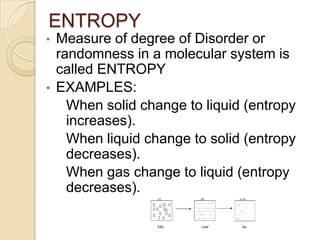
Measure of degree of Disorder or
randomness in a molecular system is
called ENTROPY
EXAMPLES:
When solid change to liquid (entropy
increases).
When liquid change to solid (entropy
decreases).
When gas change to liquid (entropy
decreases).
Mathematical Expression Of
Entropy
Mathematical expression is

Ratio of the heat change (q) to the
Temperature of the reversible cyclic
Process units is Cal/Deg or Jk-1 mol-1 or
cal k-
Significance:
 ENTROPY

& UNAVAILABLE

ENERGY
 ENTROPY

&RANDOMNESS

 ENTROPY&PROBABILITY
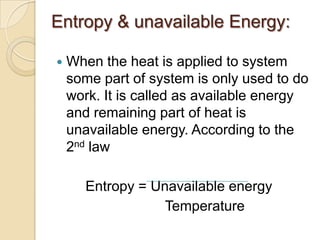
Entropy & unavailable Energy:


When the heat is applied to system
some part of system is only used to do
work. It is called as available energy
and remaining part of heat is
unavailable energy. According to the
2nd law
Entropy = Unavailable energy
Temperature
Entropy & Randomness:


It is increase in entropy there is change
from order state to disorder state

Entropy & Probability:
•

A irreversible spontaneous process
tends to proceed from less process to
more probable state and so in
spontaneous process entropy increase
Entropy changes in isothermal
expansion of ideal gas
According to 1st law of thermodynamic
dE=q-PdV
or dE=q-W
(i)
In reversible isothermal process change
in
Internal energy(dE=0)
Equation (i) becomes
qrev –W=0
qrev =W
(ii)
The work done is expansion of moles of
Gas from volume V to V at constant
Temperature „T‟is
W=nRT In V /V
(iii)
Sub(iii) in (ii)
qrev=nRT In V /V
We know that
So, qrev =
*T
T =nRT In V /V
= 1/T nRT In V /V
1

2

2

1

2

2

1

1

2

1
=nRTInV2/V1
=2.303nRlog V2/V1
P V =RT (or)
P2V2=RT (or)
1

1

(iv)

V =RT/P
V2=RT/P2
1

1

=2.303nRlog P1/P2
Entropy change in reversible
process (Non-spontaneous) :
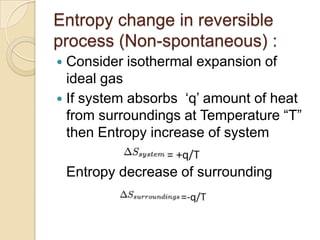
Consider isothermal expansion of
ideal gas
 If system absorbs „q‟ amount of heat
from surroundings at Temperature “T”
then Entropy increase of system


Entropy decrease of surrounding
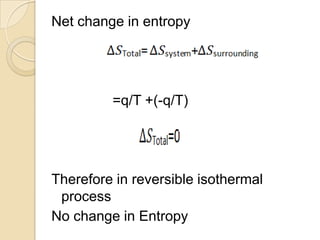
Net change in entropy

=q/T +(-q/T)

Therefore in reversible isothermal
process
No change in Entropy
Entropy change in irreversible
(spontaneous) Process:
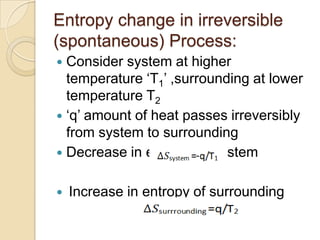
Consider system at higher
temperature „T1‟ ,surrounding at lower
temperature T2
 „q‟ amount of heat passes irreversibly
from system to surrounding
 Decrease in entropy of system




Increase in entropy of surrounding
Net change

As
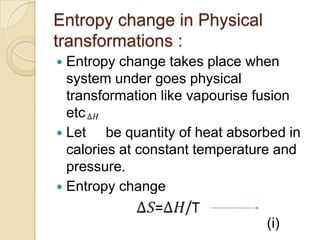
Entropy change in Physical
transformations :
Entropy change takes place when
system under goes physical
transformation like vapourise fusion
etc.
 Let
be quantity of heat absorbed in
calories at constant temperature and
pressure.
 Entropy change


(i)
But enthalpy change
(ii)
L
Latent heat in calories
M
Molecular weight in Grams
T
Temperature in Kelvin
Sub (ii) in (i)


Latent heat of Vapourisation of H2O:
540cal /gm at 100°C
Latent heat of fusion of ice: 80cal/gm at
0°C
Entropy n process

Entropy n process

  • 1.
  • 2.
    ENTROPY • • Measure of degreeof Disorder or randomness in a molecular system is called ENTROPY EXAMPLES: When solid change to liquid (entropy increases). When liquid change to solid (entropy decreases). When gas change to liquid (entropy decreases).
  • 3.
    Mathematical Expression Of Entropy Mathematicalexpression is Ratio of the heat change (q) to the Temperature of the reversible cyclic Process units is Cal/Deg or Jk-1 mol-1 or cal k-
  • 4.
    Significance:  ENTROPY & UNAVAILABLE ENERGY ENTROPY &RANDOMNESS  ENTROPY&PROBABILITY
  • 5.
    Entropy & unavailableEnergy:  When the heat is applied to system some part of system is only used to do work. It is called as available energy and remaining part of heat is unavailable energy. According to the 2nd law Entropy = Unavailable energy Temperature
  • 6.
    Entropy & Randomness:  Itis increase in entropy there is change from order state to disorder state Entropy & Probability: • A irreversible spontaneous process tends to proceed from less process to more probable state and so in spontaneous process entropy increase
  • 7.
    Entropy changes inisothermal expansion of ideal gas According to 1st law of thermodynamic dE=q-PdV or dE=q-W (i) In reversible isothermal process change in Internal energy(dE=0) Equation (i) becomes qrev –W=0 qrev =W (ii)
  • 8.
    The work doneis expansion of moles of Gas from volume V to V at constant Temperature „T‟is W=nRT In V /V (iii) Sub(iii) in (ii) qrev=nRT In V /V We know that So, qrev = *T T =nRT In V /V = 1/T nRT In V /V 1 2 2 1 2 2 1 1 2 1
  • 9.
    =nRTInV2/V1 =2.303nRlog V2/V1 P V=RT (or) P2V2=RT (or) 1 1 (iv) V =RT/P V2=RT/P2 1 1 =2.303nRlog P1/P2
  • 10.
    Entropy change inreversible process (Non-spontaneous) : Consider isothermal expansion of ideal gas  If system absorbs „q‟ amount of heat from surroundings at Temperature “T” then Entropy increase of system  Entropy decrease of surrounding
  • 11.
    Net change inentropy =q/T +(-q/T) Therefore in reversible isothermal process No change in Entropy
  • 12.
    Entropy change inirreversible (spontaneous) Process: Consider system at higher temperature „T1‟ ,surrounding at lower temperature T2  „q‟ amount of heat passes irreversibly from system to surrounding  Decrease in entropy of system   Increase in entropy of surrounding
  • 13.
  • 14.
    Entropy change inPhysical transformations : Entropy change takes place when system under goes physical transformation like vapourise fusion etc.  Let be quantity of heat absorbed in calories at constant temperature and pressure.  Entropy change  (i)
  • 15.
    But enthalpy change (ii) L Latentheat in calories M Molecular weight in Grams T Temperature in Kelvin Sub (ii) in (i)  Latent heat of Vapourisation of H2O: 540cal /gm at 100°C Latent heat of fusion of ice: 80cal/gm at 0°C