Digital Image processing:
Image Acquisition
From:
Dr Shailendra Kumar
Department of ECE,
Integral University, Lucknow, U.P., India.
Light ?
• The visible area of the electromagnetic (EM) spectrum.
• It occurs between wavelengths of approximately 400 and 700
nanometers.
Digital Image Acquisition
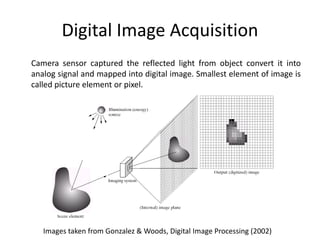
Camera sensor captured the reflected light from object convert it into
analog signal and mapped into digital image. Smallest element of image is
called picture element or pixel.
Images taken from Gonzalez & Woods, Digital Image Processing (2002)
Digital Image: 2D representation
f (xm, yn)
y
x
An Image shown in figure is a 2D function, f(x, y)
where x and y are the coordinates &
Amplitude of f is called the gray level or intensity
A Simple model of image formation
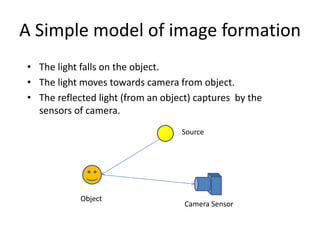
• The light falls on the object.
• The light moves towards camera from object.
• The reflected light (from an object) captures by the
sensors of camera.
Source
Camera Sensor
Object
Thank You

Image Acquisition

  • 1.
    Digital Image processing: ImageAcquisition From: Dr Shailendra Kumar Department of ECE, Integral University, Lucknow, U.P., India.
  • 2.
    Light ? • Thevisible area of the electromagnetic (EM) spectrum. • It occurs between wavelengths of approximately 400 and 700 nanometers.
  • 3.
    Digital Image Acquisition Camerasensor captured the reflected light from object convert it into analog signal and mapped into digital image. Smallest element of image is called picture element or pixel. Images taken from Gonzalez & Woods, Digital Image Processing (2002)
  • 4.
    Digital Image: 2Drepresentation f (xm, yn) y x An Image shown in figure is a 2D function, f(x, y) where x and y are the coordinates & Amplitude of f is called the gray level or intensity
  • 5.
    A Simple modelof image formation • The light falls on the object. • The light moves towards camera from object. • The reflected light (from an object) captures by the sensors of camera. Source Camera Sensor Object
  • 6.