fPLASMA DISPLAY PANELS (PDP)
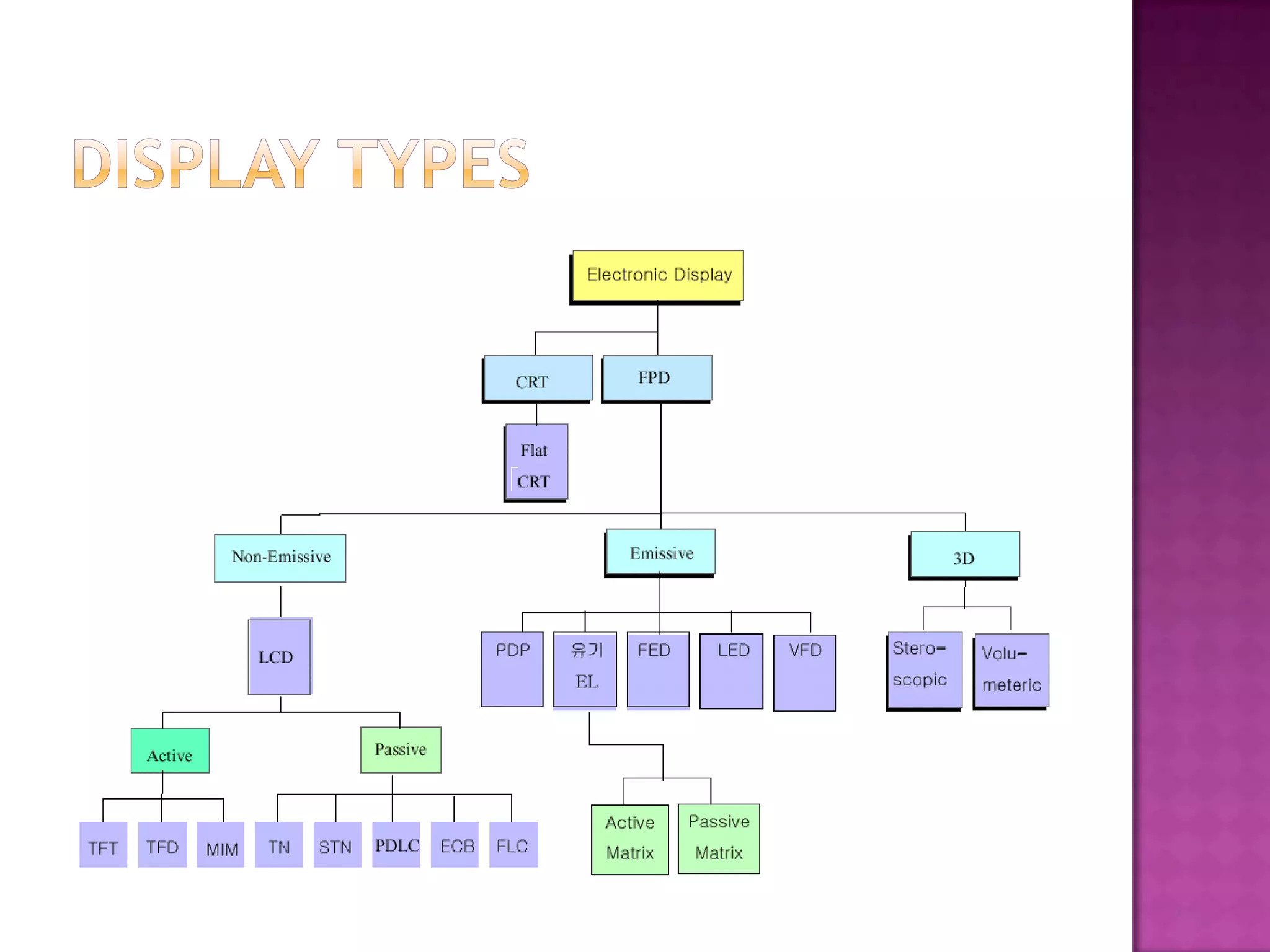
Display types
What is Plasma?Plasma is often called the "Fourth State of Matter", the other three being solid, liquid and gas. A plasma is a distinct state of matter containing a significant number of electrically charged particles, a number sufficient to affect its electrical properties and behavior. In addition to being important in many aspects of our daily lives, plasmas are estimated to constitute more than 99 percent of the visible universe.
Plasma display panels:PLASMA display panels (PDPs) are one of the leading candidates in the competition for : large-size, high-brightness ,flat panel displays
suitable for high-definition television (HDTV) monitorsTheir advantages are:Fast response
Wide viewing angle
Low weight
Simple manufacturing process
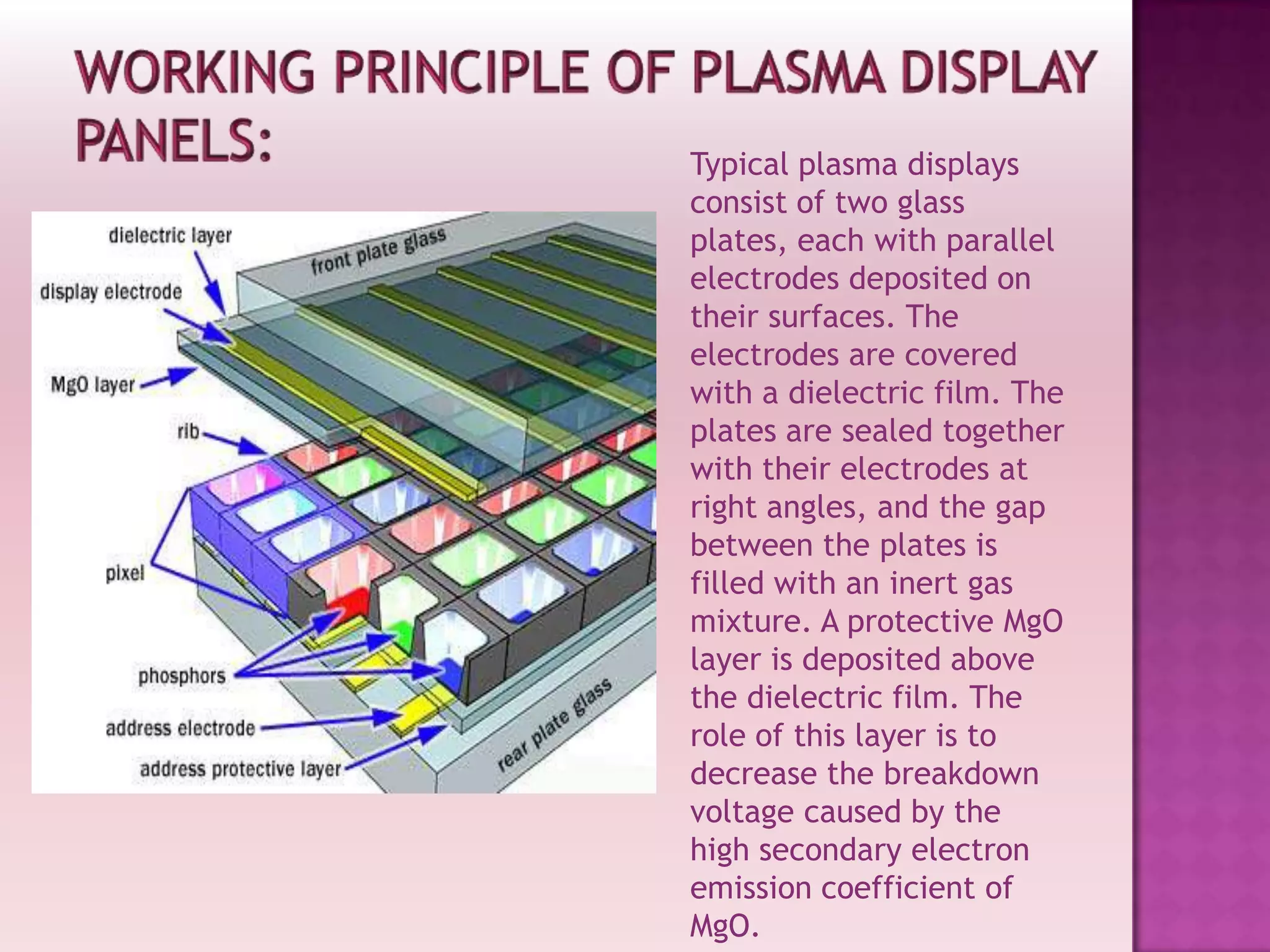
High resolutionWORKING PRINCIPLE OF PLASMA DISPLAY PANELS:Typical plasma displays consist of two glass plates, each with parallel electrodes deposited on their surfaces. The electrodes are covered with a dielectric film. The plates are sealed together with their electrodes at right angles, and the gap between the plates is filled with an inert gas mixture. A protective MgO layer is deposited above the dielectric film. The role of this layer is to decrease the breakdown voltage caused by the high secondary electron emission coefficient of MgO.
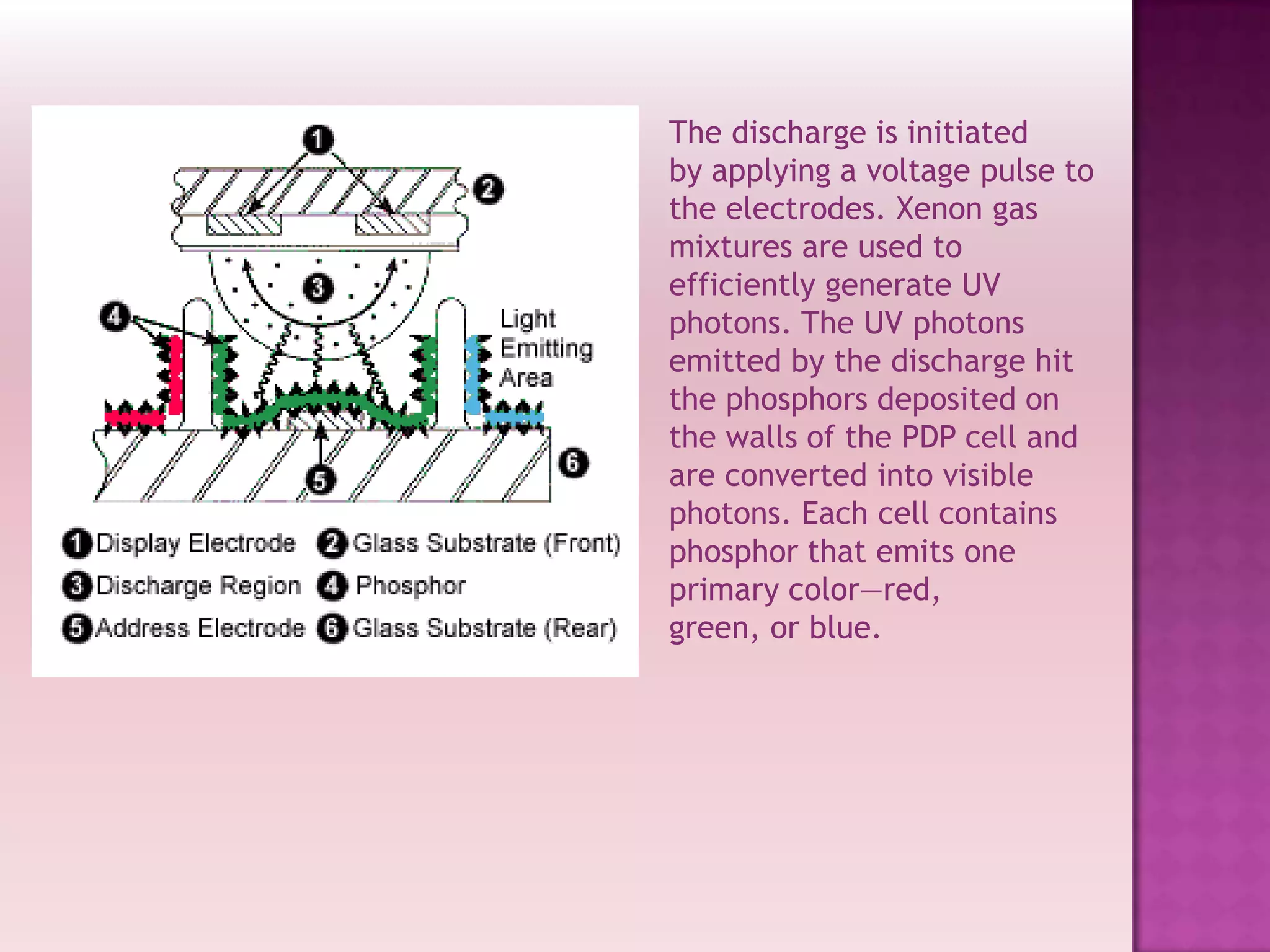
The discharge is initiatedby applying a voltage pulse to the electrodes. Xenon gas mixtures are used to efficiently generate UV photons. The UV photonsemitted by the discharge hit the phosphors deposited onthe walls of the PDP cell and are converted into visible photons. Each cell contains phosphor that emits one primary color—red,green, or blue.
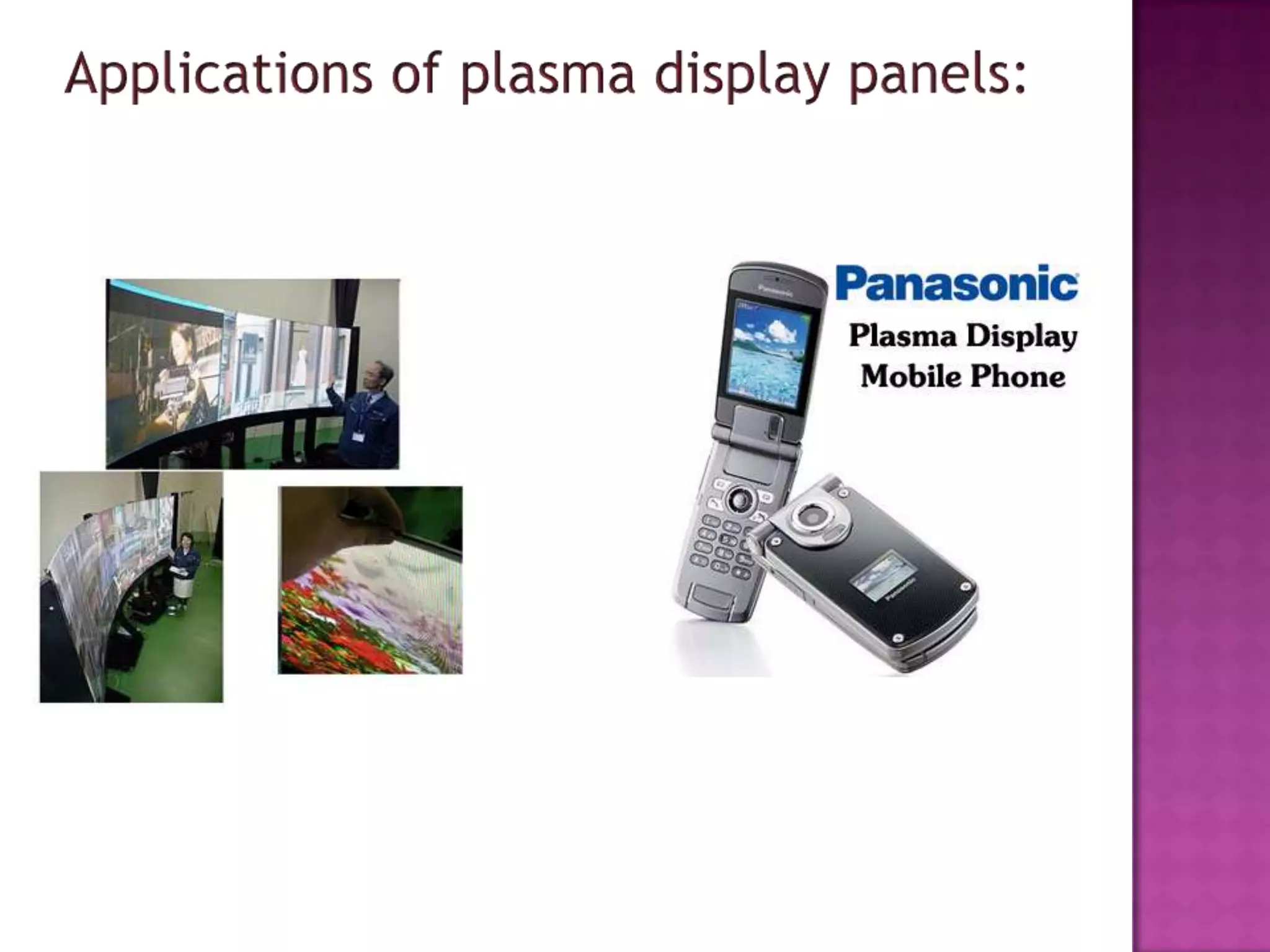
Applications of plasma display panels:
Various applications of Plasmas:Processing:• Surface Processing• Non equilibrium (low pressure)• Thermal (high pressure) Volume Processing:• Flue gas treatment• Metal recovery• Waste treatment Chemical Synthesis:• Plasma spraying• Diamond film deposition• Ceramic powders Light Sources:• High intensity discharge lamps• Low pressure lamps• Specialty sources Surface Treatment:• Ion implantation• Hardening• Welding • Cutting• Drilling Propulsion

Plasma display pannel

  • 1.
  • 2.
  • 3.
    What is Plasma?Plasmais often called the "Fourth State of Matter", the other three being solid, liquid and gas. A plasma is a distinct state of matter containing a significant number of electrically charged particles, a number sufficient to affect its electrical properties and behavior. In addition to being important in many aspects of our daily lives, plasmas are estimated to constitute more than 99 percent of the visible universe.
  • 4.
    Plasma display panels:PLASMAdisplay panels (PDPs) are one of the leading candidates in the competition for : large-size, high-brightness ,flat panel displays
  • 5.
    suitable for high-definitiontelevision (HDTV) monitorsTheir advantages are:Fast response
  • 6.
  • 7.
  • 8.
  • 9.
    High resolutionWORKING PRINCIPLEOF PLASMA DISPLAY PANELS:Typical plasma displays consist of two glass plates, each with parallel electrodes deposited on their surfaces. The electrodes are covered with a dielectric film. The plates are sealed together with their electrodes at right angles, and the gap between the plates is filled with an inert gas mixture. A protective MgO layer is deposited above the dielectric film. The role of this layer is to decrease the breakdown voltage caused by the high secondary electron emission coefficient of MgO.
  • 10.
    The discharge isinitiatedby applying a voltage pulse to the electrodes. Xenon gas mixtures are used to efficiently generate UV photons. The UV photonsemitted by the discharge hit the phosphors deposited onthe walls of the PDP cell and are converted into visible photons. Each cell contains phosphor that emits one primary color—red,green, or blue.
  • 11.
    Applications of plasmadisplay panels:
  • 12.
    Various applications ofPlasmas:Processing:• Surface Processing• Non equilibrium (low pressure)• Thermal (high pressure) Volume Processing:• Flue gas treatment• Metal recovery• Waste treatment Chemical Synthesis:• Plasma spraying• Diamond film deposition• Ceramic powders Light Sources:• High intensity discharge lamps• Low pressure lamps• Specialty sources Surface Treatment:• Ion implantation• Hardening• Welding • Cutting• Drilling Propulsion
  • 13.
    Various applications ofPlasmas:  Flat-Panel Displays:• Field-emitter arrays• Plasma displays Radiation Processing:• Water purification• Plant growth Switches:• Electric power • Pulsed power Energy Converters:• MHD converters• Thermionic energy convertersMedicine:• Surface treatment• Instrument sterilization Isotope Separation Beam Sources Lasers Material Analysis
  • 14.
    Differences between plasmadisplay panels and LCD
  • 15.
    1. Screen Sizeand Price2. Color Accuracy and SaturationCR= Luminance of brightest white/Luminance of darkest black3. Picture Resolution4. Contrast Ratio5. Burn-In6. Pixel Response Time and Screen Refresh Rate7. Power Consumption8. Viewing Angle9. Weight 10. Performance at High Altitude
  • 16.