
ELECTROMAGNETIC
SPECTRUM
PREPARED BY: JOSEPHINE L. SISON
BSED IV MATH
The electromagnetic (EM) spectrum is the range
of radiation. All types of EM Radiation is energy
that travels and spreads out as it goes –
the visible light that comes from a lamp in your
house and the radio waves that come from a
radio station are two types of electromagnetic
radiation.
ELECTRAOMGNETIC
SPECTRUM
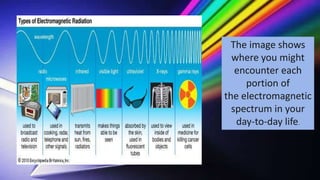
The image shows
where you might
encounter each
portion of
the electromagnetic
spectrum in your
day-to-day life.
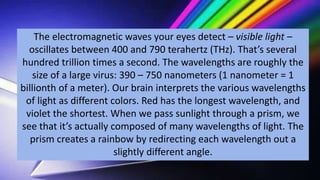
The electromagnetic waves your eyes detect – visible light –
oscillates between 400 and 790 terahertz (THz). That’s several
hundred trillion times a second. The wavelengths are roughly the
size of a large virus: 390 – 750 nanometers (1 nanometer = 1
billionth of a meter). Our brain interprets the various wavelengths
of light as different colors. Red has the longest wavelength, and
violet the shortest. When we pass sunlight through a prism, we
see that it’s actually composed of many wavelengths of light. The
prism creates a rainbow by redirecting each wavelength out a
slightly different angle.
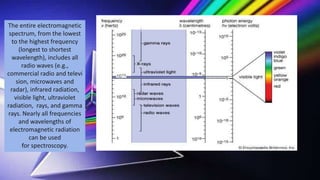
The entire electromagnetic
spectrum, from the lowest
to the highest frequency
(longest to shortest
wavelength), includes all
radio waves (e.g.,
commercial radio and televi
sion, microwaves and
radar), infrared radiation,
visible light, ultraviolet
radiation, rays, and gamma
rays. Nearly all frequencies
and wavelengths of
electromagnetic radiation
can be used
for spectroscopy.
Astronomers use the entire electromagnetic spectrum to
observe a variety of things. Radio waves and microwaves –
the longest wavelengths and lowest energies of light – are
used to peer inside dense interstellar clouds and track the
motion of cold, dark gas. Radio telescopes have been used
to map the structure of our galaxy while microwave
telescopes are sensitive to the remnant glow of the Big
Bang.
THANK YOU.
PREPARED BY: JOSEPHINE L. SISON
BSED IV MATH

Electromagnetic spectrum,

  • 1.
  • 2.
    The electromagnetic (EM)spectrum is the range of radiation. All types of EM Radiation is energy that travels and spreads out as it goes – the visible light that comes from a lamp in your house and the radio waves that come from a radio station are two types of electromagnetic radiation. ELECTRAOMGNETIC SPECTRUM
  • 3.
    The image shows whereyou might encounter each portion of the electromagnetic spectrum in your day-to-day life.
  • 4.
    The electromagnetic wavesyour eyes detect – visible light – oscillates between 400 and 790 terahertz (THz). That’s several hundred trillion times a second. The wavelengths are roughly the size of a large virus: 390 – 750 nanometers (1 nanometer = 1 billionth of a meter). Our brain interprets the various wavelengths of light as different colors. Red has the longest wavelength, and violet the shortest. When we pass sunlight through a prism, we see that it’s actually composed of many wavelengths of light. The prism creates a rainbow by redirecting each wavelength out a slightly different angle.
  • 5.
    The entire electromagnetic spectrum,from the lowest to the highest frequency (longest to shortest wavelength), includes all radio waves (e.g., commercial radio and televi sion, microwaves and radar), infrared radiation, visible light, ultraviolet radiation, rays, and gamma rays. Nearly all frequencies and wavelengths of electromagnetic radiation can be used for spectroscopy.
  • 6.
    Astronomers use theentire electromagnetic spectrum to observe a variety of things. Radio waves and microwaves – the longest wavelengths and lowest energies of light – are used to peer inside dense interstellar clouds and track the motion of cold, dark gas. Radio telescopes have been used to map the structure of our galaxy while microwave telescopes are sensitive to the remnant glow of the Big Bang.
  • 7.
    THANK YOU. PREPARED BY:JOSEPHINE L. SISON BSED IV MATH