IMAGE SENSOR
Team 5: Minh Nguyen & Linh Hoang Tuan
Advisor: Dr. Loan Pham Nguyen
Ha Noi, 3rd November 2015
Hanoi University of Science and Technology
School of Electronics and Telecommunications
CONTENTS
2
I
Introduction
II
CMOS Image Sensor
III
CCD Image Sensor
IV
Summary
I. INTRODUCTION
3
SLR Camera & Films DSLR Camera & Image Sensor
Source: Internet
I. INTRODUCTION
 The most popular image sensors types:
CMOS (Complementary Metal Oxide Semiconductor)
CCD (Charge Coupled Device)
4
 Brands: Toshiba, Fujifilm, Nikon, Kodak
Source: Internet Complementary Metal Oxide Semiconductor: chất bán dẫn kim loại ôxit bù
II. CMOS IMAGE SENSOR
Source: Internet 5
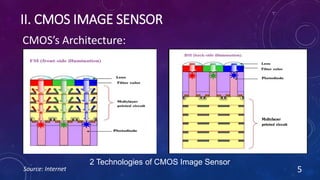
CMOS’s Architecture:
2 Technologies of CMOS Image Sensor
II. CMOS IMAGE SENSOR
Source: Internet 6
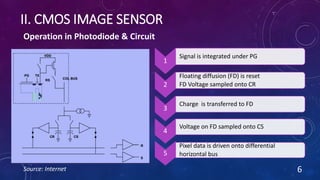
Operation in Photodiode & Circuit
1
Signal is integrated under PG
2
Floating diffusion (FD) is reset
FD Voltage sampled onto CR
3
Charge is transferred to FD
4
Voltage on FD sampled onto CS
5
Pixel data is driven onto differential
horizontal bus
II. CMOS IMAGE SENSOR
Source: Internet 7
III. CCD IMAGE SENSOR
Source: Internet 8
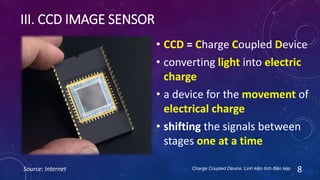
• CCD = Charge Coupled Device
• converting light into electric
charge
• a device for the movement of
electrical charge
• shifting the signals between
stages one at a time
Charge Coupled Device: Linh kiện tích điện kép
III. CCD IMAGE SENSOR
Source: Internet 9
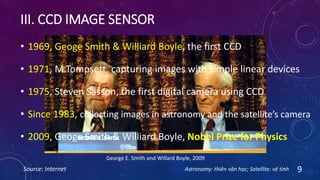
George E. Smith and Willard Boyle, 2009
• 1969, Geoge Smith & Williard Boyle, the first CCD
• 1971, M.Tompsett, capturing images with simple linear devices
• 1975, Steven Sasson, the first digital camera using CCD
• Since 1983, collecting images in astronomy and the satellite’s camera
• 2009, Geoge Smith & Williard Boyle, Nobel Prize for Physics
Astronomy: thiên văn học; Satellite: vệ tinh
Source: Internet 10
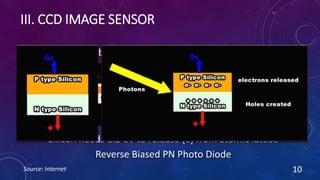
Silicon needs 1.2 eV to release (e) from atomic lattice
Visible light has 1.6 to 3.4 eV available
III. CCD IMAGE SENSOR
Reverse Biased PN Photo Diode
III. CCD IMAGE SENSOR
Source: Internet 11
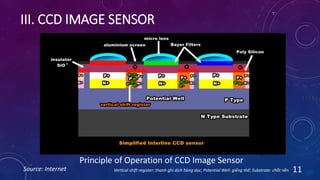
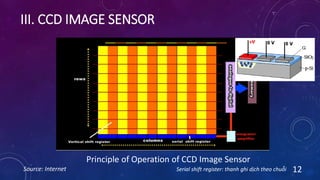
Principle of Operation of CCD Image Sensor
1
32
Vertical shift register: thanh ghi dịch hàng dọc; Potential Well: giếng thế; Substrate: chất nền
III. CCD IMAGE SENSOR
Source: Internet 12
Principle of Operation of CCD Image Sensor
Serial shift register: thanh ghi dịch theo chuỗi
III. CCD IMAGE SENSOR
Source: Internet 13
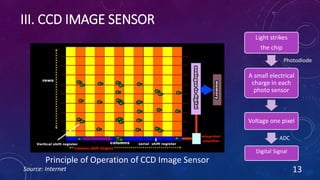
Principle of Operation of CCD Image Sensor
Photodiode
Light strikes
the chip
A small electrical
charge in each
photo sensor
Voltage one pixel
Digital Signal
ADC
III. CCD IMAGE SENSOR
Source: Internet 14
ROW
COLUMN
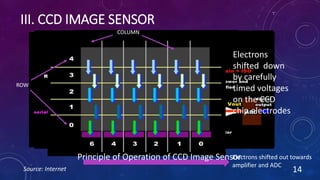
Electrons
shifted down
by carefully
timed voltages
on the CCD
chip electrodes
Electrons shifted out towards
amplifier and ADC
Principle of Operation of CCD Image Sensor
III. CCD IMAGE SENSOR
Source: Internet 15
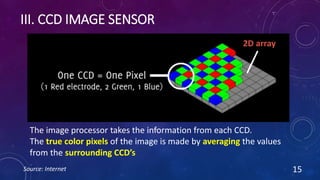
The image processor takes the information from each CCD.
The true color pixels of the image is made by averaging the values
from the surrounding CCD’s
2D array
IV. SUMMARY
CCD Technology
 Virtue: Low noise
Space Applications
 Vice:
• High power
• Slow speed
• Non-standard manufacture
CMOS Technology
 Virtue:
• Low power
• Fast Speed
• “Easy” manufacture
 Vice: High Noise
Source: Internet 16
Photographic Cameras
IV. SUMMARY
CCD and CMOS have a wide range of applications:
Source: Internet 17
CCTV Cameras
Video Cameras Photocopiers Bar-code Readers
THANKSFOR YOUR LISTENING!

CCD and CMOS Image Sensor

  • 1.
    IMAGE SENSOR Team 5:Minh Nguyen & Linh Hoang Tuan Advisor: Dr. Loan Pham Nguyen Ha Noi, 3rd November 2015 Hanoi University of Science and Technology School of Electronics and Telecommunications
  • 2.
  • 3.
    I. INTRODUCTION 3 SLR Camera& Films DSLR Camera & Image Sensor Source: Internet
  • 4.
    I. INTRODUCTION  Themost popular image sensors types: CMOS (Complementary Metal Oxide Semiconductor) CCD (Charge Coupled Device) 4  Brands: Toshiba, Fujifilm, Nikon, Kodak Source: Internet Complementary Metal Oxide Semiconductor: chất bán dẫn kim loại ôxit bù
  • 5.
    II. CMOS IMAGESENSOR Source: Internet 5 CMOS’s Architecture: 2 Technologies of CMOS Image Sensor
  • 6.
    II. CMOS IMAGESENSOR Source: Internet 6 Operation in Photodiode & Circuit 1 Signal is integrated under PG 2 Floating diffusion (FD) is reset FD Voltage sampled onto CR 3 Charge is transferred to FD 4 Voltage on FD sampled onto CS 5 Pixel data is driven onto differential horizontal bus
  • 7.
    II. CMOS IMAGESENSOR Source: Internet 7
  • 8.
    III. CCD IMAGESENSOR Source: Internet 8 • CCD = Charge Coupled Device • converting light into electric charge • a device for the movement of electrical charge • shifting the signals between stages one at a time Charge Coupled Device: Linh kiện tích điện kép
  • 9.
    III. CCD IMAGESENSOR Source: Internet 9 George E. Smith and Willard Boyle, 2009 • 1969, Geoge Smith & Williard Boyle, the first CCD • 1971, M.Tompsett, capturing images with simple linear devices • 1975, Steven Sasson, the first digital camera using CCD • Since 1983, collecting images in astronomy and the satellite’s camera • 2009, Geoge Smith & Williard Boyle, Nobel Prize for Physics Astronomy: thiên văn học; Satellite: vệ tinh
  • 10.
    Source: Internet 10 Siliconneeds 1.2 eV to release (e) from atomic lattice Visible light has 1.6 to 3.4 eV available III. CCD IMAGE SENSOR Reverse Biased PN Photo Diode
  • 11.
    III. CCD IMAGESENSOR Source: Internet 11 Principle of Operation of CCD Image Sensor 1 32 Vertical shift register: thanh ghi dịch hàng dọc; Potential Well: giếng thế; Substrate: chất nền
  • 12.
    III. CCD IMAGESENSOR Source: Internet 12 Principle of Operation of CCD Image Sensor Serial shift register: thanh ghi dịch theo chuỗi
  • 13.
    III. CCD IMAGESENSOR Source: Internet 13 Principle of Operation of CCD Image Sensor Photodiode Light strikes the chip A small electrical charge in each photo sensor Voltage one pixel Digital Signal ADC
  • 14.
    III. CCD IMAGESENSOR Source: Internet 14 ROW COLUMN Electrons shifted down by carefully timed voltages on the CCD chip electrodes Electrons shifted out towards amplifier and ADC Principle of Operation of CCD Image Sensor
  • 15.
    III. CCD IMAGESENSOR Source: Internet 15 The image processor takes the information from each CCD. The true color pixels of the image is made by averaging the values from the surrounding CCD’s 2D array
  • 16.
    IV. SUMMARY CCD Technology Virtue: Low noise Space Applications  Vice: • High power • Slow speed • Non-standard manufacture CMOS Technology  Virtue: • Low power • Fast Speed • “Easy” manufacture  Vice: High Noise Source: Internet 16
  • 17.
    Photographic Cameras IV. SUMMARY CCDand CMOS have a wide range of applications: Source: Internet 17 CCTV Cameras Video Cameras Photocopiers Bar-code Readers
  • 19.

Editor's Notes

  • #4 Thêm hình ảnh minh họa
  • #5 Thêm hình ảnh minh họa
  • #9 1. A charge-coupled device (CCD) is a device for the movement of electrical charge, usually from within the device to an area where the charge can be manipulated, for example conversion into a digital value. 2. This is achieved by "shifting" the signals between stages within the device one at a time.
  • #10 History of CMOS TECHNOLOGY In 2009 they were awarded the Nobel Prize for Physics,[13] for their invention of the CCD concept. 
  • #11 1. A photodiode is a PN junction 2. When a photon of sufficient energy strikes the diode, it excites an electron, thereby creating a mobile electron and a positively charged hole.
  • #12 3 photodiode 3 storage cell the positively charged electrode -------- Silicon = base material Silicon Dioxide = coating material Polysilicon = top layer material
  • #14 -> Let’s talk clearly about the princilpe
  • #15 Move ROW 0 into serial shift register { { Move serial shift column 0 into Amlifier Read out the analogue Voltage from amplifier into ADC Store Digital value in Memory for this R0 C0 position Serially shift all columns in serial shift register Column 4 to 3, 3 to 2, 2 to 1, 1 to 0 -> repeat process until all columns have been read } Move every ROW 1 into ROW 0, ROW 4 to 3, 3 to 2, 2 to 1 Repeat the serial shift register read out } -> repeat until every ROW has been shifted down to ROW 0 and shifted out through the serial shift register
  • #16 Each CCD represents one pixel in an image. A 2D array of CCD’s produces an entire image (2 Green because the human eye is more sensitive to slight variations of green than any other color) The image processor takes the information from each CCD and makes a true color pixels of the image by averaging the values from the surrounding CCD’s
  • #17 Manufacture: CCD requires separate production lines while could use chip production line, conventional circuit board to produce CMOS. Summary: Yet between 2000 people began to pay more attention to the CMOS sensor chip appearing at 3.2 million pixels and up to early 2002 the introduction of CMOS 6 million pixels made public sex technology amazement, admiration.