Lecture 2: Edge detection
CSCI 455: Intro to Computer Vision
Acknowledgement
Many of the following slides are modified from the
excellent class notes of similar courses offered in
other schools by Prof Yung-Yu Chuang, Fredo
Durand, Alexei Efros, William Freeman, James Hays,
Svetlana Lazebnik, Andrej Karpathy, Fei-Fei Li,
Srinivasa Narasimhan, Silvio Savarese, Steve Seitz,
Richard Szeliski, Noah Snavely and Li Zhang. The
instructor is extremely thankful to the researchers
for making their notes available online. Please feel
free to use and modify any of the slides, but
acknowledge the original sources where
appropriate.
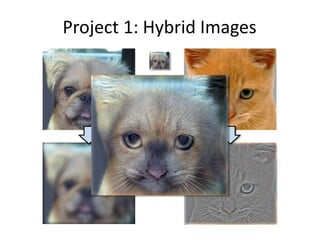
Project 1: Hybrid Images
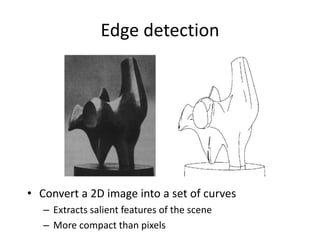
Edge detection
• Convert a 2D image into a set of curves
– Extracts salient features of the scene
– More compact than pixels
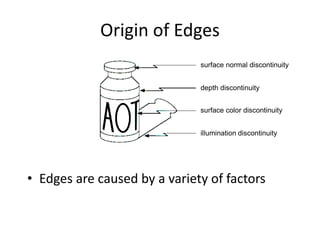
Origin of Edges
• Edges are caused by a variety of factors
depth discontinuity
surface color discontinuity
illumination discontinuity
surface normal discontinuity
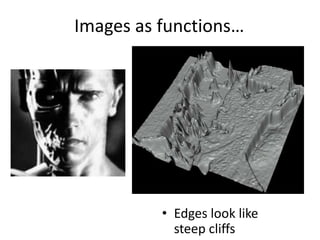
Images as functions…
• Edges look like
steep cliffs
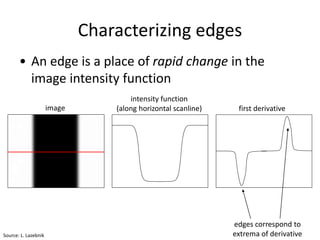
Characterizing edges
• An edge is a place of rapid change in the
image intensity function
image
intensity function
(along horizontal scanline) first derivative
edges correspond to
extrema of derivativeSource: L. Lazebnik
• How can we differentiate a digital image F[x,y]?
– Option 1: reconstruct a continuous image, f, then
compute the derivative
– Option 2: take discrete derivative (finite difference)
1 -1
How would you implement this as a linear filter?
Image derivatives
-1
1
: :
Source: S. Seitz
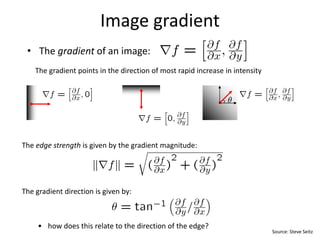
The gradient points in the direction of most rapid increase in intensity
Image gradient
• The gradient of an image:
The edge strength is given by the gradient magnitude:
The gradient direction is given by:
• how does this relate to the direction of the edge?
Source: Steve Seitz
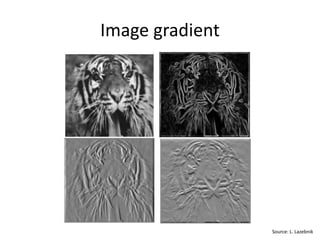
Image gradient
Source: L. Lazebnik
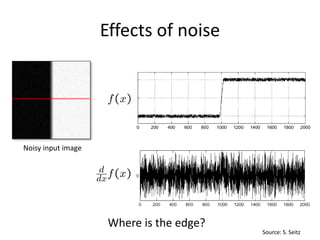
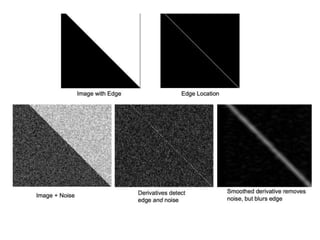
Effects of noise
Where is the edge?
Source: S. Seitz
Noisy input image
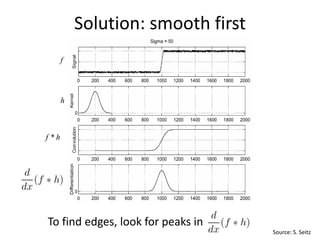
Solution: smooth first
f
h
f * h
Source: S. Seitz
To find edges, look for peaks in
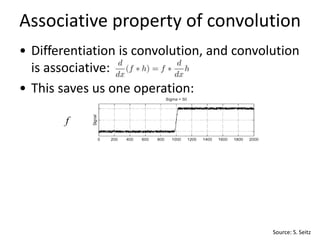
• Differentiation is convolution, and convolution
is associative:
• This saves us one operation:
Associative property of convolution
f
Source: S. Seitz
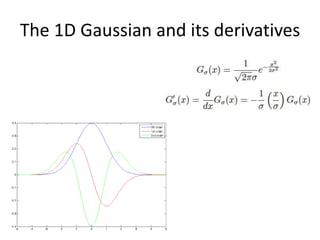
The 1D Gaussian and its derivatives
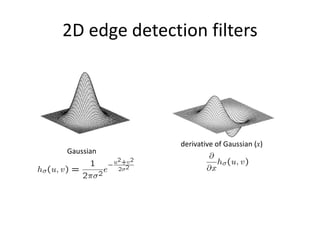
2D edge detection filters
Gaussian
derivative of Gaussian (x)
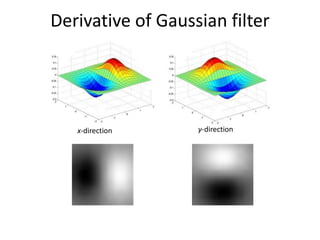
Derivative of Gaussian filter
x-direction y-direction
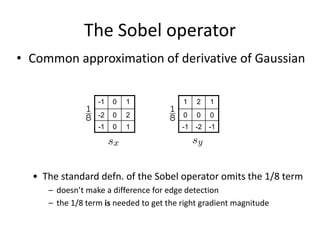
The Sobel operator
• Common approximation of derivative of Gaussian
-1 0 1
-2 0 2
-1 0 1
1 2 1
0 0 0
-1 -2 -1
• The standard defn. of the Sobel operator omits the 1/8 term
– doesn’t make a difference for edge detection
– the 1/8 term is needed to get the right gradient magnitude
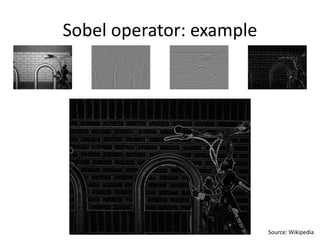
Sobel operator: example
Source: Wikipedia
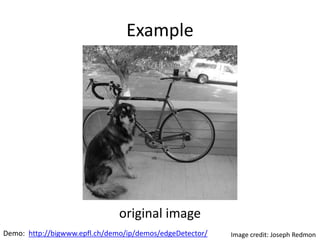
Example
original image
Demo: http://bigwww.epfl.ch/demo/ip/demos/edgeDetector/ Image credit: Joseph Redmon
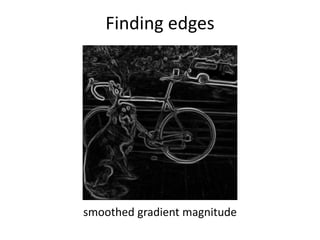
Finding edges
smoothed gradient magnitude
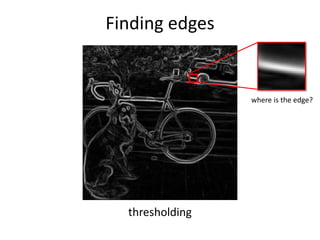
thresholding
Finding edges
where is the edge?
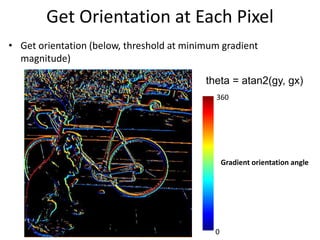
Get Orientation at Each Pixel
• Get orientation (below, threshold at minimum gradient
magnitude)
theta = atan2(gy, gx)
0
360
Gradient orientation angle
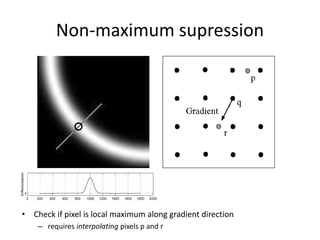
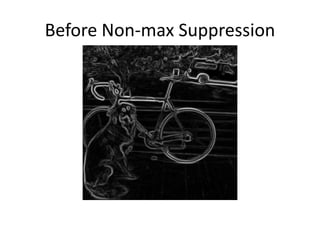
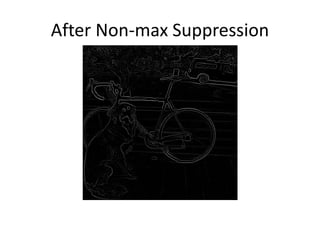
• Check if pixel is local maximum along gradient direction
– requires interpolating pixels p and r
Non-maximum supression
Before Non-max Suppression
After Non-max Suppression
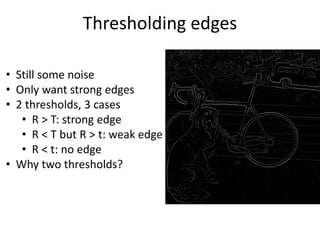
Thresholding edges
• Still some noise
• Only want strong edges
• 2 thresholds, 3 cases
• R > T: strong edge
• R < T but R > t: weak edge
• R < t: no edge
• Why two thresholds?
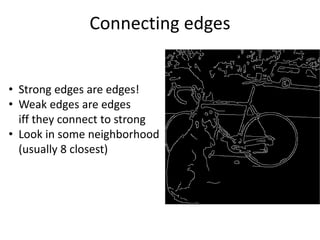
Connecting edges
• Strong edges are edges!
• Weak edges are edges
iff they connect to strong
• Look in some neighborhood
(usually 8 closest)
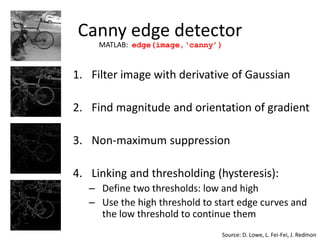
Canny edge detector
1. Filter image with derivative of Gaussian
2. Find magnitude and orientation of gradient
3. Non-maximum suppression
4. Linking and thresholding (hysteresis):
– Define two thresholds: low and high
– Use the high threshold to start edge curves and
the low threshold to continue them
Source: D. Lowe, L. Fei-Fei, J. Redmon
MATLAB: edge(image,‘canny’)
Canny edge detector
• Our first computer vision pipeline!
• Still a widely used edge detector in computer
vision
• Depends on several parameters:
J. Canny, A Computational Approach To Edge Detection, IEEE Trans. Pattern
Analysis and Machine Intelligence, 8:679-714, 1986.
: width of the Gaussian blur
high threshold
low threshold
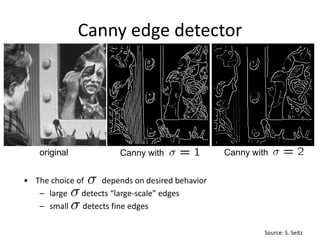
Canny edge detector
Canny with Canny withoriginal
• The choice of depends on desired behavior
– large detects “large-scale” edges
– small detects fine edges
Source: S. Seitz
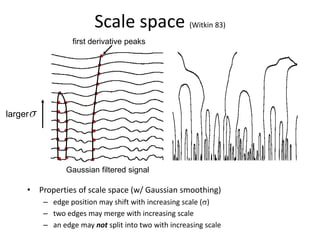
Scale space (Witkin 83)
• Properties of scale space (w/ Gaussian smoothing)
– edge position may shift with increasing scale ()
– two edges may merge with increasing scale
– an edge may not split into two with increasing scale
larger
Gaussian filtered signal
first derivative peaks
Questions?

Computer vision - edge detection

  • 1.
    Lecture 2: Edgedetection CSCI 455: Intro to Computer Vision
  • 2.
    Acknowledgement Many of thefollowing slides are modified from the excellent class notes of similar courses offered in other schools by Prof Yung-Yu Chuang, Fredo Durand, Alexei Efros, William Freeman, James Hays, Svetlana Lazebnik, Andrej Karpathy, Fei-Fei Li, Srinivasa Narasimhan, Silvio Savarese, Steve Seitz, Richard Szeliski, Noah Snavely and Li Zhang. The instructor is extremely thankful to the researchers for making their notes available online. Please feel free to use and modify any of the slides, but acknowledge the original sources where appropriate.
  • 3.
  • 4.
    Edge detection • Converta 2D image into a set of curves – Extracts salient features of the scene – More compact than pixels
  • 5.
    Origin of Edges •Edges are caused by a variety of factors depth discontinuity surface color discontinuity illumination discontinuity surface normal discontinuity
  • 6.
    Images as functions… •Edges look like steep cliffs
  • 7.
    Characterizing edges • Anedge is a place of rapid change in the image intensity function image intensity function (along horizontal scanline) first derivative edges correspond to extrema of derivativeSource: L. Lazebnik
  • 8.
    • How canwe differentiate a digital image F[x,y]? – Option 1: reconstruct a continuous image, f, then compute the derivative – Option 2: take discrete derivative (finite difference) 1 -1 How would you implement this as a linear filter? Image derivatives -1 1 : : Source: S. Seitz
  • 9.
    The gradient pointsin the direction of most rapid increase in intensity Image gradient • The gradient of an image: The edge strength is given by the gradient magnitude: The gradient direction is given by: • how does this relate to the direction of the edge? Source: Steve Seitz
  • 10.
  • 11.
    Effects of noise Whereis the edge? Source: S. Seitz Noisy input image
  • 12.
    Solution: smooth first f h f* h Source: S. Seitz To find edges, look for peaks in
  • 13.
    • Differentiation isconvolution, and convolution is associative: • This saves us one operation: Associative property of convolution f Source: S. Seitz
  • 14.
    The 1D Gaussianand its derivatives
  • 15.
    2D edge detectionfilters Gaussian derivative of Gaussian (x)
  • 16.
    Derivative of Gaussianfilter x-direction y-direction
  • 17.
    The Sobel operator •Common approximation of derivative of Gaussian -1 0 1 -2 0 2 -1 0 1 1 2 1 0 0 0 -1 -2 -1 • The standard defn. of the Sobel operator omits the 1/8 term – doesn’t make a difference for edge detection – the 1/8 term is needed to get the right gradient magnitude
  • 18.
  • 20.
  • 21.
  • 22.
  • 23.
    Get Orientation atEach Pixel • Get orientation (below, threshold at minimum gradient magnitude) theta = atan2(gy, gx) 0 360 Gradient orientation angle
  • 24.
    • Check ifpixel is local maximum along gradient direction – requires interpolating pixels p and r Non-maximum supression
  • 25.
  • 26.
  • 27.
    Thresholding edges • Stillsome noise • Only want strong edges • 2 thresholds, 3 cases • R > T: strong edge • R < T but R > t: weak edge • R < t: no edge • Why two thresholds?
  • 28.
    Connecting edges • Strongedges are edges! • Weak edges are edges iff they connect to strong • Look in some neighborhood (usually 8 closest)
  • 29.
    Canny edge detector 1.Filter image with derivative of Gaussian 2. Find magnitude and orientation of gradient 3. Non-maximum suppression 4. Linking and thresholding (hysteresis): – Define two thresholds: low and high – Use the high threshold to start edge curves and the low threshold to continue them Source: D. Lowe, L. Fei-Fei, J. Redmon MATLAB: edge(image,‘canny’)
  • 30.
    Canny edge detector •Our first computer vision pipeline! • Still a widely used edge detector in computer vision • Depends on several parameters: J. Canny, A Computational Approach To Edge Detection, IEEE Trans. Pattern Analysis and Machine Intelligence, 8:679-714, 1986. : width of the Gaussian blur high threshold low threshold
  • 31.
    Canny edge detector Cannywith Canny withoriginal • The choice of depends on desired behavior – large detects “large-scale” edges – small detects fine edges Source: S. Seitz
  • 32.
    Scale space (Witkin83) • Properties of scale space (w/ Gaussian smoothing) – edge position may shift with increasing scale () – two edges may merge with increasing scale – an edge may not split into two with increasing scale larger Gaussian filtered signal first derivative peaks
  • 33.