3D TECHNOLOGY
Presented By: Aalia Khurshid
INTRODUCTION
 A 3d display is a screen that shows a
three dimensional image.
It is a visual representation system
that tries to create moving objects in
the third dimension.
In simple, we feel that whatever
happens in 3D effect is a part of our
real life.
History of 3D Technology
 In 1844 David Brewster introduced the
stereoscope that could take 3d photo
graphic images.
HOW 3D WORKS??
 In order to see things in 3D, each eye
must see a slightly different picture.
This is done in the real world by your
eyes being spaced apart so each eye
has its own slightly different view. The
brain then puts the two pictures
together to form one 3D image.
3D Glasses
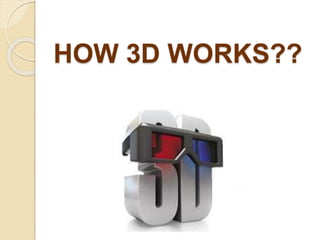
 The reason why we wear 3-D glasses
in a movie theater is to feed different
images into your eyes.
 The screen actually displays two
images, and the glasses cause one of
the images to enter one eye and the
other to enter the other eye.
Types of 3D Glasses
 There are three major varieties today:
1. Anaglyph 3D glasses
2. Polarized 3D glasses
3. 3D shutter glasses
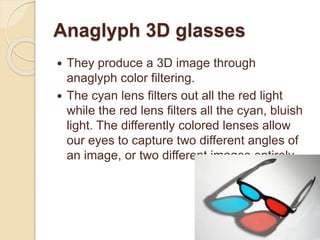
Anaglyph 3D glasses
 They produce a 3D image through
anaglyph color filtering.
 The cyan lens filters out all the red light
while the red lens filters all the cyan, bluish
light. The differently colored lenses allow
our eyes to capture two different angles of
an image, or two different images entirely.
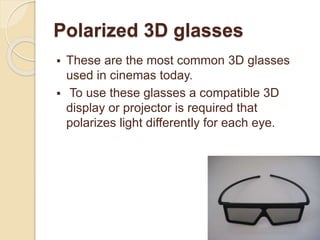
Polarized 3D glasses
 These are the most common 3D glasses
used in cinemas today.
 To use these glasses a compatible 3D
display or projector is required that
polarizes light differently for each eye.
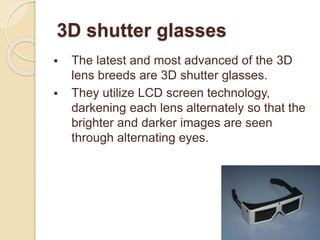
3D shutter glasses
 The latest and most advanced of the 3D
lens breeds are 3D shutter glasses.
 They utilize LCD screen technology,
darkening each lens alternately so that the
brighter and darker images are seen
through alternating eyes.
Autostereoscopy
 Auto-stereoscopic imaging is a display
technology that enables a 3-D effect
without requiring the viewer to wear
special glasses.
Applications of 3D
 3D Modeling
 3D Graphics
 3D in Architecture
 3D Printing
3 D Technology

3 D Technology

  • 1.
  • 2.
    INTRODUCTION  A 3ddisplay is a screen that shows a three dimensional image. It is a visual representation system that tries to create moving objects in the third dimension. In simple, we feel that whatever happens in 3D effect is a part of our real life.
  • 3.
    History of 3DTechnology  In 1844 David Brewster introduced the stereoscope that could take 3d photo graphic images.
  • 4.
  • 5.
     In orderto see things in 3D, each eye must see a slightly different picture. This is done in the real world by your eyes being spaced apart so each eye has its own slightly different view. The brain then puts the two pictures together to form one 3D image.
  • 6.
    3D Glasses  Thereason why we wear 3-D glasses in a movie theater is to feed different images into your eyes.  The screen actually displays two images, and the glasses cause one of the images to enter one eye and the other to enter the other eye.
  • 7.
    Types of 3DGlasses  There are three major varieties today: 1. Anaglyph 3D glasses 2. Polarized 3D glasses 3. 3D shutter glasses
  • 8.
    Anaglyph 3D glasses They produce a 3D image through anaglyph color filtering.  The cyan lens filters out all the red light while the red lens filters all the cyan, bluish light. The differently colored lenses allow our eyes to capture two different angles of an image, or two different images entirely.
  • 9.
    Polarized 3D glasses These are the most common 3D glasses used in cinemas today.  To use these glasses a compatible 3D display or projector is required that polarizes light differently for each eye.
  • 10.
    3D shutter glasses The latest and most advanced of the 3D lens breeds are 3D shutter glasses.  They utilize LCD screen technology, darkening each lens alternately so that the brighter and darker images are seen through alternating eyes.
  • 11.
    Autostereoscopy  Auto-stereoscopic imagingis a display technology that enables a 3-D effect without requiring the viewer to wear special glasses.
  • 13.
    Applications of 3D 3D Modeling  3D Graphics  3D in Architecture  3D Printing