Communication
Networks
Bluetooth
– IEEE 802.15
Overview of Module - 2
• Framing
• What is Framing
• Types of Framing
• Methods for identifying the
boundaries
• Flow Control
• What is flow control
• Types of flow control
• Access Control
• What is access control
• Types of access control
• Ethernet – IEEE 802.3
• Evolution of Ethernet
• Frame Format of Ethernet
• Access Control for Ethernet
• Performance Evaluation of Ethernet
• WLAN – IEEE 802.11
• Architecture
• Bluetooth
• WIFI
• Zigbee
• 6LowPan
• Network Layer Services
• IPv4
• Packet switching
• Network Layer Protocols
Visit www.youtube.com/GURUKULA for Lecture Videos
BLUETOOTH
• Bluetooth is a wireless LAN technology designed to connect
devices of different functions such as telephones, notebooks,
computers (desktop and laptop), cameras, printers.
• A Bluetooth LAN is an ad hoc network, which means that
the network is formed spontaneously; the devices, sometimes
called gadgets, find each other and make a network called a
piconet
• Bluetooth technology is the implementation of a protocol
defined by the IEEE 802.15 standard.
• The standard defines a wireless personal-area
network (PAN) operable in an area the size of a room or a
hall.
Visit www.youtube.com/GURUKULA for Lecture Videos
ARCHITECTURE
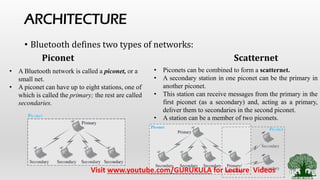
• Bluetooth defines two types of networks:
Piconet Scatternet
• A Bluetooth network is called a piconet, or a
small net.
• A piconet can have up to eight stations, one of
which is called the primary; the rest are called
secondaries.
• Piconets can be combined to form a scatternet.
• A secondary station in one piconet can be the primary in
another piconet.
• This station can receive messages from the primary in the
first piconet (as a secondary) and, acting as a primary,
deliver them to secondaries in the second piconet.
• A station can be a member of two piconets.
Visit www.youtube.com/GURUKULA for Lecture Videos
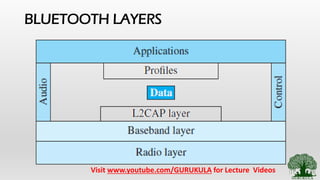
BLUETOOTH LAYERS
Visit www.youtube.com/GURUKULA for Lecture Videos
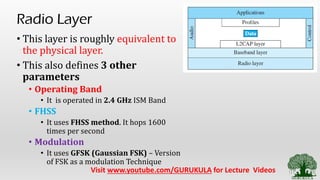
Radio Layer
• This layer is roughly equivalent to
the physical layer.
• This also defines 3 other
parameters
• Operating Band
• It is operated in 2.4 GHz ISM Band
• FHSS
• It uses FHSS method. It hops 1600
times per second
• Modulation
• It uses GFSK (Gaussian FSK) – Version
of FSK as a modulation Technique
Visit www.youtube.com/GURUKULA for Lecture Videos
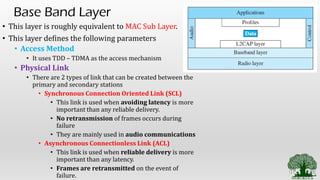
Base Band Layer
• This layer is roughly equivalent to MAC Sub Layer.
• This layer defines the following parameters
• Access Method
• It uses TDD – TDMA as the access mechanism
• Physical Link
• There are 2 types of link that can be created between the
primary and secondary stations
• Synchronous Connection Oriented Link (SCL)
• This link is used when avoiding latency is more
important than any reliable delivery.
• No retransmission of frames occurs during
failure
• They are mainly used in audio communications
• Asynchronous Connectionless Link (ACL)
• This link is used when reliable delivery is more
important than any latency.
• Frames are retransmitted on the event of
failure.
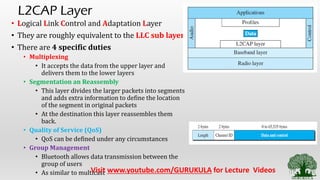
L2CAP Layer
• Logical Link Control and Adaptation Layer
• They are roughly equivalent to the LLC sub layer.
• There are 4 specific duties
• Multiplexing
• It accepts the data from the upper layer and
delivers them to the lower layers
• Segmentation an Reassembly
• This layer divides the larger packets into segments
and adds extra information to define the location
of the segment in original packets
• At the destination this layer reassembles them
back.
• Quality of Service (QoS)
• QoS can be defined under any circumstances
• Group Management
• Bluetooth allows data transmission between the
group of users
• As similar to multicastVisit www.youtube.com/GURUKULA for Lecture Videos
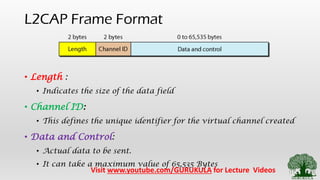
L2CAP Frame Format
• Length :
• Indicates the size of the data field
• Channel ID:
• This defines the unique identifier for the virtual channel created
• Data and Control:
• Actual data to be sent.
• It can take a maximum value of 65,535 Bytes
Visit www.youtube.com/GURUKULA for Lecture Videos
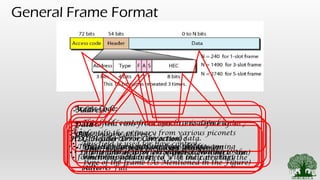
General Frame Format
Access Code:
• This field contains a synchronisation bits to
identify the primary from various piconets
• The secondary stations uses this bits to
synchronise their speed with their primary
station
Address:
• This field runs from 000 – 111 to define up to 7
secondary address.
• 000 – represents broadcast address.
Type:
• This field represents the type of data coming
form the upper layer
F :
• This field is used for flow control
• When this field is set to “1” it indicates that the
buffer is Full
A :
• This field is used for Acknowledgement
S :
• This field is used for Sequence Number
HEC (Header Error Correction) :
• This field is used for error detection (Check Sum)
Data :
• This field carries the actual data.
• The length of this field varies according to the
type of the frame (As Mentioned in the Figure)
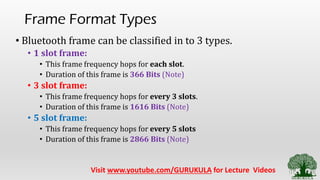
Frame Format Types
• Bluetooth frame can be classified in to 3 types.
• 1 slot frame:
• This frame frequency hops for each slot.
• Duration of this frame is 366 Bits (Note)
• 3 slot frame:
• This frame frequency hops for every 3 slots.
• Duration of this frame is 1616 Bits (Note)
• 5 slot frame:
• This frame frequency hops for every 5 slots
• Duration of this frame is 2866 Bits (Note)
Visit www.youtube.com/GURUKULA for Lecture Videos
Session Summary
• Introduction of Bluetooth
• Architecture of Bluetooth – Piconet and Scatternet
• Bluetooth Layers [ Radio, Base Band, L2cap Layers – Functions]
• Frame Format of Blutooth and its Types [1 slot, 3 slot, 5 slot]
Visit www.youtube.com/GURUKULA for Lecture Videos
References:
• Behrouz A. Forouzan, ―Data communication and Networking, Fifth
Edition, Tata McGraw – Hill, 2013
• Larry L. Peterson, Bruce S. Davie, ―Computer Networks: A Systems
Approach, Fifth Edition, Morgan Kaufmann Publishers, 2011.
• Few online References (Will be Mentioned in the description Section)
Thank You…

2.8 bluetooth ieee 802.15

  • 1.
  • 2.
    Overview of Module- 2 • Framing • What is Framing • Types of Framing • Methods for identifying the boundaries • Flow Control • What is flow control • Types of flow control • Access Control • What is access control • Types of access control • Ethernet – IEEE 802.3 • Evolution of Ethernet • Frame Format of Ethernet • Access Control for Ethernet • Performance Evaluation of Ethernet • WLAN – IEEE 802.11 • Architecture • Bluetooth • WIFI • Zigbee • 6LowPan • Network Layer Services • IPv4 • Packet switching • Network Layer Protocols Visit www.youtube.com/GURUKULA for Lecture Videos
  • 3.
    BLUETOOTH • Bluetooth isa wireless LAN technology designed to connect devices of different functions such as telephones, notebooks, computers (desktop and laptop), cameras, printers. • A Bluetooth LAN is an ad hoc network, which means that the network is formed spontaneously; the devices, sometimes called gadgets, find each other and make a network called a piconet • Bluetooth technology is the implementation of a protocol defined by the IEEE 802.15 standard. • The standard defines a wireless personal-area network (PAN) operable in an area the size of a room or a hall. Visit www.youtube.com/GURUKULA for Lecture Videos
  • 4.
    ARCHITECTURE • Bluetooth definestwo types of networks: Piconet Scatternet • A Bluetooth network is called a piconet, or a small net. • A piconet can have up to eight stations, one of which is called the primary; the rest are called secondaries. • Piconets can be combined to form a scatternet. • A secondary station in one piconet can be the primary in another piconet. • This station can receive messages from the primary in the first piconet (as a secondary) and, acting as a primary, deliver them to secondaries in the second piconet. • A station can be a member of two piconets. Visit www.youtube.com/GURUKULA for Lecture Videos
  • 5.
  • 6.
    Radio Layer • Thislayer is roughly equivalent to the physical layer. • This also defines 3 other parameters • Operating Band • It is operated in 2.4 GHz ISM Band • FHSS • It uses FHSS method. It hops 1600 times per second • Modulation • It uses GFSK (Gaussian FSK) – Version of FSK as a modulation Technique Visit www.youtube.com/GURUKULA for Lecture Videos
  • 7.
    Base Band Layer •This layer is roughly equivalent to MAC Sub Layer. • This layer defines the following parameters • Access Method • It uses TDD – TDMA as the access mechanism • Physical Link • There are 2 types of link that can be created between the primary and secondary stations • Synchronous Connection Oriented Link (SCL) • This link is used when avoiding latency is more important than any reliable delivery. • No retransmission of frames occurs during failure • They are mainly used in audio communications • Asynchronous Connectionless Link (ACL) • This link is used when reliable delivery is more important than any latency. • Frames are retransmitted on the event of failure.
  • 8.
    L2CAP Layer • LogicalLink Control and Adaptation Layer • They are roughly equivalent to the LLC sub layer. • There are 4 specific duties • Multiplexing • It accepts the data from the upper layer and delivers them to the lower layers • Segmentation an Reassembly • This layer divides the larger packets into segments and adds extra information to define the location of the segment in original packets • At the destination this layer reassembles them back. • Quality of Service (QoS) • QoS can be defined under any circumstances • Group Management • Bluetooth allows data transmission between the group of users • As similar to multicastVisit www.youtube.com/GURUKULA for Lecture Videos
  • 9.
    L2CAP Frame Format •Length : • Indicates the size of the data field • Channel ID: • This defines the unique identifier for the virtual channel created • Data and Control: • Actual data to be sent. • It can take a maximum value of 65,535 Bytes Visit www.youtube.com/GURUKULA for Lecture Videos
  • 10.
    General Frame Format AccessCode: • This field contains a synchronisation bits to identify the primary from various piconets • The secondary stations uses this bits to synchronise their speed with their primary station Address: • This field runs from 000 – 111 to define up to 7 secondary address. • 000 – represents broadcast address. Type: • This field represents the type of data coming form the upper layer F : • This field is used for flow control • When this field is set to “1” it indicates that the buffer is Full A : • This field is used for Acknowledgement S : • This field is used for Sequence Number HEC (Header Error Correction) : • This field is used for error detection (Check Sum) Data : • This field carries the actual data. • The length of this field varies according to the type of the frame (As Mentioned in the Figure)
  • 11.
    Frame Format Types •Bluetooth frame can be classified in to 3 types. • 1 slot frame: • This frame frequency hops for each slot. • Duration of this frame is 366 Bits (Note) • 3 slot frame: • This frame frequency hops for every 3 slots. • Duration of this frame is 1616 Bits (Note) • 5 slot frame: • This frame frequency hops for every 5 slots • Duration of this frame is 2866 Bits (Note) Visit www.youtube.com/GURUKULA for Lecture Videos
  • 12.
    Session Summary • Introductionof Bluetooth • Architecture of Bluetooth – Piconet and Scatternet • Bluetooth Layers [ Radio, Base Band, L2cap Layers – Functions] • Frame Format of Blutooth and its Types [1 slot, 3 slot, 5 slot] Visit www.youtube.com/GURUKULA for Lecture Videos
  • 13.
    References: • Behrouz A.Forouzan, ―Data communication and Networking, Fifth Edition, Tata McGraw – Hill, 2013 • Larry L. Peterson, Bruce S. Davie, ―Computer Networks: A Systems Approach, Fifth Edition, Morgan Kaufmann Publishers, 2011. • Few online References (Will be Mentioned in the description Section) Thank You…