Communication
Networks
Access Control
in datalink layer
[Random Access Methods]
Part - 1
Overview of Module - 2
• Framing
• What is Framing
• Types of Framing
• Methods for identifying the
boundaries
• Flow Control
• What is flow control
• Types of flow control
• Access Control
• What is access control
• Types of access control
• Ethernet – IEEE 802.3
• Evolution of Ethernet
• Frame Format of Ethernet
• Access Control for Ethernet
• Performance Evaluation of Ethernet
• WLAN – IEEE 802.11
• Architecture
• Bluetooth
• WIFI
• Zigbee
• 6LowPan
• Network Layer Services
• IPv4
• Packet switching
• Network Layer Protocols
Visit www.youtube.com/GURUKULA for Lecture Videos
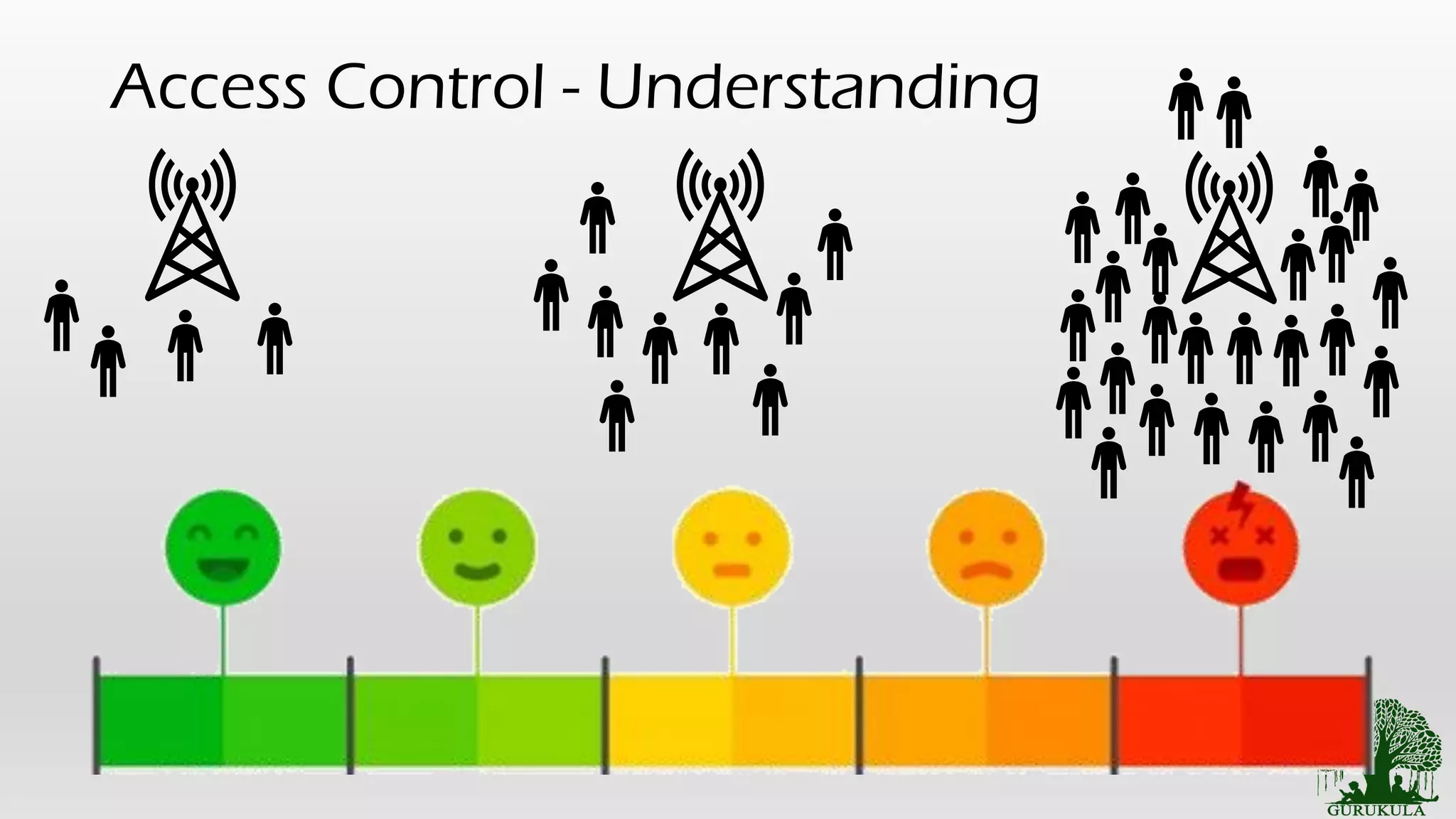
Access Control - Understanding
Need for Access Control
• when nodes or stations are connected and use a common link,
called a multipoint or broadcast link, we need a multiple-access
protocol to coordinate access to the link.
• The problem of controlling the access to the medium is similar
to the rules of speaking in an assembly.
• The procedures guarantee that the right to speak
• Ensure that two people do not speak at the same time, do not interrupt each other,
• do not monopolize the discussion, and so on.
• Many protocols have been devised to handle access to a shared
link. All of these protocols belong to a sublayer in the data-link
layer called media access control (MAC)
Visit www.youtube.com/GURUKULA for Lecture Videos
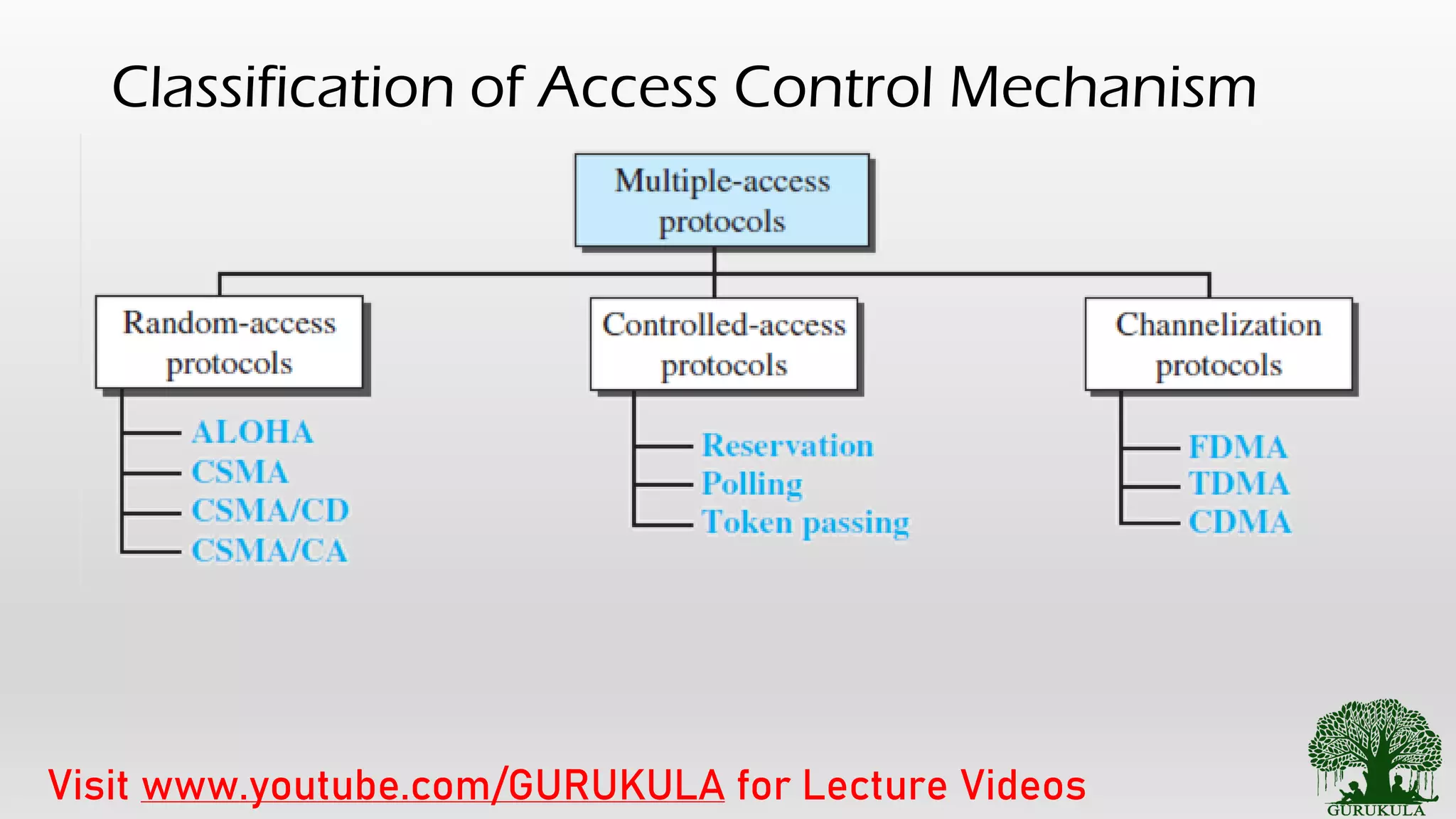
Classification of Access Control Mechanism
Visit www.youtube.com/GURUKULA for Lecture Videos
1. Random Access Protocols
• Why is it called Random Access?
• First, there is no scheduled time for a station to transmit. Transmission is
random among the stations
• Second, no rules specify which station should send next. Stations
compete with one another to access the medium
• In Random Access Protocol, Each station follows a procedure that
answers the following questions:
• When can the station access the medium?
• What can the station do if the medium is busy?
• How can the station determine the success or failure of the transmission?
• What can the station do if there is an access conflict?
Visit www.youtube.com/GURUKULA for Lecture Videos
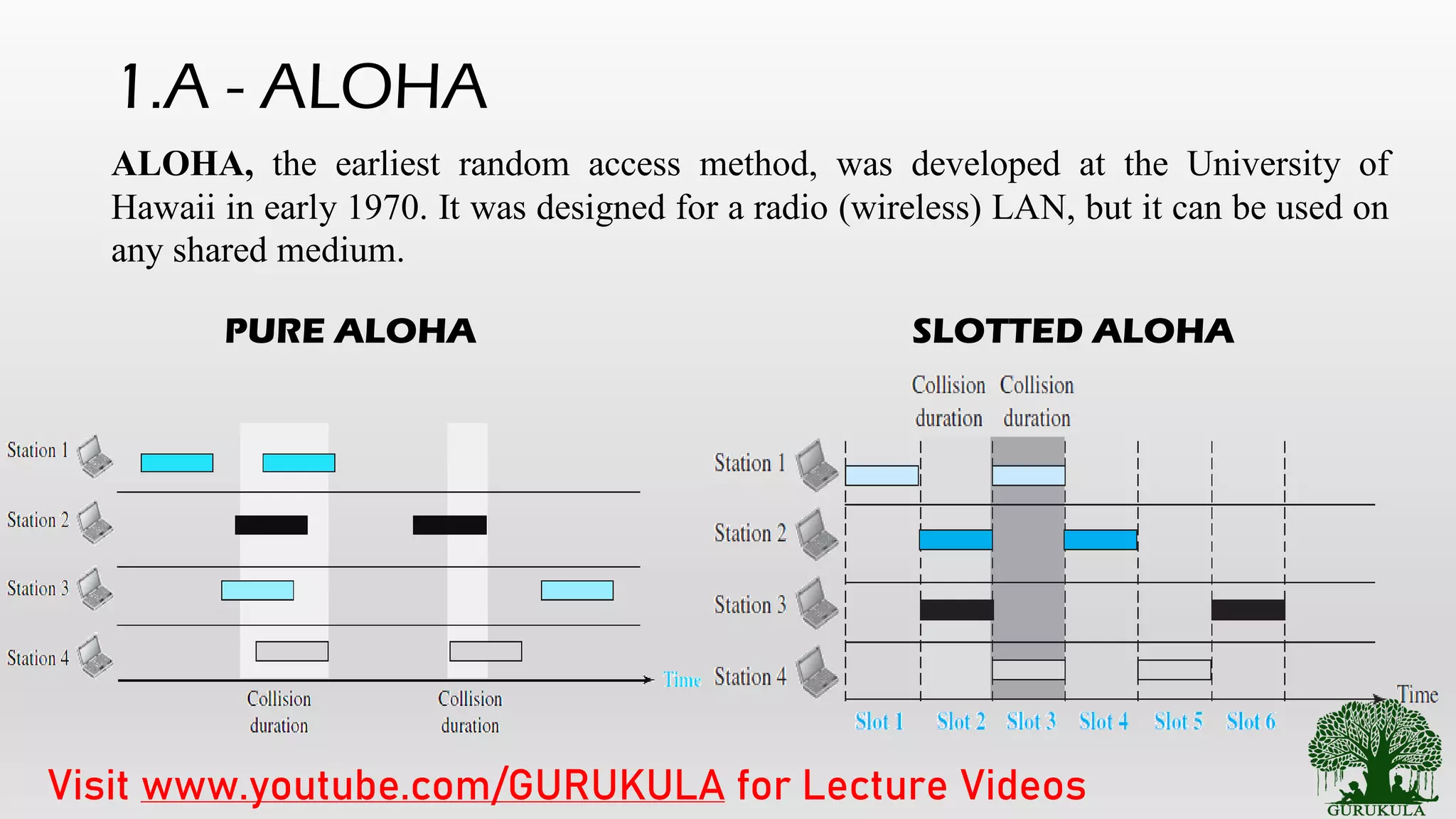
1.A - ALOHA
ALOHA, the earliest random access method, was developed at the University of
Hawaii in early 1970. It was designed for a radio (wireless) LAN, but it can be used on
any shared medium.
PURE ALOHA SLOTTED ALOHA
Visit www.youtube.com/GURUKULA for Lecture Videos
1.B – CSMA – Carrier Sense Multiple Access
The chance of collision can be reduced if a station senses the medium before trying to use it. Carrier sense
multiple access (CSMA) requires that each station first listen to the medium (or check the state of the medium)
before sending. In other words, CSMA is based on the principle “sense before transmit” or “listen before talk.”
Visit www.youtube.com/GURUKULA for Lecture Videos
CSMA - Behaviour
Visit www.youtube.com/GURUKULA for Lecture Videos
Session Summary
• Access Control [Similar to people accessing the cell tower]
• Random Access Methods [Checks the channel randomly, Idle –
Transmit, Busy – Check again]
• ALOHA [Pure ALOHA, Slotted ALOHA]
• CSMA [ 1 Persistent, n Persistent, p Persistent]
• CSMA – CD [widely used in Ethernet]
• CSMA – CA [widely used in WLAN]
Visit www.youtube.com/GURUKULA for Lecture Videos
References:
• Behrouz A. Forouzan, ―Data communication and Networking, Fifth
Edition, Tata McGraw – Hill, 2013
• Larry L. Peterson, Bruce S. Davie, ―Computer Networks: A Systems
Approach, Fifth Edition, Morgan Kaufmann Publishers, 2011.
• Few online References (Will be Mentioned in the description Section)
Thank You…

2.3 access control random access methods - part 1

  • 1.
    Communication Networks Access Control in datalinklayer [Random Access Methods] Part - 1
  • 2.
    Overview of Module- 2 • Framing • What is Framing • Types of Framing • Methods for identifying the boundaries • Flow Control • What is flow control • Types of flow control • Access Control • What is access control • Types of access control • Ethernet – IEEE 802.3 • Evolution of Ethernet • Frame Format of Ethernet • Access Control for Ethernet • Performance Evaluation of Ethernet • WLAN – IEEE 802.11 • Architecture • Bluetooth • WIFI • Zigbee • 6LowPan • Network Layer Services • IPv4 • Packet switching • Network Layer Protocols Visit www.youtube.com/GURUKULA for Lecture Videos
  • 3.
    Access Control -Understanding
  • 4.
    Need for AccessControl • when nodes or stations are connected and use a common link, called a multipoint or broadcast link, we need a multiple-access protocol to coordinate access to the link. • The problem of controlling the access to the medium is similar to the rules of speaking in an assembly. • The procedures guarantee that the right to speak • Ensure that two people do not speak at the same time, do not interrupt each other, • do not monopolize the discussion, and so on. • Many protocols have been devised to handle access to a shared link. All of these protocols belong to a sublayer in the data-link layer called media access control (MAC) Visit www.youtube.com/GURUKULA for Lecture Videos
  • 5.
    Classification of AccessControl Mechanism Visit www.youtube.com/GURUKULA for Lecture Videos
  • 6.
    1. Random AccessProtocols • Why is it called Random Access? • First, there is no scheduled time for a station to transmit. Transmission is random among the stations • Second, no rules specify which station should send next. Stations compete with one another to access the medium • In Random Access Protocol, Each station follows a procedure that answers the following questions: • When can the station access the medium? • What can the station do if the medium is busy? • How can the station determine the success or failure of the transmission? • What can the station do if there is an access conflict? Visit www.youtube.com/GURUKULA for Lecture Videos
  • 7.
    1.A - ALOHA ALOHA,the earliest random access method, was developed at the University of Hawaii in early 1970. It was designed for a radio (wireless) LAN, but it can be used on any shared medium. PURE ALOHA SLOTTED ALOHA Visit www.youtube.com/GURUKULA for Lecture Videos
  • 8.
    1.B – CSMA– Carrier Sense Multiple Access The chance of collision can be reduced if a station senses the medium before trying to use it. Carrier sense multiple access (CSMA) requires that each station first listen to the medium (or check the state of the medium) before sending. In other words, CSMA is based on the principle “sense before transmit” or “listen before talk.” Visit www.youtube.com/GURUKULA for Lecture Videos
  • 9.
    CSMA - Behaviour Visitwww.youtube.com/GURUKULA for Lecture Videos
  • 10.
    Session Summary • AccessControl [Similar to people accessing the cell tower] • Random Access Methods [Checks the channel randomly, Idle – Transmit, Busy – Check again] • ALOHA [Pure ALOHA, Slotted ALOHA] • CSMA [ 1 Persistent, n Persistent, p Persistent] • CSMA – CD [widely used in Ethernet] • CSMA – CA [widely used in WLAN] Visit www.youtube.com/GURUKULA for Lecture Videos
  • 11.
    References: • Behrouz A.Forouzan, ―Data communication and Networking, Fifth Edition, Tata McGraw – Hill, 2013 • Larry L. Peterson, Bruce S. Davie, ―Computer Networks: A Systems Approach, Fifth Edition, Morgan Kaufmann Publishers, 2011. • Few online References (Will be Mentioned in the description Section) Thank You…