
J.PREM KAMAL DAS
16W91A0423
We look into…
• OFDMA – Orthogonal Frequency Division Multiple
Access
• One of the multiple access techniques
• Recent Technology in Wireless Communication
• It is related to FDMA
•Introduced by Chang, Bell labs in 1966
•Weinstein & Ebert proposed use of FFT and
Guard interval in 1971
•Cimini described the use of OFDMA in mobile
communication
•IEEE 802.11a wireless LAN standards (Wi-Fi) in
1999
•IEEE 802.16 standards for wireless MAN
(WiMAX) in 2004
•First LTE air interface implementation was
demonstrated in 2007
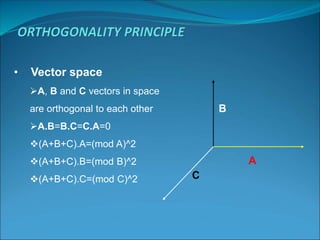
• Vector space
A, B and C vectors in space
are orthogonal to each other
A.B=B.C=C.A=0
(A+B+C).A=(mod A)^2
(A+B+C).B=(mod B)^2
(A+B+C).C=(mod C)^2
A
B
C
•OFDMA is a specialized frequency division multiple
access (FDMA) method.
•All subcarrier signals within a communication channel are
orthogonal to one another.
•The spacing between carriers are such that they are
orthogonal to one another
•Therefore no need of guard band between carriers.
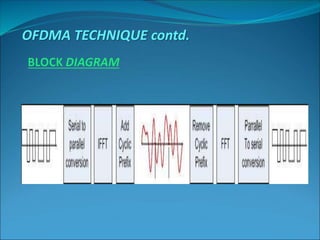
OFDMA TECHNIQUE contd.
•The cyclic prefix provides a guard interval to eliminate
intersymbol interference from the previous symbol.
•It repeats the end of the symbol so the linear convolution
of a frequency-selective multipath channel can be modeled
as circular convolution.
•This approach accommodates simple frequency domain
processing, such as channel estimation and equalization.
OFDMA TECHNIQUE contd.
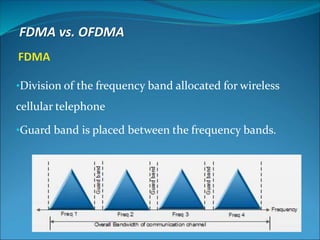
•Division of the frequency band allocated for wireless
cellular telephone
•Guard band is placed between the frequency bands.
FDMA vs. OFDMA
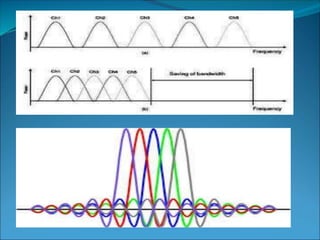
•Subcarriers overlap with each other.
•Passband bandwidth will be B ≈ N·Δf (Hz).
•By Orthogonality Principle, the signals are
transmitted.
•Receiver identifies the signals with orthogonal
principle.
FDMA vs. OFDMA
OFDMA
•Makes efficient use of the spectrum by allowing
overlap.
•Eliminates ISI through use of a cyclic prefix.
•High speed data transmission.
•It is possible to use maximum likelihood decoding
with reasonable complexity.
•OFDM is computationally efficient by using FFT
techniques to implement the modulation and
demodulation functions.
•High Peak to Average Power Ratio (PAPR)
•It has higher carrier frequency offset due to different
LOs (Local Oscillators) and DFT leakage.
•It is prone to ISI (Inter Symbol Interference) and ICI
(Inter Carrier Interference). This requires time offset
and frequency offset correction algorithms.
DISADVANTAGES
•DAB
•HDTV
•Wireless LAN Networks
•Broadband Wireless Access System
•LTE
APPLICATIONS
•5G mobile communication
•Reduction of PAPR
FUTURE SCOPE
It’s PREMKAMAL Presentation

OFDMA - Orthogonal Frequency Division Multiple Access PPT by PREM KAMAL

  • 1.
  • 2.
  • 3.
    • OFDMA –Orthogonal Frequency Division Multiple Access • One of the multiple access techniques • Recent Technology in Wireless Communication • It is related to FDMA
  • 4.
    •Introduced by Chang,Bell labs in 1966 •Weinstein & Ebert proposed use of FFT and Guard interval in 1971 •Cimini described the use of OFDMA in mobile communication •IEEE 802.11a wireless LAN standards (Wi-Fi) in 1999 •IEEE 802.16 standards for wireless MAN (WiMAX) in 2004 •First LTE air interface implementation was demonstrated in 2007
  • 5.
    • Vector space A,B and C vectors in space are orthogonal to each other A.B=B.C=C.A=0 (A+B+C).A=(mod A)^2 (A+B+C).B=(mod B)^2 (A+B+C).C=(mod C)^2 A B C
  • 6.
    •OFDMA is aspecialized frequency division multiple access (FDMA) method. •All subcarrier signals within a communication channel are orthogonal to one another. •The spacing between carriers are such that they are orthogonal to one another •Therefore no need of guard band between carriers.
  • 7.
  • 8.
    •The cyclic prefixprovides a guard interval to eliminate intersymbol interference from the previous symbol. •It repeats the end of the symbol so the linear convolution of a frequency-selective multipath channel can be modeled as circular convolution. •This approach accommodates simple frequency domain processing, such as channel estimation and equalization. OFDMA TECHNIQUE contd.
  • 9.
    •Division of thefrequency band allocated for wireless cellular telephone •Guard band is placed between the frequency bands. FDMA vs. OFDMA
  • 10.
    •Subcarriers overlap witheach other. •Passband bandwidth will be B ≈ N·Δf (Hz). •By Orthogonality Principle, the signals are transmitted. •Receiver identifies the signals with orthogonal principle. FDMA vs. OFDMA OFDMA
  • 12.
    •Makes efficient useof the spectrum by allowing overlap. •Eliminates ISI through use of a cyclic prefix. •High speed data transmission. •It is possible to use maximum likelihood decoding with reasonable complexity. •OFDM is computationally efficient by using FFT techniques to implement the modulation and demodulation functions.
  • 13.
    •High Peak toAverage Power Ratio (PAPR) •It has higher carrier frequency offset due to different LOs (Local Oscillators) and DFT leakage. •It is prone to ISI (Inter Symbol Interference) and ICI (Inter Carrier Interference). This requires time offset and frequency offset correction algorithms. DISADVANTAGES
  • 14.
    •DAB •HDTV •Wireless LAN Networks •BroadbandWireless Access System •LTE APPLICATIONS
  • 15.
  • 16.