Communication
Networks
Access Control
in datalink layer
[Channelization Methods]
Overview of Module - 2
• Framing
• What is Framing
• Types of Framing
• Methods for identifying the
boundaries
• Flow Control
• What is flow control
• Types of flow control
• Access Control
• What is access control
• Types of access control
• Ethernet – IEEE 802.3
• Evolution of Ethernet
• Frame Format of Ethernet
• Access Control for Ethernet
• Performance Evaluation of Ethernet
• WLAN – IEEE 802.11
• Architecture
• Bluetooth
• WIFI
• Zigbee
• 6LowPan
• Network Layer Services
• IPv4
• Packet switching
• Network Layer Protocols
Visit www.youtube.com/GURUKULA for Lecture Videos
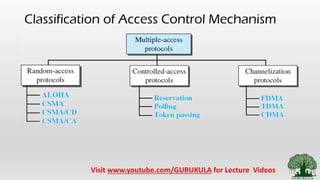
Classification of Access Control Mechanism
Visit www.youtube.com/GURUKULA for Lecture Videos
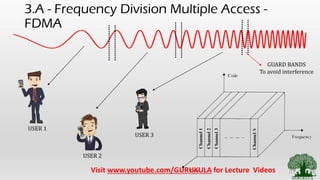
3.A - Frequency Division Multiple Access -
FDMA
USER 1
USER 3
USER 2
GUARD BANDS
To avoid interference
Visit www.youtube.com/GURUKULA for Lecture Videos
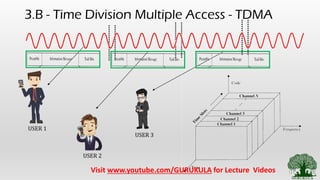
3.B - Time Division Multiple Access - TDMA
USER 1
USER 3
USER 2
Visit www.youtube.com/GURUKULA for Lecture Videos
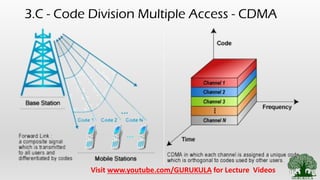
3.C - Code Division Multiple Access - CDMA
Visit www.youtube.com/GURUKULA for Lecture Videos
Session Summary
• Flow Control [Similar to traffic control signal]
• Simple Protocol
• Stop and wait protocol
• Access Control [Similar to people accessing the cell tower]
• Random Access Methods [Checks the channel randomly, Idle – Transmit, Busy – Check again]
• ALOHA [Pure ALOHA, Slotted ALOHA]
• CSMA [ 1 Persistent, n Persistent, p Persistent]
• CSMA – CD [widely used in Ethernet]
• CSMA – CA [widely used in WLAN]
• Controlled Access Methods [Following a systematic approach]
• Reservation – Similar to Reserving the seats in Bus or train
• Polling – Similar to Master Slave Concept
• Token Passing – Similar to passing a Mic among the audience in seminar
• Channelization Methods [ Similar to Highway Lane separation]
• FDMA – Users are differentiated wrt to Frequency
• TDMA – Users are differentiated wrt to Time
• CDMA – Users are differentiated wrt to Code
References:
• Behrouz A. Forouzan, ―Data communication and Networking, Fifth
Edition, Tata McGraw – Hill, 2013
• Larry L. Peterson, Bruce S. Davie, ―Computer Networks: A Systems
Approach, Fifth Edition, Morgan Kaufmann Publishers, 2011.
• Few online References (Will be Mentioned in the description Section)
Thank You…

2.5 access control channelization methods

  • 1.
  • 2.
    Overview of Module- 2 • Framing • What is Framing • Types of Framing • Methods for identifying the boundaries • Flow Control • What is flow control • Types of flow control • Access Control • What is access control • Types of access control • Ethernet – IEEE 802.3 • Evolution of Ethernet • Frame Format of Ethernet • Access Control for Ethernet • Performance Evaluation of Ethernet • WLAN – IEEE 802.11 • Architecture • Bluetooth • WIFI • Zigbee • 6LowPan • Network Layer Services • IPv4 • Packet switching • Network Layer Protocols Visit www.youtube.com/GURUKULA for Lecture Videos
  • 3.
    Classification of AccessControl Mechanism Visit www.youtube.com/GURUKULA for Lecture Videos
  • 4.
    3.A - FrequencyDivision Multiple Access - FDMA USER 1 USER 3 USER 2 GUARD BANDS To avoid interference Visit www.youtube.com/GURUKULA for Lecture Videos
  • 5.
    3.B - TimeDivision Multiple Access - TDMA USER 1 USER 3 USER 2 Visit www.youtube.com/GURUKULA for Lecture Videos
  • 6.
    3.C - CodeDivision Multiple Access - CDMA Visit www.youtube.com/GURUKULA for Lecture Videos
  • 7.
    Session Summary • FlowControl [Similar to traffic control signal] • Simple Protocol • Stop and wait protocol • Access Control [Similar to people accessing the cell tower] • Random Access Methods [Checks the channel randomly, Idle – Transmit, Busy – Check again] • ALOHA [Pure ALOHA, Slotted ALOHA] • CSMA [ 1 Persistent, n Persistent, p Persistent] • CSMA – CD [widely used in Ethernet] • CSMA – CA [widely used in WLAN] • Controlled Access Methods [Following a systematic approach] • Reservation – Similar to Reserving the seats in Bus or train • Polling – Similar to Master Slave Concept • Token Passing – Similar to passing a Mic among the audience in seminar • Channelization Methods [ Similar to Highway Lane separation] • FDMA – Users are differentiated wrt to Frequency • TDMA – Users are differentiated wrt to Time • CDMA – Users are differentiated wrt to Code
  • 8.
    References: • Behrouz A.Forouzan, ―Data communication and Networking, Fifth Edition, Tata McGraw – Hill, 2013 • Larry L. Peterson, Bruce S. Davie, ―Computer Networks: A Systems Approach, Fifth Edition, Morgan Kaufmann Publishers, 2011. • Few online References (Will be Mentioned in the description Section) Thank You…