A Medium Access Protocol:
ALOHA
Prepared by: Hinal Lunagariya
Contents
• ALOHA: Meaning
• History
• Contention protocol
• Basic idea
• Versions of ALOHA
• Pure ALOHA
• Analysis of pure ALOHA
• Slotted ALOHA
• Analysis of slotted ALOHA
• Summary
• References
ALOHA : Meaning[1]
It has been derived from a compound of the Hawaiian words:
ALO means “share”.
HA means “essence of life”
History[1]
Development of the ALOHA network was begun in 1968 at the University
of Hawaii under the leadership of Norman Abramson.
The goal was to use low-cost commercial radio equipment to connect
users on Oahu(an island of Hawaii) and the other Hawaiian islands with a
central time-sharing computer on the main Oahu campus.
ALOHAnet became operational in June, 1971, providing the first public
demonstration of a wireless packet data network.
Although ALOHAnet was designed for wireless communication, there
were two other media available for the application of an ALOHA channel –
cables and satellites.
In the 1970s ALOHA random access was employed in the widely used
Ethernet cable based network and then in the satellite network.
Contention is a media access method that is used to share a broadcast
medium.
In contention, any computer in the network can transmit data at any
time (first come-first served).
The ALOHAnet solution was to allow each client to send its data without
controlling when it was sent, with an acknowledgment/retransmission
scheme used to deal with collisions.
ALOHA: A family of Contention Protocols
Basic Idea Behind ALOHA
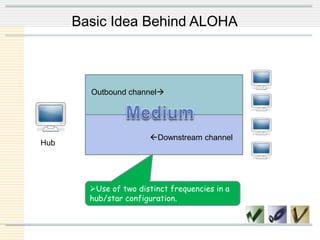
Use of two distinct frequencies in a hub/star configuration.
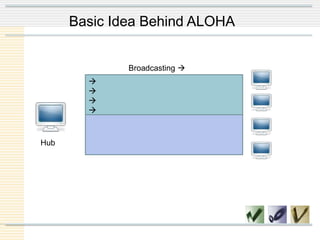
The hub machine broadcasting packets to everyone on the "outbound"
channel.
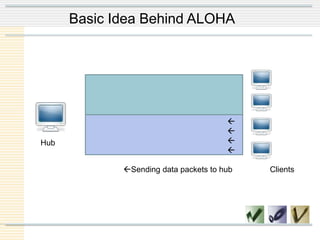
Various client machines sending data packets to the hub on the "inbound"
channel.
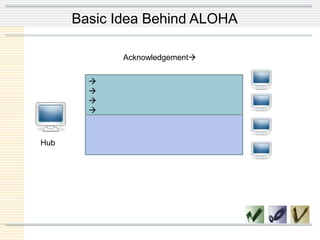
 If data was received correctly at the hub, a short acknowledgment
packet was sent to the client.
if an acknowledgment was not received by a client machine after a short
wait time, it would automatically retransmit the data packet after waiting
a randomly selected time interval.
This acknowledgment mechanism was used to detect and correct for
"collisions" created when two client machines both attempted to send a
packet at the same time.
Outbound channel
Downstream channel
Hub
Basic Idea Behind ALOHA
Use of two distinct frequencies in a
hub/star configuration.




Hub
Broadcasting 
Basic Idea Behind ALOHA




Hub
Sending data packets to hub Clients
Basic Idea Behind ALOHA




Hub
Acknowledgement
Basic Idea Behind ALOHA
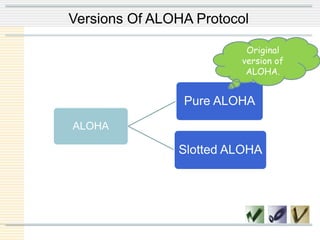
Versions Of ALOHA Protocol
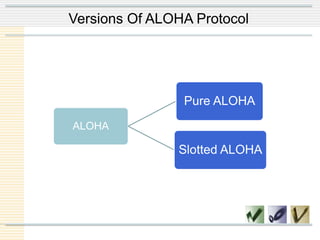
ALOHA
Pure ALOHA
Slotted ALOHA
Versions Of ALOHA Protocol
ALOHA
Pure ALOHA
Slotted ALOHA
Original
version of
ALOHA.
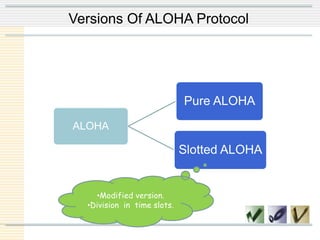
Versions Of ALOHA Protocol
ALOHA
Pure ALOHA
Slotted ALOHA
•Modified version.
•Division in time slots.
Pure ALOHA
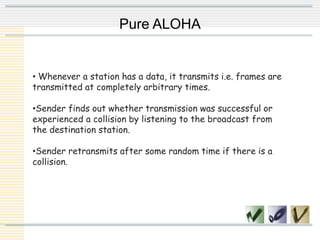
• Whenever a station has a data, it transmits i.e. frames are
transmitted at completely arbitrary times.
•Sender finds out whether transmission was successful or
experienced a collision by listening to the broadcast from
the destination station.
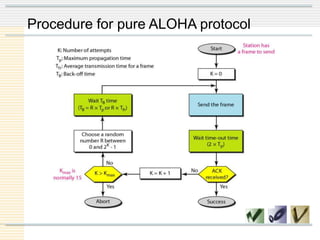
•Sender retransmits after some random time if there is a
collision.
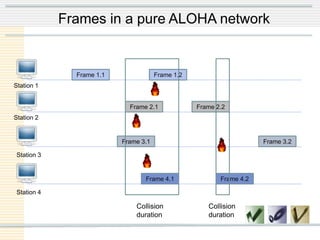
Frame 1.1
Frame 2.1
Frame 1.2
Frame 4.2
Frame 3.2
Frame 2.2
Frame 4.1
Frame 3.1
Collision
duration
Collision
duration
Station 1
Station 2
Station 3
Station 4
Frames in a pure ALOHA network
Procedure for pure ALOHA protocol
Analysis of Pure ALOHA…
• Notation:
– Tf : Frame time (processing, transmission, propagation)
– S : Average number of successful transmissions per Tf ;
that is, the throughput or efficiency.
– G : Average number of total frames transmitted per Tf
– D : Average delay between the time a packet is ready for
transmission and the completion of successful
transmission.
We will make the following assumptions:
All frames are of constant length
The channel is noise-free; the errors are only due to
collisions.
Frames do not queue at individual stations
The channel acts as a Poisson process.
Since S represents the number of “good” or “succeed”
transmissions per frame time, and G represents the total number
of attempted transmissions per frame time, then we have:
S = G * (Probability of good transmission)
….Analysis Of Pure ALOHA….
Vulnerable time for pure ALOHA protocol:
( )
( )
!
k t
k
t e
P t
k

 

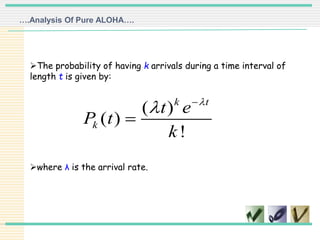
The probability of having k arrivals during a time interval of
length t is given by:
where λ is the arrival rate.
….Analysis Of Pure ALOHA….
12.21
….Analysis Of Pure ALOHA….
The vulnerable time for a successful transmission is 2Tf
i.e. collision probability increases
So, the probability of good transmission is not to have an “arrival”
during the vulnerable time .
!
)(
)(
k
et
tP
tk
k

 

And setting t = 2Tf and k = 0, we get,
20
2
0
2
( 2 )
(2 )
0!
becasue . Thus,
fT
f G
f
G
f
T e
P T e
G
S G e
T







 
  
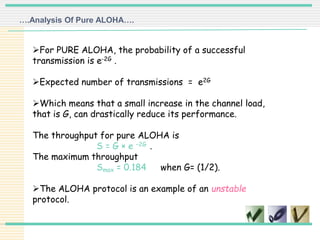
For PURE ALOHA, the probability of a successful
transmission is e-2G .
Expected number of transmissions = e2G
Which means that a small increase in the channel load,
that is G, can drastically reduce its performance.
The throughput for pure ALOHA is
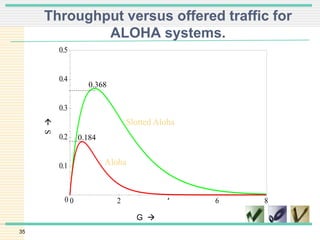
S = G × e −2G .
The maximum throughput
Smax = 0.184 when G= (1/2).
The ALOHA protocol is an example of an unstable
protocol.
….Analysis Of Pure ALOHA….
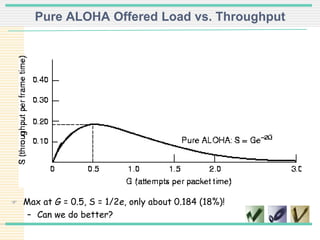
Pure ALOHA Offered Load vs. Throughput
 Max at G = 0.5, S = 1/2e, only about 0.184 (18%)!
– Can we do better?
24
Slotted ALOHA
 Slotted ALOHA was invented to improve the efficiency of
pure ALOHA as chances of collision in pure ALOHA are very
high.
 In slotted ALOHA, there is still a possibility of collision if
two stations try to send at the beginning of the same time
slot
 Slotted ALOHA still has an edge over pure ALOHA as
chances of collision are reduced to one-half.
Assumptions Made In Slotted ALOHA
• All frames consist of exactly L bits.
• Time is divided into slots of size L/R seconds (i.e., a slot
equals the time to transmit one frame).
• Nodes start to transmit frames only at the beginnings of
slots.
• The nodes are synchronized so that each node knows when
the slots begin.
• If two or more frames collide in a slot, then all the nodes
detect the collision event before the slot ends.
.
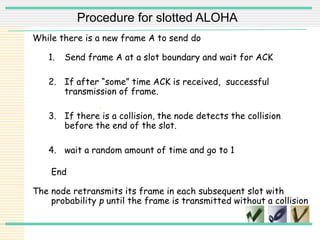
While there is a new frame A to send do
1. Send frame A at a slot boundary and wait for ACK
2. If after “some” time ACK is received, successful
transmission of frame.
3. If there is a collision, the node detects the collision
before the end of the slot.
4. wait a random amount of time and go to 1
End
The node retransmits its frame in each subsequent slot with
probability p until the frame is transmitted without a collision
Procedure for slotted ALOHA
Frame 1.1
Frame 2.1
Frame 1.2
Frame 4.2
Frame 3.2
Frame 2.2
Frame 4.1
Frame 3.1
Collision duration
Station 1
Station 2
Station 3
Station 4
Frames in a Slotted ALOHA network
Slot 1 Slot 2 Slot 3 Slot 4 Slot 5 Slot 6
Analysis of Slotted ALOHA….
Suppose N stations have packets to send,
each transmits in slot with probability p
probability of successful transmission S is:
•by any specific single node: S= p (1-p)(N-1)
•by any of N nodes
S = Prob (only one transmits)
= N p (1-p)(N-1)
for optimum p as N -> infty ...
S = 1/e = .37
At best: channel use for useful
transmissions 37% of time!!!!!
12.30
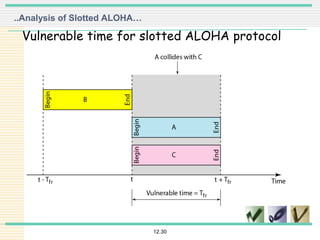
Vulnerable time for slotted ALOHA protocol
..Analysis of Slotted ALOHA…
• Note that the vulnerable period is now reduced in
half.
Hence,
!
)(
)(
k
et
tP
tk
k

 

And putting t = Tf and k = 0, we get
0
0
( )
( )
0!
because . Thus,
fT
f G
f
G
f
T e
P T e
G
S G e
T







 
  
..Analysis of Slotted ALOHA…
32
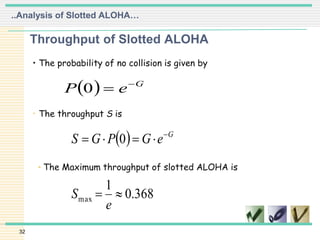
Throughput of Slotted ALOHA
  G
eP 
0
• The probability of no collision is given by
  G
eGPGS 
 0
• The throughput S is
368.0
1
max 
e
S
• The Maximum throughput of slotted ALOHA is
..Analysis of Slotted ALOHA…
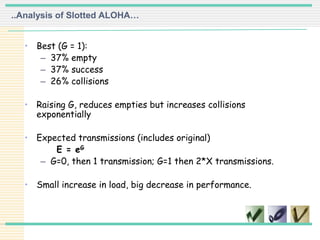
• Best (G = 1):
– 37% empty
– 37% success
– 26% collisions
• Raising G, reduces empties but increases collisions
exponentially
• Expected transmissions (includes original)
E = eG
– G=0, then 1 transmission; G=1 then 2*X transmissions.
• Small increase in load, big decrease in performance.
..Analysis of Slotted ALOHA…
Pros and Cons of Slotted ALOHA
Pros
• single active node can continuously transmit at full
rate of channel
• highly decentralized: only slots in nodes need to be
in sync
• Simple protocol
Cons
• collisions, wasting slots
• idle slots
• nodes may be able to detect collision in less than time to
transmit packet
• clock synchronization
35
Throughput versus offered traffic for
ALOHA systems.
G
86420
0.5
0.4
0.3
0.2
0.1
0
Slotted Aloha
Aloha
0.368
0.184
S
G 
Summary
ALOHA is one of the random access protocol implemented
at link layer.
Chances of collisions are more in pure ALOHA as compared
to Slotted ALOHA , but still it is least efficient as compared
to other random access protocol such as CSMA(CD/CA).
These protocols works efficiently when there are less active
nodes.
Modified versions of ALOHA are being used in some services
such as Mobile Slotted ALOHA[1].
References
[1] Wikipedia
[2] http://www.cse.iitk.ac.in/users/dheeraj/cs425/lec04.html/index.html
[3] Data Communication and Networking by Behrouz A Forouzan
[4] computer networks and the internet by Ross & Kurose
ALOHA Protocol (in detail)

ALOHA Protocol (in detail)

  • 1.
    A Medium AccessProtocol: ALOHA Prepared by: Hinal Lunagariya
  • 2.
    Contents • ALOHA: Meaning •History • Contention protocol • Basic idea • Versions of ALOHA • Pure ALOHA • Analysis of pure ALOHA • Slotted ALOHA • Analysis of slotted ALOHA • Summary • References
  • 3.
    ALOHA : Meaning[1] Ithas been derived from a compound of the Hawaiian words: ALO means “share”. HA means “essence of life”
  • 4.
    History[1] Development of theALOHA network was begun in 1968 at the University of Hawaii under the leadership of Norman Abramson. The goal was to use low-cost commercial radio equipment to connect users on Oahu(an island of Hawaii) and the other Hawaiian islands with a central time-sharing computer on the main Oahu campus. ALOHAnet became operational in June, 1971, providing the first public demonstration of a wireless packet data network. Although ALOHAnet was designed for wireless communication, there were two other media available for the application of an ALOHA channel – cables and satellites. In the 1970s ALOHA random access was employed in the widely used Ethernet cable based network and then in the satellite network.
  • 5.
    Contention is amedia access method that is used to share a broadcast medium. In contention, any computer in the network can transmit data at any time (first come-first served). The ALOHAnet solution was to allow each client to send its data without controlling when it was sent, with an acknowledgment/retransmission scheme used to deal with collisions. ALOHA: A family of Contention Protocols
  • 6.
    Basic Idea BehindALOHA Use of two distinct frequencies in a hub/star configuration. The hub machine broadcasting packets to everyone on the "outbound" channel. Various client machines sending data packets to the hub on the "inbound" channel.  If data was received correctly at the hub, a short acknowledgment packet was sent to the client. if an acknowledgment was not received by a client machine after a short wait time, it would automatically retransmit the data packet after waiting a randomly selected time interval. This acknowledgment mechanism was used to detect and correct for "collisions" created when two client machines both attempted to send a packet at the same time.
  • 7.
    Outbound channel Downstream channel Hub BasicIdea Behind ALOHA Use of two distinct frequencies in a hub/star configuration.
  • 8.
  • 9.
        Hub Sending data packetsto hub Clients Basic Idea Behind ALOHA
  • 10.
  • 11.
    Versions Of ALOHAProtocol ALOHA Pure ALOHA Slotted ALOHA
  • 12.
    Versions Of ALOHAProtocol ALOHA Pure ALOHA Slotted ALOHA Original version of ALOHA.
  • 13.
    Versions Of ALOHAProtocol ALOHA Pure ALOHA Slotted ALOHA •Modified version. •Division in time slots.
  • 14.
    Pure ALOHA • Whenevera station has a data, it transmits i.e. frames are transmitted at completely arbitrary times. •Sender finds out whether transmission was successful or experienced a collision by listening to the broadcast from the destination station. •Sender retransmits after some random time if there is a collision.
  • 15.
    Frame 1.1 Frame 2.1 Frame1.2 Frame 4.2 Frame 3.2 Frame 2.2 Frame 4.1 Frame 3.1 Collision duration Collision duration Station 1 Station 2 Station 3 Station 4 Frames in a pure ALOHA network
  • 16.
    Procedure for pureALOHA protocol
  • 17.
    Analysis of PureALOHA… • Notation: – Tf : Frame time (processing, transmission, propagation) – S : Average number of successful transmissions per Tf ; that is, the throughput or efficiency. – G : Average number of total frames transmitted per Tf – D : Average delay between the time a packet is ready for transmission and the completion of successful transmission.
  • 18.
    We will makethe following assumptions: All frames are of constant length The channel is noise-free; the errors are only due to collisions. Frames do not queue at individual stations The channel acts as a Poisson process. Since S represents the number of “good” or “succeed” transmissions per frame time, and G represents the total number of attempted transmissions per frame time, then we have: S = G * (Probability of good transmission) ….Analysis Of Pure ALOHA….
  • 19.
    ….Analysis Of PureALOHA…. Vulnerable time for pure ALOHA protocol:
  • 20.
    ( ) ( ) ! kt k t e P t k     The probability of having k arrivals during a time interval of length t is given by: where λ is the arrival rate. ….Analysis Of Pure ALOHA….
  • 21.
    12.21 ….Analysis Of PureALOHA…. The vulnerable time for a successful transmission is 2Tf i.e. collision probability increases So, the probability of good transmission is not to have an “arrival” during the vulnerable time . ! )( )( k et tP tk k     And setting t = 2Tf and k = 0, we get, 20 2 0 2 ( 2 ) (2 ) 0! becasue . Thus, fT f G f G f T e P T e G S G e T            
  • 22.
    For PURE ALOHA,the probability of a successful transmission is e-2G . Expected number of transmissions = e2G Which means that a small increase in the channel load, that is G, can drastically reduce its performance. The throughput for pure ALOHA is S = G × e −2G . The maximum throughput Smax = 0.184 when G= (1/2). The ALOHA protocol is an example of an unstable protocol. ….Analysis Of Pure ALOHA….
  • 23.
    Pure ALOHA OfferedLoad vs. Throughput  Max at G = 0.5, S = 1/2e, only about 0.184 (18%)! – Can we do better?
  • 24.
    24 Slotted ALOHA  SlottedALOHA was invented to improve the efficiency of pure ALOHA as chances of collision in pure ALOHA are very high.  In slotted ALOHA, there is still a possibility of collision if two stations try to send at the beginning of the same time slot  Slotted ALOHA still has an edge over pure ALOHA as chances of collision are reduced to one-half.
  • 25.
    Assumptions Made InSlotted ALOHA • All frames consist of exactly L bits. • Time is divided into slots of size L/R seconds (i.e., a slot equals the time to transmit one frame). • Nodes start to transmit frames only at the beginnings of slots. • The nodes are synchronized so that each node knows when the slots begin. • If two or more frames collide in a slot, then all the nodes detect the collision event before the slot ends.
  • 26.
    . While there isa new frame A to send do 1. Send frame A at a slot boundary and wait for ACK 2. If after “some” time ACK is received, successful transmission of frame. 3. If there is a collision, the node detects the collision before the end of the slot. 4. wait a random amount of time and go to 1 End The node retransmits its frame in each subsequent slot with probability p until the frame is transmitted without a collision Procedure for slotted ALOHA
  • 27.
    Frame 1.1 Frame 2.1 Frame1.2 Frame 4.2 Frame 3.2 Frame 2.2 Frame 4.1 Frame 3.1 Collision duration Station 1 Station 2 Station 3 Station 4 Frames in a Slotted ALOHA network Slot 1 Slot 2 Slot 3 Slot 4 Slot 5 Slot 6
  • 28.
    Analysis of SlottedALOHA…. Suppose N stations have packets to send, each transmits in slot with probability p probability of successful transmission S is: •by any specific single node: S= p (1-p)(N-1) •by any of N nodes S = Prob (only one transmits) = N p (1-p)(N-1) for optimum p as N -> infty ... S = 1/e = .37
  • 29.
    At best: channeluse for useful transmissions 37% of time!!!!!
  • 30.
    12.30 Vulnerable time forslotted ALOHA protocol ..Analysis of Slotted ALOHA…
  • 31.
    • Note thatthe vulnerable period is now reduced in half. Hence, ! )( )( k et tP tk k     And putting t = Tf and k = 0, we get 0 0 ( ) ( ) 0! because . Thus, fT f G f G f T e P T e G S G e T             ..Analysis of Slotted ALOHA…
  • 32.
    32 Throughput of SlottedALOHA   G eP  0 • The probability of no collision is given by   G eGPGS   0 • The throughput S is 368.0 1 max  e S • The Maximum throughput of slotted ALOHA is ..Analysis of Slotted ALOHA…
  • 33.
    • Best (G= 1): – 37% empty – 37% success – 26% collisions • Raising G, reduces empties but increases collisions exponentially • Expected transmissions (includes original) E = eG – G=0, then 1 transmission; G=1 then 2*X transmissions. • Small increase in load, big decrease in performance. ..Analysis of Slotted ALOHA…
  • 34.
    Pros and Consof Slotted ALOHA Pros • single active node can continuously transmit at full rate of channel • highly decentralized: only slots in nodes need to be in sync • Simple protocol Cons • collisions, wasting slots • idle slots • nodes may be able to detect collision in less than time to transmit packet • clock synchronization
  • 35.
    35 Throughput versus offeredtraffic for ALOHA systems. G 86420 0.5 0.4 0.3 0.2 0.1 0 Slotted Aloha Aloha 0.368 0.184 S G 
  • 36.
    Summary ALOHA is oneof the random access protocol implemented at link layer. Chances of collisions are more in pure ALOHA as compared to Slotted ALOHA , but still it is least efficient as compared to other random access protocol such as CSMA(CD/CA). These protocols works efficiently when there are less active nodes. Modified versions of ALOHA are being used in some services such as Mobile Slotted ALOHA[1].
  • 37.
    References [1] Wikipedia [2] http://www.cse.iitk.ac.in/users/dheeraj/cs425/lec04.html/index.html [3]Data Communication and Networking by Behrouz A Forouzan [4] computer networks and the internet by Ross & Kurose