Communication
Networks
Flow Control
in Datalink Layer
Visit www.youtube.com/GURUKULA for Lecture Videos
Overview of Module - 2
• Framing
• What is Framing
• Types of Framing
• Methods for identifying the
boundaries
• Flow Control
• What is flow control
• Types of flow control
• Access Control
• What is access control
• Types of access control
• Ethernet – IEEE 802.3
• Evolution of Ethernet
• Frame Format of Ethernet
• Access Control for Ethernet
• Performance Evaluation of Ethernet
• WLAN – IEEE 802.11
• Architecture
• Bluetooth
• WIFI
• Zigbee
• 6LowPan
• Network Layer Services
• IPv4
• Packet switching
• Network Layer Protocols
Visit www.youtube.com/GURUKULA for Lecture VideosVisit www.youtube.com/GURUKULA for Lecture Videos
Flow Control - Understanding
HOME
OFFICE
SOURCE
DESTINATION
Need for Flow Control
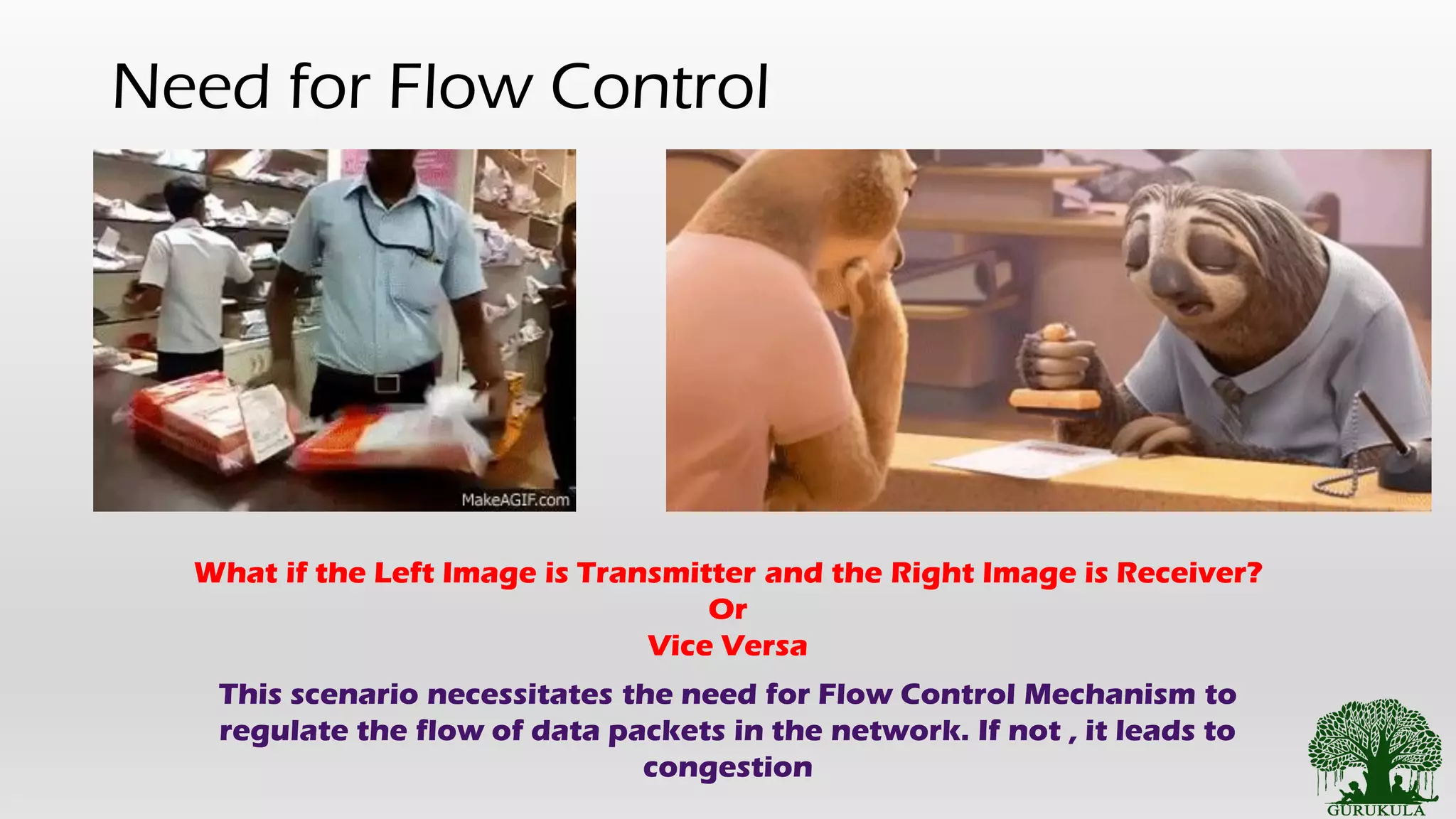
What if the Left Image is Transmitter and the Right Image is Receiver?
Or
Vice Versa
This scenario necessitates the need for Flow Control Mechanism to
regulate the flow of data packets in the network. If not , it leads to
congestion
Types of Flow Control Mechanism
• Traditionally four protocols have been defined for the data-
link layer to deal with flow and error control
•Simple Protocol
•Stop and wait Protocol
•Go Back N Protocol
•Selective Repeat Protocol
@ Sliding Window
Protocols
Visit www.youtube.com/GURUKULA for Lecture Videos
1. Simple Protocol
• Our first protocol is a simple protocol with neither flow nor error
Control. We assume that the receiver can immediately handle any
frame it receives. In other words, the receiver can never be over
whelmed with incoming frames.
Visit www.youtube.com/GURUKULA for Lecture Videos
2. Stop and Wait Protocol
• In this protocol, the sender
sends one frame at a time and
waits for an acknowledgment
before sending the next one.
• If the frame is received
successfully by the receiver, an
ACK is sent to the Transmitter.
• If frame is lost, then there will
not be any ACK from the
receiver, so that the frame will
be retransmitted.
• If the frame is received and
ACK sent by the receiver is lost.
Even then, the frame is
retransmitted assuming that the
frame is lost.
Successful transmission of Frame
What if, Frame is Lost or Damaged ?
What if, ACK is Lost or Damaged ?
Session Summary
•Flow Control [Similar to traffic control signal]
•Simple Protocol
•Stop and wait protocol
Visit www.youtube.com/GURUKULA for Lecture Videos
References:
• Behrouz A. Forouzan, ―Data communication and Networking, Fifth
Edition, Tata McGraw – Hill, 2013
• Larry L. Peterson, Bruce S. Davie, ―Computer Networks: A Systems
Approach, Fifth Edition, Morgan Kaufmann Publishers, 2011.
• Few online References (Will be Mentioned in the description Section)
Thank You…

2.2 flow control

  • 1.
    Communication Networks Flow Control in DatalinkLayer Visit www.youtube.com/GURUKULA for Lecture Videos
  • 2.
    Overview of Module- 2 • Framing • What is Framing • Types of Framing • Methods for identifying the boundaries • Flow Control • What is flow control • Types of flow control • Access Control • What is access control • Types of access control • Ethernet – IEEE 802.3 • Evolution of Ethernet • Frame Format of Ethernet • Access Control for Ethernet • Performance Evaluation of Ethernet • WLAN – IEEE 802.11 • Architecture • Bluetooth • WIFI • Zigbee • 6LowPan • Network Layer Services • IPv4 • Packet switching • Network Layer Protocols Visit www.youtube.com/GURUKULA for Lecture VideosVisit www.youtube.com/GURUKULA for Lecture Videos
  • 3.
    Flow Control -Understanding HOME OFFICE SOURCE DESTINATION
  • 4.
    Need for FlowControl What if the Left Image is Transmitter and the Right Image is Receiver? Or Vice Versa This scenario necessitates the need for Flow Control Mechanism to regulate the flow of data packets in the network. If not , it leads to congestion
  • 5.
    Types of FlowControl Mechanism • Traditionally four protocols have been defined for the data- link layer to deal with flow and error control •Simple Protocol •Stop and wait Protocol •Go Back N Protocol •Selective Repeat Protocol @ Sliding Window Protocols Visit www.youtube.com/GURUKULA for Lecture Videos
  • 6.
    1. Simple Protocol •Our first protocol is a simple protocol with neither flow nor error Control. We assume that the receiver can immediately handle any frame it receives. In other words, the receiver can never be over whelmed with incoming frames. Visit www.youtube.com/GURUKULA for Lecture Videos
  • 7.
    2. Stop andWait Protocol • In this protocol, the sender sends one frame at a time and waits for an acknowledgment before sending the next one. • If the frame is received successfully by the receiver, an ACK is sent to the Transmitter. • If frame is lost, then there will not be any ACK from the receiver, so that the frame will be retransmitted. • If the frame is received and ACK sent by the receiver is lost. Even then, the frame is retransmitted assuming that the frame is lost. Successful transmission of Frame What if, Frame is Lost or Damaged ? What if, ACK is Lost or Damaged ?
  • 8.
    Session Summary •Flow Control[Similar to traffic control signal] •Simple Protocol •Stop and wait protocol Visit www.youtube.com/GURUKULA for Lecture Videos
  • 9.
    References: • Behrouz A.Forouzan, ―Data communication and Networking, Fifth Edition, Tata McGraw – Hill, 2013 • Larry L. Peterson, Bruce S. Davie, ―Computer Networks: A Systems Approach, Fifth Edition, Morgan Kaufmann Publishers, 2011. • Few online References (Will be Mentioned in the description Section) Thank You…