Lab 12: Network Communication
Advanced Operating Systems

Zubair Nabi
zubair.nabi@itu.edu.pk

April 24, 2013
Introduction

• In *nix systems, the networking infrastructure abstracts away
many network architectures
Introduction

• In *nix systems, the networking infrastructure abstracts away
many network architectures
• Each network architecture consists of
• Network-communication protocols
Introduction

• In *nix systems, the networking infrastructure abstracts away
many network architectures
• Each network architecture consists of
• Network-communication protocols
• The protocol family
Introduction

• In *nix systems, the networking infrastructure abstracts away
many network architectures
• Each network architecture consists of
• Network-communication protocols
• The protocol family
• Conventions of naming end-points
Introduction

• In *nix systems, the networking infrastructure abstracts away
many network architectures
• Each network architecture consists of
•
•
•
•

Network-communication protocols
The protocol family
Conventions of naming end-points
The address family or address format
Introduction

• In *nix systems, the networking infrastructure abstracts away
many network architectures
• Each network architecture consists of
•
•
•
•
•

Network-communication protocols
The protocol family
Conventions of naming end-points
The address family or address format
Additional facilities
Introduction

• In *nix systems, the networking infrastructure abstracts away
many network architectures
• Each network architecture consists of
•
•
•
•
•

Network-communication protocols
The protocol family
Conventions of naming end-points
The address family or address format
Additional facilities

• Network facilities are accessed through the socket abstraction
Network Subsystem

Consists of three layers:
1

Transport layer: In charge of sockets-amenable addressing
structure and protocol mechanisms, such as ordering, reliability,
etc.
Network Subsystem

Consists of three layers:
1

Transport layer: In charge of sockets-amenable addressing
structure and protocol mechanisms, such as ordering, reliability,
etc.

2

Network layer: Responsible for delivery of data across the
network (must maintain a routing database)
Network Subsystem

Consists of three layers:
1

Transport layer: In charge of sockets-amenable addressing
structure and protocol mechanisms, such as ordering, reliability,
etc.

2

Network layer: Responsible for delivery of data across the
network (must maintain a routing database)

3

Link layer: Responsible for shipping messages between hosts
connected to a common transmission medium
Network Subsystem (2)

• The layering is just logical layering
Network Subsystem (2)

• The layering is just logical layering
• The network service itself might choose to use more or fewer
layers based on its requirements
Network Subsystem (2)

• The layering is just logical layering
• The network service itself might choose to use more or fewer
layers based on its requirements
• For instance, raw sockets use a null implementation at one or
more layers
Network Subsystem (2)

• The layering is just logical layering
• The network service itself might choose to use more or fewer
layers based on its requirements
• For instance, raw sockets use a null implementation at one or
more layers
• Similarly, tunneling of one protocol through another requires
additional implementations of multiple layers
Memory Management

• Memory management for communication protocols is different
than regular entities as memory is required in widely varying sizes
Memory Management

• Memory management for communication protocols is different
than regular entities as memory is required in widely varying sizes
• A special-purpose memory-management facility exists for IPC
and networking systems
Memory Management

• Memory management for communication protocols is different
than regular entities as memory is required in widely varying sizes
• A special-purpose memory-management facility exists for IPC
and networking systems
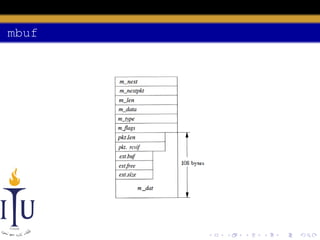
• The unit of allocation is an mbuf (skbuff in Linux), which is
128 bytes long with 100 or 108 bytes reserved for data
Memory Management

• Memory management for communication protocols is different
than regular entities as memory is required in widely varying sizes
• A special-purpose memory-management facility exists for IPC
and networking systems
• The unit of allocation is an mbuf (skbuff in Linux), which is
128 bytes long with 100 or 108 bytes reserved for data
• A chain of mbufs can be linked together (m_next) to hold an
arbitrary quantity of data
Memory Management

• Memory management for communication protocols is different
than regular entities as memory is required in widely varying sizes
• A special-purpose memory-management facility exists for IPC
and networking systems
• The unit of allocation is an mbuf (skbuff in Linux), which is
128 bytes long with 100 or 108 bytes reserved for data
• A chain of mbufs can be linked together (m_next) to hold an
arbitrary quantity of data
• For instance, a chain of mbufs is used to represent packets by
network protocols
mbuf
Data Flow

• Socket-to-network-subsystem
• Calls the transport-layer modules that support the socket
abstraction
Data Flow

• Socket-to-network-subsystem
• Calls the transport-layer modules that support the socket
abstraction
• Typically started by system calls
Data Flow

• Socket-to-network-subsystem
• Calls the transport-layer modules that support the socket
abstraction
• Typically started by system calls

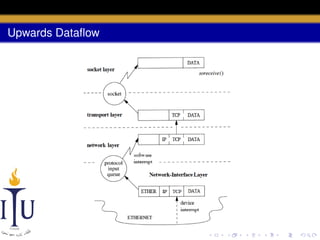
• Network-subsystem-to-socket
• Flows up the stack and is placed in the receive queue of the
destination socket
Data Flow

• Socket-to-network-subsystem
• Calls the transport-layer modules that support the socket
abstraction
• Typically started by system calls

• Network-subsystem-to-socket
• Flows up the stack and is placed in the receive queue of the
destination socket
• Asynchronously received and added to the per-protocol input
message queue
Upwards Dataflow
Network Protocols
• Defined by a set of conventions, including packet formats, states,
and state transitions
Network Protocols
• Defined by a set of conventions, including packet formats, states,
and state transitions
• Each communication-protocol module implements a particular
protocol and is made up of a collection of procedures and private
data structures
Network Protocols
• Defined by a set of conventions, including packet formats, states,
and state transitions
• Each communication-protocol module implements a particular
protocol and is made up of a collection of procedures and private
data structures
• The external interface of a module is described by a
protocol-switch structure
Network Protocols
• Defined by a set of conventions, including packet formats, states,
and state transitions
• Each communication-protocol module implements a particular
protocol and is made up of a collection of procedures and private
data structures
• The external interface of a module is described by a
protocol-switch structure
• This interface is used by the socket layer for all interaction
Network Protocols
• Defined by a set of conventions, including packet formats, states,
and state transitions
• Each communication-protocol module implements a particular
protocol and is made up of a collection of procedures and private
data structures
• The external interface of a module is described by a
protocol-switch structure
• This interface is used by the socket layer for all interaction
• The address of this structure is present within the socket’s
so_proto field
Network Protocols
• Defined by a set of conventions, including packet formats, states,
and state transitions
• Each communication-protocol module implements a particular
protocol and is made up of a collection of procedures and private
data structures
• The external interface of a module is described by a
protocol-switch structure
• This interface is used by the socket layer for all interaction
• The address of this structure is present within the socket’s
so_proto field

• Each time a socket is created the protocol is selected based on
the type of socket (pr_type)
Network Protocols
• Defined by a set of conventions, including packet formats, states,
and state transitions
• Each communication-protocol module implements a particular
protocol and is made up of a collection of procedures and private
data structures
• The external interface of a module is described by a
protocol-switch structure
• This interface is used by the socket layer for all interaction
• The address of this structure is present within the socket’s
so_proto field

• Each time a socket is created the protocol is selected based on
the type of socket (pr_type)
• Also in charge of mbuf storage management
Network Interfaces
• Each interface defines a link-layer path through which messages
can be sent and received
Network Interfaces
• Each interface defines a link-layer path through which messages
can be sent and received
• Typically, a hardware device is represented by this interface
Network Interfaces
• Each interface defines a link-layer path through which messages
can be sent and received
• Typically, a hardware device is represented by this interface
• The loopback interface is in software which is used to route
traffic to local sockets
Network Interfaces
• Each interface defines a link-layer path through which messages
can be sent and received
• Typically, a hardware device is represented by this interface
• The loopback interface is in software which is used to route
traffic to local sockets

• Also in charge of encapsulation and decapsulation of link-layer
protocol headers
Network Interfaces
• Each interface defines a link-layer path through which messages
can be sent and received
• Typically, a hardware device is represented by this interface
• The loopback interface is in software which is used to route
traffic to local sockets

• Also in charge of encapsulation and decapsulation of link-layer
protocol headers
• Typically implemented as a separate layer that is shared by
various hardware drivers
Network Interfaces
• Each interface defines a link-layer path through which messages
can be sent and received
• Typically, a hardware device is represented by this interface
• The loopback interface is in software which is used to route
traffic to local sockets

• Also in charge of encapsulation and decapsulation of link-layer
protocol headers
• Typically implemented as a separate layer that is shared by
various hardware drivers
• The selection of the interface is taken care of by the network-layer
protocol
Network Interfaces
• Each interface defines a link-layer path through which messages
can be sent and received
• Typically, a hardware device is represented by this interface
• The loopback interface is in software which is used to route
traffic to local sockets

• Also in charge of encapsulation and decapsulation of link-layer
protocol headers
• Typically implemented as a separate layer that is shared by
various hardware drivers
• The selection of the interface is taken care of by the network-layer
protocol
• Represented by an ifnet structure
Socket-to-Protocol Interface

• Enabled by two routines: 1) User request, pr_usrreq() and
2) Control output, pr_ctloutput()
Socket-to-Protocol Interface

• Enabled by two routines: 1) User request, pr_usrreq() and
2) Control output, pr_ctloutput()
• These methods are present in the protocol-switch table for each
protocol
Socket-to-Protocol Interface

• Enabled by two routines: 1) User request, pr_usrreq() and
2) Control output, pr_ctloutput()
• These methods are present in the protocol-switch table for each
protocol
• Control-output: Implements getsockopt and setsockopt
system calls
Socket-to-Protocol Interface

• Enabled by two routines: 1) User request, pr_usrreq() and
2) Control output, pr_ctloutput()
• These methods are present in the protocol-switch table for each
protocol
• Control-output: Implements getsockopt and setsockopt
system calls
• User-request: Implements all other operations
Protocol-to-Network-Interface Interface

• Lowest layer in the protocol family must interact with one or more
interfaces to send and receive packets
Protocol-to-Network-Interface Interface

• Lowest layer in the protocol family must interact with one or more
interfaces to send and receive packets
• Obviously a routing decision must have already chosen the
outgoing interface
Code: Packet Sending

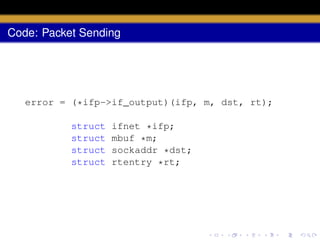
error = (*ifp->if_output)(ifp, m, dst, rt);
struct
struct
struct
struct

ifnet *ifp;
mbuf *m;
sockaddr *dst;
rtentry *rt;
Packet Sending

• Packet m is transmitted to destination dst via interface ifp
Packet Sending

• Packet m is transmitted to destination dst via interface ifp
• Steps:
• Validation of the destination address
Packet Sending

• Packet m is transmitted to destination dst via interface ifp
• Steps:
• Validation of the destination address
• Queuing of the packet on the send queue
Packet Sending

• Packet m is transmitted to destination dst via interface ifp
• Steps:
• Validation of the destination address
• Queuing of the packet on the send queue
• If the interface is not busy, using an interrupt-driven routine to
transmit the packet
Packet Sending

• Packet m is transmitted to destination dst via interface ifp
• Steps:
• Validation of the destination address
• Queuing of the packet on the send queue
• If the interface is not busy, using an interrupt-driven routine to
transmit the packet

• The link-layer address is chosen by ARP in case of Ethernet
Packet Receiving

• Incoming packets are queued in the corresponding protocol’s
input packet queue
Packet Receiving

• Incoming packets are queued in the corresponding protocol’s
input packet queue
• A software interrupt is posted to initiate network-layer processing
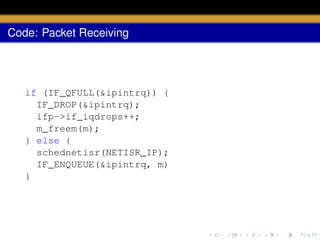
Code: Packet Receiving

if (IF_QFULL(&ipintrq)) {
IF_DROP(&ipintrq);
ifp->if_iqdrops++;
m_freem(m);
} else {
schednetisr(NETISR_IP);
IF_ENQUEUE(&ipintrq, m)
}
Routing

• The routing system has two components; one within the kernel
and one in user-space
Routing

• The routing system has two components; one within the kernel
and one in user-space
• The routing mechanism is present within the kernel while routing
policies are defined in user-space
Routing

• The routing system has two components; one within the kernel
and one in user-space
• The routing mechanism is present within the kernel while routing
policies are defined in user-space
• The routing mechanism involves a table lookup to get a first-hop
for a given destination
Routing

• The routing system has two components; one within the kernel
and one in user-space
• The routing mechanism is present within the kernel while routing
policies are defined in user-space
• The routing mechanism involves a table lookup to get a first-hop
for a given destination
• Routing policies include components that help in choosing
first-hop routes
Kernel Routing Mechanism

• Implements a routing table for first/next hop lookup
Kernel Routing Mechanism

• Implements a routing table for first/next hop lookup
• Two distinct portions:
1

A data structure with routing entries, one per specific route
Kernel Routing Mechanism

• Implements a routing table for first/next hop lookup
• Two distinct portions:
1
2

A data structure with routing entries, one per specific route
A lookup algorithm to locate the correct route for each possible
destination
Kernel Routing Mechanism

• Implements a routing table for first/next hop lookup
• Two distinct portions:
1
2

A data structure with routing entries, one per specific route
A lookup algorithm to locate the correct route for each possible
destination

• Each destination is represented by a sockaddr structure
Kernel Routing Mechanism

• Implements a routing table for first/next hop lookup
• Two distinct portions:
1
2

A data structure with routing entries, one per specific route
A lookup algorithm to locate the correct route for each possible
destination

• Each destination is represented by a sockaddr structure
• Routes are either:
1

Host or network
Kernel Routing Mechanism

• Implements a routing table for first/next hop lookup
• Two distinct portions:
1
2

A data structure with routing entries, one per specific route
A lookup algorithm to locate the correct route for each possible
destination

• Each destination is represented by a sockaddr structure
• Routes are either:
1
2

Host or network
Direct or indirect
User-space Routing Policies

• Policies add, delete, or modify kernel routing table entries
User-space Routing Policies

• Policies add, delete, or modify kernel routing table entries
• A number of routing policies exist, including the Routing
Information Protocol (RIP)
Protocol Control Blocks
• For each TCP or UDP socket, an Internet protocol control block
(inpcb) is created to hold address, ports, routing information,
and pointers to any additional data structures
Protocol Control Blocks
• For each TCP or UDP socket, an Internet protocol control block
(inpcb) is created to hold address, ports, routing information,
and pointers to any additional data structures
• TCP in addition creates a TCP control block (tcpcb) to hold
implementation-specific information
Protocol Control Blocks
• For each TCP or UDP socket, an Internet protocol control block
(inpcb) is created to hold address, ports, routing information,
and pointers to any additional data structures
• TCP in addition creates a TCP control block (tcpcb) to hold
implementation-specific information

• TCP and UDP protocol modules each have a private doubly
linked list of inpcbs
Protocol Control Blocks
• For each TCP or UDP socket, an Internet protocol control block
(inpcb) is created to hold address, ports, routing information,
and pointers to any additional data structures
• TCP in addition creates a TCP control block (tcpcb) to hold
implementation-specific information

• TCP and UDP protocol modules each have a private doubly
linked list of inpcbs
• Common routines are used by the modules to manipulate these
lists
Protocol Control Blocks
• For each TCP or UDP socket, an Internet protocol control block
(inpcb) is created to hold address, ports, routing information,
and pointers to any additional data structures
• TCP in addition creates a TCP control block (tcpcb) to hold
implementation-specific information

• TCP and UDP protocol modules each have a private doubly
linked list of inpcbs
• Common routines are used by the modules to manipulate these
lists
• Traffic is multiplexed by the IP layer on the basis of the protocol
identifier in the protocol and passed on to the individual transport
protocol
Protocol Control Blocks
• For each TCP or UDP socket, an Internet protocol control block
(inpcb) is created to hold address, ports, routing information,
and pointers to any additional data structures
• TCP in addition creates a TCP control block (tcpcb) to hold
implementation-specific information

• TCP and UDP protocol modules each have a private doubly
linked list of inpcbs
• Common routines are used by the modules to manipulate these
lists
• Traffic is multiplexed by the IP layer on the basis of the protocol
identifier in the protocol and passed on to the individual transport
protocol
• Each protocol is then responsible for passing a direct message to
the appropriate socket
Today’s task

• Design a network subsystem for xv6
Reading(s)

• Chapter 12 and 13 from “The Design and Implementation of the
4.4BSD Operating System” by Marshall Kirk McKusick, Keith
Bostic, Michael J. Karels, and John S. Quarterman.

AOS Lab 12: Network Communication

  • 1.
    Lab 12: NetworkCommunication Advanced Operating Systems Zubair Nabi zubair.nabi@itu.edu.pk April 24, 2013
  • 2.
    Introduction • In *nixsystems, the networking infrastructure abstracts away many network architectures
  • 3.
    Introduction • In *nixsystems, the networking infrastructure abstracts away many network architectures • Each network architecture consists of • Network-communication protocols
  • 4.
    Introduction • In *nixsystems, the networking infrastructure abstracts away many network architectures • Each network architecture consists of • Network-communication protocols • The protocol family
  • 5.
    Introduction • In *nixsystems, the networking infrastructure abstracts away many network architectures • Each network architecture consists of • Network-communication protocols • The protocol family • Conventions of naming end-points
  • 6.
    Introduction • In *nixsystems, the networking infrastructure abstracts away many network architectures • Each network architecture consists of • • • • Network-communication protocols The protocol family Conventions of naming end-points The address family or address format
  • 7.
    Introduction • In *nixsystems, the networking infrastructure abstracts away many network architectures • Each network architecture consists of • • • • • Network-communication protocols The protocol family Conventions of naming end-points The address family or address format Additional facilities
  • 8.
    Introduction • In *nixsystems, the networking infrastructure abstracts away many network architectures • Each network architecture consists of • • • • • Network-communication protocols The protocol family Conventions of naming end-points The address family or address format Additional facilities • Network facilities are accessed through the socket abstraction
  • 9.
    Network Subsystem Consists ofthree layers: 1 Transport layer: In charge of sockets-amenable addressing structure and protocol mechanisms, such as ordering, reliability, etc.
  • 10.
    Network Subsystem Consists ofthree layers: 1 Transport layer: In charge of sockets-amenable addressing structure and protocol mechanisms, such as ordering, reliability, etc. 2 Network layer: Responsible for delivery of data across the network (must maintain a routing database)
  • 11.
    Network Subsystem Consists ofthree layers: 1 Transport layer: In charge of sockets-amenable addressing structure and protocol mechanisms, such as ordering, reliability, etc. 2 Network layer: Responsible for delivery of data across the network (must maintain a routing database) 3 Link layer: Responsible for shipping messages between hosts connected to a common transmission medium
  • 12.
    Network Subsystem (2) •The layering is just logical layering
  • 13.
    Network Subsystem (2) •The layering is just logical layering • The network service itself might choose to use more or fewer layers based on its requirements
  • 14.
    Network Subsystem (2) •The layering is just logical layering • The network service itself might choose to use more or fewer layers based on its requirements • For instance, raw sockets use a null implementation at one or more layers
  • 15.
    Network Subsystem (2) •The layering is just logical layering • The network service itself might choose to use more or fewer layers based on its requirements • For instance, raw sockets use a null implementation at one or more layers • Similarly, tunneling of one protocol through another requires additional implementations of multiple layers
  • 16.
    Memory Management • Memorymanagement for communication protocols is different than regular entities as memory is required in widely varying sizes
  • 17.
    Memory Management • Memorymanagement for communication protocols is different than regular entities as memory is required in widely varying sizes • A special-purpose memory-management facility exists for IPC and networking systems
  • 18.
    Memory Management • Memorymanagement for communication protocols is different than regular entities as memory is required in widely varying sizes • A special-purpose memory-management facility exists for IPC and networking systems • The unit of allocation is an mbuf (skbuff in Linux), which is 128 bytes long with 100 or 108 bytes reserved for data
  • 19.
    Memory Management • Memorymanagement for communication protocols is different than regular entities as memory is required in widely varying sizes • A special-purpose memory-management facility exists for IPC and networking systems • The unit of allocation is an mbuf (skbuff in Linux), which is 128 bytes long with 100 or 108 bytes reserved for data • A chain of mbufs can be linked together (m_next) to hold an arbitrary quantity of data
  • 20.
    Memory Management • Memorymanagement for communication protocols is different than regular entities as memory is required in widely varying sizes • A special-purpose memory-management facility exists for IPC and networking systems • The unit of allocation is an mbuf (skbuff in Linux), which is 128 bytes long with 100 or 108 bytes reserved for data • A chain of mbufs can be linked together (m_next) to hold an arbitrary quantity of data • For instance, a chain of mbufs is used to represent packets by network protocols
  • 21.
  • 22.
    Data Flow • Socket-to-network-subsystem •Calls the transport-layer modules that support the socket abstraction
  • 23.
    Data Flow • Socket-to-network-subsystem •Calls the transport-layer modules that support the socket abstraction • Typically started by system calls
  • 24.
    Data Flow • Socket-to-network-subsystem •Calls the transport-layer modules that support the socket abstraction • Typically started by system calls • Network-subsystem-to-socket • Flows up the stack and is placed in the receive queue of the destination socket
  • 25.
    Data Flow • Socket-to-network-subsystem •Calls the transport-layer modules that support the socket abstraction • Typically started by system calls • Network-subsystem-to-socket • Flows up the stack and is placed in the receive queue of the destination socket • Asynchronously received and added to the per-protocol input message queue
  • 26.
  • 27.
    Network Protocols • Definedby a set of conventions, including packet formats, states, and state transitions
  • 28.
    Network Protocols • Definedby a set of conventions, including packet formats, states, and state transitions • Each communication-protocol module implements a particular protocol and is made up of a collection of procedures and private data structures
  • 29.
    Network Protocols • Definedby a set of conventions, including packet formats, states, and state transitions • Each communication-protocol module implements a particular protocol and is made up of a collection of procedures and private data structures • The external interface of a module is described by a protocol-switch structure
  • 30.
    Network Protocols • Definedby a set of conventions, including packet formats, states, and state transitions • Each communication-protocol module implements a particular protocol and is made up of a collection of procedures and private data structures • The external interface of a module is described by a protocol-switch structure • This interface is used by the socket layer for all interaction
  • 31.
    Network Protocols • Definedby a set of conventions, including packet formats, states, and state transitions • Each communication-protocol module implements a particular protocol and is made up of a collection of procedures and private data structures • The external interface of a module is described by a protocol-switch structure • This interface is used by the socket layer for all interaction • The address of this structure is present within the socket’s so_proto field
  • 32.
    Network Protocols • Definedby a set of conventions, including packet formats, states, and state transitions • Each communication-protocol module implements a particular protocol and is made up of a collection of procedures and private data structures • The external interface of a module is described by a protocol-switch structure • This interface is used by the socket layer for all interaction • The address of this structure is present within the socket’s so_proto field • Each time a socket is created the protocol is selected based on the type of socket (pr_type)
  • 33.
    Network Protocols • Definedby a set of conventions, including packet formats, states, and state transitions • Each communication-protocol module implements a particular protocol and is made up of a collection of procedures and private data structures • The external interface of a module is described by a protocol-switch structure • This interface is used by the socket layer for all interaction • The address of this structure is present within the socket’s so_proto field • Each time a socket is created the protocol is selected based on the type of socket (pr_type) • Also in charge of mbuf storage management
  • 34.
    Network Interfaces • Eachinterface defines a link-layer path through which messages can be sent and received
  • 35.
    Network Interfaces • Eachinterface defines a link-layer path through which messages can be sent and received • Typically, a hardware device is represented by this interface
  • 36.
    Network Interfaces • Eachinterface defines a link-layer path through which messages can be sent and received • Typically, a hardware device is represented by this interface • The loopback interface is in software which is used to route traffic to local sockets
  • 37.
    Network Interfaces • Eachinterface defines a link-layer path through which messages can be sent and received • Typically, a hardware device is represented by this interface • The loopback interface is in software which is used to route traffic to local sockets • Also in charge of encapsulation and decapsulation of link-layer protocol headers
  • 38.
    Network Interfaces • Eachinterface defines a link-layer path through which messages can be sent and received • Typically, a hardware device is represented by this interface • The loopback interface is in software which is used to route traffic to local sockets • Also in charge of encapsulation and decapsulation of link-layer protocol headers • Typically implemented as a separate layer that is shared by various hardware drivers
  • 39.
    Network Interfaces • Eachinterface defines a link-layer path through which messages can be sent and received • Typically, a hardware device is represented by this interface • The loopback interface is in software which is used to route traffic to local sockets • Also in charge of encapsulation and decapsulation of link-layer protocol headers • Typically implemented as a separate layer that is shared by various hardware drivers • The selection of the interface is taken care of by the network-layer protocol
  • 40.
    Network Interfaces • Eachinterface defines a link-layer path through which messages can be sent and received • Typically, a hardware device is represented by this interface • The loopback interface is in software which is used to route traffic to local sockets • Also in charge of encapsulation and decapsulation of link-layer protocol headers • Typically implemented as a separate layer that is shared by various hardware drivers • The selection of the interface is taken care of by the network-layer protocol • Represented by an ifnet structure
  • 41.
    Socket-to-Protocol Interface • Enabledby two routines: 1) User request, pr_usrreq() and 2) Control output, pr_ctloutput()
  • 42.
    Socket-to-Protocol Interface • Enabledby two routines: 1) User request, pr_usrreq() and 2) Control output, pr_ctloutput() • These methods are present in the protocol-switch table for each protocol
  • 43.
    Socket-to-Protocol Interface • Enabledby two routines: 1) User request, pr_usrreq() and 2) Control output, pr_ctloutput() • These methods are present in the protocol-switch table for each protocol • Control-output: Implements getsockopt and setsockopt system calls
  • 44.
    Socket-to-Protocol Interface • Enabledby two routines: 1) User request, pr_usrreq() and 2) Control output, pr_ctloutput() • These methods are present in the protocol-switch table for each protocol • Control-output: Implements getsockopt and setsockopt system calls • User-request: Implements all other operations
  • 45.
    Protocol-to-Network-Interface Interface • Lowestlayer in the protocol family must interact with one or more interfaces to send and receive packets
  • 46.
    Protocol-to-Network-Interface Interface • Lowestlayer in the protocol family must interact with one or more interfaces to send and receive packets • Obviously a routing decision must have already chosen the outgoing interface
  • 47.
    Code: Packet Sending error= (*ifp->if_output)(ifp, m, dst, rt); struct struct struct struct ifnet *ifp; mbuf *m; sockaddr *dst; rtentry *rt;
  • 48.
    Packet Sending • Packetm is transmitted to destination dst via interface ifp
  • 49.
    Packet Sending • Packetm is transmitted to destination dst via interface ifp • Steps: • Validation of the destination address
  • 50.
    Packet Sending • Packetm is transmitted to destination dst via interface ifp • Steps: • Validation of the destination address • Queuing of the packet on the send queue
  • 51.
    Packet Sending • Packetm is transmitted to destination dst via interface ifp • Steps: • Validation of the destination address • Queuing of the packet on the send queue • If the interface is not busy, using an interrupt-driven routine to transmit the packet
  • 52.
    Packet Sending • Packetm is transmitted to destination dst via interface ifp • Steps: • Validation of the destination address • Queuing of the packet on the send queue • If the interface is not busy, using an interrupt-driven routine to transmit the packet • The link-layer address is chosen by ARP in case of Ethernet
  • 53.
    Packet Receiving • Incomingpackets are queued in the corresponding protocol’s input packet queue
  • 54.
    Packet Receiving • Incomingpackets are queued in the corresponding protocol’s input packet queue • A software interrupt is posted to initiate network-layer processing
  • 55.
    Code: Packet Receiving if(IF_QFULL(&ipintrq)) { IF_DROP(&ipintrq); ifp->if_iqdrops++; m_freem(m); } else { schednetisr(NETISR_IP); IF_ENQUEUE(&ipintrq, m) }
  • 56.
    Routing • The routingsystem has two components; one within the kernel and one in user-space
  • 57.
    Routing • The routingsystem has two components; one within the kernel and one in user-space • The routing mechanism is present within the kernel while routing policies are defined in user-space
  • 58.
    Routing • The routingsystem has two components; one within the kernel and one in user-space • The routing mechanism is present within the kernel while routing policies are defined in user-space • The routing mechanism involves a table lookup to get a first-hop for a given destination
  • 59.
    Routing • The routingsystem has two components; one within the kernel and one in user-space • The routing mechanism is present within the kernel while routing policies are defined in user-space • The routing mechanism involves a table lookup to get a first-hop for a given destination • Routing policies include components that help in choosing first-hop routes
  • 60.
    Kernel Routing Mechanism •Implements a routing table for first/next hop lookup
  • 61.
    Kernel Routing Mechanism •Implements a routing table for first/next hop lookup • Two distinct portions: 1 A data structure with routing entries, one per specific route
  • 62.
    Kernel Routing Mechanism •Implements a routing table for first/next hop lookup • Two distinct portions: 1 2 A data structure with routing entries, one per specific route A lookup algorithm to locate the correct route for each possible destination
  • 63.
    Kernel Routing Mechanism •Implements a routing table for first/next hop lookup • Two distinct portions: 1 2 A data structure with routing entries, one per specific route A lookup algorithm to locate the correct route for each possible destination • Each destination is represented by a sockaddr structure
  • 64.
    Kernel Routing Mechanism •Implements a routing table for first/next hop lookup • Two distinct portions: 1 2 A data structure with routing entries, one per specific route A lookup algorithm to locate the correct route for each possible destination • Each destination is represented by a sockaddr structure • Routes are either: 1 Host or network
  • 65.
    Kernel Routing Mechanism •Implements a routing table for first/next hop lookup • Two distinct portions: 1 2 A data structure with routing entries, one per specific route A lookup algorithm to locate the correct route for each possible destination • Each destination is represented by a sockaddr structure • Routes are either: 1 2 Host or network Direct or indirect
  • 66.
    User-space Routing Policies •Policies add, delete, or modify kernel routing table entries
  • 67.
    User-space Routing Policies •Policies add, delete, or modify kernel routing table entries • A number of routing policies exist, including the Routing Information Protocol (RIP)
  • 68.
    Protocol Control Blocks •For each TCP or UDP socket, an Internet protocol control block (inpcb) is created to hold address, ports, routing information, and pointers to any additional data structures
  • 69.
    Protocol Control Blocks •For each TCP or UDP socket, an Internet protocol control block (inpcb) is created to hold address, ports, routing information, and pointers to any additional data structures • TCP in addition creates a TCP control block (tcpcb) to hold implementation-specific information
  • 70.
    Protocol Control Blocks •For each TCP or UDP socket, an Internet protocol control block (inpcb) is created to hold address, ports, routing information, and pointers to any additional data structures • TCP in addition creates a TCP control block (tcpcb) to hold implementation-specific information • TCP and UDP protocol modules each have a private doubly linked list of inpcbs
  • 71.
    Protocol Control Blocks •For each TCP or UDP socket, an Internet protocol control block (inpcb) is created to hold address, ports, routing information, and pointers to any additional data structures • TCP in addition creates a TCP control block (tcpcb) to hold implementation-specific information • TCP and UDP protocol modules each have a private doubly linked list of inpcbs • Common routines are used by the modules to manipulate these lists
  • 72.
    Protocol Control Blocks •For each TCP or UDP socket, an Internet protocol control block (inpcb) is created to hold address, ports, routing information, and pointers to any additional data structures • TCP in addition creates a TCP control block (tcpcb) to hold implementation-specific information • TCP and UDP protocol modules each have a private doubly linked list of inpcbs • Common routines are used by the modules to manipulate these lists • Traffic is multiplexed by the IP layer on the basis of the protocol identifier in the protocol and passed on to the individual transport protocol
  • 73.
    Protocol Control Blocks •For each TCP or UDP socket, an Internet protocol control block (inpcb) is created to hold address, ports, routing information, and pointers to any additional data structures • TCP in addition creates a TCP control block (tcpcb) to hold implementation-specific information • TCP and UDP protocol modules each have a private doubly linked list of inpcbs • Common routines are used by the modules to manipulate these lists • Traffic is multiplexed by the IP layer on the basis of the protocol identifier in the protocol and passed on to the individual transport protocol • Each protocol is then responsible for passing a direct message to the appropriate socket
  • 74.
    Today’s task • Designa network subsystem for xv6
  • 75.
    Reading(s) • Chapter 12and 13 from “The Design and Implementation of the 4.4BSD Operating System” by Marshall Kirk McKusick, Keith Bostic, Michael J. Karels, and John S. Quarterman.